Children living in out-of-home (OoH) care in the United Kingdom show striking levels of psychiatric morbidity and a range of poor long-term outcomes (Rushton & Minnis, Reference Rushton, Minnis, Rutter, Bishop, Pine, Scott, Stevenson and Taylor2008). The majority enter OoH care following exposure to multiple factors associated with risk for poor psychosocial outcomes, including birth family disorder, neonatal drug and alcohol use, maltreatment, neglect and domestic violence (UK Department for Education, 2013). Furthermore, many children go on to face repeated disruption in care arrangements, with multiple changes in placement and attempts at reunification with the birth family, factors also associated with increased risk for poor long-term outcomes (Biehal, Clayden, Stein, & Wade, Reference Biehal, Clayden, Stein and Wade1995). Given this, it is not surprising that children in OoH often present a complex clinical picture of multiple comorbid psychopathology, developmental problems, and symptoms of psychological trauma. High rates of psychiatric disorder have been reported in young children at the time of entering care (Dimigen et al., Reference Dimigen, Del Priore, Butler, Evans, Ferguson and Swan1999). There is a dearth of evidence-based intervention strategies for such children (Green et al., Reference Green, Biehal, Roberts, Dixon, Kay and Parry2014). Understanding the mechanisms and factors which mediate risk for poor outcomes for these extremely vulnerable young people will inform both assessment of need and the design of targeted intervention strategies.
Social Cognition: Theory of Mind (ToM)
Deficits or biases in the cognitive processes that facilitate social understanding and interaction, which is termed social cognition, may be a mechanism underlying some of the complex psychosocial difficulties seen in OoH care populations. A growing body of literature shows how early adverse experiences can impact the development of social cognition. Deficits and biases in social cognition have been implicated in a variety of psychopathology and developmental disorders. A deficit in ToM, the ability to recognize that others have thoughts, intentions, and feelings that differ from ones' own, has been consistently observed in classical autism (Baron-Cohen, Leslie, & Frith, Reference Baron-Cohen, Leslie and Frith1985). Recent genetically informed and observational studies show that ToM development is susceptible to the quality of early social environmental as well as to genetic influence (Hughes et al., Reference Hughes, Jaffee, Happe, Taylor, Caspi and Moffitt2005), and there is growing evidence that the quality of early parent–child interactions is important for ToM development. The amount of maternal and family mental state language (Dunn, Brown, Slomkowski, Tesla, & Youngblade, Reference Dunn, Brown, Slomkowski, Tesla and Youngblade1991; Ensor & Hughes, Reference Ensor and Hughes2008), mutuality in maternal interactions (Ensor, Spencer, & Hughes, Reference Ensor, Spencer and Hughes2011) and psychological perspective taking or “mind-mindedness” (Meins et al., Reference Meins, Fernyhough, Wainwright, Clark-Carter, Das Gupta and Fradley2003) have all been associated with aspects of child ToM development. It is a reasonable hypothesis therefore that maltreating contexts may be detrimental to ToM development through the use of inconsistent and unpredictable parenting (Cicchetti, Rogosch, Maughan, Toth, & Bruce, Reference Cicchetti, Rogosch, Maughan, Toth and Bruce2003), lower levels of internal state language (Edwards, Shipman, & Brown, Reference Edwards, Shipman and Brown2005) or a lack of emotion understanding (Shipman & Zeman, Reference Shipman and Zeman2001).
ToM deficits have also been reported in young maltreated children; one US study found significantly fewer maltreated children (56.3%; n = 203) passed false belief tasks than low (71.3%; n = 143) and middle socioeconomic status (78.1%; n = 172) comparison children. Maltreatment during toddlerhood was particularly detrimental to ToM development, possibly due to the importance of this period for the development of precursors to ToM, including self-awareness, self-other differentiation, internal state language, and the emergence of self-conscious emotions. The experience of physical abuse was also a unique predictor of false belief understanding. The authors suggested that the harsh and unpredictable nature of this form of abuse, as well as difficulties in predicting parental behavior, may be particularly detrimental for ToM acquisition (Cicchetti et al., Reference Cicchetti, Rogosch, Maughan, Toth and Bruce2003). Similarly, Pears and Fisher (Reference Pears and Fisher2005) found that maltreated foster children (n = 60) had poorer emotion understanding and ToM deficits when compared to a sample of nonmaltreated children living with birth parents, even after controlling for executive function, language, age, and intelligence. Placement variables, including age at entry to care and total number of placements, were not associated with social cognitive variables, suggesting that maltreatment experience may have been the key factor impacting social cognitive performance (Pears & Fisher, Reference Pears and Fisher2005). Given the early adverse histories of children in OoH care, ToM deficits may be present and may play a role in shaping developmental and psychosocial outcome.
Social Information Processing (SIP)
A second body of research has sought to understand the relationship between maltreatment (particularly harsh parenting and exposure to violence), externalizing disorders and social maladjustment using the model of online SIP (Crick & Dodge, Reference Crick and Dodge1994). According to the SIP model, representations of social cues are processed in a number of stages, including encoding and interpretation of cues, goal selection, and retrieval or construction of a possible behavioral response. The interpretation of environmental and social cues involves causal inference, including an attribution regarding the motivational intentions underlying the behavior of others. Intent attributions are thought to aid in subsequent goal and response retrieval and selection. The model asserts that children develop a general mental structure containing memories of past events which serve to guide future processing of social cues; cognitive heuristics are therefore used to simplify processing of complex social information but may be prone to judgment errors leading to inappropriate and socially maladjusted behavior.
A tendency for aggressive children to make hostile attributions of peer intent in ambiguous social scenarios, or a “hostile attribution bias” (Nasby, Hayden, & Depaulo, Reference Nasby, Hayden and Depaulo1979) has been a consistent finding. Crick and Dodge (Reference Crick and Dodge1994) report that associations between hostile attribution biases, aggressive behavior, and social maladjustment (i.e., peer rejection) are quite robust and can be seen in typically developing as well as clinical groups. Weiss, Dodge, Bates, and Petit (Reference Weiss, Dodge, Bates and Petit1992) used a conceptualization of harsh physical discipline as a continuous dimension to investigate externalizing and internalizing behaviors and SIP patterns in a prospective study of 526 kindergarten children. Harsh early discipline was related to child aggression and externalizing behavior. This was partially mediated by maladaptive SIP patterns, including less attention to relevant cues, a hostile attribution bias, and the generation and positive evaluation of aggressive responses. Dodge, Pettit, Bates, and Valenti (Reference Dodge, Pettit, Bates and Valenti1995) also found that physically abused children were hypervigilant to hostile cues, made hostile intent attributions, and retrieved aggressive responses that they evaluated positively.
It seems likely a priori that the developmental processes underlying both of these aspects of social cognition could be disrupted by the types of adverse experiences common in children placed in OoH care, including severe early maltreatment and neglect. In “hard to manage” preschoolers, Hughes, Dunn, and White (Reference Hughes, Dunn and White1998) showed a mixture of what they summarized as “bad theory of mind” and “theory of bad mind,” showing a delay in ToM acquisition and a tendency to perform better on a ToM task in the context of a nasty surprise (Hughes et al, Reference Hughes, Dunn and White1998). Happé and Frith (Reference Happe and Frith1996) also found that children with conduct disorder were reported by their teachers to show greater competency in the domain of antisocial rather than adaptive behavior in their social insight in everyday functioning, suggesting that these children may have experienced a delay in acquiring ToM skills, which works in combination with negative experience to produce a skewed ToM. However, ToM deficits and SIP biases have not been studied simultaneously in a severely maltreated sample, and the majority of work has focussed on young children. Adolescence is a particularly important time to study these phenomena since this is when the impact of latent or subtle disruption in social cognition may become fully apparent and lead to problematic adjustment and functioning. A more complete understanding of social cognitive functioning associated with psychopathology and other developmental outcomes, including the interrelationship between different aspects of social cognition, in adolescents in OoH care could indicate new targets for intervention.
Disinhibited Attachment Disorder (DAD)
Longitudinal studies of children adopted after severe early social deprivation in Romanian orphanages show a high prevalence of intrusive and indiscriminate social behavior, which is labeled DAD (O'Connor, Bredenkamp & Rutter, Reference O'Connor, Bredenkamp and Rutter1999); it is persistent through childhood and adolescence and associated with psychopathology, functional impairment, and high levels of service use (Kreppner et al., Reference Kreppner, Kumsta, Rutter, Beckett, Castle and Stevens2010; O'Connor, Rutter, & The English and Romanian Adoptees Study Team, Reference O'Connor and Rutter2000; Rutter et al., Reference Rutter, Colvert, Kreppner, Beckett, Castle and Grootheus2007). DAD behaviors have also been reported in noninstitutionalized maltreated young children in the United States (Lyons-Ruth, Bureau, Riley, & Atlas-Corbett, Reference Lyons-Ruth, Bureau, Riley and Atlas-Corbett2009; Pears, Bruce, Fisher, & Kim, Reference Pears, Bruce, Fisher and Kim2010). Although DAD has been previously understood as an attachment disorder, a recent evidence review concluded that it should be considered an independent disorder, arising in the context of social neglect or maltreatment, but not limited to children who show poor current attachment relationships (Zeanah & Gleason, Reference Zeanah and Gleason2010). DAD has been reclassified as disinhibited social engagement disorder within DSM-5. This reconceptualization brings to the fore the need for a more detailed understanding of the pervasive social impairments underlying symptoms of DAD, which is important not only for conceptualization of the disorder but also for the development of new approaches to assessment and intervention (Smyke et al., Reference Smyke, Zeanah, Gleason, Drury, Fox and Nelson2012). Since this study predates DSM-5, we retain the DSM-IV terminology for this paper. However, items within our DAD measure are comparable to the disinhibited social engagement disorder definition (see Measures Section). Colvert and colleagues (Reference Colvert, Rutter, Kreppner, Beckett, Castle and Groothues2008) used an advanced test of ToM, the strange stories (SS) task (Happé, Reference Happé1994) to find that Romanian adoptees with DAD had poorer ToM and executive functioning skills. Longer duration of institutional deprivation was also associated with poorer ToM skills independent of intellectual ability. Social cognitive deficits and biases have not been studied in relation to the behavioral syndrome of DAD in noninstitutionalized samples.
A recent study found aspects of caregiver reported DAD in 153 maltreated adolescents living in UK OoH care to be differentially associated with specific social difficulties (Kay & Green, Reference Kay and Green2013). Core features of DAD (indiscriminate friendliness, wandering from caregivers, and lack of social boundaries) were associated with difficulties in peer interaction. Broader problems with formation and maintenance of close reciprocal relationships with adults, commonly reported in relation to DAD but not currently considered in diagnostic guidelines, were associated with problems on multiple domains of functioning including antisocial behavior, alcohol and substance misuse, attention/hyperactivity, and emotional problems. This “relational superficiality” was also associated with experience of multiple forms of maltreatment and earlier entry to care. It could further be hypothesized that deficits in ToM specifically underlie the apparent lack of awareness of social boundaries typically associated with DAD. Both deficits in ToM and biases in SIP could underlie the broad and perhaps more pervasive problems with formation of close social relationships observed in maltreated adolescents.
The aim of this study is to make a detailed investigation of social cognitive functioning in a sample of maltreated adolescents in OoH care. We will explore the relationship between maltreatment, social cognition, psychopathology, and DAD behavior to test the hypothesis that maltreated adolescents will show both deficits in ToM and biases in SIP, through comparison with nonmaltreated adolescents who have never experienced OoH care. We predict that SIP biases will be characterized by a tendency to make hostile intent attributions leading to less competent and more hostile response generation in the context of ambiguous social scenarios. We will further explore interrelationships between ToM and SIP and test whether identified deficits and biases in social cognition are associated with increased risk for externalizing psychopathology in this group. This may provide useful targets for intervention. Finally, we will test the novel hypotheses outlined above concerning specific associations between social cognition and features of social relationship functioning including the indiscriminate and intrusive behavior characteristic of DAD.
Method
Sample
Sixty-three adolescents living in OoH care, who were participating in two larger studies of UK OoH care placements (Biehal et al., Reference Biehal, Ellison, Sinclair, Randerson, Richards and Mallon2010; Green et al., Reference Green, Biehal, Roberts, Dixon, Kay and Parry2014), took part in this study. Both studies sampled adolescents currently residing, or at risk of placement, in OoH care with complex or significant emotional difficulties and/or challenging behavior. All participants resided in OoH care at the time of this study. Exclusion criteria were severe learning disability and severe mental health problems (i.e., psychosis) as indicated by health records. Recruitment to this study took place following completion of the main longitudinal study protocol. The subsample was therefore selected on the basis of availability during the timeframe of the present study in the context of progression of the larger studies, which were of longer duration. There was no significant difference in the age, gender, ethnicity, number of previous care placements, age at first entry to care, number of maltreatment categories experienced, or Child Behavior Checklist (CBCL) internalizing scores of participants who completed social cognitive assessments from the larger samples. Participants who completed social cognitive assessments did have significantly lower CBCL externalizing scores than the larger sample, adjusting for age, gender, and ethnicity (B = –5.607, SE = 2.438, p = .023, 95% confidence interval [CI] = –10.427 to –0.787). Sixty-nine low-risk (LR) adolescents were recruited from secondary schools and youth clubs in regions of Greater Manchester, falling within the top 10% of deprived areas in England (Noble et al., Reference Noble, Wright, Dibben, Smith, McLennan and Anttila2004), in order to control for socioeconomic risk factors. They were matched for age and social demographic status to the high-risk sample. To control for maltreatment experience, the LR sample had no history of local authority or adoptive care, established via parental report.
The study was approved by the University of York Institute for Research in Social Sciences Ethics Committee, the Association of Directors of Social Services in England, and the University of Manchester Research Ethics Committee. Fully informed written consent was obtained from all children and appropriate legal guardians prior to data collection.
Measures
Maltreatment and care history
Detailed data on maltreatment and care history in the OoH sample was gathered by social worker questionnaires, which were checked and supplemented by researcher inspection of social services reports and recorded in a common format. Social services records included chronology of significant events, such as dates of entry to care and placement moves, as well as summaries of available information on maltreatment and neglect from multiagency reports and court proceedings. Information recorded included age at entry to care and number of care placements received. Reference to maltreatment, either reported by the social worker or within social services records, including physical, sexual, and emotional abuse, and neglect, were rated as present (1) or absent (0). The numbers of categories of maltreatment recorded as present were summed for each participant to create a multiple maltreatment variable ranging from 0 to 4.
Psychopathology
Caregivers of the OoH sample and parents of the LR sample completed the CBCL for 6- to 18-year-olds (Achenbach & Edelbrock, Reference Achenbach and Edelbrock1983). The CBCL has been widely used in previous studies of the psychological problems of children in care (Horan et al., Reference Horan, Kang, Levine, Duax, Luntz and Tasa1993).
DAD
At the same time as completing the CBCL, caregivers of the OoH sample and parents of the LR sample completed the Development and Well-Being Assessment, Reactive Attachment Disorder section (DAWBA-RAD; Minnis & Goodman, n.d.), a questionnaire form of the Child and Adolescent Psychiatric Assessment—Reactive Attachment Disorder (Minnis et al., Reference Minnis, Green, O'Connor, Liew, Glaser and Taylor2009). The DAWBA-RAD consists of 24 items operationalized from ICD-10 criteria for inhibited and disinhibited subtypes of RAD that successfully identified RAD in children in OoH care within a comprehensive UK-wide population survey of child mental health (Meltzer, Gatward, Goodman, & Ford, Reference Meltzer, Gatward, Goodman and Ford2000), along with additional items discriminating RAD from other psychopathology in a large UK twin epidemiological study (Twins Early Development Study; Minnis et al., Reference Minnis, Reekie, Young, O'Connor, Ronald and Gray2007). The DAWBA-RAD was also used to describe RAD in a sample of 153 adolescents living in OoH care in the United Kingdom, identifying DAD subscales using exploratory principal components analysis (Kay & Green, Reference Kay and Green2013). The disinhibited indiscriminate subscale contains items that index overfriendly behavior: asking stranger's personal questions, seeking comfort from strangers, and wandering away from caregivers. The superficial relationships subscale contains items concerning difficulties trusting familiar adults, superficial affection and a tendency to form shallow relationships with familiar and unfamiliar adults. Items are rated on a 3-point scale (2 = true of the child a lot, 1 = a little, 0 = not at all) within the last 3 months, and items relating to each subscale were summed to create subscale scores for each participant. Subscale alpha values for the disinhibited indiscriminate and superficial relationships subscales were 0.826 and 0.777, respectively. Alpha if item deleted values were satisfactory.
Language
To control for language confounds in assessing performance on social cognitive measures, receptive language comprehension was assessed using the British Picture Vocabulary Scale, Second Edition (BPVS II; Dunn, Dunn, Whetton, & Burley, Reference Dunn, Dunn., Whetton and Burley1997). Four pictures accompanied by a stimulus word are presented and participants are asked to identify the picture which best describes each word. Fourteen sets of 12 lots of pictures require increasingly advanced vocabulary to be correctly identified. Administration rules are used to establish a basal and ceiling set that allows calculation of a raw and normative score.
ToM
The SS task is an advanced test of ToM (Happé, Reference Happé1994) consisting of 12 short vignettes. A justification question regarding the content of each story requires a correct inference of characters' thoughts, desires, motivations or intentions. Six mental state stories cover themes including a lie, white lie, double bluff, deception, persuasion, and misunderstanding. Six physical stories describe an unforeseen outcome involving a mechanical or physical cause and are matched in difficulty to the mental state stories to produce a control task, ensuring that variation in scores for mental state stories represent variation in ToM ability rather than comprehension or attention (Happé, Reference Happé1994). Responses were scored blind to group status from 0 to 2, according to a standardized coding scheme where higher scores indicate a correct mental state or physical justification (Colvert et al., Reference Colvert, Rutter, Kreppner, Beckett, Castle and Groothues2008). Sixty-six cases were double rated by an undergraduate medical student. Agreement for the physical and mental state stories was excellent (intraclass correlation [ICC] = 0.92 and 0.95, respectively). The Child Friendship Interview (CFI; Kreppner, Colvert & O'Connor, Reference Kreppner, Colvert and O'Connor2001) is a semistructured interview consisting of 12 items concerning a relationship with a “best friend.” Questions such as “why are you friends with X?” and “Do you and X talk about how each of you are feeling?” are used to elicit perceptions of the friendship and the participants' understanding of the friend's perception of the friendship. Spontaneous mentalizing about the self and others during the interview is coded on a dimensional scale of 0 to 3 in which higher scores were given for the demonstration of more complex psychological perspective taking skills and appreciation that the friend's psychological states are dynamic and context specific. The interview was developed and used to assess ToM in a sample of postinstitutionalized Romanian adoptees as part of the English and Romanian Adoptees Study (Kreppner et al., Reference Kreppner, Colvert and O'Connor2001). The coding scheme is based on a similar task developed by Bosacki and Astington (Reference Bosacki and Astington1999). Information on the quality of the relationship, including the adolescent's report on how long they had known the friend and the amount of contact between the adolescent and friend outside school hours (days per month) were also recorded. Nineteen narratives were coded by a second rater and agreement was very good (ICC = 0.729). All coding was blind to group status.
SIP
Nine vignettes describing hypothetical problematic social scenarios involving adolescents, (i.e., peer group entry and unfair treatment or provocation) were presented to participants (adolescent stories task; Conduct Disorders Research and Prevention Group, 1999; Dodge, McClaskey & Feldman, Reference Dodge, McClaskey and Feldman1985). This type of task has been widely used to examine SIP patterns and externalizing problems in normative and clinical samples (Bickett, Milich, & Brown, Reference Bickett, Milich and Brown1996; Gomez, Gomez, Demello, & Tallent, Reference Gomez, Gomez, Demello and Tallent2001). Five items ask participants to (a) provide a spontaneous explanation regarding intent behind a character's behavior in each vignette, (b) rate how likely it is that the intention of the character was hostile and (c) nonhostile on a 5-point Likert scale (very unlikely, unlikely, unsure, likely, very likely), (d) report a likely behavioral response (i.e., “what would you do?”), and (e) formulate a solution to the social problem given a desired outcome. Spontaneous attribution of intent was recorded verbatim and coded blind to group membership by the first author using a standardized coding scheme as hostile, ambiguous, nonhostile, or no response made (i.e., “don't know”). The number of responses within each category were summed to create four scores ranging from 0 to 9 for each participant. Eighteen transcripts were coded by a second blind rater. Interrater agreement ranged from acceptable (ICC = 0.541) for the ambiguous category to good (ICC = 0.881 and 0.897) for the nonhostile and hostile categories respectively. A hostile intent attribution scale was constructed by awarding 2 points for a spontaneous intent attribution that was coded as hostile for the first item. This was summed with the score (0 to 5) for the rated intent attribution items, resulting in a hostile attribution scale with a range of 0 to 90. A similar process was followed for the nonhostile attribution scale where the rated attribution scores were reversed. Responses to the spontaneous intent attribution item coded as ambiguous were summed to produce an ambiguous attribution scale ranging from 0 to 9. Spontaneous behavioral responses and problem solutions were coded as hostile, competent, or inept. The number of responses within each category was summed for each participant, producing three scores ranging from 0 to 18. Interrater agreement for the competent and hostile solution category were excellent (ICC = 0.902 and 0.884, respectively) and good for the passive category (ICC = 0.719).
Procedure
Assessments were presented in a standardized order and completed in a single home visit. Caregivers completed the DAWBA-RAD and CBCL as part of a postal questionnaire.
Statistical analysis
All analyses used SPSS Version 16 and above. Descriptive statistics used two-tailed tests. To test the study hypotheses, a series of multiple regression analyses were used to first compare social cognition scores in OoH versus LR groups to determine group difference, followed by tests of association of social cognition with (a) maltreatment and care history, (b) externalizing psychopathology, and (c) DAD behavior. All analyses were adjusted for age, gender, and ethnicity, and for language where specified. All variables were entered into regression models simultaneously. Unstandardized betas are reported throughout.
Results
Sample characteristics
The OoH and LR samples were well matched for age, gender, and ethnicity. Mean age of OoH adolescents was 176 months (SD = 22 months) and of LR adolescents was 171 months (SD = 17 months; t = –1.523, df = 117.53, p = .130, ns). Forty eight percent of OoH adolescents and 46% of LR adolescents were male (χ2 = 0.475, p = .491, ns). Eighty-nine percent of OoH and 87% of LR adolescents were White British with small numbers of Black, Asian, and mixed race participants in each sample (χ2 = 0.115, p = .794, ns). OoH adolescents (M = 108.3, SD = 12.1) had significantly lower BPVS raw scores than LR adolescents (M = 113.8, SD = 14.4) after adjusting for age, gender, and ethnicity in multivariate analysis (R 2 = .153, B = –6.84, SE = 2.49, p = .007, 95% CI = –11.77, –1.91).
Ninety-seven percent of the OoH sample had experienced at least one form of maltreatment (M = 2.5, SD = 1.1). Sixty-three percent (37/59) had experienced physical abuse, 75% (44/59) emotional abuse, 78% (46/59) neglect, and 37% (22/59) sexual abuse. Age at first admission to OoH care ranged from 0 to 15 years old (M = 8, SD = 4.2, n = 53). Mean number of previous placements was 6 (SD = 3.7, n = 44) with a range of 0 to 17 placements. Fifty-two percent (28/54) of the OoH sample were living in a foster care placement, 41% (22/54) in a residential (group home) placement, and 7% (4/54) were living in other circumstances (i.e., independent living) at the time of assessment.
Presence of DAD and psychopathology in the OoH and LR samples
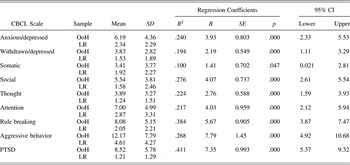
Fifty-three percent of the OoH sample and 13% of the LR sample had CBCL scores in the borderline or clinical range on the internalizing subscale of the CBCL, whereas 77% of the OoH and 16% of the LR samples had borderline or clinical scores on the externalizing subscale. Regression analyses controlling for age, gender, and ethnicity showed significantly higher scores on both DAWBA-RAD subscales (Table 1) and all CBCL subscales (Table 2) in adolescents in OoH care (n = 51 and 48, respectively) compared to the LR group (n = 42 and 38, respectively).
Mean DAWBA-RAD subscale scores in OoH and LR adolescents with regression analyses of group differences

Note: DAWBA-RAD; Development and Wellbeing Assessment: reactive attachment disorder; OoH, out of home; LR, low risk.
Group differences in CBCL raw scores controlling for age, gender, and ethnicity

Note: CBCL, Child Behavior Checklist; PTSD, posttraumatic stress disorder.
Associations between social cognition and language variables
Across the whole cohort (OoH and LR), higher age was significantly correlated with higher SIP hostile (.325, p = .000) and lower SIP competent (–.175, p = .045) scores; but there were no other significant associations between social cognition and demographic variables (Table 3). Adjusting for group membership, language ability (BPVS) is associated with higher SS ToM (.313, p = .000), less hostile attribution (c = –0.208, p = .017), and more nonhostile attribution (.218, p = .012). Adjusting for group, age, gender, ethnicity and language, higher SS ToM is associated with less hostile attribution (R 2 = .179, B = –0.822, SE = 0.403, p = .043, 95% CI = –1.618, –0.25) and hostile responding (R 2 = .311, B = –0.026, SE = 0.011, p = .023, 95% CI = –0.049, –0.004) and more competent responding (R 2 = .380, B = 0.333, SE = 0.135, p = .015, 95% CI = 0.066, 0.600).
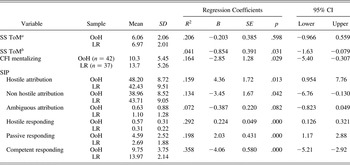
Means, standard deviations, and analyses of group differences in social cognition variables controlling for age, gender, ethnicity, and language

Note: SS, Strange Stories; ToM, theory of mind; CFI, Child Friendship Interview; SIP, social information processing.
a Controlling for age, gender, ethnicity, language, and physical control stories.
b Controlling for age, gender, and ethnicity.
Do adolescents in OoH care have ToM deficits and SIP biases?
ToM
Adjusting for age, gender and ethnicity, maltreated adolescents showed lower SS ToM scores than LR comparisons (Table 3), but this association disappeared when either language or the control task scores were entered in to the model. However on the CFI ToM measure, maltreated adolescents continued to show poorer ToM scores even controlling for language ability (Table 3). The OoH sample reported knowing their friend for a mean of 49 months, whereas the LR sample reported knowing their friend for a mean of 74 months (t = 2.465, df = 83, p = .016). The OoH and LR sample reported a similar amount of contact with their friend (M = 13.49 and 13.36, respectively, t = –0.45, df = 80, p = .964). OoH care status remained a significant predictor of CFI ToM scores (R 2 = .221, B = –3.224, SE = 0.012, p = .011, 95% CI = –5.678, –0.771) after additionally controlling for length of relationship (B = –0.021, SE = 0.049, p = .077, 95% CI = –0.045, 0.002) and reported contact, which was also an independent predictor of CFI ToM scores (B = –0.115, SE = 0.049, p = .021, 95% CI = 0.018, 0.213).
SIP
OoH adolescents made significantly more hostile attributions and less nonhostile attributions in the SIP task than LR adolescents (Table 3). Controlling for age, gender, ethnicity, and language, OoH adolescents also made significantly more hostile responses, less competent and less passive responses than the LR sample (Table 3). Lower BPVS scores were independently associated with increased hostile attribution scores (R 2 = .159, B = –0.166, SE = 0.063, p = .009, 95% CI = –0.290, –0.042) and lower nonhostile attribution scores (R 2 = .134, B = 0.165, SE = 0.061, p = .008, 95% CI = 0.044, 0.286). Age was also an independent predictor of hostile responding, with older adolescents making more hostile responses irrespective of group membership (R 2 = .292, B = 0.005, SE = 0.001, p = .000, 95% CI = 0.126, 0.321).
Are maltreatment and care history associated with social cognition?
Maltreatment
In the OoH sample multiple-maltreatment was associated with lower hostile responding scores after adjusting for age, gender, ethnicity, and language in regression analysis (R 2 = .256, B = –0.073, SE = 0.033, p = .034, 95% CI = –0.140, –0.006, n = 59). Multiple-maltreatment was not associated with any other social cognition variable.
Care history
Younger age at first entry to care was a significant predictor of higher SIP passive responding (R 2 = .353, B = –0.320, SE = 0.079, p = .000, 95% CI = –0.478, –0.162, n = 53) and lower competent responding scores (R 2 = .172, B = 0.308, SE = 0.131, p = .023, 95% CI = 0.044, 0.571, n = 53). Number of previous placements was not associated with any social cognition variable.
Is social cognition associated with psychopathology?
To test the hypothesis that poor ToM and a hostile SIP bias would be associated with externalizing psychopathology, a series of multiple regression analyses were carried out using the externalizing scale score of the CBCL as the dependent variable and entering each of the SS ToM, hostile attribution, hostile responding, and competent responding scores as independent predictors with age, gender, ethnicity, and OoH group status. Only competent responding significantly predicted externalizing scores, where higher competent responding scores were associated with lower CBCL externalizing scores (B = –0.731, SE = 0.326, p = .028, 95% CI = –1.381, –0.081).
Is social cognition associated with DAD?
Within the OoH sample, higher scores on the DAWBA-RAD superficial relationships scale were associated with lower SIP competent responding scores (R 2 = .344, B = –0.154, SE = 0.066, p = .022, 95% CI = –0.285, –0.023) and lower SS ToM scores (R 2 = .335, B = –0.229, SE = 0.115, p = .049, 95% CI = –0.458, –0.001), controlling for age, gender, ethnicity, language, and the SS control stories. There was no association between disinhibited indiscriminate scores and any social cognition variable.
Discussion
Our sample of adolescents living in UK OoH care had experienced multiple forms of maltreatment within a family context, most commonly emotional abuse and neglect. They entered the care system relatively late at a mean age of 8 years and had experienced frequent disruptions with many moves between care placements. They show significantly higher scores on all scales of the parent report CBCL compared to matched, low-risk community comparisons, and this is consistent with previous literature on mental health outcomes of children in OoH care in the United Kingdom (Ford, Vostanis, Meltzer, & Goodman, Reference Ford, Vostanis, Meltzer and Goodman2007) and with the high rates of psychopathology and poor global functional adaptation reported in the large sample of adolescents from which this subsample was drawn (Green et al, Reference Green, Biehal, Roberts, Dixon, Kay and Parry2014). Our sample, therefore, represent an extremely high-risk group with features known to be associated with adverse long-term psychosocial outcome (Rushton & Minnis, Reference Rushton, Minnis, Rutter, Bishop, Pine, Scott, Stevenson and Taylor2008). This paper explores their associated social cognitive competencies, which may mediate such poor outcomes.
The maltreated adolescents showed poorer competency than low-risk comparisons on an advanced test of ToM, but this effect was confounded by language ability. There has been considerable debate around the interpretation of ToM findings in the light of language development. Some argue that ToM and language are inextricably linked beyond a simple explanation that language provides the content of ToM (i.e., mental state language). In this sense, a verbal measure of ToM will inevitably lead to a language confound (de Villiers, Reference de Villiers2007). The significance of the group difference in ToM scores was also reduced when performance on the physical control aspect of the SS task was included in the model. The physical stories were designed to control for task demands including comprehension and attention but without requiring mental state inference. However, it has been suggested that the stories in this task can be understood and answered in mental state terms. White, Hill, Happé, and Frith (Reference White, Hill, Happé and Frith2009) showed that children with autism demonstrate more difficulty in answering questions on the physical stories and a similar set of stories involving animals than on tasks that involve inanimate nature themes and unlinked sentences. This suggests that ToM deficits may generalize to biological agents other than humans, potentially impacting on performance on the physical story task and limiting interpretation of this data. During the CFI, however, OoH adolescents did demonstrate significantly less evidence of complex spontaneous mentalizing abilities, independent of language and indicators of the quality of the relationship (reported length of relationship and frequency of contact). The friendship interview has the advantage of gathering evidence on mentalizing within a real-life and real-time context, with implication for functional social information processing. However, while we controlled for indicators of relationship quality, it is not completely possible to rule out that the mentalizing scores are confounded by other features of relationship quality.
Taking the results on ToM and mentalizing together across both of these rigorous measures, gives some cross-instrument validation of mentalizing abilities and, we suggest, gives at least partial support for the hypothesis that OoH adolescents show a deficit in ToM. Further investigation of this important issue using nonverbal assessments and more rigorous control tasks is required.
In SIP, OoH adolescents showed clear biases compared to comparisons; they were more likely to infer that intentions behind the behavior of others were hostile and to formulate responses and solutions that were hostile or passive and less frequently competent in problematic social scenarios. Younger age at entry to OoH care was associated with increased rates of passive and lower rates of competent response formation. Assuming that younger age at entry to care is an indication of more severely maltreating precare environments, this may indicate that more severe maltreatment experience is associated with poorer social competence in adolescence, in line with previous findings linking harsh and hostile early environments to hostile biases in attribution of intention and less competent behavioral strategies in response to problematic social scenarios (Dodge et al., Reference Dodge, Pettit, Bates and Valenti1995; Teisl & Cicchetti, Reference Teisl and Cicchetti2008; Weiss et al., Reference Weiss, Dodge, Bates and Petit1992). Somewhat contrary to this however, the experience of multiple forms of maltreatment was associated with less hostile responding in this study. We did not look specifically at the nature of maltreatment experience (i.e., physical abuse or neglect) in relation to SIP patterns since these commonly co-occurred within our high-risk sample, making interpretation difficult. An alternative explanation may be that the association reflects the effect of timing of maltreatment, rather than severity. Maltreatment occurring within specific developmental timeframes may have differential impact on social cognition. Future research could aim to test this hypothesis using analysis of both timing and severity of maltreatment.
Across these two domains of social cognition, superior ToM ability in the SS task was associated with a tendency to make less hostile intent attributions, as well as less hostile and more competent responses on the SIP task independent of language, OoH status and demographics. It is possible that more advanced skills in accurately inferring the thoughts, desires and intentions behind the behavior of others may enhance the ability to make attributions of intent in online social processing scenarios, leading to more competent and less aggressive response generation and social problem solving. However, this theory requires testing in longitudinal designs. Nevertheless, interventions that aim to improve ToM skills may also be useful for reducing biases in intent attribution and response generation. Given the significant association between competent responding in the SIP task and externalizing psychopathology reported by caregivers, where more competent responding was associated with lower levels of externalizing behavior, this suggests a focus of intervention to reduce externalizing behavior problems in maltreated samples. It is interesting to note that, in contrast with previous research, there was no evidence that hostile SIP biases were associated with increased reports of externalizing psychopathology. SIP theory suggests that exposure to violence and psychical maltreatment influences the memories and stored repertoire of behavior that guides subsequent interpretation and response to social cues. Although there is evidence within this OoH care sample of such social cognitive biases, this is not found to be associated with independently rated externalizing behavior. As discussed above, we did not examine specific association between physical abuse or violence exposure and social cognition. One explanation for this inconsistency may therefore be the heterogeneous nature of the early experience of the sample, including neglect and atypical caregiving experiences, which may lead to further social functioning and cognitive difficulties that preclude the identification of a linear relationship among violence exposure, cognition, and externalizing behavior.
We have previously identified high rates of indiscriminate and intrusive social behavior, as well as a tendency to form superficial relationships with adults, in a larger sample of adolescents in UK OoH care (Kay & Green, Reference Kay and Green2013). In this subsample, we tested the specific hypothesis that a deficit in ToM may underlie a lack of awareness of social boundaries in DAD. There was no direct association between social cognition and DAD disinhibited indiscriminate scores, representing core diagnostic features of DAD, similar to those described in the new DSM-5 category of disinhibited social engagement disorder. Carer-reported problems with superficiality in relationships were associated with poorer ToM scores on the SS task. Although this association only just reached statistical significance, it was independent of demographic variables and language. Superficiality in relationships was not associated with a hostile attribution bias or tendency to hostile forms of responding. However, it was associated with ratings of lower competence in behavioral responses: children for whom caregivers reported higher levels of difficulty in forming and maintaining close relationships were less likely to produce competent behavioral responses in problematic social scenarios.
Core features of DAD may therefore not represent difficulty in interpretation of others actions or lack of recognition of social boundaries due to poor social awareness. Indiscriminate friendliness has been found to be negatively associated with measures of inhibitory control (inhibition of attention and behavioral responses) in both preschool aged maltreated foster children (Pears et al., Reference Pears, Bruce, Fisher and Kim2010) and in postinstitutionalized 6- to 7-year-old children (Bruce, Tarullo & Gunnar, Reference Bruce, Tarullo and Gunnar2009). These studies show association with general inhibitory control processes, which may be disrupted following maltreatment and neglect. A recent fMRI study (Olsavsky et al., Reference Olsavsky, Telzer, Shapiro, Humphreys, Flannery and Godd2013) also found that postinstitutionalized children showed equivalent amygdala response to images of mothers and strangers, where noninstitutionalized comparison children showed reduced activation to strangers. Lack of discrimination in response to strangers was associated with parent reports of indiscriminately friendly behavior as well as later age at adoption (Olsavsky et al., Reference Olsavsky, Telzer, Shapiro, Humphreys, Flannery and Godd2013). Taken together, these findings suggest that social cognitive deficits and biases have a stronger association with difficulties in forming and maintaining close relationships and poor emotional reciprocity than with disinhibited behavioral patterns or externalizing psychopathology. Further use of paradigms which test inhibition specifically to novel social stimuli in children with DAD is needed to fully understand the cognitive mechanisms of this behavior.
Strengths and limitations
There are a number of methodological strengths to this study. First, the sample includes extremely high-risk young people, which are representative of some of the most vulnerable in society, making them highly appropriate for a study of this nature. We used a combination of young person and caregiver report on standardized and well validated instruments, limiting problems with common-rater bias and increasing confidence in the validity of findings. However, there are also a number of methodological limitations. Future studies should aim to incorporate multiple-informant measures of DAD. Reliance on carer report may result in over- or underreporting of DAD behavior. Use of teacher measures and direct observations will establish presence of disinhibited behavior across contexts. Second, the sample size of the OoH care group was moderate and some characteristics, such as the consistent high rates of maltreatment, may have limited variance, making detection of some associations difficult. There was also a tendency for participants in our OoH subsample to have lower levels of caregiver-reported externalizing behaviors than the wider OoH care sample (see Sample in the Method section). Although we find high rates of externalizing behavior in the subsample, it is possible that our findings are not generalizable to those with more severe externalizing disorders and would therefore benefit from replication in these groups. The majority of our sample was White British; although representative of the UK OoH care population, it may not be representative of care populations where there is greater ethnic diversity, for example, in the United States. We obtained relatively low return rates of parent-report psychopathology and DAD in the low-risk sample. This may have impacted on the rates of psychopathology and DAD identified in this group. Our assessment of maltreatment experience was limited by the available data from social worker reports and records, which was often patchy and inconsistent. The reporting of specific types of maltreatment by social work professionals is subjective and dependent on individual understanding and perceptions of the types of incident that may be classified under different maltreatment categories, limiting the validity of reports of individual forms of maltreatment. Given this, and the frequent cooccurrence of maltreatment categories, we opted for a simple approach to quantifying maltreatment experience with the use of a multiple maltreatment variable. A subsequent limitation may be the failure to adequately capture variance in severity of maltreatment experience as well as timing of maltreatment to further explore the differential impact of maltreatment experience occurring across developmental periods. Further research using detailed examination of case files and standardized definitions of maltreatment type, timing, and severity would facilitate tests of more specific hypotheses around differential impact of various maltreatment experiences on social cognitive development and functioning. Although we recruited the LR sample to include only those without experience of OoH care or adoption, we did not collect any third-party data or ask participants for reports of maltreatment experience (owing to the ethical implications and potential unreliability of this data). It is therefore possible that members of the LR group had experienced maltreatment.
In summary, we identify a hostile attribution bias in a very high-risk sample of maltreated adolescents in UK OoH care, significantly greater than low-risk controls. The evidence for a deficit in ToM is more instrument dependent and confounded by language competence, but the possibility of deficits here is significant and warrants further investigation. Superior ToM skills were associated with reduced hostile attribution and responding biases and increased social competence in ambiguous social scenarios. The ability to generate competent social responses was further associated with lower levels of caregiver-reported externalizing psychopathology. However, there was no evidence for an association between social cognition and core features of DAD: this is an important negative finding, and future research should aim to assess alternative cognitive mechanisms for this behavior. The findings suggest that social cognitive deficits and biases may play a role in determining the high rates of externalizing psychopathology and difficulties in forming meaningful reciprocal relationships seen in maltreated samples. ToM and social problem-solving skills may therefore represent viable targets for intervention with this group.