A number of recent studies in the government formation literature have examined the factors that influence the ability of political parties to join governments.Footnote 1 These studies treat political parties as the unit of analysis, and estimate logit or probit models to examine how party characteristics influence the likelihood that they will enter office. This methodological approach has two major shortcomings. First, it inappropriately assumes that each party can be treated as an independent observation. In reality, the likelihood of a particular party joining the government necessarily depends on the characteristics of the other parties in the government formation opportunity. While some studies have tried to address this problem using clustered standard errors, we demonstrate that this approach will not completely solve this non-independence problem. Secondly, the probability that a party will enter office depends not only on its own characteristics, but also on the characteristics of the potential coalitions of which it is a member. Studies that use the party as the unit of analysis will find it difficult, if not impossible, to account for these coalition-level factors.
In this article, we develop an approach to the study of parties joining governments that solves these problems. We first estimate a standard multinomial choice model (conditional logit or mixed logit) of coalition formation, using government formation opportunities as the unit of analysis and potential governments as the choice alternatives. This first step is well known in the government formation literature.Footnote 2 We then calculate the probabilities for individual parties in each government formation opportunity by simply summing the probabilities of entering office for all of the potential governments that contain the party. An empirical example demonstrates that this approach can change the substantive conclusions we draw about how key independent variables affect a party's likelihood of entering office.
PARTIES WITHIN GOVERNMENT FORMATION OPPORTUNITIES
In this section, we discuss why analysts should use the government formation opportunity as the unit of analysis even if the question of interest centers on parties. We also address some practical issues the analyst needs to consider when switching the unit of analysis, and how it is possible to calculate the predicted probabilities of parties entering government.
Why Formation Opportunities are the Correct Unit of Analysis
In parliamentary and semi-presidential democracies, governments need the support of a majority of the members of the legislature to take office. Single parties rarely control a majority of seats in the legislature, so when an opportunity for a new government to form arises, it usually entails a bargaining process among several parties to build a coalition that will garner majority support. Studies that ask how party characteristics affect the probability that a party will join the government are really asking how these party characteristics will affect the bargaining process to form a government. The previous literature acknowledges the fact that parties do not enter government independently – the identities and preferences of the other parties involved in the government formation process also matter. For example, the leaders of other parties might try to exclude a party from joining the government because the party is a successor to the Communist Party in an Eastern European country,Footnote 3 because the party defected from a previous governing coalitionFootnote 4 or because conflicts among a party's internal factions make it seem like an unreliable partner.Footnote 5 Alternatively, parties with previous experience in government should be more welcome to join new governments if they have a reputation for being reliable coalition partners.Footnote 6
Numerous examples suggest that as one party in a formation opportunity becomes more likely to join the government, this will influence the probabilities that other parties can also join the government. For example, Andeweg and Irwin note that government formation outcomes in the Netherlands were constrained by ‘the relations between the parties. From 1959 to 1994, VVD (the Liberals) and PvdA (Labour) excluded each other as coalition partners, which had the effect of reducing the options to either a centre-right or a centre-left coalition’.Footnote 7 The difficult Belgian government formation process in 2007–08 provides another example of how one party becoming more or less likely to enter a government affects the chances of another party entering government. At one point during the long negotiations, the Walloon environmentalist party, Ecolo, announced certain conditions for joining the government: first, the Flemish environmental party (Groen!) would also have to join the government, and second, the Flemish regionalist party N-VA could not join the government.Footnote 8 However, the Flemish Christian Democratic Party, a key actor in the negotiation process, was unwilling to exclude the N-VA, with which it had formed a pre-electoral alliance. Thus, Ecolos could not join the government. In any government formation process, if one party becomes more likely to join a government, this may well affect the likelihood of other parties joining. Empirical studies of parties joining governments must be able to account for such relationships, and existing studies do not do this.
Models that use political parties as the unit of analysis suffer from a second shortcoming: they cannot account for how coalition characteristics influence the likelihood of a party entering office.Footnote 9 For example, a party might be a member of more or fewer minority or minimal-winning potential coalitions, depending on the characteristics of the other parties in the government formation opportunity. This will naturally affect the probability that a potential government enters office. Studies that use the party as the unit of analysis will find it difficult or impossible to account for the majority status of a potential government and other coalition-level factors. In sum, when we study parties entering governments, we are really studying the formation of a governing coalition, and we should not treat parties in the same government formation opportunity as independent observations.
Methodological Considerations
Previous studies of parties joining governments have used data with political parties as the unit of analysis, and then estimated a binary choice model (logit or probit) to estimate the probability that a party with certain characteristics enters office. This approach is flawed, though, because it treats each party in a formation opportunity as an independent observation, and thus fails to capture how the context of the bargaining situation influences the ability of parties to join governments. Binary choice models necessarily assume that the probability that each party joins the government is independent of the probabilities that other parties join the government. To see this, consider a logit model to estimate the probability that party j would join the government:
 $${{P}_j}\, = \,\frac{{{{e}^{{{x}_j}\beta }} }}{{{\rm{1}}\, + \,{{e}^{{{x}_j}\beta }} }}.$$
This probability only depends on the observed characteristics of party j; the characteristics of the other parties and their influences on this probability are not captured. In other words, this model will estimate the same probability of entering the government for any party with the same characteristics xj , regardless of the bargaining context (number of parties, characteristics of other parties, etc.).
Several recent studies have acknowledged that the probability that a party joins the government may not be completely independent of other factors. Some have included country-level fixed or random effects, which will adjust all party probabilities within each country (and most likely serve as a correction for the average number of parties in the political system).Footnote 10 Others have used standard errors clustered on the political party or some other unspecified unit, which will capture correlation due to unobserved factors within each cluster (that is, correlation within the error term).Footnote 11 Neither of these approaches addresses the concern we raise here, though, which is that party probabilities will depend on the observed characteristics of the other parties in the formation opportunity and the bargaining situation itself.
Some of these recent studies also try to account for characteristics of potential coalitions (such as minority or minimal-winning status). The authors do this by calculating party-level variables that are meant to capture some of these coalition-level effects. For instance, Tavits calculates the fraction of minimal-winning coalitions in which a party holds membership, and includes that as a party-level variable in her model.Footnote 12 However, not all coalition-level characteristics can be captured in this way. Another problem is that this approach cannot account for the fact that some variables that influence the government formation process might have different effects at the coalition level versus the party level. For example, in our empirical application below we find that incumbent coalitions are advantaged in the government formation process, while incumbent parties are disadvantaged once we control for incumbency at the coalition level. Models that use political parties as the unit of analysis cannot make this kind of distinction. We need a more appropriate model of the government formation process in order to understand how party characteristics influence the ability to join governments.
The approach we adopt here is to estimate a multinomial choice model, using government formation opportunities as the unit of analysis and potential governments as the choice alternatives. A commonly used multinomial choice model in the study of the government formation process is the conditional logit (CL) model.Footnote 13 In the CL model, the probability that government j is selected out of the set of K potential governments in formation opportunity i is:
 $${{P}_{ij}}\, = \,\frac{{{{e}^{{{x}_{ij}}\beta }} }}{{\mathop{\sum}\limits_{k\, = \,{\rm{1}}}^K {{e}^{{{x}_{ik}}\beta }} }},$$
where β represents a vector of coefficients and xik represents a vector of independent variables associated with potential government k in selection opportunity i. Examination of Equation 2 shows that the probability that potential government j forms depends not only on the characteristics of that government xij , but also on the characteristics of the other potential governments in formation opportunity i. The process by which governing coalitions form is exactly the same bargaining process by which political parties join governments – potential governments are simply a set of parties, so understanding which governing coalitions are likely to form necessarily informs us which parties are likely to join the government. Put another way, there is no distinction between asking which coalition of parties will form the government and asking which parties will join the government.
Problems with using CL models in particular situations – such as when the independence of irrelevant alternatives (IIA) assumption is violated or when unobserved heterogeneity across government formation opportunities exists – have recently led scholars to estimate mixed logit (MXL) instead of CL models.Footnote
14
In this context, the mixed logit is a random coefficients version of the CL model in Equation 2, with the coefficients varying across formation opportunities according to a joint normal distribution
 $$$ \phi {\rm{(}}\beta |b,W{\rm{)}} $$$
, where b is the mean and W is the covariance matrix of the random coefficients. The probability that government j is selected out of the set of K potential governments in formation opportunity i is then calculated by integrating the CL probabilities over the density function of β:Footnote
15
 $${{P}_{ij}}\, = \,\int \left[ {\frac{{{{e}^{{{x}_{ij}}\beta }} }}{{\mathop{\sum}\limits_{k\, = \,{\rm{1}}}^K {{e}^{{{x}_{ik}}\beta }} }}} \right]\phi {\rm{(}}\beta |b,W{\rm{)}}d\beta .$$
Either of these multinomial choice models solves one of the fundamental problems with the binary logit model in Equation 1, since the probability that a political party will join the government can now be influenced by the observed characteristics of the other parties in the formation opportunity. Either the CL or the MXL approach can be applied to the study of parties joining governments.
Despite the fact that these models use the government formation opportunity as the unit of analysis and potential governments as choice alternatives, extracting information on political parties, instead of governments, is actually quite simple. The coalition-level data that scholars have been using for the past decade includes all combinations of all parties, and each party's characteristics are constant across all coalitions that include that party. Thus the coefficients on the party-level variables in our multinomial choice models tell us how an individual party's characteristics will influence the characteristics of all coalitions that include that party, which in turn influences the probability that these coalitions will form the government – that is, those coefficients tell us how party characteristics influence the probability of joining the government. This means we can interpret the sign and statistical significance of party-level variables in our multinomial choice models in the same way we would in a binary choice model.
Calculating Party Probabilities
In addition to interpreting the sign and significance of our variables, we also want to consider their substantive significance. One common approach in these situations is to calculate how the predicted probability of some event (in this case, the probability of entering office) changes as the values of the independent variable change.Footnote 16 Previous studies of parties joining governments have done this by generating a ‘hypothetical party’ with known characteristics, and then demonstrating how the probability of that party joining the government would change as the characteristics of that party change.Footnote 17 Of course, these calculations are derived from a binary choice model that uses the party as the unit of analysis, and thus will have the same flaws – a party's probability of joining the government is assumed to be independent of the characteristics of the other parties in the formation opportunity, and of the characteristics of the formation opportunity itself (such as the number of parties in the formation opportunity). Fortunately, it is relatively straightforward to extend this hypothetical case approach to the estimation strategy that we have outlined here.
To examine the substantive effect of the independent variables in our model on the probabilities of parties joining governments, we begin by setting the values of the independent variables to create a hypothetical government formation opportunity. Our estimated multinomial choice model will provide predicted probabilities for each government in this hypothetical baseline case. We then calculate how the predicted probabilities for the potential governments in this case would change as we alter the values of the independent variables to create different hypothetical scenarios. Thus far, this is exactly the same hypothetical case procedure that has been used in previous research on parties joining governments, except here we are calculating predicted probabilities for potential governments rather than political parties. The only additional step required in our empirical strategy is to convert the potential government probabilities into political party probabilities. To do this, we simply sum the predicted probabilities for the potential governments that contain the political party of interest.
Calculating standard errors on these predicted probabilities (and differences between them) is also straightforward. We first take k random draws (where k is a large number, such as 1,000) from the multivariate normal distribution defined by the model coefficients and covariance matrix, and calculate k sets of predicted probabilities for each potential government within the hypothetical formation opportunity. Then, within each of the k sets of potential governments we sum the potential government probabilities for each party, obtaining k predicted probabilities for each party in our hypothetical scenario. These k predicted probabilities can then be summarized by their mean and standard deviation.Footnote 18
Data and Coding Considerations
Of course, switching from a binary model examining political parties to a multinomial choice model examining potential governments will entail some adjustments to one's data; in most cases researchers interested in studying parties joining governments will have collected data on individual political parties. Fortunately, it is not difficult to convert party-level data to coalition-level data. If there are n parties in a formation opportunity, there will be 2 n −1 potential governments (every possible combination of the n parties, minus the empty coalition). For the most part, the characteristics of these coalitions will be simple functions of the characteristics of the individual parties that comprise the coalition. Dummy variables that capture party characteristics (largest party status, median party status, etc.) are easily converted to coalition-level variables. For instance, if a researcher is interested in whether Communist Successor Parties (CSP) are treated differently than other parties, this can be captured with a dummy variable that indicates all of the potential governments that contain a CSP.Footnote 19 If a party has declared that it will not join a government containing another party, as was the case with the Dutch and Belgian examples mentioned earlier, then we could use a dummy variable to indicate all of the potential governments containing the ‘excluded’ combination of parties.
Other party-level variables, particularly continuous variables, may not have such an obvious representation at the coalition level. The key in specifying these variables at the coalition level is to remember that these party characteristics affect the probability that a party will join the government by affecting the bargaining process between parties. For instance, when considering the effect of party size on the probability of joining the government, we must consider how the additional seats the party brings to the coalition will change the coalition’s characteristics. In some cases the increase in coalition size from adding the party will move the potential government from minority to majority status, and thus be viewed as positive by potential coalition partners and make the formation of this potential government more likely. In other cases the potential government will already have a majority, and the party's seats will just mean additional internal competition for cabinet positions – making the formation of this coalition less likely. Overall, this suggests that the importance of party size at the coalition level is best captured by including both coalition size and coalition size squared in order to capture this curvilinear relationship.
AN EMPIRICAL APPLICATION
To demonstrate how our approach works, we compare several different models estimated on the same data, but using different units of analysis. Our independent variables of interest are drawn from factors often identified in the literature as having an influence on which parties enter government. In our empirical example below, our main variable of theoretical interest will be incumbency status, though we examine other commonly used variables as well. For example, scholars of coalition governments have found that both party size (the share of legislative seats) and the ideological positions that parties take affect a party's chances of becoming a part of the government. Holding the median ideological position should help a party enter government, and potential governments that contain the median ideological party should be more likely to take office than potential governments without the median party. As far as party size is concerned, scholars consider both largest party status as well as party size more generally. Being the largest party can provide an advantage in the government formation process. It is also usually argued that larger parties will find it easier to enter government. However, there may be a point at which a party becomes so large that it becomes less attractive as a coalition partner. At the coalition level, theoretical accounts of the bargaining process suggest that minimal-winning coalitions should be more likely to form a government than minority or surplus coalitions would be.Footnote 20
We examine the effect of party characteristics in the government formation process using both binary choice and multinomial choice models in the context of Western Europe, the region most often studied in the literature on government formation. We begin with data from Glasgow, Golder and Golder, which gives us legislative parties in seventeen parliamentary and semi-presidential democracies in Western Europe from 1945 to 1998.Footnote 21 One advantage of using this dataset is that it allows us to begin with the set of legislative parties (rather than the set of potential coalitions), thereby matching the structure of the datasets used by scholars employing binary choice models. To create variables that capture the ideological positions of parties and potential governments, we used the left-right policy scores for each party from the Comparative Manifesto Project (CMP).Footnote 22 To identify all of the parties that entered government in each formation opportunity, as well as their share of the legislative seats, we relied on information from Müller and Strøm.Footnote 23 We created the coalition-level variables for minority and minimal-winning coalition status, as well as the number of parties in each potential government.
Does the Incumbency Advantage Apply to Parties or Coalitions?
A key element of our comparison is an examination of the incumbency effect. As summarized by Martin and Stevenson, there are a number of theoretical reasons to expect an incumbency advantage in the government formation process.Footnote 24 The parties in incumbent coalitions have more information about their current partners, gained from their experience of being in government together, making negotiations over the next government's policy easier.Footnote 25 Other scholars emphasize the higher bargaining costs of forming a new governing coalition as opposed to maintaining an existing coalition.Footnote 26 Finally, the incumbent coalition can be advantaged by institutional factors, as is the case in countries where the prime minister has the ability to terminate governments at times that are advantageous for the incumbent coalition's reappointment prospects.Footnote 27
Scholars interested in the effects of party characteristics have argued that incumbent parties are more likely to enter governments.Footnote 28 However, the theoretical reasons to expect an incumbency advantage mentioned above apply at the coalition level, not to the individual parties in the previously governing coalition. If an incumbent government performs poorly in office or experiences internal conflict, its members are likely to do poorly at the polls and be less attractive as coalition partners. In fact, there are reasons to believe that, should the incumbent government as a whole not re-form, the parties that were members of the former governing coalition will be disadvantaged in the subsequent government formation process. This suggests that we should distinguish between incumbent coalitions and incumbent parties. This distinction is not possible in a binary choice model that uses parties as the unit of analysis, because such a model does not allow us to capture coalition characteristics.
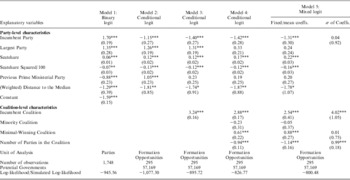
To examine the effect of incumbency, we begin by using political parties as the unit of analysis and estimate a binary logit model of the type currently used in studies of parties joining governments. The dependent variable in this model is a dummy variable, coded 1 if a party observed in a particular formation opportunity entered the government and 0 otherwise. We use standard errors clustered on the formation opportunity to capture any unobserved influences that might create correlations between parties within a formation opportunity. As we will see, this does not correct for the undesirable properties of this model that were discussed above. This model is presented as Model 1 in Table 1 below.
Parties versus Government Formation Opportunities as the Unit of Analysis in Models of Parties Entering Governments

Note: The first column presents the results from a binary logit model with parties as the unit of analysis and standard errors clustered on the formation opportunity. The next three columns present conditional logit models with government formation opportunities as the unit of analysis. The last two columns present the fixed coefficients/means of the random coefficients and the standard deviations of the random coefficients for a mixed logit model with government formation opportunities as the unit of analysis. The party-level variables indicate either party or coalition characteristics, depending on the unit of analysis of the model. All random coefficients in the mixed logit are normally distributed. Standard errors are shown in parentheses. *p < 0.10; **p < 0.05; ***p < 0.01 (two-tailed).
In Table 1, we distinguish between party- and coalition-level characteristics in our list of explanatory variables. Obviously, a model that uses parties as the unit of analysis, such as Model 1, can only use party-level characteristics as independent variables. For the models that use formation opportunities as the unit of analysis, the party-level characteristic variables indicate the presence or amount of that variable for the coalition.
Model 1 examines several different characteristics of parties and how they influence the probability of entering government. The incumbent party variable in this model is a dummy variable indicating whether the party was a member of the previous governing coalition. We control for party size by including the party's seat share, seat share squared (divided by 100 to scale the coefficient on this variable to match the scale of the other coefficients) and a dummy variable to indicate whether the party was the largest party in the formation opportunity. We also include a dummy variable for the party of the previous prime minister and a measure of ideological distance to the median party (this variable is zero for the median party). To measure ideological distance we use the CMP ideological scores for each party and calculate the absolute difference (divided by 100) between this score and the median ideological score for the formation opportunity.Footnote 29
The results from estimating Model 1 reflect those reported in several previous studies. Parties are more likely to join the government when they are the largest.Footnote 30 Party size also increases the likelihood of entering government,Footnote 31 though at a declining rate.Footnote 32 Parties that are further from the median are less likely to join the government,Footnote 33 as is the party of the previous prime ministerFootnote 34 – we defer discussion of this latter finding until we discuss Model 3 below.
Of special note for this example, the coefficient on incumbent party is positive and significant, just as it has been in previous research.Footnote 35 This suggests that any party that was a member of the previous governing coalition is more likely to join the new government.
Model 2 is a conditional logit model estimated on the same set of parties and government formation opportunities as those used for Model 1, but with the unit of analysis now defined as government formation opportunities, with potential governments as the choice alternatives. The dependent variable for this model (and the three that follow) is a dummy variable coded 1 if a particular coalition formed the government, and 0 otherwise. This model includes the same variables that were included in the binary logit model presented in Model 1, except these variables are now redefined to apply to potential governments rather than political parties – Largest Party now indicates that the largest party is present in the coalition, and so on. Ideological distance is now measured as the weighted mean ideological distance between the members of the coalition and the median (divided by 100), with the weights for each party based on its seat share.Footnote 36
Despite the shift in the unit of analysis it is still straightforward to interpret how party characteristics influence the chances of joining the government – we simply consider how an individual party's characteristics influence the characteristics of the coalitions of which that party is a member. For instance, Model 2 reveals that coalitions are less likely to form the government as their seat-share weighted distance to the median grows. This is indicated by the negative and statistically significant coefficient on Distance to the Median. In terms of individual parties, if a party adopts an ideological position further from the median, this will increase the weighted ideological distance from the median for all coalitions containing that party, and reduce the probability that these coalitions will form the government. In other words, increased ideological distance from the median will reduce the probability that a party will join the government, which is the same conclusion we would reach using Model 1. With two exceptions, the substantive conclusions we would reach using Model 2 are identical to those we would reach using Model 1.
The most important of these exceptions has to do with the effect of incumbency. Note the coefficient on Incumbent Party in the Coalition in Model 2, which is negative and statistically significant. This is precisely the opposite of the finding in Model 1, where the coefficient is positive, which suggested that incumbent parties were more likely to join the government. The reason for this discrepancy is made clear when we consider Model 3, which adds a dummy variable to indicate the incumbent coalition. In Model 3 we can now see that it is the incumbent coalition, not the incumbent parties, that holds the incumbency advantage. The coefficient on Incumbent Coalition is positive and statistically significant, but the coefficient on Incumbent Party is negative and statistically significant. In fact, once we control for the incumbent coalition effect, we see that other coalitions that include at least one incumbent party are actually less likely to form the government. As described above, this result is sensible – members of the incumbent coalition are placed at a disadvantage if the incumbent government as a whole is unable to re-form.
It is impossible to control for incumbency at the coalition level when using a binary choice model with political parties as the unit of analysis – we can only capture party-level incumbency in this case, leading us to the mistaken conclusion that incumbent parties are advantaged when trying to join governments. Model 3 also reveals that once we control for the incumbent coalition, there is no statistically significant effect for the party of the previous prime minister. Again, this would be impossible to determine if we used political parties as the unit of analysis.
Once we switch to using formation opportunities as the unit of analysis it becomes easy to include other coalition-level effects that are difficult or impossible to account for when using parties as the unit of analysis. Model 4 expands Model 3 to include several important coalition-level variables that are likely to influence the probability that a party will join a government. Following a long line of empirical analyses of government formation, we include dummy variables to indicate minority and minimal-winning coalitions, as well as the number of parties in each coalition.Footnote 37 Both minimal-winning coalitions and the number of parties in a coalition have a statistically significant effect, indicating they are important determinants of which governing coalitions will form, and thus which political parties will join governments. Controlling for these types of effects will be difficult or impossible when using parties as the unit of analysis.
CL models have been criticized in the government formation literature for making the restrictive IIA assumption and ignoring the influence of context-specific effects (unobserved heterogeneity) on the government formation process, and as a result scholars might prefer a MXL model. The MXL in Model 5 is specified in the same way as Model 4, except that the coefficients for four of the independent variables are now specified to follow random normal distributions.Footnote 38 We found statistically significant variation in the coefficients for two of our independent variables – Incumbent Coalition and Number of Parties in the Coalition. This shows that while the incumbent coalition holds an advantage on average, and coalitions that include more parties are disadvantaged on average, the magnitude of these effects varies across government formation opportunities. This of course has implications for the probabilities of parties joining governments.
The Substantive Effect of Incumbency
As described in the previous section, studying the substantive effect of the independent variables on the probabilities of parties joining governments is straightforward. We begin by creating a hypothetical government formation opportunity. In this example we base our hypothetical case on the real-world government formation opportunity that took place in Iceland in 1995, and examine the effect of changing incumbency status on the probabilities of parties joining the government.
During the 1991 government formation opportunity in Iceland, the Independence Party (IP) and Social Democratic Party (SDP) had formed the government, with the Independence Party taking the prime ministership. According to one account of the 1991 government formation process, the parties had ‘fought the election without seeming to tie their hands regarding the formation of a government’, and after the votes had been counted and the legislative seats allocated, the Independence Party could have formed a two-party majority government with either the Progressives or the Social Democrats. However, the Progressives had been in government almost continuously since 1971, and ‘the IP leadership felt that it was now time for a change. […] In any case, it seemed likely that the SDP was in fact the IP's first choice’, partly due to a disagreement over policy toward the European Community that had developed during the campaign, pitting the Progressives against the IP and SDP.Footnote 39 Four years later, prior to the 1995 election, the leaders of the outgoing government parties said that if the government retained its majority then it would be ‘natural that those parties would have discussions’ about reforming their cabinet, but they did not commit to anything further.Footnote 40 As was the case in the previous elections, in 1995 the Independence Party was the largest party and could have formed a two-party majority government with either the Progressives or the Social Democrats.
Thus, for the baseline scenario in our hypothetical case we set the values of the independent variables to reflect the real-world values of the variables in the 1995 Iceland government formation opportunity (an Independence/Social Democrat incumbent government), while for the counterfactual scenario we change the values of the incumbent party and incumbent government dummy variables to create a case in which the identity of the incumbent government was Independence/Progressive rather than Independence/Social Democrat.
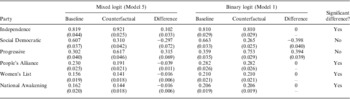
With the hypothetical case defined, we then calculate the predicted probability that each party in this case would join the government in our baseline scenario. Here we calculate predicted probabilities using Model 5 (the mixed logit model), but the same procedure could be applied to any multinomial choice model. We first take 1,000 draws from the multivariate normal distribution defined by the mixed logit model coefficients and covariance matrix, then calculate 1,000 predicted probabilities for each of the sixty-three potential governments in this formation opportunity. Then, within each of these 1,000 draws we sum the probabilities for all coalitions that contain each party, producing 1,000 predicted probabilities for each party in the baseline scenario. The means and standard deviations of the predicted probabilities resulting from this calculation for each of the six parties in our hypothetical case are presented in the first column of results in Table 2. We then repeat this calculation for the counterfactual scenario. The means and standard deviations resulting from the calculation for the counterfactual case and the differences between the baseline and counterfactual cases are presented in the second and third columns of results in Table 2.
Changes in the Predicted Probability of Joining the Government when Changing Incumbency Status, Iceland 1995

Note: This table presents the predicted probabilities from a counterfactual scenario that changes the incumbent government from Independence/Social Democrats (the baseline scenario) to Independence/Progressive (the counterfactual scenario). The first three columns present the results under a mixed logit model (Model 5 in Table 1) that uses government formation opportunities as the unit of analysis, while the next three columns present the results under a logit model (Model 1 in Table 1) that uses political parties as the unit of analysis. The last column indicates whether the differences between the baseline and counterfactual scenarios are significantly different between these two models. Standard deviations are shown in parentheses.
In the next three columns of Table 2 we present a similar counterfactual analysis, but this time using Model 1 (a binary logit with political parties as the unit of analysis). Here we take 1,000 draws from the multivariate normal distribution defined by the logit model coefficients and covariance matrix, and then calculate 1,000 predicted probabilities for each of the six political parties in the hypothetical formation opportunity – the additional step of summing probabilities is not needed, because the unit of analysis here is political parties rather than potential governments. This is the same type of calculation that has been done in previous research.Footnote 41
A comparison of the results in Table 2 reveals clear differences between Models 1 and 5 in the estimated substantive effects of incumbency. For the two political parties directly involved in the counterfactual analysis (SDP and Progressive), the predicted change in probability under the counterfactual scenario is similar for both models – changing the incumbent government from IP/SDP to IP/Progressive reduces the probability that the SDP will join the next government and increases the chances of the Progressives.
However, for the remaining four parties in our hypothetical scenario the logit model predicts no changes in the probability of joining the government. This is a consequence of using political parties as the unit of analysis and treating each party as an independent observation – there can be no change in the predicted probabilities for parties that are not directly affected by the counterfactual (parties other than the Social Democrat and Progressive parties). Note that this holds true even though Model 1 uses standard errors clustered on formation opportunities.
In contrast, the mixed logit model that uses the formation opportunity as the unit of analysis does estimate changes in the probability of joining the government for parties not directly affected by the counterfactual. Methodologically, this is what we should expect – changing the characteristics of some parties in our counterfactual scenario will change the characteristics of many of the potential governments, which in turn will affect the fortunes of the other parties in the hypothetical formation opportunity.
In this hypothetical case, the probability of joining the government under the counterfactual scenario increases for the Independence Party – the most likely governments that did not include the Independence Party under the baseline scenario were based around the second-largest Progressive Party, but with the Progressive Party now included in the incumbent coalition, these alternative coalitions become much less likely. This, in turn, reduces the probability that the smaller parties would be able to join the government. This result makes sense substantively, and again demonstrates that binary choice models with political parties as the unit of analysis can produce misleading results.
CONCLUSION
Understanding which types of parties are more likely to join governments, and why, is central to our understanding of the government formation process.Footnote 42 However, previous studies of parties entering governments have not used the most appropriate method to determine how party characteristics affect the government formation process. They have used the political party as the unit of analysis, and estimated binary choice models to estimate the probability that a party will join the government. This approach has some serious drawbacks that can lead to incorrect inferences as well as incorrect estimates of substantive effects.
First, it inappropriately treats each political party in a government formation opportunity as an independent observation in spite of the fact that parties do not enter governments independently. Instead, they enter a bargaining process with the other parties in the government formation opportunity, and the probability of a party joining the government will depend on the characteristics of these other parties in addition to its own characteristics. Clustering the standard errors in a binary model will not solve this problem. Secondly, this approach does not allow researchers to control for some important coalition-level effects that will have strong influences on the probabilities of parties entering governments. In an empirical example, we showed that a binary logit using parties as the unit of analysis is unable to control for the effect of the incumbent coalition, which leads to mistaken conclusions about the nature of incumbency in the government formation process.
The solution to these problems is to treat the government formation opportunity as the unit of analysis, with potential governments as the choice alternatives, and estimate a multinomial choice model (conditional logit or mixed logit). This approach appropriately models the government formation process while allowing researchers to control for important coalition-level variables. The approach we recommend builds on the same approach that scholars have been using for the past decade to analyze which potential government is chosen to take office. These models are already familiar to scholars interested in government formation; researchers need only consider how variables of interest at the party level should be measured at the coalition level. The only additional methodological step required is to sum the probabilities of the potential governments containing a particular party to recover the probability of that party entering government. The approach we recommend here provides researchers with a straightforward and methodologically sound way to study the likelihood of parties joining governments.