INTRODUCTION
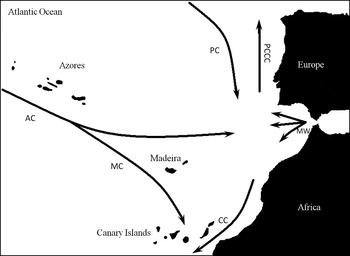
The Azores Archipelago (latitude: 36°55′–39°43′N (530 km); longitude: 24°46′-31°16′W (320 km)) comprises nine strongly-isolated islands about 800 km from Madeira Island, 1500 km from Europe and 1900 km from America, in the junction of the North American, Euroasian and African lithospheric plates astride the Mid-Atlantic Ridge (Coutinho et al., Reference Coutinho, Pacheco, Wallenstein, Pimentel, Marques and Silva2009), at the northern edge of the North Atlantic Subtropical Gyre—the rotor of the North Atlantic circulation (Bashmachnikov et al., Reference Bashmachnikov, Lafon and Martins2004). During the last two million years a series of ice ages, interglacial warming's and tectonic movements (especially in active areas such as plate junctions) have alternately lowered and raised sea levels and temperatures and produced changes in the positions and strengths of ocean currents (Morton & Britton, Reference Morton, Britton, Gibson and Barnes2000). Today, the basic average ocean circulation pattern of the North Atlantic is an asymmetric, large-scale gyre, flowing to the north, on the western side, with the Gulf Stream transporting warm water of equatorial and tropical origin into the colder northern waters. The water flows to the south, on the centre/eastern side, through a multibranched current system (Santos et al., Reference Santos, Hawkins, Monteiro, Alves and Isidro1995). Surveys by means of drifting buoys (Krauss & Meincke, Reference Krauss and Meincke1982) have revealed more complicated patterns in the detail of the water curculation, with the current field dominated by mesoscale (100–150 km) eddies and meanders rather than a steady flow (Gofas, Reference Gofas and Martins1990). The ocean circulation patterns around the Azores are very complex (see e.g. Alves, Reference Alves1990; Juliano, Reference Juliano1994) corresponding to a multibranching system that changes with the time of the year (Santos et al., Reference Santos, Hawkins, Monteiro, Alves and Isidro1995). Although for almost all the year the current flow between Madeira and the Azores, is predominantly from west to east, there are also mean-events when the current flows mainly from east to west (from Madeira towards the Azores) (Santos et al., Reference Santos, Hawkins, Monteiro, Alves and Isidro1995; Johnson & Stevens, Reference Johnson and Stevens2000). Around Madeira and in the open ocean there is also a high variability current pattern with a series of eddies in the Azores Current and the Canary Current along the African coast (Johnson & Stevens, Reference Johnson and Stevens2000) (Figure 1). Geographical location of the Azorean Islands is particularly important to the distribution of species as it corresponds to a climatic–ecological transition region, with the confluence of marine life of adjacent regions such as the subtropical north-eastern Atlantic, the north-eastern Atlantic cold temperate and the Mediterranean. The islands are composed mostly of volcanic rocks, predominantly basaltic lavas and trachytic pumice deposits (Morton et al., Reference Morton, Britton and Martins1998), and sandy beaches are scarce. On rocky shores, there are ledges projecting from the foot of the cliffs but, typically, the cliffs lunge straight into the sea, so that the intertidal zone is vertical and there is virtually no shore. The dominant subtidal environment comprises rocky outcrops, interrupted by unconsolidated sediments of gravel, sand, mud or a combination of these. Individual boulders also may lie upon or within these unconsolidated sediments (Morton et al., Reference Morton, Britton and Martins1998).
Schematic diagram of the eastern North Atlantic Circulation between the Azores, the Canary Islands and the Strait of Gibraltar, AC Azores Current; CC Canary Current; MW Mediterranean Water outflow (deep currents); PC Portuguese Current—summer season; PCCC Portuguese Coastal Counter Current—winter season).

The phylum Echinodermata has a long Precambrian history, since echinoderms were fairly common in some habitats in the Early Cambrian, nearly 600 million years ago (Hendler et al., Reference Hendler, Miller, Pawson and Porter1995). Echinoderms comprise a major food resource for certain fish and crustacean species and some are eaten by humans. The ecological role of echinoderm species on marine communities is poorly documented, but it is known, for example, that some species can influence the species composition of their environment (see, e.g. Kempf, Reference Kempf1962; Verlaque, Reference Verlaque and Boudoresque1987; Sala & Zabala, Reference Sala and Zabala1996).
Historical overview of studies on Azorean echinoderms
The first published scientific observations of Azorean echinoderm diversity dates from the 19th Century (Drouët, Reference Drouët1861) and listed six species from two classes (four Echinoidea and two Asteroidea). Twenty-seven years later in the ‘Liste des Échinodermes recueilis aux Açores’ Barrois (Reference Barrois1888) identified 18 species from the five extant classes (one Crinoidea, four Ophiuroidea, one Holothuroidea, seven Echinoidea and five Asteroidea) and included four more species of Ophiuroidea collected by Ljungman (Reference Ljungman1871); of the latter, only two are considered valid species. Also in the 19th Century, working on the asteroid specimens collected during the ‘Campagnes Scientifiques du Monaco’, Perrier (Reference Perrier1896) identified 1 more asteroid species from the shallow water of the Azores. On an extensive survey of echinoderms, mostly based on specimens collected during the campaigns of Prince Albert I of Monaco, Koehler (Reference Koehler1924) identified 28 echinoderms new for shallow Azorean waters; at this time there were 47 echinoderm species recorded, from waters shallower than 50 m. Although not adding to the list Nobre (Reference Nobre1938) compiled all existing data from echinoderms collected and deposited in Portugal, including the Azores. During the preparation of the Echinodermata—Fauna d'Italia book, Tortonese examined specimens of Luidia sarsi collected in the Azores, a species not mentioned previously. Marques (Reference Marques1983) did not add any new records but summarized the ecological information of the shallow-water echinoderm species in the Azores. An interesting taxonomic overview of the Asteroidea, including specimens from the Azores, is provided in Starfishes of the Atlantic by Clark & Donwey (Reference Clark and Downey1992) working on specimens deposited in European museums mention 2 asteroid species not previously registered in the Azorean shallow waters. Pereira (Reference Pereira1997) compiled a species register of 41 echinoderms from the Azores, including representatives of each extant class; Crinoidea (1), Ophiroidea (10), Holothuroidea (7), Echinoidea (14) and Asteroidea (9), occurring at depths ranging from intertidal to 200 m. Pereira (Reference Pereira1997) also provided a bibliography of the Azorean echinoderm taxonomic literature, but the works of Koehler (Reference Koehler1924) and Nobre (Reference Nobre1938) were not mentioned. García-Diez et al. (Reference García-diez, Porteiro, Meirinho, Cardigos and Tempera2005) produced a taxonomic review of selected invertebrate groups, including echinoderms, collected during the Campaigns of Prince Albert I of Monaco in Azorean waters, but new records for the shallow water echinoderms were not found.
The aim of this study was to establish a definitive list of echinoderm species for the Azorean Archipelago, developing a working document on diversity that can be used for future research and where it is discussed the observed diversity with a biogeography perspective. The importance of a defined protection status for this taxonomic group is highlighted.
RESULTS
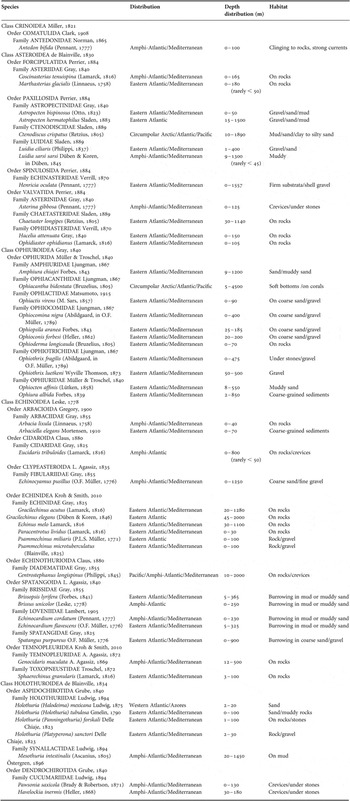
In the present work, shallow-water (<50 m) echinoderm fauna of the Azores was compiled from historical literature. A total of 49 echinoderm species (Table 1), distributed in 5 classes and 38 genera (Crinoidea (1), Asteroidea (10), Ophiuroidea (10), Echinoidea (13) and Holothuroidea (4)) were identified. Echinoidea (18) was the most diverse class followed by Asteroidea (12), Ophiuroidea (11), Holothuroidea (7) and Crinoidea (1). The systematic arrangement and nomenclature follows that proposed by Clark & Donwey (Reference Clark and Downey1992) for the class Asteroidea, Tortonese (Reference Tortonese1965) and for the classes Echinoidea and Ophiuroidea and Moyse & Tyler (in Hayward & Ryland (Reference Moyse, Tyler, Hayward and Ryland1995)) for the classes Crinoidea and Holothuroidea. More recent updates of echinoderm nomenclature were consulted in the database initiatives (see Stöhr & O'Hara, Reference Stöhr and O'Hara2007; Mah, Reference Mah2009; Kroh & Mooi, Reference Kroh and Mooi2010). The checklist is organized by class and all subsequent infra-phylum taxa to species were considered. In Table 1, depth distribution notes were based on the literature (Nobre, Reference Nobre1930; Tortonese, Reference Tortonese1965; Clark & Donwey, Reference Clark and Downey1992; Hayward & Ryland, 1995; Hansson, Reference Hansson, Costello, Emblow and White2001; Stöhr & O'Hara, Reference Stöhr and O'Hara2007; Mah, Reference Mah2009; Kroh & Mooi, Reference Kroh and Mooi2010). In the same Table, ‘Habitat’ notes were based in the previous literature and include authors' own observations.
Shallow-water Echinodermata species from the Azores.

Species list
Coscinasterias tenuispina (Lamarck, Reference Lamarck1816)
Historical records in Azores
Asterias tenuispina Lamarck, Reference Lamarck1816—Barrois (Reference Barrois1888) p. 4.
Coscinasterias tenuispina (Lamarck, Reference Lamarck1816)—Nobre (Reference Nobre1924) p. 88; Nobre (Reference Nobre1930) p. 68; Nobre (Reference Nobre1931) p. 35; Nobre (Reference Nobre1938) p. 36; Marques (Reference Marques1983) p. 2; Clark & Donwey (Reference Clark and Downey1992) p. 427.
Coscinasterias tenuispina is very abundant in the Mediterranean where it remains essentially coastal and does not occur deeper than a few metres (Koehler, Reference Koehler1924). Although this species is by far the most abundant invertebrate predator in the Canary Islands (Clemente et al., Reference Clemente, Hernández, Toledo and Brito2007), in Azores, C. tenuispina is not found in abundance (Marques, Reference Marques1983). It is a typical inhabitant of rocks. Even near shore, it is possible to find individuals in various stages of development (Tortonese, Reference Tortonese1965). Characteristically, this species has six to nine long arms, polyhedral, unequal in length, one side usually larger than the other. This species can reproduce by fissipary causing arms asymmetry and the presence of a possible second madreporite (Nobre, Reference Nobre1938).
Geographical distribution
Coscinasterias tenuispina is present on north-western Atlantic coasts from the Bay of Biscay to Guinea; Macaronesia Region and Mediterranean Sea. According to Tortonese (Reference Tortonese1965) since its accidental importation to Bermuda, it became the most common asteroid in the archipelago.
Marthasterias glacialis (Linnaeus, Reference Linnaeus1758)
Historical records in Azores
Asterias glacialis Lamarck, 1758 in Drouët (Reference Drouët1861) p. 211;
Asterias glacialis O.F.Müller, Reference Müller1776—Barrois (Reference Barrois1888) p. 4
Asterias glacialis Linnaeus, Reference Linnaeus1758—Simroth (Reference Simroth1888) p. 231; Koehler (Reference Koehler1909) p. 116
Stolasterias madeirensis Stimpson—Perrier (Reference Perrier1896) p.37
Marthasterias glacialis (Linnaeus Reference Linnaeus1758) – Nobre (Reference Nobre1924) p. 88; Nobre (Reference Nobre1930) p. 68; Nobre (Reference Nobre1931) p. 33; Nobre (Reference Nobre1938) p. 34; Chapman (Reference Chapman1955) p. 400; Tortonese (Reference Tortonese1965) p. 188; Marques (Reference Marques1983) p. 2; Clark and Donwey (Reference Clark and Downey1992) p. 443; García-Diez et al. (Reference García-diez, Porteiro, Meirinho, Cardigos and Tempera2005) p. 48.
Marthasterias glacialis is one of the most common echinoderms in the Mediterranean (Tortonese, Reference Tortonese1965) and is also widespread in the Atlantic (Koehler, Reference Koehler1924). It is a common species throughout the Azorean archipelago, characteristically found in the photophilic algal biocoenosis (Marques, Reference Marques1983). M. glacialis is mainly coastal (Koehler, Reference Koehler1924) and although it can descend down to 180 m (Madsen, Reference Madsen1950), is rarely deeper than 50 m (Clark & Donwey, Reference Clark and Downey1992). Individuals can be found on rocks, biogenic reefs in shallow water, mud and detritus on the seafloor. Young individuals are also under stones of the shallow water (Tortonese, Reference Tortonese1965). During the autumn and winter months M. glacialis occurs closer to the coast (Nobre, Reference Nobre1938). Marthasterias glacialis is a major shelf predator of marine animals including those of commercial importance such as Paracentrotus lividus and Choromytilus meridionalis (Verling et al., Reference Verling, Crook, Barnes and Harrison2003). It tolerates polluted waters (Tortonese, Reference Tortonese1965).
Geographical distribution
Marthasterias glacialis is widely distributed in Europe, from Finnmark (the northernmost county of Norway) to the Mediterranean Sea (Savy Reference Savy1987); Macaronesia Region (Nobre, Reference Nobre1938; Clark & Donwey, Reference Clark and Downey1992). In the Gulf of Guinea it was observed only in the offshore island of Annobon (Nataf & Cherbonnier, Reference Nataf and Cherbonnier1975). Although not recorded from the mainland of west Africa between Cape Verde and the west coast of Cape Province, it has been found in South Africa (Clark & Donwey, Reference Clark and Downey1992).
Astropecten bispinosus (Otto, Reference Otto1823)
Historical records in Azores
Astropecten bispinosus—Koehler (Reference Koehler1924) p. 191; Nobre (Reference Nobre1931) p. 53; Nobre (Reference Nobre1938) p. 51; Tortonese (Reference Tortonese1965) p. 140.
Astropecten bispinosus is common in the western Mediterranean and in the Adriatic. It is widespread on the coasts of France and Algeria (Koehler, Reference Koehler1924). It is found in shallow water, sandy bottoms or in mud, sometimes exposed at low tide (Cúmano, Reference Cúmano1934; Nobre, Reference Nobre1938) and associated with bivalves and Echinocardium individuals (Tortonese, Reference Tortonese1965).
Geographical distribution
In the Atlantic Astropecten bispinosus has been reported from Portugal (mainland) and Azores, and is also present in the Mediterranean Sea (Koehler, Reference Koehler1924; Nobre, Reference Nobre1930, Reference Nobre1938).
Astropecten hermatophilus Sladen, Reference Sladen1883
Historical records in Azores
Asterias pentacanthus Simroth Reference Simroth1888, p. 231
Astropecten hermatophilus (Sladen Reference Sladen1883)—‘Challenger expedition’ 1890; also specimens collected by Professor E. Tortonese (Reference Tortonese1958); Clark and Donwey (Reference Clark and Downey1992) p. 36.
This species is known only from the Azores, through the ‘Challenger expeditions’ and from few specimens collected by Professor E. Tortonese (Reference Tortonese1958) deposited at the Natural History Museum of London. The specimens in the United States National Museum of Natural History (Smithsonian Institution), collected by the University of Miami in the Gulf of Guinea, represent a considerable extension of the range: Azores and West Africa from 15 to 1500 m deep (Clark & Donwey, Reference Clark and Downey1992).
Geographical distribution
Macaronesia Region and West Africa (Clark & Donwey, Reference Clark and Downey1992)
Ctenodiscus crispatus (Retzius, Reference Retzius1805)
Historical records in Azores
Ctenodiscus crispatus (Retzius Reference Retzius1805)—García-Diez et al. (Reference García-diez, Porteiro, Meirinho, Cardigos and Tempera2005) p. 47
According to Perrier (Reference Perrier1896), two specimens of Asterias polaris Sabine, Reference Sabine and Parry1824, accepted name Ctenodiscus crispatus (Retzius, Reference Retzius1805), were collected from the intertidal of Baia de Porto Pim, Faial, Azores, during the Campagnes Scientifiques du Monaco in the Azorean waters—Hirondelle campaign in 1887. This is the only record of the species in Azorean waters. This mud star is an infaunal deposit feeder (Shick et al., Reference Shick, Edwards and Dearborn1981).
Geographical distribution
Ctenodiscus crispatus is found in the North Atlantic and Pacific Oceans (Imaoka et al., Reference Imaoka, Irimura, Okutani, Oguro, Oji, Shigei and Horikawa1990; Hasson, 2001).
Luidia ciliaris (Philippi, Reference Philippi1837)
Historical records in Azores
Luidia ciliaris (Philippi Reference Philippi1837)—Clark & Downey (Reference Clark and Downey1992) p. 11; Wirtz (Reference Wirtz2009) p. 46.
Luidia ciliaris is a temperate water species that is best known from the Mediterranean (Koehler Reference Koehler1924), in sand or gravel, often without mud (Clark & Downey, Reference Clark and Downey1992). According to Clark & Downey (Reference Clark and Downey1992), L. ciliaris has been recorded from the Azores. Wirtz (Reference Wirtz2009) reported the presence of an individual belonging to this species in a large tidal pool at Varadouro, Faial. Luidia ciliaris is known to prey upon Ophiothrix fragilis and other echinoderms (Brun, Reference Brun1972) and is usually found in moderately exposed or sheltered slightly tide-swept rock or mixed substrata with dense brittlestar beds (Hughes, Reference Hughes1998).
Geographical distribution
Luidia ciliaris has been found in north-eastern Atlantic including the Macaronesia Region and in Mediterranean sea (Clark & Downey, Reference Clark and Downey1992).
Luidia sarsi sarsi Düben & Koren, 1845
Historical records in Azores
Luidia sarsi (Düben & Koren Reference Düben and Koren1846)—Koehler (Reference Koehler1909) p. 59; Tortonese (1965) p. 150; Clark & Downey (Reference Clark and Downey1992) p. 18; García-Diez et al. (Reference García-diez, Porteiro, Meirinho, Cardigos and Tempera2005) p. 47.
Luidia sarsi sarsi lives mostly in the Atlantic. In the Mediterranean it has been found in limited numbers at localities such as Naples, La Ciotat, Crete and Cap Maléa (Koehler, Reference Koehler1924). It seems to prefer muddy bottoms rather than clean sand, or clay. It is reported to be very voracious predator of brittle stars and other echinoderms, molluscs and crustaceans (Tortonese, Reference Tortonese1965). Specimens were collected from 200 m, near Faial Island, during the Campagnes Scientifiques du Monaco in the Azorean waters— Princesse-Alice campaign in 1897 (Garcia-Diez et al., 2005). As Luidia ciliaris, L. sarsi are voracious predators of ophiuroids and other echinoderms (Brun Reference Brun1972).
Geographical distribution
Luidia sarsi sarsi is found from the Faeroe Bank south to Cap Blanc, in Mauritania, the Azores and Mediterranean (Clark & Donwey, Reference Clark and Downey1992).
Henricia oculata (Pennant, Reference Pennant1777)
Historical records in Azores
Henricia sanguinolenta (O.F. Müller)—Nobre (Reference Nobre1924) p. 88; Nobre (Reference Nobre1931) p. 38; Nobre (Reference Nobre1938) p. 39
Henricia oculata (Pennant, Reference Pennant1777)—García-Diez et al. (Reference García-diez, Porteiro, Meirinho, Cardigos and Tempera2005) p. 47.
According to Madsen (Reference Madsen1987) Henricia sanguinolenta Nobre, 1930 is a synonym of Henricia oculata (Pennant, Reference Pennant1777). It is the most common species of Henricia around the British Isles, occurring on stones, shells, and gravel. Specimens were collected from between 1266 and 1557 m deep, during the Campagnes Scientifiques du Monaco in the Azorean waters— Hirondelle campaign in 1888 (Garcia-Diez et al., 2005). Henricia oculata is found on rocky bottoms and in kelp fields below the tide level where they feed on sponges (Daly, Reference Daly1998).
Geographical distribution
Henricia oculata is found across the north-eastern Atlantic (Hasson, 2001).
Asterina gibbosa (Pennant, Reference Pennant1777)
Historical records in Azores
Asterina gibbosa (Forbes Reference Forbes1841)—Barrois (Reference Barrois1888) p.5; Koehler (Reference Koehler1924) p. 131; Tortonese (Reference Tortonese1965) p. 169.
Asterina gibbosa is a widespread species in all temperate regions of the boreal Atlantic and the Mediterranean (Koehler, Reference Koehler1924). It is very common in Italian waters, although only in specific locations and there appears to be local seasonal fluctuations of their abundance. It adheres to the lower surface of the stones, either naked or covered with algae and concretions, with sand or Caulerpa algae, Posidonia and Zostera fronds, coral, mud, muddy sand (Tortonese, Reference Tortonese1965).
Barrois (Reference Barrois1888) stated that it was a quite common species under stones of the littoral zone of Faial and São Miguel Islands. Nevertheless, neither Nobre (Reference Nobre1938) nor Marques (Reference Marques1983) have found this species in the Azores and the present authors have not found it themselves. It is possible that A. gibbosa occurred in the past but is now extinct from the Azores.
Geographical distribution
It is known from north-eastern Atlantic including the Macaronesia Region; also throughout the Mediterranean (Koehler, Reference Koehler1924; Clark & Donwey, Reference Clark and Downey1992).
Chaetaster longipes (Retzius, Reference Retzius1805)
Historical records in Azores
Chaetaster longipes (Retzius Reference Retzius1805)—Koehler (Reference Koehler1924) p. 143; Tortonese (Reference Tortonese1965) p. 154; Clark & Downey (Reference Clark and Downey1992) p. 145; Wirtz (Reference Wirtz2009) p. 47.
Chaetaster longipes is not a common species but it is found in different localities in the Mediterranean and Atlantic Ocean (Koehler, Reference Koehler1924). It occurs predominantly below 30 m deep (Nobre, Reference Nobre1938). According to Nobre (Reference Nobre1938) the mention of this species from Bermuda by Koehler (Reference Koehler1924) results from confusion with the species C. nodosus Perrier.
Geographical distribution
Chaetaster longipes is found throughout the Eastern Atlantic including the Macaronesia Region and also in the Mediterranean (Clark & Donwey, Reference Clark and Downey1992).
Hacelia attenuata Gray, Reference Gray1840
Historical records in Azores
Hacelia attenuata (Gray Reference Gray1840)—Koehler (Reference Koehler1909) p. 89; Koehler (Reference Koehler1924) p. 165; Tortonese (Reference Tortonese1965) p. 164; Marques (Reference Marques1983), p. 2; Clark & Downey (Reference Clark and Downey1992) p. 272.
Hazelia attenuata Gray, Reference Gray1840—García-Diez et al. (Reference García-diez, Porteiro, Meirinho, Cardigos and Tempera2005) p. 47
Hacelia attenuata is not a common species in the Mediterranean. It can be found on the cliffs, among the typical members of the coral reefs (Koehler, Reference Koehler1924). In the Azores it is abundant below 40 m among the coralligenous biocenose. On the island of Graciosa, it was collected in large numbers, about 60 m deep (Marques, Reference Marques1983).
Geographical distribution
This species can be found in the north-eastern Atlantic including the Macaronesia Region and in the Mediterranean (Clark & Donwey, Reference Clark and Downey1992).
Ophidiaster ophidianus (Lamarck, Reference Lamarck1816)
Historical records in Azores
Asterias loevigata Lamarck Reference Lamarck1816—Drouët Reference Drouët1861, p. 211
Ophidiaster sp.—Simroth Reference Simroth1888, p. 231
Ophidiaster ophidianus L. Agassiz Reference Agassiz1835—Barrois, Reference Barrois1888, p. 6
Ophidiaster ophidianus (Lamarck Reference Lamarck1816)—Perrier (Reference Perrier1896) p. 44; Koehler (Reference Koehler1909) p. 92; Koehler (Reference Koehler1924) p. 163; Nobre (Reference Nobre1924) p. 89; Nobre (Reference Nobre1930) p. 68; Nobre (Reference Nobre1931) p. 47; Nobre (Reference Nobre1938) p. 46; Chapman (Reference Chapman1955) p. 400; Tortonese (Reference Tortonese1965) p. 160; Marques (Reference Marques1983) p. 2; Clark & Downey (Reference Clark and Downey1992) p. 279; García-Diez et al. (Reference García-diez, Porteiro, Meirinho, Cardigos and Tempera2005) p. 47
Ophidiaster ophidianus is a temperate water (thermophilic) species found mainly in the Mediterranean, on the coasts of Algeria, Messina and Naples (Koehler, Reference Koehler1924). It is the most abundant starfish on the bedrock of the Azorean coastline (Marques, Reference Marques1983). Its colour can vary from orange-red, with or without spots of brown, to bright red. It presents a wide variation in the number of arms (Marques, Reference Marques1983).
Geographical distribution
Ophidiaster ophidianus is found in the Macaronesia Region, St Helena and from the Mediterranean to the Gulf of Guinea (Clark & Downey, Reference Clark and Downey1992).
Notes:
Asteroidea (class); Paxillosida (order); Astropectinidae (family)
Astropecten platyacanthus (Philippi, Reference Philippi1837)
Barrois (Reference Barrois1888) identified three specimens of this species, collected off the coast of Ponta Delgada that constituted the only record of this species outside the Mediterranean. Clark & Downey (Reference Clark and Downey1992) considered that the identification may be questionable or that may have been a mistake with the sampling location.
Geographical distribution
Mediterranean (Mah, Reference Mah2009).
Asteroidea (class); Forcipulatida (order); Asteriidae (family)
Leptasterias (Hexasterias) polaris (Müller & Troschel, Reference Müller and Troschel1842)
Perrier (Reference Perrier1896) identified two specimens of Asterias polaris Gray (a synonym of Leptasterias (Hexasterias) polaris (Müller & Troschel, Reference Müller and Troschel1842)) collected in Faial during the Campagnes Scientifiques du Monaco in the Azorean waters—Hirondelle campaign in 1887. Garcia-Diez et al. (2005), in the ‘Taxonomic review of selected invertebrate groups collected during the Campaigns of the Prince Albert I of Monaco in the Azorean waters’ identified the same specimens as Ctenodiscus crispatus (Retzius, Reference Retzius1805).
Geographical distribution
Labrador south to George's Bank, north-east of Cape Cod; also circumpolar Arctic and in northern North Pacific (Clark & Downey, Reference Clark and Downey1992).
DISCUSSION
Shallow-water Asteroidea in the Azores
The overall eastward circulation in the North Atlantic should allow colonization of the Azores by littoral fauna from the West Atlantic (Gofas, Reference Gofas and Martins1990). However, this is contradicted by the Azorean fauna (e.g. polychaete—Chapman & Dales (Reference Chapman and Dales1954); hydroids—Rees and White (Reference Rees and White1966); demosponges— Boury-Esnault & Lopes (Reference Boury-Esnault and Lopes1985); molluscs—Gofas (Reference Gofas and Martins1990); amphipods—Lopes et al. (Reference Lopes, Marques and Bellan-Santini1993); barnacles—Southward (Reference Southward1998) and Young (Reference Young1998)) which shows a clear relation to the European/North African mainland and the other Islands from the Macaronesia Region. Also, of the 12 species of shallow-water asteroids reported from the Azores, seven species are recorded common to the Mediterranean and adjoining Atlantic coastlines (Eastern Atlantic/Mediterranean—Table 1); only 3 species are recorded from the Mediterranean and both sides (W/E) of the Atlantic; one species is limited to the Eastern Atlantic side and one species has circumtropical distribution.
The westernmost islands of the Azores are about 2000 km from each Atlantic coast. However, species of temperate or subtropical affinity entering the Gulf Stream south of Cape Hatteras would travel some 4000 km to reach the Azores. The great distance separating the Azores from American coasts make colonization from that side particularly difficult, only species with teleplanic larvae would survive (Gofas, 1988), but probably a more relevant factor to the ability of asteroids to colonize Azores rests with the littoral hydrological conditions found on the North American coast being very different (the northern side of the Gulf Stream is mainly of Labrador/Sub-Arctic origin) from those found at the Azores (which is predominantly sub-tropical). Thus, even if colonizers did arrive, it would be very unlikely for them to survive (Santos et al., Reference Santos, Hawkins, Monteiro, Alves and Isidro1995). As there are no documented deliberate (or unintentional) introductions by humans, the successful colonizations of asteroids in the Azores may be related to chance events like the episodic anomalies found in the general pattern of oceanic circulation, or by adults arriving with floating material (rafting).
Of the 12 asteroid species recorded in Azorean shallow waters (and accepted by the authors) only four are easily found. Of these, three (Hacelia attenuata, Marthasterias glacialis and Ophidiaster ophidianus) have an Eastern Atlantic and Mediterranean distribution, and one has an amphi-Atlantic and Mediterranean distribution. The latter (Coscinasterias tenuispina) is believed to have been accidentally introduced to the western zone of the Atlantic. This affinity with the Mediterranean fauna is common among other marine invertebrates (e.g. polychaete, demosponges, amphipodsand barnacles) from Azorean shallow waters and is probably related to the seasonal sporadic events that change the main direction of the Atlantic currents flow promoting sporadic colonizations from the European mainland (north-eastern Atlantic), Madeira and Canarias islands and also Africa mainland (north-western Atlantic coast and Mediterranean).
Conservation remarks
Of the recent emerging conservation policies, only the Habitats Directive (HD) (http://eur-lex.europa.eu/ – 2010.12.05) which aims to ensure biodiversity through the conservation of natural habitats and wild fauna and flora in the European territory of the Member States, mentions a protective ‘status’ to echinoderm species (and only to four species). Of the 12 Asteroidea species recorded in Azorean shallow water, only Ophidiaster ophidianus is given a ‘strictly protected status’ by the Barcelona Convention (92/43/CEE) and is also considered a vulnerable species in Spain (Catálogo Nacional de Especies Amenazadas 2007). Ophidiaster ophidianus is the most abundant asteroid in the Azorean shallow waters (Marques, Reference Marques1983) and the ‘strictly protected status’ is only applicable in the Mediterranean Sea. Asteroid species have an important ecological role in marine communities (Micael et al., Reference Micael, Alves, Costa and Jones2009). Most asteroids are generalists, feeding on anything that is too slow to escape, whilst the others are specialized feeders preying exclusively on sponges, corals, bivalves, or algae. Nevertheless, also some crabs, fish, birds, and other echinoderms are known to prey on asteroids. Despite the ecological importance of asteroids, their disappearance from coastal marine ecosystems is not fully understood. Some asteroid species are important in determining habitat structure for other species and can represent a substantial portion of the ecosystem biomass (Paine, Reference Paine1969; Menge, Reference Menge1972; Birkeland, Reference Birkeland1982; Ambrose, Reference Ambrose1993; Freeman et al., Reference Freeman, Richardson and Seed2001; Tuya et al., Reference Tuya, Boyra, Sánchez-Jérez, Barbera and Haroun2004).
In the Azores, humans have exploited littoral, nearshore and offshore living resources since the earliest colonization (Frutuoso 15th Century—printed as Frutuoso, Reference Frutuoso1983); Ramos, Reference Ramos1869; Serpa, Reference Serpa1886; Sampaio, Reference Sampaio1904; Depledge et al., Reference Depledge, Weeks, Frias Martins, Tristao da Cunha and Costa1992; Santos et al., Reference Santos, Hawkins, Monteiro, Alves and Isidro1995). In recent years pressures on littoral and offshore resources have increased (see Martins et al. Reference Martins, Santos and Hawkins1987; Silva et al., Reference Silva, Krug and Menezes1994; Santos et al., Reference Santos, Hawkins, Monteiro, Alves and Isidro1995) with the shift from essentially subsistence or artisanal exploitation to more commercial operations. Exploitation of marine fauna of the Azores for the aquarium trade is not documented; however, many marine invertebrates, including asteroids, are popular in the global aquarium trade. Astropecten species, for example, are exported from Puerto Rico (Sadovy, Reference Sadovy1991). These species and Luidia species are in the aquarium trade of Sri Lanka (Bambaradeniya, Reference Bambaradeniya2006). Since Ophidiaster ophidianus is protected in the Mediterranean it has also a huge potential to be exploited in the Azores. Worlwide, there are growing restrictions on the collection of tropical marine ornamental species such that there is an increasing risk of subtropical echinoderm resources being harvested. Little is known of the true extent of the global use of sea-stars as souvenirs but, in Mexico, for example, an estimated 62 fisheries, each collecting an average of 12,000 sea-stars annually, collect sea-stars for the souvenir industry (Micael et al., Reference Micael, Alves, Costa and Jones2009). Lack of legislation on the capture and trade of ornamental species in European waters, associated with the high market prices that marine ornamental species can attain and the growing restrictions on tropical marine ornamental collection and trade (Wood, Reference Wood2001) can be a major problem threatening the sustainable use of these marine resources. The threats to echinoderms survival are numerous, for example, it is often hypothesized that echinoderms (both larval and adult stages) will be strongly impacted by ocean acidification—a phenomenon that consists in the continued uptake of CO2 by the oceans increasing the concentration of hydrogen ions, thereby reducing pH (Caldeira & Wickett Reference Caldeira and Wickett2003)—see Dupont et al. (2010) for review. As a future consequence, differences will be observed between taxa (e.g. highly calcified sea urchins being more affected than less calcified sea stars (Havenhand et al., Reference Havenhand, Buttler, Thorndyke and Williamson2008)) and stages (e.g. non-calcifying larval stages being less affected than calcifying adults in sea stars (Clark et al., 2008)). In a near-future ocean acidification will have negative impact on echinoderm phyla with clear consequences at the ecosystem level which reinforces the need to develop a global database of echinoderm species to summarize information on biology, ecology, threats, monitoring and conservation needs that permits to create legislation to support an echinoderm management strategy.
ACKNOWLEDGEMENTS
The authors thank Andrew Cabrinovic at the NHM-GB for his support and the anonymous referees for their constructive comments on the manuscript. This research received support from the SYNTHESYS Project http://www.synthesys.info/ which is financed by European Community Research Infrastructure under the FP7 Integrating Activities Programme. This work was also supported by the Portuguese Foundation for Science and Technology (FCT) (PhD grant SFRH/BD/27550/2006 to Joana Micael).