Introduction
Cognitive function encompasses a range of complex mental capabilities, including mental intactness and episodic memory (Blazer et al. Reference Blazer, Yaffe and Karlawish2015; Greenfield and Moorman Reference Greenfield and Moorman2019; Pan et al. Reference Pan, Wu, Liu, Li, Yang and Luo2022). Declines in cognitive function are prevalent among middle-aged and older adults, posing a higher risk of dementia and mortality (Obisesan and Gillum Reference Obisesan and Gillum2009; Köhler et al. Reference Köhler, Allardyce, Verhey, McKeith, Matthews, Brayne and Savva2013), diminishing quality of life and impacting health-care expenditures and demands for both formal and informal care (Gill et al. Reference Gill, Richardson and Tinetti1995; Horvat et al. Reference Horvat, Richards, Malyutina, Pajak, Kubinova, Tamosiunas, Pikhart, Peasey, Marmot and Bobak2014; Zhang et al. Reference Zhang, Liu and Choi2020). The maintenance of optimal cognitive function is paramount for healthy and successful ageing (Rowe and Kahn Reference Rowe and Kahn1997; Cesari et al. Reference Cesari, Araujo De Carvalho, Amuthavalli Thiyagarajan, Cooper, Martin, Reginster, Vellas and Beard2018), underscoring the practical importance of investigating the biopsychosocial processes that influence later-life cognitive function in gerontological health research (Greenfield et al. Reference Greenfield, Moorman and Rieger2021). Over recent decades, considerable efforts have been dedicated to identifying lifetime risk and protective factors of cognitive function in later life.
Given the heightened sensitivity of neurological functioning to environmental conditions during childhood (Seifan et al. Reference Seifan, Schelke, Obeng-Aduasare and Isaacson2015; Lyu and Burr Reference Lyu and Burr2016), an expanding corpus of social and epidemiological research has shifted focus towards the relationships between early-life exposures and cognitive health in subsequent stages of life, particularly against the backdrop of the ageing baby boomer generation entering old age in countries such as the United States and China (Zhang et al. Reference Zhang, Liu and Choi2020; Ding and He Reference Ding and He2021; Greenfield et al. Reference Greenfield, Reynolds and Moorman2022). Exploring the risk and protective factors that precede later life and relate to cognitive function holds substantial significance in elucidating the intricate etiological pathways from early-life conditions to cognitive health during the ageing process (Greenfield and Moorman Reference Greenfield and Moorman2019). Understanding the specific processes through which these enduring associations manifest across the lifecourse is essential for guiding endeavours to enhance the cognitive health of future cohorts of older adults. This involves advancing early detection, prevention and treatment strategies for later-life cognitive impairment (Hertzog et al. Reference Hertzog, Kramer, Wilson and Lindenberger2008; Lyu and Burr Reference Lyu and Burr2016; Greenfield et al. Reference Greenfield, Moorman and Rieger2021).
The relationship between religion and cognitive function in later life has attracted sustained scholarly attention, with the weight of evidence pointing towards a broadly protective role. This conclusion is supported by a large body of research drawing on systematic reviews (Hosseini et al. Reference Hosseini, Chaurasia and Oremus2019), cross-sectional surveys (Engelhardt et al. Reference Engelhardt, Buber, Skirbekk and Prskawetz2010; Foong et al. Reference Foong, Hamid, Ibrahim and Haron2018) and longitudinal studies (Bassuk et al. Reference Bassuk, Glass and Berkman1999; Van Ness and Kasl Reference Van Ness and Kasl2003; Hill et al. Reference Hill, Burdette, Ellison and Musick2006; Yeager et al. Reference Yeager, Glei, Au, Lin, Sloan and Weinstein2006; Corsentino et al. Reference Corsentino, Collins, Sachs-Ericsson and Blazer2009; Kraal et al. Reference Kraal, Sharifian, Zaheed, Zahodne and Sol2019; Orr et al. Reference Orr, Ward, Kenny and McGarrigle2021; Henderson et al. Reference Henderson, Walsemann and Ailshire2022; Nelson et al. Reference Nelson, Kezios, Elbejjani, Lu, Yaffe and Zeki Al Hazzouri2023). Evidence for this protective association has been documented across multiple dimensions of religiosity, including religious service attendance (Van Ness and Kasl Reference Van Ness and Kasl2003; Kraal et al. Reference Kraal, Sharifian, Zaheed, Zahodne and Sol2019), private prayer (Kraal et al. Reference Kraal, Sharifian, Zaheed, Zahodne and Sol2019), intrinsic religiosity (Foong et al. Reference Foong, Hamid, Ibrahim and Haron2018) and religious beliefs (Dürlinger et al. Reference Dürlinger, Fries, Yanagida and Pietschnig2023). It has also been observed across diverse populations, including samples in North America (Bassuk et al. Reference Bassuk, Glass and Berkman1999), older Mexican Americans (Reyes-Ortiz et al. Reference Reyes-Ortiz, Berges, Raji, Koenig, Kuo and Markides2008) and older adults in Ireland (Orr et al. Reference Orr, Ward, Kenny and McGarrigle2021). Alongside this direct association, researchers have examined the pathways through which religious involvement may confer cognitive benefits. Two mechanisms have received the most attention. First, religious attendance represents a unique form of social activity that provides opportunities for social interaction and promotes broader social engagement, which is associated with a reduced risk of cognitive decline (Bassuk et al. Reference Bassuk, Glass and Berkman1999; Choi et al. Reference Choi, Park, Cho, Chun and Park2016). Second, religion may promote health-protective behaviours such as abstinence from smoking and excessive alcohol use, thereby lowering vascular and metabolic risks for cognitive impairment (Ellison and Levin Reference Ellison and Levin1998; Corsentino et al. Reference Corsentino, Collins, Sachs-Ericsson and Blazer2009; Orr et al. Reference Orr, Ward, Kenny and McGarrigle2021; Henderson et al. Reference Henderson, Walsemann and Ailshire2022; Nelson et al. Reference Nelson, Kezios, Elbejjani, Lu, Yaffe and Zeki Al Hazzouri2023).
Existing research, nonetheless, leaves several important gaps. To begin with, findings across studies are not fully consistent. Part of this inconsistency appears to reflect differences in study populations. For example, the broadly protective association reported in North American samples (Bassuk et al. Reference Bassuk, Glass and Berkman1999; Corsentino et al. Reference Corsentino, Collins, Sachs-Ericsson and Blazer2009) is attenuated in or absent from longitudinal evidence from European contexts spanning 11 countries (Dürlinger et al. Reference Dürlinger, Fries, Yanagida and Pietschnig2023; Ahrenfeldt et al. Reference Ahrenfeldt, Stripp, Möller, Viftrup, Nissen and Hvidt2024). Findings from racially and ethnically diverse populations in the United States also suggest that the direction and magnitude of associations may vary across groups (Kraal et al. Reference Kraal, Sharifian, Zaheed, Zahodne and Sol2019; Henderson et al. Reference Henderson, Walsemann and Ailshire2022; Nguyen et al. Reference Nguyen, Kim, Qin and Shin2026). More importantly, inconsistency in the literature also reflects differences in the dimension of religiosity under examination. Religious service attendance shows the most robust association with better cognitive outcomes across diverse settings (Van Ness and Kasl Reference Van Ness and Kasl2003; Hill et al. Reference Hill, Carr, Burdette and Dowd-Arrow2020). By contrast, evidence for other dimensions such as religious affiliation remains mixed, and some longitudinal studies report null or even negative associations between these dimensions and cognitive trajectories (Orr et al. Reference Orr, Ward, Kenny and McGarrigle2021; Henderson et al. Reference Henderson, Walsemann and Ailshire2022). Beyond this, although some studies have begun to examine cumulative religious attendance across the lifecourse and its cognitive consequences (Hosseini et al. Reference Hosseini, Chaurasia and Oremus2019; Hill et al. Reference Hill, Carr, Burdette and Dowd-Arrow2020), relatively less attention has been paid to early-life religious factors. In particular, few studies have approached this issue from a religious socialization perspective by considering together parental and individual religious affiliation in early life and examining their long-term associations with cognitive health through pathways unfolding over decades (Henderson et al. Reference Henderson, Walsemann and Ailshire2022; Ahrenfeldt et al. Reference Ahrenfeldt, Stripp, Möller, Viftrup, Nissen and Hvidt2024). As a result, several important mediating mechanisms, including educational attainment, healthy lifestyles and social participation, have not been adequately examined within a lifecourse framework linking early religious environments to later-life cognitive outcomes (Corsentino et al. Reference Corsentino, Collins, Sachs-Ericsson and Blazer2009; Ahrenfeldt et al. Reference Ahrenfeldt, Stripp, Möller, Viftrup, Nissen and Hvidt2024). In addition, the empirical base remains heavily concentrated in Western societies characterized by relatively high levels of religious affiliation and a dominant Christian tradition (Hosseini et al. Reference Hosseini, Chaurasia and Oremus2019; Dürlinger et al. Reference Dürlinger, Fries, Yanagida and Pietschnig2023). This concentration narrows the cultural scope of existing evidence and limits the generalizability of current conclusions to non-Christian contexts (Orr et al. Reference Orr, Ward, Kenny and McGarrigle2021; Li and Wang Reference Li and Wang2022; Nelson et al. Reference Nelson, Kezios, Elbejjani, Lu, Yaffe and Zeki Al Hazzouri2023).
China presents a unique analytical lens for this inquiry, distinguished by its unparalleled religious and socio-economic landscapes. On the one hand, the ideological environment in China is characterized by the hegemonic position of state-sanctioned atheism, which historically relegates religious belief and practice to the societal margins (Yang Reference Yang1961). Furthermore, the religious field is dominated by non-Abrahamic and polytheistic traditions, presenting a sharp contrast to the monotheistic frameworks that inform the bulk of existing scholarship on this topic (Yang Reference Yang2004). On the other hand, China’s unique socio-economic trajectory is defined by what scholars described as a compressed and complex modernization process. Compressed modernization refers to the rapid, state-induced transformations across multiple societal domains, often leveraging late-developing advantages and policy inducements (Kit-wai Ma Reference Ma2012). The ‘complex’ dimension of this process points to China’s non-linear developmental path, marked by periods of intense political and economic volatility prior to 1978 and the profound social dislocations accompanying the market transition thereafter (Zhou et al. Reference Zhou, Lai and Li2024). Taken together, this compressed and complex modernization process has profoundly shaped the life experiences of China’s older cohorts, making them distinct from those of their counterparts in developed nations. Therefore, conducting research in China holds immense potential for enriching our understanding of the relationship between the parental religious tradition and mid-to-late-life cognition. Research on this specific case can generate crucial insights into the dynamics of religious inequality across a wider spectrum of non-Western societies.
Parental religious affiliation is widely treated as a central indicator of the family religious environment (Bacon and Wang Reference Bacon and Wang2024). Among the religious conditions into which individuals are born rather than choose, parental religious affiliation occupies a particularly salient position (Kelley and De Graaf Reference Kelley and De Graaf1997). As parents’ membership in or identification with a religious tradition (Kelley and De Graaf Reference Kelley and De Graaf1997; Vermeer Reference Vermeer2011), parental religious affiliation identifies the religious context in which religious socialization occurs and constitutes a major channel through which such socialization is transmitted (Stokes Reference Stokes2008; Smith Reference Smith2023). Parental religious affiliation also offers a relatively stable indicator of early-life religious environment. Compared with attendance or belief, religious affiliation is more likely to be formed within the family during childhood and to persist over time, making parental religious affiliation especially suitable for long-term retrospective assessment (Stokes Reference Stokes2008; Smith Reference Smith2023). From the standpoint of religious socialization, parental religious affiliation bears not only on children’s subsequent religious affiliation but also on the broader family conditions that shape developmental trajectories across the lifecourse (Croll Reference Croll2004; Barrett Reference Barrett2010; Park and Sharma Reference Park and Sharma2016). A lifecourse perspective is therefore particularly well suited to examining whether parental religious affiliation may mitigate cognitive decline (Hosseini et al. Reference Hosseini, Chaurasia and Oremus2019).
Against this background, the present study investigates the mediating pathways linking parental religious affiliation in early life to cognitive function in later life in China, a context characterized by a relatively secular social environment, enduring state regulation of religion and the coexistence of multiple religious traditions without a single dominant faith (Yang Reference Yang1961, Reference Yang2004; Chao and Yang Reference Chao and Yang2018; Francis-Tan Reference Francis-Tan2023). On the one hand, the study integrates religious socialization theory into a lifecourse framework by taking intergenerational continuity in religious affiliation as a central analytical focus. This perspective makes it possible to examine how religious socialization in early life may shape cognitive outcomes in later life. On the other hand, the study draws on major theories of cognitive ageing, including cognitive reserve (CR) theory and the revised Scaffolding Theory of Aging and Cognition (STAC-r). These perspectives help identify mediating mechanisms that are both theoretically grounded and empirically supported across different stages of the lifecourse (Barnes and Yaffe Reference Barnes and Yaffe2011; Horvat et al. Reference Horvat, Richards, Malyutina, Pajak, Kubinova, Tamosiunas, Pikhart, Peasey, Marmot and Bobak2014; Stonkute et al. Reference Stonkute, Lorenti and Hale2026). More specifically, educational attainment, healthy lifestyles and social participation are treated as the principal mediating pathways. Both theoretical reasoning and existing evidence suggest that these lifecourse experiences rank among the protective factors most closely associated with cognitive function. These factors may protect cognitive function in later life by supporting compensatory scaffolding through physiological, psychological and social pathways (Reuter-Lorenz and Park Reference Reuter-Lorenz and Park2014). These factors may also build reserves of skills that enable individuals to cope more effectively with pathological change (Scarmeas and Stern Reference Scarmeas and Stern2003). At the same time, these pathways are closely related to the forms of cultural and social capital fostered through religious socialization, as cultural capital, including value formation and moral discipline, and social capital, including broader social networks and stronger social ties, are both closely tied to religious socialization processes (Smith Reference Smith2003; Park and Sharma Reference Park and Sharma2016). In turn, cultural capital and parental network closure may facilitate educational attainment (Smith Reference Smith2003; Stokes Reference Stokes2008; Park and Sharma Reference Park and Sharma2016); moral guidance and behavioural modelling may encourage health-protective lifestyles (Ellison and Levin Reference Ellison and Levin1998; Hill et al. Reference Hill, Burdette, Ellison and Musick2007; Morton et al. Reference Morton, Lee and Martin2017); and social capital cultivated within religious households may sustain community-oriented participation throughout adulthood (Smith Reference Smith2003; Park and Sharma Reference Park and Sharma2016).
By utilizing longitudinal data from three waves of the China Health and Retirement Longitudinal Study (CHARLS), this study aims to reveal the lifecourse pathways linking parental religious affiliation to later-life cognitive function. Specifically, we employed structural equation modelling to test the mediating roles of personal religious affiliation, educational attainment, healthy lifestyles and social participation, leveraging the temporal sequence of the data to provide a more robust examination of potential relationships than is possible with cross-sectional designs.
Literature review
Parental religious affiliation, personal religious affiliation and cognitive function
Religion is commonly defined as an organized system of beliefs, practices, rituals and symbols oriented towards fostering closeness to the sacred (Moreira-Almeida et al. Reference Moreira-Almeida, Lotufo Neto and Koenig2006). Religiosity is also multidimensional, encompassing religious affiliation, service attendance, private religious practices and personal religious beliefs (Smith Reference Smith2003). Among older adults, religious affiliation may be especially consequential because it tends to remain relatively stable despite ageing and health decline, whereas other dimensions, particularly service attendance, may become less frequent because of physical limitations (Morton et al. Reference Morton, Lee and Martin2017). Empirical research has extensively documented the associations between these dimensions of religiosity and cognitive function (Hosseini et al. Reference Hosseini, Chaurasia and Oremus2019; Kraal et al. Reference Kraal, Sharifian, Zaheed, Zahodne and Sol2019). Organizational religious participation, especially service attendance, given its importance for social integration, has shown the most consistent positive association with cognitive outcomes across diverse populations, largely through the social engagement and cognitive stimulation it provides (Van Ness and Kasl Reference Van Ness and Kasl2003; Yeager et al. Reference Yeager, Glei, Au, Lin, Sloan and Weinstein2006; Hill et al. Reference Hill, Carr, Burdette and Dowd-Arrow2020). By contrast, non-organizational practices and belief-based dimensions show a more complex pattern. Private practices such as prayer have often been found to bear no association to cognitive outcomes and in some studies to be inversely related to them (Yeager et al. Reference Yeager, Glei, Au, Lin, Sloan and Weinstein2006; Dürlinger et al. Reference Dürlinger, Fries, Yanagida and Pietschnig2023). Religious belief, meanwhile, may be negatively associated with cognitive performance in some population groups (Kraal et al. Reference Kraal, Sharifian, Zaheed, Zahodne and Sol2019), while serving in others as a psychological resource that buffers the effects of environmental stressors (Foong et al. Reference Foong, Hamid, Ibrahim and Haron2018). These heterogeneous associations have been theorized through frameworks such as the vulnerability-stress model, in which religious commitment, psychological resources, coping styles and personal needs are treated as behavioural tendencies shaping health outcomes (Britt et al. Reference Britt, Boateng, Sebu, Oh, Lekwauwa, Massimo and Doolittle2024). Within this broader literature, parental religious affiliation has received much less attention.
Parental religious affiliation deserves particular attention because it captures an early-life, family-based dimension of religion. The family is the primary setting in which individual habitus is formed and serves as the foundation of religious socialization (Barrett Reference Barrett2010). In many religious traditions, the intergenerational transmission of faith is regarded as an important parental responsibility (Stokes Reference Stokes2008). One outcome of family-based religious socialization is therefore the transmission of religious affiliation from parents to children, but the significance of parental religious affiliation extends beyond this process. Parental religious affiliation may shape parenting goals and styles, especially with respect to moral guidance and value formation (Vermeer Reference Vermeer2011), and may also contribute to learned dispositions and behavioural orientations established early in life (Smith Reference Smith2003, Reference Smith2023). It may further involve the transmission of cultural and social capital, which can influence educational attainment, healthy lifestyles and social participation (Croll Reference Croll2004; Barrett Reference Barrett2010; Park and Sharma Reference Park and Sharma2016). In this sense, parental religious affiliation may shape not only children’s later religious affiliation but also the broader developmental context in which later-life outcomes take shape.
This role may be especially important in relatively secular settings such as China, where the weaker public presence of religion may encourage religious families to take a more active role in shaping children’s social environments in order to sustain religious transmission (Kelley and De Graaf Reference Kelley and De Graaf1997). Against this background, parental and personal religious affiliation may be related to later-life cognitive function in several ways (Stokes Reference Stokes2008). First, parental religious affiliation may operate mainly through personal religious affiliation, in which case the more proximate influence would come from the individual’s own religious affiliation. Second, parental religious affiliation may have an association with later-life cognitive function that is independent of personal religious affiliation, for example through its influence on family relations and the allocation of social capital. This possibility does not exclude the first, since cognitive function may reflect the combined influence of both parental and personal religious affiliation. Third, cognitive advantages may emerge most clearly when parental and personal religious affiliation are both present, suggesting a synergistic effect rooted in shared family-based social capital and moral frameworks. These possibilities suggest the value of examining parental and personal religious affiliation together within a lifecourse framework.
Cognitive function in a lifecourse framework
The lifecourse is intricately shaped by a myriad of experiences and choices (Stine-Morrow Reference Stine-Morrow2007), each of which carries implications for the structure and function of cognition and its underlying neuronal substrate (Hertzog et al. Reference Hertzog, Kramer, Wilson and Lindenberger2008). The theoretical frameworks that seek to elucidate the relationship between childhood conditions and later-life cognition predominantly include the latency model and the pathway model (Lyu and Burr Reference Lyu and Burr2016; Zhang et al. Reference Zhang, Liu, Li and Xu2018; Greenfield et al. Reference Greenfield, Moorman and Rieger2021). The former emphasizes that early-stage factors exert a direct and immediate effect, independent of other exposures to risk and protective factors during adulthood, whereas the latter suggests an indirect role wherein early-stage factors shape developmental trajectories in adulthood.
Empirical support for the latency model is not widespread (Fuhrmann et al. Reference Fuhrmann, Knoll and Blakemore2015), as the observed direct effects may hinge on specific early-stage factors closely linked to cognitive function, such as nutrition and diseases (Greenfield et al. Reference Greenfield, Moorman and Rieger2021). In the context of this study, the assertion of a direct effect is debatable since early-life religious traditions may not necessarily align with one’s religiosity, and parental religious affiliation exhibits a less direct association with cognitive functions compared to one’s religiosity.
On the contrary, the pathway model has consistently garnered empirical support. Investigations into mediators such as educational attainment, healthy lifestyles and social participation in adulthood have provided evidence supporting partial mediation (Ding and He Reference Ding and He2021; Ford et al. Reference Ford, Kobayashi and Leist2022). Alternative studies have identified evidence of full mediation, suggesting that the association between childhood factors and later-life cognitive health is entirely accounted for by adulthood educational attainment, healthy lifestyles or social participation. For example, Oi and Hass (Reference Oi and Haas2019) utilized data from the Health and Retirement Study in the United States, revealing that higher childhood socio-economic status (SES) led to a deceleration in cognitive decline, and this association was fully mediated by respondents’ educational attainment in adulthood. Similarly, Eoin McElroy and colleagues (Reference McElroy, Richards, Fitzsimons, Conti, Ploubidis, Sullivan and Moulton2021), drawing on three British birth cohort studies, found that the association between childhood SES and mid-life cognitive function was fully mediated by educational attainment and other factors.
A substantial body of research (Horvat et al. Reference Horvat, Richards, Malyutina, Pajak, Kubinova, Tamosiunas, Pikhart, Peasey, Marmot and Bobak2014; Liu and Lachman Reference Liu and Lachman2020; Zhang et al. Reference Zhang, Liu and Choi2020; Ding and He Reference Ding and He2021; McElroy et al. Reference McElroy, Richards, Fitzsimons, Conti, Ploubidis, Sullivan and Moulton2021; Pan et al. Reference Pan, Wu, Liu, Li, Yang and Luo2022) has highlighted educational attainment, healthy lifestyles and social participation as the primary social pathways linking early-life factors to later-life cognitive function. Classical theoretical frameworks such as CR theory and the revised STAC-r provide support for these pathways. Cognitive reserve theory posits that cognitive ‘reserve’ is primarily accumulated through educational experiences and engagement in cognitively stimulating lifestyles throughout the lifespan, and the accumulation of cognitive ‘reserve’ enhances cognitive flexibility by physically enabling the use of cognitive strategies and strengthening brain networks (Stern et al. Reference Stern, EM, Bartrés-Faz, Belleville, Cantilon, Chetelat, Ewers, Franzmeier, Kempermann, WS, Okonkwo, Scarmeas, Soldan, Udeh-Momoh, Valenzuela, Vemuri and Vuoksimaa2020). On the other hand, STAC-r emphasizes the concept of scaffolding as a form of neuroplasticity that can compensate for age-related declines in cognitive function, and scaffolding is boosted by ‘neural resource enrichment’ such as educational experiences and engagement in cognitively stimulating lifestyles (Reuter-Lorenz and Park Reference Reuter-Lorenz and Park2014). In essence, both CR and STAC-r consistently acknowledge the protective roles of educational attainment, healthy lifestyles and social participation in cognitive function throughout the lifecourse (Oosterhuis et al. Reference Oosterhuis, Slade, May and Nuttall2023).
Educational attainment as a potential mediator
The interplay between parental religious affiliation and educational attainment in adulthood can be understood through previous research shedding light on the association between religion and education. Given the potentially aligned or conflicting cultural orientations of religious denominations with the goals of secular education (Darnell and Sherkat Reference Darnell and Sherkat1997), consensus on the relationship between religion and education remains elusive (Sherkat Reference Sherkat2010). Some studies suggest that, theoretically, religion fosters positive outcomes in adolescent socialization by imparting moral directives, learned competencies and network ties (Smith Reference Smith2003; Horwitz Reference Horwitz2021). Empirical research predominantly supports the notion that religion promotes network expansion, subsequently enhancing educational attainment (Regnerus Reference Regnerus2000; Glanville et al. Reference Glanville, Sikkink and Hernández2008). This expansion of social network implies that religious congregations provide additional oversight beyond parental influence concerning adolescents’ educational attainment (Smith Reference Smith2003).
However, some conservative cultural orientations within specific religious groups have been widely confirmed to hinder educational attainment. Studies indicate that apart from the humanistic values and emphasis on emancipation from traditional authority of secular education that often clash with religious doctrines, the scientific methods employed in secular schools may also run counter to religious values (Darnell and Sherkat Reference Darnell and Sherkat1997; Beyerlein Reference Beyerlein2004). Therefore, theoretically, individuals with strong religious convictions may perceive secular education as unappealing or even hostile. Empirical research indicates that a more conservative religious upbringing during childhood, exemplified by parents adhering to conservative Protestantism or believing in the inerrancy of the Bible, tends to correlate with lower education attainment in adulthood (Darnell and Sherkat Reference Darnell and Sherkat1997; Lehrer Reference Lehrer1999). Therefore, it is reasonable to infer that parental religious affiliation may exhibit a negative association with educational attainment owing to its presumed role in shaping and reinforcing cultural attributes through intensive early socialization and strict parenting practices (Darnell and Sherkat Reference Darnell and Sherkat1997).
China’s unique religious landscape may amplify the tension between certain religious orientations and the goals of secular education, and the educational attainment of children raised by religious parents may be limited by a distinct combination of factors that differ from Western contexts. First, state policies disadvantaging religious groups can depress parental SES (Xie and Zhang Reference Xie and Zhang2019; Zhou et al. Reference Zhou, Lai and Li2024), thereby restricting the financial and cultural capital available for their children’s education (Zhang Reference Zhang2014). Furthermore, ideological conflicts with secular schooling (Ji Reference Ji2006; Wang and Uecker Reference Wang and Uecker2017) may foster parental scepticism towards educational institutions, potentially undermining children’s academic development (Thaning Reference Thaning2021) and ambitions (Uecker and Pearce Reference Uecker and Pearce2017; Gilliland Reference Gilliland2020). Simultaneously, the potential positive influence of religion on education faces challenges in realization within China. The country maintains a tradition of privatized religious beliefs, with the majority of Chinese religious adherents remaining non-congregational (Miller Reference Miller2000; Chao and Yang Reference Chao and Yang2018; Ruan et al. Reference Ruan, Vaughan and Wang2023). This implies that the social ties typically nurtured within religious congregations may prove difficult to establish in China owing to the prevalence of religious privatization. This limits the potential positive correlation between parental religious affiliation and educational attainment.
Healthy lifestyles as a potential mediator
Contrary to the potential antagonism between religion and education, religion, rooted in its inherent values, is aligned with the promotion of healthy lifestyles. A substantial body of research supports the positive association between individuals’ own religiosity and healthy lifestyles, offering crucial insights into the correlation between parental religious affiliation and adulthood healthy lifestyles. Specifically, religiosity correlates with decreased prevalence of smoking and alcohol consumption, and improved sleep quality (Strawbridge et al. Reference Strawbridge, Shema, Cohen and Kaplan2001; Hill et al. Reference Hill, Burdette, Ellison and Musick2006, Reference Hill, Deangelis and Ellison2018; Abdala et al. Reference Abdala, Meira, Rodrigo, Fróes, Ferreira, Abdala and Koenig2021). Several mechanisms explain the association between religiosity and healthy lifestyles. First, religion offers explicit moral directives that discourage risky behaviours, often by sanctifying the body as a sacred vessel requiring care (Burdette et al. Reference Burdette, Hill, Webb, Ford and Haynes2018). Through socialization, these external doctrines become internalized as personal virtues, such as self-control, which then guide an individual’s life choices (Smith Reference Smith2003). This internalized guidance is powerfully reinforced by the community through both negative and positive means. On one hand, violating these norms can lead to potent deterrents, including internal psychological consequences like guilt and shame (Ellison and Levin Reference Ellison and Levin1998), as well as external social sanctions such as behavioural monitoring and ostracism (Sherkat and Wilson Reference Sherkat and Wilson1995). On the other hand, communities actively encourage positive lifestyles through supportive social networks and by offering role models for emulation, wherein individuals model the healthy behaviours of esteemed members (Cochran et al. Reference Cochran, Beeghley and Bock1988; Burdette et al. Reference Burdette, Hill, Webb, Ford and Haynes2018). Together, these internalized beliefs and community-based forces create a powerful context that guides individuals towards healthier life choices.
These processes of socialization and social control find their most foundational expression within the family, which serves as the primary vehicle for the intergenerational transmission of healthy lifestyles (Wickrama et al. Reference Wickrama, Conger, Wallace and Elder1999). This transmission occurs through multiple, mutually reinforcing pathways within the religious household (Vermeer Reference Vermeer2011). First, religious parents engage in explicit moral instruction, framing healthy behaviours within a transcendent framework (Burdette et al. Reference Burdette, Hill, Webb, Ford and Haynes2018). A proscription against smoking, for example, is not merely a health guideline but a moral imperative tied to respecting the body as a divine creation (Burdette et al. Reference Burdette, Hill, Webb, Ford and Haynes2018). This moral framing imbues lifestyle choices with a sacred significance that can make them more resilient to secular peer influences (Smith Reference Smith2003).
Moreover, these values are woven into the fabric of daily life through ritual and routine (Smith Reference Smith2003). Practices such as family prayer, saying grace before meals and regular attendance at religious services create a consistent environment where health-protective norms are consistently modelled and reinforced (Cochran et al. Reference Cochran, Beeghley and Bock1988). These routinized activities ensure that behavioural standards are not just abstract rules but part of the family’s lived reality, contributing directly to the formation of what Cockerham (2005) terms the habitus, the system of durable, unconscious dispositions that guides action. This process is powerfully reinforced by the authoritative parenting styles often cultivated in religious families, which combine high expectations for obedience with warmth and clear communication of values (Vermeer Reference Vermeer2011). Parents act as constant role models whose own adherence to a healthy lifestyle provides a tangible script for their children to emulate (Cochran et al. Reference Cochran, Beeghley and Bock1988). This constellation of explicit instruction, ritualization and consistent modelling ensures that proscriptive norms against risk behaviours are not just taught but deeply internalized (Smith Reference Smith2003). The strength of this transmission facilitates the direct reproduction of healthy lifestyles into adulthood (Cockerham 2005). Crucially, these mechanisms of familial socialization can operate effectively even in socio-political contexts like China where public religion is marginalized, as the private sphere of the family remains a potent site for inculcating values (Zhou et al. Reference Zhou, Lai and Li2024).
Social participation as a potential mediator
The relationship between religion and cognitive function has often been interpreted through social integration theory, which draws on Durkheim’s foundational emphasis on social cohesion (Morton et al. Reference Morton, Lee and Martin2017). This perspective holds that social ties and activities help maintain cognitive function in later life by providing cognitively stimulating environments (Bassuk et al. Reference Bassuk, Glass and Berkman1999). One mechanism may involve formal and informal support, which can promote ongoing mental stimulation and social engagement (Henderson et al. Reference Henderson, Walsemann and Ailshire2022). Whereas the association between healthy lifestyles and cognitive function is more closely linked to physiological pathways, social participation primarily creates dynamic settings that require cognitive engagement (Hill et al. Reference Hill, Burdette, Ellison and Musick2006). Religious service attendance, in particular, represents a distinctive form of social engagement that may support cognitive function through the social networks and cognitively demanding activities it sustains (Van Ness and Kasl Reference Van Ness and Kasl2003; Yeager et al. Reference Yeager, Glei, Au, Lin, Sloan and Weinstein2006). Given the inherently social character of religious involvement, recent systematic reviews have recommended controlling for social activity when examining the religion–cognition relationship in order to assess whether religion has effects independent of other forms of social participation (Hosseini et al. Reference Hosseini, Chaurasia and Oremus2019; Kraal et al. Reference Kraal, Sharifian, Zaheed, Zahodne and Sol2019).
Parental religious affiliation may shape children’s later social participation through related processes of religious socialization. Religiously affiliated parents are more likely than non-religious parents to maintain stronger parental network closure, thereby creating pathways to intergenerational ties and peer connections within religious communities (Glanville et al. Reference Glanville, Sikkink and Hernández2008; Park and Sharma Reference Park and Sharma2016). Social participation associated with family religious background also provides one of the few settings in which children regularly interact with adults outside the family, while fostering friendship networks characterized by prosocial norms (Smith Reference Smith2003; Glanville et al. Reference Glanville, Sikkink and Hernández2008). Through moral instruction, role modelling and the cultivation of community-oriented dispositions within the family, children may develop orientations that encourage greater social participation in adulthood (Cockerham WC 2005; Vermeer Reference Vermeer2011). Social participation, in turn, offers distinctive opportunities for social engagement that can reduce social isolation and loneliness, both of which have been linked to cognitive decline (Henderson et al. Reference Henderson, Walsemann and Ailshire2022).
Although China’s largely non-congregational religious landscape may limit the extent to which parental religious affiliation translates into formal organizational participation, family-based transmission of prosocial values and community-oriented dispositions may still remain important (Zhou et al. Reference Zhou, Lai and Li2024). Evidence from China is consistent with this possibility. Zhang (Reference Zhang2010) shows that among the oldest-old, religious participation is associated with lower cognitive impairment partly through greater involvement in cognitively stimulating leisure and social activities. This suggests that social participation remains a plausible pathway linking parental religious affiliation to later-life cognitive function, even in a setting where public religious organization is more limited.
Current study
This study drew on religious socialization theory and lifecourse perspectives on cognitive ageing to examine how parental religious affiliation was associated with cognitive outcomes in later life among middle-aged and older adults in China. The analysis was guided by two considerations. First, from the perspective of religious socialization theory, it examined the relationship between parental religious affiliation and personal religious affiliation. It also considered how this relationship was linked to the mediating pathways connecting parental religious affiliation to later-life cognitive function. In this way, the study clarified the significance of parental religious background within a lifecourse framework. Second, the analysis was situated in China, a secular socialist context with a distinctive religious environment. This context made it possible to consider how the association between parental and personal religious affiliation might vary under conditions different from those usually discussed in Western research. On this basis, the analysis focused on two related questions. First, it examined whether parental religious affiliation was associated with later-life cognitive function only insofar as it was related to personal religious affiliation, or whether parental religious affiliation also showed an association with cognitive outcomes that extended beyond personal religious affiliation. Second, this study examined whether educational attainment, healthy lifestyles and social participation mediated this relationship between parental religious affiliation and later-life cognitive function. These questions led to the following hypotheses.
Hypothesis 1: Parental religious affiliation may be related to later-life cognitive function both through its association with personal religious affiliation and through pathways independent of personal religious affiliation.
Hypothesis 2: Educational attainment can mediate the association between parental religious affiliation and later-life cognitive function; specifically, individuals with parental religious affiliation may exhibit lower levels of adulthood educational attainment, subsequently resulting in diminished cognitive function in later life.
Hypothesis 3: Healthy lifestyles can mediate the association between parental religious affiliation and later-life cognitive function; specifically, individuals with parental religious affiliation are more inclined to develop healthier lifestyles in adulthood, which may be associated with enhanced cognitive function in later life.
Hypothesis 4: Social participation can mediate the association between parental religious affiliation and later-life cognitive function; specifically, individuals with parental religious affiliation are more inclined to participate in social activities in adulthood, which may be associated with enhanced cognitive function in later life.
Methods
Data
This study used data from CHARLS, a survey programme modelled after the Health and Retirement Study in the United States. Initiated in 2011, CHARLS collects data from a nationally representative sample of Chinese residents aged 45 years and older, and is conducted every two or three years by the Institute of Social Science Survey at Peking University (PKU) using a face-to-face computer-assisted personal interview method. The baseline survey in 2011 adopted a stratified multi-stage probability-proportional-to-size (PPS) sampling approach and covered 150 county-level units (e.g. counties, districts and county-level cities) across 28 provinces (autonomous regions and municipalities). With an overall response rate of 80.5 per cent in the 2011 baseline survey, subsequent panel attrition has been minimal, maintaining response rates of 88 per cent, 86 per cent, 87 per cent and 86 per cent in the follow-up surveys conducted in 2013, 2014, 2015 and 2018, respectively (Zhang et al. Reference Zhang, Liu, Li and Xu2018). Beyond the core survey waves, a special Life History survey was conducted in 2014, which included childhood history information. Notably, this survey marked the inaugural large-scale collection of information about childhood religious context in China. Therefore, it provides a unique opportunity to quantify parental religious affiliation. A comprehensive description of the survey design, sampling method and cohort profile of CHARLS can be found elsewhere (Zhao et al. Reference Zhao, Hu, Smith, Strauss and Yang2014).
This study matched participants surveyed in 2014, 2015 and 2018 using unique IDs to obtain information about their parental religious affiliation, mediating variables (personal religious affiliation, educational attainment, healthy lifestyles and social participation), covariates (sex, age, ethnic group, rural–urban registration status, marital status, self-reported health, household expenditure per capita and childhood family financial situation) and cognitive function. Following the empirical analytic approach established by Lee et al. (Reference Lee, Choi and Jung2024), earlier CHARLS waves (2011 and 2013) were excluded because the primary independent variable, parental religious affiliation, was first introduced in the 2014 Life History wave. Furthermore, following the temporal ordering principles discussed by Lövdén and colleagues (Reference Lövdén, Fratiglioni, Glymour, Lindenberger and Tucker-Drob2020), we used 2014 as the baseline for early-life religious background, placed adulthood mediators after the baseline and measured later-life cognitive outcomes in subsequent waves. The survey encompassed a total of 20,452, 20,197 and 19,816 participants in 2014, 2015 and 2018, respectively. In descriptive statistics analysis, observations with missing values for the analytic variables were excluded, resulting in a final sample size of 11,295. The flow of participants into the analytic sample is displayed in Figure S1 in the Supplementary Material.
Dependent variable
Later-life cognitive function was employed as the dependent variable in the study. Drawing from prior research using CHARLS data to assess later-life cognitive function (Ding and He Reference Ding and He2021; Wen et al. Reference Wen, Zou and Xu2021; Pan et al. Reference Pan, Wu, Liu, Li, Yang and Luo2022), the later-life cognitive function score in this study was the sum of scores from two domains of cognitive testing: mental intactness and episodic memory. Specifically, mental intactness (Cronbach’s α = 0.73) is an aggregated score based on a series of cognitive tasks, ranging from 0 to 11. It includes naming today’s date (month, day, year), recalling the day of the week and the current season, subtracting 7 from 100 five times and redrawing a picture presented by the interviewer. Episodic memory assessment involved participants recalling ten simple Chinese nouns right after they were read to them (immediate memory) and again 4 minutes later (delayed memory). The episodic memory score (Cronbach’s α = 0.83) ranges from 0 to 10, representing the average score for immediate and delayed memory. To strengthen the robustness of the results in the additional analysis of cognitive subdomains, a cognitive composite score was calculated for episodic memory. Following established approaches (Nielsen et al. Reference Nielsen, Ahrenfeldt, Jeune, Christensen and Lindahl-Jacobsen2022; Ahrenfeldt et al. Reference Ahrenfeldt, Stripp, Möller, Viftrup, Nissen and Hvidt2024), the scores for immediate recall and delayed recall were first individually standardized based on the mean and standard deviation of the youngest age group (participants aged 45 to 59) within the entire study population. These standardized scores were then summed to generate the cognitive composite score.
Independent variable
The key independent variable in this study pertained to parental religious affiliation in childhood. Notably, in the 2014 CHARLS Life History survey, the childhood period was delineated as the span preceding the age of 17. The parental religious affiliation variable was based on the question ‘Did your father/mother have a religious affiliation while you were growing up?’ and coded dichotomously so that 1 (raised by religious parents) indicated at least one religiously affiliated parent, while 0 (raised by non-religious parents) indicated that both parents were non-religious. This binary measure was used because, relative to retrospective questions on more specific religious beliefs or practices, it may place lower cognitive demands on recall and thus be less susceptible to long-term recall error (Horvat et al. Reference Horvat, Richards, Malyutina, Pajak, Kubinova, Tamosiunas, Pikhart, Peasey, Marmot and Bobak2014; Kraal et al. Reference Kraal, Sharifian, Zaheed, Zahodne and Sol2019). This approach aligns with established methodologies in previous research (e.g. Smith Reference Smith2023). In the Chinese context, religious affiliation and practice are often expressed in relatively private ways (Chi and Liu Reference Chi and Liu2024), and available survey measures of religion are therefore limited in scope (Chao and Yang Reference Chao and Yang2018; Yang and McPhail Reference Yang and McPhail2023). In addition, religious experience may take more individualized and non-exclusive forms (Yang and McPhail Reference Yang and McPhail2023) that are not always well captured by standard survey categories (Chao and Yang Reference Chao and Yang2018). Against this background, this dichotomous indicator provides a practical starting point for examining parental religiosity.
Mediating variables
Based on existing literature, this study formulated hypotheses regarding the potential mediating role of personal religious affiliation, educational attainment, healthy lifestyles and social participation in elucidating the relationship between parental religious affiliation and later-life cognitive function. Personal religious affiliation was operationalized as a binary variable to capture religious belonging. Participants who were affiliated with a religious tradition were coded as 1, while those with no such affiliation were coded as 0. Educational attainment was measured as the number of years of formal education reported by participants, ranging from 0 to 19.
Healthy lifestyles were assessed based on established indicators from prior research, encompassing non-smoking status, limited alcohol intake and adequate sleep (Li et al. Reference Li, Hüsing and Kaaks2014, Reference Li, Pan, Wang, Liu, Dhana, Franco, Kaptoge, Di Angelantonio, Stampfer, Willett and Hu2018; Sun et al. Reference Sun, Yu, Fan, Yu, Guo, Pei, Yang, Chen, Du, Yang, Sansome, Wang, Zhao, Chen, Chen, Zhao, Lv and Li2022; Ren et al. Reference Ren, Du, Lian, Sun, Zheng and Liu2023). Consistent with the coding scheme outlined by previous research (Pronk Reference Pronk, Anderson, Crain, Martinson, O’Connor, Sherwood and Whitebird2004; Liu et al. Reference Liu, Cui, Cao, Stubbendorff and Zhang2024), an aggregate measure of healthy lifestyles was constructed. This measure comprised non-smoking status, limited alcohol intake and adequate sleep (defined as more than 6 hours per night). Each component was coded 1 if present and 0 if absent, yielding a cumulative score ranging from 0 to 3 to represent overall adherence to healthy lifestyles.
Social participation was assessed based on the established coding scheme outlined by previous research (Liu et al. Reference Liu, Cui, Cao, Stubbendorff and Zhang2024). The measure comprised 11 social activities (e.g. interacting with friends; playing Ma-jong, chess or cards; participating in community clubs; engaging in sport, social or other kinds of club; participating in volunteer or charity work; and attending educational or training courses). The measure was coded 1 if participants reported taking part in any social activities within the past month and 0 if they did not, yielding a binary indicator to represent overall social participation.
Covariates
Referring to previous studies (Hill et al. Reference Hill, Carr, Burdette and Dowd-Arrow2020; Ding and He Reference Ding and He2021; Du et al. Reference Du, Miyazaki, Dong and Li2023; Upenieks and Zhu Reference Upenieks and Zhu2024), this study controlled for several socio-demographic and socio-economic covariates consistently linked with cognitive function. The covariates included sex (0 = male, 1 = female), age (0 = 45–59, 1 = 60–74, 2 = ≥ 75), ethnic group (0 = Han, 1 = ethnic minority), rural–urban registration status (0 = urban, 1 = rural), marital status (0 = living without a spouse, 1 = living with a spouse), self-reported health (0 = poor, 1 = good) and household expenditure per capita [0 = lowest (< 7,825 RMB), 1 = medium (7,830–16,440 RMB), 2 = highest (≥ 16,441 RMB)]. In particular, childhood family financial situation (0 = poor, 1 = medium, 2 = good) was introduced into covariates to control potential selection mechanisms, wherein during early life, individual and environmental characteristics led to systematically differential exposure to developmental risk or protective factors that accounted for their respective effects rather than solely the causal effect of the risk or protective factor (McLeod and Pavalko Reference McLeod and Pavalko2008; Greenfield et al. Reference Greenfield, Reynolds and Moorman2022).
Analytic strategy
Descriptive statistics were conducted to delineate the distribution of the analytic sample across socio-demographic and socio-economic characteristics, as well as to ascertain the average score of later-life cognitive function and mediating variables (personal religious affiliation, educational attainment, healthy lifestyles and social participation) in different socio-demographic and socio-economic groups.
To explore the mechanisms mediating the association between parental religious affiliation and later-life cognitive function, this study constructed structural equation models (SEMs) based on longitudinal data. Within a serial mediation framework, the independent and serial mediation associations of parental religious affiliation retrospectively reported in the 2014 Life History wave were estimated through personal religious affiliation measured in 2018, as well as educational attainment, healthy lifestyles and social participation measured in 2015, in relation to cognitive function measured in 2018 (Preacher and Hayes Reference Preacher and Hayes2008; Jiang et al. Reference Jiang, Yan and Zhu2025). In the theoretically specified serial pathways, personal religious affiliation was specified as the first mediator, followed by educational attainment, healthy lifestyles or social participation. This specification was based on the assumption that religious affiliation remains relatively stable across adulthood (Kelley and De Graaf Reference Kelley and De Graaf1997; Hu and Leamaster Reference Hu and Leamaster2015). Unlike cross-sectional analyses (detailed information on the model based on 2018 cross-sectional data can be found in Figure S2 in the Supplementary Material), the longitudinal approach accounted for the temporal sequence of measured variables, providing a stronger basis for examining these mediation associations (Du et al. Reference Du, Miyazaki, Dong and Li2023).
To control potential bias caused by missing data, the full information maximum likelihood method was employed, assuming that missing values were randomly conditional on observed covariates (Acock Reference Acock2013). Model fit was assessed using goodness-of-fit indices, including the comparative fit index (CFI), the Tucker–Lewis index (TLI) and root mean square error of approximation (RMSEA). Acceptable model fit was defined as CFI > 0.90, TLI > 0.90 and RMSEA ≤ 0.08 (Browne and Cudeck Reference Browne and Cudeck1992; Xia and Yang Reference Xia and Yang2019). The mediation hypotheses underwent testing using the bias-corrected bootstrap method with 5,000 resamples to compute 95 per cent confidence intervals (CIs) for the coefficients of total, indirect and direct effects (Preacher and Hayes Reference Preacher and Hayes2008).
Additionally, in previous studies which also lacked early-life cognitive function data (Lyu and Burr Reference Lyu and Burr2016; Zhang et al. Reference Zhang, Liu, Li and Xu2018; Greenfield et al. Reference Greenfield, Moorman and Rieger2021), the latency model was tested by examining the direct effects of early-stage factors on later-life cognitive function. Accordingly, this study constructed a SEM to test a model in which personal religious affiliation, educational attainment, healthy lifestyles and social participation partially mediate the association between parental religious affiliation and later-life cognitive function, while also accounting for a direct effect. However, from the model comparison perspective, the model without a direct path exhibited a lower value of Bayesian inference criterion (BIC, 436,370.581 versus 436,376.445), indicating a superior model fit than that with a direct path. For the sake of model parsimony, this study primarily presented the results of the model without a direct path, while the results with a direct path were provided in Figure S3 in the Supplementary Material. All analyses were conducted using Stata (Version 16.0).
Results
Descriptive results
Table 1 shows the descriptive statistics of the analytic variables. Overall, 8.38 per cent of participants experienced a childhood upbringing within families with religious traditions. The mean score of cognitive function across the entire sample was 10.46 (standard deviation [SD] 4.65). Participants with religious parents appeared to have a higher mean cognitive function score compared to their counterparts without such exposure (10.71 versus 10.44; p < 0.001). However, the difference was not statistically significant (p = 0.083). The mean scores of personal religious affiliation, educational attainment, healthy lifestyles and social participation for the entire sample were 0.09 (SD 0.29), 5.84 (SD 3.99), 1.69 (SD 0.95) and 0.57 (SD 0.49), respectively. Participants with religious parents demonstrated higher probability of having personal religious affiliation (0.43 versus 0.06; p < 0.001), fewer years of formal education (5.57 versus 5.86; p = 0.030) and higher healthy lifestyle scores (1.83 versus 1.68; p < 0.001) compared to those without religious parents. However, there was no significant difference in social participation scores between the two groups (0.60 versus 0.57; p = 0.074).
Participant demographic characteristics (N = 11,295)

Table 1 Long description
The table reports sample size and percentage for demographic groups and mean with standard deviation for later-life cognitive function, personal religious affiliation, educational attainment, healthy lifestyles and social participation. Of 11,295 participants, 8.38 per cent were raised by religious parents and 91.62 per cent by non-religious parents; 49.07 per cent were male and 50.93 per cent female; 45.97 per cent were aged 45–59, 44.63 per cent aged 60–74 and 9.40 per cent aged 75 or older. It also presents distributions by ethnic group, rural–urban registration status, marital status, self-reported health, household expenditure per capita and childhood family financial situation. Asterisks indicate statistically significant between-group differences based on t-tests or one-way analyses of variance.
Notes: Sample size and corresponding percentages (in parentheses) for categorical variables, and mean and standard deviation (in parentheses) for continuous variables were presented. Further, ***, ** and * indicate a statistically significant difference (p < 0.001, p < 0.01 and p < 0.05, respectively) between groups based on a t-test or one-way analysis of variance.
In general, 49.07 per cent of participants were male; 5.97 per cent, 4.63 per cent and 9.40 per cent fell within the 45–59, 60–74 and ≥ 75 age groups, respectively. Furthermore, 92.05 per cent belonged to the Han ethnicity, 78.73 per cent held an agricultural household registration, 82.69 per cent lived with a spouse and 24.95 per cent self-reported a good level of health. Regarding SES, 33.07 per cent, 33.78 per cent and 33.15 per cent of participants fell into the lowest, medium and highest household expenditure per capita categories, respectively. Additionally, 38.95 per cent, 51.31 per cent and 9.75 per cent of participants were categorized with poor, medium and good childhood family financial situations, respectively.
Path model of lifecourse linkages
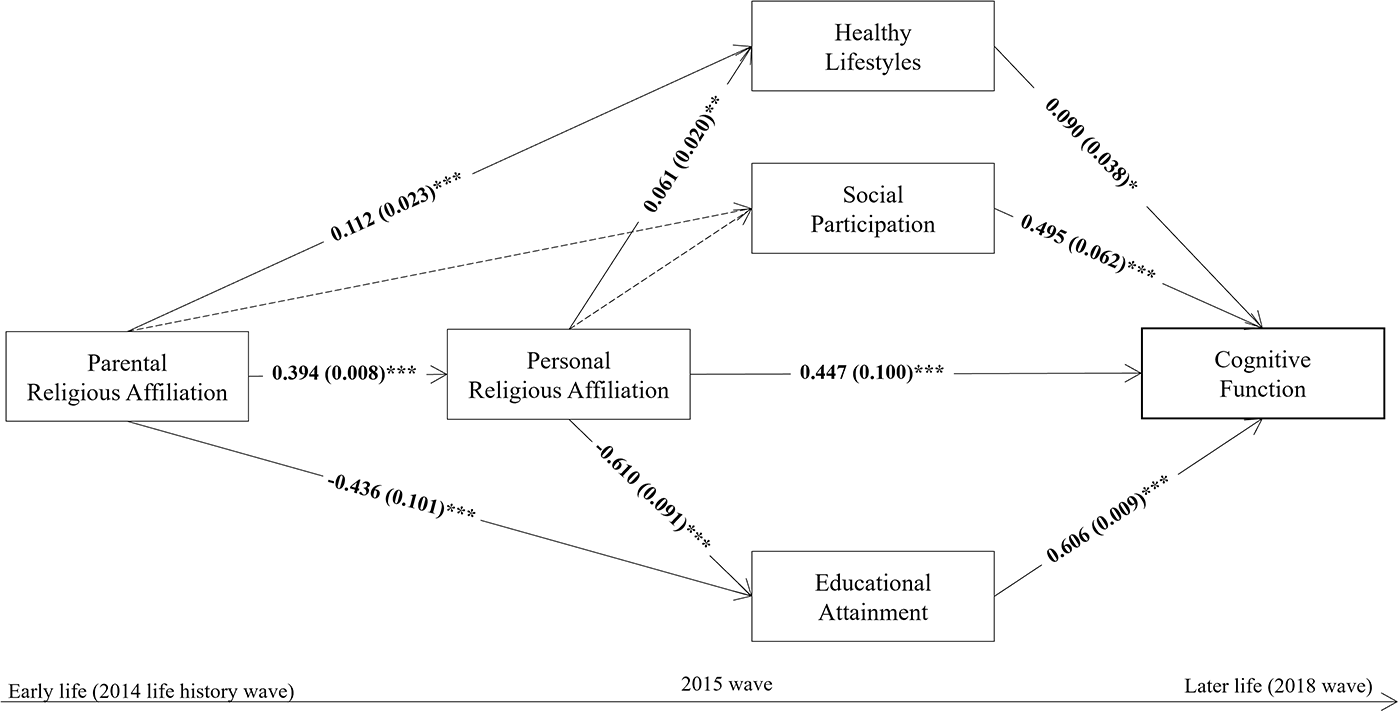
The SEM analysis yielded results indicating that the model fits the data adequately: CFI = 0.998, TLI = 0.962, RMSEA = 0.029. Figure 1 presents the estimates for the main paths among the variables of interest (detailed results for the comprehensive regression models, including all control variables, are provided in Table S1 in the Supplementary Material). The solid lines in Figure 1 depict statistically significant paths, with regression coefficients and standard errors displayed for each path. After controlling for socio-demographic and socio-economic covariates, parental religious affiliation was positively associated with personal religious affiliation (B = 0.394, p < 0.001). Parental religious affiliation was also found to be negatively associated with educational attainment (B = −0.436, p < 0.001) and positively associated with adulthood healthy lifestyles (B = 0.112, p < 0.001). However, the association between parental religious affiliation and adulthood social participation was not statistically significant (B = 0.014, p = 0.339).
Pathways linking parental religious affiliation, personal religious affiliation, educational attainment, healthy lifestyles, social participation, and later-life cognitive function among middle-aged and older adults in China.

Figure 1 Long description
Parental religious affiliation predicts higher personal religious affiliation (B = 0.394, SE = 0.008, p < 0.001) and healthier lifestyles (B = 0.112, SE = 0.023, p < 0.001), but lower educational attainment (B = −0.436, SE = 0.101, p < 0.001). Personal religious affiliation predicts healthier lifestyles (B = 0.061, SE = 0.020, p < 0.01), lower educational attainment (B = −0.610, SE = 0.091, p < 0.001), and higher later-life cognitive function (B = 0.447, SE = 0.100, p < 0.001). Educational attainment (B = 0.606, SE = 0.009, p < 0.001), healthy lifestyles (B = 0.090, SE = 0.038, p < 0.05) and social participation (B = 0.495, SE = 0.062, p < 0.001) are positively associated with cognitive function. Paths from parental and personal religious affiliation to social participation are non-significant. The diagram progresses from early life, through mediators measured in 2015, to cognitive function measured in 2018.
Crucially, personal religious affiliation was significantly associated with the subsequent lifecourse mediators. Personal religious affiliation demonstrated a negative association with educational attainment (B = −0.610, p < 0.001) but showed a significant positive correlation with healthy lifestyles (B = 0.061, p = 0.003). Similar to the parental generation, the association between personal religious affiliation and social participation did not reach statistical significance (B = 0.015, p = 0.250).
Regarding the associations with the outcome, personal religious affiliation (B = 0.447, p < 0.001), educational attainment (B = 0.606, p < 0.001), healthy lifestyles (B = 0.090, p = 0.010) and social participation (B = 0.495, p < 0.001) were all positively correlated with later-life cognitive function at the follow-up. These results indicated that participants raised by religious parents tended to have lower educational attainment but stronger personal religious affiliation and healthier lifestyles; subsequently, higher educational attainment, stronger religious affiliation and healthier lifestyles were linked to better cognitive function.
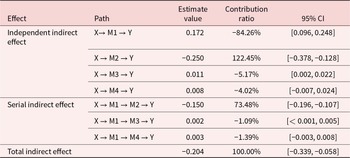
The results of the mediation analysis using the bootstrap method (1,000 samples) in Table 2 indicated that the total indirect association was statistically significant (B = −0.204, 95% CI = [−0.339, −0.058]). The findings revealed that the independent indirect associations of X → M1 → Y, X → M2 → Y and X → M3 → Y, as well as the serial mediation effects of X → M1 → M2 → Y and X → M1 → M3 → Y, were all significant. Specifically, the independent indirect effect via personal religious affiliation (X → M1 → Y) was positive (B = 0.172, 95% CI = [0.096, 0.248]), whereas the independent indirect association through education (X → M2 → Y) was negative (B = −0.250, 95% CI = [−0.378, −0.128]). The indirect association through healthy lifestyles (X → M3 → Y) was also positive, although small in magnitude (B = 0.011, 95% CI = [0.002, 0.022]). In addition, the serial mediation pathway through personal religious affiliation and educational attainment (X → M1 → M2 → Y) was negative (B = −0.150, 95% CI = [−0.196, −0.107]), whereas the serial pathway through personal religious affiliation and healthy lifestyles (X → M1 → M3 → Y) was positive but small (B = 0.002, 95% CI = [< 0.001, 0.005]). By contrast, the pathways involving social participation (X → M4 → Y and X → M1 → M4 → Y) were not significant, as their CIs included zero. The results indicate two indirect pathways operating in opposite directions. Taken together, the two education-related pathways yielded a combined indirect association of −0.400, whereas the significant positive pathways through personal religious affiliation and healthy lifestyles together amounted to 0.185. This indicates that the magnitude of the combined education-related negative association was about 2.2 times as large as that of the combined positive association through personal religious affiliation and healthy lifestyles, resulting in an overall negative total indirect association.
Decomposition of direct effect, indirect effect and total effect in mediation analysis
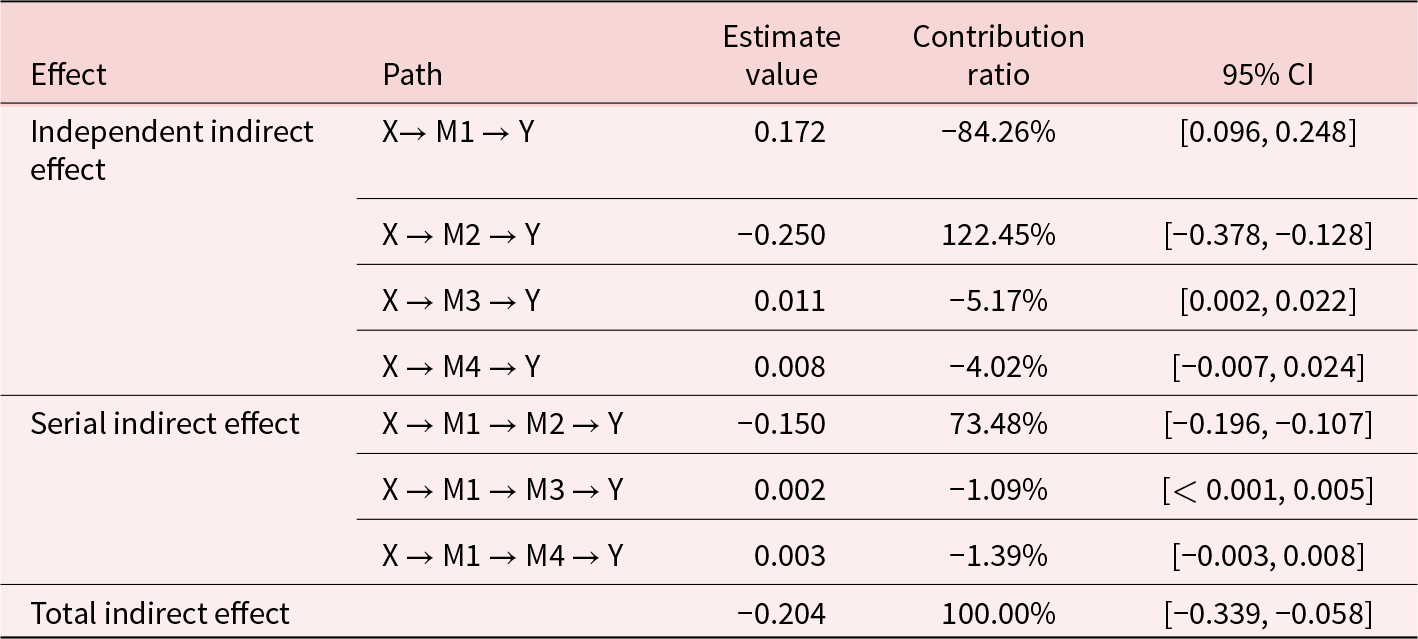
Table 2 Long description
The table reports estimated mediation effects, contribution ratios and 95 per cent bias-corrected bootstrap confidence intervals. Independent indirect effects are 0.172 through personal religious affiliation, −0.250 through educational attainment, 0.011 through healthy lifestyles and 0.008 through social participation. Serial indirect effects through personal religious affiliation followed by education, healthy lifestyles and social participation are −0.150, 0.002 and 0.003, respectively. The total indirect effect is −0.204 with a 95 per cent confidence interval of [−0.339, −0.058].
Notes: CI = confidence interval. CI values represent 95 per cent bias-corrected, bootstrapped CIs.
X = Parental religious affiliation; M1 = Personal religious affiliation; M2 = Educational attainment; M3 = Healthy lifestyles; M4 = Social participation; Y = Later-life cognitive function.
Additional analyses
As a robustness check, we re-estimated the models by replacing the 2015 mediators with corresponding measures from the 2011 and 2013 CHARLS waves. Because parental religious affiliation was collected retrospectively in the 2014 Life History wave, this approach provided an additional test of whether the findings depend on the timing of the mediating variables. The results were broadly consistent with those reported in the main analysis, indicating that the main findings are robust. For detailed information, please see Figures S4 and S5 in the Supplementary Material.
Acknowledging the multidimensional nature of cognition characterized by distinct domains (Greenfield et al. Reference Greenfield, Moorman and Rieger2021), this study extended to examine potential variations in the association between parental religious affiliation and later-life cognitive function in terms of mental intactness and episodic memory. In these analyses, episodic memory was operationalized as a cognitive composite score based on standardized immediate and delayed recall measures, rather than the simple average used in the main analysis. This alternative measure provides an additional check on the robustness of the findings. The results were broadly consistent with those reported in the main analysis. The findings consistently revealed significant associations for both domains of cognition. Specifically, parental religious affiliation exhibited a lifelong association with distinct domains of cognitive function in later life via hindering educational attainment and promoting healthier lifestyles. For detailed information, please see Figures S6 and S7 in the Supplementary Material.
Furthermore, prior literature (Du et al. Reference Du, Miyazaki, Dong and Li2023) has noted the associations between educational attainment and the adoption of healthy lifestyles including social participation, thereby linking to later-life cognitive function. Therefore, this study constructed a serial mediation model comprising pathways from educational attainment to healthy lifestyles and social participation. Specifically, the results further confirmed significant negative indirect effects via educational attainment, operating both independently and sequentially through healthy lifestyles and social participation. For further details, please refer to Figure S8 in the Supplementary Material.
Discussion
This study pioneered the utilization of nationally representative longitudinal survey data to examine the mechanisms underlying the association between parental religious affiliation and later-life cognitive function. It advanced the understanding of how religious factors intersect with healthy cognitive ageing within a lifecourse framework. Leveraging multiple waves of data from CHARLS, we hypothesized and subsequently confirmed that educational attainment and healthy lifestyles could mediate the association of parental and personal religious affiliation with later-life cognitive function.
This study examined two possible ways in which parental religious affiliation was related to later-life cognitive function. First, it considered whether parental religious affiliation was linked to later-life cognitive function through its association with personal religious affiliation. Second, it examined whether parental religious affiliation was also related to later-life cognitive function through pathways independent of personal religious affiliation. The findings suggested that parental religious affiliation was positively associated with personal religious affiliation. This pattern was consistent with the unidirectional model of religious socialization described in research based on Western societies (Bebiroglu et al. Reference Bebiroglu, Roskam and van der Straten Waillet2015; Hu and Leamaster Reference Hu and Leamaster2015; Pearce et al. Reference Pearce, Uecker and Denton2019). From a religious socialization perspective, this positive association between parental and personal religious affiliation constituted an important pathway linking parental religious background to later-life cognitive function. It also suggested that, although personal religious affiliation is an important social correlate of cognitive function, its association with cognitive function cannot be fully understood apart from the religious socialization process rooted in early life. Previous research has often examined the association between personal religious affiliation and later-life cognitive function without taking early-life religious socialization into account. As a result, existing studies may have mis-estimated the overall association between personal religious affiliation and cognitive function. Building on this point, the present analysis further examined the direct and indirect associations between personal religious affiliation and cognitive function. The chain mediation analysis also captured the cumulative pattern of associations linking parental religious affiliation to later-life cognitive function. At the same time, the findings were consistent with the possibility raised by Hill and colleagues (Reference Hill, Carr, Burdette and Dowd-Arrow2020) that religious socialization may be associated with a process of neural resource depletion. In this view, the belief systems fostered through religious socialization, such as the idea that life is guided by supernatural forces, and the patterned lifestyles associated with repeated religious activities in specific communities, may be linked to less demanding cognitive styles. These orientations may encourage more intuitive forms of cognition, discourage more reflective forms of cognition and thereby reduce cognitive stimulation across the lifecourse (Das Reference Das2022). The findings also suggested that parental religious affiliation was related to later-life cognitive function through pathways that were not reducible to personal religious affiliation alone. Regardless of whether children acquired a religious affiliation through socialization, parental religious background remained associated with later-life cognitive function. This pattern helps clarify the multidimensional and parallel ways in which religious factors in early life are related to cognitive function in later life. Taken together, these findings supported Hypothesis 1 and suggested that parental religious affiliation was associated with later-life cognitive function through both intergenerational continuity in religious affiliation and additional pathways beyond personal religious affiliation.
The findings suggested that parental religious affiliation was associated with an overall negative indirect relationship with cognitive function in later life. This pattern reflected the operation of mediating pathways in opposite directions. Parental religious affiliation was associated with a greater likelihood of individuals’ own religious affiliation and with healthier lifestyles, both of which were positively related to cognitive health and may have partially offset the overall negative association. At the same time, parental religious affiliation was also associated with lower educational attainment, which constituted the principal negative mediating pathway and outweighed the countervailing positive pathways. Taken together, these findings did not support the assumption, common in much of the Western literature, that religion is uniformly beneficial for cognitive ageing. Rather, the results suggested that the direction and magnitude of this relationship might depend on the institutional and ideological context in which religion is embedded. Furthermore, these findings were consistent across two cognitive function domains, including mental intactness and episodic memory.
The results aligned with established theoretical frameworks of CR and STAC-r. By conceptualizing educational attainment, healthy lifestyles and social participation as indicators of three potentially interconnected lifecourse pathways, this study underscored the mediating role of these factors in the relationship between parental religious affiliation and later-life cognitive function, and identified them as protective factors of later-life cognitive function. Our results not only corroborate existing literature (Oi and Haas Reference Oi and Haas2019; McElroy et al. Reference McElroy, Richards, Fitzsimons, Conti, Ploubidis, Sullivan and Moulton2021) but also contribute additional empirical evidence from the Chinese context. As a core aspect of socialization, parental religious affiliation exerts far-reaching effects (Pearce et al. Reference Pearce, Uecker and Denton2019; Brooks et al. Reference Brooks, Tian, Parks and Stamoulis2022), which can link to later-life cognitive function through educational attainment and healthy lifestyles.
The negative indirect pathway from parental religious affiliation through educational attainment to cognitive function differed from the more general positive relationship between religion and education observed in the United States (Bacon and Wang Reference Bacon and Wang2024). Still, similar patterns appeared in some American religious subgroups and in Europe. In the United States, conservative Protestant orientations have been found to conflict with secular educational norms (Darnell and Sherkat Reference Darnell and Sherkat1997; Beyerlein Reference Beyerlein2004). Sectarian affiliations are also linked to lower verbal ability, even after educational attainment is taken into account (Sherkat Reference Sherkat2010). These findings suggest that some forms of religious socialization may limit exposure to diverse linguistic resources. This may create tension with secular schooling. A similar negative pattern appeared in Europe, where parental religious education was associated with poorer cognitive function among older adults (Ahrenfeldt et al. Reference Ahrenfeldt, Stripp, Möller, Viftrup, Nissen and Hvidt2024). This association may partly reflect the more conservative family and social environments in which post-war cohorts received parental religious education. Taken together, these studies suggest that this broader negative pattern was not limited to the specific American religious traditions examined in earlier work. In China, several contextual features may have strengthened this pattern. Limited intergenerational transmission of religion may create cultural dissonance between religious parents and children raised in a largely secular society (Stolz Reference Stolz2009; Hu and Leamaster Reference Hu and Leamaster2015; Upenieks and Thomas Reference Upenieks and Thomas2021). Some religious cultures have also placed less emphasis on secular education as a route to social mobility (Shimbo Reference Shimbo2017). State-promoted atheism and continuing religious regulation may also impose social costs on religious minorities. One example is weaker access to networks that support educational advancement (Ji Reference Ji2006; Stolz et al. Reference Stolz, Pollack and De Graaf2020; Francis‐tan Reference Francis-Tan2023). Under these conditions, parents may become more sceptical of secular education, thereby reducing both parental involvement and educational expectations for children. Taken together, these findings support Hypothesis 1 by indicating that educational attainment constitutes an important negative pathway linking parental religious affiliation to later-life cognitive function.
The positive indirect pathway from parental religious affiliation through healthy lifestyles to cognitive function was consistent with the broader pattern linking religious involvement to health-protective behaviours across different settings (Ellison and Levin Reference Ellison and Levin1998; Moreira-Almeida and Koenig Reference Moreira-Almeida, Lotufo Neto and Koenig2006; Morton et al. Reference Morton, Lee and Martin2017; Shen Reference Shen2019). Religion often promotes behavioural norms that discourage risks such as smoking and excessive alcohol consumption, while encouraging physical activity and self-care practices (Morton et al. Reference Morton, Lee and Martin2017). Similar processes may apply to China, where religious socialization can also foster lifestyles that persist into adulthood. In this respect, the present study extended existing research by showing that parental religious affiliation, rather than personal religiosity alone, was associated with healthy lifestyles linked to cognitive function. Accordingly, Hypothesis 3 was supported. At the same time, earlier research rarely examined these mediating pathways together in a single model, which made it difficult to compare their relative importance (Morton et al. Reference Morton, Lee and Martin2017). The present findings showed that the educational pathway remained more important than the behavioural pathway for understanding cognitive ageing. Although the indirect effect through healthy lifestyles was statistically significant, it was much smaller than the negative indirect effect through educational attainment. This contrast was consistent with CR theory, which identifies education as a major source of CR across the lifecourse (Stern et al. Reference Stern, EM, Bartrés-Faz, Belleville, Cantilon, Chetelat, Ewers, Franzmeier, Kempermann, WS, Okonkwo, Scarmeas, Soldan, Udeh-Momoh, Valenzuela, Vemuri and Vuoksimaa2020). It was also in accordance with evidence that educational disadvantage in early life has lasting cognitive consequences because it creates structural barriers to later resource acquisition (Glymour and Manly Reference Glymour and Manly2008). Within this framework, healthy lifestyles functioned as secondary protective factors. They did not fully compensate for the cognitive benefits lost through limited educational opportunity. Taken together with the supplementary model including a direct path, the educational pathway may be understood as suppressing the positive association between parental religious affiliation and cognitive function. The serial pathway analysis further suggested that the negative association between parental religious affiliation and educational attainment may also limit the benefits linked to healthier lifestyles. This finding indicated that structural disadvantage in early life could extend across multiple domains. It also reflected the institutional context of a secular socialist society, where religious minority status may intensify educational marginalization and weaken otherwise protective mechanisms (Lu and Yang Reference Lu and Yang2022). The findings therefore suggested that behavioural health promotion alone was unlikely to offset educational disadvantage accumulated over the lifecourse.
The positive association between social participation and cognitive function is well established in cross-national research (Scarmeas and Stern Reference Scarmeas and Stern2003; Krueger et al. Reference Krueger, Wilson, Kamenetsky, Barnes, Bienias and Bennett2009; Kelly et al. Reference Kelly, Duff, Kelly, McHugh-Power, Brennan, Lawlor and Loughrey2017). Social integration theory further suggests that social networks and support encourage participation in social activities, which then influence health through psychological and behavioural pathways (Berkman et al. Reference Berkman, Glass, Brissette and Seeman2000). In many Western settings, congregational participation provides dense interpersonal networks that support cognitive function through social integration mechanisms (Ellison and Levin Reference Ellison and Levin1998; Cohn-Schwartz Reference Cohn-Schwartz2020). The present study also confirmed the positive association between social participation and cognitive function in China. However, the findings showed that social participation did not mediate the relationship between parental religious affiliation and later-life cognitive outcomes. This result suggested that the pathways linking religion and health did not operate uniformly across lifecourse stages and social contexts (Morton et al. Reference Morton, Lee and Martin2017). Several features of the Chinese context may help explain this pattern. Religious practice in China is often non-congregational and privatized. In particular, indigenous religions do not impose strict requirements for regular participation in organized religious activities (Liu Reference Liu2010). Therefore religion in China often lacks the institutional structures and organized community ties that support congregational social engagement in many Western settings (Zhang et al. Reference Zhang, Lu and Sheng2021; Zhou et al. Reference Zhou, Lai and Li2024). In addition, physiological ageing may shift older adults towards more individualized religious practice and may therefore limit the conversion of religious engagement into public social capital (Orr et al. Reference Orr, Ward, Kenny and McGarrigle2021). More broadly, social participation may not be a universal pathway linking religion to later-life outcomes, including cognitive ageing (Hayward and Krause Reference Hayward, Krause and Saroglou2014; Morton et al. Reference Morton, Lee and Martin2017). These findings further suggested that the association between religion and cognitive function was context-dependent rather than uniform across populations. In this respect, the present results were consistent with evidence that race-ethnicity may moderate the relationship between religion and cognitive function (Henderson et al. Reference Henderson, Walsemann and Ailshire2022). Therefore, Hypothesis 4 was not supported. While social participation remained positively associated with cognitive function, it did not constitute a significant pathway linking parental religious affiliation to later-life cognitive outcomes.
Implications
This study contributes to theoretical understanding of the relationship between religion and cognition by integrating religious socialization theory with lifecourse frameworks of cognitive ageing. While existing research has primarily examined the role of individuals’ own religious affiliation or participation, our findings show that parental religious background also has distinct implications for cognitive ageing that cannot be reduced to personal religious affiliation alone (Ahrenfeldt et al. Reference Ahrenfeldt, Stripp, Möller, Viftrup, Nissen and Hvidt2024). By considering parental and personal religious affiliation together, this study extends existing theoretical accounts of religion and cognitive function beyond individual religiosity and highlights parental religious background as an early-life religious exposure relevant to cognitive outcomes across the lifecourse. The study also showed the value of examining multiple mediators within a unified lifecourse framework. Previous research often examined educational attainment, healthy lifestyles and social participation as separate mechanisms (Reyes-Ortiz et al. Reference Reyes-Ortiz, Berges, Raji, Koenig, Kuo and Markides2008; Nelson et al. Reference Nelson, Kezios, Elbejjani, Lu, Yaffe and Zeki Al Hazzouri2023). However, such models could not capture their simultaneous operation or assess their relative importance. The findings showed that positive and negative mediating pathways could coexist and interact. The overall effect on cognitive outcomes depended on the balance between competing influences rather than on any single mechanism. This complexity highlighted the need for theoretical frameworks that can account for multidimensional mediation across lifecourse stages. The findings also showed that institutional context reshaped religion–health relationships. In China, the secularized and state-regulated religious environment appeared to strengthen the negative educational consequences of parental religious affiliation while weakening potential benefits through other channels. This pattern differed markedly from patterns observed in more religiously pluralistic settings. Stronger parental religiosity effects have been found in secularized societies (Kelley and De Graaf Reference Kelley and De Graaf1997). The present evidence suggested that such amplification could take the form of stronger negative pathways when religious minority status carried institutional costs. This contextual specificity indicated that theories developed in Western settings required refinement before they could be applied to secularized environments. It also pointed to the need for comparative research across diverse institutional contexts.
At the empirical level, this study separated the net effect of personal religious affiliation on cognitive function from the intergenerational socialization context in which it developed by modelling parental and personal religious affiliation at the same time. This approach provided more precise estimates of their respective contributions than earlier studies that examined dimensions of religiosity in isolation. The study also combined longitudinal panel data with structural equation modelling across early life, mid-life and later life. This design aligned the analytical strategy with lifecourse theory and allowed the simultaneous estimation of multiple pathways. These empirical advances suggested that inconsistencies in earlier research may partly reflect differences in model specification. Few studies incorporated parental religious background, some focused only on personal religious affiliation and others did not distinguish clearly between the two. These inconsistencies may also reflect variation in the lifecourse stages at which mediating variables were measured.
The findings also carried clear policy implications for reducing cognitive inequality in China’s secular socialist context. Educational attainment was the main pathway linking parental religious affiliation to later-life cognitive outcomes. This result suggested that interventions targeting educational disadvantage in early life were especially important. Policies could widen access to educational opportunity, reduce barriers to progression and strengthen support for children from religiously affiliated households. Such measures may be particularly important for offsetting the negative cognitive consequences of parental religious background. Early-life educational interventions could also do more than address the main negative pathway directly. They could also create conditions in which the protective health behaviours associated with religious upbringing exerted their beneficial effects more fully. Behavioural health promotion in later life still had value. However, it was unlikely to offset on its own the cumulative cognitive consequences of educational disadvantage across the lifecourse. A lifecourse policy approach may therefore be more effective. Such an approach would prioritize early educational support while also sustaining health promotion over time. This combination may be best suited to reducing cognitive inequalities associated with religious background.
Limitations
Several limitations should be noted. First, the measurement of religious affiliation was limited for both parents and respondents. The binary indicators available in the data could not capture the multidimensional nature of religiosity. The current measurement did not distinguish religious traditions, levels of commitment, specific practices or institutional participation. However, different dimensions of religion may relate to cognitive outcomes in different ways (Nelson et al. Reference Nelson, Kezios, Elbejjani, Lu, Yaffe and Zeki Al Hazzouri2023). Future research should therefore move beyond binary measures to examine how religious beliefs, religious practices and institutional participation are associated with cognitive function in later life. Future work should also develop culturally sensitive multidimensional scales and use continuous measures where possible. These improvements would make it easier to distinguish the effects of different dimensions of religiosity and to clarify under what conditions different dimensions of family religious environment are differently associated with cognitive function.
Second, although structural equation modelling is well suited to testing mediation in a longitudinal design, it does not in itself permit causal inference (Lyu and Burr Reference Lyu and Burr2016; Greenfield et al. Reference Greenfield, Moorman and Rieger2021). The mediating variables may still be endogenous, and residual confounding cannot be ruled out. Educational attainment and healthy lifestyles may both be associated with unobserved childhood characteristics that are also related to parental religious affiliation. Although the longitudinal design helps establish temporal ordering, future research using quasi-experimental approaches or family-based designs would provide more credible evidence on these relationships.
Third, the study relies on retrospective reports of parental religious affiliation during childhood and is therefore subject to possible recall bias. Respondents were asked to report parental religious affiliation many years after childhood, and some misclassification cannot be excluded. Future research would benefit from parent–child dyadic or intergenerational linked data that collect information from both generations directly, ideally within longer-term longitudinal designs that follow families over time.
Conclusion
This study used multiple waves of CHARLS data to examine the mediating mechanisms linking parental religious affiliation in early life to cognitive function in later life among middle-aged and older adults in China. Grounded in religious socialization, the research examined how parental and personal religious affiliation associated with cognitive function. At the same time, the study assessed the explanatory roles of educational attainment, healthy lifestyles and social participation as mediating mechanisms across different stages of the lifecourse in China’s distinctive context. The findings indicated that parental religious affiliation was associated with later-life cognitive function both through its link to personal religious affiliation and through independent pathways. Overall, however, parental religious affiliation showed a negative association with cognitive outcomes. This pattern was driven mainly by the dominant negative mediating pathway through educational attainment. The positive pathway through healthy lifestyles was statistically significant, but it was not strong enough to offset the negative effect. The pathway through social participation was not significant. These findings extended existing theoretical frameworks on religion and cognitive function by showing the complexity of multidimensional mediation across an extended lifecourse in a secularized national context.
Supplementary material
The supplementary material for this article can be found at https://doi.org/10.1017/S0144686X26101032.
Financial support
This work was supported by the National Social Science Foundation of China (grant number 25BRK025).
Competing interests
The authors have no competing interests to declare that are relevant to the content of this article.
Ethical standards
The data in this study were sourced from the China Health and Retirement Longitudinal Study (CHARLS). The CHARLS was approved by the Biomedical Ethics Review Committee of Peking University. The Institutional Review Board approval number is IRB00001052-11,015. Written informed consent was obtained from all participants, which was approved by the Biomedical Ethics Review Committee of Peking University. The data that support the findings of this study are openly available in the Institute of Social Science Survey at Peking University at [https://charls.pku.edu.cn/]. Data and coding instructions required to replicate the research results can be obtained.