

INTRODUCTION
The radiocarbon (14C) age of sedimentary organic matter (OM) is an important characteristic that can be exploited in studies of the contemporary and past oceanic carbon cycle. Several prior investigations have explored controls on the 14C age distribution in marine sediments (e.g., Wakeham et al. Reference Wakeham, Canuel, Lerberg, Mason, Sampere and Bianchi2009; Griffith et al. Reference Griffith, Martin and Eglinton2010; Bao et al. Reference Bao, McIntyre, Zhao, Zhu, Kao and Eglinton2016). Such investigations have indicated that interactions between OM and minerals, which have been frequently inferred to exert a strong influence on OM preservation (Mayer Reference Mayer1994; Hedge and Keil Reference Hedges and Keil1995; Bergamaschi et al. Reference Bergamaschi, Tsamakis, Keil, Eglinton, Montluçon and Hedges1997; Blair and Aller Reference Blair and Aller2012), may further influence corresponding 14C age characteristics of sedimentary OM (Hwang et al. Reference Hwang, Druffel and Eglinton2010; Bao et al. Reference Bao, McIntyre, Zhao, Zhu, Kao and Eglinton2016; Wakeham and Canuel Reference Wakeham and Canuel2016). While 14C measurements on bulk OM can be used to understand the net 14C age of all organic components, prior studies have demonstrated that further information can be gleaned from isotopic analysis of specific organic components separated from bulk OM (Trumbore and Zheng Reference Trumbore and Zheng1996; Eglinton et al. Reference Eglinton, Benitez-Nelson, Pearson, McNichol, Bauer and Druffel1997; Wakeham et al. Reference Wakeham, Canuel, Lerberg, Mason, Sampere and Bianchi2009).
Ocean sediments are composed of a spectrum of grain sizes that reflects source inputs, depositional and sedimentological conditions. Consequently, 14C contents of OM in different grain size fractions may be one of the factors influencing bulk 14C ages. Cathalot et al. (Reference Cathalot, Rabouille, Tisnérat-Laborde, Toussaint, Kerhervé, Buscail, Loftis, Sun, Tronczynski and Azoury2013) showed that 14C ages of OM are related to the percentage of finer fractions (<63 µm) in bulk coastal sediments. However, while prior studies have examined 14C variations in organic carbon (OC) associated with specific size or density fractions of soil or marine sediments (Trumbore and Zheng Reference Trumbore and Zheng1996; Megens et al. Reference Megens, van der Plicht, De Leeuw and Smedes2002; Wakeham et al. Reference Wakeham, Canuel, Lerberg, Mason, Sampere and Bianchi2009; Bao et al. Reference Bao, McIntyre, Zhao, Zhu, Kao and Eglinton2016), an assessment of underlying 14C age variability within specific grain size fractions has not been undertaken yet may shed new light on OM sources and mechanisms of preservation.
Recently, ramped pyrolysis-oxidation (RPO) analysis was developed at the National Ocean Sciences Accelerator Mass Spectrometry (NOSAMS) facility, Woods Hole Oceanographic Institution (WHOI) (Rosenheim et al. Reference Rosenheim, Day, Domack, Schrum, Benthien and Hayes2008; Hemingway et al. Reference Hemingway, Galy, Gagnon, Grant, Rosengard, Soulet, Zigah and McNichol2017; Zigah et al. Reference Zigah, Minor, McNichol, Xu and Werne2017; Bao et al. Reference Bao, Strasser, McNichol, Haghipour, McIntyre, Wefer and Eglinton2018). This technique allows separation of OM components in a sample based on thermochemical stability in response to exposure to a linear temperature gradient (Rosenheim and Galy Reference Rosenheim and Galy2012). Simultaneous oxidation of thermal decomposition products yields CO2 that can be trapped and subsequently analyzed for its carbon isotopic (including 14C) composition. Application of the RPO technique to marine sedimentary OM has revealed marked heterogeneity in 14C ages among different thermal windows within the RPO thermograms (Schreiner et al. Reference Schreiner, Bianchi and Rosenheim2014), shedding new light on 14C age distribution within OC. Here, we examine 14C ages of OM associated with different grain size fractions in a surficial sediment sample from the northwestern Arabian Sea (Figure 1). We further explore the spectrum of 14C ages exhibited by different organic components residing in each grain size fraction using RPO in order to develop improved insights about the processes contributing to OC 14C ages observed at the bulk level.
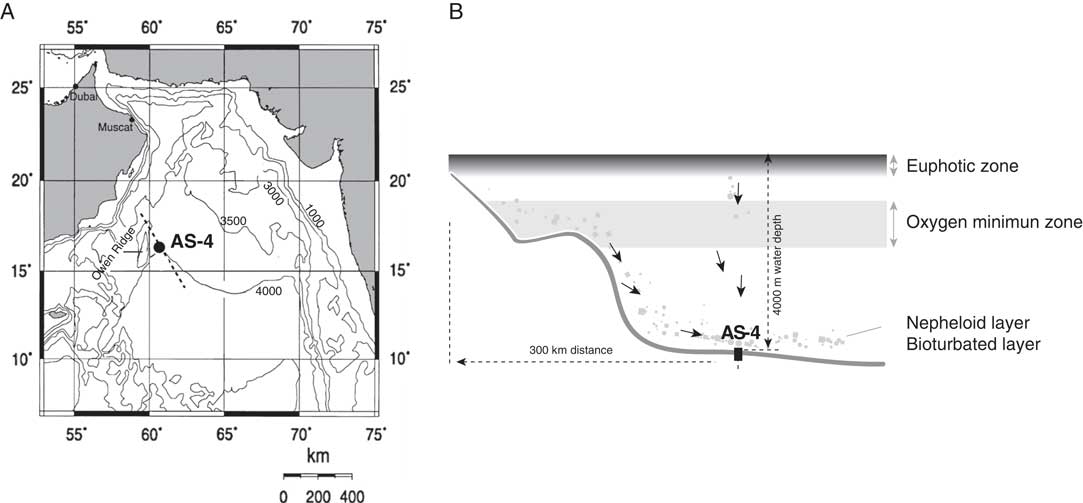
(A) Sample location in the NW Arabian Sea (modified from Schnetger et al. Reference Schnetger, Brumsack, Schale, Hinrichs and Dittert2000); (B) schematic water column cross-section showing characteristic features, including the oxygen minimum (deficient) zone, and nepheloid layers, the arrows show the sediment transport (modified after Pfannkuche and Lochte Reference Pfannkuche and Lochte2000).
MATERIAL AND METHODS
Background and Sampling
The northwestern Arabian Sea is characterized by high nutrient concentrations in surface waters that drives high biological productivity and is accompanied by a well-developed subsurface oxygen minimum zone (OMZ) (Morrison et al. Reference Morrison, Codispoti, Gaurin, Jones, Manghnani and Zheng1998, Reference Morrison, Codispoti, Smith, Wishner, Flagg, Gardner, Gaurin, Naqvi, Manghnani and Prosperie1999; Pfannkuche and Lochte Reference Pfannkuche and Lochte2000) (Figure 1b). This combination of properties results in high OC burial in underlying sediments (~3.2 g C m–2 yr–1; Pfannkuche and Lochte Reference Pfannkuche and Lochte2000; Boetius et al. Reference Boetius, Ferdelman and Lochte2000a, Reference Boetius, Springer and Petry2000b; Schnetger et al. Reference Schnetger, Brumsack, Schale, Hinrichs and Dittert2000). Upwelling conditions also give rise to large fluxes of biogenic opal to the sediments (~14.1 g m–2 yr–1, Haake et al. Reference Haake, Ittekkot, Rixen, Ramaswamy, Nair and Curry1993) as a result of the prominence of diatoms in the phytoplankton community and opal concentrations in sediments are further enriched by preferential decomposition of OC compared to opal dissolution (Grandel et al. Reference Grandel, Rickert, Schlüter and Wallmann2000). Turbidites are observed in underlying sediments located in the eastern Owen Ridge, characterized by carbonate-rich and pelagic sediments but with enriched in OC contents (Schnetger et al. Reference Schnetger, Brumsack, Schale, Hinrichs and Dittert2000). According to results of Schnetger et al. (Reference Schnetger, Brumsack, Schale, Hinrichs and Dittert2000), a sedimentation rate on the top of Owen Ridge is ~3 cm/ky. A markedly higher sedimentation rate can thus be expected in the eastern flank of Owen Ridge (Kraal et al. Reference Kraal, Slomp, Reed, Reichart and Poulton2012). The underlying sediments in this area are characterized by low bioturbation rates, shallow depth of mixing layer (~5 cm; Turnewitsch et al. Reference Turnewitsch, Witte and Graf2000), and shallow oxygen penetration depths (~2 cm; Grandel et al. Reference Grandel, Rickert, Schlüter and Wallmann2000). These characteristics suggest minimal biological or physical disturbance of sediments in this area (Turnewitsch et al. Reference Turnewitsch, Witte and Graf2000; Pfannkuche and Lochte Reference Pfannkuche and Lochte2000).
We obtained a sediment core (AS-4, 15.9945ºN, 61.5333ºE, 3985 m water depth) from the eastern flank of Owen Ridge using a box corer during R/V Thomas Thompson cruise TTN041, in November 1994 (Figure 1). One sediment section (2–10 cm) that was frozen until this analysis was selected for investigation as sufficient material was available for in-depth analysis. Upon thawing, the sample (~10 g) was wet sieved into 6 grain size fraction: <32 µm, 32–63 µm, 63–125 µm, 125–250 µm, 250–500 µm, and >500 µm fractions using ~200 mL Milli-Q water through stainless steel mesh sieves in less than 1 hr (in order to minimize OM losses). An aliquot of the <32 µm fraction was further sieved into <20 µm and 20–32 µm, and the latter fractions were subsequently only processed for 14C analysis. Bulk sediment samples and grain size fractions were then freeze-dried prior to analysis.
Mineral Surface Area, Grain Size Distribution, Scanning Electron Microscopy
Aliquots (~1 g dw) of freeze-dried samples were heated at 350°C for 24 hr to remove OM (Mayer Reference Mayer1994). The samples were subsequently outgassed at 350°C under vacuum for 2 hr to ensure complete removal of moisture, and mineral-specific surface area (SA) measured using a 5-point Brunauer–Emmett–Teller (BET) method on a NOVA 4000 surface area analyzer (Quantachrome Instruments) (Keil et al. Reference Keil, Montluçon, Prahl and Hedges1994, Reference Keil, Mayer, Quay, Richey and Hedges1997; Mayer Reference Mayer1994; Tao et al. Reference Tao, Eglinton, Montluçon, McIntyre and Zhao2016). Grain size analysis was performed on bulk sediment for mass percentage using a Mastersizer 2000 (Malvern Instruments Ltd) laser-diffraction instrument at Geological Institute, ETH-Zurich (Tao et al. Reference Tao, Eglinton, Montluçon, McIntyre and Zhao2016). The individual sample image (scanning electron microscope; SEM) was performed at Scientific Center for Optical and Electron Microscopy (FEI Quanta 200F) of ETH Zurich (SEM images are shown in Supplementary Figure 1).
Acidification
Different laboratories utilize different acidification methods to remove carbonate from sediment samples prior to elemental and carbon isotope analysis. At ETH Zurich, HCl fumigation was chosen to remove inorganic carbon (Bao et al. Reference Bao, McIntyre, Zhao, Zhu, Kao and Eglinton2016), whereas HCl rinsing was the applied pretreatment at NOSAMS (McNichol et al. Reference McNichol, Osborne, Gagnon, Fry and Jones1994).
Method 1, Fumigation (ETH Zurich)
Freeze-dried samples were weighed into Ag capsules. A beaker filled with 37 % HCl was placed at the bottom of a glass desiccator; the samples were placed on a ceramic tray above the acid. The desiccator was evacuated and the samples were heated at 60°C for 72 hr. The HCl was subsequently replaced with a beaker containing NaOH pellets, and the desiccator was again evacuated and placed at 60°C, for 72 hr in order to neutralize any excess acid. This “fumigation” pretreatment process was conducted at ETH Zurich.
Method 2, HCl Rinsing (NOSAMS)
Bulk and grain size fraction samples were treated with 1N HCl and then rinsed with Milli-Q water to remove the inorganic carbon at NOSAMS prior to further analysis. All glassware used during this “HCl rinsing” process was precombusted at 550°C for 5 hr prior to use. Each sample (>100 mg dry weight) was weighed into a 60 mL glass centrifuge tube and 10 mL of 1.0 N HCl was added (Fisher Trace Metal Grade, A508-P212). After gentle agitation, the glass tubes were placed in a 60°C water bath (1 hr). The samples were then centrifuged (2500 rpm) to separate the supernatants and solid materials. To remove residual acid, Milli-Q water (10 mL) was added to the centrifuge tubes, which were then agitated, centrifuged, and decanted as above (repeated three times). Finally, the solid samples (residues) were vacuum-filtered onto a precombusted GF/F filter (0.7 µm) using a glass funnel, placed in glass petri dish, and dried (60°C, 24 hr).
Bulk and Grain Size-Specific Organic Geochemistry
Fumigated samples were analyzed for organic carbon content (TOC), and carbon isotope composition at ETH Zurich. These samples (except <20 µm and 20–32 µm fractions) were prepared for 14C analysis using an automated graphitization system at the Laboratory of Ion Bean Physics, ETH Zurich (AGE 3, Ionplus AG, Switzerland). Corresponding 13C compositions and TOC contents were measured at the Stable Isotope Laboratory of Geological Institute, ETH Zurich. Corresponding δ13C values were determined to a precision of better than±0.1‰. The HCl-rinsing samples and the fumigated <20 µm and 20–32 µm fractions were prepared via sealed tube combustion, and subsequently analyzed as CO 2 for 14C using a mini radiocarbon dating system (MICADAS) at ETH Zurich (Ruff et al. Reference Ruff, Wacker, Gäggeler, Suter, Synal and Szidat2007). All 14C data are reported as fraction modern (Fm) and 14C age (yr BP), as defined by Stuiver and Polach (Reference Stuiver and Polach1977).
Ramped Pyrolysis-Oxidation (RPO)
HCl-rinsing samples were weighed, loaded into a quartz reactor, and heated using a linear temperature program (5°C min–1) from 150°C until a maximum of 895°C. Evolved volatile products (thermal decomposition fractions [Tn]) were simultaneously oxidized and removed from the reactor using a carrier gas mixture of O2 and He (~8% O2, 35 mL min–1 total flow rate). A continuous record of evolved CO2 was obtained via a flow-through infrared CO2 analyzer (Sable Systems International Inc., CA-10a), before CO2 derived from thermally volatilized components was sequentially collected in 5–7 temperature windows (intervals) (Tn: 150–300°C, 300–371°C, 371–414°C; 414–462°C, 462–507°C, 507–556°C, 556–896°C). For the 20–32 µm and 63–125 µm grain size fractions, evolved products from two thermal windows (462–507°C, 507–556°C) were tapped into a single fraction (i.e., 462–556°C), due to limited amounts of CO2. For the 32–63 µm grain size fraction, evolved products from three thermal windows (462–507°C, 507–556°C, 556–896°C) were trapped into a single fraction (462–896°C). After isolation of evolved products corresponding to these thermal windows, the CO2 was further distilled and quantified manometrically using standard vacuum line techniques (McNichol et al. Reference McNichol, Osborne, Gagnon, Fry and Jones1994). Resulting CO2 samples were then trapped into precombusted glass tubes with ~50 mg CuO and ~10 mg Ag granules and combusted (525°C, 5 hr) as a final gas purification step prior to isotopic measurement. RPO analysis was performed at NOSAMS and 14C measurements of evolved CO2 were analyzed using the ETH Zurich MICADAS.
RESULTS
Analysis of Grain Size Fractions
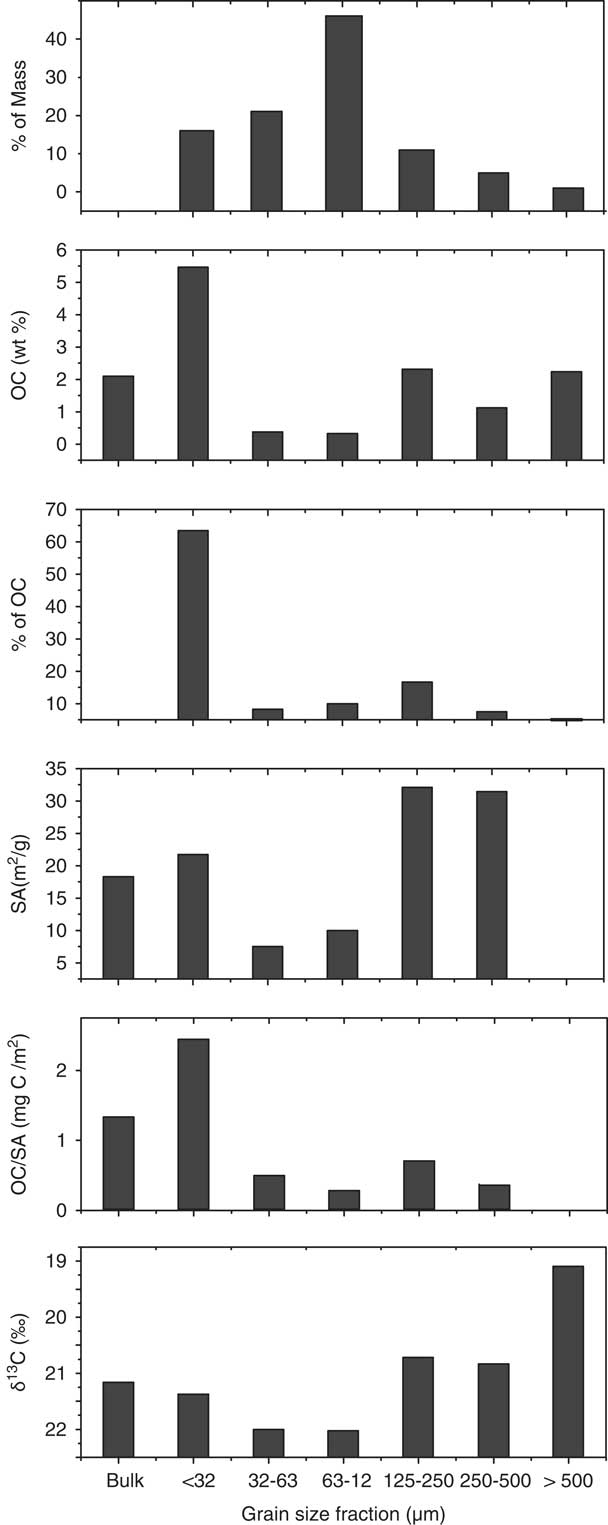
The majority of sediment mass occurs in the 63–125 µm grain size fraction (Table 1 and Figure 2), accounting for >40% of the bulk sample. The <32 µm and 32–63 µm are the next most abundant, collectively accounting for ~35% of the mass. The mass percentage decreases with increasing grain size in the >63 µm size range. With respect to mineral-specific SA (Table 1 and Figure 2), the bulk SA is 16.2 m2/g, with the 32–63 µm fraction exhibiting the lowest value (7.5 m2/g) and the 125–250 µm fraction yielding the highest value (32.0 m2/g). The 250–500 µm fraction also has a relatively high SA, whereas SA values for the <32 µm and 63–125 µm fractions are 22 m2/g and 10.0 m2/g, respectively.
Histograms of sediment mass percentage (% of mass), mineral-specific surface area (SA), and organic geochemical characteristics of individual grain size fractions (fumigated samples) in the Arabian Sea sediment sample.
Organic geochemical data for fumigated grain size fractions.

§ Indicates that 14C age of <32 µm fraction was calculated by measured 14C ages of <20 µm (892±91 yr BP) and 20–32 µm fractions (1071±91 yr BP), and their mass %.
# For fumigation samples, <20 µm and 20–32 µm fractions were also measured for 14C ages, 675±76 yr BP, 747±81 yr BP, respectively.
Fumigation Samples
The maximum %OC (5.5%) is found in the finest fraction (<32 µm), while %OC values of other fractions range between 0.3 % to ~ 2.3 %, with the 32–63 µm and 63–125 µm fractions exhibiting the lowest %OC values (Table 1 and Figure 2). The bulk OC content of the sample is 21 mg/gdw with the largest proportion of the TOC residing in the <32 µm fraction (~64%), with lesser amounts in the 63–125 µm and 125–250 µm fractions (~9% and ~17%, respectively; Figure 2). Correspondingly, the<32 µm fraction exhibits the maximum OC:SA ratio (2.5 mg C/m2), while other fractions are markedly lower (≤0.7 mg C/m2).
Acid-fumigated samples were analyzed for 13C and 14C composition of OC. The δ13C value of the bulk OC is –21.2‰, similar to that of the<32 µm fraction (–21.5‰, Figure 2). The 32–63 µm and 63–125 µm fractions exhibit lower δ13C values, –22.5‰ and –22.0‰, respectively, whereas the coarser fractions (125–250 µm, 250–500 µm, and >500 µm) exhibit higher δ13C values (–20.7‰, –20.8‰, and –19.1‰, respectively). Corresponding 14C results (bulk 14C age, 1455±53 yr BP) reveal a clear trend of increasing 14C ages (decreasing Fm) with increasing grain size (Figure 3), the <32 µm fraction being the youngest (763±53 yr BP) and the >500 µm fraction being the oldest (3958±92 yr BP). The integrated 14C age taking into account mass balance and OC contents of grain size fractions is 1506±53 yr BP, similar to the measured bulk age (1455±53 yr BP). The former agrees with the latter within error, suggesting that any redistribution of OM across the grain size fractions during sample preparation does not significantly affect the 14C results.
14C age characteristics of sedimentary OM as a function of grain size for fractions pretreated using the two acidification methods (black: fumigation; white: HCl rinsing). The >500 µm fraction was not acidified using HCl rinsing.

HCl-Rinsing Samples
Samples subjected to carbonate removal via HCl rinsing exhibit 14C ages similar to those subjected to acid fumigation (Figure 3). The youngest 14C age (892 ± 91 yr BP) is found in finest (<20 µm fraction), while the 250–500 µm fraction exhibits the oldest 14C age (3178±91 yr BP; >500 µm fraction was not measured). Notably, however, all the individual grain size fractions subjected to HCl rinsing exhibit systematically older 14C ages than corresponding fumigation samples. The offsets range from 117±167 yr (<20 µm fraction) to 582±145 yr (250–500 µm fraction (Figure 3). While some of these observed differences between the fumigated and HCl-rinsing samples may reflect contrasting analytical and/or instrumental methods, this discrepancy is most likely due to preferential solubilization of labile (young) OC during the HCl-rinsing treatment (Komada et al. Reference Komada, Anderson and Dorfmeier2008; Brodie et al. Reference Brodie, Leng, Casford, Kendrick, Lloyd, Yongqiang and Bird2011).
RPO Results
HCl-Rinsing Samples
RPO analyses of the individual grain size fractions processed using the HCl-rinsing method show the presence of two distinct peaks in the thermogram of each sample with consistent temperatures of maximum CO2 generation (Tmax, peak 1 and peak 2, ~320°C and ~440°C, respectively among samples (Figure 4), however relative peak heights differ markedly between grain size fractions. The overall similarity of the thermograms suggests similarities in thermochemical stability of OM. The finest fractions (<20 µm and 20–32 µm) exhibit near identical thermogram patterns, whereas the second thermal peak increases its relative height compared with that of the first thermal peak with increasing grain size from 63–125 µm to 250–500 µm (Figure 4).
Thermograms of OM from different grain size fractions and bulk sample (pretreated by HCl rinsing). Vertical lines show the temperature windows. Taking <20 µm fraction as an example, peak 1 and peak 2, and thermal windows (T1-7) are labeled.

Table 2 and Figure 5 show the variability in 14C ages among thermal windows obtained from different grain size fractions. These range from 700±76 yr BP to 3721±91 yr BP. Analysis of thermally resolved OM decomposition products from different grain size fractions reveals an overall increase in age of corresponding thermal decomposition products from finer to coarser fractions (Figure 5). Generally, thermal windows from the relatively fine grain size fractions (<63 µm fractions and/or 63–125 µm fraction) exhibit relatively uniform 14C ages, especially for the lower thermal windows (i.e., those evolving at <500°C; Figure 5). In contrast, thermal windows exhibit a general increase in 14C ages with increasing temperature for coarser grain size fractions (>125 µm). One exception to the general trend of increasing age with increasing temperature of thermal windows from coarser particles is thermal window 6 (507–556°C, blue bar), and thermal window 5’ (462–556°C, pink bar) (Figure 5). Similarly, Rosenheim et al. (Reference Rosenheim, Day, Domack, Schrum, Benthien and Hayes2008) found that Antarctic sediments also exhibited lower 14C age in the ~520–560°C thermal window relative to its neighbor thermal windows. This suggests that some thermally refractory OM associated with all grain size fractions may exhibit relatively young 14C ages. Nevertheless, overall 14C ages of corresponding thermal windows from each sample exhibit a step-wise increase from finer (<20 µm and 20–32 µm) to coarser fractions, consistent with bulk 14C ages of the grain size fractions.
14C age spectrum among thermal windows from corresponding grain size fractions as well as the original bulk sample. The x-axis shows the number of thermal windows, and corresponding temperature intervals are indicated in Figure 4.
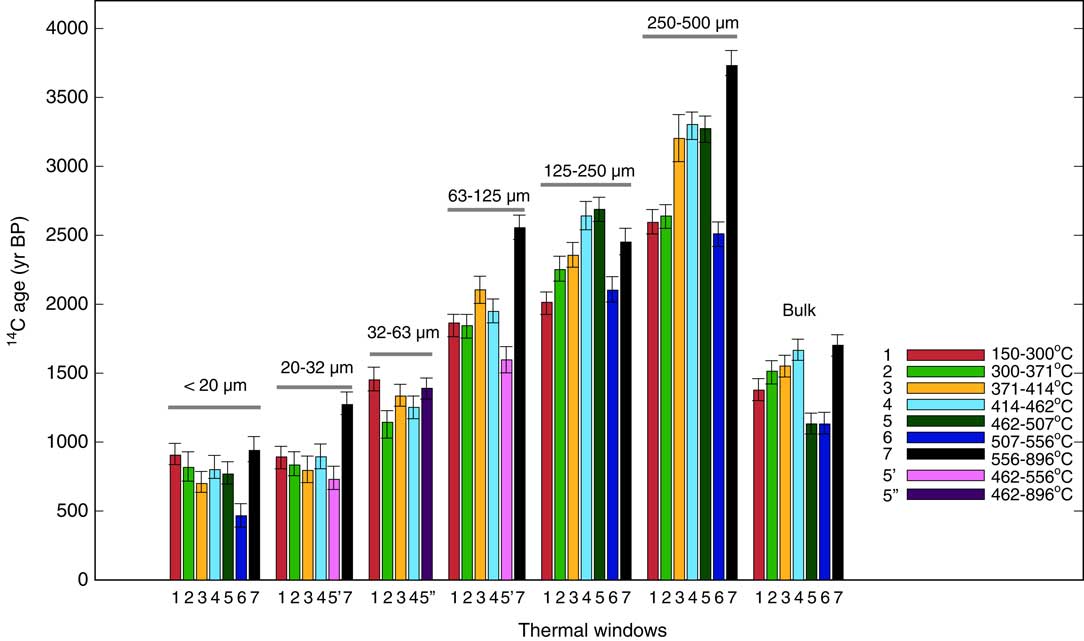
Radiocarbon ages of thermal decomposition components in different grain size fractions of AS-4 sample.

DISCUSSION
The OM in the different grain size fractions of sediment sample AS-4 exhibits a range of properties (Figure 2). Generally, relatively high δ13C values (–22.5‰ to –19.1‰) suggest that marine OC represents the dominant OC source in all fractions (Table 1), however the range in 14C ages (763±51 to 3958±53 14C yr BP), suggests that this OM has experienced diverse pre and post-depositional processing and fates. We note that the 32–63 µm and 63–125 µm fractions have lower δ13C values, as well as lower SA values, compared to both corresponding finer and coarser fractions (Figure 2). SA has previously been argued to play an important role in preservation of sedimentary OM (e.g., Mayer Reference Mayer1994). In this study, we find that SA displays a positive relationship with δ13C values (SA vs. δ13C, r2=0.97, not-shown), implying that SA may be linked to either OC source or the preferential degradation/preservation of specific molecules in the corresponding materials (Wang et al. Reference Wang, Druffel and Lee1996, Reference Wang, Druffel, Griffin, Lee and Kashgarian1998; Wang and Druffel Reference Wang and Druffel2001; Hwang and Druffel Reference Hwang and Druffel2003).
SEM images of grain size fractions reveal the presence of small aggregates of OM and other biological detritus (e.g., diatom frustules, coccoliths) in the <32 µm fraction, Supplementary Figure 1S). Similar aggregates were also observed in the low-density fraction (fine fraction) of sediments from the oxygen-deficient zone of the Eastern Pacific Ocean continental margin (Arnarson and Keil Reference Arnarson and Keil2007). For these finer grain size fractions, we speculate that OM may be preserved both through close association with fine-grained, high SA particles (Mayer Reference Mayer1994; Wakeham et al. Reference Wakeham, Canuel, Lerberg, Mason, Sampere and Bianchi2009), as well as via stabilization in aggregates (Arnarson and Keil Reference Arnarson and Keil2007; Blair and Aller Reference Blair and Aller2012). In contrast, the coarser fractions (e.g., 125–250 µm and 250–500 µm) contain abundant calcareous microfossils (e.g., foraminiferal tests, Supplementary Figure 1S). In contrast to detrital sand grains residing in such coarser grain-size fractions, these microfossils may contain abundant pore space within their biomineral matrix, with the latter serving both to increase SA, and to protect OM intrinsic to (Ingalls et al. Reference Ingalls, Lee, Wakeham and Hedges2003) or associated with the biomineral host from degradation (Mayer Reference Mayer1994; Arnarson and Keil Reference Arnarson and Keil2007; Wakeham et al. Reference Wakeham, Canuel, Lerberg, Mason, Sampere and Bianchi2009). These different modes of SA-related protection in fine and coarse fractions may influence the content as well as 14C age of the OM associated with specific grain size fractions.
Despite both fractions having relatively high SA (Figure 2), the 14C ages of OC within the coarsest size fraction (250–500 µm, 2686 ± 54 yr BP) are substantially older than those in the finest fraction (<32 µm, 763 ± 51 yr BP). This indicates that 14C ages are not only controlled by the kind of OM protected by SA, but are also closely linked to grain size itself, which in turn argues for the importance of hydrodynamic or other physical processes associated with sedimentation (Arnarson and Keil Reference Arnarson and Keil2007; Mollenhauer et al. Reference Mollenhauer, Inthorn, Vogt, Zabel, Sinninghe Damsté and Eglinton2007; Wakeham et al. Reference Wakeham, Canuel, Lerberg, Mason, Sampere and Bianchi2009). 14C ages of sedimentary OM increase with increasing grain size, irrespective of the acid-treatment that was applied (Figure 3). We therefore infer differences in 14C ages correspond to variations in hydrodynamic properties, and specifically that grain size-dependent particle sorting effects influence 14C ages. Prior studies demonstrated that the bio-diffusion coefficient varies inversely with grain size (McCave Reference McCave1988; Bard Reference Bard2001; Sepulcre et al. Reference Sepulcre, Durand and Bard2017). For instance, Thomson et al. (Reference Thomson, Cook, Anderson, Mackenzie, Harkness and McCave1995) concluded that the residence time in the mixed layer in deep sea sediments was particle size dependent, with coarser particles exhibit longer residence time than finer particles in low-sedimentation-rate settings (McCave Reference McCave1988; Thomson et al. Reference Thomson, Cook, Anderson, Mackenzie, Harkness and McCave1995; Brown et al. Reference Brown, Cook, MacKenzie and Thomson2001). Age offsets of OM associated with different sediment grain size fractions may thus reflect hydrodynamic properties of particles both during the transport and/or its residence time in the sediment mixed layer.
Thermograms from RPO of the grain size fractions exhibit similar overall patterns that suggest a relatively homogenous carbon source, consistent with the relatively invariant δ13C values of the grain size fractions (~1.2‰ S.D.; Figure 2 and 4). Despite a potentially similar OC source, the thermally resolved organic components associated with each specific grain-size fraction differ in 14C age to varying degrees, with the proportion and age of dominant organic components in each fraction contributing to the observed 14C age of the bulk OM.
For the finer grain size fractions (i.e., <20 µm, 20–32 µm), the dominant thermal windows (e.g., T1–5) exhibit a relatively narrow range in 14C age variability (Figure 5). Notably, however, the 14C ages for corresponding major thermal windows (e.g., T1–5) systematically increase from the <20 µm to 32–63 µm fractions. Indeed this continues throughout the grain size spectrum, echoing the step-wise increase in bulk 14C results (Figure 3). These results imply that the majority of OM within specific grain-size fraction experiences similar residence times in the sedimentation environment following its initial (rapid) association with specific mineral particles. This uniform 14C increase with grain size may reflect hydrodynamic processes occurring in oceanic nepheloid layers. Both intermediate-depth nepheloid layers (INLs) and bottom (or benthic) nepheloid layers (BNLs) have been observed in this region (Morrison et al. Reference Morrison, Codispoti, Gaurin, Jones, Manghnani and Zheng1998, Reference Morrison, Codispoti, Smith, Wishner, Flagg, Gardner, Gaurin, Naqvi, Manghnani and Prosperie1999; Pfannkuche and Lochte Reference Pfannkuche and Lochte2000). Hydrodynamic influences on grain size distributions of ocean sediments are well documented (e.g., McCave Reference McCave1988; Thomsen and Gust Reference Thomsen and Gust2000; Thomsen and McCave Reference Thomsen and McCave2000), and are likely to affect 14C age characteristics of associated OM, especially in nepheloid layers where such processes are active (Inthorn et al. Reference Inthorn, Mohrholz and Zabel2006; Mollenhauer et al. Reference Mollenhauer, Inthorn, Vogt, Zabel, Sinninghe Damsté and Eglinton2007; Bao et al. Reference Bao, McIntyre, Zhao, Zhu, Kao and Eglinton2016). We suggest that “aging” (14C decay) during hydrodynamically driven transport could result in systematic 14C depletion of all organic components within a specific grain-size fraction, with transport times/speeds varying as a function of grain size.
In contrast to the finer fractions (<63 µm), the 14C ages of different thermal windows of the coarser grain size fractions (e.g., 125–250 µm and 250–500 µm), are less uniform within a specific grain size fraction (Table 2 and Figure 5). In particular, 14C ages of the most abundant thermal windows (e.g., T1–5) increase with increasing temperature, and this trend is superimposed on the general increase in corresponding thermal windows with increasing grain size (Figure 5). Bioturbation processes are unlikely to induce significant discrepancies between 14C ages of different thermal windows in specific coarser fraction given high regional surface ocean productivity, a pronounced oxygen deficient zone within the overlying water column (Pfannkuche and Lochte Reference Pfannkuche and Lochte2000) as well as low oxygen penetration depths (Grandel et al. Reference Grandel, Rickert, Schlüter and Wallmann2000; Smith et al. Reference Smith, Levin, Hoover, McMurtry and Gage2000), and high accumulation rates of underlying sediments (Schnetger et al. Reference Schnetger, Brumsack, Schale, Hinrichs and Dittert2000). We therefore consider two alternative explanations for this observed 14C variability among thermal windows, as follows:
1. The first explanation would invoke protracted (lateral) transport and associated aging of matrix-associated OM prior to deposition, with subsequent addition of fresh (young) OM following deposition. The apparent 14C aging of preassociated OM would likely reflect a combination of both lateral transport time and selective decomposition of more labile (younger) organic components. This line of reasoning is consistent with observations of Arnarson and Keil (Reference Arnarson and Keil2007) where the OM in marine sediments have experienced extensive diagenesis accumulates in the high-density (coarse) fractions. Such a scenario would imply significant timescales for development of OM associations because the 14C ages of low temperature thermal windows in the coarser fractions are older than the corresponding thermal windows in the relatively finer fractions (Figure 5). Moreover, the sphericity of particles in these larger grain size fractions (Supplementary Figure S1) also implies that they have been extensively reworked (Broecker et al. Reference Broecker, Barker, Clark, Hajdas and Bonani2006), and subjected to long-term influence of hydrodynamic processes during laterally transport over long distances prior to deposition.
2. The second explanation for the observed 14C variability among thermal windows in the coarser grain size fractions would imply the presence of thermally refractory rock-derived (i.e., petrogenic) OC (i.e., 14C-dead) in larger detrital grains (Figure 5, black bars (556–896°C). Rosenheim and Valy (2012) found petrogenic OC in river sediment, and identified its thermal window as>~600°C. Given significant inputs of lithogenic material to this region via both fluvial and aeolian transport (Sirocko and Lange Reference Sirocko and Lange1991; Schnetger et al. Reference Schnetger, Brumsack, Schale, Hinrichs and Dittert2000; Dahl et al. Reference Dahl, Oppo, Eglinton, Hughen, Curry and Sirocko2005) this explanation is equally plausible. Without further in-depth analyses (e.g., biomarker analysis, Raman spectroscopy), it is not feasible to determine whether one or both of these scenarios are involved, although relatively high δ13C values and similar overall thermogram patterns of the coarser and finer fractions might argue against significant contributions of entrained 14C-dead OM in these fractions. Nevertheless, it is clear that grain size appears to be a dominant factor controlling 14C heterogeneity in Arabian Sea deep-sea sediments, and that grain size-related effects associated with transport appear to be the most plausible cause of the internal 14C age variability.
In an attempt to explain our observations on the 14C ages of OM in specific grain-size fractions, we propose a conceptual model that invokes different modes of OM preservation (Figure 6). In this model, finer-grained sediments (<63 µm) are mostly comprised of small (µm-scale) mineral-OM aggregates containing marine OM that is both intrinsic to the detrital particles and binds them together. Hydrodynamic processes result in parallel aging of all organic components within each grain size fraction, leading to relatively homogeneous 14C ages among major RPO thermal windows. Such aggregates are likely to be metastable, with their stability related to both hydrodynamic regime and bottom water conditions (e.g., O2 concentrations) (Inthorn et al. Reference Inthorn, Mohrholz and Zabel2006), however these aggregates themselves may protect otherwise labile components from degradation (Arnarson and Keil Reference Arnarson and Keil2007, reference therein). In addition, OM associated with intermediate grain sizes (e.g., silt, 32–63 µm) is relatively depleted in 13C and %OC relative to other fractions (Figure 2) due to greater propensity for erosion and remobilization under lower shear stress (McCave and Hall Reference McCave and Hall2006) (Figure 6), implying that sediment advection influences organic geochemical characteristics such as 14C age distribution (Bao et al. Reference Bao, McIntyre, Zhao, Zhu, Kao and Eglinton2016). For the coarser-grained (>63 µm) sediments, higher bed shear stress is required for erosion, limiting rapidly and lateral transport and redistribution under prevailing hydrodynamic conditions. For these coarser fractions, the influence of hydrodynamic processes on 14C ages is intertwined due to OM encapsulation within particles. A combination of transport and deposition of encapsulated OM as well as OM that forms coatings on mineral particles during and subsequent to sedimentation may give rise to the observed age variability. Depending on particle type, material that is intrinsic to the particle may reflect marine OM (biomineral clasts; Ingalls et al. Reference Ingalls, Anderson and Pearson2004) or terrestrial OM (detrital mineral grains; Eglinton et al. Reference Eglinton, Eglinton, Dupont, Sholkovitz, Montluçon and Reddy2002; Dickens et al. Reference Dickens, Gélinas, Masiello, Wakeham and Hedges2004), and would be expected to be relatively impervious to degradation, even during protracted transport. In contrast, OM coating surfaces of coarser grains is likely younger, and only forms ephemeral associations due to its exposure on the grain surface and susceptibility to degradation. The interplay between these two scenarios, as well as their varying importance as a function of hydrodynamic and depositional regime, thus adds a layer of complication in the interpretations of sedimentary 14C ages. This is particularly so for OM associated with coarser-grained fractions which, in contrast to the more homogeneous isotopic characteristics associated with finer-grained sediments, may contain both “stable” and “labile” forms of OM, resulting in a broader range of 14C ages among thermal windows. While these conceptual models are clearly over-simplistic, they provide a framework for understanding and further investigation of relationships between sediment fabrics and the sources and isotopic characteristics of OM.
Conceptual model of preservation of sedimentary OM in the grain size fraction and schematic relationship between bed shear stress and grain size distribution, modified from McCave and Hall (Reference McCave and Hall2006).

CONCLUSIONS
∙ Combined 14C analyses of OM in bulk sediment, specific grain size fractions, and RPO thermal OC decomposition products reveal that particle grain size is critical factor controlling in 14C ages of OM in deep-sea sediment from the NW Arabian Sea.
∙ In this depositional setting, grain size is linked to (1) hydrodynamic processes that influence the mode and timescales of sediment and OC supply and redistribution, and (2) the spatial disposition of OM within and among sediment grains.
∙ Finer and coarser particle fractions exhibit contrasting degrees of 14C heterogeneity. While OM derived from marine productivity is the dominant source of OC to the sediment, differing fates of OC (e.g., aggregation, encapsulation within biogenic or detrital minerals, or coating on mineral surfaces) influence its susceptibility to decomposition and resilience to physical perturbation (hydrodynamic processes), with the latter also being influenced by depositional conditions (e.g., oxygen exposure).
∙ We conclude that it is important to examine properties of different grain size and/or density fractions considering the strong influence imposed by hydrodynamic processes on the abundance, composition (including isotopic characteristics) and reactivity of sedimentary OM in the marine sediments. Further investigations, including relationships between microbial reactivity and OM 14C as a function of grain size are warranted in order to better understand underlying processes.
ACKNOWLEDGMENTS
This study was supported by Doc. Mobility fellowship (No. P1EZP2_159064) (R. B.) from the Swiss National Science Foundation (SNSF). This work was also supported by SNSF “CAPS-LOCK” project 200021_140850 (T. I. E.). Additional funding came from a U.S. National Science Foundation Cooperative Agreement (OCE 0753487). We thank Julian Sachs as well as the crew of the R/V Thomas Thompson for enabling sample collection. We thank support of the NOSAMS staff in the execution of this project. We appreciate the assistance from members of the Laboratory for Ion Beam Physics in AMS measurements. We are grateful for the assistance of Stewart Bishop and Madalina Jaggi for stable carbon isotopic analysis at ETH Zurich.
Supplementary material
To view supplementary material for this article, please visit https://doi.org/10.1017/RDC.2018.22



