Known primarily for his essays and creative writings, Lu Xun 魯迅 (Zhou Shuren 周樹人, 1881–1936) was also a prolific translator and cultural critic dedicated to introducing foreign thought.Footnote 1 By his own accounts, encounters with foreign cultures, technology, thinkers, and representational forms played a formative role in his development as an intellectual and writer. In the preface of his first short-story collection Call to Arms 吶喊 (1923), Lu Xun noted that his initial ambition after abandoning medical studies in Japan in 1906 was to become a translator who would galvanize the spirits of his compatriots through his rendering of foreign works (Lu Xun 2005, 1:439). He famously promoted “grabbism” (na lai zhuyi 拿來主義), the selective appropriation of the foreign as a means to self-strengthening.Footnote 2 Among his last literary endeavors was a translation of the Russian writer Nikolai Gogol's (1809–52) Lost Souls, uncompleted at the time of his death.
Yet, Lu Xun's attitude toward cultural exchange was fundamentally an ambivalent one. By the 1920s, he expressed profound doubts over the prospect of cultural transmission to bring about transformative change. Among the questions posed in his writings: How are foreign discourses, technologies, and knowledge appropriated and disseminated? Do they enable new frameworks for understanding the self and the world at large and forward an emancipatory agenda? Or perpetuate systems of oppression?
This essay unravels Lu Xun's ambivalent views toward cultural exchange through an intertextual reading of texts and images in his writings on the subject. The first portion examines his explicit calls for reviving indigenous voices through the transmission of foreign ideas. In particular, I examine the notion of “cultivating the human” (liren 立人) in Lu Xun's early essays published in 1908. While various foreign thinkers and poets whose voices he hoped would incite the Chinese to resist oppression are cited as models for the ideal individual, Lu Xun also cautions against a persistent “slave mentality” that makes the Chinese susceptible to a new system of domination: that is, by Western imperialist “masters.” His vernacular short stories, which he began publishing in 1918, reveal how some of the discourses appropriated from the West—such as “science,” “hygiene,” and “individualism”—rather than having an enlightening or emancipatory effect, turn out to be little more than tactics of “civilizing” oppression.
The second portion examines Lu Xun's depiction of three cultural encounters in his writings published between 1924 and 1926: the “Shelley fever” raging in Chinese literary circles in the mid-1920s; the Indian poet Rabindranath Tagore's (1861–1941) reception on his 1924 visit to China; and Lu Xun's own relationship with his Japanese anatomy teacher Fujino Genkurō 藤野厳九郎 (1874–1945), as depicted in the essay “Mr. Fujino” 藤野先生 (1926).Footnote 3 Lu Xun's critical assessment of the former two encounters served as indictments of a vision of modernity promoted by cultural interlocutors of an Anglo-American persuasion, whose superficial aping of foreign manners, in his eyes, merely reinforced colonial discourse and systems of oppression, old and new. In contrast, “Mr. Fujino” radically challenges teleological narratives of modernity by imagining a form of relationality that goes beyond the limits of national and colonial discourse. Lu Xun's mythologizing of his relationship with Fujino Genkurō—one that harks back to Confucian notions of benevolence, reciprocity, and the mission of “cultivating the human”—illustrates how “new voices from alien lands” can revitalize elements of indigenous culture, reflecting and, in a certain sense, enacting Lu Xun's more sanguine vision of the transformative possibilities of cultural exchange.
Humans and Slaves
The Chinese have never earned the right to be “human,” they have at most been slaves.
Lu Xun, “Jottings under the Lamp”In 1908, Lu Xun published a series of essays reflecting upon the possibilities and pitfalls of importing Western technology and thought. While promoting the appropriation of foreign voices as a means of revitalizing indigenous culture, his essays published in Henan 河南 also cautioned against the simplistic conflation of the “modern” with the “civilized” West. In “On the Extremes of Cultural Development” 文化偏至論 (1908), he challenged teleological notions of history and the view of Western experience as a universal model for modernity (Lu Xun 2005, 1:45–64). While developments in Chinese history had contributed to the culture's decline, Western civilizations were no less prone to “aberrant” developments. He cautioned that the ills plaguing modern Western nations—rampant materialism and erosion of moral values—might inadvertently be transmitted to the countries that mindlessly mimic Western ways. Civilization, he countered, was defined not by the accumulation of material wealth or weaponry, but the development of an inner soul (1:57). “The Power of Mara Poetry” 摩羅詩力說 (1908) promoted the genre of poetry as a medium for voicing protest against oppressive social conventions and regimes of power (1:65–120). Hard pressed to find “spiritual warriors” 精神之戰士 among his comrades, Lu Xun introduced the works of foreign poets in the hopes of arousing the submerged voices of his own countrymen (1:68). In “On Refuting Malevolent Voices” 破惡聲論 (1908), he noted the central role that religious beliefs and rituals played in the spiritual life of peasants (8:25–40). He criticized the “modern” scholars, who with but a superficial understanding of Western ideas, readily advocated eradicating native traditions in the name of scientism. In a polemical plea, he urged that one “should get rid of the hypocritical scholars and let ‘superstition’ remain” (8:30).
Concerns expressed in these early essays betray a persistent anxiety Lu Xun shared with some of the late Qing reformers, which Theodore Huters (Reference Huters2005, 2) describes as the “fear that adapting too easily to alien ways would result in irreparable damage to the very set of institutions that reform was designed to save—that is, a Chinese culture whose continuity as a unified whole could be traced back thousands of years.” As Lu Xun noted in “Mara Poetry,” his “search for new voices from alien lands” 求新聲於異邦 was motivated “by a cherishing of the past” 懷古 (Lu Xun 2005, 1:68). He advocated a selective appropriation of the foreign to reinvigorate indigenous culture, performatively enacted in his early essays. Foreign ideas are introduced through the use of archaic classical Chinese; foreign and Chinese terms are creatively melded and adapted. In “Mara Poetry,” Lu Xun appropriates the Sanskrit reference to the demon “Mara” and the Hebrew term “Satan” and invests them with positive connotations of a rebellious individual spirit; Mara/satanic poets courageously articulate their “voice from the heart” (xinsheng 心聲)—an expression from the Fayan 法言 by the Han scholar Yang Xiong 揚雄 (53 BCE–18 BCE). The original reads: “Language is the voice from the heart, writing is an image of the heart. . . . One can discern whether a person is a gentleman or a petty man through the substance of his voice and image” (Han 1992, 110). In “Malevolent Voices,” Lu Xun writes: “Only when one speaks from the heart, becoming the master of one's own soul, can one begin to have an identity; only when each person possesses an individual identity will the public approach total awakening” (Kowallis, forthcoming; Lu Xun 2005, 8:26).
What conditions enable individual voices from the heart to be enunciated and heard, and, in turn, to awaken the masses? Such enunciations are possible in a culture that focuses on a key idea central to Lu Xun's early essays, and arguably, all of his writings: liren 立人. Lu Xun's use of the term, which first appears in “Cultural Development,” is derived from the Confucian Analects (Lun yu 論語). In response to a disciple's question, Confucius defined benevolence (ren 仁) in the following manner: “A benevolent person is one who, wanting to establish himself, establishes others (liren 立人); wanting to achieve, enables others to achieve” 夫仁者,己欲立而立人,己欲達而達人 (Yang 1980, 65).
What is the human ideal that one should establish oneself as? In “Cultural Development” Lu Xun associates this ideal with the geren 個人, a newly imported Japanese neologism for the term “individual” (Lu Xun 2005, 1:51).Footnote 4 Liren (translated as “cultivating the human” from here on) involves the full development of an individual's self-awareness and moral conviction, models of which are to be found in Henrik Ibsen's Dr. Stockmann in Enemy of the People, Friedrich Nietszche's uebermensch (superman), and the Romantic poets Byron and Shelley, among others. Defiant in the face of injustice and impervious to praise or condemnation, such individuals fearlessly articulate the truth and fight on the behalf of the downtrodden. The radical individualism Lu Xun espouses here is not an antidote to an oppressive tradition premised on a teleological view of history, as later promoted by his New Culture peers; rather, it is an embodiment of a universal human spirit that crosses boundaries of space and time, one that opposes all systems of hegemony, modern or traditional.
Lu Xun further extends his notion of self-cultivation from the individual to the nation. He writes: “Drawing on the new and revitalizing the old would establish a new frame of reference, enabling a people to achieve a profound understanding of the significance of life and lead them to achieve self-awareness”; this would in turn allow a weak country to transform into a “nation of human beings” 人國 (translation adapted from Kowallis, forthcoming; Lu Xun 2005, 1:57). In “Malevolent Voices,” he draws a contrast between such awakened nations from the “slavish” and “bestial” natures of imperialist countries. Ringing a pacifist note, Lu Xun proposes a paradigm of relationality beyond the world system of domination prescribed by social Darwinian theories popular at the time. A “nation of human beings,” he writes, would support the struggles of the subjugated; they would resist imperial powers without replicating their aggression (Lu Xun 2005, 8:33).
Not long after these early forays in cultural criticism, Lu Xun went through a period of disillusion, reflected in his almost decade-long literary silence from 1909 to 1917. His initial efforts to enunciate his “voice from the heart”—his call to arms, so to speak—fell on deaf ears. As he wrote poignantly in the preface to Call to Arms, there was perhaps no more acute sense of loneliness to be felt than when one's raised voice was met with neither praise nor opposition, only silence (Lu Xun 2005, 1:439). Contributing to Lu Xun's depressed spirits: the aborted launch of a journal of translations he and a few friends were working on, New Life (Xin sheng 新生), which was to bear the Italian title La vita nuova, inspired by Dante's poetry collection of the same name; and the poor reception garnered by Stories from Abroad (Yuwai xiaoshuo 域外小說, 1909), a collaborative translation of “literature of the oppressed” (mostly Russian and Eastern European fiction) he published with his brother, Zhou Zuoren (1885–1967). Hopeful pleas for cultivating the human after he resumed writing in 1918 appear in much more subdued fashion, as his early preoccupation with the notion of liren surfaces in an opposite guise, that is, an insistent focus on the failure to cultivate the human, as the Chinese toil on as “slaves” 奴隸.
The term nuxing 奴性 (slave nature) appears in “Mara Poetry” and “Malevolent Voices” to describe those who blindly follow convention and, in particular, Western fashions of the day; its variants (such as nuli 奴隸 [slave] and nucai 奴才 [servant]) frequently appear in Lu Xun's essays written between 1924 and 1926. In “Jottings under the Lamp” 燈下漫筆 (1925), he attributed the origins of a “slave mentality” to a culture that demanded individuals' compliance to rigid hierarchies to maintain social order. The division of people into categories and assigned roles, in his view, nurtured a culture of conformity, leaving people bereft of an inner core and alienating them from their own kind. In stark opposition to the Confucian notion of benevolence, the dysfunctional system encouraged a predatory mentality, as people exploited the system for self-gain and often at the expense of others. For, “bullied by others, one nonetheless has the ability to bully others; eaten by others, one can nonetheless eat others” (Lu Xun 2005, 1.227).
What then, of his original calls for cultivating the human? Such hopeful aspirations are replaced by descriptions of a people habituated to their identity as slaves. In “Jottings,” Lu Xun portrays Chinese history as alternating between two ages: of “order,” in which people are able to temporarily secure their position as slaves, and “disorder,” in which they are deprived of even such a “right” (Lu Xun 2005, 1:225). In an echo of his early appeals for the cultivation of a radically rebellious spirit, he calls upon youths to “wipe out these cannibals, overturn this banquet table, and destroy this kitchen” in order to establish a third age, one that lends itself to cultivating the human (1:229).
The reference to cannibals, banquets, and kitchens here calls to mind Lu Xun's two famous analogies: Chinese history as an ongoing banquet, feasting on the flesh of its own people (1:441), and China as a hermetically sealed iron house, suffocating its sleeping inhabitants to death (3:474). Refusing to join the feast and “destroying the kitchen” cannot be accomplished by simply rejecting tradition and appropriating things Western, premises on which the New Culture intellectuals operated. Rather, it involves an overcoming of a structure of thought and a mode of relationality that laid the foundation for the cannibalistic system in the first place. The daunting nature of such a task is cynically portrayed in “The Wiseman, the Fool, and the Slave” 聰明人和傻子和奴才 (1926), written just a few months after the call to action in “Jottings.” When an empathetic “fool” chisels away part of the wall of the slaves' dingy shack to create a window to the outside world, the agitated slaves drive him away, one among them proudly reporting their good deed to the master (2:222). The parable illustrates how slaves who have submitted to the logic of enslavement are instrumental in perpetuating the conditions of their own oppression, even threatened by the prospect of emancipation.
What happens, then, to a country habituated to their identities as “slaves” in an age of imperialism? How would foreign technology, discourses, and knowledge be put to use in such a case? This question is taken up in “On Photography” 論照相之類 (1924). Lu Xun recounts the awkward history of how foreign technology—in this case, photography—was received in his hometown of Shaoxing. The first part of the essay bemusedly describes Chinese beliefs about “foreign devils,” reflecting some of the superstitions and xenophobia prevalent at the time: the devils pickled human eyes to conduct electricity and for use in picture-taking; they used human hearts to make kerosene for lamps (1:191). Such examples provide a context for understanding the reception of the medium of photography, which was initially likened to a form of sorcery, the camera regarded as a contraption that had the ability to steal one's soul.
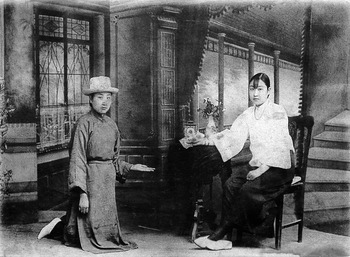
Such attitudes, however, soon gave way to a fetish with the new technology, domesticated to suit local tastes. Lu Xun describes a particular way of displaying photos that came into fashion, called “Picture of Two Selves” (er wo tu 二我圖), a modern variation of a genre in classical Chinese painting.Footnote 5 Two images of oneself are placed side by side, “each with different costume and expression . . . like a guest and host, or a master and slave”; “when one of the selves was seated imperiously above the other, which knelt before it depraved and pitiful,” it was referred to as a “Picture of Me Entreating Myself” (qiu ji tu 求己圖) (Denton Reference Denton1996, 200; Lu Xun 2005, 1:193; see figure 1). While purportedly writing about a local practice, Lu Xun depicts this genre of portraiture as itself reflective of aspects of a national character (traits also embodied by the Chinese everyman, Ah Q): narcissism and a psyche conditioned to servility, reproduced in pictographic form. As Lu Xun writes: “There's a common saying in Chinese that those who treat their subordinates arrogantly will be servile to their superiors. . . . You can find no better illustration of this than in the ‘Me Entreating Myself’ pictures” (Lu Xun 2005, 1:194).
An image in the vein of a “Picture of Me Entreating Myself.” Undated postcard from the collection of Siu Yung Wong. Used with permission.Footnote 6

Photography, for all its potential for bringing about new ways of seeing, has been, in Lu Xun's accounting, domesticated as a form of amusement to satisfy people's narcissistic desires. The image projected in “Me Entreating Myself” photos is that of the self as a spectacle, that is, as an other performing the dual roles of master and slave. What Lu Xun finds disconcerting is that viewing such self-limiting images neither furthers self-knowledge nor prompts a sense of horror from recognizing one's entrapment in a system of oppression; rather, the images bring comfort and self-satisfaction, in reifying a mode of relationality that one is familiar with and has come to accept in the world of the real and in the world of representations. Uncannily mirrored in the fascination with the double image of the self is an alienation from the self, others, and the world at large. In Lu Xun's account, the Chinese psyche has been so thoroughly ingrained in a sociality defined by domination and submission that it has come to dictate not only one's mode of being and means of relating to the world; even in the realm of imagination and fantasy, it seems, people are unable to construct an alternate identity for themselves, other than as master or slave.
Such a mentality, Lu Xun suggests, lends itself easily to transference to new structures of domination—this time under Western imperialist masters. His stories, less polemical and more nuanced than his early essays, reveal the extent to which cultural exchanges are negotiated on unequal terms, the discourse of inferiority often internalized by the “lesser” culture that attempts to superficially ape its more “civilized” counterparts. Western technology and discourses, it turns out, are appropriated not in the name of “cultivating the human,” which Lu Xun had advocated in his early essays; rather, his stories reveal how things foreign have been domesticated, like photography, to reinforce and support a nation of slaves.
“Civilizing” Oppression
What a pity it is that the moment foreign things reach China they change color as if they had fallen into a vat of black dye.
Lu Xun, “Random Thoughts Forty-three”“Madman's Diary” 狂人日記 (1918) has typically been read as a searing indictment of traditional culture, whose cannibalistic nature has been concealed under a façade of Confucian civility and whitewashed by textual lies. Often overlooked, however, is Lu Xun's trenchant criticism of scientism. The “madman,” a prototype of the “real human” 真的人,Footnote 7 raises his voice to expose the violence of the system; he is silenced by the preface-writer, who, citing the authority of Western medical discourse, proclaims the protagonist “ill.” “Madman's Diary,” then, might be seen as a chilling instance of how “medical science,” rather than curing the diseased mind and body, can be harnessed to legitimize and perpetuate systems of oppression. As the preface suggests, the madman/revolutionary, after being “cured” of his bout of “persecution complex,” has, in the end, been disciplined into assimilation, rehabilitated back into the cannibalistic culture he once condemned.
Lu Xun's depiction of the illiterate and uncouth peasant in “The True Story of Ah Q” 阿Q正傳 (1921), as Lydia Liu (Reference Liu1995, 52) has noted, owes a debt to the Western missionary Arthur Smith and his book, Chinese Characteristics. Yet, the story is more than a derivative of the discourse on national character popular in the West in the nineteenth century. Lu Xun's criticism of colonial narratives and the effects of internalizing them can hardly be missed in his caricature of the “Fake Foreign Devil” 假洋鬼子. The imprints of his foreignness are readily seen in his outward appearance—his dress and the cane he carries in the manner of a Western gentleman. The fake queue he wears, however, indicates that his appropriation of the foreign is only piecemeal and superficial; paired with his Western attire, it suggests his submission to two masters: both Manchus and Westerners. The cane—known as a “civilized stick” (wenming gun 文明棍)Footnote 8 —is hardly a subtle metaphor for the Fake Foreign Devil's role as a comprador, currying favor with the foreign, while subjugating his own kind. More than a mere accessory accentuating his difference from his compatriots, the cane is wielded by the Fake Foreign Devil as a weapon to “pai! pai-pai!” thwack Ah Q and his other inferior comrades into submission (Lu Xun 2005, 1:522).
Yet another civilizing discourse is cleverly mocked in “Soap” 肥皂 (1925). Readings of the story typically focus on the facetious portrayal of the moralistic Confucian scholar, Siming. After returning home with a bar of foreign soap for his wife, Siming is shown to be in a foul mood. The source of his irritability is a scene he witnessed earlier in the day: a young girl begging for alms with her grandmother. Siming expresses indignation at, while exhibiting a strange fixation on, a young man's rude comment to his friend—“Don't be fooled by the dirt on this piece of goods. If you buy two cakes of soap and give her a ‘ge-zhi, ge-zhi’ scrubbing, the result won't be bad at all!” (2:50). Siming's twisted process of transference is comically unraveled in the story, as his actions—purchasing soap for his wife and channeling his frustrations into writing an essay in praise of the “filial daughter”—are unmasked as signs of his sublimated attraction to the young beggar girl.
The satirical portrait in “Soap,” like many of Lu Xun's other stories, is double-edged. Siming's seemingly paternalistic concern for the beggar girl, displayed through invocations of Confucian morality, mirrors the “civilizing narratives” deployed by Western colonizers, in this case, the discourse on hygiene (weisheng 衛生) alluded to in the title of the story. As Ruth Rogaski (Reference Rogaski2004, 9) notes, “hygiene” was a “derivative discourse of nationalism, based on an argument of native deficiency originally devised by colonial powers.” The discourse on weisheng brought together “private and public meanings of health into a powerful model of modernity” (18). Such a cosmetic model of modernity is not-so-subtly derided in the elaborate descriptions of foreign soap in the story: It is packaged in a “green paper wrapper” with “a bright golden seal with a network of tiny designs” (Lu Xun 2005, 2:51). When unwrapped, a second layer of green-colored paper is revealed, which, upon further unraveling, turns out to be a thin sheath of translucent paper covering the glossy “palm-leaf-green” soap. Intricate designs are carved on the surface of the soap, which exudes a fragrant scent of olive. The story ends with the following passage, as Siming's wife lathers the soap on her neck: “The bubbles produced were like those emitted from the mouth of a giant crab, piled high behind both her ears; the difference between them and the thin layer of white foam produced when using honey locust pods was like heaven and earth” (2:56).
The exaggerated tongue-in-cheek praise of the superiority of Western soap over the indigenous honey locust pods, along with the grating repetition of the sound “ge-zhi, ge-zhi” scattered about in the text, enhance the story's comic effect. Palmolive brand soap, carefully packaged in layers of wrapping, is hardly a subtle analogy for the civilizing discourses justifying colonial ventures; the image of civility and the “fragrance” of the rhetoric they project are unable to fully conceal the colonizer's intent—to reap monetary profit by opening the local market to Western commodities. In “Soap,” Lu Xun shows how women are depicted as the “goods” in need of a hygienic overhaul and how colonial discourses exacerbate social inequities—in this case, gender and class oppression—inherent in the targeted culture. The beggar girl in this instance is doubly deprived—of alms from the more well-to-do, diverted to purchase imported soap, and also of her dignity, as she is subjected to dirty male gazes, imagining her “scrubbed clean.” Soap, then, is not dissimilar to the native “remedy” of blood-soaked buns used to cure consumption in “Medicine” 藥 (1919)—the purportedly cleansing and curative effects of both commodities, the former “civilized,” the latter “barbaric,” are marketed in an inhuman system, the exploitative effects of which are most marked on the poor and marginalized.
A similar message is conveyed in “Divorce” 離婚 (1925). The feisty and outspoken Aigu refuses to accept the terms of the dissolution of her arranged marriage as stipulated by her husband. Her hopes for a fair settlement from the village patriarchs are shattered as the “moral” authorities of a Confucian persuasion one by one strong-arm her into passively accepting her lot through a process of adjudication clearly stacked against her. The once vociferous Aigu, outnumbered and outmaneuvered, is essentially disciplined into silence in what appears as an “amicable” settlement. In his deliberate choice of “Divorce” for the title, Lu Xun hints that “civilized” settlements of disputes, whether they invoke the authority of Confucian morality or a modern court of law, may turn out to be little more than tactics of “civilizing” oppression, legitimizing the disenfranchisement of the very victims (in this case, women) they were purportedly meant to protect.
Such uneasiness on Lu Xun's part regarding the inscription of systems of oppression, old and new, through the uncritical appropriation of foreign discourses gain an increasing urgency in his writings between 1924 and 1926. Part of the concern may have arisen from what Theodore Huters (Reference Huters2005) has noted as a narrowing of possibilities after 1895, as the West was increasingly seen as the only model for Chinese modernity. In Lu Xun's mind, the constriction of choices may have become even more thorough-going by the mid-1920s, with the success of the New Culture movement and the promotion of Western bourgeois mores in mass media and by influential intellectual groups, such as the Contemporary Review Group 現代評論派 and the Crescent Moon Society 新月社, whose members were predominantly educated in either England or the United States. At the heart of the “pen-battles” Lu Xun waged against his Westernized literary adversaries lies the perennial question of the moral responsibility of the educated elite at times of national crises, as well as other questions more relevant to his own time: What is the role of intellectuals as mediators in an increasingly commercialized cultural field and in a world order in which the terms of transactions are predominantly defined by the West? The skewed nature of such exchanges and some of the absurd and unfortunate consequences that result are highlighted in Lu Xun's depiction of two cultural encounters: the “Shelley fever” raging in Chinese literary circles in the mid-1920s, and Tagore's reception during his 1924 visit to China.
The Lost Image of Shelley
A foul society has flung itself, like Narcissus, to gaze at its trivial image on metal.
Charles Baudelaire, “Salon of 1859”The wide circulation of translated texts and imported images and the prominent role they played in the daily life of urban intellectuals in the mid-1920s are alluded to in Lu Xun's short story “Regrets for the Past” 傷逝 (1925). The protagonist Juansheng freely quotes the texts of foreign thinkers, displays an image of the Romantic poet Percy Bysshe Shelley (1792–1822) on his wall, and watches Hollywood movies. Traveling ideas and images have in this story inscribed themselves in the Chinese cultural imaginary in a way that “brings the world home”Footnote 9 —Juansheng, who by all indications has never traveled abroad, nonetheless feels an affinity and familiarity with the West. This imagined West is constructed not from actual contact with the West or confrontation with the political realities of Western imperialism, but through encounters with a repository of imported images derived from texts, photographs, and films. Juansheng not only apprehends the West from the world of representations; he contributes to its imagination through his own translations and interpretations of Western works.
Yet, on what terms are such cultural transmissions transacted and for what purposes? Ostensibly a story of love gone awry, “Regrets” can well be read as a cautionary tale of the dangers of indiscriminately importing foreign theory. Juansheng's initial preaching of “the tyranny of the family, the need to break with tradition, the equality of men and women, Ibsen, Tagore, and Shelley” (Lu Xun 2005, 2:250) to “emancipate” his lover from the shackles of a patriarchal familial system seems initially to accord with the tenets of “cultivating the human”: he encourages his lover's discovery and expression of her individuality, something that he aspires to for himself; he enables her to tap into her own “voice from the heart” by introducing her to foreign ideas. Indeed, the potentially transformative power of cultural exchange is embodied in Zijun's metamorphosis into a Chinese version of Ibsen's Nora, as she assumes a new identity and renounces her family with the following Nora-like declaration—“I'm my own mistress, not one of them has any right to interfere with me!” This prompts Juansheng to reflect upon his lover's awakening as the sign of the dawn of a new era of women's rights (2:115).
In spite of its early promise, the alliance based on Western-style “free-love” leads to no good outcome. After a period of cohabitation, Zijun assumes the role of homemaker and appears in the eyes of her lover to be the complete antithesis of the Nora figure. Juansheng, it turns out, is no benevolent “enlightener,” but rather, a close kin to the Fake Foreign Devil, minus the cane. The civilizing tool he wields is in the form of cultural capital—that is, his purported familiarity with foreign thought, texts, and thinkers—which he uses to discipline his lover into submission. Grown weary of his lover, he parrots the same Western rhetoric he deployed earlier to convince Zijun to elope with him, this time to end their affair. The psychological blow Zijun receives from the invisible stick seems far more devastating than the physical thrashing inflicted on Ah Q by the Fake Foreign Devil's cane. With no means of support, Zijun is forced to return to her father's home. She dies not long after of unknown causes, possibly by suicide. The death of the Chinese Nora here points to how emancipatory agendas can victimize individuals in terms no less violent than the system they were aimed to overthrow.
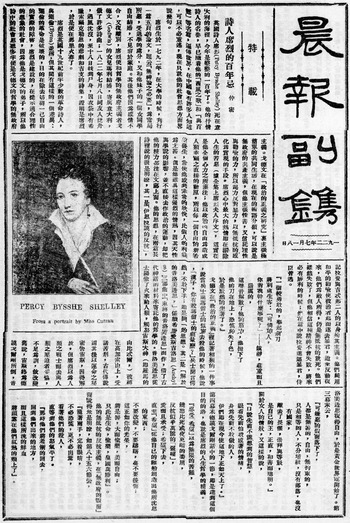
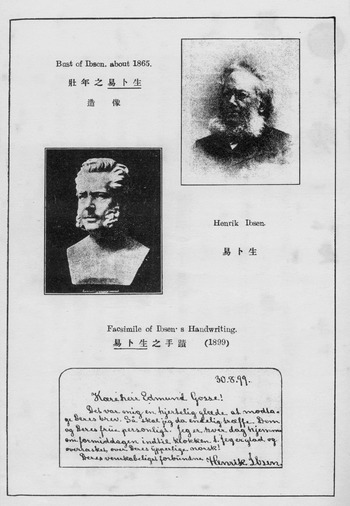
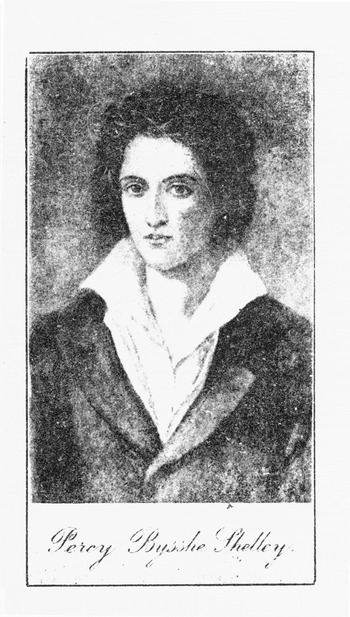
Lu Xun here points to a few problems regarding cultural exchange: For what reason does the cultural interlocutor promote foreign thought? And what is the extent of the interlocutor's knowledge of the foreign thought he promotes? The superficial nature of Juansheng's appropriation of the foreign is hinted at early on in his fetish with an image of Shelley proudly displayed on his wall (see figure 2). During their early courtship, he takes special care to point the picture out to his lover; when it fails to impress, he deliberates whether to replace it with a more dramatic image of the poet drowning at sea or a portrait of a presumably more imposing Ibsen, foreshadowing the fickle nature of his attachments (see figure 3). By the end of the story, the once prized-image, we are told, has mysteriously disappeared.
An image of Shelley. Chenbao fukan 晨報副刊 (Morning post supplement), July 18, 1922.

Busts of Ibsen. Xin qingnian 新青年 (New youth magazine), June 15, 1918.

What is the function of this Shelley image, prominently alluded to several times in the story? Lu Xun's “On Photography” gives us some hints as to its significance. The essay notes that at the time of writing (1924), the display of “Me Entreating Myself” portraits were no longer as common as the fashionable practice of putting up “an enlarged bust of someone grand and awe-inspiring.” Lu Xun viewed such displays as “half of the ‘Entreating Myself’” pictures—insinuating that the owner displaying the picture is the “slave” worshipping the exhibited image of his “master” (Lu Xun 2005, 1:194).
The centennial anniversary of Shelley's death in 1922 prompted a flurry of interest in the Romantic poet. Between 1922 and 1924, leading journals of the day published critical essays and translations of Shelley's works, along with images of the poet similar to the one described in “Regrets” (see figure 4). The Shelley-worshipping Juansheng, then, may well be read as Lu Xun's fictional mocking of an intellectual craze he witnessed in his time. Indeed, Juansheng's attachment to Shelley's picture smacks of pop idolatry. The image—a reproduction of a copper-plate etching of a bust of a long-deceased Romantic poet, cut out from a magazine—also points to the multiple levels of mediation between the real and the represented, and foreshadows the inevitable gaps that ensue in this particular instance of cultural appropriation.
What parades as radical individuality early in “Regrets” turns out to be little more than empty masquerading. The affair in the story is, in a sense, a poor Western derivative; it emerges as what Guy Debord has called a “spectacle,” which he defines as “not a collection of images,” but “a social relation between people that is mediated by images” (Debord Reference Debord and Nicholson-Smith1999, 2). What unfolds is a Chinese tragicomedy of errors based on mistaken identities and faulty impersonations, as life imitates a world of (Western) representations: the Chinese Nora turns out to be a model of traditional femininity; she is forced back to her father's home by the Chinese Shelley, who proves himself to be a feckless lover.
Image of Shelley. Chuangzao yuekan 創造月刊 (Creation monthly), September 10, 1923.

Or is Juansheng such a poor rendition of his “master” after all? Lu Xun may have intended a kind of irony with his reference to a portrait of Shelley drowning at sea, which Juansheng considers substituting for the one on his wall, presumably for a more dramatic effect. The love affair in “Regrets,” as lackluster as it is, in fact mirrors Shelley's own relationship with his first wife, Harriet Westbrook (1795–1816), with whom the poet eloped as an adolescent.Footnote 10 He later abandoned her while she was with child, in pursuit of Mary Godwin (1797–1851).Footnote 11 Westbrook committed suicide by drowning herself in a river a few years later. The resonances between the portrait of Shelley's drowning and the unspoken story of his abandoned first wife with Juansheng's notes, in which the ghostly imprint of Zijun can be overcome but never fully erased, then, may be more than coincidental—an irony surely lost on Juansheng and those who equate the Romantic poet with “free love” and “women's emancipation,” among other popular slogans of the day.
Tagore's Unfashionable Turban
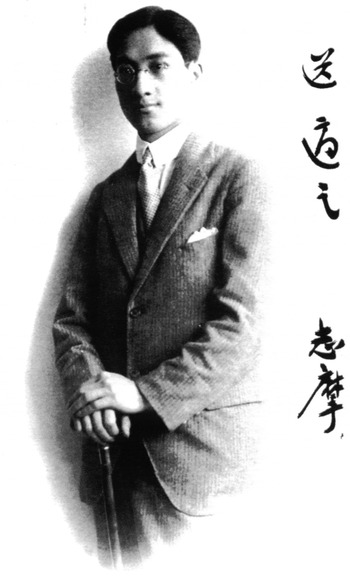
Lu Xun was among the earliest critics to introduce both Ibsen and Shelley to a Chinese audience, citing both figures as exemplars of the radical rebel in “Mara Poetry” (Lu Xun 2005, 1:85–89). His introduction, which preceded the Shelley craze by well over a decade, focused on the poet's rejection of convention and support of the Irish liberation movement, with no mention of his love life. It was, however, the image of Shelley as the embodiment of free love that had become the subject of intellectual fascination in the mid-1920s. Among the most famous of Shelley imitators was Xu Zhimo 徐志摩 (1897–1931), also known as the “Chinese Shelley,” who emerged as a literary celebrity not long after his return to China from England in 1922 (see figure 5).Footnote 12 His fame was tied to his poetic achievements as well as his flamboyant love affairs. In fervent pursuit of Lin Huiyin 林徽因 (1904–55) while a married man, Xu may have regarded his divorce in 1922 from his wife, Zhang Youyi 張幼儀 (1900–1989), then pregnant with their second child, to be a revolutionary gesture modeled after his Romantic idol.Footnote 13
A portrait of Xu Zhimo, also known as the “Chinese Shelley” (Xu Reference Shishan2005, 1:n.p.).

Lu Xun's disparaging portrait of the lovelorn poet in the doggerel “My Lost Love” 我的失戀 (1925; Lu Xun 2005, 2:173–74) and the figure of Juansheng in “Regrets,” if not direct jabs at Xu Zhimo, very well extend to intellectuals like him.Footnote 14 In a speech delivered at Yanjing University in 1929 titled “The Current State of New Literature” 現今的新文學的概觀, Lu Xun derisively mocked the intellectual fashion of associating oneself with foreign figures: “Xu Zhimo has a Tagore, Hu Shih has a Dewey—and yes, Xu Zhimo also has a Mansfield, he had gone to her grave and wept” (4:137). Such identification, Lu Xun suggests, had little to do with spreading enlightenment or forwarding an emancipatory cause through the introduction of foreign ideas; rather, such sycophantic worship of foreign celebrities had more to do with intellectuals' desire to enhance their own “cultural capital,” so to speak, by mimicking and associating themselves with foreign “masters.”
For all Lu Xun's disdain, Xu Zhimo and other intellectuals with an Anglo-American leaning played influential roles as cultural interlocutors, actively promoting foreign thought, aesthetics, and values, as well as intercultural exchanges. For one, Xu Zhimo was instrumental in bringing about the visit of another thinker cited by Juansheng, the first Asian recipient of the Nobel Prize in Literature in 1913, the Indian poet Rabindranath Tagore.
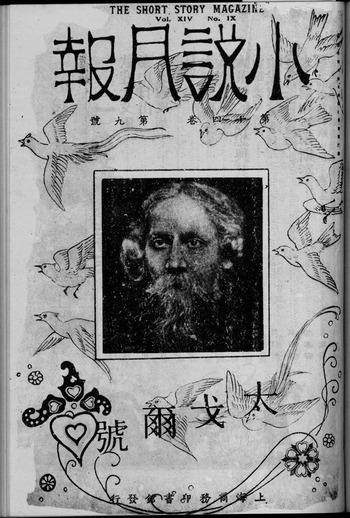
The “Tagore fever” came in 1923, a year before his visit to China (see figure 6). Lu Xun did not contribute to the spate of articles on the Indian poet and played a minimal role during his visit, prompting critics to suggest that he was critical of Tagore. Lu Xun's essay on George Bernard Shaw (1856–1950), however, provides another plausible reason for his relative reticence on the matter. His fondness for the Irish playwright, Lu Xun explains, stemmed from hearing that Shaw liked to “tear off the fake masks worn by men of letters” and that “many of the Chinese who liked to ape Western men of letters disliked him.” He confessed to thinking that “the people disliked by those whom I dislike are good” (Lu Xun 2005, 4:508).
Special issue on Tagore. Xiaoshuo yuebao 小說月報 (The short story magazine), September 1924.

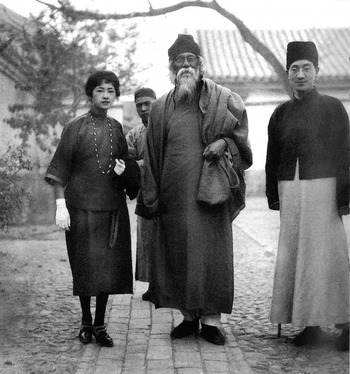
The converse, then, may also be applicable to Lu Xun's purported “dislikes” of particular foreign figures. Part of Tagore's visit to Beijing was sponsored by members of the Contemporary Review Group and the Crescent Moon Society. The latter, with Xu Zhimo as one of its founding members, took its name from one of Tagore's famous poetry collections and came into being as a social club, modeled on the Bloomsbury group, in 1923. Lu Xun was among one of the 400 guests attending a banquet in honor of Tagore's sixty-third birthday sponsored by the group and held at Beijing Normal University on May 8, 1924. The evening's festivities included speeches, the presentation of a gift by Hu Shih (1891–1962), and the bestowal of the Chinese name “Zhu Zhentan” 竺震旦 by Liang Qichao (1873–1929), capped off with a theatrical performance of Tagore's play Chitra in English. Lin Huiyin was cast as the princess who woos a handsome prince, while Xu Zhimo, her once real-life suitor, played the god of love (Hay Reference Hay1970, 167; see figure 7).
Lin Huiyin, Rabindranath Tagore, and Xu Zhimo, 1924 (Lin Reference Congjie2000, n.p.).

Given Lu Xun's well-known dislike for drama and spectacles, it is hardly surprising that he would be unimpressed with the evening's fanfare. In “On Photography,” he takes a rather bemused stance toward what in his eyes appeared to be a strange comedy of errors:
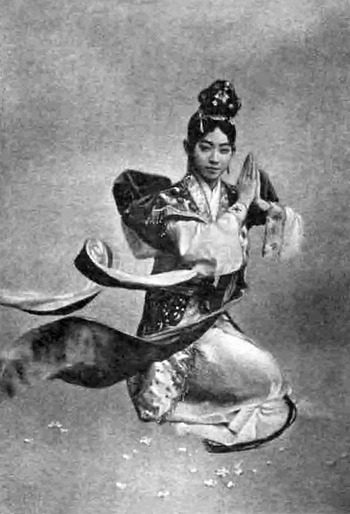
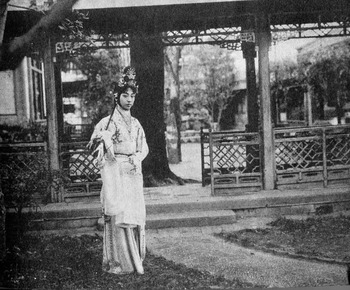
When the Indian saint of poetry Tagore visited China, he aromatized like sweet perfume several of our gentlemen of letters with his literariness and mysticism, but only Mei Lanfang earned the honor of sitting with Tagore to celebrate his birthday: their joining of hands symbolized the union of artists from the two nations. After this venerable poet changed his name to Zhu Cathay and took leave of his all-but-ideal country of Cathay, the sage-poets of Cathay no longer much wore their Indian turbans, and the newspapers only very rarely reported news of Tagore. But what continued to adorn this all but ideal country of Cathay were those pictures of the “Celestial Maiden Scattering Flowers” and “Daiyu Burying Flowers,” which hung so imposingly in the windows of the photography studios. (Denton Reference Denton1996, 202; Lu Xun 2005, 1:195; see figure 8)
Mei Lanfang in “Celestial Maiden Scattering Flowers” (Cheng Yuyan 2004, 56).

Lu Xun's wry, tongue-in-cheek commentary none-too-subtly points to an absurd mismatch: in the presence of the renowned Indian poet-philosopher, China's cultural emissary, presumably chosen by the “sage-poets” hosting the event, was Mei Lanfang—an opera star dressed in drag (see figure 9). In Lu Xun's narrative, the encounter hardly leads to a transformative exchange; rather, the shallow and faddish nature of the Chinese hosts' adulation and mimicking of Tagore is hinted at in their performance of an act of passing through “ethnic drag,” that is, by temporarily donning Indian turbans. The asymmetrical nature of this particular exchange is further seen in its aftermath. While the Indian poet commemorates his visit by assuming the Chinese name bestowed upon him by his hosts, his affections go unrequited. Lacking the spectacular appeal of a cross-dressed opera star, Tagore, like his unfashionable turban, is quickly tossed out of memory by his fickle hosts.
Mei Lanfang in costume as Lin Daiyu in “Daiyu Burying Flowers” (Cheng Yuyan 2004, 51).

What is lost in such an encounter? Lu Xun curiously avoids mention of the main reason for Tagore's unpopularity during his visit: that is, the Indian poet's messages lauding Eastern spirituality and excoriating Western material excesses, ideas that resonate with Lu Xun's own early views on cultural exchange.Footnote 15 Perhaps in part due to the hostility with which Tagore's ideas were received in progressive circles, Lu Xun focuses instead on the Indian poet's status as a “Mara poet” and his views on imperialism as a colonized subject. Squandered is the opportunity for transmitting Tagore's “voice from the heart,” to galvanize the spirits of a Chinese audience sorely in need of his wisdom and inspiration. In a speech delivered in Hong Kong three years after Tagore's visit and published as “Voiceless China” 無聲的中國, Lu Xun noted: “Let's consider which nations are without a voice. Can we hear the voice of the Egyptians? Can we hear the voice of Vietnam and Korea? And besides Tagore's, are there any other voices in India?” (Lu Xun 2005, 4:15). In “Death by Censure and Death by Praise” 罵殺與捧殺 (1932), written eight years after Tagore's visit, Lu Xun laments:
On one of his speaking engagements when he came to China, people displayed a zither and burned a pot of incense. Seated on his left was Lin Changmin, on his right Xu Zhimo. Everyone donned an Indian turban on their heads. Xu Zhimo started his introduction: “An! Jiligulu [gibberish], white clouds and breezy winds, silver lining . . . dang!” He spoke of him [Tagore] as if he were a living saint, and so our youths of this world felt disappointed and left. And why wouldn't they leave, what kind of connection can there be between saints and ordinary folk? But this year I read Tagore's essay on the Soviet Union in which he proclaimed: “I am an Indian under British colonial rule.” He was very much aware of this fact. When he came to China, he was by no means befuddled. Had our poets and other gentlemen not made him into a living saint, the youths would not have felt so alienated from him. (5:615–16).
In Lu Xun's eyes, the Indian poet's interlocutors did a grave injustice to Tagore and the audience of Chinese wisdom seekers during the Indian poet's visit to China. In capitalizing on his stature as a Nobel laureate and the Indian poet's exotic appeal to enhance their own status, Xu Zhimo and his ilk effectively drowned out the poet's “voice from the heart” and the potentially revolutionary message he had to offer Chinese youths fighting for their own cause. Echoing the spirit of his early essay “Malevolent Voices,” Lu Xun urges knowing bystanders to unmask the shallow and opportunistic promotion of the foreign by fraudulent scholars, a task that he himself readily undertakes, to restore Tagore's submerged voice and redeem his honor, so to speak (5:616).
Are their ways to use the master's tools without replicating the system of domination? Are there viable alternatives to capitalistic modernity and the Western bourgeois mores promoted by Anglo-American leaning intellectuals? These questions are taken up in Lu Xun's “Mr. Fujino.”
A Photo of Mr. Fujino
Throughout history, the Chinese have only had two ways of referring to other races: beasts or royal highnesses. They are never referred to as friends, nor said to have anything in common with us.
Lu Xun, “Random Thoughts Forty-eight”Prototypes of the “real human,” diametrically opposed to the hypocritical scholars and Westernized intellectuals whom Lu Xun mocked, appear with some frequency in his fiction and essays. Reflecting his pessimism, however, these enlightened nonconformists, recalling the long lineage of frustrated scholars drawn up by the Grand Historian Sima Qian (145–186 BCE?),Footnote 16 invariably fail to actualize their human potential, as their “voices from the heart” are ignored or subjected to ridicule. Those not ostracized or killed toil on in frustration or submit apathetically to a society they once resisted.Footnote 17
The eponymous protagonist in “Mr. Fujino,” written in 1926 and anthologized in Lu Xun's collection of reminiscences titled Dawn Blossoms Plucked at Dusk 朝花夕拾 (1928), proves an exception.Footnote 18 Fujino Gekurō, Lu Xun's anatomy teacher when he was a student at the Sendai Medical Academy between 1904 and 1906, is introduced in the following manner: “At this time, a dark, thin gentleman with a moustache the shape of the character “eight” (八), wearing spectacles and carrying a pile of books of various sizes in his arms, entered the classroom. After setting his books on the lectern, he introduced himself to the students in a drawn-out voice with a distinct accent: ‘I am called Fujino Genkurō . . .’” (Lu Xun 2005, 2:314). Rather than commanding respect, a reaction elicited from the back of the classroom is a student's scornful laugh. Some students who had previously failed the class regaled others with tales associated with the careless dressing habits of their teacher, who at times forgot to wear a tie; dressed in the same tattered coat all winter, he was once purportedly mistaken for a pickpocket on a train.
A far cry from the “imposing and awesome” figures whose busts were displayed in progressive magazines of the time, Fujino's disheveled appearance, socially awkward behavior, and devotion to books instead conjures an image of a familiar stereotype: the eccentric scholar, one whom the young Lu Xun was at first inclined to dismiss. Yet, Fujino's shabby appearance belies his inner greatness and his ability to transform the lives of those he encounters. The anatomy teacher's persistent and selfless efforts—meticulously correcting Lu Xun's notes, encouraging his studies—eventually have a transformative impact on his Chinese pupil. Fujino's transmission of his knowledge of science is depicted as part of a mission of enlightenment, to enable others to fulfill their individual potential and contribute to the larger world of humanity. At the end of the essay, Lu Xun attributes the care and affection that Fujino demonstrated toward him as an individual as part of his teacher's larger humanitarian concern. He concludes: “His fervent hopes for me, his tireless teaching were, on a smaller scale, for China, on a larger scale, in the name of research, that is, in the hopes that medical studies would be transmitted to China” (2:318).
Such sentimentality and sweeping generalizations are rather uncharacteristic of Lu Xun; they were, in fact, gestures he repudiated in his mocking of these very same tendencies in Juansheng in “Regrets” and Xu Zhimo's fawning idolatry of Tagore. Such sentimentality becomes all the more perplexing given the number of details in the essay that have been subject to dispute. Some minor factual inaccuracies, to be sure, are attributable to lapses in memory, given the two-decade gap from the events being narrated.Footnote 19 Subjective interpretations of events, too, may play a role. When interviewed after Lu Xun's death, Fujino gave a somewhat different account. Though moved by the essay, Fujino expressed that he had not gone out of his way to accommodate his Chinese pupil; nor did he recollect giving him a photo (Hanzawa Reference Zechun2005, 173).
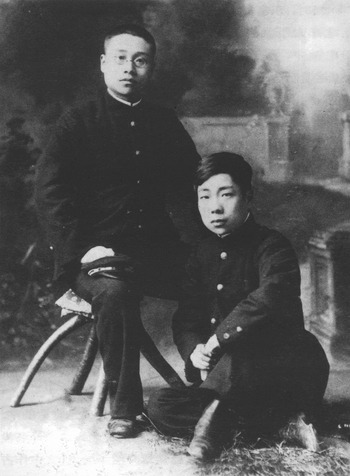
Some other discrepancies, however, cannot be readily explained away. Among the most glaring: Lu Xun's assertion that he was the first and only Chinese student in Sendai, when another Chinese student by the name of Shi Lin 施霖 was there concurrently, possibly preceding him; the two had purportedly roomed together for a time, and photos of the two taken together in Sendai are extant (Huang Qiaosheng Reference Zechun2005; see figure 10). Lu Xun did not receive passing marks in Fujino's anatomy course, a detail he omits. What, then, accounts for these discrepancies and omissions?
Zhou Shuren and Shi Lin in Sendai, 1903 (Lu Xun 1976, 3).

The fictionalization and elision of certain details were likely “distortions” (qubi 曲筆) to make for a more compelling story.Footnote 20 Academic failure would have made for an odd and unpromising premise for a feel-good story that lauds a professor's transformative impact on his student. Lu Xun's sense of isolation becomes all the more palpable as the lone Chinese student in Sendai at the time. Indeed, such incongruities between fact and fiction are rather common in Lu Xun's personal essays. His biographical sketches share much in common with traditional biographical writings. As Burton Watson (Reference Watson1962, 72) observes of the early historical text, “though it relates events which often have a basis in historical fact, it is concerned primarily with the literary and ethical import of its story.”Footnote 21
The literary and ethical import of “Mr. Fujino” goes far beyond describing the intimate bond between student and teacher. Here, it might be appropriate to note that Lu Xun's “Mr. Fujino” was likely in part inspired by Natsume Sōseki's (1867–1916) essay “Kureigu sensei” クレイグ先生 (Mr. Craig, 1909). “Mr. Craig” was written to commemorate the Irish scholar of Shakespeare, William James Craig (1843–1906), who was Sōseki's tutor for ten months while he resided in London in 1900 (Natsume 1965–67, 8:136–44).Footnote 22 With a mix of mockery and admiration, Sōseki depicts his teacher as an eccentric, curmudgeonly, and miserly individual who devoted his life to scholarship, the fruits of which, Sōseki speculates, would likely go unappreciated. Lu Xun's translation of the essay, “Kelaika xiansheng” 克萊喀先生, was included in Collection of Modern Japanese Short Stories 現代日本小說集 (1923), edited by his brother, Zhou Zuoren (Lu Xun 2008, 2:7–11).Footnote 23 Unlike the more dispassionate depictions in Sōseki's “Mr. Craig” and Lu Xun's essays written in memory of another one of his teachers, Zhang Taiyan (1868–1936),Footnote 24 however, the less complex and uniformly laudatory portrait of Mr. Fujino, as I show below, deals with larger issues that go beyond the commemoration of a singular individual.
What is perhaps most remarkable about the essay is the historical context of its emergence. “Mr. Fujino,” completed in October 1926 and published in the journal Mangyuan 莽原 (The wilderness) two months later, was written at a time of heightened anti-Japanese sentiment. Early in 1925, a series of strikes erupted as Chinese workers protested unfair labor practices at Japanese-owned mills in Shanghai. Students held demonstrations in the Shanghai concessions after news spread of an incident on May 15, during which a Chinese worker was shot and killed at a Japanese-owned mill. The subsequent student arrests led to a mass demonstration of over 10,000 students and workers in the international settlement on May 30, which was met with gunfire by British forces, killing thirteen protestors. The series of anti-imperialist demonstrations and anti-foreign boycotts that spread sporadically throughout various cities, referred to as the “May Thirtieth Movement,” persisted for the ensuing months.
Lu Xun's scattered thoughts triggered by the aftermath of the May Thirtieth incident are expressed in a series of essays he wrote between June and July, which provides a useful context for reading “Mr. Fujino.” In “Sudden Thoughts” 忽然想到 (1925), Lu Xun questioned simplistic understandings of imperialism as a binary structure and warned against the dangers of ethnocentric nationalism. Reflecting upon people's predatory nature, Lu Xun observed the following: “A civilization in which justice and military might go hand in hand has yet to appear in this world. The germination of such ideas may be found, perhaps, only in the minds of a few pioneers or groups of peoples who have been oppressed. As soon as one gains power, however, justice is invariably left behind” (Lu Xun 2005, 3:95). In a provocative confusion of alliances, he calls for the need to learn from one's “enemies”—in particular, those with a critical eye for identifying the weaknesses of Chinese—and to distance oneself from one's “fellow comrades” 同胞—defined as those who are either blind patriots or complicit in the oppression of their own people (3:98–99).
Lu Xun's account turns attention to Chinese atrocities committed against their own kind. He contrasts the reaction elicited by two incidents: the first, a British constable's shooting and killing of a Chinese in Shanghai; the second, the shooting of anti-imperialist demonstrators ordered by local authorities in Hankou, resulting in the deaths of four Chinese protestors. The former provoked outrage, while the latter received little attention. Writers' relative silence after the Hankou incident, Lu Xun observes, led some people to pose the following question: “What is the function of writers?” He surmises that some might say: “Other than chanting some poetry, they have no function.” Harking back to the revolutionary poets he hailed in “Mara Poetry,” however, Lu Xun urges writers to “shout maniacally” (kuang han 狂喊) in protest against those unjustly treated. The function of writers, he notes, is to record the lives of the sacrificed so that the written records can “touch people and enlighten posterity” (3:99–100).
The moral responsibility of writers during times of heightened violence was also a subject Lu Xun frequently touched upon in his literary squabbles with members of the Contemporary Review Group, most notably Chen Yuan 陳源 (1896–1970) and Xu Zhimo, which commenced early in 1925.Footnote 25 Lu Xun expressed the need to unmask the civilized men of letters who actively supported warlord regimes in suppressing student activism and turned a blind eye to imperialist aggression by retreating to the ivory tower. These bitter exchanges continued after the March 18 incident in 1926, which Lu Xun referred to as “the darkest day of the Republic.”Footnote 26 The warlord Duan Qirui ordered the shooting of anti-imperialist demonstrators protesting Japanese aggression at Tiananmen Square. Forty-seven students, including one of Lu Xun's own from the Beijing Woman's Normal College, Liu Hezhen 劉和珍 (1904–26), whom he memorialized in an essay, were killed (3:289–95). Lu Xun not only excoriated the Duan regime, he also attacked the “upstanding gentlemen” who spoke out against neither imperialist aggression nor the compliant warlord regime, but instead, faulted student demonstrators whom they claimed wittingly put themselves in the line of fire.Footnote 27
“Mr. Fujino” is an iteration of many of the ideas expressed in these essays written between 1925 and 1926, in particular, his criticisms of intellectuals' complicity with systems of domination and turning a blind eye to the suffering and violence around them as they dabbled in writing what he dubbed a “literature of concealment and deceit” 瞞和騙的文學.Footnote 28 In contrast, the selfless Fujino emerges as a model intellectual, critical of imperialist aggression and sympathetic to the plight of the oppressed. Lu Xun's one-dimensional portrait of his teacher and mythification of their friendship was also no doubt an attempt to overcome the vociferous anti-Japanese sentiments at the time. His sentimental tribute at once humanizes and exalts Fujino's character, downplaying his race while playing up his significance as a humanitarian figure. As with his sympathy for Tagore's anti-colonial message, such a portrait questions Western universalism and underscores the possibility of forming uncommon alliances. Lu Xun's gestures, however, should not be construed as facile affirmations of pan-Asianism, or evidence of his identity as a “traitor,” a suspicion his close association with Japanese intellectuals has sometimes raised.Footnote 29 It is, rather, an attempt to think beyond the limits of ethnocentric nationalism and colonial discourse, an imagining of a kind of relationality that goes beyond simplistic binaries and the oppressive logic of domination and submission.
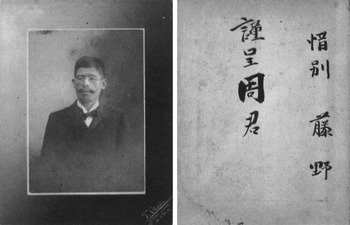
Lu Xun writes regretfully that the anatomy notes Mr. Fujino corrected were lost after repeated moves, but that “his photograph till now still hangs on the eastern wall next to my desk in my home in Beijing” (2:318–19). The image displayed here is not a magazine cut-out of some famous Western figure worshipped as an idol; nor is it of a foreign celebrity, quickly discarded once the fanfare of his visit has passed. Rather, the nondescript photo is of a beloved teacher, a model for intellectual responsibility and public integrity, lovingly preserved. The image urges Lu Xun to articulate his thoughts as a means to refute “malevolent voices.” As he writes at the end of the essay: “Whenever I feel tired in the evening, right when I wanted to slack off, I would look up and in the lamplight see the image of his dark and thin face, as if about to say something in that distinct accent. This would ignite my conscience, embolden my courage, and I would light a cigarette and resume writing things that would provoke the ire of those ‘upstanding gentlemen’ and their ilk” (2:319).
It is the voice of one whom some might perceive as the “enemy” that galvanizes Lu Xun to wage pen-battles against his “comrades,” to expose their uncritical assimilation of Western discourses and complacency, even complicity, in face of violent acts committed by imperialist powers and warlord regimes against their own people (1:252). Fujino here emerges as a foil to Lu Xun's literary adversaries, who appear in his caricatures as little more than Fake Foreign Devils. In contrast, Fujino's association with the foreign is depicted as going far beyond the superficial adoption of Western attire and mannerisms or the mindless parroting of Western slogans. Rather, he reflectively acquires and transmits knowledge—derived from an array of Chinese, Japanese, and other foreign sources—in the name of science and enlightenment. Unconcerned with his self-image, swayed neither by blind scientism, worship of the West, or ethnocentric rhetoric, Fujino emerges as an embodiment of the “warrior of the spirit,” the “real human” who uses his “voice from the heart” to galvanize others to fight against oppression and injustice.
Indeed, it seems that it is through this “new voice from an alien land” that the best of one's native traditions are reflected, revived, and transformed: Fujino Genkurō, driven by an inner moral compass and oblivious to convention, embodies the radical subjectivity of the geren as well as the Confucian ideal of the “benevolent man”—that is, he, “wanting to establish himself, establishes others. Wanting to achieve, enables others to achieve.” (Yang 1980, 65) Finding many “petty men” among his intellectual peers, it seems that it is in a foreign land and in the realm of imagination that Lu Xun is able to discover a consummate gentleman with whom to kindle an ideal literati friendship. Fujino emerges in the essay as an ideal model of the shiyou 師友, of a revered teacher-friend. Yet, the intimacy and affection conveyed in the essay go beyond the formalities of a teacher-student bond; Fujino also appears as a zhiyin 知音, a kindred spirit so desperately desired yet rarely encountered in one's lifetime. Crossing the boundaries of space and time, the essay portrays two individuals bound together by a shared moral commitment, embedded in the cultivation of human relationships, and devoted to realizing emancipatory ideals which would bring about a more human way of relating to others and a more humane existence for all.
Harking back to traditional literati friendships, the student-teacher relationship is affirmed through the exchange of gifts and acts of reciprocity. As noted in the Book of Rites (Li ji 禮記): “In antiquity, what was prized was sincerity, and in later times, the obligation of giving and repaying. What the rules of propriety values is reciprocity” 太上貴德, 其次務施報.禮尚往來 (Wang Yunwu and Wang Meng'ou 1984, 2:7). Fujino transmits his knowledge and hopes for a better future to his student, and bestows on him two characters, xibie 惜別 (regret at departure), inscribed on the back of his photograph (see figure 11). The lessons he imparts to his student go far beyond the transmission of scientific knowledge; his image and words serve as lifelong inspirations for Lu Xun, reminding him to enunciate his “voice from the heart” and to fulfill his moral mission as an intellectual. The “gifts” are deeply cherished by Lu Xun and the “elegant debt” he owes to his teacher weighs heavily on him.Footnote 30 By then a literary figure of renown, Lu Xun returns a gift in kind, albeit two decades later, yet one no less transformational. His written tribute transmits his teacher's “voice from the heart” and ensures that Fujino's virtuous character and deeds are made known to posterity. In Lu Xun's account, the encounter between the kindred spirits emerges as a transformative cultural exchange based on sincerity, benevolence, and reciprocity, untainted by the pursuit of personal fame, narcissistic attachment, or slavish devotion. Fujino is neither worshipped as a “royal highness” nor scorned as a “beast,” but cherished as a friend.
Photo of Fujino Gekurō, inscribed with the words “presented to Zhou kun, regret at departure” (Lu Xun Wenxian Tuzhuan 1998, 36).

The sentimental story of the bond between teacher and student that overcame national boundaries has long since become a symbol of Sino-Japanese friendship. Like the perfect love story, unrealized, that the two were never again to reunite after Lu Xun's 1906 departure from Sendai makes their friendship all the more precious, its splendor all the more lustrous after the repeated recall and polish in the realm of collective memory. “Mr. Fujino” has been anthologized in textbooks in Japan and China. Fujino Genkurō's name has been passed down to posterity by association with his famous Chinese pupil's name, and his photo remains hanging on the wall above Lu Xun's desk in his former residence in Shanghai, now a museum. Lest people forget, the photo is singled out and the story of their encounter repeated by the guide. The legendary friendship is also enshrined in busts, statues, steles, and exhibits in both China and Japan and has inspired fictionalized plays and novels; it continues to spawn a steady stream of commemorative events, collaborative work, and intercultural exchanges.Footnote 31 While certain details in “Mr. Fujino,” like many others in Lu Xun's biographical essays, may turn out to be more like urban legend, the positive sentiments and encounters the story continues to generate in spite of the aggravated relations between China and Japan in our own times, reflect, and in a certain sense, enact, Lu Xun's more sanguine vision of “cultivating the human” and the transformative possibilities of cultural exchange.
Acknowledgments
I am grateful to Peter Flueckiger, Hu Ying, Lee Haiyan, Kamachi Noriko, Theodore Huters, Andrew Stuckey, Jeffrey Wasserstrom, and two anonymous reviewers for reading and commenting on the essay, vastly improving it with their suggestions. Allan Barr and audience members in various venues where preliminary ideas were presented posed thoughtful questions and comments which helped me conceptualize the form of the paper. My gratitude as well to Ji Zhiqiang for helping me configure some of the images.