Persistent pulmonary hypertension of the newborn is defined as failure to achieve or sustain the normal decrease in pulmonary vascular resistance at birth and is a serious debilitating illness that is associated with high neonatal morbidity and mortality. Reference Lai, Chu, Lakshminrusimha and Lin1,Reference Shivanna, Gowda, Welty, Barrington and Pammi2 Optimal management of persistent pulmonary hypertension is critical for improving outcomes in high-risk neonates. Reference Shivanna, Gowda, Welty, Barrington and Pammi2 Inhaled nitric oxide is the only United States of America Food and Drug Administration-approved pulmonary vasodilator for treating persistent pulmonary hypertension in infants, but 30 to 50% of neonates with severe persistent pulmonary hypertension have a suboptimal response to inhaled nitric oxide. Reference Lai, Chu, Lakshminrusimha and Lin1–Reference Fortas, Di Nardo, Yousef, Humbert and De Luca4 Therefore, analysing the efficacy and safety of treatment with other pulmonary vasodilators such as prostanoids, phosphodiesterase inhibitors, and endothelin antagonists is necessary to generate an evidence-based consensus for appropriate therapeutic interventions. Reference Lai, Chu, Lakshminrusimha and Lin1,Reference Shivanna, Gowda, Welty, Barrington and Pammi2,Reference Fortas, Di Nardo, Yousef, Humbert and De Luca4
Prostacyclin is a biologically active prostanoid that signals via G-protein-coupled cell surface receptors, which, when activated, stimulate the enzyme adenylate cyclase, and the resulting increase in intracellular cyclic adenosine monophosphate, opening of Ca2+-activated K+ channels, and hyperpolarisation of the membrane leads to relaxation of vascular smooth muscle and vasodilatation. Reference Shivanna, Gowda, Welty, Barrington and Pammi2,Reference Gomberg-Maitland and Olschewski5,Reference Vane and Botting6 Among infants, prostacyclin is shown to be comparable to inhaled nitric oxide in decreasing pulmonary artery pressure and improving the oxygenation. Reference Bos, Tibboel, Koot, Hazebroek and Molenaar7,Reference Nakayama, Shimada and Takatsuki8 Therefore, prostacyclin and its analogues are increasingly used as an "add-on" therapy for both inhaled nitric oxide-refractory persistent pulmonary hypertension and in case of inhaled nitric oxide unavailability. Reference Shivanna, Gowda, Welty, Barrington and Pammi2,Reference Fortas, Di Nardo, Yousef, Humbert and De Luca4,Reference Kelly, Porta, Goodman, Carroll and Steinhorn9–Reference Levy, Celermajer and Bourges-Petit12
Iloprost is a prostacyclin analogue with a half-life of 20 to 30 minutes, which can be administered intravenously or by inhalation. Reference Lai, Chu, Lakshminrusimha and Lin1,Reference Shivanna, Gowda, Welty, Barrington and Pammi2,Reference Ewert, Schäper, Halank, Gläser and Opitz13 The route of application by inhalation results in selective pulmonary vasodilator effect and better ventilation/perfusion ratio and limits systemic adverse effects. However, the need for repeated nebulisations and side effects such as development of reactive airway disease and increased need for inotropic support among infants limits its use. Reference Ivy, Doran and Smith14–Reference Janjindamai, Thatrimontrichai, Maneenil, Chanvitan and Dissaneevate17 Endotracheal instillation of epoprostenol, which is another prostacyclin analogue, was shown to result in improved oxygenation in four preterm neonates with persistent pulmonary hypertension without any side effects. Reference De Jaegere and van den Anker18 We could not find any study investigating the efficacy and safety of endotracheal iloprost instillation. In the light of the literature, we aimed to determine the efficacy and safety of endotracheal instillation of iloprost as a rescue therapy in treatment-resistant persistent pulmonary hypertension.
Materials and methods
This was a retrospective cross-sectional study conducted from January 2021 to April 2021 at Sanliurfa Training and Research Hospital. The research centre is the largest referral perinatal centre of Southeast Anatolia region in our country and has a tertiary level neonatal ICU with 110 incubators. Ethics Committee approval was obtained for the study from Harran University Clinical Research Ethics Committee (date: 26.04.2021, number: 21.09.20). Neonates diagnosed with persistent pulmonary hypertension who were unresponsive to standard treatment protocol for pulmonary hypertension applied in our neonatal ICU and who were being followed up with mechanical ventilation were included in the study. All the neonates included in the study were tested for coagulation disorders and treated with vitamin K and fresh frozen plasma if there was concomitant haemorrhage with coagulation disorder detected before being recruited in the study. All decisions for transfusion of blood products were made according to the threshold levels predetermined in our national transfusion guideline. Reference Çetinkaya, Atasay and Perk19 The neonates, who did not need intubation for respiratory support and responded to standard persistent pulmonary hypertension treatment, were excluded from the study.
Persistent pulmonary hypertension of the newborn was suspected in reference to the presence of hypoxic respiratory failure despite optimal respiratory support and diagnosed by echocardiography. Neonates were diagnosed with persistent pulmonary hypertension if they had one or more of the following echocardiographic findings: enlargement of the right heart chambers, deviation of the interventricular septum to the left, tricuspid regurgitation and right-to-left or bidirectional shunting across patent foramen ovale, and patent ductus arteriosus. Reference Mathew and Lakshminrusimha20 Systolic pulmonary artery pressure was determined by echocardiography. The pressure difference between the right ventricle and the right atrium was measured using a tricuspid regurgitation jet, and the estimated right atrial pressure was added to obtain the systolic pulmonary artery pressure. Based on collapse of the inferior vena cava, the estimated right atrial pressure was assumed to be 5, 10, 15, or 20 mmHg. Reference Forfia, Wiegers and Otto21
Neonatal ICU protocol for the management of persistent pulmonary hypertension
General management principles were followed for all patients, including maintenance of normothermia, providing optimal nutritional support, avoidance of stress, maintaining a “low-noise” environment, gentle handling with sedation as needed, and maintenance of adequate intravascular volume and systemic blood pressure, optimising ventilator support for lung recruitment and alveolar ventilation. Reference Fuloria and Aschner22,Reference Sweet, Carnielli and Greisen23 Specific treatments were applied according to the underlying diagnosis of each patient. Surfactant treatment was given according to European Consensus Guidelines on the Management of Respiratory Distress Syndrome-2019 Update. Reference Sweet, Carnielli and Greisen23
The primary treatment modality was inhaled nitric oxide after a diagnosis of persistent pulmonary hypertension was made in late preterm and term neonates. Reference Barrington, Finer and Pennaforte3 Inhaled nitric oxide was initiated at an initial concentration of 20 ppm, and the dose was increased to 40 ppm (2 ppm every 30 minutes, while closely monitoring the patients for side effects) if the preductal venous oxygen saturation (SPO2) was <90%, although the fraction of inspired oxygen (FIO2) was 100% and the mean airway pressure (MAP) was adequate for optimal inflation of the lungs that was checked by chest X-ray. Reference Barrington, Finer and Pennaforte3,Reference Kelly, Ohlsson and Shah24 Oral sildenafil, inhaled and intravenous iloprost treatment were initiated simultaneously for the treatment of inhaled nitric oxide resistant cases. Oral sildenafil was initiated at a dose of 1 mg/kg four times a day, and the dose was increased to a maximum dose of 2 mg/kg four times a day, if the patient did not respond to treatment after 24 hours. Reference Kelly, Ohlsson and Shah24 Inhaled iloprost was given at a dose of 2 mcg, diluted with 1ml of isotonic sodium chloride, 12 times a day. Intravenous iloprost infusion was initiated at a dose of 4 ng/kg/min, and the dose was increased up to 20 ng/kg/min according to the response to treatment. Reference Shivanna, Gowda, Welty, Barrington and Pammi2,Reference Mathew and Lakshminrusimha20,Reference Verma, Lumba and Kazmi25 The increments of the infusion rate were applied as 4 ng/kg/min every four hours.
For neonates <34 w, intravenous and inhaled iloprost were used for the treatment of persistent pulmonary hypertension. Inhaled iloprost was given at a dose of 1 mcg, diluted with 1ml of isotonic sodium chloride, 12 times a day. The intravenous dose was the same as it was used for late preterm and term neonates. Inhaled nitric oxide was not used for persistent pulmonary hypertension, since there was both a paucity of data on whether inhaled nitric oxide was effective and safe among this group of neonates, and inhaled nitric oxide treatment was very expensive for our resource-limited neonatal ICU. Reference Barrington, Finer and Pennaforte3 Sildenafil was also not used for neonates <34 w, as it might be associated with worsening of retinopathy of prematurity. Reference Aboudi, Swaminathan and Brumberg26
After exclusion or correction of the major causes of the need for intense cardiopulmonary support (such as a displaced or blocked endotracheal tube, septicaemia, hypovolemia, pneumothorax) in neonates who received standard persistent pulmonary hypertension treatment, endotracheal iloprost was instilled as a rescue treatment for persistent pulmonary hypertension, if fraction of inspired oxygen was 100% and mean airway pressure was sufficient to ensure adequate inflation of the lungs (≥ eight ribs - ≤ nine ribs were counted on chest X-ray), but preductal oxygen saturation was still below 90%, plus systolic pulmonary artery pressure was suprasystemic. The preductal and postductal oxygen saturation were measured by pulse oxymeter.
Iloprost (Ilomedin®) was administered by endotracheal instillation through a catheter reaching the distal end of the endotracheal tube at the dose of 2 mcg for neonates ≥ 34 w and 1 mcg for neonates < 34 w, and the calculated doses were diluted with 1 ml of isotonic sodium chloride. To instill endotracheal iloprost, patients were disconnected from the ventilator, endotracheal iloprost was given, and then, positive pressure ventilation was performed with a self-inflating balloon 30 times per minute. Later, the patients were reconnected to the ventilator. The mean airway pressure, ventilation mode, applied oxygen fraction (fraction of inspired oxygen) and preductal and postductal oxygen saturation, heart rate, and blood pressure were monitored closely at least six hours after endotracheal iloprost instillation. The oxygen saturation index (OSI) was calculated as MAP × FIO2 × 100 / preductal sPO2 and was recorded before and after 30 minutes of endotracheal iloprost instillation. Reference Aboudi, Swaminathan and Brumberg26 Oxygen saturation index was used instead of oxygenation index (OI), as oxygen saturation index was found to be strongly correlated with OI and a non-invasive method to assess oxygenation status of the patients continuously. Reference Muniraman, Song and Ramanathan27 Systolic pulmonary arterial pressure, the degree of tricuspid regurgitation, OSI, MAP, FIO2, preductal and postductal SPO2, heart rate, systolic (SBP) and diastolic blood pressure (DBP), and mean arterial blood pressure (MABP) measurements were recorded before and after 30 minutes of endotracheal iloprost instillation. Blood pressure was measured non-invasively by using proper cuffs.
The aetiology of persistent pulmonary hypertension and postnatal hour of endotracheal iloprost instillation was recorded. All patients received continuous cardiorespiratory monitoring and continuous assessment of pulse oximetry. As all the treatment modalities used for persistent pulmonary hypertension were known to cause systemic hypotension, blood pressure of the neonates was followed closely and inotropic treatments were started as needed and titrated continuously to keep patients normotensive. Reference Lai, Chu, Lakshminrusimha and Lin1 Transfontanel ultrasonography was performed for all patients before and after the treatment. All the adverse events after endotracheal iloprost instillation such as hypotension, haemorrhage, mortality were recorded for safety assessment.
Statistical analysis
The Statistical Package for Social Sciences version 21.0 (SPSS Inc., Chicago, IL, USA) was used for statistical analyses. The data were assessed for normality using visual and analytic methods. Data were tested for normality with the Shapiro-Wilk test and expressed as a mean (standard deviations) or median (interquartile range) when appropriate. Qualitative variables were expressed as percentages and frequencies, normally distributed continuous variables as means (standard deviation), and non-normally distributed variables as medians (interquartile range, p25-p75). Differences between two paired groups were tested using paired samples t-test for parametric variables and Wilcoxon test for non-parametric variables. p values <0.05 were considered to be statistically significant.
Results
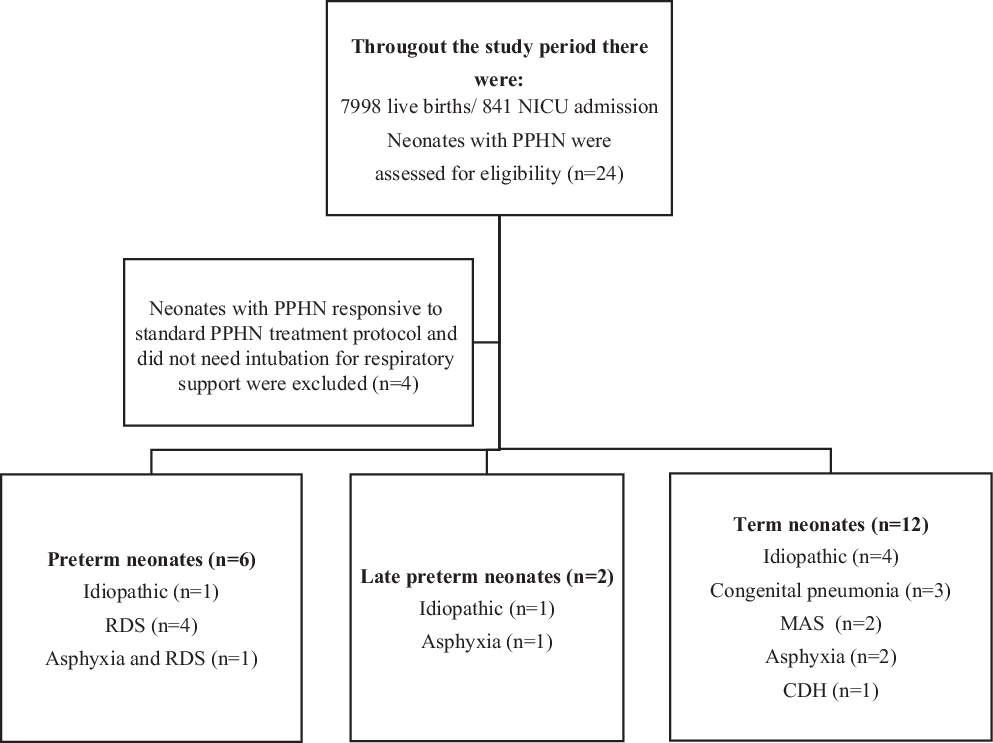
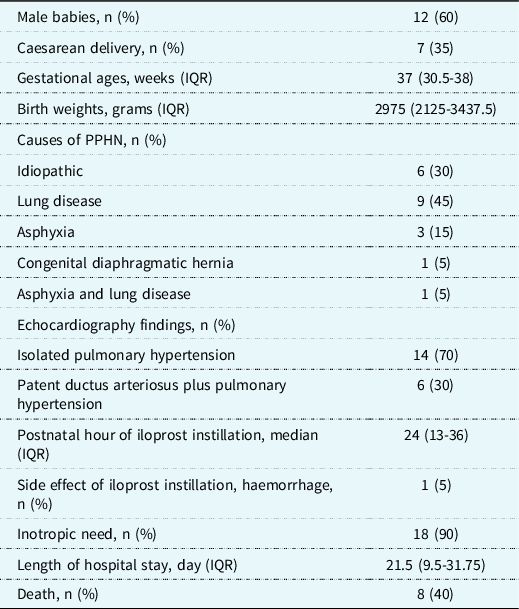
During the study period, there were 7998 live births in our hospital and 841 babies were admitted to our neonatal ICU. Twenty-four neonates with the diagnosis of persistent pulmonary hypertension were eligible for the study, four patients were excluded because of predetermined reasons, and 20 neonates were analysed (Fig 1). The incidence of persistent pulmonary hypertension was found to be 5/1000 live births. The median gestational age and birth weight were found to be 37 (30.5-38) weeks, and 2975 (2125-3437.5) grams, respectively. The most common cause of persistent pulmonary hypertension was lung disease (n, %: 9, 45), and the second most common cause was idiopathic causes (n, %: 6, 30). The underlying causes of lung disease were respiratory distress syndrome in preterm neonates (n = 4); congenital pneumonia (n = 3) and meconium aspiration syndrome (n = 2) in term neonates. Seven (35%) of the neonates were ventilated in intermittent mandatory ventilation mode, and 13 (65%) were ventilated with high-frequency oscillatory ventilation mode. Grade 2 intracranial haemorrhage was detected in one patient before endotracheal iloprost instillation, and there was no increase in haemorrhage after the treatment. A patient, who had massive pulmonary haemorrhage 12 hours before the endotracheal iloprost instillation and whose haemorrhage was stopped with endotracheal surfactant and adrenaline treatment, died two hours after the endotracheal iloprost instillation due to massive pulmonary haemorrhage. Eighteen (90%) of the neonates were taking inotropes for low blood pressure, and 8 (40%) of them died. The demographic and clinical characteristics of the study population are shown in Table 1.
Flowchart for selection of eligible infants in the study.
CDH: congenital diaphragmatic hernia, MAS: meconium aspiration syndrome, NICU: neonatal intensive care unit, PPHN: persistent pulmonary hypertension of the newborn, RDS: respiratory distress syndrome

Demographic and clinical characteristics of the neonates with persistent pulmonary hypertension (n = 20)

IQR: interquartile range, PPHN: persistent pulmonary hypertension of the newborn.
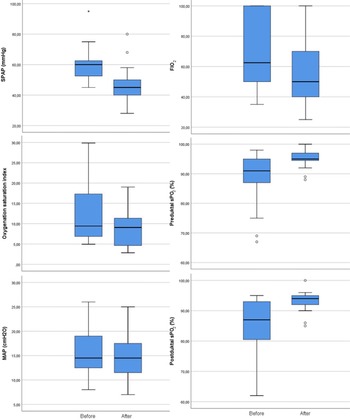
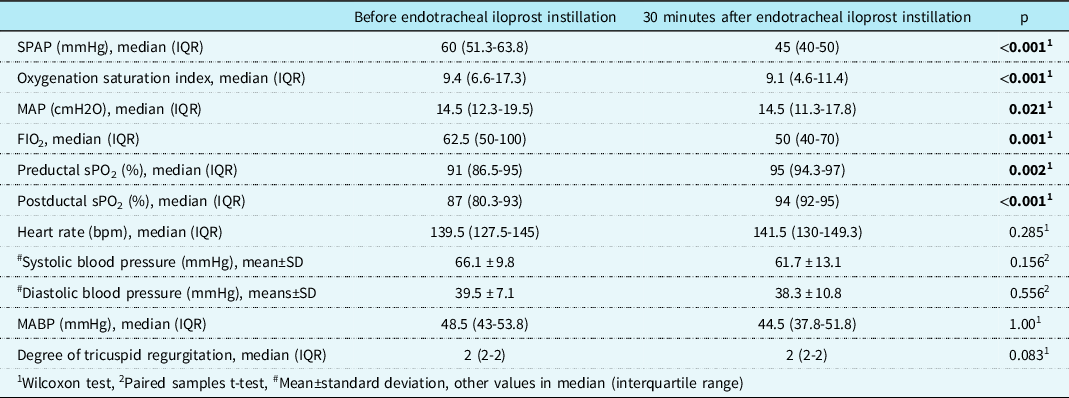
When compared to the values recorded before the endotracheal iloprost instillation; systolic pulmonary artery pressure, OSI, MAP, and FIO2 values were significantly decreased 30 minutes after endotracheal iloprost instillation (p < 0.001, p < 0.001, p = 0.021, p = 0.001, respectively). When compared to the values recorded before the endotracheal iloprost instillation, preductal and postductal SPO2 values were significantly increased 30 minutes after endotracheal iloprost instillation (p = 0.002, p < 0.001, respectively) (Fig 2, Table 2). The effect of endotracheal iloprost on OSI continued for at least two hours for all neonates. There was no significant difference in heart rate, SBP, DBP, and MABP before and after iloprost administration (p = 0.285, p = 156, p = 556, p = 1.00, respectively). Comparison of cardiorespiratory findings before and after the endotracheal iloprost administration is shown in Table 2.
Systolic pulmonary artery pressure, oxygenation saturation index, mean airway pressure, fraction of inspired oxygen, preductal and postductal sPO2 before and after endotracheal iloprost instillation.
FIO2: fraction of inspired oxygen, MAP: mean airway pressure, SPAP: systolic pulmonary artery pressure, sPO2: venous oxygen saturation

Comparison of cardiorespiratory findings before and after endotracheal iloprost administration (n = 20)

FIO2: fraction of inspired oxygen, IQR: interquartile range, MABP: mean arterial blood pressure, MAP: mean airway pressure, SPAP: systolic pulmonary artery pressure, sPO2: venous oxygen saturation, SD: standard deviations.
Discussion
We found that endotracheal instillation of iloprost in neonates with pulmonary hypertension was both effective and safe as a rescue therapy. There was a dramatic response to endotracheal iloprost among neonates who were resistant to the standard treatment protocol applied in our neonatal ICU for persistent pulmonary hypertension. A significant reduction occurred in systolic pulmonary artery pressure after endotracheal instillation of iloprost. While the need for respiratory support decreased in terms of MAP, FIO2, and OSI, both preductal and postductal SPO2 increased, which means that the endotracheal iloprost successfully dilated pulmonary vessels and improved lung mechanics. Heart rate and blood pressure were not affected by the instillation of endotracheal iloprost. It could be concluded that endotracheal iloprost was well tolerated, and no adverse cardiocirculatory events and haemodynamics swings occurred. The effects of treatment on oxygenation were sustained at least two hours without any systemic side effects, but it was not possible to find out whether the death of a patient, whose pulmonary haemorrhage was stopped before endotracheal iloprost instillation and who died because of massive pulmonary haemorrhage after endotracheal iloprost, was an incidental event or a drug-induced side effect. Therefore, endotracheal iloprost should not be used in cases with a history of pulmonary haemorrhage, as iloprost is known to be a potent vasodilator, and there is a risk of recurrent pulmonary haemorrhage.
The inhaled usage of pulmonary vasodilators for treatment of pulmonary hypertension was shown to have numerous advantages, such as reducing systemic adverse effects by enhancing pulmonary specificity, improving ventilation/perfusion matching by dilating vessels and supplying ventilated regions, and potentially reducing drug cost by achieving higher local drug concentrations at a lower overall dose. Reference Hill, Preston and Roberts28 Several studies demonstrated that inhaled iloprost was an effective and safe treatment in both preterm and term infants with persistent pulmonary hypertension, improved oxygenation and hypoxemia refractory to inhaled nitric oxide without significant complications requiring treatment termination. Reference Ehlen and Wiebe10,Reference De Luca, Zecca, Piastra and Romagnoli11,Reference Eifinger, Sreeram and Mehler29–Reference Gokce, Kahveci, Turkyilmaz, Adakli and Zeybek32 In a recent review, it was indicated that iloprost was preferred as a second-line treatment after inhaled nitric oxide failure or in case of inhaled nitric oxide unavailability, as it was a well-known vasodilator characterised by synergy with inhaled nitric oxide, and optimal safety profile. Reference Fortas, Di Nardo, Yousef, Humbert and De Luca4
Direct lung administration by inhalation route is an advantage of iloprost, but drug delivery during high-frequency oscillatory ventilation was reported to be negligible, so use of nebulised iloprost might not be possible during this form of ventilation. Reference Fortas, Di Nardo, Yousef, Humbert and De Luca4,Reference De Luca, Zecca, Piastra and Romagnoli11 In such a case, it would be an option to administer a prostacyclin analogue endotracheally for persistent pulmonary hypertension, and the efficacy of instillation of both endotracheal iloprost and epoprostenol was shown in case reports. Reference Fortas, Di Nardo, Yousef, Humbert and De Luca4,Reference Ehlen and Wiebe10,Reference De Luca, Zecca, Piastra and Romagnoli11,Reference De Jaegere and van den Anker18 Additionally, endotracheal instillation of prostacyclin analogues was found to be a safe treatment option for cases of resistant persistent pulmonary hypertension cases with no overt side effects and repeated or continuous administration was reported to lead to a sustained response. Reference Ehlen and Wiebe10,Reference De Luca, Zecca, Piastra and Romagnoli11,Reference De Jaegere and van den Anker18
To our knowledge, this is the first study that evaluated the efficacy and safety of endotracheal iloprost instillation in a large group of cases of treatment-resistant persistent pulmonary hypertension. The most appropriate treatment for persistent pulmonary hypertension is still unknown, and under investigation, and the main goal of neonatologists is to keep infants with persistent pulmonary hypertension alive. Therefore, we think that every treatment option that could increase survival chance should be tried for this group of patients. Iloprost is a widely available, relatively cheap, well-known, and frequently used pulmonary vasodilator. As we found out, endotracheal iloprost instillation was an effective and safe treatment option for persistent pulmonary hypertension, and it could be concluded that, whatever the application route is, iloprost is a good choice for the treatment of persistent pulmonary hypertension. Reference Shivanna, Gowda, Welty, Barrington and Pammi2,Reference Fortas, Di Nardo, Yousef, Humbert and De Luca4
Our study has some methodological limitations. Firstly, the retrospective design of the study did not allow us to evaluate the efficacy and safety of repeated doses as well as future effects of endotracheal instillation of iloprost in neonates, such as long-term neurodevelopmental and pulmonary outcomes, in addition to short-term outcomes. Secondly, the number of neonates included in the study was small, and the patients were heterogeneous in terms of persistent pulmonary hypertension aetiology and gestational age. Thirdly, the neonates included in the study were receiving all the available medical therapies for persistent pulmonary hypertension before inclusion into the study, so it was not possible to state that endotracheal iloprost improved the patients by itself. The final limitation was that we used the dose we determined according to gestational age, which was not corrected for the weights of the neonates, because the required dose for endotracheal iloprost was not predetermined.
Conclusion
In conclusion, endotracheal installation of iloprost, a prostacyclin analogue, is a promising therapy for persistent pulmonary hypertension, and it seems effective and safe. Endotracheal iloprost instillation can be tried as a life-saving treatment in cases with treatment-resistant persistent pulmonary hypertension precautiously. In view of our findings, further studies with larger groups of more homogeneous neonates should be conducted to fully elucidate the efficacy and safety of endotracheal installation of iloprost.
Acknowledgements
None.
Financial support
This research received no specific grant from any funding agency, commercial or not-for-profit sectors.
Conflicts of interest
None.
Ethical standards
The authors assert that all procedures contributing to this work comply with the ethical standards of the relevant national guidelines on human experimentation (Harran University Clinical Research Ethics Committee) and with the Helsinki Declaration of 1975, as revised in 2008, and has been approved by the institutional committees (Harran University Clinical Research Ethics Committee, date: 26.04.2021, number: 21.09.20).
Informed consent
Informed consent could not be obtained because the study was retrospective.