Introduction
Cistaceae is a plant family widely represented in the Mediterranean shrublands (Allen, Reference Allen and Woodward2009). This plant family is characterized by seeds with hard coats that impose physical dormancy and, consequently, prevent germination until seed coats are softened and seed imbibition takes place (Baskin and Baskin, Reference Baskin and Baskin2000). Dormancy release is possible by seed-coat scarification, and in fire-prone habitats can be related to the heat produced during fires (Aronne and Mazzoleni, Reference Aronne and Mazzoleni1989; Thanos et al., Reference Thanos, Georghiou, Kadis and Pantazi1992; Keeley et al., Reference Keeley, Pausas, Rundel and Bradstock2011).
Fire plays a crucial role in Mediterranean ecosystems, controlling plant regeneration, especially in the case of seeders, which rely on their seeds for survival (Moreira and Pausas, Reference Moreira and Pausas2012). Cistaceae usually form persistent soil seed banks, which germinate massively after fire when seedlings find a favourable environment without competitors (Arianoutsou and Margaris, Reference Arianoutsou and Margaris1981; Trabaud, Reference Trabaud, Moreno and Oechel1994). Seeders are supposed to germinate promptly in response to fire cues under a wide range of environmental conditions. This high capacity to germinate and emerge early in the first rainy season after a fire, regardless of other conditions, endows an ecological advantage because these species would be the first ones to establish (De Luis et al., Reference De Luis, Verdú and Raventós2008b). Furthermore, seedlings of seeders show traits that allow them to deal with water-limited and highly variable conditions (Vilagrosa et al., Reference Vilagrosa, Hernández, Luis, Cochard and Pausas2014).
Germination of most hardseeded species has been described under a wide range of temperatures in light as well as in darkness once the seed becomes permeable (Thanos and Georghiou, Reference Thanos and Georghiou1988; Baskin and Baskin, Reference Baskin and Baskin2000). However, to our knowledge there is no information about the germination response of these species to water conditions after the seed coats are softened. In Mediterranean areas, where precipitation is highly variable and droughts are frequent, water availability rather than temperature controls plant regeneration (Hadas, Reference Hadas and Khan1982; Koller and Hadas, Reference Koller, Hadas, Lange, Nobel, Osmond and Ziegler1982). In these environments with seasonal climate, germination occurs after the first rains in autumn (Espigares and Peco, Reference Espigares and Peco1993; Céspedes et al., Reference Céspedes, Torres, Urbieta and Moreno2012). Duration and timing of the wet season have important consequences for seed germination and recruitment, so that later and shorter wet seasons lead to lower germination and lower richness and diversity of species (Miranda et al., Reference Miranda, Padilla and Pugnaire2009; Céspedes et al., Reference Céspedes, Torres, Urbieta and Moreno2012). Nonetheless, the moisture availability required for germination of most seeder species is currently unknown. In Mediterranean shrublands, germination patterns are closely related to post-fire precipitation (Moreno et al., Reference Moreno, Zuazua, Pérez, Luna, Velasco and de Dios2011). During wet years germination is highest and occurs only during the first post-fire year. However, during dry years germination is lower and is extended over several years (Moreno et al., Reference Moreno, Zuazua, Pérez, Luna, Velasco and de Dios2011).
Germination sensitivity to water stress can regulate timing of germination and consequently improve reproductive success. Each species is thought to have a critical water potential requirement for germination (Bewley et al., Reference Bewley, Bradford, Hilhorst and Nonogaki2013; Baskin and Baskin, Reference Baskin and Baskin2014). Germinating too early can result in seedlings being exposed to a high number of threats, but seeds that germinate too late are exposed to predation for longer periods (Donohue et al., Reference Donohue, de Casas, Burghardt, Kovach and Willis2010). In the Mediterranean, early germination may ensure the appropriate root development for facing up to summer drought (Moreno and Oechel, Reference Moreno and Oechel1992; De Luis et al., Reference De Luis, Verdú and Raventós2008b) but also can lead to seedlings being exposed to frosts (Quintana et al., Reference Quintana, Cruz, Fernández-González and Moreno2004) or unpredictable torrential rainfalls (De Luis et al., Reference De Luis, Raventós and González-Hidalgo2006). Therefore, a fine tuning between environmental conditions and germination patterns can improve plant fitness by ensuring seedling survival (Fenner and Thompson, Reference Fenner and Thompson2005; Donohue et al., Reference Donohue, de Casas, Burghardt, Kovach and Willis2010).
In addition to the environmental factors that control germination, other reproductive traits, such as seed mass, can change the germination tolerance to these environmental factors. Seed size is one of the most studied reproductive traits, and it has been studied profusely in relation to germination patterns. Results from such work, however, have not led to general emerging patterns (Shipley and Parent, Reference Shipley and Parent1991; Milberg et al., Reference Milberg, Andersson, Elfverson and Regnér1996; Leishman et al., Reference Leishman, Wright, Moles, Westoby and Fenner2000). Small seeds can show delayed germination since they remain in the soil seed bank for a longer time and large seeds suffer from higher post-dispersal predation and, consequently, need to germinate rapidly (Janzen, Reference Janzen1971; Venable and Brown, Reference Venable and Brown1988; Rees, Reference Rees1994). Although some supporting results have been found in grasslands (Grime et al., Reference Grime, Mason, Curtis, Rodman, Band, Mowforth, Neal and Shaw1981), not so in arid environments (Jurado and Westoby, Reference Jurado and Westoby1992; Leishman and Westoby, Reference Leishman and Westoby1994), or for tropical trees, for which the opposite was found (Norden et al., Reference Norden, Daws, Antoine, González, Garwood and Chave2009). In post-fire Mediterranean environments, individuals of Cistus species with larger seeds must be favoured, because seed mass was positively correlated with germination percentages after heat shock (Delgado et al., Reference Delgado, Serrano, López and Acosta2001; Tavşanoğlu and Çatav, Reference Tavşanoğlu and Çatav2012). On the other hand, how seed size is related to the germination response to water stress has been scarcely studied (Kos and Poschlod, Reference Kos and Poschlod2008). In the Mediterranean, large-seeded annuals are more abundant in drier grassland communities, and even more so during years with dry autumns (Peco et al., Reference Peco, Rico and Azcárate2009; Azcárate et al., Reference Azcárate, Manzano and Peco2010). Plants from dry habitats seem to be favoured by large seeds and, thus, large seeds are expected to be more tolerant to water stress, but this is not always the case (Leishman et al., Reference Leishman, Wright, Moles, Westoby and Fenner2000). On the other hand, and contrary to the previous argument, a positive relationship between seed size and time to germination can be explained in biophysical terms; small seeds have lower absolute water requirements than bigger ones (Fenner and Thompson, Reference Fenner and Thompson2005). Furthermore, small seeds have a higher surface to volume ratio and, consequently, higher absorption rates than large seeds (Kikuzawa and Koyama, Reference Kikuzawa and Koyama1999).
In this work, we analysed the germination response to water stress of eight Cistaceae species with hard-coated seeds after heat shock, which overcomes physical dormancy, and incubation under different water potentials. The eight species belong to five genera: Cistus, Fumana, Halimium, Helianthemum and Tuberaria, all of them native to the Mediterranean. Cistaceae are abundant in dry habitats where precipitation is highly variable, droughts are frequent and fire occurs periodically. Germination of hard-coated Mediterranean species under water stress, however, has scarcely been studied. Since explanations for the variation in germination responses to water stress can be found in traits of the seeds, we analysed whether seed size is related to the germination sensitivity to water stress of the different species. Therefore, we related the seed mass of these species with the base water potential from the hydrotime model, which characterizes germination sensitivity to water stress.
Materials and methods
Study species and germination experiments
The species studied were Cistus clusii Dunal, Cistus ladanifer L., Cistus populifolius L., Cistus salvifolius L., Fumana ericoides (Cav.) Gand., Halimium viscosum (Willk) P. Silva, Helianthemum apenninum L. (Mill.) and Tuberaria lignosa (Sweet) Samp. Fruits of all species except C. ladanifer were harvested in Serranía Baja de Cuenca (Central-Eastern Spain, province of Cuenca; 39°45′–39°54′N and 1°20′–1°35′W). C. ladanifer fruits were harvested in Quintos de Mora (Central Spain, province of Toledo; 39°23′N and 4°00′W). The climate in these areas is Mediterranean, with a mean annual precipitation of around 600 mm and mean annual temperatures between 12.5 and 14.5°C for both sites. Although potential vegetation is holm-oak woods (Quercus rotundifolia Lam.), the landscape is usually dominated by shrublands, which frequently show a high representation of Cistaceae species.
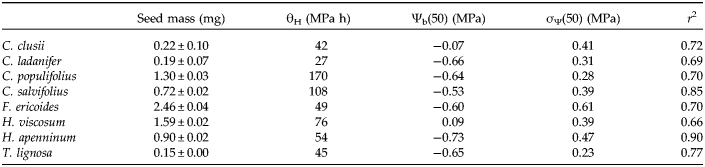
Ripe fruits were collected from at least 30 plants. The capsules were carried to the laboratory where seeds were separated and stored in paper bags under laboratory conditions. One hundred seeds per species were individually weighed and average seed mass was determined (see Table 3). Prior to the germination experiments, seeds were exposed to a heat shock of 100°C for 10 min in an air-forced oven. This temperature and time are commonly found in Mediterranean fire shrublands (Moreno et al., Reference Moreno, Zuazua, Pérez, Luna, Velasco and de Dios2011; Céspedes et al., Reference Céspedes, Torres, Urbieta and Moreno2012) and was the optimal temperature for breaking seed dormancy of most of the studied species (data not shown).
Seeds were germinated at 20°C and 12 h photoperiod, which is optimal for germination of many Mediterranean species (Thanos and Georghiou, Reference Thanos and Georghiou1988; Luna et al., Reference Luna, Pérez, Torres and Moreno2012). Seeds were sown in plastic Petri dishes of diameter 5.5 cm on two sheets of filter paper (Whatman no. 1). Five replicates of 25 seeds were set to germinate for each species. Seeds were germinated under different levels of water stress, by moistening the Petri dishes with 1.2 ml of deionized water or the appropriate polyethylene glycol (PEG) solution to produce five levels of water potential: 0, −0.2, −0.4, −0.6 and −0.8 MPa. The required water potential was produced with PEG 6000 and deionized water (Michel and Kaufmann, Reference Michel and Kaufmann1973). Germination was monitored every 3 d and germinated seeds (those with an emerged radicle) were removed. After 45 d, ungerminated seeds from the different water stress treatments were transferred to germinate in distilled water under the same experimental conditions. The duration of this second germination test also lasted 45 d and germination was registered only at the end. Recovery of germination was determined as the final germination percentage with respect to viable ungerminated seeds at the beginning of this second experiment. At the end of the second germination experiment, the viability of ungerminated seeds was tested by a tetrazolium test. Seeds were cut and incubated in a 1% solution of 2,3,5-triphenyl tetrazolium chloride for 48 h in the dark. Germination data were corrected by viability, i.e. final germination was assessed in relation to viable seeds and not in relation to total number of sown seeds. Seed viability was estimated as the sum of germinated seeds plus stained seeds after the tetrazolium test.
Data analyses
Final germination and time to reach 50% of the final germination (t 50) in PEG solutions, recovery of germination in water and seed viability of each species were tested for the effects of water stress treatments by means of generalized linear models (GLMs) (Lindsey, Reference Lindsey1997). Based on error structure we used a binomial error distribution and logit link function for final germination, recovery of germination and seed viability. In the case of t 50, a Poisson error distribution with identity link function fitted best to the data. When water stress treatment effects were significant, pairwise comparisons among treatments were performed using Bonferroni correction. All statistical analyses were performed using the SPSS Statistics version 19.0 (SPSS, Chicago, Illinois, USA).
Furthermore, the germination response to water stress was described by hydrotime analysis (Bradford, Reference Bradford1990). The hydrotime model is defined as θH = (Ψ − Ψb(g))t g where Ψ is the seed water potential (MPa), Ψb(g) is the base water potential (MPa) defined for a specific germination fraction g, and t g is the time required for germination of percentage g. Base water potential, Ψb, is the minimum water potential permitting germination and the Ψb of individual seeds varies as a normal distribution in the population of seeds (Gummerson, Reference Gummerson1986; Bradford, Reference Bradford1990) with a median Ψb(50) and the corresponding standard deviation σΨb(50). This model assumes that seeds start to germinate when they have accumulated sufficient moisture over time. Hydrotime parameters quantify the speed of germination (θH), the stress tolerance of germination (Ψb) and the uniformity of germination (σΨb) (Bradford and Still, Reference Bradford and Still2004).
Values of θH,, Ψb(50) and σΨb(50) were determined, using repeated probit regression analysis to fit the time courses to the hydrotime model, by means of a program provided by Professor Kent J. Bradford (Bradford, Reference Bradford1990). An increase of θH indicates slower germination rates, i.e. a higher number of days needed for germination. A shift of Ψb to more negative values means that seeds will germinate across a wider range of water potentials. Finally, higher values of σΨb imply greater germination variability. Additionally, we determined the relationship between the germination sensitivity to water stress, as characterized by Ψb(50), and seed mass by least square regression.
Results
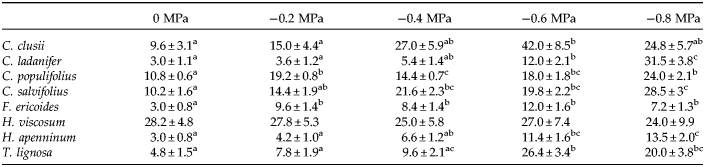
Final germination decreased significantly with water stress in all species except H. apenninum. Furthermore, t 50 also increased with water stress in all cases except for H. viscosum (Table 1). However, despite these general patterns, sensitivity to water stress varied among species (Fig. 1). So, C. clusii and H. viscosum were the species with final germination more sensitive to water stress and the latter species showed the highest t 50 values (Table 2). On the other hand, C. ladanifer was the species with a germination rate more sensitive to water stress, with t 50 values from 3 to 31.5 d (Table 2). Recovery of germination in water was high in all species except H. viscosum and H. apenninum and did not vary among water stress treatments (Table 1, Fig. 1).
Final germination (mean and standard error) of seeds incubated under different water potentials (dark grey bars) and their recovery of germination after being transferred to water (white bars) after exposure to heat shock. Final germination in water (control at 0 MPa) and without heat shock is also represented (light grey bars). Different letters show significant differences among water stress treatments based on pairwise comparisons with Bonferroni correction after GLM analysis. An absence of letters indicates no significant differences amongst treatments.

Results from generalized linear models for final germination (FG) and time to reach 50% germination (t 50) under five water potentials, recovery of germination in water after water stress treatments (Recovery) and seed viability after treatments

t 50 (time to reach 50% of final germination) (mean ± SE) for studied species incubated under different water potentials (0, −0.2, −0.4, −0.6 and −0.8 MPa). Superscripts with different letters show significant differences among water stress treatments from pairwise comparisons with Bonferroni correction (P < 0.05) after GLM analysis. Absence of letters indicates no significant differences amongst treatments

Seed viability was not affected by water stress treatments in three species (i.e. C. clusii, F. ericoides and H. apenninum) that additionally showed the lowest values of viability (Fig. 2). On the contrary, for the rest of the species, seed viability decreased with increasing water stress, especially under the most stressful treatment (Fig. 2).
Seed viability (mean and standard error) after incubation at different water potentials and subsequent recovery in water. Different letters show significant differences among water stress treatments based on pairwise comparisons with Bonferroni correction after GLM analysis. An absence of letters indicates no significant differences amongst treatments.

The hydrotime model fitted the germination patterns quite well, with r 2 between 0.66 and 0.90 (Table 3). θH ranged between 27 and 170 MPa h, Ψb(50) values ranged between 0.09 and −0.73 and the values of σ were large, indicating high germination variability. Median base water potentials Ψb(50) supported results from GLM, showing again that C. clusii and H. viscosum are the most sensitive species to water stress (Table 3). Seed mass also showed a wide range, from 0.15 to 2.46 mg in T. lignosa and F. ericoides, respectively. However, despite the range of Ψb(50) and seed masses found, no relationship between seed mass and sensitivity to water stress (Ψb(50)) emerged (P = 0.87, r = 0.071).
Seed mass (mean ± SE) and parameters of the hydrotime model for seed germination of the studied species under five water potentials (0, −0.2, −0.4, −0.6 and −0.8 MPa)

Discussion
Water stress affected germination of all studied species negatively but varied among species. Additionally, the negative effects of water stress disappeared when water availability was adequate, that is, the recovery of germination was high when water stress was eliminated. This strategy would promote germination under appropriate conditions, allowing a temporal gap between physical dormancy release (after summer fires) and the favourable conditions for establishment in the Mediterranean (autumn and winter). Seed viability, however, decreased in the most stressful treatments in five of the eight studied species.
Consequently, germination of Cistaceae must be closely water controlled, at least after dormancy release by heat shock, since germination decreased considerably with decreasing water potentials. C. clusii and H. viscosum were the most sensitive species while H. apenninum was the most tolerant to water stress. Final germination of H. apenninum was unaffected but its germination rate decreased under water stress. This species must have a higher proportion of soft-coated seeds (i.e. non-dormant) since it showed high germination percentages both without and with heat shock. Thus, the germination response of this species must be tolerant to fire more than fire-stimulated (Luna et al., Reference Luna, Moreno, Cruz and Fernández-González2007) and germination may be controlled by other factors, such as temperature, rather than water (Martin et al., Reference Martin, Grzeskowiak and Puech1995; Tébar et al., Reference Tébar, Gil and Llorens1997).
Despite the importance of water potential in regulating germination (Potter et al., Reference Potter, Ueckert, Petersen and McFarland1986; Flores and Briones, Reference Flores and Briones2001), not many studies have focused on the germination response of Mediterranean wild plants to water potential, especially in the case of hard-coated seed species. Mediterranean annuals showed high tolerance to water stress, with Ψb(50) mean values for 36 species near to −1.0 MPa (Köchy and Tielbörger, Reference Köchy and Tielbörger2007). Mediterranean conifers also showed high tolerance to water stress, with germination at −1.5 MPa for Pinus brutia and P. halepensis (Thanos and Skordilis, Reference Thanos and Skordilis1987; Boydak et al., Reference Boydak, Dirik, Tilki and Çalikoglu2003). Shrub species with hard-coated seeds do not show consistent results. While Anthyllis cytisoides showed a high tolerance to water stress, even germinating at −2 MPa (Ibáñez and Passera, Reference Ibáñez and Passera1997), Genista scorpius emerged as highly sensitive to water stress, with germination considerably reduced under −0.05 MPa (Bochet et al., Reference Bochet, García-Fayos, Alborch and Tormo2007). In these studies, seeds were previously scarified but no heat shock or other fire cues were involved. Although both species are Fabaceae and seem to show similar ecological characteristics, they have very different water potential requirements for germination. In the case of unscarified seeds of C. ladanifer, germination was reduced from 30 to 20% under water potentials of 0 and −0.5 MPa, respectively (Pérez-Fernández et al., Reference Pérez-Fernández, Calvo-Magro and Ferrer-Castán2006). Our results confirm that germination of Cistaceae after a heat shock shows a high spectrum of base water potentials, but always above −0.75 MPa.
However, despite the fact that germination was not very tolerant of water stress, all species showed some germination across a wide range of water potentials (from 0 to −0.8 MPa). This indicates the possibility of some germination under a wide variety of conditions, probably related to the colonizing character of these species after fire occurrence. Although only a small fraction of seeds is able to germinate under the most stressful water conditions, it may ensure early post-fire recovery of the species. Fire generates a narrow window for plant establishment and those seeds that germinate first will have more time for growth and therefore will be more able to survive the rigours of the next first post-fire summer. The ability to germinate at low water potentials must be essential for species from dry habitats (Evans and Etherington, Reference Evans and Etherington1990; Flores and Briones, Reference Flores and Briones2001; Bochet et al., Reference Bochet, García-Fayos, Alborch and Tormo2007).
Germination recovery in water was high and without differences after water potential treatments. This means that these species may be able to germinate once soil moisture conditions are adequate, even after a 45-day period of water stress. This ability of seeds to remain partially hydrated without germination has been considered as a type of dormancy and seems to be an appropriate response in dry habitats (Hegarty, Reference Hegarty1977). In these water-limited environments, seeds in the soil become partially hydrated during a rain episode, after which seeds start to dry until a new rain episode occurs (Karssen, Reference Karssen and Khan1982). Cycles of seed hydration–dehydration and seed priming can also increase final germination percentages and rates (Black et al., Reference Black, Halmer and Bewley2006; Bewley et al., Reference Bewley, Bradford, Hilhorst and Nonogaki2013) and their effects are cumulative (Baskin and Baskin, Reference Baskin and Baskin1982). These cumulative effects have been related to the ability of seeds to retain the physiological changes resulting from seed hydration during periods of dehydration, which has been called ‘seed hydration memory’ (Dubrovsky, Reference Dubrovsky1996). The additive effects of seed hydration periods would permit acceleration of seed germination under natural conditions of soil water fluctuations, i.e. reducing the time between a rain event, after a dry period, and germination (Dubrovsky, Reference Dubrovsky1996; Adams, Reference Adams1999). However, the exposure of partially imbibed seeds to periods of drought can also entail a hazard, because when drought is too intense seeds may lose viability.
The length and frequency of the hydration periods determine whether effects on germination are positive or negative (Black et al., Reference Black, Halmer and Bewley2006; Bewley et al., Reference Bewley, Bradford, Hilhorst and Nonogaki2013). In the present work, seeds of five species suffered viability loss with water stress, as already found for C. ladanifer (Chamorro et al., Reference Chamorro, Parra and Moreno2016). Seed viability loss occurs when the hydration of seeds is enough to start cell division but not enough to finish the germination process (Berrie and Drennan, Reference Berrie and Drennan1971). Only the seed viability of C. clusii, F. ericoides and H. apeninnum did not decrease with water stress treatments, and these showed the lowest seed viability percentages. This probably means that there was not sufficient water to trigger the metabolic process belonging to the germination phase III (Bewley et al., Reference Bewley, Bradford, Hilhorst and Nonogaki2013) .
We did not find any relationship between germination sensitivity to water stress and seed size. Similarly, Kos and Poschlod (Reference Kos and Poschlod2008) did not find a correlation between seed size and Ψb(50) of 28 species from the Kalahari savannah. Overall, large seeds are considered to be adaptive under severe conditions (Willson, Reference Willson1983; Westoby et al., Reference Westoby, Leishman and Lord1996), and allow seedling establishment under a wider range of field conditions (Venable and Brown, Reference Venable and Brown1988; Rees, Reference Rees1996) because large seeds produce large seedlings with higher levels of survival (Moles and Westoby, Reference Moles and Westoby2004; Metz et al., Reference Metz, Liancourt, Kigel, Harel, Sternberg and Tielbörger.2010). Accordingly, plants in dry habitats may have large seeds, which would improve the establishment of their seedlings (Baker, Reference Baker1972; Leishman and Westoby, Reference Leishman and Westoby1994). In Mediterranean grasslands the abundance of large-seeded annuals increases in warmer and more-arid communities (Azcárate et al., Reference Azcárate, Manzano and Peco2010), and large-seeded species appear to have an advantage in years with a dry autumn (Peco et al., Reference Peco, Rico and Azcárate2009). However, other studies have not found support for the association between large seeds and dry habitats (Mazer, Reference Mazer1989; Long and Jones, Reference Long and Jones1996), nor for a greater tolerance of large seeds to drought (Schütz et al., Reference Schütz, Milberg and Lamont2002; Pérez Fernández et al., Reference Pérez-Fernández, Calvo-Magro and Ferrer-Castán2006). The simplest explanation for the differences in responses of the seeds to varying water availability may lie in their morphology. For example, small seeds, or those with hairs or wings, may be better able to absorb water under dry conditions (Salisbury, Reference Salisbury1974; Wilson and Witkowski, Reference Wilson and Witkowski1998; Kikuzawa and Koyama, Reference Kikuzawa and Koyama1999). However, complex interactions between life-traits and environmental conditions or the evolutionary history of these species may hide any relationship between seed size and germination sensitivity to water stress or other environmental conditions.
In conclusion, germination of Cistaceae is reduced and delayed under water stress once physical dormancy is released by heat shock. Nevertheless, germination capacity is recovered once water availability returns to adequate levels. These responses suggest that post-fire germination is water-controlled, which may represent an ecological advantage in Mediterranean habitats where fire usually occurs in summer. This mechanism allows physical dormancy release after fires in summer, and postpones germination until water conditions are favourable in autumn or winter, ensuring, in this way, seedling survival. On the other hand, a small fraction of seeds may germinate even under the most severe conditions of water stress, which may also represent an ecological advantage because early germination allows fast occupation of space and resources in environments disturbed by fire. This dual strategy may reduce the risk for establishment; while a few seeds can germinate early under unfavourable water conditions, most of the seeds, less tolerant to water stress, remain stored in the soil until water conditions are more propitious. This second germination flush may allow replacement of the early germinated seeds when conditions become more adverse and seedlings die. Indeed, the observed variations in germination sensitivity to water stress within and across species must be seen as both a bet-hedging strategy, by reducing the risk of seedling death (Venable, Reference Venable1985; Philippi and Seger, Reference Philippi and Seger1989), and a process that favours the co-existence of different species (Daws et al., Reference Daws, Garwood and Pritchard2006; De Luis et al., Reference De Luis, Raventós, Wiegand and Carlos González-Hidalgo2008a). Finally, although species showed differential sensitivity to water stress, this was not correlated with seed size. It appears that there is still a long way to go to elucidate the factors and mechanisms explaining drought tolerance, and, consequently, new approaches are necessary.
Acknowledgements
We thank Viviana Amigo for her collaboration in the germination experiment and Ángel Velasco for his technical assistance. Thanks to Manuel Hernández, Costas Thanos and three anonymous reviewers for their useful comments and suggestions. We thank Kent J. Bradford for providing the program for the hydrotime analysis.
Financial support
This work was supported by the University of Castilla-La Mancha.
Conflicts of interest
None.