1. Introduction
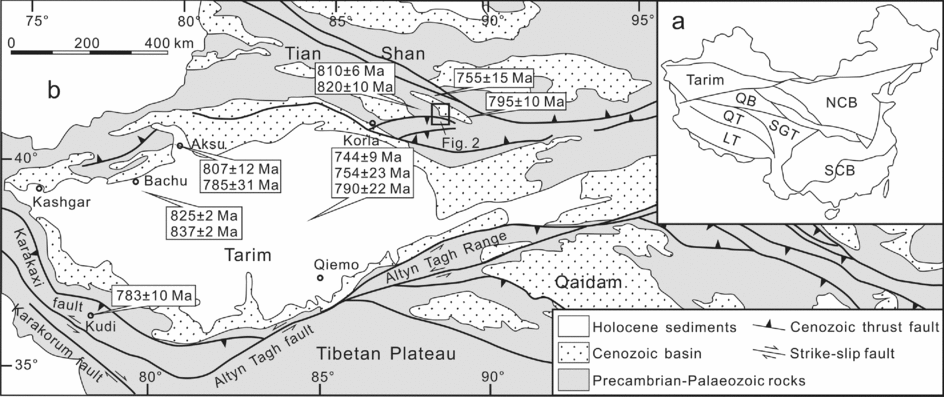
The Tarim Block, one of major Asian blocks, is located in NW China, with the Tian Shan mountains to the north and Kunlun and Altyn mountains to the south (Fig. 1). It is generally accepted that the Tarim Block joined the proposed supercontinent Rodinia at the beginning of Neoproterozoic time, and remained a part of Rodinia during the Neoproterozoic. Although the Tarim Block is believed to contain records of Neoproterozoic rifting events that broke up Rodinia, there is uncertainty about its history of assembly, configuration and breakup (Chen et al. Reference Chen, Xu, Zhan and Li2004; Zhu et al. Reference Zhu, Zhang, Shu, Lu, Su and Yang2008).
(a) Main tectonic elements of China. NCB: North China Block, SCB: South China Block, SGT: Songpan–Ganzi terrane, QB: Qaidam Basin, QT: Qiangtang terrane, LT: Lhasa terrane (modified from Li et al. Reference Li, Liu, Wang, Yan, Guo, Zhang, Zheng, Jiang, Wang and Chu2007). (b) Simplified tectonic map of the Tarim Block and its surrounding areas in NW China (modified from Yin & Nie, Reference Yin, Nie, Yin and Harrison1996).

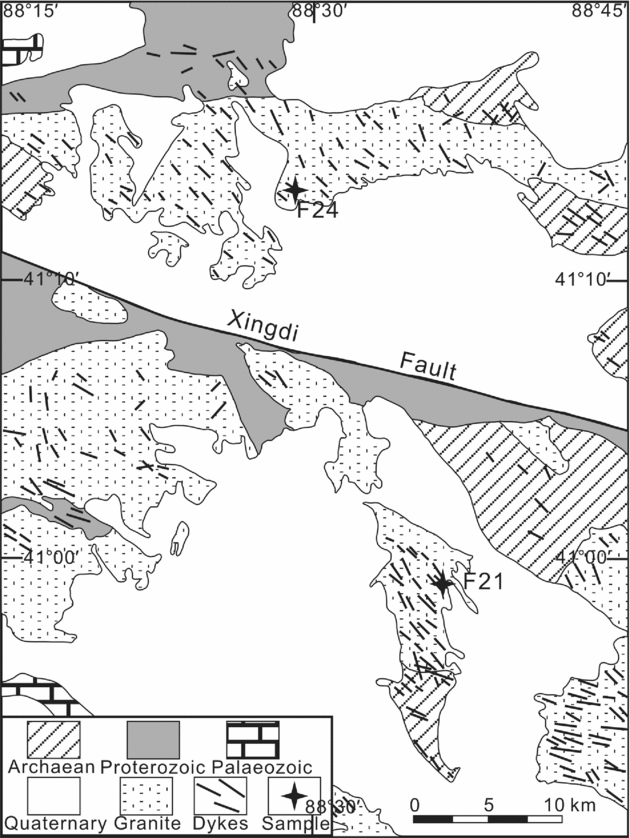
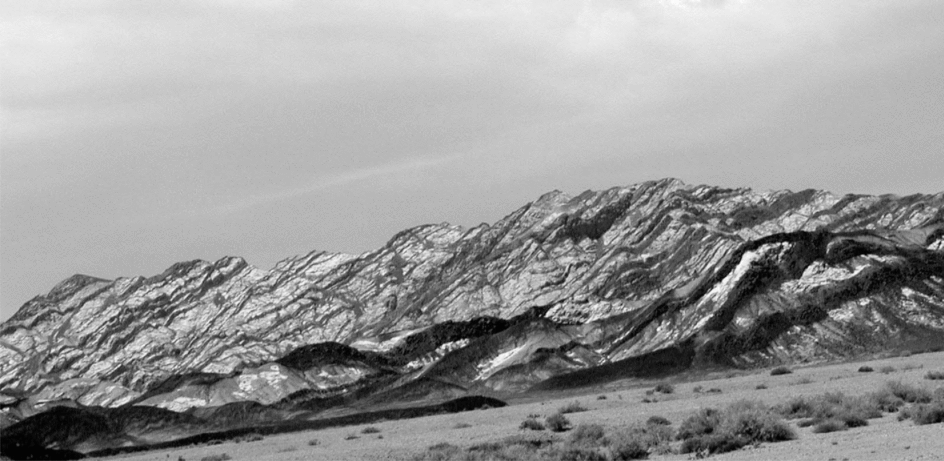
The Kuluketage region is located in the northeastern Tarim Block, with excellent geological exposure over a region c. 100–250 km wide and c. 500 km long (Zhang et al. Reference Zhang, Li, Li, Lu, Ye and Li2007b; Zhu et al. Reference Zhu, Zhang, Shu, Wan, Lu, Wang, Yang and Su2007). The Kuluketage diabase dyke swarm comprises a sequence of sub-parallel dykes, which are equally distributed on both sides of the Xingdi strike fault (Fig. 2). The dyke swarm intrudes into the Archaean and Proterozoic granitic rocks. The black mafic dykes interlace with the white granitic rocks, forming a very special geomorphological landscape, the ‘zebra pattern’ landscape (Fig. 3). The Kuluketage diabase dyke swarm is NNW-striking and nearly vertically-dipping or slightly SE-dipping, indicating that the dykes have not rotated since intrusion (Xinjiang BGMR, 1993, pp. 1–20). The total number of dykes exceeds several thousand, with widths varying from <1 m to several metres. Lengths range from several tens of metres to several hundreds of metres. Most dykes have distinct chilled margins at their contacts with the country rocks.
Geological sketch map of the Kuokesu area, NE Tarim Block (modified after Xinjiang BGMR, 1993). Sampling locations are also shown.

The Kuluketage diabase dyke swarm. The black mafic dykes interlace with the white granitic rocks, forming the very special ‘zebra pattern’ geomorphological landscape (photograph by Liangshu Shu; a colour version of this figure is given in Appendix 1, available online at http://journals.cambridge.org/geo).

There have been several prior studies of the geochemistry and isotope geochronology of the dyke swarm. Zhang, Guo & Liu (Reference Zhang, Guo and Liu1998) reported an emplacement age based on whole-rock K–Ar analysis of four mafic dyke samples. They derived an 40Ar/36Ar–40K/36Ar isochron age of 282 Ma; however in a subsequent paper (Liu et al. Reference Liu, Zhang, Guo, Huang and Mu1999) the vacuum was reportedly only 0.4–0.5×10⁻⁶ Pa; inappropriate for the 40Ar/36Ar–40K/36Ar isochron method which requires a vacuum below 10−8 Pa. In addition, the whole-rock K–Ar method is notoriously inaccurate for dating old rocks, due to the potential for Ar loss. Without any step-heating data, it is impossible to know to what extent ‘ages’ were partially or completely reset by later reheating or low-temperature alteration. Moreover, a mantle plume was present during the Permian below Central Asia (Zhou et al. Reference Zhou, Lesher, Yang, Li and Sun2004; and references therein), so this Permian emplacement age may represent a thermal resetting event. The most important thing is that the age is in conflict with our field observation that mafic dykes do not intrude into Ordovician rocks around the area.
Later, Zhang et al. (Reference Zhang, Guo, Liu and Liu2004) presented data on the isotope compositions of He and Ar in the mafic dyke rocks, which were shown to reflect mixtures between enriched mantle and upper crust, while Jiang et al. (Reference Jiang, Jiang, Ye, Xia and Lu2005) reported Nd, Sr, Pb isotopic data, which showed that the diabase dykes had suffered crustal contamination.
Thus, there is uncertainty as to the age of the Kuluketage diabase dyke swarm. Zhang et al. (Reference Zhang, Li, Li, Lu, Ye and Li2007b) recently described the dyke swarm as ‘numerous mafic dykes of unknown ages’. As a result, we collected two samples (F21 and F24, Fig. 2) in order to determine the age of emplacement of these dykes, and to pave the way for further study of the tectonic evolution of the region.
2. Analytical method
U–Th–Pb dating was performed on zircons on the SHRIMP II at the Beijing SHRIMP Center of the Chinese Academy of Geological Sciences following procedures summarized by Williams (Reference Williams1998). Cathodoluminescence (CL) images of zircons were prepared prior to analysis. Sri Lankan gem zircon standard SL13 and the Australian National University zircon standard TEMORA 1 (Black et al. Reference Black, Kamo, Allen, Aleinikoff, Davis, Korsch and Foudoulis2003) were used respectively as the calibration standard and the internal standard. Common Pb corrections were made using the measured 204Pb. Isotopic data of our two samples are shown in Appendix 2, available online at http://journals.cambridge.org/geo.
3. Results
Two samples from the Kuluketage diabase dyke swarm were collected for U–Pb zircon dating: F21 (N40°59′07″, E088°36′17″) and F24 (N41°13′05″, E088°29′04″). Each sample, initially weighing ~10 kg, was crushed for mineral separation. After the heavy non-magnetic fractions had been concentrated by conventional magnetic and density techniques, representative zircons were extracted by hand-picking under a binocular microscope.
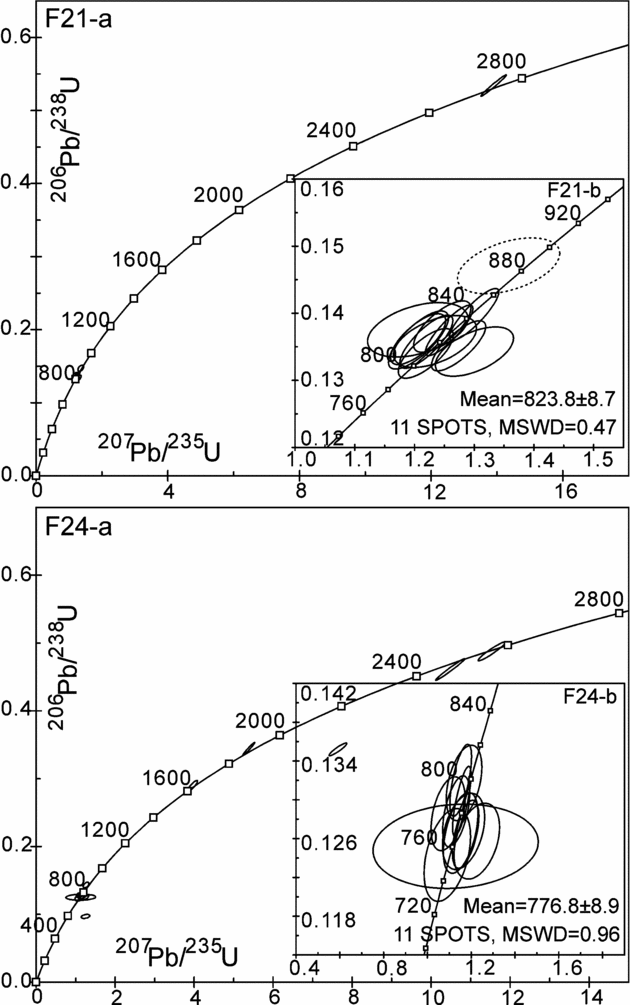
F21 lies south of the Xingdi Fault and consists of augite (45%), plagioclase (50%), and some chlorite. Plagioclase is partly sericitized and kaolinized. Zircon grains from this sample are typical euhedral magmatic grains with fine internal zonation. A few grains contain small dark inherited cores visible under CL. All zircons are transparent and colourless with maximum length up to 150 μm and length-to-width ratios of 2:1 to 3:1. 13 grains were analysed, of which 11 grains produce a simple concordant population with a mean 206Pb–238U age of 823.8±8.7 Ma (MSWD = 0.47, Fig. 4), U concentrations range from 141 to 601 ppm, Th ranges from 86 to 216 ppm, and Th/U ratios range from 0.24 to 0.63. Spot 12.1 gives an older age, while Spot 9.1 is slightly older than the majority of samples, probably due to the influence of an older core (Appendix 2).
U–Pb SHRIMP concordia diagrams for zircons from F21 and F24.

F24 was collected north of the Xingdi Fault and comprises augite (35%), plagioclase (60%) and some chlorite, with euhedral plagioclase in a classic ophitic texture. Zircons from this sample are similar to those of F21, but a little smaller in size and somewhat fragmented. Out of the 18 grains analysed, eleven spots combine to give an average 206Pb–238U age of 776.8±8.9 Ma (MSWD = 0.96, Fig. 4) with U concentrations ranging from 66 to 389 ppm, Th from 57 to 501 ppm, and Th/U ratios from 0.69 to 1.38. Another six analyses yield older ages, and one was younger. The significantly older ages are produced by inherited grains with the exception of Spot 16.1 which may be slightly influenced by an older core. The significantly younger 206Pb–238U age of c. 597 Ma probably results from Pb loss (Appendix 2).
From the ages of the zircon crystals, we infer that the Kuluketage diabase dyke swarm in Tarim was emplaced in Neoproterozoic time. Due to variable crustal contamination, Nd model ages (of 1.86 Ga, 2.21–3.10 Ga, 3.69 and 3.92 Ga; Jiang et al. Reference Jiang, Jiang, Ye, Xia and Lu2005) and U–Pb SHRIMP ages of inherited zircons (four of 2471–2731 Ma, and three of 1496–1856 Ma, Appendix 2) reflect the age of the country rocks (Hu et al. Reference Hu, Jahn, Zhang, Chen and Zhang2000). Before discussing the relationship between the Neoproterozoic ages of the Kuluketage diabase dyke swarm and breakup of Rodinia, we briefly review previous work in Tarim.
4. Previous research on Rodinia in Tarim
Based on a preliminary tectono-stratigraphic analysis, Li, Zhang & Powell (Reference Li, Zhang and Powell1996) suggested that the Tarim Block may have been adjacent to the Kimberley region during the Early Neoproterozoic. Further research indicated that Late Mesoproterozoic to Middle Neoproterozoic tectono-thermal events could be subdivided into two major periods (Zhang et al. Reference Zhang, Lu, Yu and Ye2007a; Lu et al. Reference Lu, Li, Zhang and Niu2008). The first period of events (1.05–0.90 Ga) was the Tarimian (Grenville) Orogeny and reflected a compressional regime corresponding to the final assembly of Rodinia. This orogeny, being a milestone in the Precambrian evolution of the Tarim Block and surrounding terranes, and an important connection with South China and other blocks, was reportedly documented in several places including the Qaidam Massif, Central Tarim, and the Western Kunlun Range (Li et al. Reference Li, Song, Wu, Wang, Li and Zheng2005; Zhang et al. Reference Zhang, Li, Li, Lu, Ye and Li2007a; Lu et al. Reference Lu, Li, Zhang and Niu2008).
The second period of events lasted from 0.84 to 0.74 Ga and reflected rifting related to breakup of Rodinia. Recently, several Neoproterozoic igneous rocks have been reported from the Tarim Block, including the c. 825±2 and 837±2 Ma gabbro from the Wajilitag mafic intrusive complex in western Tarim (Li et al. Reference Li, Jia, Hu, Huang, Zeng and Tan1999), the c. 807±12 or 785±31 Ma mafic dyke swarm which is intruded into the Aksu blueschist in NW Tarim (Chen et al. Reference Chen, Xu, Zhan and Li2004; Zhan et al. Reference Zhan, Chen, Xu, Wang and Faure2007; Zhang L. F. pers. comm.), the c. 755±15 Ma Beiyixi volcanic rocks in Xinger, NE Tarim (Xu et al. Reference Xu, Jian, Zheng, Zou, Zhang and Liu2005), the c. 744±9, 754±23 and 790±22 Ma alkaline diorites in central Tarim (Guo et al. Reference Guo, Yin, Robinson and Jia2005), the c. 783±10 Ma alkaline bimodal intrusive complex (gabbro–granite) south of Tarim (Zhang et al. Reference Zhang, Li, Li, Ye, Wang and Guo2006), the c. 810±6 Ma carbonatite and plagioclase-bearing pyroxenite from the Qiganbulake mafic–ultramafic–carbonatite complex (QMC), the c. 820±10 Ma Xingdi granodiorite and the c. 795±10 Ma Taiyangdao granite in Kuluketage, NE Tarim (Zhang et al. Reference Zhang, Li, Li, Lu, Ye and Li2007b). Geochronological and geochemical studies of these igneous rocks show that they were most likely related to the breakup of Rodinia. These and other data point to major episodic igneous events during the Neoproterozoic in South China, Australia and many other parts of the Rodinia continent (Li et al. Reference Li, Li, Kinny, Wang, Zhang and Zhou2003; Baldo et al. Reference Baldo, Casquet, Pankhurst, Galindo, Rapela, Fanning, Dahlquist and Murra2006; Ernst et al. Reference Ernst, Wingate, Buchan and Li2008; Li, Li & Li, Reference Li, Li and Li2008; and references therein).
The breakup of the Rodinia supercontinent may have been initiated by upwelling of a mantle plume, evidenced by massive intrusion of mafic rocks. The Kuluketage diabase dyke swarm offers such a good opportunity for this study which has provided important and precise geochronological data as evidence; based on new data the relationship between the Tarim Block and other continental fragments is also discussed later in the text.
5. Discussion and conclusion
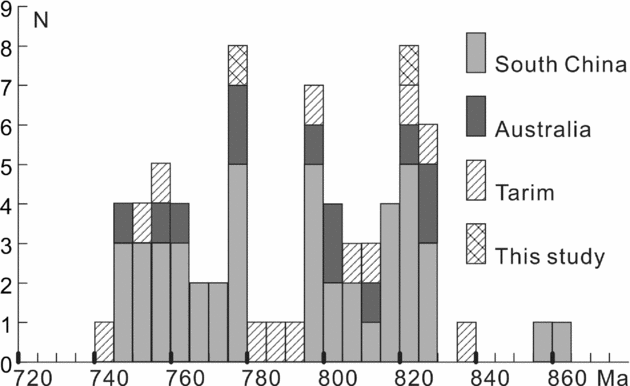
In this study, we present precise U–Pb SHRIMP ages of two samples from the Kuluketage diabase dyke swarm in Tarim. The episodic magmatic events in Tarim along with its rifting history are somewhat similar to igneous activities in India, southern Africa and Laurentia, and can be closely matched with those in South China and Australia (Li et al. Reference Li, Li, Kinny, Wang, Zhang and Zhou2003; Ernst et al. Reference Ernst, Wingate, Buchan and Li2008; and references therein; Fig. 5). Figure 5 shows the age histogram of known igneous rocks in South China, Australia and Tarim for the 880–720 Ma interval, including the new data reported in this study. Comparing two new precise U–Pb SHRIMP ages of the Kuluketage diabase dyke swarm in Tarim with ages from other continents, we can conclude that the earlier age (823.8±8.7 Ma of F21) was at the starting point of continental rifting and represented the initial breakup of Rodinia, whereas the latter one (776.8±8.9 Ma of F24) occurred during the continental rifting. The prolonged duration of the magmatic and continental rifting events in Tarim (~50 Ma of this paper and about 100 Ma of the full published data) implies that the Tarim Block may have been associated with mantle plume magmatism and the breakup of Rodinia. Observations of common pre- and syn-rift lithospheric doming and unroofing imply the existence of a mantle superplume under the Rodinia supercontinent (Li et al. Reference Li, Li, Kinny, Wang, Zhang and Zhou2003), and the mantle plume hypothesis is also supported by observed stratigraphic relationships. Unroofing is implied by the observation that on the northeastern margin of the Tarim Block, 929±28 Ma dolomites of the Mesoproterozoic Paergantage Group are unconformably overlain by 755±15 Ma volcanic rocks at the bottom of the Beiyixi Formation (Xu et al. Reference Xu, Jian, Zheng, Zou, Zhang and Liu2005, and references therein). In NW Tarim, the unconformity between the Neoproterozoic strata and the underlying Mesoproterozoic Aksu Group, which is intruded by an 807±12 or 785±31 Ma mafic dyke swarm (Chen et al. Reference Chen, Xu, Zhan and Li2004; Zhan et al. Reference Zhan, Chen, Xu, Wang and Faure2007; Zhang L. F. pers. comm.), can again be explained by plume-induced crustal unroofing. As in South China, both episodes of magmatism were accompanied by continental rifting and lithospheric doming and unroofing during the Middle Neoproterozoic (Li et al. Reference Li, Li, Kinny, Wang, Zhang and Zhou2003). Considering the similarities in geochronology and Neoproterozoic stratigraphy among Tarim, South China and Australia, these three blocks might once have been conjoint with each other.
Age histogram of igneous rocks in South China, Australia and Tarim between 880 and 720 Ma. Sources and descriptions of the data from Tarim are given in text; sources for ages from South China and Australia are from the literature (Li et al. Reference Li, Li, Kinny, Wang, Zhang and Zhou2003 and references therein).

The significance of the Kuluketage diabase dyke swarm should be re-evaluated. The most widely exposed dykes in Tarim, the Kuluketage diabase dyke swarm, were previously considered to have been emplaced in Permian times. With these new ages, the Kuluketage diabase dyke swarm in the Tarim Block was clearly emplaced in the Neoproterozoic. Correlated with peaks of magmatism in South China and Australia at c. 825 Ma and c. 780 Ma (Fig. 5), these two new precise ages provide significant information for palaeocontinental reconstructions; consequently the Kuluketage diabase dyke swarm is one of the most important dyke swarms in Tarim associated with Rodinia. Further study of the Kuluketage diabase dyke swarm is required to confirm the link between the dyke swarm and the breakup of Rodinia.
We conclude that the Kuluketage diabase dyke swarm in Tarim was emplaced in Neoproterozoic time and propose that there is a close relationship between the Kuluketage diabase dyke swarm, the breakup of Rodinia, and a mantle plume.
Acknowledgements
We are grateful to Yuruo Shi for his considerate help during the SHRIMP analyses; we also wish to thank Lijuan Wang, Hua Xiang, Xiongying Yang and Dazhao Gu for assistance in laboratory work. In particular, we would like to acknowledge Albrecht W. Hofmann: this manuscript benefitted greatly from his constructive comments after his critically review of an early version. Special thanks are expressed to Richard Ernst, Wenjiao Xiao, and editor David Pyle for their critical and constructive comments that promoted substantial improvements in this manuscript. This work was financially supported by grants from the National Basic Research Program of China (973 Program, No.2007CB411301) and the Natural Science Foundation of China (No.40573038).