Introduction
Bread wheat (Triticum aestivum L.) is one of the world's major cereal crops, with global production of 769.6 million tonnes in 2021 (FAO, 2021a). Wheat is currently second only to rice in terms of volume consumed, with 67% of the wheat produced going to food, 21% to animal feed, and the rest going to other uses such as industrial biofuels (FAO, 2021b). By 2050, the world's population is predicted to reach nine billion people, necessitating a 60% increase in wheat productivity (United Nations, 2019). To address this problem, wheat yields must be increased from 1% per year to at least 1.6% per year (Giraldo et al., Reference Giraldo, Benavente, Manzano-Agugliaro and Gimenez2019). This is made more difficult by irregular rainfall patterns predicted for climate change, which are expected to result in an increase in droughts (IPCC, 2019). The impact on final yield is, however, dependent on the growth stage as well as the intensity and duration of stress events (Sarto et al., Reference Sarto, Sarto, Rampim, Bassegio, da Costa and Inagaki2017). Abiotic factors such as drought, salinity and heat stress, rather than biotic factors, are the primary causes of wheat output losses (Abhinandan et al., Reference Abhinandan, Skori, Stanic, Hickerson, Jamshed and Samuel2018; Chaudhary et al., Reference Chaudhary, Swati, Nagar and Dhyani2022). Recurrent drought conditions have threatened world wheat production, and immediate action is needed to address this. Water stress has diverse effects on wheat at different growth stages (Khadka et al., Reference Khadka, Earl, Raizada and Navabi2020), and the duration and intensity of water stress can impair wheat development for many traits (Sarto et al., Reference Sarto, Sarto, Rampim, Bassegio, da Costa and Inagaki2017), ultimately reducing grain yield.
Drought is divided into three categories meteorological, agricultural and hydrological droughts. Meteorological drought is caused by anomalies in the atmosphere and higher temperatures; agricultural drought is caused by low precipitation and high evapotranspiration rates; and hydrological drought is caused by water sources falling below their normal average (Bakke et al., Reference Bakke, Ionita and Tallaksen2020). The rainfed condition is a hydrological drought, where the development of crops depends on rainfall. Water stress has a negative impact on crop development, dry matter production and prospective yield (Zhang et al., Reference Zhang, Zhang, Cheng, Jiang, Zhang, Peng, Lu, Zhang and Jin2018). The effect of water stress depends on the growth stages of wheat as well as the duration and intensity of water stress (Daryanto et al., Reference Daryanto, Wang and Jacinthe2016; Sarto et al., Reference Sarto, Sarto, Rampim, Bassegio, da Costa and Inagaki2017). Using a wide range of testing environments, both normal and stressed, may be more appropriate and efficient in identifying the genotype that has adapted to water stress conditions. By lowering dependency on final grain yield, measuring yield attributing traits independent of grain yield enhances selection efficiency. Utilizing the potential for additive gene action this technique may enhance the likelihood of creating more successful crossings in a breeding effort (Dolferus et al., Reference Dolferus, Thavamanikumar, Sangma, Kleven, Wallace, Forrest, Rebetzke, Hayden, Borg, Smith and Cullis2019).
The future potential of wheat hybrid technology is dependent on male-sterility systems, floral biology, combining ability, heterosis and economic level exploitation that can be utilized to break yield restrictions and boost productivity in the country's key wheat-growing area (Basnet et al., Reference Basnet, Dreisigacker, Joshi, Mottaleb, Adhikari, Vishwakarma, Bhati, Kumar, Chaurasiya, Rosyara, Kashyap, Gupta, Gupta, Sendhil, Gopalareddy, Jasrotia and Singh2022). The selection of parents based on their mean performance may not always result in the desired outcomes (Riaz et al., Reference Riaz, Yang, Yousaf, Sami, Mei, Shah, Rehman, Xue, Si and Ma2021). As a result, the use of heterosis, or hybrid vigour, in the wheat crop might be considered one of the key breakthroughs in plant breeding because it produces superior traits in the offspring compared to the parents. Furthermore, the extent to which heterosis can be used is largely determined by the direction and degree of heterosis (Begna, Reference Begna2021). Heterosis demonstrates the parents' potential to combine traits and is used in breeding programmes. In practical plant breeding, standard heterosis is more important than heterobeltiosis and relative heterosis because it aims to develop desired hybrids superior to the existing high-yielding commercial varieties (Lingaiah et al., Reference Lingaiah, Raju, Sarla, Radhika, Venkanna and Reddy2023). Estimation of heterosis in wheat crop has also been reported by Saren et al. (Reference Saren, Mandal and Soren2018) and Gimenez et al. (Reference Gimenez, Blanc, Argillier, Pierre, Le Gouis and Paux2021) for grain yield, plant height, productive tillers, days to heading and several other agro morphological traits. Wheat production will likely increase by generating new cultivars with a broader genetic base and better performance in changing environments (Tadesse et al., Reference Tadesse, Sanchez-Garcia, Assefa, Amri, Bishaw, Ogbonnaya and Baum2019; Langridge and Reynolds, Reference Langridge and Reynolds2021). In order to develop high-yielding climate-resilient cultivars the ability of a genotype to perform well in both a normal and stressful environment should be identified. This study compares several bread wheat crosses made using the Line × Tester mating design under two distinct water regimes with the aim of calculating standard heterosis. The best heterotic combinations with resilient traits were identified here for yield and yield-attributing traits using standard heterosis estimations in stress and normal environments. These cross-combinations can be used for the exploitation of heterosis by identifying transgressive segregants from the advanced generation, which could be important in wheat breeding programmes for tolerance to water stresses and yield improvement.
Material and methods
Plant genetic material
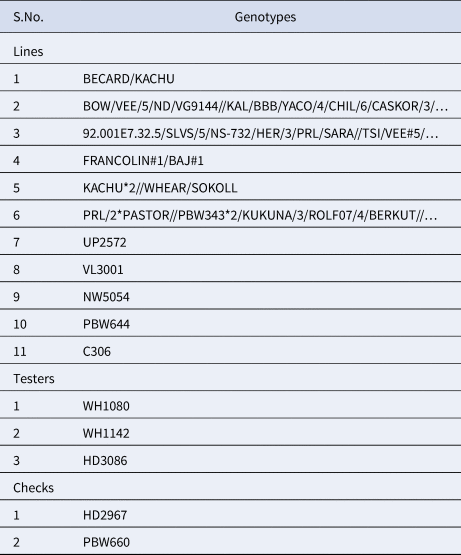
The present investigation was undertaken to study the heterosis for grain yield and its component of bread wheat genotypes using line × tester (L × T) analysis under irrigated (E1) and rainfed (E2) conditions. The crosses were made between 11 lines and three testers (Table 1) in L × T mating design. The genotypes used for crossing contained drought-tolerant wheat varieties suitable for growing in rainfed condition viz., UP2572, VL3001, PBW644, C306, WH1080, WH1142 and PBW644.
List of parents and checks

Experimental trial
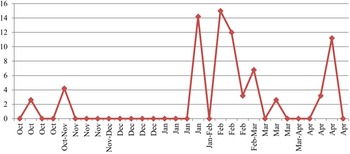
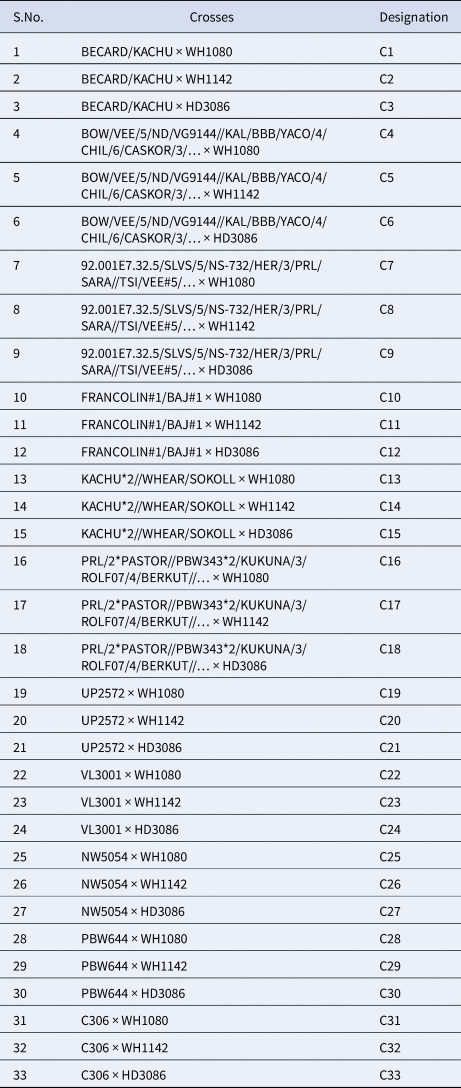
Forty-nine genotypes comprising 11 lines, 3 testers, 33 F1s and 2 checks (Tables 1 and 2) were planted in completely randomized block design with three replications in two environments i.e. irrigated (E1) and rainfed (E2) conditions at G. B. Pant University of Agriculture and Technology, Pantnagar in 2018-19 during Rabi season. The experimental materials for irrigated and rainfed conditions were planted on two different sowing dates. E1 was sown in mid of November, while E2 was in the first week of October. Pantnagar falls in a humid subtropical zone having the miscellaneous type of soil texture, which is generally 1.0–1.5 m deep. The favourable climatic condition for the normal growth of wheat crop is 20–25°C temperature throughout the crop duration with equitable distribution of rainfall. In this study, only a single irrigation was applied at tillering stage, after that no irrigation was applied to keep the experiment under moisture stress. While in irrigated condition, four irrigations were applied during the crown root initiation stage, tillering stage, flowering stage and dough stage for proper growth of the wheat genotypes. The water requirement is 450–650 mm for the whole production period of the wheat crop (Tadesse et al., Reference Tadesse, Halila, Jamal, El-Hanafi, Assefa, Oweis and Baum2017). During this experiment in the whole Rabi season, the total rainfall was 75.8 mm (Fig. 1). In the rainfed environment (E2), it is shown in Fig. 1 that there was no rain from the tillering to the booting stage (November to January). According to the metrological data (Fig. 1), stress criteria are met for the E2 environment.
Graph showing monthly rainfall pattern (mm) during the wheat season in 2018-19.

List of cross combinations

Measurement of agronomic traits
Data was taken on 14 morphological characters viz., days to 75% heading, days to maturity, plant height (cm), peduncle length (cm), awn length (cm), tillers per plant, flag leaf area (cm2), spike length (cm), spikelets per spike, grains per spike, grain weight per spike (g), 1000 grain weight (g), biological yield per plant (g) and grain yield per plant (g). The flag leaf area was calculated using the following formula according to Singh (Reference Singh1970).
Leaf area = Leaf length × Width × 0.7238
Computation of drought susceptibility index
Fischer and Maurer's (Reference Fischer and Maurer1978) formula was used to calculate the drought susceptibility index (DSI) for yield character per cross.

where, Xi represents phenotypic means for each cross under a stressed condition, X represents phenotypic means for each cross under a control condition, Yi represents phenotypic means for all the crosses under a stressed condition, Y represents phenotypic means for all the crosses under control condition.
Estimation of heterosis
The mean data was subjected to L × T analysis as per Kempthorne (Reference Kempthorne1957). The standard heterosis, expressed as a per cent increase or decrease in the performance of F1 hybrid over check parent, was computed for each character using the following formula:

where,
$\overline {\rm F} _1$ = Mean performance of F1 hybrid
$\overline {CP}$ = Mean performance of check parent
The significance of heterosis was tested with the ‘t’ test as given below:
For standard heterosis ${\rm t} = {{{\overline {\rm F} }_1-\overline {CP} } \over {\sqrt {2Me/r} }}$
Where, Me = Error mean square; r = Number of replications.
Violin plot for the density distribution of standard heterosis was drawn using the R-package ‘ggplot2’ (Wickham, Reference Wickham2016).
Results
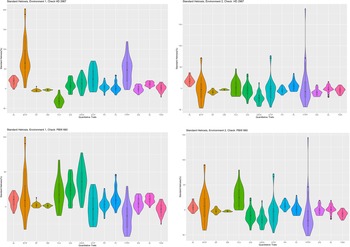
The mean performance and analysis of variance revealed that all the wheat genotypes differ significantly for all the traits in both irrigated (E1) and rainfed (E2) conditions, and genotype × environment (G × E) interaction was significant for all the traits except peduncle length. In the present study, crosses were examined for standard heterosis over both checks for yield and it's contributing traits in both environments. The density distribution graph for standard heterosis is shown by a violin plot for two checks and two environments in the respective figures (Fig. 2). The heterosis of cross combinations for all the traits in both conditions is explained for each trait as follows.
Density distribution of standard heterosis over the checks HD2967 and PBW660 for yield and its component traits in the irrigated and rainfed conditions. Box plot within the violin represents the mean of all standard heterosis values. Environment1, Irrigated condition; Environment2, rainfed condition; AL, awn length; BY/P, biological yield per plant; DF, days to 75% heading; DM, days to maturity; FLA, flag leaf area; G/S, grains/spike; GW/S, grain weight/spike; GY/P, grain yield/plant; PH, plant height; PL, peduncle length; PTPP, productive tillers/plant; S/S, spikelets/spike; SL, spike length; TGW, 1000 grain weight.

Days to 75% heading and days to maturity
The Standard heterosis (%) over the check HD2967 for days to 75% heading ranged from −8.33 to 5.80 in E1 and from −16.34 to 0.65 in E2 environments (Fig. 2). The highly significant negative heterosis for this trait was found in crosses C4, C10 and C12 (−8.33) in E1, whereas C6 (−16.34) was followed by C11(−15.03) in E2. For days to maturity, heterosis over the check HD2967 ranged from −6.85 to 0.51 in E1 and −5.15 to −0.23 in E2. Significant negative heterosis for this trait was demonstrated by crosses C4 (−6.85), followed by C28 (4.26) in E1, whereas crosses C18 (−5.15), followed by C11, and C23 (−4.92) were identified in E2.
For days to 75% heading in E1 and E2, the heterosis (%) over check PBW660 ranged from −1.94 to 13.18 and from −10.49 to 7.7, respectively. For days to maturity, over the same check the heterosis ranged from −2.39 to 5.32 and −4.71 to 0.23 in E1 and E2, respectively (Fig. 2). Crosses C6(−10.49) followed by C11(−9.09) showed highly significant negative heterosis for days to 75% heading in E2 but in E1 did not have any crosses with significant negative heterosis. Whereas, cross C4(−2.39) in E1 and crosses C18(−4.71) followed by C11, C14, C23 and C33(−4.47) in E2 were identified of days to maturity.
Plant architecture (Cm/Cm2)
The range of heterosis values over the check HD2967 and PBW660 for the attributes related to plant architecture viz., plant height, peduncle length, awn length, flag leaf area and spike length are represented in Fig. 2. For plant height, the highest significant negative heterosis over check HD2967 was shown by crosses C15 (−16.46) followed by C1 (−12.04) in E1 and crosses C14 (−16.19) followed by C24 (−14.88) in E2. Whereas, the highest significant negative heterosis over check PBW660 was shown by crosses C15 (−16.77), followed by C1 (−12.36), in E1, and cross C14 (−4.37) in E2. For another yield attribute, peduncle length, standard heterosis over the check HD2967 was shown by crosses C2 (−16.20) followed by C1 (−16.05) in E1, and in E2, none of the crosses showed significant negative heterosis. Whereas, for this trait in both environments, cross C2 (−8.79 in E1 and −11.68 in E2) showed the highest significant negative heterosis over the check PBW660.
Flag leaf area and awn length are important plant attributes that affect photosynthesis. For the flag leaf area, significant positive heterosis over check HD2967 was observed in C15 (46.02), followed by C14 (29.22) in E2, but it's not identified in any crosses in E1. Whereas, for the same trait, C15 (67.09 in E1 and 79.89 in E2) showed the highest significant positive heterosis over check PBW660 in both environments, followed by C23 (58.87) in E1 and C14 (59.20) in E2. For the yield attribute awn length, over both the checks HD2967 and PBW660, C8 (34.20 and 23.53, respectively) followed by C32 (31.46 and 21.02, respectively) in E1, and crosses C26 (36.93 and 22.30, respectively) followed by C27 (35.70 and 21.20, respectively) in E2 showed the highest significant positive heterosis.
In another attribute, spike length, crosses C21 (20.73), followed by C32 (20.49) in E1 and C32 (15.64) in E2 demonstrated the highly significant positive heterosis over check HD2967, respectively. Whereas, the highest significant positive standard heterosis over check PBW660 showed by crosses C32 (19.42), followed by C21 (19.66) in E1, and crosses C32 (18.79) followed by C20 (13.44) in E2.
Yield and yield components
Numerical yield attributes such as productive tillers/plant, spikelets/spike and grains/spike are crucial. For all of these traits, Fig. 2 illustrates the range and mean of heterosis values over the check HD2967 and PBW660. For productive tillers/plants, the highly significant positive standard heterosis over the check HD2967 was observed in cross C33 (119.44), followed by C32 (102.78), in E1, and cross C21 (186.41) followed by C4 (71.18), in E2. Whereas, significant positive heterosis over check PBW660 for the same trait was observed in cross C33 (29.53), followed by C1 (18.05), in E1, and cross C21 (144), followed by C4 (45.83), in E2. In another numerical yield component, spikelets/spike, C24 (12.46) in E1 and cross C29 (7.81) in E2 had highly significant positive heterosis over the check HD2967. Whereas, for the same trait over the check PBW660, it was shown by crosses C8 and C24 (18.78), followed by C23 (16.58) in E1, and crosses C29 (18.90), followed by C5 (14.88) in E2. For grains/spike the highly significant positive heterosis over the check HD2967 was reported in crosses C24 (33.20), followed by C23 (32.79), in E1, and crosses C15 (33.42), followed by C29 (28.63), in E2. For the same trait, C15 (23.65) followed by C29 (19.21) in E1 and crosses C24 (53.30) followed by C23 (52.83) in E2 demonstrated the highly significant positive heterosis over the check PBW660.
The yield and its contributing traits were measured in weight are 1000 grain weight, grain weight per spike, grain yield/plant and biological yield/plant. The range and mean of heterosis values for these traits are shown in Fig. 2. For 1000 grain weight, the same crosses (crosses C31 followed by C4) showed the highest significant positive heterosis over both the checks in E1 environment. While in E2, cross C31 (8.33), followed by C22 (5.83), showed highly significant positive heterosis over check HD2967, and none of the crosses showed significant positive heterosis over check PBW660 for this trait. For grain weight per spike, crosses C23 and C24 showed the highest significant positive heterosis over both checks in E1, whereas only the C29 cross showed significant positive heterosis in E2. For grain yield/plant, the highest significant positive heterosis over check HD2967 was observed in cross C29 (70.23) in E1 and cross C20 (76.29) in E2. While C29 (32.18) and C17 (26.74) in E1 and C20 (71.90) and C21 (66.67) in E2, respectively, had the highest significant positive heterosis over the check PBW660. In another yield trait, biological yield/plant, crosses C33 (202.22) followed by C32 (188.47) in E1 and crosses C21 (71.56) followed by C20 (71.16) in E2 had highly significant positive heterosis over check HD2967. Whereas crosses C33 (99.71) followed by C32 (90.62) showed highly significant positive heterosis over check PBW660 in E1, and crosses C21 (90.01) followed by C20 (89.57) in E2.
Discussion
Our investigation advances understanding of how morphological traits are affected by different water regimes, which is important in selecting the best genotype to be utilized in the breeding programmes (Sarto et al., Reference Sarto, Sarto, Rampim, Bassegio, da Costa and Inagaki2017). The results demonstrate that for all traits except peduncle length, there was a significant G × E interaction, and the performance of each genotype was different in irrigated and rainfed environments. Crosses C4 and C18 demonstrated highly significant negative heterosis in both irrigated and rainfed conditions for days to maturity. The importance of negative heterosis for days to 75% heading and days to maturity has been highlighted because early flowering and maturity are responsible for the drought escape mechanism in wheat plants (Shavrukov et al., Reference Shavrukov, Kurishbayev, Jatayev, Shvidchenko, Zotova, Koekemoer, De Groot, Soole and Langridge2017). Early maturation and heading are essential in the breeding programme of wheat crop Saren et al., (Reference Saren, Mandal and Soren2018), Sharma et al. (Reference Sharma, Dodiya, Dubey, Khandagale and Shekhawat2018), Shamuyarira et al., (Reference Shamuyarira, Shimelis, Tapera and Tsilo2019), Bapela et al., (Reference Bapela, Shimelis, Tsilo and Mathew2022).
Crosses C15 and C14 showed highly significant negative heterosis over the check in both the irrigated and rainfed conditions, respectively, for plant height, similar to the reports of Saren et al. (Reference Saren, Mandal and Soren2018) and Gimenez et al. (Reference Gimenez, Blanc, Argillier, Pierre, Le Gouis and Paux2021). To reduce water requirements and prevent moisture loss owing to transpiration, drought-tolerant plants have a reduced height. As a result, smaller plants exhibit less growth reduction than larger plants, implying that smaller plants are less sensitive to water stress (Nazir et al., Reference Nazir, Sarfraz, Mangi, Nawaz Shah, Mahmood, Mahmood, Iqbal, Ishaq Asif Rehmani, El-Sharnouby, Shabaan, Sorour and EL Sabagh2021). Khadka et al., (Reference Khadka, Earl, Raizada and Navabi2020) also reported that water stress affects different stages of growth.
In the present study, crosses C8 and C26 had longer awns in E1 and E2 environments. Under drought, awns retain a greater relative water content and photosynthetic electron transport rate than flag leaves, indicating that they are more resistant to soil moisture deficits (Maydup et al., Reference Maydup, Antonietta, Graciano, Guiamet and Tambussi2014). Green awns also contribute to the photosynthetic area and positively influence grain yield (Rebetzke et al., Reference Rebetzke, Bonnett and Reynolds2016). Cross C15 was identified as the best heterotic cross for the flag leaf area. Flag leaf plays a major role in photosynthesis, thus, flag leaf area is important for grain filling (Ma et al., Reference Ma, Xie, Zhang, Yang, Li, Liu, Lin and Zhang2021). Sharma et al. (Reference Sharma, Dodiya, Dubey, Khandagale and Shekhawat2018) also reported positive heterosis for the flag leaf area. In irrigated and rainfed conditions, crosses C33 and C21 showed the highest significant positive heterosis over both the checks for tillers/plant. Tillering and stem elongation stages are critical for maintaining the number of spikelets per plant and spikes per plant, both of which directly affect grain yield. As a result, the severe drought during wheat tillering and stem elongation affects the number of grains per spike, and finally grain yield (Ding et al., Reference Ding, Huang, Zhu, Li, Zhu and Guo2018). Patel (Reference Patel2018), Adhikari et al. (Reference Adhikari, Ibrahim, Rudd, Baenziger and Sarazin2020) also reported significant positive heterosis for productive tillers in their studies. C2 was determined to be the best cross combination across the two checks for short peduncles, which is considered an adaptive trait in wheat for water stress conditions and is also responsible for shorter plant height (Nazir et al., Reference Nazir, Sarfraz, Mangi, Nawaz Shah, Mahmood, Mahmood, Iqbal, Ishaq Asif Rehmani, El-Sharnouby, Shabaan, Sorour and EL Sabagh2021). Patel et al. (Reference Patel, Moitra, Shukla and Singh2015) have previously reported on the role of negative heterosis on peduncle length.
Crosses C21 and C32 showed standard positive heterosis over checks in E1 and E2 for spike length, whereas for spikelets per spike C24, C8 and C29 were the best cross combinations. The spike-related characters i.e. spike length, spikelets per spike, grains per spike, 1000 grain weight, grain weight per spike are essential component characters of yield; positive heterosis for these characters is desirable for increasing yield and these traits are influenced under water stress condition (Khadka et al., Reference Khadka, Earl, Raizada and Navabi2020; Chaudhary et al., Reference Chaudhary, Swati, Kumar, Joshi, Kandwal and Bhatt2023). Significant positive heterosis for spike length and spikelets per spike was in agreement with the findings of El-Gammaal and Yahya (Reference El-Gammaal and Yahya2018), Patel (Reference Patel2018), Nagar et al. (Reference Nagar, Kumar, Singh, Gupta, Singh and Tyagi2019), Ibrahim et al. (Reference Ibrahim, Yadav, Anusha and Magashi2020), Khaled et al. (Reference Khaled, Elameen and Elshazly2020). Crosses C24 and C15 were the best cross combinations in both environments for grains per spike. Positive heterosis for grains per spike was also reported by Sharma et al. (Reference Sharma, Dodiya, Dubey, Khandagale and Shekhawat2018), and Ibrahim et al. (Reference Ibrahim, Yadav, Anusha and Magashi2020).
Higher grain yield is the primary objective of wheat breeding. For the 1000 grain weight, cross C31 was identified as the best heterotic cross. Salam et al. (Reference Salam, Hammadi and Azzam2019), Ibrahim et al. (Reference Ibrahim, Yadav, Anusha and Magashi2020), and Gimenez et al. (Reference Gimenez, Blanc, Argillier, Pierre, Le Gouis and Paux2021) also reported significant positive heterosis for this trait. For grain weight per spike, C23 and C29 were identified as the best cross combinations over both the checks in irrigated as well as rainfed conditions. Sharma et al. (Reference Sharma, Dodiya, Dubey, Khandagale and Shekhawat2018) reported similar findings for this trait. The crosses C29 and C20 were identified as the best cross combinations for grain yield in both irrigated and rainfed conditions. Positive heterosis for grain yield was also reported by Thomas et al. (Reference Thomas, Marker, Lal and Dayal2017), Saren et al. (Reference Saren, Mandal and Soren2018), Salam et al. (Reference Salam, Hammadi and Azzam2019), Ibrahim et al. (Reference Ibrahim, Yadav, Anusha and Magashi2020) and Gimenez et al. (Reference Gimenez, Blanc, Argillier, Pierre, Le Gouis and Paux2021). Over both the checks, C33 was the best heterotic crossover for biological yield under irrigated condition, whereas C21 was identified under rainfed condition. In general biological yield positively correlated with economic yield and so positive heterosis is desired for this trait (Motawea, Reference Motawea2017).
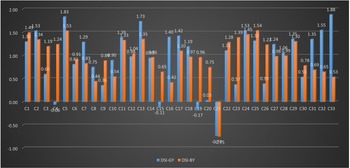
The DSI is a crucial factor in determining which genotypes are drought tolerant. It is a measure of drought, based on loss of yield under drought conditions in comparison to the yield under normal conditions. The effects of water stress on grain yield and biological yield are shown in Fig. 3. Based on that for grain yield C3, C4, C6, C8, C9, C10, C12, C14, C15, C19, C20, C21, C23, C26 and C30 crosses showed <1 DSI. Whereas, for biological yield C6, C7, C8, C9, C10, C14, C15, C16, C18, C19, C20, C21, C27, C28, C30, C31, C32 and C33 cross combinations showed <1 DSI. From these tolerant cross combinations, C20 for grain yield whereas C21 and C33 for biological yield also showed the highest positive heterosis. Hence, these heterotic crosses can withstand water stress with minimum loss in yield.
Drought Susceptibility Index (DSI) based on mean performance of hybrids under irrigated and rainfed conditions. DSI-GY, Drought Susceptibility index for grain yield; DSI-BY, Drought Susceptibility index for biological yield.

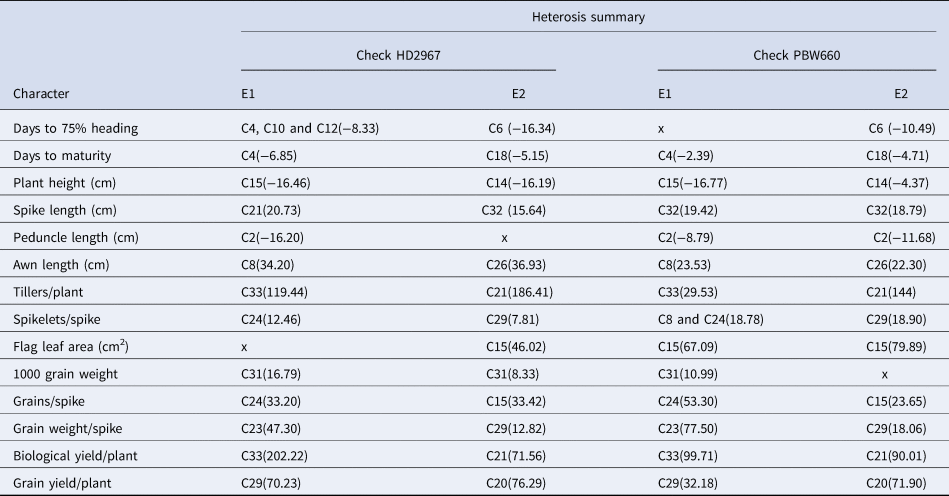
In summary, this investigation advances understanding of important traits contributing to wheat yield under irrigated and rainfed condition. Overall, under the irrigated condition, crosses C4, C8, C33, C24 and C23, were identified as the best heterotic cross over both checks HD2967 and PBW660 for yield and its attributes. While, in rainfed condition crosses C18, C14, C26, C21 and C20 were best heterotic combinations over both the checks. For both irrigated and rainfed conditions, the best cross combinations identified were C29, C15, C32, C2, and C31. The best cross combinations under irrigated and rainfed conditions for yield and its attributed (Table 3) can be employed in future wheat breeding programmes to generate cultivars with high yield and water stress tolerance.
Promising heterotic crosses for various characters

E1, Irrigated condition; E2, Rainfed condition; x, Indicate none of the entries found in desirable direction over the checks, Parenthesis values indicates % heterosis over check in desirable direction.
Conclusions
In conclusion, results revealed that crosses showed varied performance under irrigated and rainfed environments. For both environments, the best cross combinations for yield and its attributes were PBW644 × WH1142, KACHU*2//WHEAR/SOKOLL × HD3086, C306 × WH1142, BECARD/KACHU × WH1142, and C306 × WH1080. Cross combinations UP2572 × WH1142 for grain yield, UP2572 × HD3086 and C306 × HD3086 for biological yield showed the highest positive heterosis with <1 DSI. Therefore, these heterotic hybrids can tolerate water stress with minimum yield loss. The identified cross combinations can be exploited in future wheat breeding programme for obtaining higher yields and selection could be exercised in segregating generations for developing water stress-tolerant genotypes. The tolerance of these crosses and their performance under water stress conditions can be studied further by physiological and biochemical studies.
Supplementary material
The supplementary material for this article can be found at https://doi.org/10.1017/S1479262123000412.
Acknowledgements
The authors are thankful to the Director, Experiment Station, G. B. Pant University of Agriculture and Technology, Pantnagar-263145, Uttarakhand, India for providing the research facilities to undertake the present study.
Author contributions
Conceptualization: D. C., S. Data curation: D. C. Formal analysis: D. C., S. Methodology: D. C., S. Project administration: S., J. J. Resources: D. C., S., R. and S. J. Supervision: S., Validation: S., J. J. Writing original draft: D. C., S., R., S. J.
Ethical statements
Hereby, I Divya Chaudhary consciously assure that for the manuscript ‘Comparative study of standard heterosis for yield and its attributes in bread wheat under two different water regimes’ the following is fulfilled:
1) This material is the authors’ own original work, which has not been previously published elsewhere.
2) The paper is not currently being considered for publication elsewhere.
3) The paper reflects the authors’ own research and analysis in a truthful and complete manner.
4) The paper properly credits the meaningful contributions of co-authors and co-researchers.
5) The results are appropriately placed in the context of prior and existing research.
6) All sources used are properly disclosed (correct citation). Literally copying of text must be indicated as such by using quotation marks and giving proper reference.
7) All authors have been personally and actively involved in substantial work leading to the paper, and will take public responsibility for its content.