INTRODUCTION
Pisione Grube, 1857 is a genus of small-sized interstitial polychaetes that comprises about forty-four species distributed world-wide. Pisione species are mainly found in marine intertidal and shallow subtidal clean sands although some species have been reported at deeper areas (e.g. Martínez et al., Reference Martínez, Aguirrezabalaga and Adarraga2008) and a fresh water species was described by San Martín et al. (Reference San Martín, López and Camacho1998). Recent studies have increased the number of known species from several geographical areas (e.g. De Wilde & Govaere, Reference De Wilde and Govaere1995; Yamanishi, Reference Yamanishi1998; Moreira et al., Reference Moreira, Quintas and Troncoso2000; Martínez et al., Reference Martínez, Aguirrezabalaga and Adarraga2008) thus suggesting that the actual diversity of this genus was previously underestimated.
So far, only two Pisione species have been recorded from the Macaronesian area, which comprises the Azores, Madeira, Selvagens, Canary and Cape Verde archipelagos. Pisione remota (Southern, Reference Southern1914) was recently reported from the Azores (Bamber & Robbins, Reference Bamber and Robbins2009) and the Canary Islands (Brito et al., Reference Brito, Núñez, Bacallado and Ocaña1996). Pisione guanche San Martín, López & Núñez, Reference San Martín, López and Núñez1999 was described from shallow sandy sediments at the Canary Islands (San Martín et al., Reference San Martín, López and Núñez1999) and was later recorded from the eastern Mediterranean (Çinar, Reference Çinar2009). As a result of a sampling programme devoted to the study of shallow soft bottoms from the Azores, several individuals of Pisione were found, representing two species, namely P. remota and P. guanche. The finding of the latter supposes the first record of this species in the Azores Islands; its identity was confirmed after comparison with the type series. Specimens of P. guanche are described here and additional observations on the morphological features of the species are provided.
MATERIALS AND METHODS
Over eight specimens of Pisione were examined. Animals were found in samples collected at Pisão (37°42′26.13″N 25°30′22.17″W) and São Roque (37°44′51.23″N 25°37′57.77″W), both located in the south of São Miguel Island (the Azores). Sampling was done in clean sand at 10–12 m depth by SCUBA divers operating corers manually (10 cm diameter and 10 cm depth). Collected sediment was put into individual labelled plastic bags and transported to the laboratory. Samples were later fixed in 5% formaldehyde and then sieved through a column of 0.5 mm and 0.063 µm nested sieves and the residue (sediment and animals) placed on plastic buckets. Animals retained on the 0.5-mm mesh were sorted under a dissection stereomicroscope and preserved in 70% ethanol until identification. Specimens were examined using a dissection stereomicroscope and a light microscope provided with interference contrast optics (Nomarski). Animals identified as Pisione guanche were compared with the type series deposited at the Museo Nacional de Ciencias Naturales (MNCN) Madrid, Spain. Line drawings were done with the aid of a camera lucida connected to an Olympus BX51 microscope.
Sediment residue was dried at 60°C until constant weight and then sieved through a column of nested sieves (4, 2, 1, 0.5, 0.25, 0.125 and 0.063 mm) for 4 minutes using a mechanical shaker (Retsch AS200). After sieving each fraction was weighed. The median particle size (Md) and quartile deviation (QDφ), were calculated following the procedures described by Buchanan (Reference Buchanan, Holme and McIntyre1984).
RESULTS
Praegeria remota Southern, Reference Southern1914.
Pisione remota: Hartman, Reference Hartman1939; San Martín, Reference San Martín, Ramos, Alba-Tercedor, Belles, Gosálbez, Geurra, MacPherson, Serrano and Templado2004.
MATERIAL EXAMINED
One anterior end and three complete specimens, the three latter measuring 3.50–3.75 mm in length, 0.17–0.18 mm in width, with 39–41 chaetigers. Pisão, in poorly-sorted medium sand (Md = 0.41; QDφ = 1.03), at 10–12 m depth.
DISTRIBUTION
North Atlantic coasts of North America and Europe, Mediterranean and Caribbean Seas, from coarse sand to muddy sediments, at depths of 10–200 m (San Martín, Reference San Martín, Ramos, Alba-Tercedor, Belles, Gosálbez, Geurra, MacPherson, Serrano and Templado2004). Because this species was wrongly considered as having a cosmopolitan distribution, reports from other areas should be revised (San Martín, Reference San Martín, Ramos, Alba-Tercedor, Belles, Gosálbez, Geurra, MacPherson, Serrano and Templado2004).
REMARKS
The specimens from the Azores agree widely with the description of the species provided by San Martín (Reference San Martín, Ramos, Alba-Tercedor, Belles, Gosálbez, Geurra, MacPherson, Serrano and Templado2004) although none of the specimens showed genital organs externally discernible.
Pisione guanche San Martín, López & Núñez, Reference San Martín, López and Núñez1999. (A) Anterior end, dorsal view; (B) anterior end, ventral view; (C) dorsal cirrus, chaetiger 1; (D) dorsal cirrus, chaetiger 13; (E) ventral cirrus, chaetiger 14; (F) buccal acicula; (G) simple chaeta, anterior chaetiger; (H) simple chaeta, posterior chaetiger; (I–L) compound chaetae, posterior chaetiger. Scale bars: A, 0.2 mm; B, 0.225 mm; C–E, 36 µm; F, 23 µm; G–L, 17 µm.

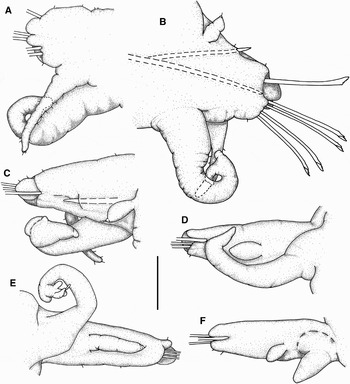
Pisione guanche San Martín, López & Núñez, Reference San Martín, López and Núñez1999. (A) Chaetiger 3, ventral view; (B) chaetiger 3, dorsal view; (C) chaetiger 8, ventral view; (D) chaetiger 8, dorsal view; (E) chaetiger 14, ventral view; (F) chaetiger 14, dorsal view. Scale bars: A–F, 0.1 mm.

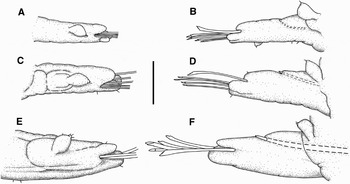
Pisione guanche San Martín, López & Núñez, Reference San Martín, López and Núñez1999. Large male, chaetiger 56: (A) copulatory organ, anterior view; (B) the same, posterior view; (C) the same, dorsal view. Small male: (D) copulatory organ, chaetiger 35, ventral view; (E) copulatory organ, chaetiger 36, ventral view; (F) copulatory organ, chaetiger 42, ventral view. Scale bars: A–F, 0.1 mm.

Pisione guanche San Martín et al., Reference San Martín, López and Núñez1999.
Pisione guanche: Çinar, Reference Çinar2009.
MATERIAL EXAMINED
One incomplete ♂, 9.75 mm long, 0.37 mm wide, with 58 chaetigers; one complete ♂, 9.62 mm long, 0.37 mm wide, with 65 chaetigers; two complete specimens of undetermined sex, 10.5 and 3.62 mm long, 0.32 and 0.22 mm wide, with 70 and 81 chaetigers, respectively. São Roque, in poorly-sorted coarse sand (Md = 0.58 mm; QDφ = 1.6) and in well-sorted very fine sand (Md = 0.01 mm; QDφ = 0.39), at 10–12 m depth.
COMPARATIVE MATERIAL EXAMINED
Type series of Pisione guanche San Martín, López & Núñez, Reference San Martín, López and Núñez1999, Gomera (Canary Islands). MNCN 16.01/4893: Holotype (♀), allotype (♂), paratypes (♀, 3 ♂♂, 4 incomplete specimens), coarse sand, 20–45 m depth. MNCN 16.01/4894: paratypes (2 ♀♀, 2 ♂♂, 2 incomplete specimens). MNCN 16.01/4895: paratypes (♀, ♂), coarse sand, 20–25 m depth.
DESCRIPTION
Body translucent in ethanol; segmental furrows well-defined laterally, latero-dorsally and latero-ventrally (Figure 1A, B). Pilose tips scattered along palps and parapodial surfaces. Prostomium surrounded by buccal segment; palps long, smooth. Buccal segment provided with two long dorsal cirri, about half length of palps; ventral cirri smaller, piriform. Protruding buccal aciculae, extending backwards to chaetiger 1; aciculae distally expanded, with coarse short dentations at tip (Figure 1F). Two pairs of dark coalescent eyes (3 in larger ♂), distinguishable in dorsal view between chaetigers 1–2. Brain lobes distinguished by transparency dorsally, extending from buccal segment to limit between chaetigers 3 and 4. Pharynx armed with two pairs of jaws, at level of chaetigers 3–5. Dorsal cirri (apart from those of chaetiger 2) small, globular to piriform, provided with a short stalk and usually with a distal small papillae with pilose tips (Figure 1C, D); dorsal cirri of chaetiger 1 slightly smaller than others. Dorsal cirri of chaetiger 2 elongate, digitiform, about twice the length of other cirri. Ventral cirri similar to dorsal ones (Figures 1E & 2A, C, E); those from chaetiger 1 longer and digitiform, similar in shape to dorsal ones of buccal segment, located anteriorly to parapodial lobe of chaetiger 1. Parapodia elongated, the anterior ones shorter (Figures 1A & 2A, B). One divided prechaetal lobe; superior lobe larger. Two aciculae per parapodium; superior one protruding from chaetiger 8 backwards, arising latero-dorsally at half way between dorsal cirrus and parapodial lobe (Figure 2D, F). Usually five chaetae per parapodium, including one simple chaeta and four heterogomph compound chaetae. Dorsal simple chaeta thicker in posterior chaetigers, provided with a subdistal knob, with acute distal tip; subdistal spines along medial margin more conspicuous in anterior chaetigers (Figure 1G, H). Compound chaetae with shaft provided with subdistal knob; blades short, distally unidentate, with long spines along cutting margin, more or less worn out in chaetae from posterior chaetigers (Figure 1I–L). Blades showing dorsoventral gradation in length, more conspicuous in anteriormost parapodia (22–13 µm) than in posterior ones (21–16 µm). Pygidium bilobed, lacking cirri, probably lost.
Reproductive system present in two males; sex of the other two specimens undeterminable. Larger male provided with 16 pairs of successive copulatory organs occurring on parapodia of chaetigers 43–58. Ventral cirri long, digitiform, with pilose tips at least in the distal 2/3 of their length (Figure 3A). Copulatory organ distally curved and bifid (Figure 3B), provided with a subdistal bulk and a fold-like structure at the beginning of the subdistal curvature, behind the subdistal bulk (Figure 3C). No papillae distinguishable externally in this specimen. Parapodia provided with protruding dorsal acicula, internal lower acicula, simple chaeta and four compound chaetae (Figure 3A). Smaller male with eight pairs of copulatory organs on chaetigers 35–42, showing different degree of development (Figure 3D–F), the posteriormost less developed, provided with short ventral cirri (Figure 3F); some copulatory organs showing one papilla among two branches of bifid tip (Figure 3E).
DISTRIBUTION
Lanzarote, Fuerteventura, Gran Canaria, Tenerife, La Gomera and La Palma: Canary Islands (Núñez et al., Reference Núñez, Brito and Docoito2005). Iskenderun Bay: Levantine Sea (Çinar, Reference Çinar2009). São Miguel: Azores Islands (this work). This species has been reported from coarse sand at depths of 8–45 m (San Martín et al., Reference San Martín, López and Núñez1999; Çinar, Reference Çinar2009) and from Cymodocea nodosa meadows, in which Pisione guanche is present in the first 5 cm of the sediment (Brito et al., Reference Brito, Martín and Núñez2005).
REMARKS
San Martín et al. (Reference San Martín, López and Núñez1999) characterizes mainly Pisione guanche by having protruding notoaciculae, elongated dorsal cirri on chaetiger 2, divided neuropodial prechaetal lobes and lack of spiniger compound chaetae. In addition, male copulatory organs in the type series are present in number of 4–8 consecutive pairs and those lack the papillae and other structures present in species such as P. subulata Yamanishi, 1992, P. garciavaldecasasi San Martín, López & Camacho, Reference San Martín, López and Camacho1998 and P. parapari Moreira, Quintas & Troncoso, Reference Moreira, Quintas and Troncoso2000. Specimens from the Azores agree well with the original description mostly regarding morphology of chaetae, which also show the same patterns of variation. Thus, the blades from anterior chaetigers have a stronger dorsoventral gradation in length within the same parapodium than in the posterior ones and spinulation of blades seems worn out in chaetae from posterior chaetigers.
The largest male from the Azores bears a greater number of copulatory organs (16) than that previously described for this species. Nevertheless, examination of the type series revealed that the holotype actually bears nine pairs instead of the eight pairs reported in the original description. Therefore, it is likely that larger specimens have more pairs of copulatory organs than previously thought. In addition, the copulatory organs of the small male from the Azores show several degrees of development and are not as developed as those of the larger male. In the former specimen, one pair of copulatory organs bear one papilla (penis?) at the end of the main stem which was not observed either in the larger male or in the type series; it can be suggested that this penis-like papilla might be covered during development by some kind of fold and this way being unnoticed externally.
Specimens reported from the eastern Mediterranean by Çinar (Reference Çinar2009) do not differ substantially from the Atlantic ones; the former did not, however, bear copulatory organs and therefore those could not be compared. Çinar (Reference Çinar2009) suggests that the presence of this species in the Mediterranean could be related to transport by ballast water. Nevertheless, it should be taken into account that most of the records of pisionids across European waters were traditionally attributed to P. remota and those might actually refer to other species as the recent descriptions of new taxa have highlighted (e.g. San Martín et al., Reference San Martín, López and Núñez1999; Moreira et al., Reference Moreira, Quintas and Troncoso2000; Martínez et al., Reference Martínez, Aguirrezabalaga and Adarraga2008). Therefore, the true distribution of those recently described pisionids including P. guanche might be wider than expected.
DISCUSSION
The coastal polychaete diversity in most of the Macaronesian islands is well known (Canary Islands: Pascual & Núñez, Reference Pascual and Núñez1999; Brito & Núñez, Reference Brito and Núñez2003; Brito et al., Reference Brito, Martín and Núñez2005; Núñez et al., Reference Núñez, Brito and Docoito2005; Madeira: Núñez & Talavera, Reference Núñez and Talavera1995; Núñez et al., Reference Núñez, Pascual, Delgado and San Martín1995; Pascual & Núñez, Reference Pascual and Núñez1999; Cape Verde: López & San Martín, Reference López and San Martín1992, 1994; Núñez et al., Reference Núñez, Viera, Riera and Brito1999). However, the polychaete faunas of the Azores are comparatively less studied (Chapman & Dales, Reference Chapman and Dales1954; Bellan, Reference Bellan1978). This work provides information about the genus Pisione at the Azores and constitutes the first record of P. guanche at this archipelago, thus increasing its known distribution range to the north. In addition, P. remota was recorded in shallow bottoms (10–12 m) of poorly-sorted medium sand, which is within the range of sedimentary composition and depth previously reported for this species (San Martín, Reference San Martín, Ramos, Alba-Tercedor, Belles, Gosálbez, Geurra, MacPherson, Serrano and Templado2004). The available information about the habitat of P. guanche is scarce because of the limited number of records due to its recent description. In the Azores, P. guanche was found in shallow bottoms (10–12 m) of poorly-sorted coarse sand sediments and in well-sorted very fine sand. Similar habitat features have been reported for this species in the Canary Islands (San Martín et al., Reference San Martín, López and Núñez1999) and eastern Mediterranean (Çinar, Reference Çinar2009). Furthermore, Brito et al. (Reference Brito, Martín and Núñez2005) also report this species in sandy sediments colonized by Cymodocea nodosa. Therefore, P. guanche seems to inhabit shallow-water habitats, whether they are vegetated or not, in sandy sediments in oligotrophic waters.
ACKNOWLEDGEMENTS
We are grateful to J. Santos and Dr G. Martins for providing the studied material from the Azores and Javier Sánchez Almazán (MNCN, Madrid) for the loaning of the type series of Pisione guanche. Two anonymous referees provided constructive comments which helped to improve the final version of the manuscript.