The diagnosis of bipolar disorder (BD) in children and adolescents is controversial, in part because of disagreement on the nosological status of youth with severe, chronic irritability and symptoms like those seen in attention-deficit/hyperactivity disorder (ADHD). To facilitate research on these youth, Leibenluft, Charney, Towbin, Bhangoo, and Pine (Reference Leibenluft, Charney, Towbin, Bhangoo and Pine2003) operationalized criteria for a syndrome called severe mood dysregulation (SMD); the SMD criteria were designed to capture the children at the center of the BD diagnosis controversy. SMD youth have chronic irritability, including a persistently angry mood and overreactivity to negative emotional stimuli, as well as hyperarousal symptoms (Figure 1; Leibenluft et al., Reference Leibenluft, Charney, Towbin, Bhangoo and Pine2003). Thus, they typically meet Diagnostic and Statistical Manual of Mental Disorders, Fourth Edition (DSM-IV; American Psychiatric Association, 1994) criteria for ADHD and oppositional defiant disorder (ODD), although, because the SMD criteria require extreme irritability, SMD youth are among the most severely impaired of those meeting criteria for comorbid ADHD and ODD. Because SMD children do not meet DSM-IV criteria for a distinct manic episode, they fail to meet BD diagnostic criteria. Despite this, youth with SMD symptoms are often diagnosed in the community with BD (Pogge et al., Reference Pogge, Wayland-Smith, Zaccario, Borgaro, Stokes and Harvey2001). In comparison, children with narrow phenotype BD (NP-BD), as defined by Leibenluft et al., clearly meet DSM-IV criteria for BD, because they have a lifetime history of at least one distinct episode of mania or hypomania meeting DSM-IV duration criteria, with the additional proviso that their mania is defined by the presence of euphoria and/or grandiosity (Leibenluft et al., Reference Leibenluft, Charney, Towbin, Bhangoo and Pine2003).
Research diagnostic criteria for severe mood dysregulation.

One way to address the diagnostic controversy surrounding pediatric BD is to compare SMD and NP-BD youth on a task that assesses a domain known to be impaired in one of these groups, to determine whether comparable deficits are found in the other. Such a study may also clarify the extent to which the pathophysiologies of SMD and BD are shared or distinct. One such domain is emotional face processing. The ability to accurately discern different emotional facial expressions is an integral component of competent human social interaction (Taylor, Batty, & Itier, Reference Taylor, Batty and Itier2004). Studies indicate that individuals with BD are impaired in their ability to process facial expressions. Adults with BD are deficient in facial affect perception (Addington & Addington, Reference Addington and Addington1998; Bozikas, Tonia, Fokas, Karavatos, & Kosmidis, Reference Bozikas, Tonia, Fokas, Karavatos and Kosmidis2006; Getz, Shear, & Strakowski, Reference Getz, Shear and Strakowski2003; Harmer, Grayson, & Goodwin, Reference Harmer, Grayson and Goodwin2002; Lembke & Ketter, Reference Lembke and Ketter2002), and two recent studies also find face processing deficits in youth with BD. Specifically, compared to controls, BD youth make more errors when labeling emotional faces (McClure et al., Reference McClure, Treland, Snow, Schmajuk, Dickstein and Towbin2005) and misinterpret neutral facial expressions as being more hostile and fear-producing (Rich et al., Reference Rich, Vinton, Roberson-Nay, Hommer, Berghorst and McClure2006).
Results of these studies in BD youth generated three questions. Are face-labeling deficits specific to children with strictly defined manic episodes (e.g., NP-BD), or are such impairments also characteristic of children with chronic irritability and hyperarousal (e.g., SMD)? Are face-processing deficits in BD youth specific to certain emotional expressions? Are face-labeling deficits related to social deficits in youth with NP-BD or SMD?
The first question is relevant to the controversy surrounding the diagnosis of BD in children and the appropriate nosological status of SMD youth. By comparing face-labeling deficits in SMD and NP-BD youth, researchers can begin to identify common and divergent impairments. Researchers can then use these data to determine the extent to which these two disorders represent the same or different diagnostic entities.
Our second question was whether face-labeling deficits in BD youth were specific to certain emotions. We did not have the power to examine this issue in our previous studies documenting face emotion misidentification and misinterpretation in BD youth (McClure et al., Reference McClure, Treland, Snow, Schmajuk, Dickstein and Towbin2005; Rich et al., Reference Rich, Vinton, Roberson-Nay, Hommer, Berghorst and McClure2006). The identification of emotion-specific face-labeling deficits in NP-BD and SMD youth might differentiate these syndromes while indicating targets for treatment. Further, because different emotional expressions are processed by distinct neural circuits (Adolphs, Reference Adolphs2002), specifying the relationship between particular psychopathologies and misidentification of specific face emotions may begin to differentiate the pathophysiology of these disorders.
Our third and final question concerned potential associations between face-labeling deficits and social deficits in NP-BD and SMD youth. There is increasing evidence that BD children are socially impaired (Geller et al., Reference Geller, Bolhofner, Craney, Williams, Delbello and Gundersen2000; Goldstein, Miklowitz, & Mullen, Reference Goldstein, Miklowitz and Mullen2006; Lewinsohn, Seeley, & Klein, Reference Lewinsohn, Seeley and Klein2003; Rucklidge, Reference Rucklidge2006; Towbin, Pradella, Gorrindo, Pine, & Leibenluft, Reference Towbin, Pradella, Gorrindo, Pine and Leibenluft2005). Prior work indicates an association between social deficits and face-labeling deficits in healthy and psychologically impaired individuals, because accurate interpretation of facial expressions is related to social competence, interpersonal conflict resolution, and reduced aggression (Cicchetti, Ackerman, & Izard, Reference Cicchetti, Ackerman and Izard1995; De Sonneville et al., Reference De Sonneville, Verschoor, Njiokiktjien, Op het Veld, Toorenaar and Vranken2002; Dodge et al., Reference Dodge, Lansford, Burks, Bates, Pettit and Fontaine2003; Klinnert, Emde, Butterfield, & Campos, Reference Klinnert, Emde, Butterfield and Campos1987; Penn, Mueser, Spaulding, Hope, & Reed, Reference Penn, Mueser, Spaulding, Hope and Reed1995). However, the direction of a possible causal relationship remains unclear. Further, it is unclear whether such associations exist in BD or SMD youth. If so, this might suggest the utility of psychosocial treatment interventions.
In this study, we compared NP-BD and SMD youth on their ability to label emotional facial expressions using a multimorph task that allows a fine-grained assessment of the intensity required before specific facial emotions can be identified (Adolphs & Tranel, Reference Adolphs and Tranel2004; Blair, Colledge, Murray, & Mitchell, Reference Blair, Colledge, Murray and Mitchell2001). We then examined if impaired face labeling was associated with psychosocial dysfunction. We predicted that, compared to controls, both NP-BD and SMD youth would make more errors and require greater face emotion intensity before responding. We also predicted the deficits would differ between the two patient groups based upon the face emotion. Specifically, given that NP-BD youth have experienced manic episodes and SMD youth have not, we predicted that the NP-BD sample would respond more quickly than control and SMD subjects to happy faces. Finally, SMD youth display severe behavioral dysregulation and irritability comparable to that seen in youths with psychopathy. Because the latter display aberrant identification of distressed faces (i.e., fearful and sad; Blair & Coles, Reference Blair and Coles2000; Blair et al., Reference Blair, Colledge, Murray and Mitchell2001; Blair, Jones, Clark, & Smith, Reference Blair, Jones, Clark and Smith1997; Stevens, Charman, & Blair, Reference Stevens, Charman and Blair2001), we predicted that, compared to NP-BD and control subjects, SMD youth would require greater face emotion intensity to identify fearful and sad faces.
Methods and Materials
Participants
Inclusion/exclusion criteria
NP-BD (N = 39), SMD (N = 31), and controls (N = 36) were enrolled in an institutional review board-approved study at the National Institute of Mental Health. Parents and children gave written informed consent/assent. NP-BD subjects met DSM-IV criteria for BD, with the strict requirements of a history of at least one full duration hypomanic or manic episode, that is, lasting ≥4 days for hypomania or ≥7 days for mania, with abnormally elevated or expansive mood and/or grandiosity, and at least three DSM-IV criterion “B” mania symptoms (Leibenluft, Charney, Towin, Bhangoo, & Pine, Reference Leibenluft, Charney, Towbin, Bhangoo and Pine2003). Although youth with irritability but without elation met NP-BD inclusion criteria provided they had grandiosity and three other B criteria, in actuality all NP-BD youth reported here presented with euphoric mood. Of our current NP-BD subjects, 25 (64%) were included in the McClure et al. (Reference McClure, Treland, Snow, Schmajuk, Dickstein and Towbin2005) study of face emotion processing and 18 (46%) were included in the Rich et al. (Reference Rich, Vinton, Roberson-Nay, Hommer, Berghorst and McClure2006) study.
Inclusion criteria for SMD were chronic irritability, characterized by angry mood and overreactivity to negative emotional stimuli (i.e., explosive tantrums at least three times weekly), and hyperarousal symptoms (including at least three of insomnia, intrusiveness, pressured speech, flight of ideas/racing thoughts, distractibility, psychomotor agitation; Leibenluft et al., Reference Leibenluft, Charney, Towbin, Bhangoo and Pine2003; Figure 1). Symptoms had to begin prior to age 12, and be present for at least 1 year without remission ≥2 months. Symptoms had to cause severe impairment in at least one setting (home, school, peers), and mild impairment in another. Euphoric mood or distinct episodes lasting ≥4 days were exclusionary (Leibenluft et al., Reference Leibenluft, Charney, Towbin, Bhangoo and Pine2003).
Measures
Diagnoses were made using the Kiddie Schedule for Affective Disorders—Present and Lifetime Version (KSADS-PL; Kaufman et al., Reference Kaufman, Birmaher, Brent, Rao, Flynn and Moreci1997), a semistructured diagnostic interview administered to parents and children separately by graduate level clinicians with established reliability (i.e., κ ≥ 0.9, agreement regarding the specific type of “BD spectrum” diagnosis, i.e., SMD vs. NP-BD, based on blinded video-tape review). Based on criteria established by Leibenluft et al. (Reference Leibenluft, Charney, Towbin, Bhangoo and Pine2003), SMD was assessed using a KSADS supplementary module developed in collaboration with Joan Kaufman. Items in the SMD module specified that there had been no symptom-free period longer than 2 months in the past year, consistent with SMD criteria. Items drawn from the depression and mania sections were adapted so that, rather than ascertaining episodic symptoms, they assessed for the nonepisodic presentation of symptoms. This was done because the SMD criteria explicitly select for youth with chronic, nonepisodic illness; indeed, the presence of a DSM-IV episode of mania or hypomania is exclusionary for SMD. For all questions, symptoms were scored as not present, subthreshold (e.g., presence was of insufficient impairment, intensity, frequency, or duration), or meeting threshold.
The SMD module assesses the presence and severity of eight symptoms. Questions pertaining to seven of these symptoms (irritable mood, insomnia, racing thoughts, distractibility, physical restlessness, intrusiveness, and pressured speech) are drawn from the mania, depression, and ADHD sections of the KSADS. Specifically, the “racing thoughts” and “pressured speech” items are copied from the mania section. From the KSADS depression section, “irritable mood” is drawn from the irritability and anger question (i.e., copied with minor modifications to better map onto the clinical presentation of SMD youth), and “insomnia” is a composite of the initial, middle, and terminal insomnia questions in the depression section (i.e., those three questions that assess similar constructs were collapsed into a single question). Finally, from the KSADS ADHD section, “distractibility” is a composite of the difficulty sustaining attention and easily distracted questions, “physical restlessness” is drawn from the fidget question, and “intrusiveness” is drawn from the interrupts or intrudes item. The eighth and final SMD criteria, markedly excessive reactivity, is not assessed in the KSADS. Thus, using a format identical to that of other KSADS questions, this question assesses the subject's tendency to become very angry, explode, scream, call people names, destroy things, and threaten or actually hurt another person in response to a negative emotional stimulus such as being told “no,” or other frustrating events. Reliability of the SMD module was established by comparing consistency of ratings for the SMD diagnosis between raters, and by differentiation of the SMD diagnosis from NP-BD and other KSADS diagnoses (all κs ≥ 0.9).
Exclusion criteria for both patient groups included IQ < 70, pervasive developmental disorder, unstable medical illness, or substance abuse within 2 months. Controls had normal physical and neurological examinations. They and a parent completed the KSADS to ensure that there was no mood disorder in the subject, and an interview established that there was no history of a mood disorder in any of the child's first-degree relatives.
IQ was measured with the Wechsler Abbreviated Scale of Intelligence (Wechsler, Reference Wechsler1999). To evaluate mood, clinicians with interrater reliability administered the Children's Depression Rating Scale (CDRS; Poznanski et al., Reference Poznanski, Grossman, Buchsbaum, Banegas, Freeman and Gibbons1984), and the Young Mania Rating Scale (YMRS; Young, Biggs, Ziegler, & Meyer, Reference Young, Biggs, Ziegler and Meyer1978). Patients completed the Manifest Anxiety Scale for Children (MASC; March, Parker, Sullivan, Stallings, & Conners, Reference March, Parker, Sullivan, Stallings and Conners1997). The Children's Global Assessment Scale (CGAS; Shaffer et al., Reference Shaffer, Gould, Brasic, Ambrosini, Fisher and Bird1983) measured general level of function.
Social function was assessed using two measures: the Longitudinal Interval Follow-up Evaluation (LIFE; Keller et al., Reference Keller, Lavori, Friedman, Nielsen, Endicott and McDonald-Scott1987) and the Social Responsiveness Scale (SRS; Constantino et al., Reference Constantino, Gruber, Davis, Hayes, Passanante and Przybeck2004). The LIFE is a clinician-administered interview given to parents. It evaluates functioning over the previous 6 months in domains including interpersonal relations with family and interpersonal relations with peers, among others. For family function, open-ended questions ask about general family relations, chores, rules, arguments, and problem solving. Peer relationship questions ask about school and neighborhood friendships and frequency of get togethers. Clinicians assess the quality of interpersonal relations, based on a 1–5 scale, where 1 = very good (e.g., experiences close emotional relationships, arguments are rare and quickly resolved, feels only minor need to improve quality of relations) and 5 = very poor (e.g., constantly argues with friends/family members or withdraws from them most of the time). The SRS is a parent-completed measure of social behaviors with an emphasis on social reciprocity (e.g., social awareness, social information processing, and capacity for reciprocal social responses). Studies support the validity and reliability of the SRS and find that it has a normal distribution in the population (Constantino & Todd, Reference Constantino and Todd2003).
Finally, because face-processing deficits have been identified in youth with pervasive developmental disorders (PDD; Baron-Cohen et al., Reference Baron-Cohen, Ring, Wheelwright, Bullmore, Brammer and Simmons1999; Dalton et al., Reference Dalton, Nacewicz, Johnstone, Schaefer, Gernsbacher and Goldsmith2005), and social deficits similar to those in youth with SMD and NP-BD have been identified in PDD youth (Towbin et al., Reference Towbin, Pradella, Gorrindo, Pine and Leibenluft2005), we examined the relationship between face-processing deficits and PDD traits in our patients. Specifically, parents of NP-BD and SMD youth completed the Social Communication Questionnaire (SCQ; Berument, Rutter, Lord, Pickles, & Bailey, Reference Berument, Rutter, Lord, Pickles and Bailey1999) and the Children's Communication Checklist (CCC-2; Bishop, Reference Bishop1998). The SCQ, previously termed the Autism Screening Questionnaire, was designed to screen for a broad range of DSM-IV and International Classification of Diseases-10 PDD symptoms. Parents rate their child's normative communication and social behaviors, such as directing another person's attention, nodding one's head, or initiating a social gesture, as well as deviant communication or social behaviors, such as using odd phrases over and over or asking strangers embarrassing questions. The CCC is a qualitative measure of pragmatic language and social communication. Parents rate their child's speech, syntax, inappropriate initiation of conversation, coherence, stereotyped language, use of context, rapport, social ability, and interests. Although the CCC is not a screening measure for PDD, it does assess domains (e.g., pragmatic language and social communication) that are, by diagnostic definition, impaired in PDD youth (Bishop & Baird, Reference Bishop and Baird2001).
Procedure
The emotional expression multimorph task
The emotional expression multimorph task (morph task) is a variation of a task by Blair et al. (Reference Blair, Colledge, Murray and Mitchell2001). Face stimuli were taken from the valid and reliable pictures of facial affect (Ekman & Friesen, Reference Ekman and Friesen1976). Visual stimuli were created by blending a picture of a prototypical emotional expression (i.e., 100% intensity) with a picture of neutral facial expression (i.e., 0% intensity). Gradual blending created a continua of 39 morphed images of each emotional expression.
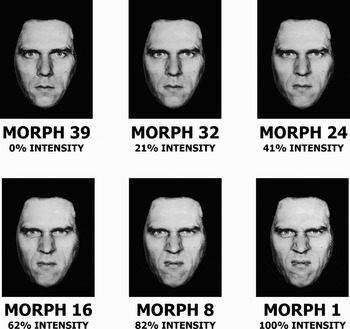
During the task, participants viewed each facial expression as it morphed through the 39 incremental stages, from neutral to the full emotional expression (Figure 2). The task included six different expressions: happiness, surprise, fear, sadness, anger, and disgust (Figure 3). Participants were told that the expression would begin as neutral, but would slowly change to reveal one of the six emotions, all of which were listed on the computer screen beneath the face stimulus. Subjects were instructed to carefully watch the face and, once they thought they knew the emotional expression being revealed, to press the “stop” button on the computer. This froze the morph, at which time the subject selected the emotional expression from the six options listed on the screen. Once the subject selected the emotion, the face continued through the remaining morph iterations. Subjects were told that they could stop the morph at any time to change their response. Finally, when the face reached the final morph, subjects were asked to provide their final response. Each morph iteration was presented for 100 ms, and each emotional expression was presented six times, in randomized order, for a total of 36 trials.
Gradations of multimorph emotional expression. Depicted are examples of disgust facial expressions across the 39 increment stages from 0% intensity (i.e., neutral) to 100% intensity (i.e., prototypical emotional expression).

Multimorph face emotions. Examples of the six types of facial emotions displayed during the emotional expression multimorph task are depicted.

Scoring of the emotional expression multimorph task
The primary outcome variables involved the response point, that is, the morph along the 1–39 continua at which the subject provided his/her response. Response point indicates the facial intensity required before recognition occurred. Two response point variables were created: first response point (i.e., the number of morphs required before first responding, regardless of accuracy), and correct response point (i.e., the number of morphs required before successfully identifying the emotional expression, where the final response was correct). Trials on which the final answer of the subject was incorrect were not used to calculate the correct response point; this was done so that subjects were not given credit for trials on which they may have at some point correctly identified the face expression, but later changed and remained with an erroneous answer. A higher response point score indicated better performance, that is, a 39 would indicate that the subject responded immediately at absolute neutral expression, whereas a 1 would indicate that the subject responded at the final morph iteration.
Other outcome variables were percentage of trials on which subjects changed their responses, total number of changes per trial, percentage correct on first response, percentage correct at final response (i.e., accuracy), and type of incorrect response.
Statistical procedures
Data analysis used repeated-measures analysis of covariance (ANCOVAs), where group (NP-BD, SMD, control) was the between-group factor, the measures described above were the dependent variables, and age, IQ, and gender served as covariates. Age and IQ were covariates due to group differences in these variables (see below). We controlled for gender based on previous work showing gender differences in facial affect processing in school-age children (Gross & Ballif, Reference Gross and Ballif1991; McClure, Reference McClure2000; Brody, Reference Brody1985; De Sonneville et al., Reference De Sonneville, Verschoor, Njiokiktjien, Op het Veld, Toorenaar and Vranken2002). Results were considered significant based on a two-tailed p ≤ .05. To minimize Type I errors, the Greenhouse–Geisser procedure was applied when appropriate for within-subject and repeated measures comparisons. All subsequent between-subject post hoc comparisons employed the Tukey honestly significant difference test.
To examine associations between impaired social function and face emotion labeling deficits, we conducted bivariate correlational analyses between correct response point and social function as measured by the LIFE and the SRS. Correct response was the variable of interest because, as presented below, both euthymic NP-BDs and SMDs differed from controls on this variable. To correct for multiple comparisons, p < .01 was required for significance. All data were analyzed using SPSS version 14.0 (SPSS, 2005).
Results
Participant demographics and clinical characteristics
Analysis of variance (ANOVA) comparison found significant group differences for age, F (2, 105) = 6.96, p = .001, and IQ, F (2, 105) = 6.82, p = .002. SMDs were significantly younger than both NP-BDs (p = .01) and controls (p = .002), and SMDs had significantly lower IQ than controls (p = .001), with a trend compared to NP-BDs (p = .08). There were no significant age or IQ differences between NP-BDs and controls. Because of these results, all comparisons controlled for age and IQ.
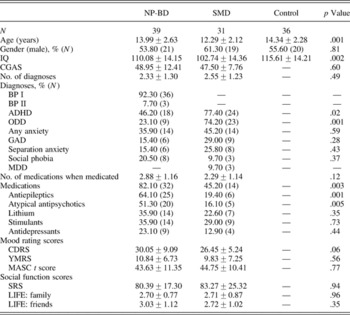
Among NP-BDs, 92.3% (N = 36) met criteria for BP-I. 66.7% (N = 26) of NP-BDs had comorbid diagnoses, the most common being ADHD, ODD, and social phobia. The most common diagnoses among the SMD children were ADHD (77.4%) and ODD (74.2%); anxiety disorders were also common (45.2%), and 87.1% had more than one DSM-IV diagnosis (Table 1).
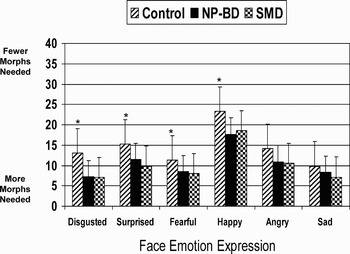
The correct response point. NP-BD, narrow phenotype-bipolar disorder; SMD, severe mood dysregulation. *p < .05 for both controls versus NP-BDs and controls versus SMDs. Shown is the response point along the 1–39 continua at which subjects correctly identified the facial expression. Scores are adjusted after controlling for age, IQ, and gender. Compared to controls (N = 36), NP-BDs (N = 39) and SMDs (N = 31) required significantly greater face emotion intensity before correctly labeling the expression for disgusted, F (2, 98) = 8.85, p < .001, surprised, F (2, 98) = 5.73, p = .004, fearful, F (2, 98) = 4.36, p = .02, and happy, F (2, 98) = 8.05, p = .001, faces. NP-BDs and SMDs did not differ from each other.

Demographic data

Note: NP-BD, narrow phenotype bipolar disorder; SMD, severe mood dysregulation; CGAS, Children's Global Assessment Scale; BP, bipolar disorder; ADHD, attention-deficit/hyperactivity disorder; GAD, generalized anxiety disorder; MDD, major depressive disorder; ODD, oppositional defiant disorder; CDRS, Children's Depression Rating Scale; YMRS, Young Mania Rating Scale; MASC, Manifest Anxiety Scale for Children; SRS, Social Reciprocity Scale; LIFE, Longitudinal Interval Follow-up Evaluation. All diagnoses are current.
ANOVA comparisons of CDRS, F (1, 67) = 3.82, p = .06, YMRS, F (1, 67) = .35, p = .56, and MASC, F (1, 46) = .09, p = .77, scores showed that NP-BDs did not differ from SMDs on mood ratings. Scores showed that 48.7% (N = 19) of NP-BDs and 58.1% (N = 18) of SMDs were euthymic at testing (i.e., CDRS ≤ 40 and YMRS ≤ 12). Of the 20 noneuthymic NP-BDs, 13 were hypomanic, 6 had mixed hypomania, and 1 was depressed. None of the SMD were currently depressed, and because, by definition, no SMD child had a definable episode of mania, YMRS scores >12 in 13 SMD patients reflected hyperarousal symptoms, rather than manic symptoms per se. CGAS, LIFE, and SRS scores, comparable between patient groups, indicated severe overall impairment and moderately impaired social function (Table 1). Among NP-BDs, 82.1% (N = 32) were medicated, with a mean of 2.9 ± 1.2 medications per subject. Among SMDs, 45.2% (N = 14) were medicated, with a mean of 2.6 ± 1.2 medications (see Table 1 for specific medications).
Faces morph behavioral data
The repeated-measures ANCOVA for first response point revealed a significant main effect of group, F (2, 100) = 6.08, p = .003, with both NP-BDs (p = .001) and SMDs (p = .02) requiring more morphs before responding than did controls. The Group × Emotion interaction was nonsignificant, F (10, 192) = 1.62, p = .10, indicating that this group difference did not differ based on the facial emotion. The main effect for all three covariates was nonsignificant: age, F (5, 96) = .61, p = .70; IQ, F (5, 96) = .77, p = .58; gender, F (5, 96) = 2.13, p = .07.
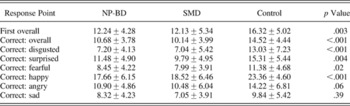
The repeated-measures ANCOVA for correct response point yielded a significant main effect of group, F (2, 98) = 8.33, p < .001; compared to controls, both NP-BDs (p < .001) and SMDs (p = .005) required more morphs before responding correctly. The main effect for all three covariates was nonsignificant: age, F (5, 94) = 1.05, p = .40; IQ, F (5, 94) = 1.08, p = .38; gender, F (5, 94) = 1.10, p = .37. The Group × Emotion interaction was significant, F (10, 188) = 1.91, p = .04. Post hoc analyses revealed significant between-group differences for disgusted, F (2, 98) = 8.85, p < .001, surprised, F (2, 98) = 5.73, p = .004, fearful, F (2, 98) = 4.36, p = .02, and happy, F (2, 98) = 8.05, p = .001 faces, with a trend for angry, F (2, 98) = 2.88, p = .06. The group-level contrast for sad was nonsignificant, F (2, 98) = .96, p = .39. For all emotions on which group differences were found, both NP-BDs and SMDs had significantly later correct response points than controls, indicating that they required more intense facial expressions before they responded correctly (Table 2 and Figure 4). NP-BDs did not differ from SMDs on any of the correct response point measures.
Group differences in response points on faces multimorph task

Note: NP-BD, narrow phenotype bipolar disorder; SMD, severe mood dysregulation. Responses indicate points along expression morph at which subjects responded, where higher scores indicate better performance, that is, fewer morphs required before successful emotion recognition. Results of repeated measures analyses of covariance, age, IQ, and gender as covariates. For all post hoc comparisons, both NP-BD and SMD samples required significantly more morphs before responding, but the two patient samples did not differ from each other.
We conducted repeated-measures ANCOVAs for our other outcome variables: percentage of trials with changed responses, total number of changes per trial, percentage correct on first response, percentage correct on final response, and type of incorrect response. All group, Group × Emotion interactions, and covariate effects were nonsignificant.
Post hoc analyses
Post hoc analyses focused on associations between correct response point and clinical and demographic variables. Age, IQ, and gender were again used as covariates. Caution should be used when interpreting these post hoc analyses because of the risk of Type I error due to multiple comparisons and risk of Type II error due to small sample sizes and limited power.
Demographic variables
Although age, gender, and IQ showed nonsignificant main effects when entered as covariates in our repeated measures ANCOVAs, we further examined their relationship to face processing. For each sample we conducted bivariate correlational analyses between correct response point and age and IQ, separately, as well as repeated-measures ANOVAs with gender as the between-group variable. For all subjects, age and IQ did not significantly correlate with correct response point. There was a significant main effect of gender in both controls, F (1, 34) = 7.24, p = .01, and NP-BD subjects, F (1, 35) = 4.27, p = .04, with females responding correctly at a significantly earlier morph point than males. The main effect of gender was nonsignificant in SMD subjects, F (1, 29) = .04, p = .84. In all three samples, the Gender × Face Emotion interaction was nonsignificant.
Mood state
Because only one NP-BD subject was depressed, in our analyses of the impact of mood state, we removed that subject from the data set and divided the NP-BD sample into euthymic (N = 19) and hypomanic/mixed (N = 19). We then compared these two NP-BD samples to SMDs and controls using an ANCOVA, with age, IQ, and gender as covariates. We did not divide the SMD sample because none were acutely depressed and, by definition, none were currently manic/hypomanic.
With correct response point, we found a significant main effect for group, F (3, 96) = 6.81, p < .001, a significant Group × Emotion interaction, F (15, 480) = 1.78, p = .04, but nonsignificant main effects for the covariates. With the group effect, all three patient groups required significantly more morphs than did controls before responding correctly: versus controls, euthymic NP-BDs (p = .04), hypomanic/mixed NP-BDs (p < .001), and SMDs (p = .004). The three patient groups did not differ from each other. Post hoc analyses of the Group × Emotion interaction revealed that, compared to controls, hypomanic/mixed NP-BDs and SMDs required significantly more morphs before responding correctly on disgusted (hypomanic/mixed NP-BDs: p = .002; SMDs: p = .004), surprised (hypomanic/mixed NP-BDs: p < .001; SMDs: p = .004), fearful (hypomanic/mixed NP-BDs: p = .002; SMDs: p = .04), and happy (hypomanic/mixed NP-BDs: p < .001; SMDs: p = .04) faces. Euthymic NP-BDs required significantly more morphs than controls before correctly responding to disgusted (p = .001) and happy faces (p = .03). Finally, before responding correctly, hypomanic/mixed NP-BDs required significantly more morphs than did euthymic NP-BDs on surprised faces (p = .02), and more than did SMDs on happy faces (p = .04). In sum, hypomanic/mixed NP-BDs display face-labeling deficits across all emotions, whereas euthymic NP-BDs have face-labeling deficits on disgusted and happy faces.
Comorbid diagnoses
Using correct response point as the outcome variable, we conducted a series of ANCOVAs comparing NP-BD with versus without comorbid anxiety, SMD with versus without comorbid anxiety, NP-BD with versus without ADHD, and NP-BD with versus without ODD. Analyses examining the impact of ADHD and ODD diagnoses could not be conducted in the SMD sample because most subjects had these diagnoses. For all ANCOVAs, we found no significant differences in response point scores based on the presence or absence of any comorbidity. Finally, we conducted bivariate correlational analyses, Bonferroni corrected for multiple comparisons, between correct response point and scores on two measures of PDD symptomatology: the SCQ (Berument et al., Reference Berument, Rutter, Lord, Pickles and Bailey1999) and the CCC-2 (Bishop, Reference Bishop1998). SCQ and CCC scores did not correlate significantly with face-processing ability in either the NP-BD or SMD sample.
Social function
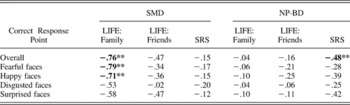
Bivariate correlational analyses compared face labeling in the SMD and NP-BD samples, analyzed separately, and social function as measured by LIFE scores in the family and friends domains and total SRS scores. Face-labeling ability was measured by correct response point overall and correct response point for those emotions on which NP-BD and SMD subjects differed from controls (i.e., disgusted, surprised, fearful, and happy faces). In the SMD sample, there was a significant relationship between worse family function and requiring greater emotion intensity before responding correctly for all emotions (r = −.76, p = .002), and between worse family function and requiring greater emotion intensity before responding correctly for fearful (r = −.79, p = .001) and happy faces (r = −.71, p = .004; Table 3). Interpersonal relationships with friends was not significantly correlated with any response point measures in SMD youth. In the NP-BD sample, family and friend social function was not correlated significantly with any response point measures. SRS scores were unrelated to face-processing deficits in SMD youth, but in NP-BD youth, poorer social reciprocity correlated significantly with requiring more intense emotion displays for a correct response across emotion type (r = −.48, p = .006; Table 3).
Correlations between correct response point on faces multimorph task and measures of social functioning

Note: NP-BD, narrow phenotype bipolar disorder; SMD, severe mood dysregulation; LIFE, Longitudinal Interval Follow-up Evaluation; SRS, Social Reciprocity Scale.
**p < .01.
Discussion
In this study we used a face emotion labeling task to compare children with NP-BD (i.e., episodic mania with elevated and/or grandiose mood), to those with SMD (i.e., chronic irritability, marked reactivity, and hyperarousal, but no episodic mania; Leibenluft et al., Reference Leibenluft, Charney, Towbin, Bhangoo and Pine2003), and controls. We sought to determine if children with NP-BD and SMD differ in their ability to label emotional facial expressions, if face-processing deficits in these patients were specific to particular emotions, and if impaired face labeling was associated with psychosocial dysfunction.
Regarding our first research aim, we found that, compared to controls, both NP-BD and SMD youth displayed face-processing deficits, but the patient samples did not differ from each other. Specifically, both NP-BD and SMD subjects required significantly greater intensity of emotional expression than did controls before the first response and before correctly identifying the facial expression. The finding that our patient samples require more intense displays of face emotion is important because subtle displays of emotion are common in social interactions, and facial expressions change rapidly during social interactions (Addington & Addington, Reference Addington and Addington1998; De Sonneville et al., Reference De Sonneville, Verschoor, Njiokiktjien, Op het Veld, Toorenaar and Vranken2002). These results extend previous work with NP-BD children (McClure et al., Reference McClure, Treland, Snow, Schmajuk, Dickstein and Towbin2005; Rich et al., Reference Rich, Vinton, Roberson-Nay, Hommer, Berghorst and McClure2006) by documenting that face-processing deficits are also present in SMD youth. These results are also consistent with another study that used a task of face emotion labeling and found that NP-BD and SMD youth were equally deficient in labeling face emotions compared to controls and youth with ADHD and anxiety/depression, who themselves were not impaired (Guyer et al., Reference Guyer, McClure, Adler, Brotman, Rich and Pine2007). Although methodological differences between that study and our current study may limit the complete integration of these results, it is notable that two different paradigms found NP-BD and SMD youth to be equally impaired when processing faces.
Because the rate of ADHD in both patient samples is high, one might have predicted that NP-BD and SMD youth would have responded more quickly (i.e., impulsively) than controls to the faces. We found just the opposite, in that the time to first response was longer in both patient samples than in controls. This result, coupled with the similar accuracy rates among our three samples, suggests that NP-BD and SMD youth were in fact attending to the faces. In addition, it is possible that the group differences in response point reflect slowed motor responsivity in patients, rather than a face-labeling deficit per se. Although we cannot rule this out, the fact that the subjects' later responding was not found across all emotion types (i.e., subjects were deficient on happy, surprised, fearful, and disgusted faces, but not sad faces) does not seem to indicate an overall slowness to respond. In sum, we believe that our results support the conclusions that, (a) compared to controls, NP-BD and SMD youth require significantly greater intensity of emotional expression before they can identify a facial emotion, and (b) our findings do not simply reflect inattention or motor slowness in patients.
Our data here should be interpreted in light of other research comparing SMD and NP-BD youth. Previous studies, coupled with the data presented here, demonstrate shared and divergent affective, behavioral, cognitive, and psychophysiological impairments in NP-BD versus SMD youth. Indeed, the question of the nosological relationship between SMD and NP-BD may have a dimensional, rather than categorical, answer, because BD is a multigenic illness with many affective and behavioral diagnostic symptoms (Althoff, Faraone, Rettew, Morley, & Hudziak, Reference Althoff, Faraone, Rettew, Morley and Hudziak2005; Kowatch, Youngstrom, Danielyan, & Findling, Reference Kowatch, Youngstrom, Danielyan and Findling2005). Overall, research to date largely supports the notion that SMD is distinct from NP-BD: children with SMD have an elevated risk for MDD at age 18 (Brotman et al., Reference Brotman, Schmajuk, Rich, Dickstein, Guyer and Costello2006); youth with NP-BD are more likely than those with SMD to have a family history of BD (Brotman et al., Reference Brotman, Kassem, Reising, Guyer, Dickstein and Rich2007); and SMD and NP-BD youth differ in response flexibility deficits and in the brain mechanisms mediating response to frustration (Dickstein et al., Reference Dickstein, Nelson, McClure, Grimley, Knopf and Brotman2007; Rich et al., Reference Rich, Schmajuk, Perez-Edgar, Fox, Pine and Leibenluft2007). Nonetheless, the fact that both SMD and NP-BD exhibit face-labeling deficits, and that those deficits are not present in other psychopathological groups (Guyer et al., Reference Guyer, McClure, Adler, Brotman, Rich and Pine2007), indicates that SMD and NP-BD may ultimately be found to be on the same pathophysiological continuum.
Our results may also suggest avenues for beginning to distinguish the neural substrates of SMD and NP-BD. Pathophysiological differences may be apparent even when behavioral differences are absent, because the same behavioral deficit may be mediated by different brain mechanisms (Wilkinson & Halligan, Reference Wilkinson and Halligan2004). Thus, despite the comparable performance between SMD and NP-BD youth in this study, face-processing tasks may identify different neural correlates of these two disorders. There is substantial overlap between the neural regions implicated in the pathophysiology of pediatric BD and those involved in processing face emotions. For example, in BD youth, volumetric and functional aberrations have been documented in the amygdala (Blumberg et al., Reference Blumberg, Fredericks, Wang, Kalmar, Spencer and Papademetris2005; Blumberg, Kaufman et al., Reference Blumberg, Kaufman, Martin, Whiteman, Zhang and Gore2003; Chang et al., Reference Chang, Karchemskiy, Barnea-Goraly, Garrett, Simeonova and Reiss2005; Chen et al., Reference Chen, Sassi, Axelson, Hatch, Sanches and Nicoletti2004; Delbello, Zimmerman, Mills, Getz, & Strakowski, Reference Delbello, Zimmerman, Mills, Getz and Strakowski2004; Dickstein et al., Reference Dickstein, Milham, Nugent, Drevets, Charney and Pine2005; Rich et al., Reference Rich, Vinton, Roberson-Nay, Hommer, Berghorst and McClure2006), orbitofrontal cortex (Rich et al., Reference Rich, Vinton, Roberson-Nay, Hommer, Berghorst and McClure2006; Wilke, Kowatch, Delbello, Mills, & Holland, Reference Wilke, Kowatch, Delbello, Mills and Holland2004), cingulate (Chang et al., Reference Chang, Adleman, Dienes, Simeonova, Menon and Reiss2004; Kaur et al., Reference Kaur, Sassi, Axelson, Nicoletti, Brambilla and Monkul2005; Wilke et al., Reference Wilke, Kowatch, Delbello, Mills and Holland2004), insula (Chang et al., Reference Chang, Adleman, Dienes, Simeonova, Menon and Reiss2004), putamen (Blumberg, Martin, et al., Reference Blumberg, Martin, Kaufman, Leung, Skudlarski and Lacadie2003; Chang et al., Reference Chang, Adleman, Dienes, Simeonova, Menon and Reiss2004; Delbello et al., Reference Delbello, Zimmerman, Mills, Getz and Strakowski2004), and basal ganglia (Wilke et al., Reference Wilke, Kowatch, Delbello, Mills and Holland2004; Leibenluft et al., Reference Leibenluft, Rich, Vinton, Nelson, Fromm and Berghorst2007). These same neural regions have been shown to assist in the processing of emotional facial expressions (Adolphs et al., Reference Adolphs, Tranel, Hamann, Young, Calder and Phelps1999; Blair, Morris, Frith, Perrett, & Dolan, Reference Blair, Morris, Frith, Perrett and Dolan1999; Gorno-Tempini et al., Reference Gorno-Tempini, Pradelli, Serafini, Pagnoni, Baraldi and Porro2001; Killgore & Yurgelun-Todd, Reference Killgore and Yurgelun-Todd2004; Morris et al., Reference Morris, Frith, Perrett, Rowland, Young and Calder1996; Phillips et al., Reference Phillips, Young, Senior, Brammer, Andrew and Calder1997, Reference Phillips, Bullmore, Howard, Woodruff, Wright and Williams1998; Sprengelmeyer, Rausch, Eysel, & Przuntek, Reference Sprengelmeyer, Rausch, Eysel and Przuntek1998; Yang et al., Reference Yang, Menon, Eliez, Blasey, White and Reid2002; Whalen et al., Reference Whalen, Rauch, Etcoff, McInerney, Lee and Jenike1998). Functional magnetic resonance imaging studies utilizing face-processing tasks may identify the neural correlates of NP-BD and SMD and clarify the extent to which the pathophysiology of these two disorders overlaps or differs.
A second goal of this study was to determine if face-labeling deficits were specific to certain emotional expressions. We predicted that, given their history of mania, NP-BD youth might show particular sensitivity to happy faces. We also predicted that, because SMD youth display severe behavioral dysregulation and irritability similar to that seen in psychopathic youths, SMD youth would display aberrant identification of fearful and sad faces similar to psychopathic youths (Blair et al., Reference Blair, Jones, Clark and Smith1997, 2000, Reference Blair, Colledge, Murray and Mitchell2001; Stevens et al., Reference Stevens, Charman and Blair2001). In general, these predictions were not supported. Of the six emotional expressions used in this task, both samples of patients were significantly impaired on four (happy, surprised, fearful, and disgusted), and there was a strong trend for impairment on a fifth (anger). Only sad faces failed to elicit NP-BD or SMD deficits. Our results indicate that the difficulty identifying facial emotions in NP-BD and SMD youth is evident across multiple emotions, and is best characterized as a general face emotion identification impairment, as opposed to being specific to certain emotions.
As previously noted, another study from our group found no face emotion identification deficits in youth with ADHD or comorbid depression and anxiety (Guyer et al., Reference Guyer, McClure, Adler, Brotman, Rich and Pine2007). However, the literature has not been entirely consistent on this point. That is, some studies find that ADHD youth display a generalized face-labeling deficit across emotions when face stimuli are paired with voice recordings (Cadesky, Mota, & Schachar, Reference Cadesky, Mota and Schachar2000; Corbett & Glidden, Reference Corbett and Glidden2000). Similarly, other studies suggest that some childhood psychopathologies may be associated with deficits recognizing specific emotions; for example, threatening faces (i.e., fearful and angry) in depressed children (Lenti, Giacobbe, & Pegna, Reference Lenti, Giacobbe and Pegna2000), angry faces with maltreated (Pollak & Kistler, Reference Pollak and Kistler2002; Pollak, Cicchetti, Hornung, & Reed, Reference Pollak, Cicchetti, Hornung and Reed2000) and physically abused children (Pollak & Tolley-Schell, Reference Pollak and Tolley-Schell2003), and distressed faces (i.e., fearful and sad) in children with psychopathy (Blair et al., Reference Blair, Jones, Clark and Smith1997, Reference Blair and Coles2000, Reference Blair, Colledge, Murray and Mitchell2001; Stevens et al., Reference Stevens, Charman and Blair2001). Clearly, direct comparisons of different childhood psychopathologies (e.g., youth with anxiety, depression, ADHD, ODD, BD, and SMD), using an identical face-processing task, are needed to clarify the specificity of face-processing deficits between diagnoses.
Elucidating face-processing impairments in BD may also be achieved using developmental studies that compare children and adults on identical tasks. Comparable to the face emotion labeling difficulties we identified in NP-BD youth, prior work finds that adults with BD have face emotion labeling deficits that do not appear to be emotion specific (Bozikas et al., Reference Bozikas, Tonia, Fokas, Karavatos and Kosmidis2006; Getz et al., Reference Getz, Shear and Strakowski2003; Lembke et al., Reference Lembke and Ketter2002; Yurgelun-Todd et al., Reference Yurgelun-Todd, Gruber, Kanayama, Killgore, Baird and Young2000). For example, whereas two studies suggest that adults with BD may show enhanced recognition of disgust (Harmer et al., Reference Harmer, Grayson and Goodwin2002) and sad faces (Lennox, Jacob, Calder, Lupson, & Bullmore, Reference Lennox, Jacob, Calder, Lupson and Bullmore2004), other studies find BD adults to be deficient in their identification of these specific face emotions (Bozikas et al., Reference Bozikas, Tonia, Fokas, Karavatos and Kosmidis2006; Getz et al., Reference Getz, Shear and Strakowski2003; Lembke et al., Reference Lembke and Ketter2002). Further, when identifying happy faces, studies have found BD adults both to be deficient (Bozikas et al., Reference Bozikas, Tonia, Fokas, Karavatos and Kosmidis2006; Getz et al., Reference Getz, Shear and Strakowski2003) and comparable to controls (Yurgelun-Todd et al., Reference Yurgelun-Todd, Gruber, Kanayama, Killgore, Baird and Young2000).
The inconsistency of the data in BD adults, coupled with minimal data on BD youth, makes it difficult to draw conclusions regarding the developmental progression of face-processing deficits in individuals with BD. In contrast, there may be differences in face processing between youth and adults with BD. These may reflect a variety of developmental factors, including adults' more extended exposure to social interactions (which may improve face-processing skills), longer use of psychotropic medications (which may lessen the neurochemical or neurophysiological dysfunction associated with impaired face processing), or developmental changes in brain function. At the same time, in this study we did not find an age effect on our results, and a prior study with BD adults found that impaired face affect identification was not related to age of onset or duration of illness (Bozikas et al., Reference Bozikas, Tonia, Fokas, Karavatos and Kosmidis2006). The lack of age effects may reflect the fact that by 6 years of age, the recognition of basic emotions such as happy, angry, scared, and sad, appears to be fully developed (Markham & Adams, Reference Markham and Adams1992; McClure, Reference McClure2000), and there is not substantial improvement in face emotion identification accuracy after age 10 (Harrigan, Reference Harrigan1984). A longitudinal study of children at risk for BD, or a comparison of subjects with early-onset BD to those with adult-onset BD, would begin to elucidate the developmental progression of deficient face emotion processing in individuals with BD.
An additional line of future research may explore the role of gender in BD youth when processing faces. Consistent with a prior review in healthy youth (McClure, Reference McClure2000), we found that, in NP-BD youth and controls, males may require more intense displays of facial expression for accurate emotion identification than do females. Gender-related differences were not identified in SMD youth. Studies with large samples are necessary to explore further the role of gender in NP-BD face-labeling deficits.
Our third goal in this study was to examine associations between social impairment and face-labeling deficits. Two aspects of social function were measured: social reciprocity and a general measure of social interactions with peers and family. In the NP-BD sample, we found a negative correlation between delayed face emotion identification and parent-reported social reciprocity (e.g., social awareness, social information processing, and capacity for reciprocal social responses). These results expand upon a prior study of parent-reported poor social skills in BD youth (Goldstein et al., Reference Goldstein, Miklowitz and Mullen2006).
In contrast, in the SMD sample we found an association between delayed face emotion identification, in particular of fearful and happy faces, and impaired family function. The relationship between impaired face processing and family dysfunction may be bidirectional. Consistent with prior work (Cicchetti & Curtis, Reference Cicchetti and Curtis2005; Pollak & Kistler, Reference Pollak and Kistler2002; Pollak, Klorman, Thatcher, & Cicchetti, Reference Pollak, Klorman, Thatcher and Cicchetti2001; Marshall & Fox, Reference Marshall and Fox2004; Parker & Nelson, Reference Parker and Nelson2005), adverse environmental conditions, such as family dysfunction, may result in the impaired face emotion processing seen in SMD youth. Indeed, recent work suggests that aberrant social environments may impact adversely the development of neuropeptide systems central to social and emotional development (Fries, Ziegler, Kurian, Jacoris, & Pollak, Reference Fries, Ziegler, Kurian, Jacoris and Pollak2005). Conversely, impaired identification of facial emotions may lead to problematic family interactions in SMD children. Our results suggest that psychotherapeutic interventions might target NP-BD and SMD children's face-labeling deficits, perhaps in the form of psychoeducation and practicing face emotion identification, in an effort to improve social function.
One potential limitation of our study is the varied mood states of our NP-BD subjects. However, consistent with previous data (McClure et al., Reference McClure, Treland, Snow, Schmajuk, Dickstein and Towbin2005; Rich et al., Reference Rich, Vinton, Roberson-Nay, Hommer, Berghorst and McClure2006), we found that euthymic NP-BD patients were impaired in face emotion recognition when compared to controls. Another limitation is the high rates of co-occurring diagnoses, particularly ADHD and ODD, in our NP-BD sample, although this rate is typical of that seen in other samples of BD children (Biederman, Faraone, Chu, & Wozniak, Reference Biederman, Faraone, Chu and Wozniak1999). When we compared NP-BD subjects with and without comorbid ADHD or ODD, we did not find between-group differences in response point. However, small sample sizes limit the interpretation of these negative results. Comparable examinations in the SMD sample were not possible due to the high rates of ADHD and ODD in this group; indeed, SMD, ODD, and ADHD can be viewed as different approaches to describing closely related clinical phenomena. Future studies should compare BD children with and without comorbid conditions (e.g., ADHD, ODD, anxiety) to children with ADHD, ODD, and anxiety.
In conclusion, the current study extends prior work on face-processing deficits in bipolar youth by documenting face-labeling deficits in SMD children, that is, those in whom the BD diagnosis is controversial. Our results indicate that NP-BD and SMD youth require significantly greater intensity of facial expression before correctly identifying an emotion, in particular disgust, surprise, fear, and happiness. Finally, we provide evidence of an association between impaired face labeling and impaired social reciprocity in NP-BD youth and impaired family function in SMD youth.