Introduction
Following trauma, most people experience stress-related symptoms but these typically resolve over a relatively short period of time. An important minority who continue to experience post-traumatic stress symptoms after 4 weeks are diagnosed with post-traumatic stress disorder (PTSD) (Rothbaum et al. Reference Rothbaum, Foa, Riggs, Murdock and Walsh1992; Blanchard et al. Reference Blanchard, Hickling, Mitnick, Taylor, Loos and Buckley1995; Riggs et al. Reference Riggs, Rothbaum and Foa1995; Koren et al. Reference Koren, Arnon and Klein1999). Diagnostic markers that identify this unique subgroup could inform attempts to improve early intervention and prevention (Bryant et al. Reference Bryant, Sackville, Dang, Moulds and Guthrie1999, Reference Bryant, Mastrodomenico, Felmingham, Hopwood, Kenny, Kandris, Cahill and Creamer2008). In this study we focused on the predictive risk of two cognitive markers measured immediately following a potentially traumatic event: self-reported symptoms of psychological dissociation and behaviorally measured threat-related attention bias.
Monitoring potential threats in the environment is essential for survival. The human threat-monitoring system relies on a dedicated neural network that continually balances the cognitive resources allocated to the evaluation of potential threats and coordinates ongoing psychological and behavioral response patterns (Liddell et al. Reference Liddell, Brown, Kemp, Barton, Das, Peduto, Gordon and Williams2005; Pessoa & Adolphs, Reference Pessoa and Adolphs2010; Adolphs, Reference Adolphs2013). Traumatic events can challenge the delicate cognitive-behavioral balance maintained by the threat-monitoring system, and could manifest as threat-related cognitive biases (Ehlers & Clark, Reference Ehlers and Clark2000). Importantly, such perturbations in the threat-monitoring system seem to resemble two primary symptom clusters of PTSD, namely threat avoidance/dissociation and hypervigilance (Scully, Reference Scully2000).
High levels of peritraumatic dissociation symptoms have been identified as a potential risk marker for PTSD, with meta-analyses reporting a medium effect size (Ozer et al. Reference Ozer, Best, Lipsey and Weiss2003; Lensvelt-Mulders et al. Reference Lensvelt-Mulders, van der Hart, van Ochten, van Son, Steele and Breeman2008). Symptoms of psychological dissociation during and immediately following a traumatic experience are fairly common (Bremner et al. Reference Bremner, Southwick, Brett, Fontana, Rosenheck and Charney1992; Koopman et al. Reference Koopman, Classen and Spiegel1994; Marmar et al. Reference Marmar, Weiss, Schlenger, Fairbank, Jordan, Kulka and Hough1994, Reference Marmar, Weiss, Metzler, Delucchi, Best and Wentworth1999) and involve reduction in awareness to one's surroundings and altered perceptions of self and the environment (Cardena & Spiegel, Reference Cardena and Spiegel1993). Although dissociation symptoms could be adaptive in the short run by allowing traumatic perceptions and experiences to be split from awareness and thus reduce immediate distress, they also index later risk for PTSD (van der Kolk et al. Reference van der Kolk, van der Hart, Marmar, van der Kolk, McFarlane and Weisaeth1996; Bremner & Brett, Reference Bremner and Brett1997; Harvey & Bryant, Reference Harvey and Bryant1998, Reference Harvey and Bryant2002; Marmar et al. Reference Marmar, Weiss, Metzler, Delucchi, Best and Wentworth1999; Briere et al. Reference Briere, Scott and Weathers2005).
Another potential cognitive marker of risk for PTSD following trauma emerges from the research on threat-related attention biases in anxiety. Attention bias toward threats represents one of the most consistently demonstrated correlates of anxiety disorders including PTSD (Yiend, Reference Yiend2010). The attention of patients with PTSD is selectively biased toward threat-related information (Thrasher et al. Reference Thrasher, Dalgleish and Yule1994; Litz et al. Reference Litz, Weathers, Monaco, Herman, Wulfsohn, Marx and Keane1996; Bryant & Harvey, Reference Bryant and Harvey1997; Moradi et al. Reference Moradi, Taghavi, Doost, Yule and Dalgleish1999; Jenkins et al. Reference Jenkins, Langlais, Delis and Cohen2000). However, these findings relate to patients with ongoing PTSD and do not reveal whether peritraumatic attention bias is predictive of PTSD risk. One study tested longitudinally whether attention bias toward threat following a traumatic event predicted later risk for PTSD, and found null results (Elsesser et al. Reference Elsesser, Sartory and Tackenberg2005). In that study participants from a range of potentially traumatic exposures were included, the task used to measure attention bias used complex pictures depicting neutral and traumatic events, and attention bias was first assessed approximately 1 month after the trauma, with large variability in post-event testing times (7–56 days).
In the current study, to reduce potential experimental variability, we tested whether threat-related attention bias measured within 24 h after a specific traumatic event (motor vehicle accident, MVA) and using visually less complex standardized word stimuli may serve as a predictive marker of PTSD at the 3-month follow-up. We expected that threat vigilance would confer higher risk for PTSD above and beyond the established predictive value of self-reported dissociation symptoms. Direct measurement of perturbations in the threat-monitoring system using computerized tasks could highlight aspects of risk that are not accessible from self-reports on symptoms. Such direct measurement also bypasses the concern of shared method variance between patient-reported dissociation symptoms and patient-reported PTSD symptoms as outcome.
Method
Participants
MVA survivors with minor injuries, who were admitted to the emergency department (ED) at the Soraski Medical Center, Tel-Aviv between March 2011 and January 2012, formed the potential pool of participants in the study. Data were collected 5 days a week in two 5-h shifts/day. During these shifts, every potential participant was approached for recruitment. Inclusion criteria were: (a) being involved in an MVA and fulfilling DSM-IV criterion A1 of the PTSD diagnosis; (b) suffering only minor injuries as determined by the ED medical staff; specifically, subjects could not suffer internal bleeding, head injury or require urgent surgery; (c) age between 18 and 65 years; (d) fluent in Hebrew; and (e) the MVA had occurred within the past 24 h.
Of the 618 potentially eligible individuals, 41 declined participation, generating data in 577 (mean age = 35.02 years, s.d. = 11.68, range 18–65, 356 males). Of these 577, 194 were drivers of four-wheel vehicles, 248 were motorcyclists, 42 were bicycle riders, 30 were pedestrians, and 63 were passengers. Three months later, an attempt was made to contact these 577, among whom 24 could not be contacted and 138 declined further participation. This left 415 participants with full data, representing 71.9% of the initial sample. Participants with full data sets did not differ from other subjects in terms of most variables acquired at baseline. These included age, gender distribution, threat-related attention bias, and most types of symptoms (all p's > 0.17). However, relative to participants with full data, non-participants had more dissociation symptoms following the MVA (6.2 v. 9.3, t 406 = 2.46, p = 0.014).
Written informed consent was obtained from all participants. Given the sensitivity of research in the ED setting, research staff ensured that participants clearly understood the voluntary nature of the study. The study was approved by the Tel Aviv University Institutional Review Board and the Ethics Committee of the Sourasky Medical Center.
Clinician-Administered PTSD Scale (CAPS)
PTSD was diagnosed using the CAPS and served as the outcome measure of the study. The CAPS is a structured interview used to make current or lifetime diagnosis of PTSD. The first 17 items of the CAPS correspond to the DSM-IV criteria for PTSD (Blake et al. Reference Blake, Weathers, Nagy, Kaloupek, Gusman, Charney and Keane1995). For each item, symptom intensity (from 0 = no distress to 4 = severe distress) and frequency (from 0 = never to 4 = almost every day) over the past month are evaluated. The impact of symptoms on social and occupational functioning and overall PTSD severity are also measured. The three symptom clusters of PTSD are indexed: intrusive recollections (cluster B), avoidant/numbing symptoms (cluster C) and hyper-arousal (cluster D). A symptom is considered present if it has a frequency of ⩾1 and an intensity of ⩾2. A PTSD diagnosis required at least one B-cluster symptom, three C-cluster symptoms and two D-cluster symptoms, in addition to meeting the other diagnostic criteria of at least 1 month's duration and significant distress or impairment in functioning. CAPS total score was derived by summing the first 17 items. The CAPS is considered the gold standard in PTSD diagnosis and possesses good sensitivity, specificity, retest reliability and validity (Blake et al. Reference Blake, Weathers, Nagy, Kaloupek, Gusman, Charney and Keane1995; Blanchard et al. Reference Blanchard, JonesAlexander, Buckley and Forneris1996). Interviewers were four graduate clinical psychology students trained and supervised to 85% reliability criterion with an experienced clinical psychologist. Internal consistency in the current study was good (Cronbach's α = 0.95).
Primary predictors of PTSD
Clinician-Administered Dissociative States Scale (CADSS)
The CADSS (Bremner et al. Reference Bremner, Krystal, Putnam, Southwick, Marmar, Charney and Mazure1998) is designed to assess the occurrence and severity of dissociative symptoms in relation to the participant's perceptual experience during the interview. The items assess how perceptually 'in touch’ (or 'out of touch’) an individual is with the environment following exposure to stressful conditions. The scale contains 19 items rated on a Likert-type scale from 0 (not at all) to 4 (extremely). Cronbach's α in the current study was 0.75.
Threat bias assessment: the dot-probe task
The dot-probe task used in the current study was similar to the one used by Bar-Haim et al. (Reference Bar-Haim, Holoshitz, Eldar, Frenkel, Muller, Charney, Pine, Fox and Wald2010) and Wald et al. (Reference Wald, Lubin, Holoshitz, Muller, Fruchter, Pine, Charney and Bar-Haim2011a ). In brief, 25 word pairs, each consisting of one general threat word (e.g. scared, danger, dead) and one neutral word (e.g. line, tomatoes, carpets), were used as stimuli. Words of each pair were matched on number of letters and frequency of usage in Hebrew. Each trial began with a 500-ms fixation display ’+++’ in the center of the screen followed by a word pair presented in white block text 1-cm high. One word appeared directly above and the other directly below the location vacated by the preceding fixation signal. A distance of 1.5 cm separated the two words. The word pair remained on the screen for 1000 ms, and was then replaced by a target probe (either ’..’ or ’.’) that appeared in one of the two locations vacated by the wordsFootnote 1 Footnote †. Participants had to identify the probe types. The participant's response cleared the screen and the next trial begun 500 ms later.
The task comprised 100 trials and took approximately 4 min to complete. Probes appeared with equal frequency at the location of either the threat or the neutral word. The speed with which participants discriminated the probe type accurately was recorded on each trial. Trials with an incorrect response and trials in which the response time was more than 2 standard deviations of the participant's mean for a particular condition were excluded from subsequent analysis (<2% of all trials). Threat bias was calculated as the difference between the average response time to targets appearing at neutral word locations and those appearing at threat word locations. Positive bias values represent attention bias toward threat and negative values reflect an attentional bias away from threat. Word valance location, target location and target type were fully counterbalanced.
Baseline PTSD and depression symptoms
Nine-item Patient Health Questionnaire (PHQ-9)
The PHQ-9 (Spitzer et al. Reference Spitzer, Kroenke and Williams1999) is a self-reported depression rating scale consisting of nine items on which the DSM-IV diagnosis of major depressive disorder is based. Each item is scored on a Likert-type scale ranging from 0 (not at all) to 3 (nearly every day). A total score is obtained by summing across all items. An additional item assesses the severity of impairment. Reliability and diagnostic validity of the PHQ-9 have been established in several studies (Spitzer et al. Reference Spitzer, Kroenke and Williams1999; Kroenke et al. Reference Kroenke, Spitzer and Williams2001; Kroenke & Spitzer, Reference Kroenke and Spitzer2002). Cronbach's α in the current study was 0.78.
PTSD Checklist (PCL)
The prevalence of PTSD symptoms before the MVA was evaluated using the 17-item National Center for PTSD Checklist of the Department of Veterans Affairs, the PCL (Blanchard et al. Reference Blanchard, JonesAlexander, Buckley and Forneris1996; Kang et al. Reference Kang, Natelson, Mahan, Lee and Murphy2003; Hoge et al. Reference Hoge, Castro, Messer, McGurk, Cotting and Koffman2004). Symptoms were related to any stressful experience (in the wording of the 'specific stressor’ version of the checklist). Scores can range from 17 to 85, with higher scores reflecting more symptoms of PTSD. Cronbach's α in the current study was 0.92.
Procedure
Participants were assessed twice 3 months apart. In the first assessment, at the ED within 24 h of their MVA, participants completed the CADSS, the dot-probe task, the PCL and the PHQ-9. At the second assessment, 3 months later, participants were diagnosed for PTSD in a telephone interview using the CAPS.
Data analysis
Hierarchical multivariate logistic regression analysis was conducted to examine the predictive contribution of dissociation symptoms and threat-related attention bias collected within 24 h of an MVA to vulnerability to PTSD at the 3-month follow-up. Baseline self-reported PTSD and depression symptoms (PCL and PHQ-9) were entered into the regression model first. Because PTSD at follow-up was more prevalent in females than males and in passengers than drivers, gender and role in the MVA were also entered into the regression in the first step. The primary predictors (dissociation symptoms and threat-related attention bias) were entered into the model in the second step. The interaction between dissociation and attention bias was entered in the third step.
Results
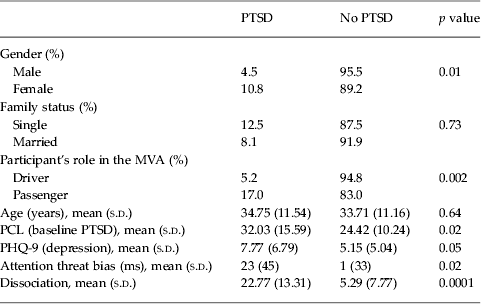
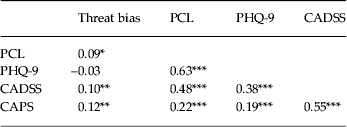
Descriptive statistics for all variables are provided in Table 1. Zero-order correlations between the different measures collected at baseline are presented in Table 2. Of the 415 participants who provided data at follow-up, 28 (6.75%) had PTSD based on the CAPS. Participants diagnosed with PTSD did not differ from the non-PTSD group in age or gender distribution (p's > 0.10). Nevertheless, the two groups differed in pre-MVA self-reported PTSD symptoms (PCL) and depression symptoms (PHQ-9) as measured immediately after the MVA (ts 413 = 2.54 and 2.0, p's = 0.02 and 0.055 respectively), with higher symptoms in the PTSD than the non-PTSD group. Within the group with PTSD at follow-up, there were more females than males (10.8% v. 4.5%, χ 2 = 6.04, p = 0.014) and more passengers than drivers (17.0% v. 5.2%, χ 2 = 9.59, p = 0.008).
Background characteristics and predictor measures within 24 h of the MVA by PTSD diagnosis at the 3-month follow-up

MVA, Motor vehicle accident; PTSD, post-traumatic stress disorder; PCL, PTSD Checklist; PHQ-9, nine-item Patient Health Questionnaire; s.d.; standard deviation.
Zero-order correlations between baseline measures of PTSD (PCL), depression (PHQ-9), dissociation (CADSS), and attentional threat bias and CAPS total scores

PTSD, Post-traumatic stress disorder; PCL, PTSD Checklist; PHQ-9, nine-item Patient Health Questionnaire; CADSS, Clinician-Administered Dissociative States Scale; CAPS, Clinician-Administered PTSD Scale.
* p = 0.052, ** p < 0.05, *** p < 0.0001.
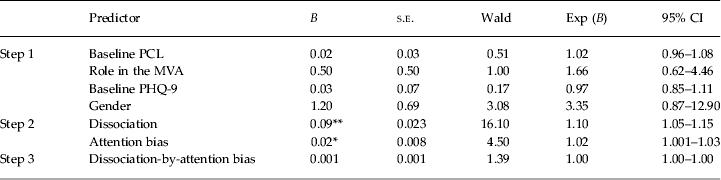
The regression model accounted for 38% of the variance in PTSD diagnosis at follow-up (χ 2 7 = 42.8, p < 0.001). The four background variables entered in step 1 (PCL, PHQ-9, gender, and role in the MVA) significantly accounted for 18% of the variance in PTSD at follow-up (χ 2 = 20.32, p < 0.001). Step 2 of the regression revealed that higher levels of dissociation immediately following the MVA were associated with greater risk for PTSD at the 3-month follow-up [B = 0.09, odds ratio (OR) 1.10, 95% confidence interval (CI) 1.05–1.15, Wald = 16.10, p < 0.0001], accounting for an additional 16% of the variance in PTSD diagnosis. Greater attention bias toward threat at baseline was also associated with higher incidence of PTSD at follow-up, accounting for an additional 4% of the variance above and beyond the variance accounted for by the variables entered in step 1 and the dissociation symptoms (B = 0.02, OR 1.02, 95% CI 1.001–1.03, Wald = 4.50, p < 0.04). Finally, the interaction term between dissociation and attention bias did not predict PTSD diagnosis (χ 2 = 1.53, p > 0.20). The estimate coefficients for the regression model are shown in Table 3.
Estimated coefficients, standard errors and 95% CIs for predictors in the three steps of the regression model predicting PTSD

PTSD, Post-traumatic stress disorder; PCL, PTSD Checklist; MVA, motor vehicle accident; PHQ-9, nine-item Patient Health Questionnaire; B, unstandardized estimated coefficient; s.e., standard error; CI, confidence interval.
* p < 0.05, ** p < 0.0001.
Discussion
The novel finding of the current study is that performance-based attention bias toward threat, measured immediately after an MVA, predicted PTSD above and beyond the variability predicted by self-reported dissociation symptoms, which was previously found to be a strong predictor of risk for PTSD (Lensvelt-Mulders et al. Reference Lensvelt-Mulders, van der Hart, van Ochten, van Son, Steele and Breeman2008), and specifically in MVA survivors (Ehlers et al. Reference Ehlers, Mayou and Bryant1998; Holeva & Tarrier, Reference Holeva and Tarrier2001).
One possible mechanism linking enhanced threat-related attention bias to risk for later PTSD relates to greater accessibility and enhanced consolidation of trauma-related elements that is facilitated by increased threat attendance. Increased attention to the traumatic event could extend the range of accessible trauma-related triggers and thereby increase the risk for PTSD symptoms. A mechanism that may operate in a similar way but in a different system has been suggested in studies demonstrating that enhanced priming for trauma-related stimuli measured shortly after the traumatic event predicted subsequent flashbacks (Michael et al. Reference Michael, Ehlers and Halligan2005), or re-experiencing of the trauma (Ehlers et al. Reference Ehlers, Michael, Chen, Payne and Shan2006). More research is needed to establish the validity of such mechanisms in relation to attentional threat bias and enhanced PTSD symptoms.
Enhanced low-level attention toward threats following a traumatic event could also enhance the psychological tendency to dissociate. Specifically, hyper-engagement with threats at the basic attention allocation level could feed forward to induce intolerable stress that, in some people, invokes psychological defenses in the form of dissociative symptoms. Indeed, in the current sample, a small but significant association was found between threat bias and dissociation symptoms. Similar vigilance-avoidance models of attentional engagement have been proposed for other anxiety disorders in which dissociation is not a typical symptom (Mogg et al. Reference Mogg, Bradley, Miles and Dixon2004; Koster et al. Reference Koster, Verschuere, Crombez and Van Damme2005; Pflugshaupt et al. Reference Pflugshaupt, Mosimann, von Wartburg, Schmitt, Nyffeler and Muri2005). It may be the case that the high intensity of threat associated with traumatic events causes more minor patterns of attentional avoidance to propagate to other cognitive systems and manifest more robustly in the form of dissociation. Evidence from neuroimaging research in PTSD patients lends support this possibility of a biphasic process of initial attentional vigilance toward threats and later threat avoidance (Adenauer et al. Reference Adenauer, Pinosch, Catani, Gola, Keil, Kissler and Neuner2010).
The results of the current study should also be discussed in relation to prior reports of plasticity in threat-related attention bias under conditions of acute stress. Unlike the typical finding of threat vigilance in anxious participants under neutral laboratory conditions (Bar-Haim et al. Reference Bar-Haim, Lamy, Pergamin, Bakermans-Kranenburg and van IJzendoorn2007), several studies have shown that, in normative samples, imminent threat can produce attentional threat avoidance rather than vigilance (Beevers et al. Reference Beevers, Lee, Wells, Ellis and Telch2011; Wald et al. Reference Wald, Lubin, Holoshitz, Muller, Fruchter, Pine, Charney and Bar-Haim2011a ; Shechner et al. Reference Shechner, Britton, Perez-Edgar, Bar-Haim, Ernst, Fox, Leibenluft and Pine2012). Such threat avoidance under stress has been associated with risk for PTSD symptoms (Wald et al. Reference Wald, Shechner, Bitton, Holoshitz, Charney, Muller, Fox, Pine and Bar-Haim2011b ). Thus, why, in the context of the current study, does threat vigilance rather than threat avoidance conferred risk for later PTSD? The answer to this question may relate to the different contexts in which these previous studies were conducted relative to the context of the current study. Studies that found attentional threat avoidance to predict PTSD symptoms were conducted under conditions of immediate and imminent threat (e.g. ongoing rocket attack, threat of an electric shock, or military deployment). In these situations an adaptive response involves attending to threats, making attentional threat avoidance a maladaptive response that has been associated with risk of PTSD symptoms. By contrast, the minor severity of injuries of participants in the current study, and the timing and location of attention bias measurement relative to the trauma (threat was no longer present and the participants were in the caring environment of the ED), may have rendered the situation relatively safe. Therefore, the adaptive response would be to ignore minor threats, and a maladaptive association between hypervigilance for minor threats and anxiety-related symptoms emerged as a risk factor for PTSD. Additional studies are needed to further clarify the interplay between threat-related attention patterns and context and their relationship to PTSD.
The current study also has limitations that future research may overcome. First, although the results indicate that threat-related attention bias and dissociation symptoms predict increased risk for PTSD, they do not provide information about participants' threat-related attention or dissociative tendencies prior to the traumatic event. Therefore, the correlation between these predictors and PTSD could be driven either by pre-trauma cognitive styles acting as personal vulnerability factors or by differential plasticity in participants' cognitive reactions to the traumatic event. The resolution of this issue may point to threat bias and dissociation as general risk factors for anxiety and stress-related psychopathology (Bar-Haim et al. Reference Bar-Haim, Lamy, Pergamin, Bakermans-Kranenburg and van IJzendoorn2007), or as indices more closely associated with responses to traumatic exposure. Second, in the current study threat-related attention bias and dissociation were not measured at follow-up and thus do not allow inference about the potential role of persistent threat bias and dissociation in PTSD development. Future studies measuring threat-related attention bias and dissociation at various time points before and after exposure to traumatic events are needed to clarify these conceptual issues (Wald et al. Reference Wald, Degnan, Gorodetsky, Charney, Fox, Fruchter, Goldman, Lubin, Pine and Bar-Haim2013).
In conclusion, the current findings contribute an additional piece to the puzzle of PTSD vulnerability factors that can be measured efficiently and at a low cost soon after the occurrence of traumatic events. Nevertheless, the combined percentage of the variance in risk for PTSD accounted for by the current predictors is relatively small (38%), and thus renders their clinical utility unclear. Additional research is needed to establish the role of threat-related attention bias in vulnerability to PTSD and its interaction with other factors that could reliably predict PTSD development. Identification of the risk associated with enhanced vigilance toward threats in the ED could lead to the development of computer-based interventions designed to modify such attention biases, with the intention of reducing risk for PTSD (Pine et al. Reference Pine, Helfinstein, Bar-Haim, Nelson and Fox2009). Attention bias modification treatments (ABMTs) have shown efficacy in the treatment of anxiety disorders (Bar-Haim, Reference Bar-Haim2010; Hakamata et al. Reference Hakamata, Lissek, Bar-Haim, Britton, Fox, Leibenluft, Ernst and Pine2010). The current results suggest that there may also be a potential for an ABMT as a prevention protocol for those at increased risk for PTSD following traumatic exposures (See et al. Reference See, MacLeod and Bridle2009).
Acknowledgments
This work was supported by the Israel Insurance Association, Association of Life Insurance Companies of Israel (0610714692). Professor Y. Bar-Haim is independent of any commercial funder and had full access to all the data in the study and takes responsibility for the integrity of the data and the accuracy of the data analysis.
Declaration of Interest
None.