

Introduction
The widespread utilization of ceramic thermal-barrier coatings (TBCs) in both energy and propulsion systems has, to a large extent, been enabled by the development of advanced deposition technologies. The refractory nature of TBC materials such as yttria partially stabilized zirconia (YSZ) with melting points approaching or in excess of 3000 K requires ultrahigh temperature materials processing capabilities. Hence, thermal plasmas and electron beam sources have become primary and preferred methods of manufacturing. The former involves melt fabrication of powdered ceramics, while the latter is based on evaporation and vapor deposition from ceramic ingots.
A remarkable attribute of this process development is the scale of implementation of such advanced materials. According to various industrial sources, some 1–1.5 million kilograms of YSZ was atmospheric plasma sprayed (APS) onto engine components in 2011 alone. Aero-engine components benefiting from APS TBCs include combustors, vanes, and turbine shrouds, while TBCs are plasma sprayed onto both rotating and stationary parts of large land-based power-generation engines. On the other hand, virtually all hot section rotating turbine blades of aircraft-engines contain TBCs deposited via electron-beam physical vapor deposition (EBPVD) processes. These applications are expected to grow in the next two decades, especially as the importance of TBCs continues to grow due to ever increasing demands for fuel efficiency.
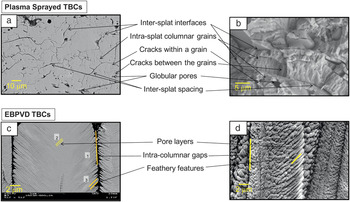
A critical aspect of ceramic TBCs, in addition to the material, is the coating defect architecture facilitated by processing. Both APS and EBPVD TBCs are comprised of some 10–30% porosity, which reduces the already low thermal conductivity of YSZ by an additional 100–150%.Reference Kulkarni, Wang, Nakamura, Sampath, Goland, Herman, Allen, Ilavsky, Long, Frahm and Steinbrech1, Reference Flores Renteria, Saruhan, Schulz, Raetzer-Scheibe, Haug and Wiedenmann2 EBPVD coatings display conductivities from 45 to 65% of bulk values, depending on process conditions, while as-deposited APS coatings can show properties as low as 20% of bulk values. This substantial reduction in thermal conductivity is attributed to the assortment of deposition-induced defects in these coatings, including pores of various sizes and morphologies, as well as a myriad array of interfaces of different character and length scales. Figure 1 shows exemplary scanning electron micrographs of these coatings identifying the nature and dimensions of these defects.
Microstructures and defect components of atmospheric plasma sprayed and electron-beam physical vapor deposition (EBPVD) thermal-barrier coatings (TBCs). (a,c) Scanning electron micrograph of polished coating cross-sections; (b,d) scanning electron micrographs of fractured cross-sections revealing the grain elements and interfacial features. In the plasma sprayed case, inter-splat gaps and interfaces are seen, which provide substantial reduction to thermal conductivity. For the EBPVD case, intra-columnar gaps perpendicular to the surface are shown, which impart in-plane compliance, while the feathery features formed by rotation and resultant shadowing effects provide reduction to through-thickness conductivity.

Given the scale of reduction of thermal properties due to these defects, their manipulation and control via processing have been an important research endeavor. In recent years, manufacturing reliability and reproducibility of these controlled defected structures has become paramount given the scale of the industrial applications and the importance of the coatings in energy and propulsion systems.
Defects also impart compliance to the TBC system, an essential property as the ceramic coating is fabricated on metallic substrates and subjected to thermal cycling and thermomechanical loading. In some ways, the emergence of YSZ as the preferred material of choice has been fortuitous, as YSZ displays higher than usual thermal expansion coefficients for ceramics and is more closely matched with that of the metal. However, during sustained exposure, the evolution of thermally grown alumina at the interface between the metal and the TBC complicates the mismatch effects warranting careful control of coating compliance.Reference Evans, Mumm, Hutchinson, Meier and Pettit3
The EBPVD coating possesses a feathery microstructure with vertical separations that offers excellent compliance to thermal cycling. EBPVD coatings exhibit enhanced durability under aero-engine thermal loading situations. A typical APS coating, on the other hand, displays a layered architecture built up via discrete “splats” (impacted and solidified droplets). This brick wall structure with interpenetrating porosity and interfaces also offers compliance, although to a lesser extent than the vertical separations. Recent research has pointed to the fact that pores, cracks, and interfaces in APS coatings contribute to nonlinear elastic stress–strain response with hysteresis, together described as anelastic. Recent work further suggests that these novel mechanisms contribute to significant coating compliance and thus durability during thermal cycling.Reference Liu, Nakamura, Dwivedi, Valarezo and Sampath4–Reference Johnson, Ruud, Bruce and Wortman6 Of further importance is our ability to measure and control these advanced properties via processing, which enables improved coating design and predicted performance in service.
There has been significant progress both in industry and academia to build ideal microstructures that combine the unique capabilities of EBPVD and APS. Of particular interest is the development of dense vertically cracked (DVC) or segmented crack microstructures synthesized via advanced APS processing. These structures display vertical separations similar to those of EBPVD, but the conditions required to generate vertical macrocracks result in increased coating density between the cracks and hence much higher thermal conductivity compared to typical layered APS coatings. To compensate for this higher conductivity, DVC coatings are typically sprayed to much greater thickness. These coatings have been employed in advanced engines for more than 15 years.Reference Taylor7, Reference Gray, Lau, Johnson, Boron and Nelson8
The introduction of suspension and solution precursor plasma spraying further hybridizes the benefits of feathery EBPVD coatings and vertical cracking of the DVC structures. Such structures, produced through introduction of slurries/solutions into the thermal plasma rather than powder, introduce new complexities to the process with concomitant opportunities for research.Reference Fauchais and Montavon9 Similar attempts have emerged to produce advanced vapor deposited structures, for instance through the electron-beam directed vapor deposition (EBDVD) process, which combines a flowing carrier gas, as in thermal spray processes, with thermal vaporization of the material and PVD-based growth of the coating from the vapor phase.Reference Hass and Wadley10 In yet another nuance, the plasma spray process has been used to produce vapor phase deposition through the development of advanced high vacuum plasma spray technology (termed plasma spray PVD or PSPVD), resulting in high rate deposition of vapor phase materials.
This article will cover the underlying principles of both contemporary manufacturing methods (EBPVD and APS), modifications to traditional APS processes (segmented TBCs and suspension/solution sprays), and lastly, emerging hybrid technologies that combine attributes of particle based techniques and vapor processes (PSPVD).Reference Von Niessen and Gindrat11
Current approaches to TBC processing
Electron-beam physical vapor deposition of TBC ceramics
EBPVD processing relies on evaporation of a material from a melt, utilizing a high vapor pressure over an overheated molten pool.Reference Von Niessen and Gindrat11 A highly energetic electron beam is scanned over the ceramic material to melt and evaporate it within a vacuum chamber. Preheated substrates are positioned in the vapor cloud, and the vapor is deposited onto the substrates at deposition rates of μm/minute. To achieve a defined stoichiometry of the zirconia, oxygen is bled into the deposition chamber to compensate for the deficit caused by dissociation. Rotation of the parts is mandatory if the substrates or blades need to be coated on all sides. Due to the formation of the coating from the vapor phase and combined actions of surface diffusion, shadowing, and crystallographic growth selection, a columnar microstructure of the TBC can be achieved, providing a high level of strain tolerance (Figure 1c–d). To ensure continuous growth of the ceramic coating, cylindrical ingots of the ceramic are bottom-fed into the crucibles.
Formation of the microstructure of EBPVD TBCs is closely connected to processing conditions used.Reference Schulz, Saruhan, Fritscher and Leyens12 Columns and inter-columnar gaps originate from vapor phase condensation and macroscopic shadowing caused by the curved column tips, triggered by rotation of the parts during deposition. Since shadowing occurs primarily along the plane of vapor incidence, columns are significantly wider in the direction parallel to the rotation axis than perpendicular to it, leading to an anisotropy of the in-plane compliance with notable consequences to the strain tolerance of the TBC system.
Globular and elongated spheroid pores are a consequence of rotation. They are arranged in layers inward from the edge to the center of the columns nearly parallel to the substrate surface, more precisely parallel to the individual column tip at that very location during growth. Each layer represents one revolution. These features are believed to consist mostly of closed porosity. Due to the sunset-sunrise situation as the object rotates perpendicular to the direction of deposition, bent sub-columns within each layer may be visible, depending on rotational speed, cutting direction of the cross-section for SEM with regard to the rotational axis, and thickness of the TBC.
The last microstructural feature, often referred to as “feather arms” (Figure 1d), is a consequence of shadowing by growth steps on the column tips near the center of a column. Since energetic reasons favor {111} planes to build the facets of a column tip while the column tip is curved for macroscopic shadowing reasons, a multitude of growth steps is formed that act as shadowing centers during further growth, leading to mostly opened porosity aligned at angles of between 35 and 50° (often 45°) to the main column axis. These feather arms might partly transform into lines of small nanometer-sized globular pores already during deposition, mainly driven by minimization of surface energy, overshadowing effects, and gas entrapment. This is found more often in the center area of a column. Recent investigations using ultra-small angle x-ray diffraction (USAXS) and small-angle neutron diffraction (SANS) indicate that the distribution of most elongated and feathery pores is also highly anisotropic.Reference Flores Renteria, Saruhan, Ilavsky and Allen13 Intra-columnar pores are a combination of globular and elongated spheroids and range between 18 and 25 nm in size. Image analyses indicate opening dimensions of 200–250 nm at feathery features with a typical aspect ratio of 1 to 10. To lower thermal conductivity, EBPVD TBCs rely mainly on elongated and feathery pores (intra-columnar porosity), while inter-columnar porosity primarily provides compliance.Reference Flores Renteria, Saruhan, Schulz, Raetzer-Scheibe, Haug and Wiedenmann2
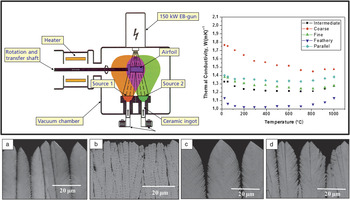
The microstructural factors regarding intra-columnar porosity are size, distribution, concentration, and morphology, all of which can be manipulated via processing, including deposition temperature, rotational speed, chamber pressure, pattern of vapor incidence, condensation rate, and partial shadowing. Hence, microstructure tailoring is feasible, within limits, which might be set by durability, processing cost issues, and physical restrictions due to shadowing.Reference Schulz, Terry and Levi14 Examples of different microstructures are given in Figure 2, together with the resulting thermal conductivities.
A schematic of electron-beam physical vapor deposition (EBPVD) processing is shown, where the orange and green represent two vapor clouds of different chemistry that can be mixed on the airfoil. (a–d) Electron micrographs showing cross-sections of the column tips found in EBPVD coatings, demonstrate the variability of microstructure achievable by varying important EBPVD process parameters such as substrate temperature and rotational speed, including variation in column diameter, porosity, and width of inter-columnar gaps. The plot shows their corresponding thermal conductivity values.Reference Flores Renteria, Saruhan, Schulz, Raetzer-Scheibe, Haug and Wiedenmann2

In summary, the major advantage of EBPVD is the columnar structure that provides strain tolerance and pseudo-plasticity. In comparison to plasma-sprayed TBCs, a higher erosion resistance, a smoother surface finish that offers aerodynamic advantages, and the fact that cooling holes stay open through the processing stages are key benefits. On the other hand, high cost, higher thermal conductivity, and limits in chemical variability due to vapor pressure issues are drawbacks along with a low utilization of the raw material.
Atmospheric plasma spray deposition of TBC ceramics
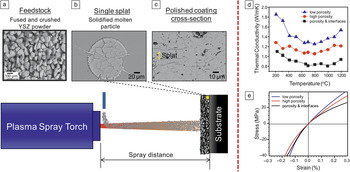
Thermal plasma spray is molten droplet deposition technology in which tens of micrometer-sized particles of metals and ceramics are introduced in powder form into an arc-plasma jet, entrained therein, and projected onto a prepared substrate. The particles acquire thermal energy and momentum from the thermal plasma, undergo melting, followed by impact and rapid solidification. Typically, for oxides and even most metallic alloys, plasma sprays are conducted under ambient conditions, hence the term atmospheric plasma spraying (oxidation sensitive metals can be sprayed in a low pressure environment). The resultant spray-deposited materials are comprised of an assemblage of “splats” of rapidly solidified materials assembled to form a brick-wall structure. Typical powder particle sizes range from 10–100 micrometers with resultant splats of the order of a few microns in thickness and upward of 100–150 micrometers in diameter. Under typical APS conditions, most particles solidify independently, resulting in a chaotic assemblage of the deposited microstructure that consists of splat-interfaces and unfilled regions resulting in porosity. Figure 3 provides an illustrative description of the process, including source material (feedstock powder), the building blocks of the microstructure (splats), and assemblage of many splats as depicted in the cross-section micrograph of the deposit. The two critical properties of importance, namely thermal conductivity and non-linear stress–strain behavior, are shown for different types of coating microstructures.
Illustrative description of atmospheric plasma spray deposition process for thermal-barrier coatings in which a ceramic feedstock (gray dots) is carried to the substrate by a plasma spray. Electron micrographs show (a) the feedstock powder, (b) an individual component of the coating assembly (splat), and (c) a polished cross-section of an aggregated coating. On the right are (d) thermal conductivities of three different coatings with different pore/interface content, along with (e) non-linear stress–strain relations as obtained from curvature measurements. Detailed description of the parametric effects can be found in Reference Liu, Nakamura, Dwivedi, Valarezo and SampathReferences 4, Reference Chi, Sampath and Wang18, and Reference Dwivedi, Nakamura and Sampath19.

As one can envision, the characteristics of the deposited microstructure are strongly dependent on processing.Reference Vaidya, Srinivasan, Streibl, Friis, Chi and Sampath15 Parameters of critical importance include the characteristics of the spray stream (particle trajectory and thermal and kinetic state, including degree of melting); the location and state of the substrate, including roughness, temperature, position, part geometry, and relative movement; and speed of the torch and part. Both characteristics of the feedstock powder as well as the attributes of the spray device are of significance. All of the mentioned processing attributes govern the nature of the deposit buildup and, as such, both the extrinsic microstructural character (porosity, interfaces) as well as intrinsic or material dependent attributes (grain size, texture, cracking, phase evolution, and stability). With respect to TBC systems based on the YSZ polymorph, the critical microstructural elements include splat and interpass interfaces (the latter is a temporal effect associated with torch movement), intra-splat cracking due to relief of very large quenching stresses upon impact and solidification, and finally incompletely filled layers resulting in highly varied porosity.Reference Kuroda and Clyne16
Much progress has been achieved in our ability to characterize the interplay between processing and microstructure and hence the performances of this complex defect containing system. Although the processing conditions can affect the defect quantity and type in a very significant way for YSZ, there has been specific and steady progress not only in macroscopic quantification of the structure-property relationship (e.g., porosity-thermal conductivity relations) but also in the underlying fundamentals in terms of the generation of the defect type and their characteristics.Reference Nakamura and Liu17 This is particularly significant for monitoring and controlling coating compliance, which in recent years has been attributed to the unique nonlinear/anelastic response of the porous ceramic coating on metallic substrates.Reference Evans, Mumm, Hutchinson, Meier and Pettit3, Reference Chi, Sampath and Wang18 An illustrative example of the link between processing and porosity properties is provided in the plots in Figure 3d–e, where thermal conductivity and compliance are described for different microstructures. These developments have not only enhanced the applicability of YSZ TBC systems, but have also paved the way for expanded opportunities for other oxide systems.
In recent years, much of the scientific and technological efforts have focused on process control to achieve reliable manufacturing of TBC coatings. TBCs are fabricated by small to large factories all over the world to specifications defined by the engine manufacturer. As these spray factories are entitled to use any available (approved) spray device and powder, the specifications tend to be rather wide to accommodate microstructural variation. This has, to some extent, resulted in design engineers reducing their reliance on the coating for reliable performance and focusing more on life extension of the underlying superalloy components. However, as the engine inlet temperatures increase, the need for reliable and controlled coatings is becoming increasingly critical. As such, advancements in process science have been sought to develop methodologies not only for process control, but also effective materials science descriptions for microstructural control.
Segmented cracked TBCs via advanced APS strategies
Both APS and EBPVD coatings, which are now used in mainstream TBC manufacturing, offer benefits in terms of both compliance and conductivity due to their defected structure. Typical APS coatings offer lower conductivity, but EBPVD coatings provide for better compliance and erosion resistance. As outlined earlier, there is significant interest to incorporate the benefits of EBPVD into APS coatings, particularly for large component TBC applications in power systems. This has led to both industrial and academic research on segmented or vertically cracked ceramic coatings and their successful implementation in gas turbines.Reference Taylor7, Reference Gray, Lau, Johnson, Boron and Nelson8, Reference Guo, Murakami and Kuroda20, Reference Guo, Vaßen and Stöver21
Plasma sprayed zirconia splats undergo extremely rapid quenching (108 K s–1) as they impact a substrate or the surface of already deposited layers, spread into sheets of a few μm thickness, and are cooled down predominantly by thermal conduction to the underlying solid body. As a result, if one observes a single ceramic splat formed on a flat metal substrate, an intricate network of microcracks can be seen (Figure 3b). The patterns and the principle behind the formation of these cracks are similar to mud cracking or crazing on some porcelain pieces, where the shrinkage of the surface layer is restricted by the underlying massive body, resulting in large lateral tensile stresses and consequent cracking during cooling. Since the coefficient of thermal expansion of YSZ is approximately 10–5 K–1, and the temperature drop ΔT that plasma sprayed splats undergo is more than 2000 K, the amount of strain that must be incorporated is approximately 2 × 10⁻², which is an order of magnitude larger than the failure strain of most ceramics, including zirconia.
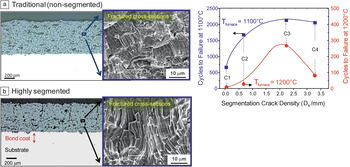
As a result, APS ceramic coatings usually contain a large number of microcracks. When the deposition temperature is raised significantly, an interesting tendency has been observed to transition from splat level microcracking to large macroscale cracking (i.e., so-called segmentation cracks or dense vertical cracks). Figure 4 provides an illustrative description of the phenomenon indicating the role of substrate temperature on the segmentation crack density.Reference Guo, Murakami and Kuroda20 It has been shown that the density of segmentation cracks increases at the expense of micropores as the substrate/deposition temperature increases.Reference Guo, Vaßen and Stöver21 This transition is related to both the improvement of wetting between overlaid splats at high deposition temperatures and the reduction of the temperature drop ΔT. As the wetting among several splats improves and multiple splats are connected at high temperature, they start to behave more or less as a larger single body. There is also evidence of columnar grains grown across multiple splats when observations are made on fractured cross-sections. As a result, cracks between thicker masses of zirconia are formed associated with more macroscopic temperature variations experienced during APS. Recent experiments to detect acoustic emission during APS to some extent support this hypothesis, but further investigation is needed.Reference Ito, Kuriki, Watanabe, Kuroda and Enoki22 Significant improvement in terms of thermal cycle life has been reported for such vertically cracked TBCs, and this technology has been used in industry for more than a decade.
Despite the industrial acceptance of these techniques, several fundamental issues remain, such as what optimal crack density is needed to achieve optimum performance as a TBC. Furthermore, thermal conductivity is somewhat sacrificed, as there is greater vertical connection of splats as compared to TBCs sprayed in a conventional manner, where significant portions of the lamellar interfaces are not bonded.Reference Kulkarni, Goland, Herman, Allen, Ilavsky, Long, Johnson and Ruud23 This results in a significantly thicker TBC being needed to impart similar heat resistance.
Suspension and solution plasma spraying of ceramics
Thermal spray processes usually involve the injection of a powder feedstock into a flame or a plasma jet. In the case of the conventional APS process, the powder particles must have a diameter in the range of 10–100 μm in order to be flowable (favored by smaller particles) and also capable of impact deposition (requires inertial mass). This limitation in the feedstock particle size leads to limitations in terms of expanding process capabilities. With APS, it is difficult to obtain nanostructured coatings with a very fine microstructure and/or to manufacture very thin coatings (below approx. 10 μm in thickness), as at least several lamellae piled up on each other are necessary to form a coating.
Suspensions and solutions have long been considered as alternative feedstock for plasma spray.Reference Fauchais and Montavon9, Reference Karthikeyan, Berndt, Tikkanen, Reddy and Herman24, Reference Bhatia, Ozturk, Xie, Jordan, Cetegen, Gell, Ma and Padture25 This area received much more attention in recent years through the desire to both use nanostructured materials as well as to fabricate nanostructured coatings. In this approach, submicron particles are agglomerated within a liquid suspension to allow their introduction into high pressure thermal plasma jets. Referred to as suspension plasma spraying (SPS), this relatively novel process is very promising for the manufacture of nanostructured coatings for a large range of applications.
The use of such suspensions or solutions in the case of TBC deposition leads to the generation of hybrid microstructures that combine the low conductivity of APS TBCs resulting from through-thickness layering with the ability to produce vertical separations (segmented cracks) imparting in-plane compliance.Reference Rampon, Filiatre and Bertrand26, Reference Delbos, Fazilleau, Rat, Coudert, Fauchais and Pateyron27 In some respects, this technique combines the advantages of traditional APS, segmented crack structures, and EBPVD attributes, and overcomes some of the limitations of segmented crack TBCs.
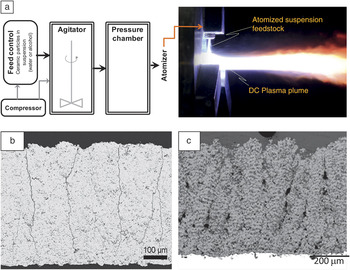
To produce SPS coatings, fine particles of the oxide materials are dispersed in a solvent such as ethanol with a solid fraction commonly in the range of 5–30 wt%, and the formulated suspension is directly injected into a typical APS thermal plasma jet (Figure 5). Liquid injection can be realized as a coherent stream or as atomized droplets.Reference Rampon, Filiatre and Bertrand26 When entering the plasma jet, the liquid is subjected to fragmentation due to the plasma jet shear effects, yielding even smaller suspension droplets.Reference Delbos, Fazilleau, Rat, Coudert, Fauchais and Pateyron27 The solvent is rapidly vaporized, and the particles located in a single droplet form an agglomerate. The obtained solid agglomerates are accelerated and melted in the plasma jet, transforming into ceramic molten droplets, and eventually impacted onto the substrate surface. The deposited splats have very small dimensions (diameters from 0.2–6 μm and thicknesses of 20–300 nmReference Kassner, Siegert, Hathiramani, Vassen and Stoever28) compared to typical APS splats having thicknesses of about 2–5 μm. As a result, SPS coatings have an increased number of lamellae and interfaces and present significantly finer microstructures, resulting in coatings with significantly lower thermal conductivities than conventional APS coatings.Reference Kaßner, Stuke, Rödig, Vaßen and Stöver29
Metallographically prepared cross-sections of (a) traditional (non-segmented) and (b) highly segmented thermal-barrier coatings (TBCs) produced at low and high substrate temperatures, respectively, with enlarged scanning electron microscopy images obtained from fractured sections of the coatings. On the right are plots of thermal cycle life of TBCs tested at 1100 and 1200°C as a function of segmentation crack density. C1 to C4 correspond to different plasma spray conditions with increasingly higher substrate temperatures during spraying.Reference Guo, Murakami and Kuroda20

Illustrative and pictorial description of the suspension plasma spraying process for deposition of thermal-barrier coatings along with examples of deposited microstructures displaying segmentation cracking resulting from high temperature processing (>600°C). (a) Key components of a suspension feeding system and associated injection in the thermal plasma torch. Two variants of the microstructures are shown, (b) similar to an atmospheric plasma spray segmented crack structure, while (c) is closer to the electron-beam physical vapor deposition structures displaying both vertical separations as well as a feathery inner structure within the columns. Adapted from References Reference Delbos, Fazilleau, Rat, Coudert, Fauchais and Pateyron27 and Reference Guignard31.

The processing conditions for SPS are drastically different than those of APS in two ways: First, the powder carrier is no longer a gas but a liquid whose interaction with hot gases is more complex than that of a gas, and second, submicrometer- or nanometer-sized particles, contained in suspensions or those formed in-flight in solution, have very low inertia and can only reach the substrate in a melted state if the spray distance is short (from one-half to one-fifth of that of conventional coatings). This results in very strong heat fluxes to the coating under formation, with corresponding microstructural implications. SPS coatings do not have the lamellar structure of conventional APS, but present a mostly granular nanostructure.
Figure 5 provides an illustrative description of the process along with examples of microstructures. As in standard coatings, SPS coatings show areas of (a) good and (b) poor inter-splat bonding. But what is common to both cases is the presence of periodic vertical separations. These separations are a result of the elevated processing temperatures in SPS and are in some ways similar to segmented APS TBCs.
Another closely related SPS process employs liquid precursors rather than suspensions. The solution precursor plasma spray (SPPS) utilizes molecularly mixed solutions, for example aqueous solutions of yttrium and zirconium salts targeted to achieve the standard 7% yttria composition of YSZ.Reference Bhatia, Ozturk, Xie, Jordan, Cetegen, Gell, Ma and Padture25 The precursor is introduced into the spray torch via atomization of the liquid in a manner similar to the SPS process, and the resultant liquid undergoes a series of substeps within the plasma flame, including evaporation, breakup of the droplet, gelation, pyrolysis, and sintering prior to impact on to the substrate. The deposit formed is comprised of very fine agglomerates devoid of the typical splat boundaries and cracks, and, due to the high deposition temperature, also results in vertical segmentation cracks. SPPS coatings, also due to the fine architecture (many more interfaces), show simultaneously good compliance and low conductivity. As a result, these coatings typically offer enhanced durability compared to traditional APS coatings.
Innovative future concepts: Plasma spray physical vapor deposition
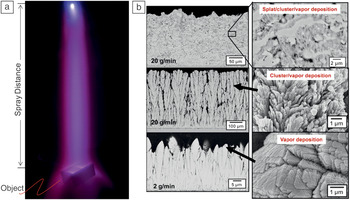
PSPVD is a novel extension to vacuum plasma spray technology allowing for vapor generation within the thermal plasma followed by deposition onto a hot substrate in ways akin to PVD but at higher rates.Reference Von Niessen and Gindrat11, Reference Guignard31, Reference Hospach, Mauer, Vassen and Stover32 Originally developed as a very low pressure plasma spray (VLPPS), the goal was depositing uniform and thin coatings with large area coverage based on plasma spraying. At typical pressures of 50–200 Pa, the characteristics of the plasma jet change compared to conventional low pressure plasma spraying processes operating at 5–20 kPa, increasing in length from a few 100 mm to 1.5 m. At appropriate parameters, it is even possible to evaporate powder feedstock material, achieving advanced microstructures and non-line of sight deposition (e.g., for TBCs). Thin and dense ceramic coatings as well as columnar-structured strain-tolerant coatings with low thermal conductivity can be achieved.Reference Liu, Nakamura, Srinivasan, Vaidya, Gouldstone and Sampath5 Under certain process conditions, it is possible to use VLPPS to obtain structures very similar to that of EBPVD, hence these conditions are termed PSPVD. Figure 6 shows examples of microstructures obtained from the VLPPS process at different deposition rates ranging from splat/cluster deposition all the way to vapor deposition. PSPVD has the advantage of coating non-line of sight objects, such as complex shaped vane doublets at a relatively higher rate. The process is currently being investigated by turbine companies for potential commercialization.
(a) Photograph of a plasma spray physical vapor deposition (PSPVD) plume coating a part (plume length ∼1 m) and (b) scanning electron microscopy images of PSPVD microstructures from splat/cluster deposition all the way to vapor deposition obtained at different deposition rates. Adapted with permission from Reference Kaßner, Stuke, Rödig, Vaßen and StöverReference 29. ©2011 Forschungszentrum Jülich GmbH. Process photo courtesy of Sulzer Metco.

Summary and concluding remarks
The integration of thermal-barrier coatings (TBCs) into modern propulsion and energy-generating turbine systems has allowed both performance enhancement and life extension of advanced superalloy components. Their widespread use has created a large industrial manufacturing base for advanced ceramic deposition technologies, such as plasma spray and EBPVD. Advanced TBCs are now moving from life extension to prime reliance (i.e., they are essential to component life and engine operation), requiring insertion of process science and control in manufacturing. Given the complexity in terms of structure, defects, and layering, the interplay between scientific research and technology will continue to evolve. To some extent, the ease of TBC processing is enabled due to the utilization of YSZ. Both yttria and zirconia have similar vapor pressures, melting points, and thermophysical characteristics, and as such chemical complications from rapid heating, melting, and evaporation are not significant. However, industry is moving toward more complex compositions (e.g., multicomponent stabilization based Y, Yb, and Gd), as well as pyrochlore structures based on zirconates (La2Zr2O7, Gd2Zr2O7) to meet new performance requirements such as erosion resistance, molten glass attack (CMAS), as well as increased heat flux.Reference Zhu and Miller33–Reference Jarligo, Mack, Vassen and Stöver35
An additional issue for consideration is the stability of the as-deposited defected microstructure and their crystal phases during sustained thermal exposure. In the case of YSZ, at temperatures above 1000°C, the porosity and splat interfaces tend to sinter, causing a loss of compliance and an increase in conductivity. The extent of sintering is microstructure dependent and controlled via processing parameters.Reference Tan, Longtin, Sampath and Wang36 Similarly, both APS and EBPVD YSZ coatings are comprised of a metastable tetragonal prime (t’) structure, which is generally stable up to 1200°C. Under sustained exposure above 1200°C, the t’ phase is susceptible to decomposition into cubic and tetragonal forms, with the latter ultimately transforming into monoclinic upon cooling.Reference Miller, Smialek, Garilick, Heuer and Hobbs37 The t’ phase is also known to be of significantly higher toughness than other phases due to ferroelastic switching events, which not only depend on composition but also on metastability.Reference Mercer, Williams, Clarke and Evans38 Thus, emergence of new compositions is closely tied to process-related microstructural and phase attributes. It is clear that future development of TBCs will involve integration among processing science, phase/microstructure control, and linkage to performance. Research is under way in all of these areas, driven by the need for reliable multifunctional coating systems.
Acknowledgments
We are grateful to Dr. Gopal Dwivedi of Stony Brook University for his assistance in integrating the figures for this article.