Introduction
Recent epidemiological studies have shown that subclinical psychotic-like experiences (PLEs), such as hallucinatory experiences and delusional beliefs, are common in the general population (Poulton et al. Reference Poulton, Caspi, Moffitt, Cannon, Murray and Harrington2000; van Os et al. Reference van Os, Hanssen, Bijl and Ravelli2000; Olfson et al. Reference Olfson, Lewis-Fernandez, Weissman, Feder, Gameroff, Pilowsky and Fuentes2002) leading to suggestions that these experiences might represent risk factors for the development of clinical psychotic disorder or schizophrenia (Laurens et al. Reference Laurens, Hodgins, Maughan, Murray, Rutter and Taylor2007; Lataster et al. Reference Lataster, Myin-Germeys, Derom, Thiery and van Os2009). One such prospective study showed that children at 11 years of age who reported either a probable or definite PLE were 16 times more likely to have a schizophreniform diagnosis at 26 years than individuals without such experiences (Poulton et al. Reference Poulton, Caspi, Moffitt, Cannon, Murray and Harrington2000).
While PLEs are commonly reported in young people, there is indirect evidence that such experiences decrease in prevalence from childhood to adulthood and persistent PLEs are limited to only a small proportion of this population. Studies examining current or lifetime experience of hallucinations in childhood and adolescence demonstrate prevalence rates of between 6% and 29.9% (Poulton et al. Reference Poulton, Caspi, Moffitt, Cannon, Murray and Harrington2000; Dhossche et al. Reference Dhossche, Ferdinand, van der Ende, Hofstra and Verhulst2002; Yoshizumi et al. Reference Yoshizumi, Murase, Honjo, Kaneko and Murakami2004; Laurens et al. Reference Laurens, Hodgins, Maughan, Murray, Rutter and Taylor2007; Scott et al. Reference Scott, Martin, Bor, Sawyer, Clark and McGrath2009 a). Dhossche et al. (Reference Dhossche, Ferdinand, van der Ende, Hofstra and Verhulst2002) showed that self-reported rates of hallucinations decreased from 6% in childhood and adolescence (11–18 years) to 3% in young adulthood (19–26 years). Similarly in adults, Hanssen et al. (Reference Hanssen, Bak, Bijl, Vollebergh and van Os2005) found that of 79 respondents who reported subclinical psychotic symptoms, 25 showed stability of reporting 2 years later, 11 reported a clinical psychotic disorder, while the remaining 43 respondents reported no such experiences.
Several demographic and environmental variables are known to be associated with risk for psychosis in the general population, including childhood trauma (Kelleher et al. Reference Kelleher, Harley, Lynch, Arseneault, Fitzpatrick and Cannon2008), urban living (Krabbendam & van Os, Reference Krabbendam and van Os2005), non-white ethnicity or a foreign environment (Laurens et al. Reference Laurens, West, Murray and Hodgins2008), substance misuse (Henquet et al. Reference Henquet, Krabbendam, Spauwen, Kaplan, Lieb, Wittchen and van Os2005) and certain personality characteristics (Goodwin et al. Reference Goodwin, Fergusson and Horwood2003). Similar to the vulnerability model (Meehl, Reference Meehl1962), it has been proposed that exposure to environmental risk factors might increase the risk for persistent PLEs in individuals predisposed to the development of schizophrenia (Cougnard et al. Reference Cougnard, Marcelis, Myin-Germeys, de Graaf, Vollebergh, Krabbendam, Lieb, Wittchen, Henquet, Spauwen and van Os2007). Studies have shown an association between childhood trauma and PLEs in adulthood (Bebbington et al. Reference Bebbington, Bhugra, Brugha, Singleton, Farrell, Jenkins, Lewis and Meltzer2004; Janssen et al. Reference Janssen, Krabbendam, Bak, Hanssen, Vollebergh, de Graaf and van Os2004; Spauwen et al. Reference Spauwen, Krabbendam, Lieb, Wittchen and van Os2006; Shevlin et al. Reference Shevlin, Dorahy and Adamson2007; Kelleher et al. Reference Kelleher, Harley, Lynch, Arseneault, Fitzpatrick and Cannon2008). More recently, emerging research has focused on the relationship between peer victimization and PLEs in childhood and adolescence (Lataster et al. Reference Lataster, van Os, Drukker, Henquet, Feron, Gunther and Myin-Germeys2006; Campbell & Morrison, Reference Campbell and Morrison2007; Schreier et al. Reference Schreier, Wolke, Thomas, Horwood, Hollis, Gunnell, Lewis, Thompson, Zammit, Duffy, Salvi and Harrison2009). Victims of bullying are described as having negative interactions with peers and report being victims of physical and verbal attacks (Olweus, Reference Olweus1996). One recent study examined the prospective relationship between childhood victimization and later PLEs. Schreier et al. (Reference Schreier, Wolke, Thomas, Horwood, Hollis, Gunnell, Lewis, Thompson, Zammit, Duffy, Salvi and Harrison2009) found that adolescents who were bullied across two time points (8 and 10 years) and those who experienced both overt (i.e. aggression) and relational (i.e. excluded from peers) bullying had a greater likelihood of experiencing PLEs at 12 years of age.
Prospective studies have examined the impact of both internalizing and externalizing behaviour on PLEs. For instance, Scott et al. (Reference Scott, Martin, Welham, Bor, Najman, O'Callaghan, Williams, Aird and McGrath2009 b) showed that participants who scored in the highest quartile of the internalizing or externalizing subscales of the Child Behaviour Checklist and the Youth Self Report at 5 and 14 years of age were four times more likely to report delusional experiences at 21 years. These findings highlight that the severity and stability of internalizing or externalizing behaviour in childhood and adolescence can predict the occurrence of PLEs in adulthood. Reviewing the evidence for a predictive association between internalizing and externalizing behaviour in childhood and later adult schizophrenia, Tarbox and Pogue-Geile (Reference Tarbox and Pogue-Geile2008) suggested that there might be two separate internalizing and externalizing paths to the development of a psychotic disorder, or a single path categorized by both sets of behaviours. However, irrespective of the risk factor, the evidence reviewed does not state how these behavioural profiles might interact with the development of PLEs over time.
Several prospective studies have examined the relationship between cannabis use and psychosis (Arseneault et al. Reference Arseneault, Cannon, Poulton, Murray, Caspi and Moffitt2002; van Os et al. Reference van Os, Bak, Hanssen, Biji, de Graaf and Verdoux2002; Fergusson et al. Reference Fergusson, Horwood and Swain-Campbell2003; Henquet et al. Reference Henquet, Krabbendam, Spauwen, Kaplan, Lieb, Wittchen and van Os2005). Consistent associations were found between cannabis use in adolescence and an increased risk for psychotic symptoms while controlling for other potential confounding affects, such as alcohol, cigarette and other drug use. Moreover, preliminary reports of an interaction between the genetic risk for psychosis, cannabis use and a functional polymorphism of the COMT gene that codes for dopamine (Caspi et al. Reference Caspi, Moffitt, Cannon, McClay, Murray, Harrington, Taylor, Arsenault, Williams, Braithwaite, Poulton and Craig2005) provides further support that cannabis use might represent a risk factor for some individuals with a genetic vulnerability for the development of psychosis. Studies have also examined the prospective relationship between psychotic disorders and other substances, including cigarette, cocaine, stimulant and alcohol use (Degenhault & Hall, Reference Degenhault and Hall2001; Zammit et al. Reference Zammit, Allebeck, Dalman, Lundberg, Hemmingsson and Lewis2003; Ferdinand et al. Reference Ferdinand, van der Ende and Verhulst2004; Weiser et al. Reference Weiser, Reichenberg, Grotto, Yasvitzky, Rabinowitz, Lubin, Nahon, Knobler and Davidson2004; Wiles et al. Reference Wiles, Zammit, Bebbington, Singleton, Meltzer and Lewis2006). Even though contradictory results exist about whether certain substances represent a unique risk factor for psychotic disorder, or the self-medication of psychotic symptoms, a recent meta-analysis showed that exposure to cannabis, alcohol and certain psychoactive drugs can increase the risk of subclinical psychosis (van Os et al. Reference van Os, Linscott, Myin-Germeys, Delespaul and Krabbendam2009).
The goals of the current study were to: (1) identify subgroups of adolescents that followed distinct developmental trajectories of PLEs; (2) examine whether demographics and environmental risk factors differentiated the subgroups. We applied general growth mixture modelling (GGMM; Muthen, Reference Muthen and Kaplan2004) to the data, which provides the ideal number of trajectory classes that underlie a population distribution. While the majority of participants are expected to report low levels of PLEs, we assumed that a small group would demonstrate elevated and persistent PLEs. As adolescents become increasingly engaged in substance use, we posited that a third group would emerge, reporting increasing PLEs.
To explore PLEs, we used a series of self-report questions assessing both hallucinatory experiences and delusional beliefs. A previous study, using a similar self-report questionnaire (e.g. Laurens et al. Reference Laurens, Hodgins, Maughan, Murray, Rutter and Taylor2007), showed that 11.2% of children who reported evidence of PLEs also demonstrated emotional, social or behavioural problems and 8.9% demonstrated speech and/or motor delay, suggesting that self-reports of PLEs can identify children with additional putative factors. More recently, Kelleher et al. (Reference Kelleher, Harley, Murtagh and Cannon2009) demonstrated predictive validity using seven similar self-report questionnaire items. They reported good sensitivity and specificity in identifying adolescents with PLEs in the general population. In particular, a question on auditory hallucinations was predictive of interview-verifiable PLEs.
Method
Participants and procedure
The current sample reports data from 409 participants (mean age 14 years and 7 months) who scored high in four personality risk factors and formed part of a larger study investigating a personality-targeted intervention for adolescents. Participants were recruited from 12 secondary schools in London. In total, 2630 adolescents were invited to participate in the initial surveying phase of the study. Of these, 321 participants (12.3%) declined to take part and 161 participants (6.1%) were eliminated from the study due to unreliable data. Informed consent at this stage involved both active student consent (i.e. an opt-in format) and passive parent consent (i.e. an opt-out format). Of the remaining 2148 participants, 994 (46.3%) scored above the school mean on one of four subscales of the Substance Use Risk Personality Scale (SURPS: Conrod & Woicik, Reference Conrod and Woicik2002), hopelessness, anxiety-sensitivity, impulsivity and sensation-seeking, and 1154 participants (53.7%) scored below the school mean on all personality subscales.
The 994 participants who scored above the mean were invited to take part in the longitudinal study. For this phase, both active student and parent consent was required. Consequently, the sample was reduced to 364 participants as 87 participants (8.8%) refused to take part in follow-up sessions and 543 participants (54.3%) did not obtain parental consent. Previous statistical comparisons between those participants who were eligible to take part (i.e. provided active student and parental consent) and those who were not eligible did not demonstrate large differences in drug use or personality scores (Conrod et al. Reference Conrod, Castellanos and Strang2010).
In addition, a randomly selected 15% (n=173) of the 1154 participants who scored below the school mean were invited to take part in the longitudinal study. This would allow for five equally sized groups. Of the 173 low scoring participants, 74 participants (42.8%) agreed to take part and provided parental consent. Thus, of the 438 participants who took part in the longitudinal study, 17% were low on all personality subscales. A total of 29 participants reported unreliable data (i.e. responding inconsistently across the survey or positively to a sham drug item) across all follow-ups, reducing the sample to 409 participants. The resulting sample was revealed to be diverse (35.5% Caucasian, 29.6% black African/Caribbean, 16.4% Asian, 11% mixed race and 6.4% other).
Ethical approval for this study was given by the Research Ethics Committee of the Institute of Psychiatry and South London and Maudsley NHS Trust. The design of this study is prospective (18 months), consisting of an initial survey (time 1) and three further follow-up surveys (time 2 to time 4) equally spaced by 6 months. All testing procedures were administered at the participants' school, in a classroom format. When participants could not be reached at school, a questionnaire booklet was posted to their home. Book vouchers were offered as an incentive for returning the questionnaire.
Measures
PLEs
Nine questions assessed hallucinatory experiences and delusional beliefs. All nine questions were previously used and validated in a community sample of children and adolescents by Laurens et al. (Reference Laurens, Hodgins, Maughan, Murray, Rutter and Taylor2007). Five questions were adapted by Laurens et al. (Reference Laurens, Hodgins, Maughan, Murray, Rutter and Taylor2007) from the Diagnostic Interview Schedule (Costello et al. Reference Costello, Edelbrock, Kalas, Kessler and Klaric1982).
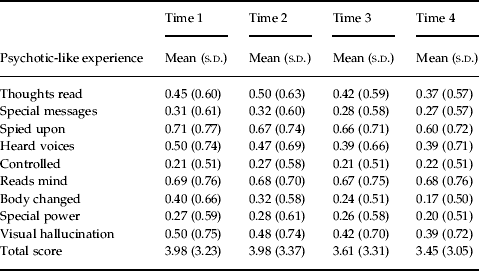
These included: (1) ‘Some people believe that their thoughts can be read, have other people ever read your thoughts?’; (2) ‘Have you ever believed that you were being sent special messages through the TV?’; (3) ‘Have you ever thought that you were being spied upon?’; (4) ‘Have you ever heard voices that no-one else could hear?’; (5) Have you ever felt that your body had changed in some unusual way?'. The additional four questions included: (6) ‘Have you ever felt that you were under the control of some special power?’; (7) ‘Have you ever known what someone else was thinking even though they were not speaking?’; (8) ‘Do you have some special powers that other people do not have?’; (9) ‘Have you ever seen something or someone that other people could not see?’. Participants were asked whether the experience happened in the previous 6 months and to rate their responses on a 3-point scale (0=if not true; 1=sometimes true; 2=certainly true). Each response was subsequently summed to form a total score (range 0–18). In the current sample, good internal consistency was shown at all time points (α=0.74–0.81). Table 1 provides means and standard deviations for each PLE from time 1 to time 4.
Descriptive statistics for each psychotic-like experience and the total score for each time point

s.d., Standard deviation.
Personality
The SURPS (Conrod & Woicik, Reference Conrod and Woicik2002) assessed personality characteristics. This is a 23-item measure assessing four personality risk factors for substance abuse/dependence: hopelessness; anxiety-sensitivity; impulsivity; sensation-seeking. Previous studies on the current sample (e.g. Conrod et al. Reference Conrod, Castellanos and Mackie2008) and in other samples (e.g. Conrod et al. Reference Conrod, Stewart, Comeau and Maclean2006; Woicik et al. Reference Woicik, Stewart, Pihl and Conrod2009) have shown good internal reliability, construct reliability and adequate 2-month test–retest reliability. In the present sample good internal reliability was demonstrated across all subscales (α=0.66–0.74).
Alcohol use
Quantity of alcohol use was assessed by asking participants to rate: ‘how many drinks containing alcohol do you have on a typical day when you are drinking?’ on an ordinal scale, ranging from 1 (none) to 6 (10 drinks). Frequency of alcohol use was assessed by asking participants: ‘how often do you usually drink alcohol?’ ranging from 1 (never) to 6 (almost daily). Quantity and frequency of alcohol use (QXF) were combined to create a composite score.
Depression and anxiety
The 7-item depression subscale from the Brief Symptom Inventory (BSI; Derogatis, Reference Derogatis1993) assessed severity of depression symptoms in the previous 6 months on an ordinal scale, ranging from 1 (not at all) to 5 (often). The BSI depression scale is comparable to the Beck Depression Inventory with regard to its accuracy in detecting depression symptoms in adolescents (Sahin et al. Reference Sahin, Batiguen and Ugurtas2002). The 6-item anxiety subscale from the BSI assessed severity of anxious symptoms in the previous 6 months. In the current sample, good internal consistency was shown for depression (α=0.89–0.91) and anxiety (α=0.85–0.86).
Substance use
Three items from the Reckless Behaviour Questionnaire (Shaw et al. Reference Shaw, Wagner, Arnett and Aber1992) assessed frequency of illicit drug use: ‘how many times in the last 6 months have you’ used cannabis, cocaine and other drugs that are not cannabis or cocaine. Participants were asked to rate the frequency of drug use on a 5-point scale (never, once, two to five times, six to 10 times, >10 times). Each individual item was dichotomized into a ‘yes/no’ variable to provide the prevalence rate of each drug. An additional sham drug item was included to detect unreliable self-report. Participants were also asked whether they had smoked cigarettes.
Peer victimization
Four separate questions derived from the revised Olweus Bully/Victim Questionnaire (Olweus, Reference Olweus1996) assessed victimization. The items asked respondents to state whether they had experienced any overt bullying (i.e. kicked, hit, pushed or shoved) or any relational bullying (i.e. excluded on purpose or called mean names) across a 5-point scale (none to several times per week) in the previous 6 months. Each subscale was summed to provide a measure of frequency of peer victimization.
Statistical analyses
First, GGMM was used to identify subclasses of individuals on the basis of distinct profiles of PLEs across four time points. The GGMM procedure is an extension of latent growth curve modelling in which key parameters of the growth processes are allowed to vary by trajectory class. GGMM differs from traditional latent growth curve modelling in that it does not assume that individuals within the same population follow the same trajectory, instead it allows subclasses of individuals to vary around different mean growth curves. Mplus version 5.2 (Muthen & Muthen, Reference Muthen and Muthen2002), using maximum likelihood estimation, estimated the models. Models were fitted, beginning with a one-group trajectory model moving to a four-group trajectory model, all with random starting values. The best fitting model was established using the number-adjusted Bayesian Information Criterion (BIC; Schwartz, Reference Schwartz1978), Akaike's Information Criterion (AIC; Akaike, Reference Akaike1974), the Lo–Mendell–Rubin Likelihood Ratio Test (LMR-LRT: Lo et al. Reference Lo, Mendall and Rubin2001) and entropy (Muthen, Reference Muthen and Kaplan2004). A lower value in the BIC and AIC indicates a more parsimonious model. The LMR-LRT provides a k-1 likelihood ratio method to determine the ideal number of classes (p<0.05 indicates a better fit). Entropy is a measure of classification accuracy, with values close to 1 indicating a good separation of classes.
Second, we examined group differences in demographics and environmental risk factors using Stata v. 10.1 (Stata Corporation, USA). Due to positive skew, alcohol use variables were log transformed. Because of unequal populations in the trajectory classes we used non-parametric Wilcoxon rank sums tests for continuous measures and logistic regressions for categorical variables. Cohen's d was provided as a measure of effect size for continuous measures (index mean – control mean/pooled standard deviation; Cohen, Reference Cohen1987). Cohen (Reference Cohen1987) suggested the following guidelines for the interpretation of effect size: d=0.2 small; 0.5 medium; 0.8 large. Third, to verify these associations we entered all risk factors at time 1 in a multivariate logistic regression to examine which risk factors predicted class membership over and above all other variables.
Results
Trajectories of PLEs
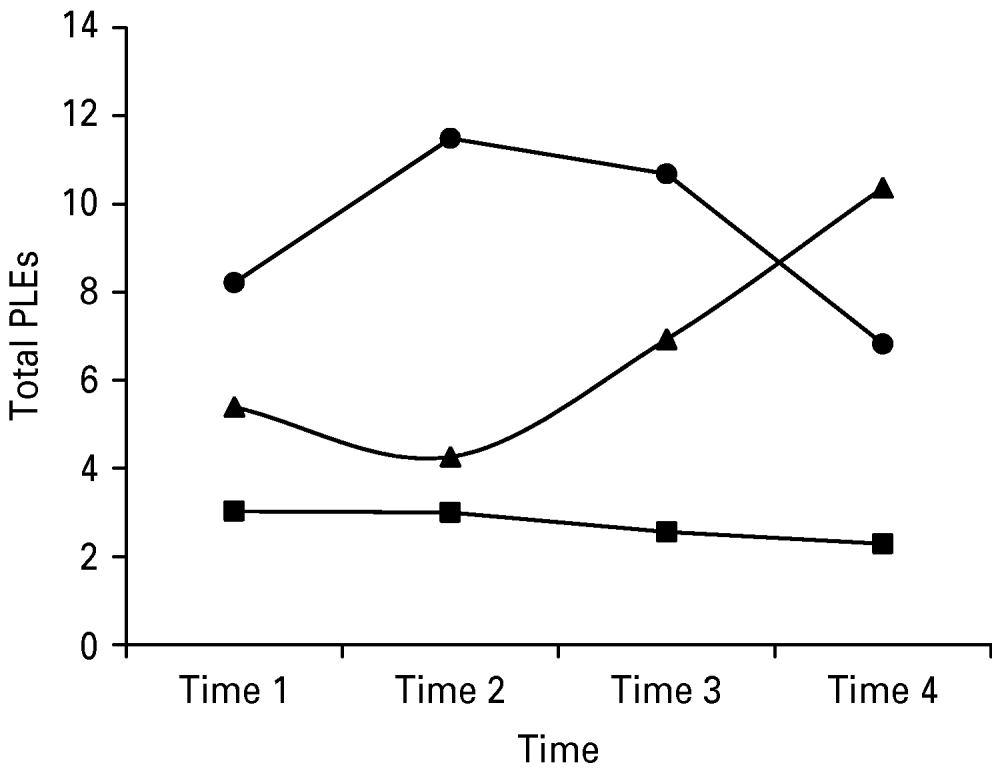
A logistic regression revealed that PLEs, victimization, depression, anxiety, alcohol and substance use did not predict non-follow-up of data (all ps>0.17), thus allowing for the use of all available data. A three-class model was selected as the best model on the basis of the empirical fit indices (BIC=6083.3; AIC=6069.8, entropy=0.80; LMR-LRT, p<0.05). A decrease in the BIC (6247.0 to 6135.5 to 6083.3) and AIC (6240.2 to 6125.5 to 6069.8) between a one-, two- and a three-class model was demonstrated. Moving from a three- to a four-class model was not well supported; a decrease in the BIC (6069.8 to 6064.4) and the AIC (6069.8 to 6047.6) was small, classification accuracy was lower (entropy=0.72) and a non-significant LMR-LRT result did not justify an additional class (p=0.27). Fig. 1 presents the three-group trajectory model. The trajectories included a persistent class (9% of the sample), who demonstrated an initial increase (linear slope=4.44, p=0.03) followed by a slight decrease (quadratic slope=−1.62, p=0.008) and an increasing class (7%), who demonstrated moderate PLEs at time 1 and then subsequently increased (quadratic slope=1.15, p<0.001). The majority of the sample (84%) was characterized by low levels of PLEs at all time points. All trajectory classes significantly differed from each other in total mean PLEs at time 1 (persistent class mean=8.21; increasing class mean=5.25; low class mean=3.48; p<0.016). Average class probabilities were good (0.84 for the persistent class; 0.90 for increasing class; 0.94 for the low class), indicating that the classes were well separated.
Developmental trajectories of psychotic-like experiences (PLEs). –•–, Group 1, persistent (9%, n=36); –▴–, group 2, increasing (7%, n=27); –▪–, group 3, low (84%, n=346).

Comparisons by trajectory class in demographics and environmental risk factors
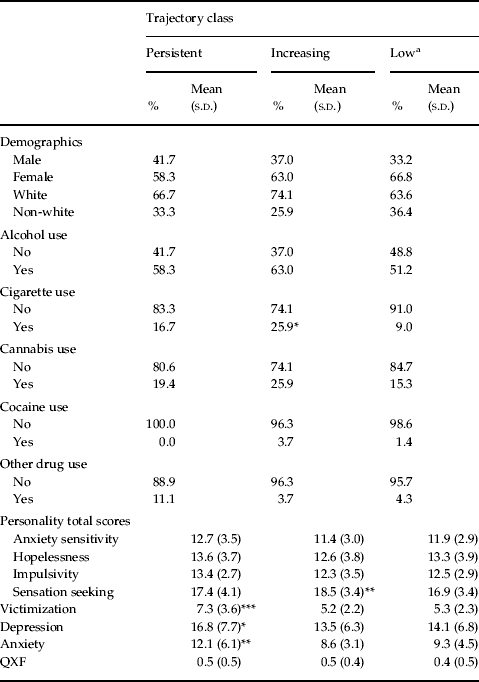
Table 2 presents the descriptive statistics for demographics, victimization, emotional behaviour and substance use at time 1, by trajectory class. Two sets of planned comparisons were performed, examining whether those on the persistent and increasing trajectories differed from those on the low trajectory. Results from this table highlight three main findings. First, no group differences emerged in gender or ethnicity. The groups were comparable in personality data; with one exception, adolescents who followed the increasing trajectory scored higher in sensation seeking than the low class, p=0.01, d=0.3. Second, adolescents who followed the persistent trajectory reported higher scores in anxiety and depression, and more frequent victimization, compared with the low class (p's <0.01). Effect sizes were small for depression (d=0.3) and medium for victimization and anxiety (d=0.6). Third, adolescents who followed the increasing trajectory were 3.6 times [odds ratio (OR) 3.6; 95% confidence interval (CI) 1.4–9.1] more likely to smoke cigarettes than those in the low class.
Descriptive statistics for demographics, personality, victimization, depression, anxiety and drug use by each trajectory class at time 1

Means and standard deviations (s.d.) for quantity and frequency of alcohol use (QXF) are log transformed scores.
a Low class was the comparison class.
* p<0.05, ** p<0.01, *** p<0.001 in planned group comparisons.
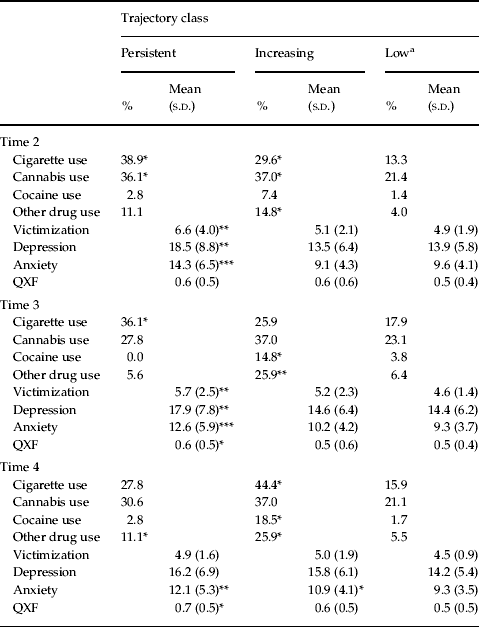
Table 3 presents descriptive statistics for victimization, emotional behaviour and substance use at time 2 to time 4, by trajectory class. Three main findings are conveyed. First, adolescents who followed the persistent trajectory continued to demonstrate elevated scores in depression, anxiety and victimization. Differences between the persistent and low class reached statistical significance in victimization and depression at time 2 and time 3 (p<0.008), with a medium effect size demonstrated (d=0.4). At all time points the persistent class scored significantly higher in anxiety compared with the low class (p<0.001), with moderate to large effect sizes shown (d=0.4 to 0.8). Second, to varying degrees, adolescents following the persistent trajectory demonstrated increasing alcohol, cigarette and occasional drug use. Differences between the persistent and low classes reached statistical significance in QXF at time 3 and time 4 (p<0.03, d=0.3 to 0.4). Participants in the persistent class were 4.2 times and 2.6 times more likely to report cigarette use at time 2 (OR 4.2, 95% CI 1.9–8.7) and time 3 (OR 2.6, 95% CI 1.2–5.4). Compared with the low class, the persistent class was 2.1 times more likely to report cannabis use at time 2 (OR 2.1, 95% CI 1.0–4.3) and 6.2 times more likely to report other drug use at time 4 (OR 6.2, 95% CI 1.4–27.9).
Descriptive statistics for victimization, depression, anxiety, alcohol and drug use for time 2 to time 4

Means and standard deviations (s.d.) for quantity and frequency of alcohol use (QXF) are log transformed scores.
a Low class was the comparison class.
* p<0.05, ** p<0.01, *** p<0.001 in planned group comparisons.
The third main finding concerns adolescents who followed the increasing trajectory. Interestingly, this group of participants showed an increase in the prevalence of substance use in the absence of any emotional difficulties and no significant alcohol use. Compared with the low class, adolescents following the increasing trajectory were 2.8 times (OR 2.8, 95% CI 1.1–6.6) and 4.3 times (OR 4.3, 95% CI 1.9–9.8) more likely to smoke cigarettes at time 2 and time 4, respectively. Results also showed an increased likelihood to report cannabis use at time 2 (OR 2.2, 95% CI 1.0–4.9) and to report cocaine use at time 3 (OR 4.5, 95% CI 1.3–14.8) and time 4 (OR 12.9, 95% CI 3.6–45.5). Additionally, adolescents following the increasing trajectory demonstrated an increased likelihood of reporting other drug use at all time points (OR 4.1, 95% CI 1.3–13.5; OR 5.2, 95% CI 1.9–13.5; OR 12.9, 95% CI 3.6–45.5).
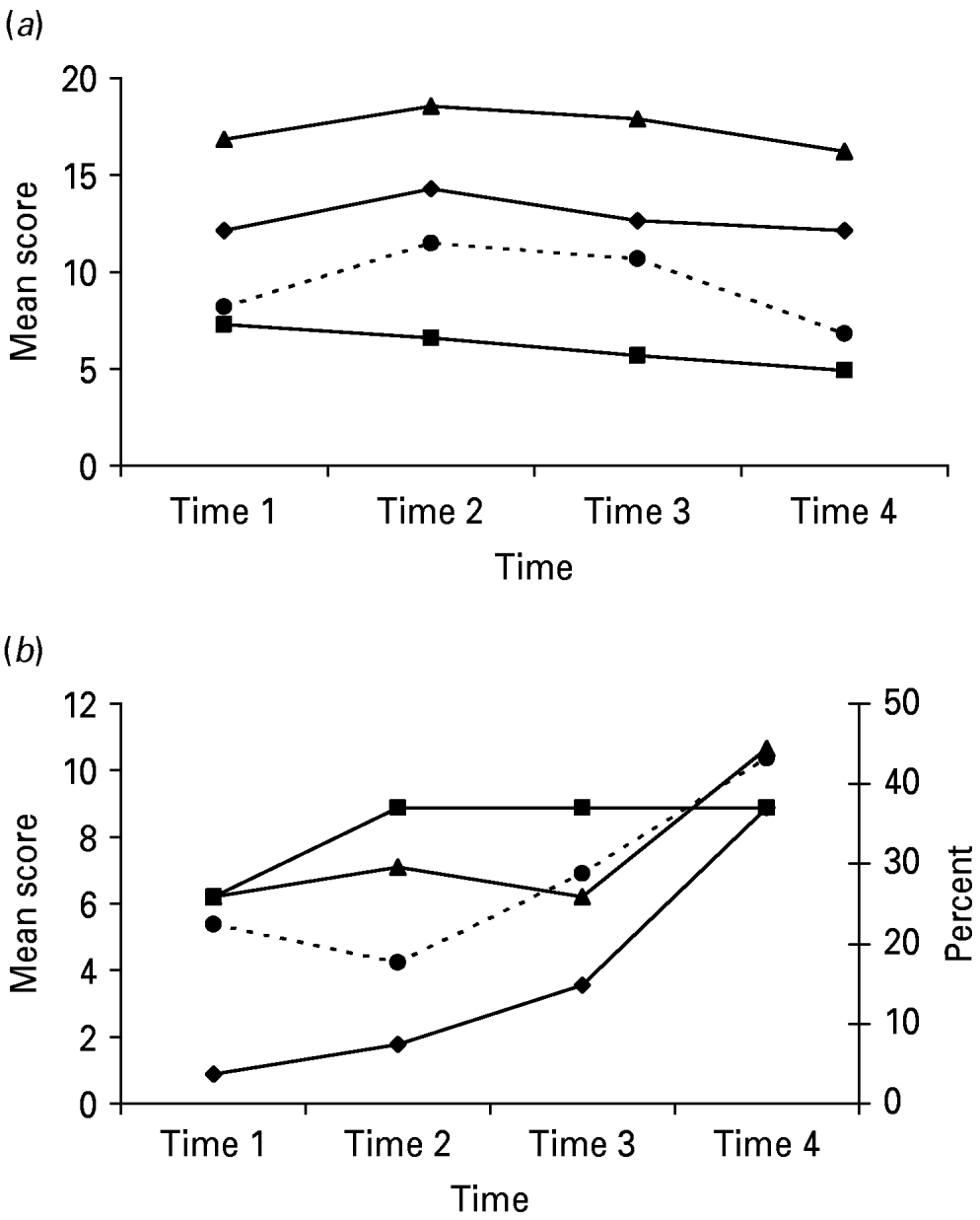
Fig. 2 a shows the mean PLEs, depression, anxiety and victimization scores for the persistent class over time. This graph demonstrates that as PLEs change over time, depression and anxiety symptoms follow similar patterns. However, victimization scores show a decrease over time. For the increasing class, mean PLE scores are plotted in Fig. 2 b together with rates of cigarette, cannabis and cocaine use. PLEs are shown to be relatively low between time 1 and time 2, but increase linearly from time 2. However, cigarette, cannabis and cocaine prevalence rates all show increases between time 1 and 2, prior to any increase in PLEs, and, in the case of cigarette and cocaine use, further increases occur between time 3 and time 4.
(a) Plot of change in mean psychotic-like experiences (PLEs; - -•- -), depression (–▴–) and anxiety (–◆–) total scores and frequency of victimization (–▪–) in the persistent trajectory class; (b) plot of change in mean PLEs (- -•- - ) and cigarette (–▴–), cannabis (–▪–) and cocaine (–◆–) rates (%) in the increasing trajectory class.

Predictors of PLE trajectory classes
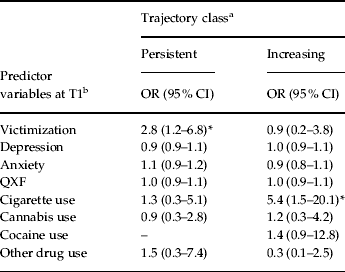
Differences existed between trajectory classes in depression, anxiety, victimization and cigarette use in univariate analyses at time 1. Multivariate analyses examined whether these variables predicted membership of the persistent and increasing classes, compared with the low class, over and above all other variables. As Table 4 shows, victimization increased the risk of persistent PLEs (OR 2.8, 95% CI 1.2–6.8) and adolescents with elevated cigarette use at time 1 were 5.4 times more likely to report increasing PLEs (OR 5.4, 95% CI 1.5–20.1).
Multivariate logistic regressions examining the association between time 1 (T1) variables and persistent and increasing psychotic-like experience trajectory classes

OR, Odds ratio; CI, confidence interval; QXF, quantity and frequency of alcohol use.
– Indicates that due to low prevalence of cocaine use in the persistent class, cocaine use was excluded from this analysis.
a Low class was the comparison class in each instance.
b Includes all demographic and personality covariates.
* p<0.05.
Discussion
The present investigation utilized methodology allowing for differing trajectories of PLEs and for unique risk factors to predict trajectory group membership. Our findings demonstrated three distinct subgroups following persistent, increasing and low trajectories.
A growing body of research is accumulating regarding whether developmental PLEs are transitory and disappear over time (van Os et al. Reference van Os, Linscott, Myin-Germeys, Delespaul and Krabbendam2009). Evidence has suggested that transitory developmental expression of psychosis may become persistent and clinically relevant, depending on the environmental risk the individual has been differentially exposed to (Cougnard et al. Reference Cougnard, Marcelis, Myin-Germeys, de Graaf, Vollebergh, Krabbendam, Lieb, Wittchen, Henquet, Spauwen and van Os2007). These environmental factors include childhood trauma (Spauwen et al. Reference Spauwen, Krabbendam, Lieb, Wittchen and van Os2006), cannabis use (Henquet et al. Reference Henquet, Krabbendam, Spauwen, Kaplan, Lieb, Wittchen and van Os2005) and victimization (Schreier et al. Reference Schreier, Wolke, Thomas, Horwood, Hollis, Gunnell, Lewis, Thompson, Zammit, Duffy, Salvi and Harrison2009). The findings of the present study showed that victimization increased the likelihood of persistent PLEs. A number of different mechanisms have been proposed as explanations for why socio-environmental factors impact on the development of psychosis (Morgan & Fisher, Reference Morgan and Fisher2007). Our results support a model suggesting adverse life events can render individuals vulnerable to PLEs via increasing their emotional reactivity to subsequent stressors (Myin-Germeys et al. Reference Myin-Germeys, van Os, Schwartz, Stone and Delespaul2001). The ‘affective pathway to psychosis’ model is unrelated to cognitive impairment, a phenotype associated with genetic risk for schizophrenia (Myin-Germeys et al. Reference Myin-Germeys, Krabbendam, Jolles, Delespaul and van Os2002), suggesting the existence of two separate (stress versus non-stress) pathways to psychosis. Thus, it has been suggested that, in individuals with a higher than average liability to psychosis, repeated or cumulative exposure to psychosocial stress early in adolescence can lead to increased emotional and psychotic reactions (Myin-Germeys & van Os, Reference Myin-Germeys and van Os2007). This may result from biological and psychological behavioural sensitization (van Winkel et al. Reference van Winkel, Stefanis and Myin-Germeys2008). Moreover, it has been posited that the neurobiological substrate of behavioural sensitization involves a dysregulation of the hypothalamic-pituitary-adrenal axis (HPA; Collip et al. Reference Collip, Myin-Germeys and van Os2008). The HPA axis is proposed to be one of the major systems involved in stress response (see Read et al. Reference Read, van Os, Morrison and Ross2005 for a discussion).
In addition, dopamine is also consistently implicated in the aetiology of schizophrenia and psychosis (Howes & Kapur, Reference Howes and Kapur2009) and that exposure to traumatic events might impact on the sensitization of the dopaminergic system. Alternatively, a cognitive appraisal model of schizophrenia can also be applied to the relationship of victimization and PLEs. Garety et al. (Reference Garety, Kuipers, Fowler, Freeman and Bebbington2001) suggested that the appraisal of PLEs might reflect an interaction between a cognitive dysfunction and adverse life events in the environment. Peer victimization is also associated with specific cognitive biases for external attribution of peer aggression (e.g. Camodeca et al. Reference Camodeca, Goossens, Schuengel and Terwogt2003).
Adolescents who followed the increasing PLE trajectory were distinguished based on their thrill seeking and substance use. These findings would suggest that we identified a group of adolescents who are either susceptible to both substance misuse and PLEs, or whose primary substance misuse indicates a risk for future increasing PLEs. The role of cannabis in psychosis has been the most extensively researched of all drug use (see review by Degenhault & Hall, Reference Degenhault and Hall2006). However, our findings failed to demonstrate a predictive association between cannabis use and trajectory class membership. Instead early exposure to cigarette smoking predicted increasing PLEs. Two prospective cohort studies have shown that cigarette smoking begins prior to psychosis symptom onset (Weiser et al. Reference Weiser, Reichenberg, Grotto, Yasvitzky, Rabinowitz, Lubin, Nahon, Knobler and Davidson2004; Wiles et al. Reference Wiles, Zammit, Bebbington, Singleton, Meltzer and Lewis2006). Nicotine use during adolescence can produce alterations in brain functioning (Slotkin, Reference Slotkin2004) and, in some cases, lead to illicit drug use, including cannabis (Kapusta et al. Reference Kapusta, Plener, Schmid, Thau, Walter and Lesch2007). These complex interactions may result in cigarette use having an impact on increasing reports of PLEs.
Limitations
A number of limitations of this study need to be highlighted. The first limitation concerns the measurement of PLEs. A brief questionnaire was used rather than a clinical interview, which might increase the number of false positives. The second limitation concerns the time-frame of the study. Follow-up assessments were conducted over an 18-month period. In order to examine whether these developmental trajectories follow a persistent course, a longer time-frame would be required. Third, the number of participants in each subgroup was relatively small and, consequently, the CIs were wide, in particular for illicit drug use. Fourth, participants in the current study were selected based on four personality risk factors for substance abuse/dependence. We believe that by selecting a sample at elevated risk for substance misuse, this will provide a greater amount of variability to investigate the association between PLEs and substance use. However, it is possible that the strength of these associations might only be observed in adolescents who are at an increased risk for substance use and possible associated psychopathology.
Overall, this is the first longitudinal study to demonstrate different trajectories of PLEs, specifically limited to the adolescent period. These results highlight the importance of early detection of PLEs and that early prevention should target both the causes of psychotic disorder and the factors that are related to its persistence.
Acknowledgements
The authors thank Action on Addiction, which supported the current investigation, (registered charity number 1007308), Nadia Al-Khudhairy, Laura Sully and Rebecca Wyton, who assisted with data collection. C.J.M. is supported by an MRC/ESRC Interdisciplinary Post-Doctoral Research Fellowship (G0800060).
Declaration of Interest
None.