Introduction
The burden of alcohol misuse on our nation's public health (Okoro et al. Reference Okoro, Brewer, Naimi, Moriarty, Giles and Mokdad2004; Grant et al. Reference Grant, Goldstein, Saha, Chou, Jung, Zhang, Pickering, Ruan, Smith, Huang and Hasin2015; Sacks et al. Reference Sacks, Gonzales, Bouchery, Tomedi and Brewer2015) extends to the US Armed Forces, where hazardous drinking poses threats to both the health of individual servicemembers and troop readiness (Bray et al. Reference Bray, Brown and Williams2013; Hurt, Reference Hurt2015). Military personnel who drink heavily suffer more accidents/injuries; occupational, relational, and legal problems; and productivity loss than others (Mattiko et al. Reference Mattiko, Olmsted, Brown and Bray2011). Moreover, alcohol misuse is associated with mental disorders (Sampson et al. Reference Sampson, Cohen, Calabrese, Fink, Tamburrino, Liberzon, Chan and Galea2015; Stein et al. Reference Stein, Campbell-Sills, Gelernter, He, Heeringa, Nock, Sampson, Sun, Jain, Kessler, Ursano and Army2017), suicidal ideation (Mash et al. Reference Mash, Fullerton, Ramsawh, Ng, Wang, Kessler, Stein and Ursano2014), and suicide (LeardMann et al. Reference LeardMann, Powell, Smith, Bell, Smith, Boyko, Hooper, Gackstetter, Ghamsary and Hoge2013) among servicemembers. Improved understanding of scope and risk factors may help reduce alcohol misuse and its sequelae within the military population.
Deployment to a combat zone increases risk of alcohol misuse among certain subgroups (Jacobson et al. Reference Jacobson, Ryan, Hooper, Smith, Amoroso, Boyko, Gackstetter, Wells and Bell2008). Yet systematic characterizations of drinking behavior across military deployment cycles are scarce (Hurt, Reference Hurt2015; Harbertson et al. Reference Harbertson, Hale, Watkins, Michael and Scott2016); and few prospective studies have investigated risk factors for post-deployment alcohol misuse. A notable exception from the Millennium Cohort Study examined alcohol misuse among > 48 000 previously non-deployed US servicemembers surveyed in 2001–2003 and 2004–2006 (Jacobson et al. Reference Jacobson, Ryan, Hooper, Smith, Amoroso, Boyko, Gackstetter, Wells and Bell2008). Deployment with combat exposure during the time between surveys was associated with onset of binge drinking (BD) among active-duty personnel; and with onset of BD, heavy drinking (HD), and alcohol-related problems among Reserve/National Guard personnel. Risks were not elevated among personnel who were deployed but not exposed to combat.
Non-combat-related stress also may contribute to risk for alcohol misuse. Independent of combat stress exposure, personal life stressors were associated with subsequent alcohol use disorder (AUD) among Ohio National Guard members who had deployed to Iraq or Afghanistan (Cerda et al. Reference Cerda, Richards, Cohen, Calabrese, Liberzon, Tamburrino, Galea and Koenen2014). Similarly, changes in alcohol consumption were associated with personal life events but not deployment to Iraq/Afghanistan among UK military personnel (Thandi et al. Reference Thandi, Sundin, Ng-Knight, Jones, Hull, Jones, Greenberg, Rona, Wessely and Fear2015). Vulnerability to post-deployment alcohol misuse also may depend on socio-demographic and military service characteristics (Jacobson et al. Reference Jacobson, Ryan, Hooper, Smith, Amoroso, Boyko, Gackstetter, Wells and Bell2008; Boulos & Zamorski, Reference Boulos and Zamorski2016) or mental health factors such as posttraumatic stress disorder (PTSD) and major depressive disorder (MDD), which are consistently linked to alcohol misuse in military samples (Jacobson et al. Reference Jacobson, Ryan, Hooper, Smith, Amoroso, Boyko, Gackstetter, Wells and Bell2008; Thomas et al. Reference Thomas, Wilk, Riviere, McGurk, Castro and Hoge2010; Kehle et al. Reference Kehle, Ferrier-Auerbach, Meis, Arbisi, Erbes and Polusny2012; Thandi et al. Reference Thandi, Sundin, Ng-Knight, Jones, Hull, Jones, Greenberg, Rona, Wessely and Fear2015; Stein et al. Reference Stein, Campbell-Sills, Gelernter, He, Heeringa, Nock, Sampson, Sun, Jain, Kessler, Ursano and Army2017).
The Army Study to Assess Risk and Resilience in Servicemembers (Army STARRS) Pre/Post Deployment Study (Kessler et al. Reference Kessler, Colpe, Fullerton, Gebler, Naifeh, Nock, Sampson, Schoenbaum, Zaslavsky, Stein, Ursano and Heeringa2013a; Ursano et al. Reference Ursano, Colpe, Heeringa, Kessler, Schoenbaum, Stein and Army2014) affords opportunities to examine drinking behavior across the deployment cycle and prospective risk factors for post-deployment alcohol misuse. We estimated prevalence of BD, HD, and alcohol or substance use disorder (AUD/SUD) among soldiers shortly before their deployment to Afghanistan, and approximately 3 and 9 months following their return to the USA. Additionally, we evaluated associations of socio-demographic characteristics, prior deployment history, combat/deployment stress, personal life stress during deployment (e.g., relationship, family, financial problems), pre- and peri-deployment mental health, and pre-deployment BD with risk of incidence and persistence of both HD and AUD/SUD at 3 months post-deployment. To further extend the literature on military deployment and alcohol misuse, we utilized the multiple pre/post deployment study (PPDS) assessments to determine which of the pre- and peri-deployment risk factors contributed to prediction of chronic HD and AUD/SUD (i.e., alcohol misuse that was present at both 3 and 9 months post-deployment).
Method
Participants and procedures
The PPDS is a multi-wave panel survey of US Army soldiers in three Brigade Combat Teams (BCTs). Baseline (T0) assessment was conducted during Q1 of 2012, 1–2 months before deployment of the BCTs to Afghanistan. Follow-up assessment occurred within 1 month of re-deployment of the BCTs to the USA (T1) and at approximately 3 months post-deployment (T2) and 9 months post-deployment (T3). Participants gave written, informed consent for the self-administered questionnaires (SAQs). Baseline SAQ respondents also were asked for consent for collection of blood samples, linkage of Army and Department of Defense (DoD) administrative records to their SAQ responses, and contact for participation in future assessments. Procedures were approved by the Human Subjects Committees of all collaborating organizations.
At T0, 9949 soldiers were present for duty in the 3 BCTs and 9488 (95.3%) consented to the SAQ. Of those who consented, 8558 (86.0%) provided complete data and consent for Army/DoD record linkage. The subpopulation of interest for this investigation was T0 participants with complete SAQ data who subsequently deployed to Afghanistan (n = 7742). Because the analysis used data from all waves, the sample was restricted to the 60.0% of deployed soldiers who completed all follow-ups (n = 4645).
To mitigate impacts of selection factors and enhance generalizability of results to the broader population of deployed soldiers, weights were developed and applied in all analyses (Heeringa et al. Reference Heeringa, West and Berglund2010). Combined analysis weights include: (1) a propensity-based weighting adjustment for baseline attrition due to incomplete surveys and inability to link to administrative data (e.g., due to absence of soldier consent); (2) post-stratification to map the observed sample of 7742 eligible PPDS soldiers to key demographic and Army service characteristics of soldiers in the three combined BCTs that deployed to Afghanistan after the T0 interview dates; and (3) a propensity-based attrition adjustment to account for the fact that 3097 of the 7742 T0 deployed cohort did not have complete data in one or more of the three follow-up waves. More information about weighting of Army STARRS data can be obtained elsewhere (Kessler et al. Reference Kessler, Heeringa, Colpe, Fullerton, Gebler, Hwang, Naifeh, Nock, Sampson, Schoenbaum, Zaslavsky, Stein and Ursano2013b).
Measures
Alcohol use outcomes
The T0, T2, and T3 surveys assessed frequency of alcohol binges (5 or more drinks of alcohol on the same day) during the past 30 days (never, less than 1 day a week, 1–2 days a week, 3–4 days a week, and every or nearly every day; coded 0–4). Following the Substance Abuse and Mental Health Services Administration definitions of BD (5 or more alcoholic drinks on the same occasion on at least 1 day in the past 30 days) and HD (5 or more drinks…5 or more days in the past 30 days), ratings > 1 were coded positive for past-month BD and ratings > 2 were coded positive for past-month HD. Missing alcohol binge frequency data were rare (<0.5% at each wave) and coded ‘0’ to yield conservative estimates.
Diagnoses of AUD/SUD were based on items from the self-administered Composite International Diagnostic Interview Screening Scales (CIDI-SC; Kessler & Ustun, Reference Kessler and Ustun2004), which assessed negative consequences of alcohol and/or drug use and symptoms of dependence. An algorithm employing respondents’ ratings was used to diagnose AUD/SUD and results were validated against structured clinical interviews in the Army STARRS clinical reappraisal study (Kessler et al. Reference Kessler, Santiago, Colpe, Dempsey, First, Heeringa, Stein, Fullerton, Gruber, Naifeh, Nock, Sampson, Schoenbaum, Zaslavsky and Ursano2013c). In the T0 survey, respondents endorsing any lifetime alcohol or drug use rated AUD/SUD items in reference to the period when they used the most alcohol (for those with no lifetime use of other drugs), drugs (for those with no lifetime use of alcohol), or alcohol or drugs (for those with lifetime alcohol and other drug use); yielding lifetime AUD/SUD diagnoses. For T2 and T3 surveys, AUD/SUD items were rated in reference to the past 30 days, yielding past-month AUD/SUD diagnoses. AUD/SUD was not assessed at T1.
Because the surveys did not establish whether AUD/SUD symptoms were due to alcohol or drug use (or both), non-alcohol drug use was examined among respondents with AUD/SUD at T2 and at T3. The T2 and T3 surveys assessed past 30-day use of marijuana/hashish; spice/synthetic marijuana; and any other illegal drug; and past 30-day misuse of prescription stimulants, tranquilizers/sedatives, and analgesics. Among respondents with AUD/SUD at T2, 10.0% endorsed use of any non-alcohol drug 1–2×/week or more during the month prior to assessment. The same proportion (10.0%) of those with AUD/SUD at T3 endorsed non-alcohol drug use 1–2×/week or more in the month prior to the T3 assessment. These data suggest that a large majority of AUD/SUD was in fact AUD.
Socio-demographic and Army service variables
Age, sex, race, ethnicity, marital status, highest educational degree, and number of prior deployments were considered as predictors of alcohol misuse. BCT was adjusted for in all models.
Combat/deployment stress and life stress
The T1 survey inquired how many times soldiers had experienced 14 highly stressful/traumatic events during the index deployment. Frequency ratings were discretized (0/1 or 0/1/2) and summed to create a deployment stress scale (DSS; range = 0–16; Supplementary Table 1). The T1 survey also assessed stress during deployment that arose from 7 domains of soldiers’ lives (rated none, mild, moderate, severe, or very severe; coded 0–4). Exploratory factor analysis using minimum residual estimation and promax rotation indicated that 2 latent factors best explained the covariance of these ratings (Supplementary Table 2). Two life stress variables were therefore derived. The first was personal life stress (PLS), quantified as the sum of ratings of stress from finances, romantic relationships, legal problems, family relationships, and problems experienced by loved ones (range = 0–20; Cronbach's α = 0.76). The second was military life stress (MLS), or the sum of ratings of stress from problems with chain of command and fellow unit members (range = 0–8; α = 0.73). For regression analysis, DSS, PLS, and MLS scores were standardized to facilitate interpretation of results. Standard scores of 1.0 and 2.0 were considered ‘above-average stress’ and ‘high stress,’ respectively.
Pre- and peri-deployment mental health
Regression models included a variable indicating presence v. absence of any past-month PTSD, major depressive episode (MDE), generalized anxiety disorder (GAD), or suicidal ideation (SI) at T0. PTSD, MDE, and GAD diagnoses were based on items from the CIDI-SC (Kessler & Ustun, Reference Kessler and Ustun2004) and PTSD Checklist (Weathers et al. Reference Weathers, Litz, Herman, Huska and Keane1993). Validation of these diagnoses was the focus of a prior report (Kessler et al. Reference Kessler, Santiago, Colpe, Dempsey, First, Heeringa, Stein, Fullerton, Gruber, Naifeh, Nock, Sampson, Schoenbaum, Zaslavsky and Ursano2013c). SI was established with an expanded self-report version of the Columbia Suicidal Severity Rating Scale (Posner et al. Reference Posner, Brown, Stanley, Brent, Yershova, Oquendo, Currier, Melvin, Greenhill, Shen and Mann2011).
Models also included indicators of soldiers’ mental health during deployment. The T1 survey contained five items assessing PTSD symptoms during deployment; ratings of these items were summed to quantify overall severity of PTSD symptoms during deployment (range = 0–20; α = 0.84). The T1 survey items assessing MDE and GAD symptoms (seven items total) had excellent internal consistency (α = 0.90) and were summed to quantify overall severity of MDE/GAD symptoms during deployment (range = 0–28). The peri-deployment PTSD and MDE/GAD symptom severity measures were standardized prior to regression analysis to facilitate interpretation of results.
Data analysis
Weighted prevalence of the following was calculated: 30-day BD and HD at T0, T2, and T3; lifetime AUD/SUD at T0; and 30-day AUD/SUD at T2 and T3. Weights-adjusted logistic regression models were fit to estimate associations of hypothesized risk factors with onset and persistence of HD and AUD/SUD. Models of onset of HD were estimated for soldiers who denied past-month HD at T0; models of onset of AUD/SUD were estimated for soldiers without lifetime AUD/SUD at T0, and persistence models were estimated for soldiers who endorsed the outcome under consideration at T0. Onset and persistence of HD and AUD/SUD at T2 were the primary outcomes. To ascertain which risk factors were associated with chronic post-deployment alcohol misuse, HD and AUD/SUD that were present at both T2 and T3 were considered secondary outcomes.
The following independent variables were included in all models: sex, age, race, ethnicity, education, marital status, BCT, number of prior deployments, and pre-deployment emotional disorder (from T0); and combat/deployment stress, personal life stress, military life stress, peri-deployment PTSD symptom severity, and peri-deployment MDE/GAD symptom severity (from T1). Pre-deployment past-month BD was included in models of new-onset HD and AUD/SUD.
PPDS data are clustered (by BCT and administration session) and weighted; therefore, the design-based Taylor series linearization method was used to estimate standard errors. Multivariable significance was examined using design-based Wald χ2 tests. Two-tailed p < 0.05 was considered significant. Analyses were conducted using R Version 3.3.2 (R Core Team, 2013).
Results
Descriptive findings
Weighted prevalence of past-month BD, HD, and AUD/SUD is shown in Table 1. More than half of soldiers endorsed BD at pre-deployment and 3 months post-deployment; lower prevalence was observed 9 months post-deployment. The rate of HD was relatively stable, with approximately one-quarter of soldiers endorsing past-month HD at each wave. Past-month AUD/SUD was slightly more prevalent at 9 months post-deployment than at 3 months post-deployment. Past-month AUD/SUD was not assessed at the pre-deployment assessment; however, prevalence of lifetime AUD/SUD at T0 was 20.4% (s.e. = 0.7%).
Weighted prevalence of past-month binge drinking, heavy drinking, and AUD/SUD among US Army soldiers pre- and post-deployment (n = 4645)

Note. AUD/SUD, alcohol or substance use disorder. Values are weighted prevalence (standard error). Analysis sample was comprised of Pre/Post Deployment Study respondents who completed surveys at all 4 waves: pre-deployment (T0), within 1 month of re-deployment to the USA (T1), 3 months post-deployment (T2), and 9 months post-deployment (T3). No data are shown for T1 because neither alcohol binge frequency nor AUD/SUD were assessed at that wave. The T0 survey did not assess past-month AUD/SUD; prevalence of lifetime AUD/SUD at T0 was 20.4% (0.7%).
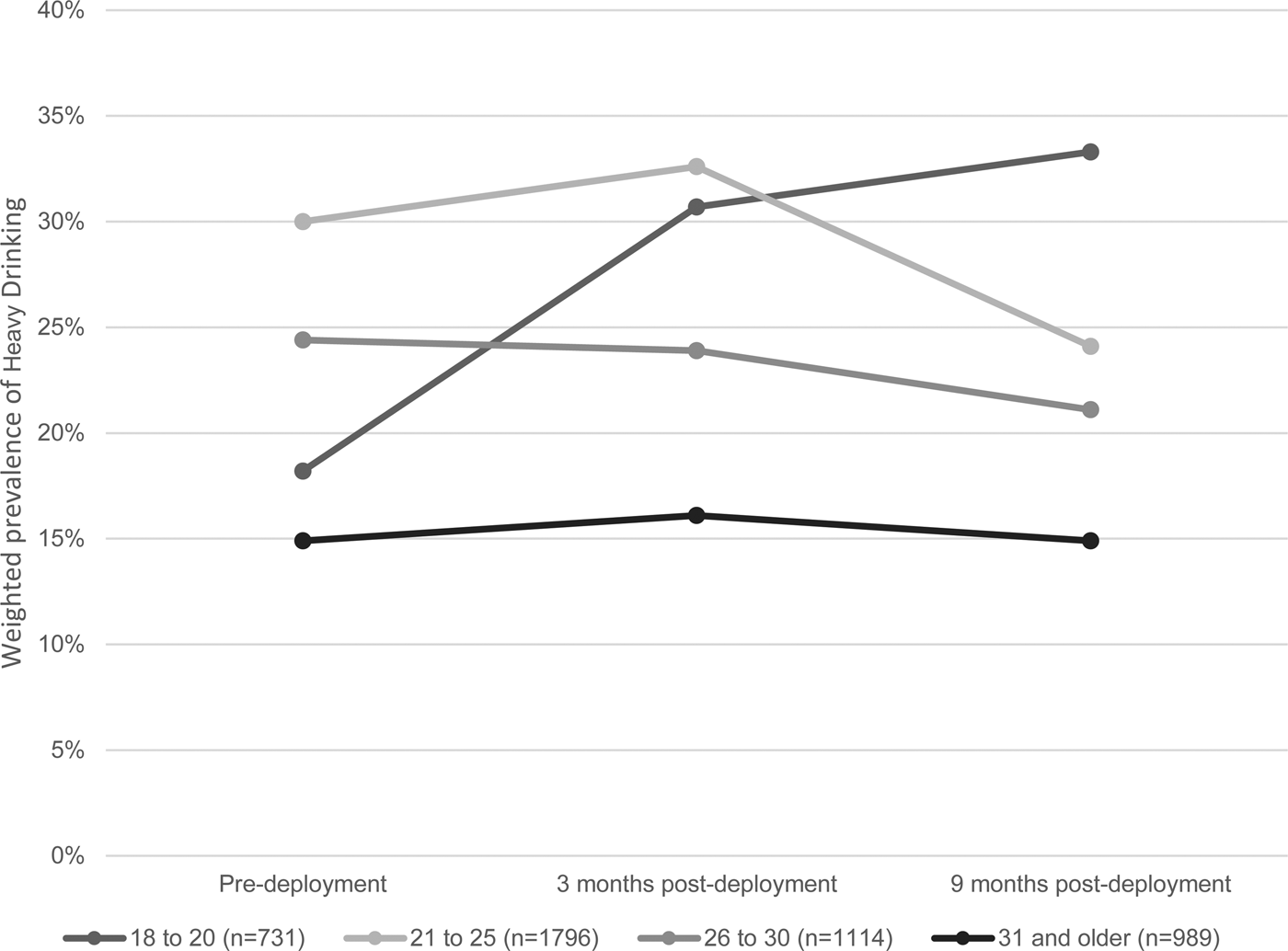
Demographic differences in prevalence of BD, HD, and AUD/SUD were examined and full results appear in Supplementary Tables 3 and 4. Women exhibited lower prevalence of BD, HD, and AUD/SUD than men at all waves (see Fig. 1 for BD and HD results). Relative to White soldiers, Black and Asian soldiers displayed lower prevalence of BD (all waves), HD (all waves except T3), and lifetime AUD/SUD at T0. Whereas other age groups exhibited stable or declining rates of BD and HD from pre-deployment to 9 months post-deployment, the youngest soldiers (aged 18–20) displayed substantial increases in BD and HD over the same period (see Fig. 2 for HD results).
Weighted prevalence by gender of binge drinking and heavy drinking at pre-deployment (T0), 3 months post-deployment (T2), and 9 months post-deployment (T3). Group n’s total slightly less than 4645 due to rare missing gender data. Prevalence of binge drinking and heavy drinking was lower among women than men at all waves [χ2(1) = 21.98– 63.42, ps < 0.001].

Weighted prevalence by age group of heavy drinking at pre-deployment (T0), 3 months post-deployment (T2), and 9 months post-deployment (T3). Group n’s total slightly less than 4645 due to rare missing age data. Prevalence of heavy drinking differed by age group at all waves [χ2(3) = 85.01–92.02, ps < 0.001].

Nearly 1 in 10 soldiers (9.6%, s.e. = 0.4%) had past-month PTSD, MDE, GAD, or SI at T0. On average, soldiers were exposed to four combat/deployment stressors during their deployment to Afghanistan [mean DSS = 3.98, s.d. = 2.72, observed range = 0–15]. Note that this value represents distinct types of combat/deployment stressors encountered – not total number of stressful experiences, which could have been higher in number (see Supplementary Table 1 for DSS scoring details). Reported levels of personal life stress, military life stress, PTSD symptoms, and MDE/GAD symptoms during deployment were generally mild [mean PLS = 2.68, s.d. = 3.10, range = 0–20; mean MLS = 1.73, s.d. = 1.89, range = 0–8; mean T1 PTSD score = 3.18, s.d. = 3.63, range = 0–20; mean T1 MDE/GAD score = 5.56, s.d. = 5.20, range = 0–28].
Risk factors for onset and persistence of HD
New-onset of HD post-deployment
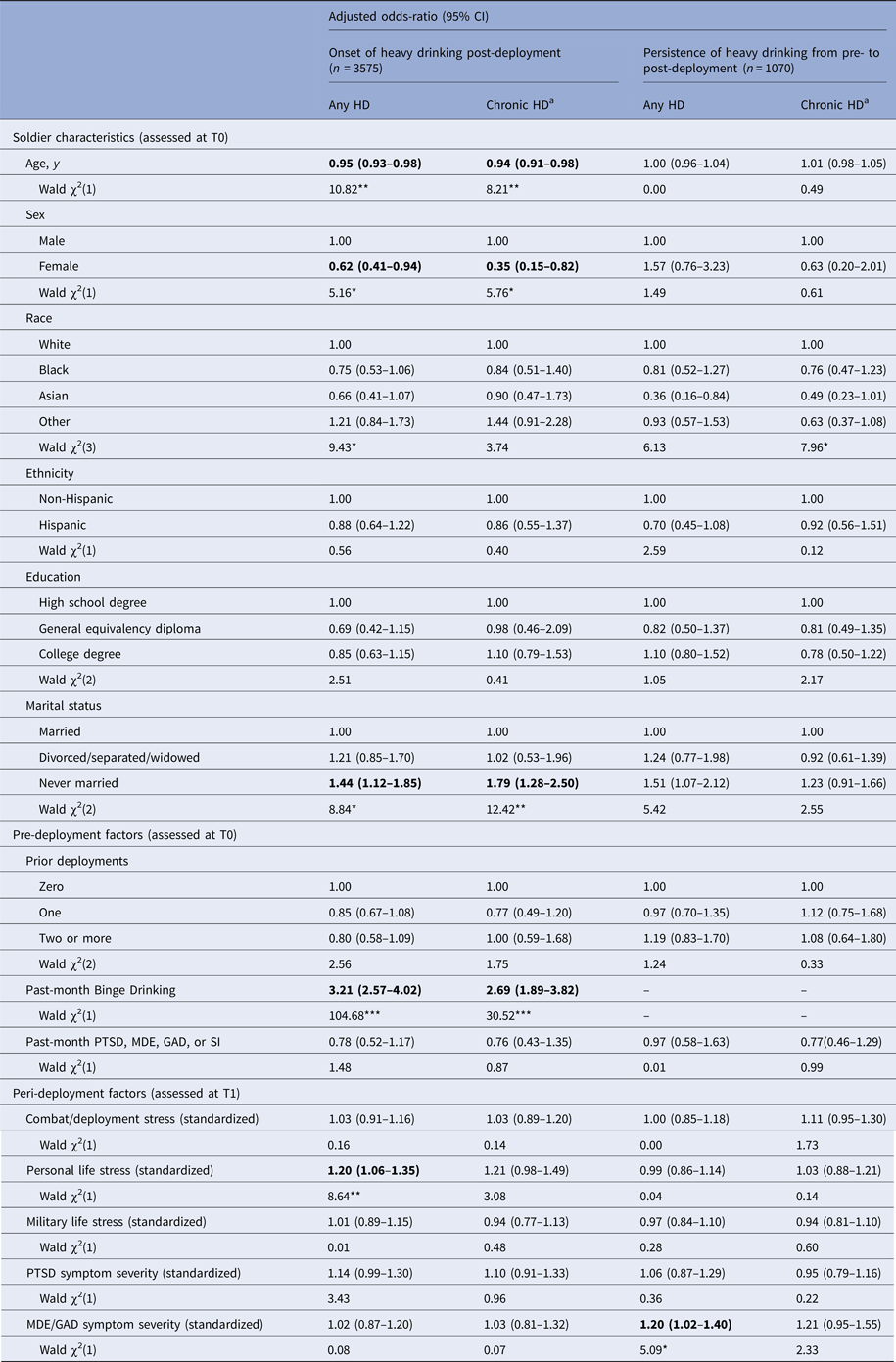
Male sex, younger age, never-married status, pre-deployment BD, and greater personal life stress during deployment were associated with increased odds of onset of HD at T2 among soldiers who denied HD at T0 (Table 2). The adjusted odds-ratio (AOR) characterizing the association of personal life stress with HD onset indicates that soldiers with above-average (z = 1.00) and high personal stress (z = 2.00) during deployment exhibited 20 and 44% increased risk of post-deployment HD onset, relative to those with average personal stress during deployment. Prior deployments, combat/deployment stress, military life stress, and pre- and peri-deployment mental health factors were not significantly related to onset of HD.
Adjusted odds of onset and persistence of post-deployment heavy drinking among Army STARRS Pre/Post Deployment Study respondents

Note. CI, confidence interval; HD, heavy drinking; PTSD, posttraumatic stress disorder; MDE, major depressive episode; GAD, generalized anxiety disorder; SI, suicidal ideation. Each column displays the results for a separate weights-adjusted logistic regression model. Models also adjusted for Brigade Combat Team. Significant adjusted odds ratios (where the overall Wald χ2 test is also statistically significant) are bolded.
*p < 0.05; **p < 0.005; ***p < 0.0005
a Chronic HD was defined as heavy drinking that was present at both 3 months and 9 months post-deployment (i.e., at both T2 and T3).
Most (62.0%) new HD observed at T2 had remitted by T3 – i.e., frequency of alcohol binges dropped back below the threshold for HD. When onset of chronic HD (present at T2 and T3) was specified as the outcome, similar risk factors were evident. Male sex, younger age, never married status, and pre-deployment BD were significantly associated with onset of chronic HD. However, the association of personal life stress during deployment with onset of chronic HD was not statistically significant (p = 0.079; Table 2).
Persistence of HD from pre-to-post deployment
The hypothesized risk factors generally lacked substantive associations with persistence of HD from pre- to post-deployment. Only peri-deployment MDE/GAD symptoms were associated with persistence of HD at T2 among soldiers who endorsed HD at T0 (Table 2). Soldiers with above-average (z = 1.00) and high MDE/GAD symptoms (z = 2.00) during deployment exhibited 20% and 43% increased risk of HD persistence at T2, relative to those with average distress during deployment. MDE/GAD symptoms were not associated with chronic persistence of HD at T2 and T3 (p = 0.13; Table 2).
Risk factors for incidence and persistence of AUD/SUD
Incidence of AUD/SUD post-deployment
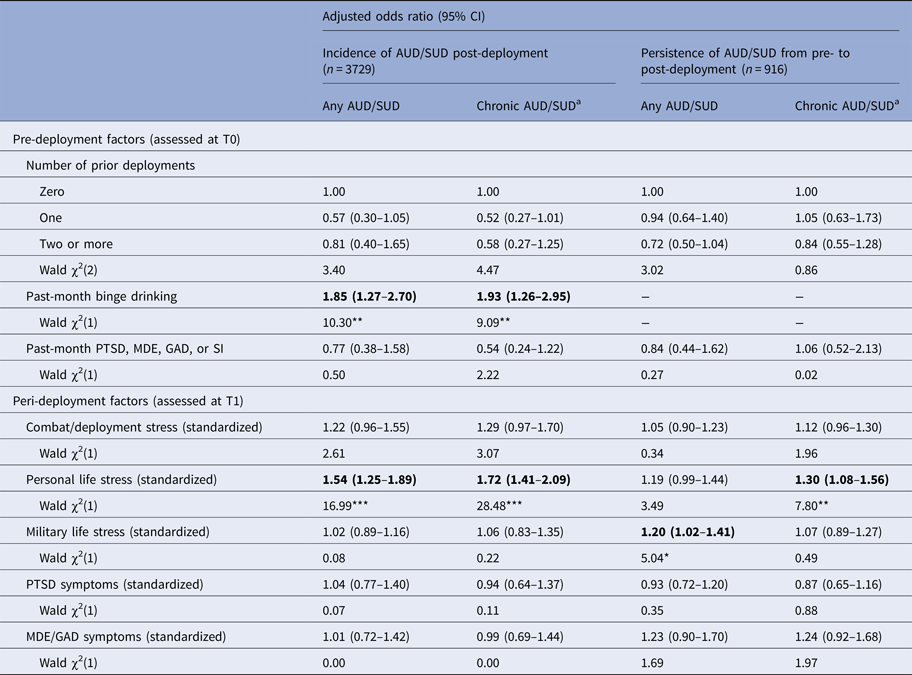
Pre-deployment BD and greater personal life stress during deployment were associated with increased risk of AUD/SUD at T2 among soldiers without lifetime AUD/SUD at T0 (Table 3). Relative to average personal stress during deployment, above-average personal stress was associated with 54% increased risk of incidence of AUD/SUD and high personal stress was associated with more than doubled (AOR = 2.36) odds of incidence of AUD/SUD.
Adjusted odds of onset and persistence of post-deployment AUD/SUD among Army STARRS Pre/Post Deployment Study respondents

Note. AUD/SUD, alcohol or substance use disorder; CI, confidence interval; PTSD, posttraumatic stress disorder; MDE, major depressive episode; GAD, generalized anxiety disorder; SI, suicidal ideation. Each column displays the results for a separate weights-adjusted logistic regression model. To streamline the table, soldier characteristics included in the models (age, sex, race, ethnicity, education, and marital status) are omitted; none displayed significant associations with incidence or persistence of AUD/SUD (ps > 0.10). Models also adjusted for Brigade Combat Team. Significant adjusted odds ratios (where the overall Wald χ2 test is also statistically significant) appear in bold.
*p < 0.05; **p < 0.005; ***p < 0.0005
a Chronic AUD/SUD was defined as the disorder being present at both 3 months and 9 months post-deployment (i.e., at both T2 and T3)
Nearly two-thirds (64.0%) of new-onset AUD/SUD persisted at T3. The same factors – pre-deployment BD and personal stress during deployment – were associated with increased risk of incidence of chronic AUD/SUD (i.e., at T2 and T3; Table 3). Odds of incidence of chronic AUD/SUD were 72% higher among soldiers with above-average personal stress and nearly tripled (AOR = 2.94) for soldiers with high personal stress, relative to those with average personal stress during deployment.
Persistence of AUD/SUD from pre- to post-deployment
Among soldiers with lifetime AUD/SUD at T0, only greater military life stress during deployment was significantly associated with persistence of the disorder at T2 (Table 3). Compared with soldiers with average military life stress, odds of persistence of AUD/SUD at T2 were 20% and 45% higher among soldiers with above-average and high military life stress, respectively. The association of personal life stress severity with persistence of AUD/SUD at T2 was not statistically significant (p = 0.062); however, greater personal life stress during deployment was significantly associated with chronic persistence of AUD/SUD at T2 and T3 (Table 3). Relative to those with average personal life stress during deployment, odds of persistence of AUD/SUD at both T2 and T3 were 30% and 69% higher among soldiers with above-average and high personal stress, respectively.
Discussion
This prospective, longitudinal study of US Army soldiers from three Brigade Combat Teams reveals associations between personal life stress during deployment and a range of post-deployment alcohol misuse outcomes. Among soldiers with no lifetime AUD/SUD pre-deployment, high levels of personal life stress during deployment (defined as standard score of 2.00 or higher on the PLS measure) were associated with doubled risk of incidence of AUD/SUD at 3 months post-deployment; and nearly tripled risk of incidence of chronic AUD/SUD observed at 3 and 9 months post-deployment. In addition, personal life stress during deployment predicted onset of HD among soldiers who denied drinking heavily pre-deployment and chronic persistence of AUD/SUD (at both 3 and 9 months post-deployment) among soldiers with the disorder earlier in life. BD shortly before deployment also portended onset of more serious alcohol misuse post-deployment; reflected in tripled odds of onset of HD and nearly doubled odds of incidence of AUD/SUD. In addition to predicting these outcomes at a single post-deployment time point, pre-deployment BD predicted onset of chronic HD and AUD/SUD that were present at both 3 and 9 months post-deployment.
The PPDS survey did not permit differential diagnosis of AUD v. SUD due to non-alcohol drug use. Available evidence suggests the large majority of AUD/SUD in this sample was in fact AUD; only 10% of respondents with AUD/SUD at either post-deployment assessment endorsed regular use of any non-alcohol drug. Prior work also indicates that AUD is more common than drug abuse/dependence among servicemembers (Fink et al. Reference Fink, Calabrese, Liberzon, Tamburrino, Chan, Cohen, Sampson, Reed, Shirley, Goto, D'Arcangelo, Fine and Galea2016). Chronicity (persistence at T3) of two-thirds of AUD/SUD with post-deployment onset argues against characterization of these new disorders as transient reactions; and may reflect more enduring stress/adjustment demands associated with deployment to a combat zone and subsequent re-deployment to the USA. While chronicity was the norm for AUD/SUD with post-deployment onset, a minority of new-onset HD persisted at T3. Considered together, these findings suggest that presence of abuse or dependence symptoms shortly following return from deployment – as opposed to increased alcohol consumption per se – merit greatest concern.
The absence of associations of combat stress severity with the alcohol misuse outcomes is counterintuitive, but largely converges with results of two other studies that jointly examined predictive effects of combat and personal stress (Cerda et al. Reference Cerda, Richards, Cohen, Calabrese, Liberzon, Tamburrino, Galea and Koenen2014; Thandi et al. Reference Thandi, Sundin, Ng-Knight, Jones, Hull, Jones, Greenberg, Rona, Wessely and Fear2015). Although underlying explanations for the greater apparent influence of personal (v. combat) stressors were not explored in the current analysis, some possibilities meriting future study are: continuance of personal stressors into the post-deployment period (v. offset of deployment stress); soldier perception of drinking as a more effective coping tool for everyday stress than for combat stress; concentration of other vulnerability characteristics (e.g., traits predisposing individuals to alcohol misuse) among soldiers with greater personal stress; and increased resilience among those with low stress arising from their personal lives (e.g., relationships are stable/supportive).
While we conclude that severity of combat stress was not independently associated with post-deployment alcohol misuse in this cohort, we make no inference regarding the effects of deployment (with or without combat exposure) per se on risk of alcohol misuse. A previous large-scale prospective analysis from the Millennium Cohort Study (MCS) addressed that question and found that, relative to not deploying, deployment with combat exposure (but not deploying without combat exposure) was associated with increased risk of onset of BD among active-duty personnel; and with onset of BD, HD, and alcohol-related problems among Reserve/National Guard personnel (Jacobson et al. Reference Jacobson, Ryan, Hooper, Smith, Amoroso, Boyko, Gackstetter, Wells and Bell2008). We cannot make similar comparisons, as all soldiers in the current study deployed to Afghanistan – with most reporting exposure to several combat stressors. Future research should examine the effects of personal life stress and other risk factors for alcohol misuse in samples of servicemembers deployed to non-combat positions.
Contrary to expectation, pre-deployment emotional disorder was not associated with increased risk of post-deployment HD or AUD/SUD. Peri-deployment PTSD symptoms also lacked associations with the alcohol misuse outcomes; and peri-deployment MDE/GAD symptoms only exhibited an association with persistence of HD from pre-deployment to 3 months post-deployment. These largely null findings diverge from results of prior studies that found relationships between PTSD, MDE, and alcohol misuse. Among 358 National Guard soldiers deployed to Iraq, PTSD symptom severity was associated with increased risk of new-onset AUD (Kehle et al. Reference Kehle, Ferrier-Auerbach, Meis, Arbisi, Erbes and Polusny2012). Baseline symptoms of PTSD and/or MDE contributed to prediction of incidence of alcohol-related problems (endorsing 1 or more indicators of alcohol abuse) – but not incidence of BD or HD – in the aforementioned MCS investigation that included both deployed and non-deployed servicemembers (Jacobson et al. Reference Jacobson, Ryan, Hooper, Smith, Amoroso, Boyko, Gackstetter, Wells and Bell2008). Disparities in study results may reflect differences in sample characteristics or in the consideration or operationalization of mental health and other predictor variables. Although robust predictive effects of mental health variables were not found in this analysis, alcohol misuse displays consistent cross-sectional associations with PTSD, MDE, and other disorders in military samples (Thomas et al. Reference Thomas, Wilk, Riviere, McGurk, Castro and Hoge2010; Stein et al. Reference Stein, Campbell-Sills, Gelernter, He, Heeringa, Nock, Sampson, Sun, Jain, Kessler, Ursano and Army2017); thus, co-occurring mental health problems must be considered in clinical interventions and other efforts to reduce hazardous drinking and AUD/SUD.
Male, younger, and never-married soldiers displayed increased odds of onset of HD post-deployment, converging with previous findings of elevated risk of hazardous drinking in these subgroups (Jacobson et al. Reference Jacobson, Ryan, Hooper, Smith, Amoroso, Boyko, Gackstetter, Wells and Bell2008; Boulos & Zamorski, Reference Boulos and Zamorski2016). The marked increase in risky drinking pre- to post-deployment among soldiers aged 18–20 distinguishes them from others and signals that young soldiers who deploy (particularly those possessing other risk factors) may be a subgroup to consider for targeted prevention efforts, even if the rise is partly attributable to some of them attaining legal drinking age between assessments.
More generally, this study conveys information regarding the scope of alcohol misuse among Army soldiers shortly before and at multiple points after their deployment to a combat zone. Approximately half of respondents reported BD and nearly one-quarter endorsed HD during the month before pre-deployment assessment. Although differences in study design preclude definitive comparisons, pre-deployment prevalence of HD in this sample (23%) appears similar to prevalence of a related outcome (regular BD; 27%) among Navy/Marine Corps personnel preparing to deploy (Harbertson et al. Reference Harbertson, Hale, Watkins, Michael and Scott2016).
Typical scheduling of the Army's Post-Deployment Health Reassessment (PDHRA) places it in closest proximity to the PPDS T2 assessment. Given that soldiers endorsing HD would likely score in the high-risk range, it is striking that T2 prevalence of HD was twice the reported rate of ‘high risk for alcohol abuse’ among PDHRA respondents during 2008–2014 (Hurt, Reference Hurt2015). This may signal under-estimation of the true scope of alcohol misuse when non-confidential forms of assessment such as the PDHRA are used (Warner et al. Reference Warner, Appenzeller, Grieger, Belenkiy, Breitbach, Parker, Warner and Hoge2011).
Finally, substantially higher rates of past-month BD and HD were observed among PPDS respondents (at all waves) compared with a cohort of new soldiers (Stein et al. Reference Stein, Campbell-Sills, Gelernter, He, Heeringa, Nock, Sampson, Sun, Jain, Kessler, Ursano and Army2017). Higher prevalence of hazardous drinking among PPDS respondents could reflect increased alcohol misuse with longer Army tenure, selection of light drinkers/abstainers out of Army service, or differences in demographic composition or other characteristics of the two samples. Potential contributions of these factors should be explored in future research.
Novel aspects of the current investigation include availability of outcome data at both 3 and 9 months post-deployment; inclusion of number of prior deployments as a potential risk factor; increased granularity in measurement of combat stress exposure (0–16 index v. dichotomous characterization of deployment status or combat exposure); and joint consideration of a range of peri-deployment stressors and symptoms in relation to post-deployment HD and AUD/SUD.
The study also has several limitations. Conclusive differential diagnosis of AUD v. SUD was not possible. Retrospective self-report data are vulnerable to recall and response biases; in the case of alcohol and drug use assessment, under-reporting may occur. Estimates of non-alcohol drug use might be more susceptible to this bias than estimates of alcohol use given fear of repercussions for admitting drug use in light of the Army's zero-tolerance policy. Under-reporting of both alcohol and drug use could have been accentuated at the pre-deployment assessment, due to heightened desires to appear ‘combat-ready’.
Weights were applied to mitigate impacts of attrition and to enhance generalizability to the broader population of deployed soldiers. Nevertheless, selection factors may have influenced the results (i.e., soldiers who completed all assessments may have differed from the larger population of soldiers on variables not adjusted for via weights or covariates). The T0 survey did not assess lifetime HD; thus, new-onset of HD could only be defined in relation to drinking during the month before T0 assessment. Finally, low representation limited power to detect risk differences for certain subgroups (e.g., females). More research is needed to investigate whether sex differences are present with respect to risk factors for post-deployment alcohol misuse.
In conclusion, pre- and post-deployment alcohol misuse was common among soldiers from three US Army Brigade Combat Teams that deployed to Afghanistan. Severity of personal life stress during deployment – but not severity of combat stress – was associated with post-deployment onset of HD and incidence and persistence of AUD/SUD. Pre-deployment BD also predicted onset of HD and AUD/SUD post-deployment. Detection of risky drinking occurring shortly before deployment would provide an opportunity for early intervention to prevent onset of more severe alcohol-related problems. Additionally, efforts to identify and assist soldiers experiencing substantial personal life stress during deployment could prove beneficial not only for reduction of alcohol misuse, but possibly for overall mental health.
Supplementary material
The supplementary material for this article can be found at https://doi.org/10.1017/S0033291717003105
Acknowledgements
The Army STARRS Team consists of Co-Principal Investigators: Robert J. Ursano, MD (Uniformed Services University of the Health Sciences) and Murray B. Stein, MD, MPH (University of California San Diego and VA San Diego Healthcare System).
Site Principal Investigators: Steven Heeringa, PhD (University of Michigan), James Wagner, PhD (University of Michigan), and Ronald C. Kessler, PhD (Harvard Medical School).
Army liaison/consultant: Kenneth Cox, MD, MPH (USAPHC (Provisional)).
Other team members: Pablo A. Aliaga, MA (Uniformed Services University of the Health Sciences); COL David M. Benedek, MD (Uniformed Services University of the Health Sciences); Laura Campbell-Sills, PhD (University of California San Diego); Chia-Yen Chen DSc (Harvard Medical School); Carol S. Fullerton, PhD (Uniformed Services University of the Health Sciences); Nancy Gebler, MA (University of Michigan); Joel Gelernter (Yale University); Robert K. Gifford, PhD (Uniformed Services University of the Health Sciences); Paul E. Hurwitz, MPH (Uniformed Services University of the Health Sciences); Sonia Jain, PhD (University of California San Diego); Tzu-Cheg Kao, PhD (Uniformed Services University of the Health Sciences); Lisa Lewandowski-Romps, PhD (University of Michigan); Holly Herberman Mash, PhD (Uniformed Services University of the Health Sciences); James E. McCarroll, PhD, MPH (Uniformed Services University of the Health Sciences); James A. Naifeh, PhD (Uniformed Services University of the Health Sciences); Tsz Hin Hinz Ng, MPH (Uniformed Services University of the Health Sciences); Matthew K. Nock, PhD (Harvard University); Nancy A. Sampson, BA (Harvard Medical School); CDR Patcho Santiago, MD, MPH (Uniformed Services University of the Health Sciences); Jordan W. Smoller, MD, ScD (Harvard Medical School); and Alan M. Zaslavsky, PhD (Harvard Medical School).
Army STARRS was sponsored by the Department of the Army and funded under cooperative agreement number U01MH087981 (2009–2015) with the US Department of Health and Human Services, National Institutes of Health, National Institute of Mental Health (NIH/NIMH). Subsequently, STARRS-LS was sponsored and funded by the Department of Defense (USUHS grant number HU0001-15-2-0004). The contents are solely the responsibility of the authors and do not necessarily represent the views of the Department of Health and Human Services, NIMH, Department of the Army, or Department of Defense.
Declaration of Interest
Dr Stein has in the past 3 years been a consultant for Actelion, Dart Neuroscience, Healthcare Management Technologies, Janssen, Oxeia Biopharmaceuticals, Pfizer, Resilience Therapeutics, and Tonix Pharmaceuticals. In the past 3 years, Dr Kessler received support for his epidemiological studies from Sanofi Aventis; was a consultant for Johnson & Johnson Wellness and Prevention, Shire, Takeda; and served on an advisory board for the Johnson & Johnson Services Inc. Lake Nona Life Project. Kessler is a co-owner of DataStat, Inc., a market research firm that carries out healthcare research. The remaining authors have no financial disclosures.
Ethical standards
The authors assert that all procedures contributing to this work comply with the ethical standards of the relevant national and institutional committees on human experimentation and with the Helsinki Declaration of 1975, as revised in 2008.