Introduction
Coronary heart disease (CHD) is the leading cause of death globally, with 7.2 million deaths occurring worldwide every year.Reference Mackay and Mensah 1 In China, CHD causes death in over 1 million people each year. 2 Although CHD mortality has been declining in the United States and in Western Europe since 1970s, it remains the leading cause of death.Reference Levi, Lucchini and Negri 3 , Reference Xu, Lee and Peterson 4 And for all we know, CHD is considered as a multifactorial chronic disease that may be associated with hypertension, dyslipidemia, impaired glucose tolerance,Reference Frankel, Elwood and Sweetnam 5 – Reference Stein, Fall and Kumaran 7 a small body size at birth,Reference Eriksson, Forsén and Tuomilehto 8 , Reference Forsén, Eriksson and Tuomilehto 9 and some traditional factors (e.g. high fat diet, low occupational status, low household income and mother’s parity).Reference Barker, Osmond and Forsén 10 – Reference Barker, Forsén and Uutela 12 A recent study reported that physical inactivity could increase the risk of CHD.Reference Lee, Shiroma and Lobelo 13
According to the ‘fetal origins’ hypothesis, the fetus makes metabolic adaptations when it is undernourished and these persist to adult life and predispose to CHD.Reference Barker 14 Early studies have shown that low birth weight (LBW) was considered to result from slow intrauterine growth.Reference Stein, Fall and Kumaran 7 , Reference Barker, Winter and Osmond 15 However, slow growth in utero may result in accelerated weight gain during childhood, which may contribute to a relatively greater risk of CHD, hypertension and type 2 diabetes mellitus.Reference Gluckman, Hanson and Cooper 16 In addition, extensive epidemiological studies have reported that babies who later developed CHD tended to be thin in men and be short in women at birth.Reference Eriksson, Forsén and Tuomilehto 8 , Reference Forsén, Osmond and Eriksson 17
To date, many studies have suggested that there is a significant relationship between birthweight (BW) and the risk for CHD.Reference Barker, Gluckman and Godfrey 18 – Reference Osmond, Barker and Winter 28 Nevertheless, this relationship is inconsistent. Although some epidemiological studies have reported an inverse association between BW and risk of CHD,Reference Barker, Gluckman and Godfrey 18 , Reference Irving, Belton and Elton 23 , Reference Leon, Lithell and Vagero 26 others have reported no significant association or a positive association between BW and risk of CHD.Reference Eriksson, Tibblin and Cnattingius 21 , Reference Banci, Saccucci and Dofcaci 22 Moreover, in the reports of Danish birth cohort by Osler et al.,Reference Osler, Lund and Kriegbaum 27 a U-shaped relationship was observed between BW and risk of CHD. Therefore, we carried out a meta-analysis to further identify the association between BW and subsequent risk of CHD.
Methods
This systematic review and meta-analysis was performed according to the Cochrane methodology and the recommendations for reporting proposed by the Meta-analysis of observational studies in epidemiology group.Reference Stroup, Berlin and Morton 29
Study selection
An electronic literature search was conducted in PUBMED to identify human studies published from January 1995 up to October 2013, using a search strategy that combined text word and MeSH heading of BW and of CHD. No restrictions on the language or location of the study were imposed. In addition, we manually searched all references cited in original studies and reviews identified.
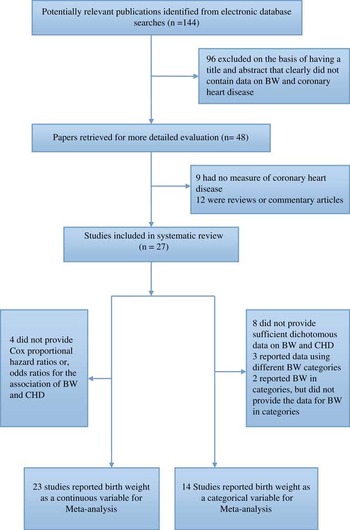
Two of the authors (L. Shu and M. Mu) read the abstracts of articles retrieved in the initial search to identify studies that examined the association between BW and risk of CHD. When all agreed (S.F. Wang, L. Shu and M. Mu), the articles were reviewed against inclusion and exclusion criteria for this meta-analysis. To be eligible, studies had to fulfill the following criteria: (1) the study was published as an original article. (2) The association between BW and risk of CHD has been reported in studies. (3) Odds ratios (ORs) or hazard ratios (HRs) and 95% confidence intervals (or data can be calculated) for BW and CHD were provided. Moreover, if BWs were reported as categorical data in studies, BWs should be categorized according to the international standards (LBW: <2500 g; normal BW: 2500–4000 g; high BW: ⩾4000 g). (4) CHD was diagnosed based on clinical manifestations (including angina or myocardial infarction, or myocardial ischemia, or cardiac failure and arrhythmia, or a death certificate cause of death as CHD), electrocardiogram and coronary arteriography. Papers were excluded for the following reasons: (1) Title and abstract did not contain data on BW and CHD; (2) there were insufficient data on HRs or ORs for the association of BW and CHD; (3) there was no measure of CHD; (4) the paper was a review or commentary article; (5) there were insufficient dichotomous data on BW and CHD; and (6) the paper reported data using different BW categories. Among 144 papers detected by our search, 27 provided data reporting the relationship of BW to CHD, of which 23 cohort studies considered BW as a continuous variable, and of which 14 cohort studies considered BW as a categorical variable for this meta-analysis.
Quality assessment
The Newcastle-Ottawa Quality Assessment scale was used for quality assessment.Reference Stang 30 Eight questions were assessed and each satisfactory answer received 1 point (may receive 2 points in comparability categories), resulting in a maximum score of 9. Only these studies in which most of the questions were deemed satisfactory (i.e. with a score of 6 or higher) were considered to be of high methodological quality.
Assessment of heterogeneity
Heterogeneity of study results was estimated by the χ2-test. P-values <0.05 were considered to be significant. In our meta-analysis, a random-effects model was used to account for possible heterogeneity between studies, whereas a fixed-effects model was adopted in the absence of heterogeneity.Reference Higgins, Thompson and Deeks 31
Statistical analysis
Statistical analyses were performed by using Review Manager, version 5.0 (Nordic Cochrane Centre Copenhagen, Denmark) and STATA, version 12 (Stata Corp, College Station, TX, USA). ORs and 95% confidence intervals (CIs) from individual studies were combined to produce an overall OR. Sensitivity analysis was conducted to determine whether differences in study design, age, statistical methods and sex of the study population affected study conclusions. Publication bias was assessed by inspection of the funnel plot and by formal testing for ‘funnel plot’ asymmetry using Begg’s test and Egger’s test.Reference Begg and Mazumdar 32 All statistical tests were two-sided and P-values <0.05 were considered significant.
Results
Overview of studies included in the meta-analysis
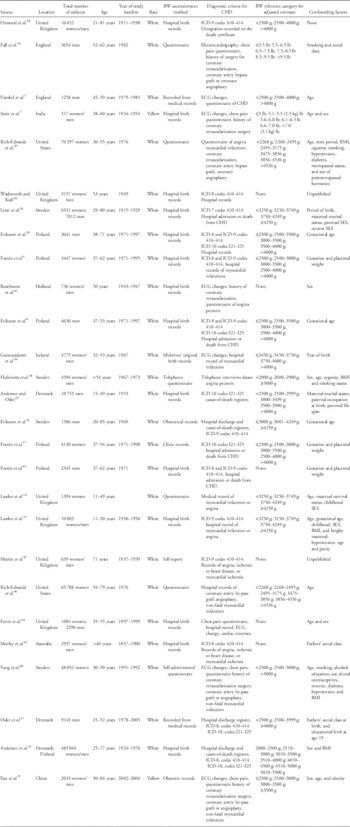
A search in the database of PUBMED identified 144 papers, 117 of which were excluded based on the reasons shown in Fig. 1. Finally, there are 27 articlesReference Frankel, Elwood and Sweetnam 5 , Reference Stein, Fall and Kumaran 7 – Reference Forsén, Eriksson and Tuomilehto 9 , Reference Forsén, Osmond and Eriksson 17 , Reference Eriksson, Forsén and Tuomilehto 20 , Reference Lawlor, Davey Smith and Ebrahim 24 – Reference Osmond, Barker and Winter 28 , Reference Andersen, Angquist and Eriksson 33 – Reference Wadsworth and Kuh 48 reporting the relationship between BW and risk of CHD, of which 14 papersReference Frankel, Elwood and Sweetnam 5 , Reference Stein, Fall and Kumaran 7 – Reference Forsén, Eriksson and Tuomilehto 9 , Reference Forsén, Osmond and Eriksson 17 , Reference Eriksson, Forsén and Tuomilehto 20 , Reference Osler, Lund and Kriegbaum 27 , Reference Osmond, Barker and Winter 28 , Reference Fall, Vijayakumar and Barker 36 – Reference Yang, Kuper and Weiderpass 40 considered BW as a categorical variable, and 23 papersReference Frankel, Elwood and Sweetnam 5 , Reference Stein, Fall and Kumaran 7 – Reference Forsén, Eriksson and Tuomilehto 9 , Reference Forsén, Osmond and Eriksson 17 , Reference Eriksson, Forsén and Tuomilehto 20 , Reference Lawlor, Davey Smith and Ebrahim 24 – Reference Leon, Lithell and Vagero 26 , Reference Osmond, Barker and Winter 28 , Reference Andersen, Angquist and Eriksson 33 – Reference Eriksson, Wallander and Krakau 35 , Reference Fan, Zhang and Li 37 – Reference Rich-Edwards, Stampfer and Manson 39 , Reference Morley, McCalman and Carlin 41 – Reference Martin, Gunnell and Pemberton 47 considered BW as a continuous variable (10 articles repeat). Descriptive information for each included study was presented in Table 1.
Flow chart of the article screening and selection process. BW, birth weight; CHD, coronary heart disease.

Characteristics of 27 studies reporting the association between BW and subsequent risk of CHD (1993–2010)

BW, birth weight; CHD, coronary heart disease, LB, pound; ICD, International Classification of Disease; ECG, electrocardiogram; SES, socioeconomic status; BMI, body mass index.
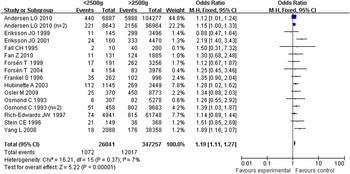
Figure 2 showed the forest plot for risk of CHD in subjects with LBW (<2500 g) compared with subjects with BW⩾2500 g. There was less evidence of heterogeneity (P=0.37, I 2=7%), and hence data from 14 studiesReference Frankel, Elwood and Sweetnam 5 , Reference Stein, Fall and Kumaran 7 – Reference Forsén, Eriksson and Tuomilehto 9 , Reference Forsén, Osmond and Eriksson 17 , Reference Eriksson, Forsén and Tuomilehto 20 , Reference Osler, Lund and Kriegbaum 27 – Reference Higgins, Thompson and Deeks 31 , Reference Irving, Belton and Elton 23 , Reference Fall, Vijayakumar and Barker 36 – Reference Yang, Kuper and Weiderpass 40 were assessed using the fixed-effects model. The results showed that LBW was associated with increased risk of CHD (OR, 1.19; 95% CI, 1.11–1.27, P<0.00001).
The forest plot for risk of coronary heart disease in subjects with low birth weight (<2500 g) compared with subjects with birth weight >2500 g. The pooled odds ratios are calculated by a fixed-effects model; 95% confidence interval (95% CI) are shown in parentheses and horizontal bars.

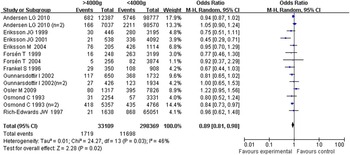
Eleven articles (reporting 14 original data) analyzed the risk of CHD in subjects with high birth weight (HBW; ⩾4000 g) compared with that of subjects with BW<4000 g.Reference Frankel, Elwood and Sweetnam 5 , Reference Eriksson, Forsén and Tuomilehto 8 , Reference Forsén, Eriksson and Tuomilehto 9 , Reference Forsén, Osmond and Eriksson 17 , Reference Eriksson, Forsén and Tuomilehto 20 , Reference Osler, Lund and Kriegbaum 27 , Reference Osmond, Barker and Winter 28 , Reference Andersen, Angquist and Eriksson 33 , Reference Gunnarsdottir, Birgisdottir and Thorsdottir 34 , Reference Rich-Edwards, Stampfer and Manson 39 There was significant heterogeneity (P=0.03, I 2=46%) and hence the effect was assessed using the random-effects model. The results from this analysis revealed the relationship between HBW and risk of CHD (OR, 0.89; 95% CI, 0.81–0.98; P=0.02; Fig. 3).
The forest plot for risk of coronary heart disease in subjects with high birth weight (>4000 g) compared with subjects with birth weight <4000 g. The pooled odds ratios are calculated by a random-effects model; 95% confidence interval (95% CI) are shown in parentheses and horizontal bars.

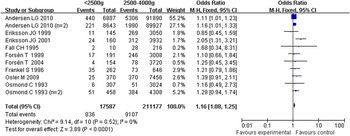
To assess the risk of CHD associated with both ends of the BW spectrum, using normal BW (2500–4000 g) as the reference category, all studies that provided data for both high and LBW were analyzedReference Levi, Lucchini and Negri 3 . Figure 4 showed the forest plot for risk of CHD in subjects with LBW (<2500 g) compared with normal BW (2500–4000 g). Nine studies (reporting 11 original data)Reference Frankel, Elwood and Sweetnam 5 , Reference Eriksson, Forsén and Tuomilehto 8 , Reference Forsén, Eriksson and Tuomilehto 9 , Reference Forsén, Osmond and Eriksson 17 , Reference Eriksson, Forsén and Tuomilehto 20 , Reference Osler, Lund and Kriegbaum 27 , Reference Osmond, Barker and Winter 28 , Reference Andersen, Angquist and Eriksson 33 , Reference Fall, Vijayakumar and Barker 36 analyzed the risk of CHD in subjects with LBW (<2500 g) compared with subjects with normal BW (2500–4000 g). There was no significant heterogeneity (P=0.52, I 2=0%) and hence the effect was assessed using the fixed-effects model. The results showed that LBW was associated with increased risk of CHD (OR, 1.16; 95% CI, 1.08–1.25; P<0.0001).
The forest plot for risk of coronary heart disease in subjects with low birth weight (<2500 g) compared with subjects with normal birth weight (2500–4000 g). The pooled odds ratios are calculated by a fixed-effects model; 95% confidence interval (95% CI) are shown in parentheses and horizontal bars.

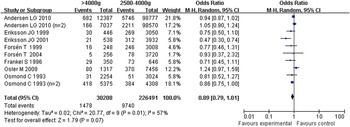
Figure 5 showed the forest plot for risk of CHD in subjects with HBW (⩾4000 g) compared with normal BW (2500–4000 g). Eight studies (including 10 original data)Reference Frankel, Elwood and Sweetnam 5 , Reference Eriksson, Forsén and Tuomilehto 8 , Reference Forsén, Eriksson and Tuomilehto 9 , Reference Forsén, Osmond and Eriksson 17 , Reference Eriksson, Forsén and Tuomilehto 20 , Reference Osler, Lund and Kriegbaum 27 , Reference Osmond, Barker and Winter 28 , Reference Andersen, Angquist and Eriksson 33 reported the ORs for CHD in subjects with HBW (>4000 g), as compared with subjects with normal BW. There was significant heterogeneity (P=0.01, I 2=57%) and hence the effect was assessed using the random-effects model. The results suggested (not quite significant) that HBW was associated with decreased risk of CHD (OR, 0.89; 95% CI, 0.79–1.01; P=0.07).
The forest plot for risk of coronary heart disease in subjects with high birth weight (>4000 g) compared with subjects with normal birth weight (2500–4000 g). The pooled odds ratios are calculated by a random-effects model; 95% confidence interval (95% CI) are shown in parentheses and horizontal bars.

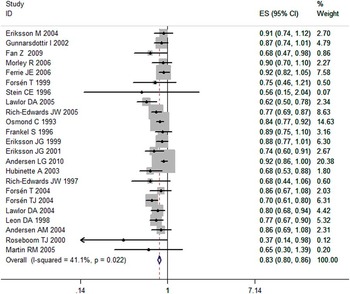
All of the identified studies suggested an inverse association between BW and risk of CHD. In 23 studiesReference Frankel, Elwood and Sweetnam 5 , Reference Stein, Fall and Kumaran 7 – Reference Forsén, Eriksson and Tuomilehto 9 , Reference Forsén, Osmond and Eriksson 17 , Reference Eriksson, Forsén and Tuomilehto 20 , Reference Lawlor, Davey Smith and Ebrahim 24 – Reference Leon, Lithell and Vagero 26 , Reference Osmond, Barker and Winter 28 , Reference Andersen, Angquist and Eriksson 33 , Reference Gunnarsdottir, Birgisdottir and Thorsdottir 34 , Reference Fan, Zhang and Li 37 – Reference Rich-Edwards, Stampfer and Manson 39 , Reference Morley, McCalman and Carlin 41 – Reference Martin, Gunnell and Pemberton 47 that examined the relation of per kilogram of BW with the combined outcome for non-fatal and fatal CHD, the overall relative risk for CHD was 0.83 (95% CI, 0.80–0.86) per 1 kg higher BW (Fig. 6).
Relative risks and 95% confidence intervals (CIs) for risk of coronary heart disease associated with 1 kg higher birth weight.

Quality assessment
Quality of each study in terms of population and sampling methods, description of exposure and outcomes and statistical adjustment of data, was summarized in Appendix 1. Out of sixteen studies, 14 studies received 6 scores or higher on the Newcastle-Ottawa Quality Assessment scale and were considered to be of high methodological quality.Reference Frankel, Elwood and Sweetnam 5 , Reference Eriksson, Forsén and Tuomilehto 8 , Reference Forsén, Eriksson and Tuomilehto 9 , Reference Forsén, Osmond and Eriksson 17 , Reference Eriksson, Forsén and Tuomilehto 20 , Reference Osler, Lund and Kriegbaum 27 , Reference Osmond, Barker and Winter 28 , Reference Andersen, Angquist and Eriksson 33 – Reference Fan, Zhang and Li 37 , Reference Rich-Edwards, Stampfer and Manson 39 , Reference Yang, Kuper and Weiderpass 40
Sensitivity analysis
Sensitivity analyses revealed that differences in sample size, sex and source of data for BW had an effect on the BW/CHD association. When comparing HBW (>4000 g) with BW<4000 g and normal BW (2500–4000 g), the BW/CHD association was more obvious when sample size was <5000 and age was >50 years. In addition, when comparing LBW (<2500 g) with normal BW (2500–4000 g), the BW/CHD association was more obvious when source of data for BW were hospital birth records, sample size was >5000, and sex was male. As these variables have a strong impact on the association between BW and risk of CHD, their differences can partially explain the observed heterogeneity between studies (Appendix 2).
Publication bias
Inspection of funnel plots did not reveal evidence of asymmetry (Appendix 3). Egger’s tests for publication bias was not statistically significant (Egger’s tests, P=0.218 for studies comparing LBW (<2500 g) with BW>2500 g; P=0.342 for studies comparing HBW (>4000 g) with BW<4000 g; P=0.130 for studies comparing LBW with normal BW (2500–4000 g); P=0.50 for studies comparing HBW with normal BW).
Discussion
Previous studies have reported the associations between BW and risk of CHD. Among these studies, some studies showed that LBW was associated with increased risk of CHD.Reference Eriksson, Tibblin and Cnattingius 21 , Reference Osler, Lund and Kriegbaum 27 , Reference Gunnarsdottir, Birgisdottir and Thorsdottir 34 In contrast, other studies showed no significant association of BW with later CHD risk.Reference Forsén, Osmond and Eriksson 17 , Reference Eriksson, Wallander and Krakau 35 – Reference Fan, Zhang and Li 37 In addition, Hubinette and Osler et al. found a U-shaped relationship between BW and CHD.Reference Osler, Lund and Kriegbaum 27 , Reference Osmond, Barker and Winter 28 However, in the present study, the results indicate that there is an inverse association between BW and the subsequent risk of CHD. To our knowledge, Rachel Huxley et al.Reference Huxley, Owen and Whincup 49 in 2007 have reported an excellent review of BW and the risk of ischemic heart disease. In this study, however, we have an update on the earlier meta-analysis and further explore the associations between LBW, HBW and the risk of CHD.
In our analyses, LBW was significantly associated with increased risk of CHD. Consistent with our findings, many epidemiological studies have reported an inverse association between BW and risk of CHD.Reference Eriksson, Tibblin and Cnattingius 21 , Reference Gunnarsdottir, Birgisdottir and Thorsdottir 34 , Reference Harding 50 Rachel Huxley et al.Reference Huxley, Owen and Whincup 49 in 2007 reported 15–20% risk reduction (HR, 0.84; 95% CI, 0.81–0.88) per kg higher BW in a meta-analysis of ischemic heart disease. Another meta-analysis of cardiovascular mortality showed a 12% lower risk (HR, 0.88; 95% CI, 0.85–0.91) per kg higher BW.Reference Risnes, Vatten and Baker 51 More than BW, postnatal growth patterns are also related to the risk of CHD as adults. There is now clear evidence that people who develop CHD grew differently to other people in their early life. They tended to grow slowly in utero, so that their birthweights were lower. In addition, they tended to remain small for the first 2 years after birth. After that, they gained weight and body mass index rapidly. This pattern of growth during childhood was associated with insulin resistance in later life.Reference Barker, Osmond and Forsén 10
Like other living creatures, humans are plastic during their development. Malnutrition and other adverse influences during development can alter gene expression and permanently change body structure and function, a phenomenon known as ‘programming’,Reference West-Eberhard 52 that are related to adverse cardiovascular risk later in life. In animals, it is surprisingly easy to produce lifelong changes in the physiology and metabolism of the offspring by minor modifications to the diet of the mother before and during pregnancy.Reference Gluckman and Hanson 53 Malnutrition and other adverse influences during development also lead to slowing of fetus growth, which is why some chronic diseases are associated with LBW.
During development, there are critical periods during which a system or organ has to mature. These periods are brief. For human, much of the development is completed during the first 1000 days after conception (i.e. during intrauterine life and infancy). There are several reasons to explain the increased risk of cardiovascular disease among persons who were small at birth and during infancy. First, they have reduced function in important organs, such as the kidney.Reference Brenner and Chertow 54 Second, they have altered settings in their metabolism and hormonal feedback.Reference Phillips 55 Third, they are more susceptible to adverse environmental influences in later life.Reference Barker, Forsen, Uute la, Osmond and Eriksson 56 Fourth, their ‘catch-up growth’ occurs when undernutrition during early development is followed by adequate nutrition in childhood.Reference Eriksson, Forsén and Tuomilehto 8 Children who are undernourished in the first 2 years of life and put on weight rapidly later in childhood and adolescence have a disproportionately high fat mass in relation to muscle mass, which leads to insulin resistance, a known risk factor for CHD.Reference Barker, Osmond and Forsén 10 Finally, people with LBW may be those who experienced intrauterine growth retardation, partly due to maternal hypertensive disorder during pregnancy, thus may be genetically predisposed to CHD.Reference Osler, Lund and Kriegbaum 27 Thus, our findings of the inverse association between BW and the risk of CHD may emphasize the importance of reducing LBW for the primary prevention of CHD in adults. Protecting the nutrition and health of girls and young women will contribute to the reduction of LBW and the prevention of chronic disease in the offspring and should be the cornerstone of public health.Reference Barker 57
Consistent inverse associations between BW and CHD were found across most studies. The present meta-analysis shows that HBW is associated with decreased risk of CHD in later life. However, women who have gestational diabetes are more likely to give birth to large babies who are at increased risk of developing diabetes later in life.Reference Harder, Roepke and Diller 58 HBW could be a result of gestational diabetes, and therefore potentially a risk factor for CHD in the child. Curhan et al.Reference Curhan, Willett and Rimm 59 found HBW was associated with an increased risk of adult obesity. In addition, HBW has also been described to be a risk factor for type 2 diabetes and hypertension.Reference Barker, Gluckman and Godfrey 18 , Reference Whincup, Kaye and Owen 60 In this context, HBW may be considered as a key linking factor for CHD. To date, however, very few studies have confirmed that HBW is directly assocaited with increased risk of CHD. In addition, some studies reported the relationship between BW and the subsequent risk of CHD after adjusting for gestational age. A further limitation of this analysis is the lack of information on the association between HBW and gestational diabetes in most of the studies; thus, further studies are needed to confirm the association between HBW and risk of CHD.
Strengths and limitations
This meta-analysis holds its own strengths. First, this is the latest meta-analysis reporting the associations between BW and the risk of CHD. We not only have an update on the earlier meta-analysis (Huxley et al. in 2007), but also further explore the associations between LBW, HBW and the risk of CHD in adults. Second, BW has been classified according to international standards in our analyses, avoiding underestimation or distortion of effect of LBW. Third, no signs of publication bias were evident in the funnel plot, and the statistical test for publication bias was non-significant. Finally, studies included in this meta-analysis are all cohort studies, reducing the possibility of recall bias.
However, some limitations need to be considered in our meta-analysis. First, the principal limitation of this study was the use of potentially biased evidence. No additional information could be obtained from the studies’ authors. Confounding factors were poorly handled in some of the selected studies and four articles about birth characteristics were obtained by parental recall or questionnaire. As a result, the data included in our analyses might suffer from differing degrees of completeness and accuracy. Second, two articles were low quality in this meta-analysis, and low quality grade studies increased inter-study heterogeneity. Third, this meta-analysis involved 27 studies, most from Europe and North America. Thus, the BW/CHD association might be only reflected in European and American people and could not be expanded to all populations.
Conclusion
In conclusion, the present meta-analysis has indicated that LBW is significantly associated with increased risk of CHD and a 1 kg higher BW is associated with 10–20% lower risk of CHD. Our findings underline the importance of reducing LBW for the primary prevention of CHD. Therefore, further research should elucidate the mechanisms underlying this association.
Acknowledgments
The authors thank all participants from Department of Nutrition and Food, School of Public Health, Anhui Medical University, China.
Financial Support
This study was supported by the National Natural Science Foundation of China (81102125).
Conflicts of Interest
None.
Ethical Standards
The study was approved by the institutional review and ethics committee of Anhui Medical University.
Supplementary material
To view supplementary material for this article, please visit http://dx.doi.org/10.1017/S2040174414000440