Ebola virus disease (EVD), once considered a devastating but geographically isolated illness occurring only in remote areas of West Africa, is now a global threat. Countries such as the United States had to acknowledge this reality and rapidly prepare health care systems for the treatment of Ebola patients. The challenge confronting the health care system in response to Ebola is not just limited to hospitals, but involves prehospital emergency medical services (EMS) and public health as well.
Infectious disease outbreaks such as Ebola place a significant burden on the health care system. In addition to treating infected patients, hospitals, EMS providers, and public health personnel must implement appropriate practices to protect health care workers. Previous studies have shown that in cases of large-scale disasters, some health workers express decreased willingness to report for work in cases of infectious outbreaks.Reference Qureshi, Gershon and Sherman 1
The threat posed by EVD is significant. The average reported case fatality rate is approximately 50%, with rates varying from less than 25% to 90% depending on medical resources and site of care. 2 As of March 2015, the number of fatalities from the outbreak beginning in 2014 had surpassed 10,000 according to the World Health Organization. 3 Health care providers caring for Ebola patients, as well as the family and friends in close contact with them, are at the highest risk of infection because they are exposed to infected blood or body fluids from these ill individuals. 4 As the 2014 outbreak demonstrated, Ebola can spread quickly within health care settings (such as a clinic or a hospital). Infection from Ebola can occur in any health care setting where hospital staff are not wearing appropriate protective equipment that covers all body surfaces, including masks, gowns, gloves, and eye protection. Although highly infectious with respect to the low number of virions needed to produce disease, the actual contagious nature of Ebola across the population is low. The Ro for Ebola (the number of previously unexposed individuals that are infected by one patient on average over the infectious period) is approximately 1.5-2.5.Reference Althaus 5 As a comparison, the Ro for influenza is 2-3, that for HIV is 2-5, and that for measles is 12-18.Reference Milligan and Barrett 6
While preparatory and response guidance can be obtained from the Centers for Disease Control and Prevention (CDC) and other agencies, such guidance is sometimes generic in nature without sufficient specificity for easy implementation at the local level. Subsequent review articles have also been published providing overviews. However, these articles, to a moderate degree, lack sufficient detail to permit local agencies to craft clear policies and procedures or focus on only one aspect of the problem.Reference McCoy, Lotfipour and Chakravarthy 7 , Reference Sugalski, Murano, Fox and Rosania 8 Most organizations and facilities lack the resources available to national treatment centers such as those located at the National Institutes of Health, the Nebraska Medical Center, and Emory University. As such, effective detailed implementation procedures can be difficult to develop and operationalize. Nonetheless, multiple health care institutions across the United States have volunteered to become Ebola Treatment Centers, with 55 institutions receiving this designation as of February 18, 2015, according to the CDC. 9
Our institution, the University of California (UC) Irvine Medical Center, is one such facility that agreed to provide care to Ebola patients. The State of California distributed potential Ebola patients to its 5 UC hospitals on the basis of county of origin. UC Irvine Medical Center’s catchment area consisted of Orange, San Bernardino, and Riverside Counties with a total population of around 7.5 million and one major airport serving this area. Although we are a regional level I trauma center and tertiary care provider, we also deliver care to patients as a local hospital supporting the community. UC Irvine Medical Center is a 350-bed hospital with 50,000 annual emergency department (ED) visits. Preparation for UC Irvine’s commitment to treat Ebola patients required an extensive and intensive series of activities, including development and implementation of new policies, procedures, and facility-wide training. The entire process for creating the Ebola management plan was supervised by a committee created de novo, composed of representatives from all areas of the institution, and chaired by the director of nursing. Areas of expertise reflected in the committees’ membership included hospital administration, nursing (intensive care unit, ED, and ambulatory care), physicians (intensive care, infectious disease, and emergency medicine), facilities management, epidemiology and infection control, environmental services, supply management, employee health and safety, media relations, nursing education, and communications. The committee met frequently over several months and was intimately involved in all aspects of development and implementation. At least 8 individuals were also members of the hospital’s Emergency Management Committee, whereas at least 12 were not. Because membership changed over time, it is not possible to provide an exact distribution. Our selection process did not mandate that any particular number of Ebola committee members be selected from the Emergency Management Committee. However, having some representation from the Emergency Management Committee was important.
The facility did not receive any additional external support for Ebola preparation activities. Therefore, the process we developed to synthesize detailed protocols and procedures in anticipation of receiving Ebola patients may be useful to others facing similar challenges with limited resources. In addition, our actual encounters with situations that occurred in the community illustrate the value of our approach. This article describes in detail how we prepared our academic medical center to accept and treat Ebola patients. Table 1 provides a summary of the major issues faced by our hospital.
Summary of Issues Confronting the Ebola Preparedness Committee and the Hospital in the Management of Ebola PatientsFootnote a

a Abbreviations: EMS, emergency medical services; PPE, personal protective equipment.
Situations Confronted by Prehospital Providers
The CDC has issued detailed guidance to EMS agencies on preparation, training, and screening processes to identify patients potentially infected with Ebola. 10 , 11 The assumption may have been that individuals staffing public safety answering points or PSAPs (centers that initially receive 911 calls in the United States) and following these instructions would manage encounters without too much difficulty. However, these guidelines cannot account for the stress and anxiety surrounding such situations. In addition, they task paramedics with performing duties outside their normal scope of practice. As such, significant potential exists for errors. Two examples illustrate these points.
Paramedics responded to a medical aid call for a person with fever and vomiting. A language barrier existed so the patient history was difficult to obtain. The patient mentioned he had met people from Liberia in the last 3 weeks. This patient contact occurred during the height of the national anxiety over Ebola. In subsequent discussions, the paramedics stated they felt tremendous pressure to activate their protocol for a potentially infected Ebola patient, fearing what would happen if they missed a case. They donned personal protective equipment (PPE), placed the patient in a similar ensemble, and obtained an ambulance specifically designed for transport of Ebola patients. The individual was then transported to the ambulance ramp at UC Irvine Medical Center.
Because the patient history was incomplete, the patient was held on the ambulance ramp while more data were obtained. After a brief discussion between the paramedics, the patient, and an experienced emergency physician, doubt emerged regarding the probability that the patient was infected with Ebola. Consultation ensued with representatives from public health and the hospital’s epidemiology and infection prevention team. Public health determined that the patient had not travelled outside the country and had no record of any passport activity. Instead, the patient had only met briefly with asymptomatic individuals traveling from Liberia at a local airport. The entire encounter lasted less than 5 minutes. The team concluded no Ebola threat existed and the patient was managed in the ED without further actions.
In the second case, an individual called 911 complaining of fever, abdominal pain, and vomiting after a recent trip to Liberia. On arrival, paramedics noted that the patient’s behavior seemed erratic and not totally consistent with the initial history. At this point, the EMS providers became suspicious and requested support from public health. Upon arrival on scene, the public health officer was able to identify the individual and obtain passport records. At that time, anyone traveling into the United States from West Africa was identified on arrival at 5 screening airports. Their identities were forwarded to public health agencies at their final destination. As a result, all regional public health entities were aware of all potential Ebola cases. This was true for Orange County, California, and passport information on any potentially infected person was available to the public health department. As such, the public health officer determined that the individual had not left the country in years. The patient was then transported to a local ED for further medical and psychiatric evaluation.
These cases illustrate the difficulties confronting paramedics in accurately determining the risk of infection with EVD and how support from those with additional expertise and resources can be extremely helpful. In future encounters, patients with a positive response to initial screening questions by paramedics exploring recent West African travel and symptoms will be further evaluated in consultation with public health or others with access to additional information. Medics can don gloves, masks, and face shields while awaiting consultation. This will minimize the false-positive diagnosis of EVD and reduce the use of full PPE and subsequent extensive resource utilization at the receiving hospital.
For most encounters where concern for Ebola infection arises, patients will tolerate some delay in transport to more accurately assess the potential for EVD. In situations where the need for transport is more immediate, paramedics should don full PPE and transport the patient per their Ebola protocols. Some delay will occur during this activity but such compromise is unavoidable. A review of comments by ethicists addressing the conflict between provision of patient care and provider safety found no clear evidence that patient care should be prioritized higher than ensuring the safety of health care providers. These points are summarized in Table 2.
Prehospital Management of Patients Potentially Infected With EbolaFootnote a

a Abbreviations: EVD, Ebola virus disease; PPE, personal protective equipment; PSAP, public safety answering point.
Hospital Reception of Patients with Potential or Established EVD
Generally, 2 types of patients with concern for EVD will arrive at hospitals: (1) those with potential infection transported to the ED by ambulance or who self-transport (walk-ins), and (2) those with established infection accepted from outside hospitals. Our ED plays a major role in initial containment, evaluation, and treatment of the former patient group and has a minimal role in managing the latter.
Patients Arriving at the Emergency Department by Ambulance From the Field
Patients requesting either ambulance transport or paramedic assistance are commonly screened for EVD by the PSAP, emergency medical dispatchers, or responders who arrive first on scene. Scene responders should immediately notify Ebola receiving centers if the patient screens positive for potential infection. This will allow centers to begin preparation for patient care and isolation. These efforts typically require between 1 to 2 hours for full activation at our institution. Activities include requesting an additional physician and 2 nurses for patient care, deploying and donning PPE, identifying a safety officer to supervise donning and doffing of PPE, erecting a tent outside the ED where patient care occurs, consulting with epidemiology and infection prevention personnel and the infectious disease service, activating the Hospital Incident Command System (HICS), notifying public health if not already involved, and placing initial equipment and supplies in the tent.
If stable, the patient will remain in the ambulance until preparations are complete. At that point, the ambulance will drive directly to the tent location and the patient will disembark from the ambulance and enter the tent. If the patient is potentially unstable, the ambulance may arrive before preparations are complete. In this situation, hospital security personnel will secure the ramp and entrance to the ED, and in this corridor, paramedics or hospital personnel in PPE will escort the patient to an isolation room within the ED. This room is an airborne infection isolation room (AIIR) with air that is not recirculated to other areas of the hospital. Staff will don PPE and provide care in this room. The room contains its own bathroom and a gurney. The room is relatively easy to secure, thus preventing unauthorized entrance or exit. Although not suited for prolonged care, the room serves as a holding area until the tent is erected. Location of such a room within the department is not ideal; however, other options were not available. Once the tent is deployed, the patient is transferred to the tent. Our procedure for donning and doffing PPE is complex but generally follows the actions depicted in the video produced by the New England Journal of Medicine.Reference Ortega, Bhadelia and Obanor 12 These activities are consistent with CDC and infectious disease guidelines.
After transferring the patient to hospital staff, both the ambulance and the prehospital providers will require decontamination. Our institution does not provide this service directly but offers a location on site where both can occur. The prehospital personnel’s employer is responsible for performing decontamination and sends a team to the hospital to accomplish this task. When completed, the hospital collects any contaminated waste and arranges for disposal. Some disagreement existed between the ambulance companies and the hospital regarding interpretation of Department of Transportation regulations that govern movement of hazardous materials by ambulances. The ambulance companies felt that movement of vehicles off the hospital grounds was prohibited until the decontamination process was completed. Therefore, in compliance with this regulation, our institution has provided a secure on-site location where the ambulance can park until the company that owns the vehicle can send a team to complete this task.
After the patient arrives, immediate isolation is necessary. Our institution deploys a tent but other options include using areas of the ED that are relatively isolated where access is easily controlled. Whichever location is utilized for care, access to isolated bathroom facilities is also necessary. For the tent, a commode is provided. Our tent facility supports patient care for an extended time period, because preparing an in-patient bed may require 12 to 24 hours. Activities that may occur during this time include relocating other patients within the hospital to create an area that is isolated and will support the care of a highly infectious individual. Typical isolation rooms are usually insufficient because of a lack of space and the absence of an adjacent anteroom supporting appropriate donning and doffing of PPE. Additional staff must also be identified to provide in-patient care, as it is our policy that those caring for an Ebola-infected patient cannot provide care for others.
While in the ED, dedicated staff care for patients with potential EVD and are assigned no other responsibilities. Given the extended time required to continually don and doff PPE, it is impractical to have physicians and nurses caring for Ebola patients also working in the ED evaluating other patients. In addition, it is not clear how well patients would accept care from a health care provider if they knew that person was also caring for an individual who may be infected with Ebola. After some debate, we decided that only attending physicians and fellows should provide direct care to patients with EVD. Residents and medical students are not involved. While this policy may have some deleterious effects on training, it reflects concerns for both potential ethical dilemmas and liability exposure.
Once inside the tent, initial evaluation and treatment begin. This includes testing for malaria, influenza, and tuberculosis as well as Ebola. Additional lab capacity may be needed to support these additional tests. The definitive diagnostic testing of patients potentially infected with Ebola necessitates identification of viral nucleic acid using polymerase chain reaction (PCR) techniques. This test requires a minimum level of viral nucleic acid circulating within the patient. Turnaround times vary between 12 and 24 hours, because the samples must be sent to outside reference labs usually at the county or state level. If the first test is negative (possibly due to insufficient levels of viral nucleic acid to support detection), a second test is sent 48 hours later. It can take up to 72 hours after symptoms begin to obtain a positive result. A second negative test excludes Ebola. A new rapid antigen test (the ReEBOV Antigen Rapid Test kit; Corgenix, Broomfield, CO) identifying Ebola protein has been developed in collaboration with the World Health Organization. It requires approximately 15 minutes to produce results. It has a sensitivity of 100% and specificity of 92%.Reference Broadhurst, Kelly and Miller 13 Although these results are encouraging, the sample size is relatively small and thus this test cannot be presumed accurate enough to qualify as a definitive test. However, it can help to risk stratify a patient and support more or less aggressive measures until the PCR test results are available.
Diagnostic and treatment activity are limited while the patient remains in the tent. Some basic testing is performed and oral rehydration is attempted. If this proves unsuccessful, intravenous fluids are given. Equipment that supports monitoring of vital signs, suctioning, ventilation, oxygen delivery, and airway intervention are positioned inside the tent before the patient arrives. A cache of medication is delivered from the pharmacy and every effort is made to utilize only these drugs. Providers attempt not to request additional supplies and equipment be brought to the tent. EKGs and x-rays are not requested unless absolutely necessary. A portable Wi-Fi-enabled computer is used to document care in the electronic medical record.
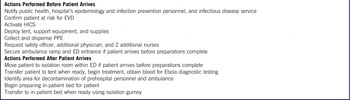
When the in-patient bed is ready, the patient is transferred from the tent. The path from the tent to the in-patient bed is secured by hospital staff. This includes identifying an appropriate elevator and ensuring no persons on intervening floors will have access until the patient has arrived on the unit and the elevator is decontaminated. ED staff in PPE escort the patient from the tent to the isolation unit, but this could also be accomplished by in-patient nurses. We employ a special isolation gurney that is draped on all sides with plastic to decrease the risk of contamination during transport. These recommendations are summarized in Table 3.
Emergency Department Management of Potentially Infected Ebola Patients Transported to the Hospital by Emergency Medical Services (EMS)a

aAbbreviations: ED, emergency department; EVD, Ebola virus disease; HICS, Hospital Incident Command System; PPE, personal protective equipment.
Patients Arriving at the Emergency Department Spontaneously (Walk-ins)
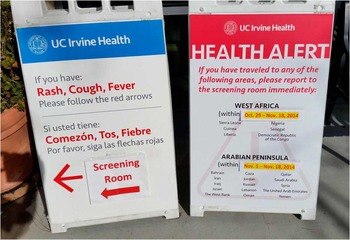
Patients who transport themselves to the ED create a separate set of challenges. These individuals have not been previously screened for Ebola risk factors. Therefore, our department asks each person, as they arrive, the typical set of questions advocated by the CDC: (1) Have you been to Liberia, Sierra Leone, or Guinea in the last 21 days? and (2) Are you suffering from fever, vomiting, and diarrhea? In addition, signs are placed at entrances to the main hospital, ED, and certain clinics on campus asking arriving individuals the same questions. If they have travelled to high-risk countries during the susceptible time frame, the signs direct them to a separate entrance. These signs have the date range posted on them to encompass the last 21 days and are updated daily (Figure 1). Hospital personnel will periodically masquerade as patients to evaluate whether these questions are being asked of individuals as they present for care.
Signage Advising Visitors on the Screening Questions and Time Frames for Potential Ebola Exposure.

If a person presenting to the ED screens positive for possible EVD, the patient is immediately given a mask and escorted to the AIIR within the department. This is the same room discussed in the previous section. Once isolated, further patient evaluation occurs, including obtaining a more detailed history in consultation with personnel from epidemiology and infection prevention and public health. If after this additional investigation the patient remains at risk for EVD, the same procedure is followed as in the previous section describing the management of patients arriving from the field, including activation of the HICS and deployment of the tent. When preparations are completed, the patient is then transferred to the tent.
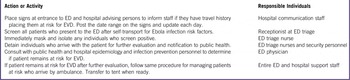
Individuals accompanying the patient to the hospital who are asymptomatic will require counseling and possible follow-up by public health. Although they are not currently infectious, they are at risk and will require daily monitoring and possible restriction of travel. Information on these persons must be collected and reported to public health to facilitate further evaluation. A compilation of these practices is listed in Table 4.
Emergency Department Management of Potentially Infected Ebola Patients Who Arrive Spontaneously (Walk-ins)Footnote a

a Abbreviations: ED, emergency department; EVD, Ebola virus disease.
Patients Transferred From Outside Hospitals With Confirmed EVD
Our institution has agreed to accept patients from non-Ebola-receiving centers who have confirmed EVD if we have capacity. A strict protocol exists that dictates how this process unfolds. Once an outside hospital has received a positive PCR test for Ebola on a patient, they contact the transfer center at our facility and request that we accept the patient. All communication must occur through transfer center personnel. This ensures a single point of contact for information originating from UC Irvine Medical Center and minimizes the chances for errors. The transfer center is staffed 24/7 and its personnel have received training on this issue.
Once a request is received to transfer a confirmed Ebola case, the HICS is activated and an isolation bed is created. Between 12 and 24 hours is typically required to complete this activity before transporting the patient. Many different groups are involved in coordinating the transfer, including public health, the in-patient team, hospital security, the hospital pharmacy and facilities management, and the ambulance service. The preparedness activities are tracked by the incident management team. The patient cannot be transferred until all groups are ready. Once all groups have completed their preparation activities, the incident commander under the HICS authorizes the transfer center to accept the patient. Only the transfer center can provide final authorization to the outside hospital to transport the patient. The ED’s only official role is to provide nursing transport personnel in PPE to move the patient from the ambulance to the in-patient bed (although Intensive Cardiac Care Unit [CCU] nurses could perform this function as well). However, ED management personnel are kept informed throughout the process so they can provide assistance in the event of unforeseen problems. Doffing of PPE by the ED nurse transport team will occur in the CCU.
After final authorization is received by the outside hospital, the patient is transported by ambulance to a previously determined hospital entry portal. This area is secured by hospital staff and the specialized transport gurney is used to move the patient. Again, elevator access is controlled. Once the staff have transported the patient into the hospital, the ambulance and crew are decontaminated in the same manner as discussed in the previous section.
Hospital Management of In-Patients with Potential or Established EVD
Our medical center has the capacity to manage only one patient with confirmed EVD. Should a second patient arrive and ultimately be confirmed to have infection with Ebola, transfer of the second patient to another Ebola receiving center would be necessary. This is not overly conservative, as the special biocontainment unit at Emory University Hospital can only treat 2 patients simultaneously.
In-patient management will occur in the CCU. Our CCU has capacity for 12 cardiac patients located in individual rooms. In the event a patient with EVD is admitted, the space used for 6 beds will be converted to an Ebola treatment suite. These specific rooms were previously designated for this purpose. Staff will transfer any patients occupying these beds to other locations within the hospital. One room will serve as the treatment location for the patient with EVD and will qualify as an AIIR. The other rooms are each used for decontamination, point-of-care testing, clean supplies, clean equipment, and staff changing and hydration.
Reconfiguration of the CCU space and the reduction in access to various locations within the Ebola suite to minimize infection risk created potential problems related to violations of fire and life safety codes. Several National Fire Protection Association and Joint Commission regulations could not be completely enforced in this environment. However, management personnel believe that patient and provider safety benefits outweigh the risks associated with violations of these codes if adequate mitigating strategies and interim life safety measures are created. As a result, the hospital implemented interim life safety measures to compensate for the potential increased risk. All areas within the Ebola suite are supported by a sprinkler system. The suite is protected by 1-hour fire-rated walls and opening protection. Supply carts and the soft barriers (used to prevent unauthorized access) are all on wheels and are lightweight, making it easy to move them in the event an emergency evacuation is necessary. When an Ebola patient is admitted to the CCU, notification of the fire marshal and fire department will occur with immediate implementation of a 24/7 fire watch. Another concern was whether the volume of combustible materials stored in rooms that are not separated by fire walls with storage level ratings will exceed the allowable 100 square foot limit. To minimize the risk, combustible items will be restricted to immediate use patient care items and linens (clean and soiled) and will be stored in c-lockers. Carts will be stocked to accommodate between 30 and 50 patient encounters. Soiled linens will be removed continuously as category A waste (no storage due to risk of exposure).
Certain equipment, such as dialysis machines and ventilators, will remain in the Ebola treatment suite as dedicated devices. Other equipment, such as portable x-ray and ultrasound machines, will be summoned as needed. Such devices will be draped in plastic before they enter the Ebola suite and will be disinfected after use. Laboratory examinations will occur in the suite by using point-of-care testing equipment by laboratory personnel. Technicians will install a portable fume hood to support lab activity. Very limited testing will occur outside the suite and will utilize special transport devices for specimens. Owing to the risk of rupturing specimen containers and subsequent contamination of equipment, the tube system will not be used. A closed-circuit video patient monitoring system will be established with a high-resolution camera mounted in the treatment room and a video monitor mounted on a wall outside the decontamination room. This way, the patient can be continuously observed without the need to enter the room. This will help to minimize patient encounters.
Reusable instruments or equipment that requires high-level sterilization or disinfection (eg, endoscopes) will not be used with a suspected or confirmed Ebola patient unless national guidance is available to direct how and where reprocessing should be handled. Case reports from early 2015 of failure to disinfect duodenoscopes after endoscopic retrograde cholangiopancreatography illustrate this concern, resulting in patient infection with carbapenem-resistant enterobacteriaceae. It is possible the Ebola virus might be spread in the same way. Patients with EVD will not be moved from the treatment suite to the operating room for procedures. Obstetrical, surgical, or procedural interventions will only be performed if they can be done in the patient’s room. These policies can be suspended on a case by case basis for patients with possible but not confirmed EVD.
The management of human waste and soiled linens generated prolonged discussions between committee members and county agencies. Hospital personnel reviewed CDC and other published recommendations and had discussions with representatives from Orange County Public Health. Input was also obtained from hospital risk management. The decision was made to dispose of urine, feces, and other liquid waste (bathing water) in the toilet after decontamination with a 1:10 concentration of chlorine bleach. Soiled linens, towels, gowns, and other solid waste items will not be reused. They will be removed and treated as category A waste. Current evidence supports this approach. 14 , 15
Limitations exist regarding the extent to which hospital personnel will implement aggressive critical care interventions. Some measures, including life-saving care that might otherwise be offered to these patients, may not be available due to the required prohibitions against exposure of staff and facilities to a patient with Ebola infection. Futile care will not occur. Therefore, moribund patients who experience a cardiac arrest will not receive cardiopulmonary resuscitation. Implementation of dialysis would be offered on a case by case basis.
Regardless of the circumstances surrounding the arrival of a patient with suspected EVD, the media will eventually discover this fact. Therefore, the hospital enterprise needs a uniform response to media inquiries. Our institution decided to channel all information requests to the hospital’s public information officer and to empower this individual to manage the institutional media response. Employees contacted by media outlets were asked to refer questions and interview requests to the public information officer. This accomplished the goals of ensuring that the patient’s rights under the Health Insurance Portability and Accountability Act were not violated and minimized any potential compromise to the hospital’s reputation in the community.
PPE Selection and Training of Hospital Personnel
Protecting hospital personnel from infection with Ebola is critical. Health care workers must feel safe if they are to deliver appropriate care to patients with EVD. The most important intervention to maintain worker safety is the use of PPE. Failure to appropriately utilize PPE is a major cause of Ebola infection in health care workers. Therefore, effective training in donning, use, and doffing of PPE is mandatory.
To achieve this goal, our institution adopted several strategies to train hospital personnel. First, providers watched a detailed video demonstrating how to don and doff PPE. This was accompanied by text and visual materials utilizing computer-based training. Everyone had to view the video and complete the computer-based training before proceeding to the second step. Next, individuals were required to demonstrate the successful donning and doffing of PPE to a safety officer previously trained in this procedure. Safety officers were also trained in breach procedures. In the event of a PPE breach during patient care, these officers could act quickly to contain the breach and minimize the risk of health care worker infection. No simulation was permitted. Individuals needed to demonstrate proficiency with the actual equipment the hospital would deploy if a patient with EVD was admitted. The safety officers were selected from the departments most likely to interface with Ebola patients and represented many of the specialties involved, including both nurses and physicians. The PPE chosen was designed to cover all exposed skin as recommended by the CDC.
Finally, all personnel were fit-tested with either N-95 respirators or powered air purifying respirators (PAPRs). Either option was offered to staff, depending on personal preference. However, if the risk of aerosolization existed during a patient encounter, such as when performing intubation or other procedures, use of a PAPR was required. Only after successfully completing all 3 training requirements was a staff member eligible to provide care to patients with EVD.
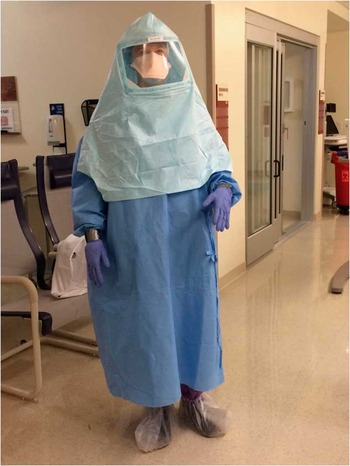
Two levels of PPE were created for staff. One is for use in situations where exposure to body fluids is unlikely (“dry patients”), such as in a clinic environment where concern exists for potential Ebola infection but the patient has minimal symptoms without vomiting or diarrhea. These ensembles are more basic without the requirement to cover all exposed skin. A second level of PPE is deployed in situations where exposure to body fluids is more likely (“wet patients”). Here, waterproof ensembles are used with complete covering of skin and include: (1) rubber clogs (Crocs, Niwot, CO), (2) knee-high booties, (3) waterproof gown that drapes below knees, (4) double set of gloves with large cuffs, (5) cap, (6) goggles, (7) face shield, (8) N-95 respirator or PAPR, and (9) hood (Figure 2).
Personal Protective Equipment Ensemble Used by Hospital Personnel Providing Care to High-Risk Ebola Patients.

All hospital personnel providing care to patients with EVD will enter their names on a log document. This will facilitate tracking of any potential exposures. In addition, staff participate in a self-monitoring program to evaluate for fever and other signs of infection for 21 days after last patient contact. However, the hospital has not required quarantine of health care providers during the monitoring period and these individuals can continue working. This is supported by current evidence and CDC guidance. 16 , Reference Koenig 17 Table 5 summarizes these practices.
Personal Protective Equipment (PPE) Training of Hospital PersonnelFootnote a

a Abbreviation: PAPR, powered air purifying respirator.
Health Policy Considerations Related to Hospital Preparedness
Preparing an academic medical center for management of Ebola patients is an intensive process requiring extensive resources. This article provides information about our experience. In addition to understanding the practical considerations and steps required for EVD readiness, several health policy issues should be considered.
First, whereas all facilities should be prepared to manage a patient with potential EVD presenting spontaneously, the decision to become a designated Ebola treatment facility should be made with the realization that substantial resources are needed. Designation as an Ebola treatment center will result in very significant costs related to training staff, procuring supplies and equipment, and developing policies and procedures. These activities and direct costs may divert resources from other health care activities.
Second, concerns from nursing unions about the adequacy of protection have led to nursing strikes—an activity that can have unintended negative consequences on routine patient care. Unfounded fears may prevent health care providers from reporting to work in a facility that houses an Ebola patient. In addition, poorly informed decision makers have inappropriately implemented 21-day quarantines of asymptomatic health care workers exposed to Ebola patients and this can lead to staff shortages.Reference Koenig 17 Further education and training will be necessary to effectively manage these challenges.
Finally, the most effective strategy to maintain competencies and preparedness for what is likely a rare event remains unclear. Given the significant costs in staff time associated with maintaining competency, the institution will implement just-in-time training if another outbreak occurs. No plans currently exist to impose a recurring training requirement. Our article was not designed to address how effective this strategy will be.
Acknowledgments
The authors would like to recognize and thank the following individuals who served on the UC Irvine Medical Center Ebola Preparedness Committee and made significant contributions to the final Ebola management protocols: Karen A. Grimley, PhD, RN (Chair); David Adrian; Darlene Bradley, PhD, RN; Pamela Brashear; Susan Christensen, RN, MHA; Boris Chung; Linda Dickey, RN, MPH; Shruti Gohil, MD, MPH; Donna Grochow, MSN, RNC; Susan Huang, MD, MPH; Alice Issai, MBA; Sonia Ramos Lane, RN, MSN; Michael E Lekawa, MD; Steven Leven, MD; Julie Limfueco, BSN; Tom Malone; Kerby Mellott, BS; Douglas Merrill, MD, MBA; John D. Murray; Carl H. Schultz, MD; Lauren Teetor, RN, BSN; Jamie Viramontes; and William C. Wilson, MD, MA.