Introduction
The perinatal period (during pregnancy and the first 12 months postpartum) has been recognized as a susceptible time for the development or exacerbation of depressive and anxiety disorders. Reference Gavin, Gaynes and Lohr1,Reference Nillni, Mehralizade, Mayer and Milanovic2 In the perinatal period, depressive disorders commonly develop or worsen at rates of approximately 13–19%. Reference O’Hara and McCabe3,Reference O’Hara and Swain4 While significant attention has been paid to perinatal depression, the development or exacerbation of anxiety disorders is also common, with prevalence of anxiety disorders estimated at 3–6% in pregnancy, Reference Viswasam, Eslick and Starcevic5 11–17% in the postpartum period, Reference Fairbrother, Janssen, Antony, Tucker and Young6,Reference Giardinelli, Innocenti and Benni7 and comorbidity with depressive symptoms at rates of 19–35%. Reference Farr, Dietz, O’Hara, Burley and Ko8,Reference Uguz, Yakut, Aydogan, Bayman and Gezginc9
The negative consequences of perinatal depression on child outcomes, such as long-lasting emotional and behavioral problems, have been well documented. Reference Leis, Heron, Stuart and Mendelson10–Reference Verbeek, Bockting and van Pampus13 It is also well documented that depressed mothers are more likely than non-depressed mothers to provide negative evaluations of their child, a phenomena seen as early as the first day postpartum up through preschool (ages 3–5). Reference Lee and Hans14,Reference West and Newman15 Moreover, a depressed mother’s perception of her child affects the way she responds to her child. Reference Field16 Although this phenomenon is well explored in samples of depressed mothers, it is unknown if elevated anxiety symptoms similarly alter maternal report and potential response, especially in the context of comorbid depressive symptoms. Research suggests that not only is maternal anxiety prevalent, but it can be associated with suboptimal parenting behaviors. Some examples of parenting behaviors associated with maternal anxiety include less involvement in developmental activities (e.g., reading stories) or inconsistent parenting behaviors, Reference Seymour, Giallo, Cooklin and Dunning17 engaging in more behavioral control, Reference Ginsburg, Grover and Ialongo18,Reference Lindhout, Markus and Hoogendijk19 and acting in more intrusive and less supportive ways. Reference van der Bruggen, Bögels and van Zeilst20,Reference Drake and Ginsburg21 However, there remains limited information on the association between specific maternal anxiety disorders and child outcomes. The small number of existing studies suggest that social anxiety and panic symptoms may be particularly detrimental in early childhood by affecting a mother’s sensitivity to her infant and through social behavior modeling. Reference Murray, De Rosnay and Pearson22,Reference Warren, Gunnar and Kagan23 Further, socially anxious parents have been found to exhibit more negativity and less warmth when interacting with their children. Reference Budinger, Drazdowski and Ginsburg24 Yet due to the limited literature, more research is needed to determine the extent to which maternal social anxiety, panic, and agoraphobia symptoms impact child behavior and temperament.
Approximately one in five pregnant and postpartum women meet criteria for an anxiety or anxiety-related disorder (e.g. social anxiety, panic disorder, obsessive compulsive disorder), Reference Fawcett, Fairbrother, Cox, White and Fawcett25 yet most studies have examined the relation between state-trait anxiety and child outcomes rather than evaluating how anxiety disorder subtypes, specifically panic, social anxiety, and agoraphobia symptoms, may affect maternal behavior and subsequent report of child behavior. Reference Alibekova, Huang, Lee, Au and Chen26,Reference Britton27 Given the prevalence of perinatal anxiety disorder symptoms, it is important to understand the degree to which perinatal anxiety is predictive of a woman’s perceptions and subsequent interactions with her child.
While literature on how perinatal anxiety may affect child behavior and temperament is limited, maternal depression and child behavior problems have been strongly linked across the developmental period. Reference Campbell, Pierce, Moore, Marakovitz and Newby28,Reference Thomas, Forehand and Neighbors29 One promising hypothesis for how maternal internalizing psychopathology may affect child outcomes is in the depression–distortion hypothesis. The depression–distortion hypothesis Reference Richters and Pellegrini30 posits that the negative emotionality associated with depression can stimulate a negative perceptual bias in the mothers’ ratings of child behaviors, an association which have been supported in the literature. Reference Field16,Reference Geller and Johnston31–Reference Gartstein, Bridgett, Dishion and Kaufman33 Building on this hypothesis, a seminal meta-analysis found a robust association between postpartum depression and corresponding mother–infant interactions. Reference Beck34 The authors concluded that a depressed mother is more likely to be unresponsive to her infant’s signals, including positive cues, leading to a disruption in mother–child interactions and biased view of their infant. Further, women who have been diagnosed with depression have been found to judge their children’s temperament more negatively than an impartial third-party observer, even after viewing the same interaction. Reference Hart, Field and Roitfarb35 This phenomenon may explain how elevated perinatal depressive symptoms can affect a mother’s perception and subsequent report of her child’s behavior and temperament. Given the potential for how psychopathology can color the perception of child behavior and how negative affect is common to both depressive and anxiety disorders, Reference Clark and Watson36,Reference Clark, Watson and Mineka37 it is important to determine if postpartum anxiety is similarly associated with negative maternal report of child behavior.
An important component to consider in how anxiety may be affecting the mother–child dyad is the fetal programming hypothesis, Reference Barker, Jaffee, Uher and Maughan38 which may be working in tandem with negative emotionality to affect child outcomes. This hypothesis proposes that maternal factors affect the development of the fetus in utero in a permanent way, which can subsequently affect the child’s health and development over the life course. Reference Guardino, Schetter and Saxbe39,Reference Van den Bergh, Mulder, Mennes and Glover40 Further, a programming effect in utero followed by sub-optimal behavior due to maternal anxiety may affect child outcomes. Maternal mental health, specifically maternal stress, trauma, and depression, has all been examined and found to predispose the developing fetus to higher risk of developmental physical and mental health adversities. Reference Barker, Eriksson, Forsén and Osmond41,Reference Pies and Kotelchuck42 Stress is the most widely examined prenatal risk factor, Reference Laplante, Brunet and King43 yet similar to how most studies of maternal anxiety and child outcomes focus on state-trait anxiety, there is a clear lack of literature examining specific anxiety disorder subtypes and later child development and temperament. State-trait anxiety does not account for some of the specific difficulties encompassed by anxiety disorder subtypes (e.g. avoidance of public areas associated with agoraphobia, avoidance of social interactions for social anxiety, and fear of own bodily sensations for panic disorder). 44 To better understand if timing of specific maternal anxiety symptoms, as well as co-occurring depressive symptoms, could affect child behavior and temperament, it is important to examine prenatal and postnatal maternal anxiety and depressive symptoms in relation to child behavior.
There is a significant lack of research on how specific anxiety disorder symptoms, especially when co-occurring with depressive symptoms, in the perinatal period may be affecting maternal perception and subsequent report of child behavior and temperament. Given the important clinical implications of the potential for perinatal anxiety to affect a woman’s subsequent behavior towards her child, the current study aimed to examine perinatal anxiety, specifically panic, social anxiety, and agoraphobia symptoms, and their relation to maternal report of several facets of child behavior and temperament in a community sample. Due to the relatively healthy community sample and length of postpartum period that mothers would have to interact with their children, it was hypothesized that increased postpartum anxiety and depressive symptoms (rather than prenatal anxiety and depressive symptoms) would have a distinct negative association with maternal report of poorer child behavior and temperament, specifically developmentally oriented behaviors (e.g. communication, motor skills, social skills) and temperament (e.g. negative affectivity, effortful control). It was hypothesized that the effect of postpartum anxiety on child behavior and temperament would be evident after controlling for maternal depressive symptoms, demonstrating a distinct clinical relevance of maternal anxiety.
Method
Participants
There was a total N = 104 participants who participated in the current study. The current study was part of a larger study which examined the effects of stress during pregnancy on women and their offspring, particularly stress caused by a devastating flood. Reference Brock, O’Hara and Hart45,Reference Nylen, O’Hara and Engeldinger46 Participants provided data at approximately 30–32 weeks gestation and again at 16 months postpartum. The total number of participants for the current study was based on the number of women who completed both pregnancy and postpartum assessments. There were 174 participants who completed the first pregnancy assessment and 104 participants who also completed the self-report and clinician-administered assessment measures at 16 months postpartum.
Recruitment
Recruitment for the study occurred from July 2007 to January 2009. Participants were recruited during the first 28 weeks of pregnancy via advertisements distributed throughout the state, in-person recruiting in the Department of Obstetrics and Gynecology at the University Hospital, letters distributed to patients of obstetrics and gynecology practices in the state, and the clinic associated with the County Department of Public Health in the United States of America. Eligible women were: (a) 18 years of age or older, (b) having a singleton pregnancy, and (c) able to read and speak English; non-native English speakers were not excluded from participating in the study.
Procedures
During the third trimester of pregnancy, participants completed an approximately 2-hour assessment that included a set of self-report questionnaires that assessed demographic information (a study-specific measure) as well as panic, social anxiety, and depressive symptoms (Inventory of Depression and Anxiety Symptoms (IDAS)). Reference Watson, O’Hara and Simms47 At 16 months postpartum, women were sent self-report questionnaires that assessed maternal symptoms of psychopathology (IDAS-II) Reference Watson, O’Hara and Naragon-Gainey48 and maternal perceptions of child behavior and temperament (Ages and Stages Questionnaire (ASQ); Early Childhood Behavior Questionnaire (ECBQ)). Reference Squires, Bricker and Potter49,Reference Putnam, Gartstein and Rothbart50 Participants also completed a 90-min structured clinical interview to assess anxiety and depressive symptoms at 16 months postpartum (Interview for Mood and Anxiety Symptoms (IMAS)). Reference Kotov, Perlman, Gámez and Watson51 Participants were compensated $20 for completing the pregnancy questionnaire and $25 for each postpartum component completed. All procedures were approved by the University’s Institutional Review Board.
Measures
Demographics
A study-specific measure assessing various facets of background information was utilized. This measure included questions about: race, relationship status, current employment, sex of the baby, level of education and total household income, number of children living in the home and weight of baby at birth.
Internalizing symptoms
A validated self-report measure and a structured clinical interview were utilized to assess symptoms of maternal depressive and anxiety disorders. The self-report measure, the IDAS-II, Reference Watson, O’Hara and Simms47,Reference Watson, O’Hara and Naragon-Gainey48 was used to assess depression and anxiety symptoms over the previous two weeks utilizing a five-point Likert scale (ranging from “not at all” to “extremely”). The IDAS (a 64-item measure) was used during pregnancy assessments, and the IDAS-II (an expanded 100-item measure) was used during the postpartum assessments. Symptom subscales that were utilized from the IDAS included depression, panic, and social anxiety; the same symptom subscales were utilized from the IDAS-II along with the newly added agoraphobia subscale. Footnote a,Footnote b The measure has demonstrated convergent and discriminant validity Reference Watson, O’Hara and Naragon-Gainey48 and normative data available based on a nationally representative sample. Reference Nelson, O’Hara and Watson52 In this sample, the IDAS subscales demonstrated acceptable internal consistency in pregnancy (mean Cronbach’s α = .77) and the IDAS-II subscales demonstrated good internal consistency in the postpartum (mean Cronbach’s α = .83).
The IMAS Reference Watson, O’Hara and Simms47,Reference Kotov, Perlman, Gámez and Watson51 is a semi-structured clinical interview used to dimensionally assess symptoms of mood and anxiety disorders. Symptoms are rated on a three-point scale: absent (0), subthreshold (1), or above-threshold (2) to allow for a dimensional measure of psychopathology. The IMAS symptom subscales utilized for this report included: depression, panic, agoraphobia, and social anxiety. Good discriminant validity and internal consistency have been found for the IMAS, with α ranging from .71 to .90 (mean = .79) in students and α ranging from .80 to .94 (mean = .87) in patients. Reference Watson, O’Hara and Simms47,Reference Watson, O’Hara and Naragon-Gainey48,Reference Kotov, Perlman, Gámez and Watson51 The IMAS subscales had good internal consistency in the postpartum (mean Cronbach’s α = .83). Higher scores on the IDAS, IDAS-II, and IMAS indicate higher symptom severity.
IMAS and IDAS-II subscale scores were standardized and combined to create each of the postpartum anxiety and depression indices because parallel postpartum IDAS-II and postpartum IMAS scales were moderately to strongly correlated (r = .40–.67). Combined and standardized scales included the postpartum measures of depression, panic, agoraphobia, and social anxiety.
Child behavior
The ASQ for 18-month-old children Reference Squires, Bricker and Potter49 is a valid and well-established developmental screening tool for children between 1 month and 5 ½ years. Reference Squires, Bricker and Twombly53 The ASQ consists of five domains: communication, fine motor skills, problem-solving abilities, personal/social skills, and gross motor skills. The questions that constitute the five domains can be answered “yes,” “sometimes,” or “not yet” for skills a child is or is not able to do. Measure scores are categorized as age-appropriate development, development in need of monitoring, and delayed development. The ASQ demonstrated good internal consistency across subscales (mean Cronbach’s α = .80). Higher scores indicate age-appropriate development of behaviors in each specific domain.
Child temperament
The ECBQ Reference Putnam, Gartstein and Rothbart50 is designed to assess participants’ perceptions of their child’s temperament. This instrument is composed of 201 items with each item ranked on a seven-point Likert scale ranging from “never” to “always.” The ECBQ contains 18 scales including: discomfort, fear, motor activation, sadness, perceptual sensitivity, shyness, soothability, frustration, impulsivity, activity level, high-intensity pleasure, sociability, positive anticipation, inhibitory control, attention shifting, low-intensity pleasure, cuddliness, and attention focusing. These scales comprise three factor-analytically derived domains of child temperament: negative affectivity, effortful control, and surgency/extraversion. Reference Putnam, Gartstein and Rothbart50 The ECBQ demonstrated good internal consistency across subscales (mean Cronbach’s α = .80). Higher scores indicate more behaviors typical of subscale content.
Statistical analyses
Statistical analyses were performed using SPSS version 23.0 (IBM Corp., Armonk, NY, USA) with listwise deletion utilized for missing data. Bivariate correlations and hierarchical multiple regression analyses were utilized. Outcome variables were maternal report of domains of child behavior (communication, fine motor skills, problem-solving abilities, personal/social skills, and gross motor skills) and child temperament (negative affectivity, effortful control, and surgency/extraversion). Univariate independent t-tests and chi-square tests were used to compare demographic characteristics and IDAS scale scores of participants completed the study during pregnancy to study completers. Correlations were conducted between perinatal internalizing indices, maternal report of child behavior, and maternal report of temperament domains. To better understand if timing of internalizing symptoms had a significant effect on maternal report, all prenatal depressive and anxiety symptoms were entered in Step, while all postpartum depressive and anxiety symptoms were entered in Step 2 for all hierarchical multiple regression models. Correlations were statistically significant at alpha level α = .05.
Results
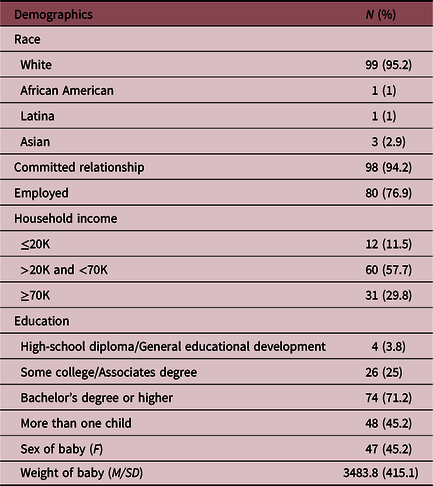
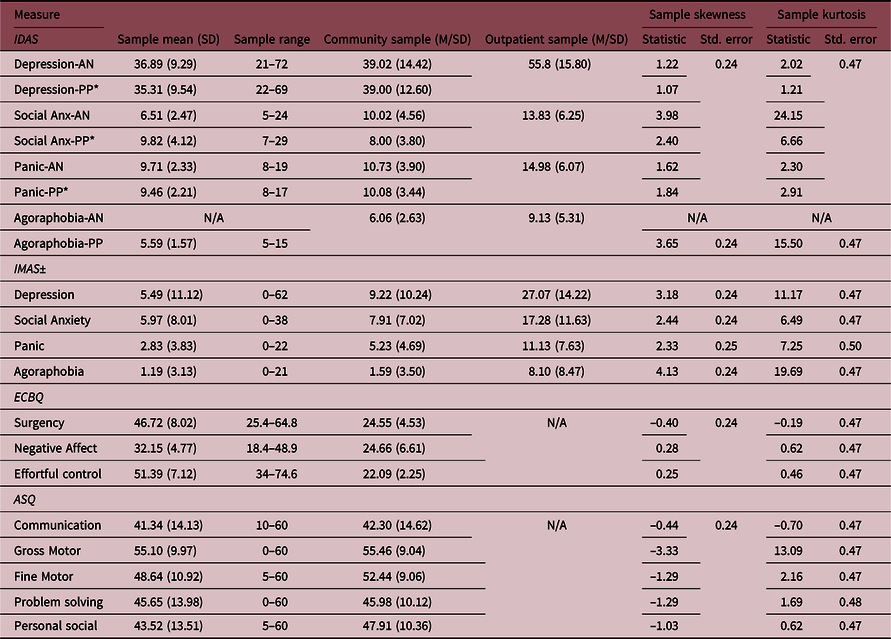
Participants were primarily White (95%), in a committed relationship (94%), and had obtained a bachelor’s degree or higher (71%; Table 1). Overall, participants endorsed low levels of depressive and anxiety symptoms that were comparable to or slightly lower than community norms (community and outpatient sample means included in Table 2). In this sample, child temperament variables did not significantly deviate from normality. Maternal psychopathology and child behavior variables were not normally distributed (K–S test p < .05), though this was expected given the non-normal distribution of clinical symptoms in a community sample. Across measured variables between study completers and non-completers, the only significant difference was that non-completers had a higher mean number of children than study completers (t = -2.79, p < .01).
Participant characteristics

Note. N = Number of participants; % = percentage of the total sample; M = mean; SD = standard deviation; weight of baby in grams; K = thousand; N = 103–104.
Sample descriptives, community norms, and outpatient norms for all study measures

Note. M = mean; SD = standard deviation; Std. Error = standard error; AN = prenatal; PP = postpartum; Anx= Anxiety; IMAS = Inventory of Mood and Anxiety Symptoms; ECBQ = Early Childhood Behavior Questionnaire; ASQ = Ages and Stages Questionnaire; * = Came from a postpartum-specific sample while prenatal scores came from a general community sample; ± = Skewness and kurtosis of the IMAS reflect the skewness and kurtosis of the postpartum scores, which are the combined postpartum IMAS and IDAS-II; the community sample was composed of students and adults. Skewness and kurtosis values between −2 and +2 are considered acceptable to demonstrate normal distribution. IDAS norms (Watson et al., 2012; Watson & O’Hara, 2017); IMAS norms (Kotov et al., 2015); ECBQ norms (Putnam et al., 2006); and ASQ norms (Lopes et al., 2015); N = 90-104.
Correlations
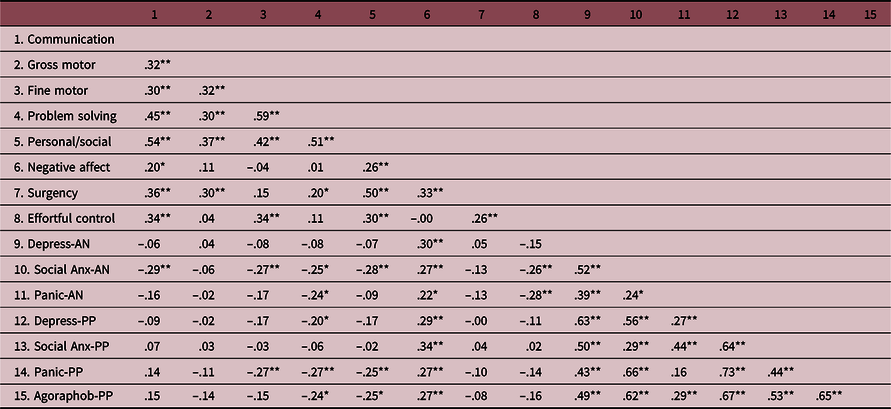
Correlations were conducted between child behavior, child temperament, and all prenatal and postpartum anxiety/depression indices (Table 3). Correlations were moderate to strong among child outcomes (r = .30 to .49, p < .01) and most psychopathology scales (r = .24–.65, p < .01). Prenatal social anxiety (r = −.29 to .25, p < .01), postpartum panic (r = −.27 to .25, p < .01), and postpartum agoraphobia symptoms (r = -.24, -.25, p < .05) were most frequently significantly associated with child behavior. For child temperament, all symptoms were significantly associated with negative affect (r = .22–.30, p < .05). There was also a notable lack of associations between anxiety and depressive symptoms and some child behavior and temperament outcomes (e.g. gross motor skills).
Intercorrelations among child behavior domains, child temperament domains, and prenatal and postpartum internalizing indices

Note. Affect = affectivity; Depress =depression; Soc Anx= social anxiety; Agoraphob =agoraphobia; AN= during pregnancy; PP = during postpartum. Negative affectivity, effortful control and surgency temperament subscales from ECBQ; communication, gross, and fine motor skills, problem solving, and personal/social developmental indices from ASQ; * p < .05, ** p < .01; N = 87−104.
Child behavior
Communication
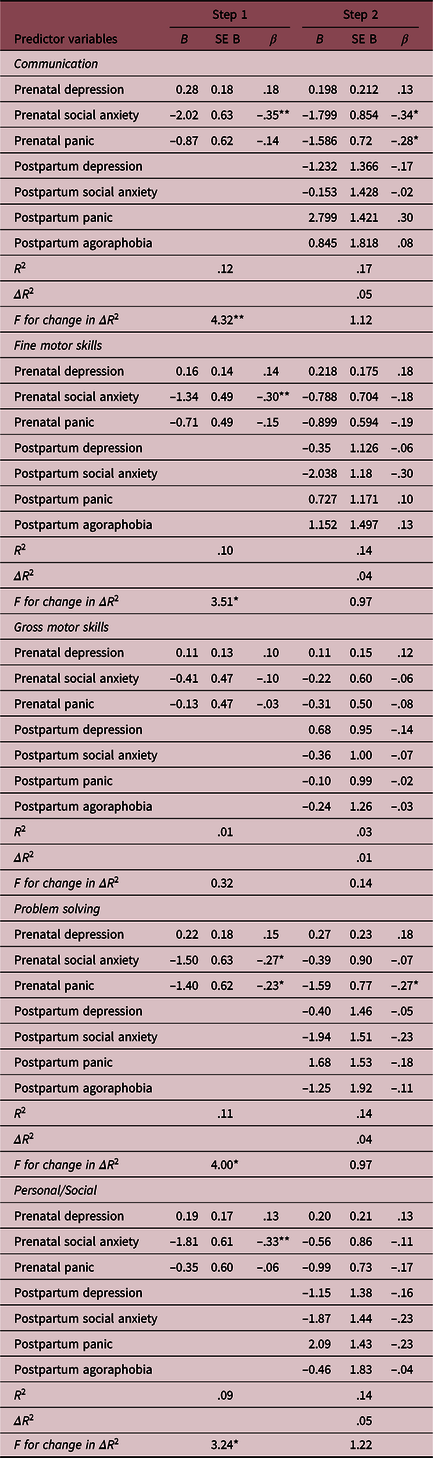
In the context of a hierarchical multiple regression model, there was a significant effect of prenatal social anxiety on child communication skills (β = -.36, p < .01); prenatal depressive and panic symptoms were not significant (β = .18, -.14, p > .05; Table 4). After controlling for the effects of prenatal depression and anxiety, the postpartum internalizing indices were not significantly related to communication levels (depression, β = -.17; social anxiety, β = -.02; panic, β = .30; agoraphobia, β = .08, p > .05). Prenatal social anxiety symptoms predicted poorer communication skills, explaining 11.5% of the variance in child communication.
Hierarchical multiple regression of internalizing variables predicting maternal perception of child behavior

Note. B = unstandardized beta; SE B = standard error of unstandardized beta; β = standardized beta; all prenatal depressive and anxiety symptoms were entered in Step 1, postpartum depressive and anxiety symptoms were entered in Step 2. N =83-104; * p < .05, ** p < .01, *** p < .001.
Fine and gross motor skills
Prenatal social anxiety symptoms were a significant predictor of child fine motor skills (β = −.30, p < .01); prenatal depressive and panic symptoms were not significant (β = .14, -.15, p > .05). After controlling for the effects of prenatal internalizing symptoms, the postpartum internalizing indices were not significantly related to fine motor abilities (depression, β = −.06; social anxiety, β = −.30; panic, β = .10; agoraphobia, β = .13, p > .05). Prenatal social anxiety significantly predicted poorer child fine motor skills, explaining 9.6% of the variance of the children’s ASQ fine motor scores. Neither prenatal internalizing symptoms (depression, β = .10; social anxiety, β = −.10; panic, β = .03, p > .05) nor postpartum internalizing symptoms (depression, β = −.14; social anxiety, β = −.07; panic, β = −.02; agoraphobia, β = −.03, p > .05) were significant predictors of child gross motor skills.
Problem-solving abilities
Prenatal social anxiety (β = −.27, p < .05) and panic symptoms (β = −.23, p < .05) were significant predictors of poorer problem-solving abilities; prenatal depressive symptoms were not significant (β = .15, p > .05). After controlling for the effects of prenatal internalizing symptoms, the postpartum internalizing indices were not significantly related to children’s problem-solving abilities (depression, β = −.05; social anxiety, β = −.23; panic, β = −.18; agoraphobia, β = −.11, p >.05). Prenatal social anxiety and panic symptoms significantly predicted poorer child problem-solving skills, explaining 11% of the variance in child problem-solving abilities.
Personal/social skills
There was a significant effect of prenatal social anxiety on child personal/social skills (β = −.33, p < .01); prenatal depressive and panic symptoms were not significant (β = .13, -.06, p > .05). After controlling for the effects of prenatal depression and anxiety, the postpartum internalizing indices were not significantly related to children’s communication levels (depression, β = −.17; social anxiety, β = −.02; panic, β = .30; agoraphobia, β =.08, p >.05). Prenatal social anxiety symptoms explained 9% of the variance in child personal/social skills.
Child temperament
Negative affectivity
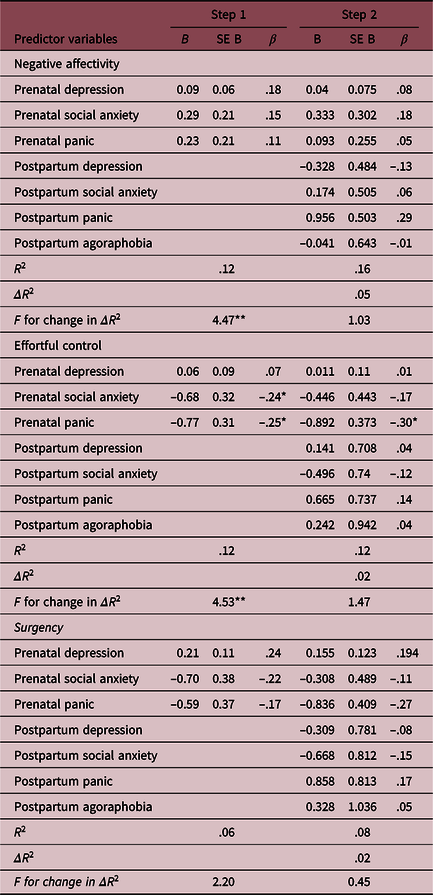
For child negative affectivity, no prenatal internalizing symptoms were significant predictors (depression, β = .18; social anxiety, β = .15; panic, β = .11, p > .05; Table 5). After controlling for prenatal internalizing symptoms, the postpartum internalizing indices were also not significantly related to the children’s negative affectivity (depression, β = −.13; social anxiety, β = .06; panic, β = .29; agoraphobia, β = −.01, p >.05).
Hierarchical multiple regression of internalizing variables predicting maternal perception of child temperament

Note. B = unstandardized beta; SE B = standard error of unstandardized beta; β = standardized beta; N = 84–104; *p < .05, ** p < .01, *** p < .001.
Effortful control
For effortful control, prenatal social anxiety (β = −.24, p < .05) and panic symptoms (β = −.25, p < .05) were significant predictors; prenatal depressive symptoms were not significant (β = .07, p > .05). After controlling for the effects of prenatal internalizing symptoms, the postpartum internalizing indices were not significantly related to the children’s effortful control abilities (depression, β = .04; social anxiety, β = −.12; panic, β = −.14; agoraphobia, β = .04, p >.05). Prenatal social anxiety and panic symptoms significantly predicted poorer child effortful control skills, explaining 12% of the variance in child effortful control.
Surgency/extraversion
For surgency/extraversion, neither prenatal internalizing symptoms (depression, β = .24; social anxiety, β = −.22; panic, β = −.17, p >.05) nor postpartum internalizing symptoms (depression, β = −.08; social anxiety, β = −.15; panic, β = .17; agoraphobia, β = .05, p >.05) were significant predictors of child surgency/extraversion.
Discussion
This study examined the association between perinatal depressive and anxiety symptoms and maternal report of several behavior and temperament domains in early childhood based on parental report at 16 months. Contrary to our hypothesis, prenatal rather than postpartum anxiety symptoms were predictive of later negative maternal report of child behavior and temperament. Social anxiety emerged as a risk factor for later negative maternal report of child communication, fine motor skills, problem-solving abilities, and personal/social skills, even when controlling for perinatal depression. Prenatal panic symptoms were predictive of child problem-solving abilities. For the temperament domains, prenatal social anxiety and panic symptoms were risk factors for later negative maternal reports of effortful control. Depressive and agoraphobia symptoms were not predictive of maternal report of child behavior or temperament.
Maternal anxiety and report of child behavior
Maternal prenatal social anxiety symptoms affect postpartum report of several facets of child behavior. Social anxiety symptoms during pregnancy were the most predictive of maternal report of child behavior, indicating possible long-standing difficulties rather than new onset of symptoms in the postpartum. One explanation for why social anxiety in particular may lead to more negative reports of child behavior may stem from how socially anxious mothers model behavior for their children. For example, one study Reference Murray, Cooper, Creswell, Schofield and Sack54 found that women with social anxiety were significantly less likely to encourage their infant to engage with a stranger, and in turn, the infants were less likely to positively interact with the stranger; this effect was not seen in mothers with generalized anxiety disorder or controls.
Prenatal social anxiety symptoms were also predictive of maternal report of child behavior in areas involving communication, problem solving, and personal/social areas, all which are domains that often involve others. Women experiencing social anxiety symptoms tend to be more fearful of their environments and particularly prone to avoid social situations. 44,Reference Clark, Wells, Heimberg, Liebowitz, Hope and Schneier55,Reference Teo, Lerrigo and Rogers56 Subsequently, this fearfulness and avoidance may result in fewer opportunities for mothers experiencing social anxiety symptoms to expose their children to a variety of social situations that promote the type of exploration that improves child communication, problem-solving abilities, and personal/social skills. Reference Marshall, Bouquet, Thomas and Shipley57,Reference Rogers, Nulty, Betancourt and DeThorne58 This is consistent with the literature as anxious mothers may be more likely to find the experience of their child being in a challenging situation anxiety-provoking, be more likely to display intrusiveness in these tasks, and more negative expectations of their children’s performance on social, performance, and physical challenges. Reference Creswell, Apetroaia, Murray and Cooper59 Thus, mothers with elevated social anxiety symptoms may be both modeling fear responses to social situations and creating a more impoverished social environment for their infant, resulting in perceived deficits in behavior.
While women who are experiencing anxiety in the perinatal period and early motherhood may be more prone to model problematic behaviors for their infants, the fetal programming hypothesis is also relevant to consider. It is possible prenatal social anxiety symptoms affected the development of the fetus, resulting in actual deficits rather than simply perceived deficits.
Maternal depressive and anxiety symptoms can affect fetal development, Reference Glover60 including in utero. Reference Kaitz, Mankuta, Rokem and Faraone61 For example, prenatal anxiety and depressive symptoms can significantly affect fetal reactivity. Higher levels of anxiety increase fetal eye-blink, while higher levels of depressive symptoms decrease fetal eye-blink. Reference Reissland, Froggatt, Reames and Girkin62 Further, emerging research biomarkers have been shown for prenatal psychopathology, as elevated prenatal depression and anxiety have been associated with increased infant NR3C1 methylation, predictive of greater cortisol responsiveness at three months. Reference Oberlander, Weinberg and Papsdorf63,Reference Hompes, Izzi and Gellens64
Of note, the present study relied only on mothers’ ratings of child behavior and represent the “filter” of parental perceptions. Third-party observations were not available in the present study, and thus, it could not be determined if mothers’ reports of their children’s developmental abilities were accurate. This negative perceptual bias likely operated in the context of the current investigation and objective indices of behavior, such as biomarkers, should be considered in the future to better elucidate the relation between maternal psychopathology and child behavior.
Maternal internalizing symptoms and report of child temperament
Prenatal social anxiety and panic symptoms were associated with maternal report of poorer child effortful control, which is often conceptualized as the ability to self-regulate when needed. Reference Oberlander, Weinberg and Papsdorf63,Reference Hompes, Izzi and Gellens64 There has been limited information on the role maternal psychopathology may play in child effortful control, with the literature similarly focused on outcomes of children with deficits in effortful control, such as elevated risk for externalizing and depressive symptoms during middle childhood. Reference Eisenberg, Valiente and Spinrad65,Reference Kotelnikova, Mackrell, Jordan and Hayden66 However, in a recent study of child temperamental risk for psychopathology, children displaying lower effortful control and higher negative affect had an increased probability of having a mother with a history of anxiety. Reference Kryski, Olino and Dyson67 Importantly, the authors conceptualized maternal anxiety as a proxy for a child’s own risk for future anxiety, given the genetic risk for anxiety among family members. Reference Hettema, Neale and Kendler68 Prenatal social anxiety and panic symptoms are worth noting in regard to maternal report of child effortful control although more research is needed.
Additionally, perinatal depressive symptoms were not uniquely predictive of maternal report of child outcomes, which is inconsistent with the literature. Reference Lee and Hans14,Reference West and Newman15 Prenatal depressive and anxiety symptoms together were statistically significant predictors for later report of child negative affectivity, although prenatal depressive symptoms specifically did not emerge as a statistically significant risk factor. This was unexpected given the prior significant association between depressive symptoms and maternal report. Reference Hart, Field and Roitfarb35 Further, prenatal depressive symptoms have consistently predicted negative child outcomes in later childhood, such as an increase in emotional problems, increased externalizing/conduct behaviors, and small decreases in IQ scores. Reference Leis, Heron, Stuart and Mendelson10,Reference Barker, Jaffee, Uher and Maughan69 The findings from this study are consistent with the research showing that prenatal anxiety predict later child outcomes. Reference O’Donnell, Glover, Barker and O’Connor70 Given the conflicting findings from the broad literature, more research is needed to disentangle how similar or dissimilar the mechanisms associated with prenatal anxiety and depressive symptoms are to better understand how they affect child outcomes.
Limitations and strengths
One significant limitation of this study is that the study sample was primarily white, educated, middle- to upper-class women, resulting in limited generalizability of the findings. Another significant limitation of this study is the lack of observations of child behavior and temperament by a third party. Future research should utilize a third-party observer of child behavior to better understand if maternal report is congruent with actual development deficits. An additional limitation of this study is that the postpartum anxiety associations were measured at 16 months postpartum. This period is outside of the more commonly measured postpartum period (one year post-delivery), and it is possible that maternal anxiety may manifest differently at an earlier point in the postpartum period. Reference O’Connor, Heron, Golding and Glover71 Third, there was significant attrition between the pregnancy assessment and the assessment at 16 months, resulting in a smaller sample size. Lastly, some variables were not included in this study that could have influenced the findings, such as mode of delivery, objective measures of child health, and length of stay in the neonatal intensive care unit if applicable. Importantly, this study did not assess stress during gestation. Stress during gestation, including perceived levels of current stress, exposure to different types of stressful events over the lifetime, and/or pregnancy-specific stress have been associated with poorer perinatal outcomes. Reference Horsch, Kang, Vial, Ehlert, Borghini and Marques72,Reference Dunkel Schetter73 A seminal review has shown increased prenatal stress may create a susceptibility to developing psychopathology, Reference Huizink, Mulder and Buitelaar74 which could influence the findings of this study. Future research should incorporate self-report measures of different types of stress, as well as incorporating physiological and/or behavioral measures of stress (e.g. heart rate variability, skin conductance, changes in facial expression/voice), to better understand how different aspects of stress during pregnancy may affect subsequent perinatal psychopathology.
The present study had several strengths in its design. First, this study incorporated measures of both maternal anxiety and child outcomes, two understudied areas of the perinatal psychopathology, and its consequences. Second, anxiety was examined during pregnancy and the postpartum, allowing for a prospective examination of elevated anxiety symptoms across the perinatal period. Further, specific types of anxiety symptoms were examined rather than general state or trait anxiety, which has been the more common approach. Reference Leach, Poyser and Fairweather-Schmidt75 Third, clinician-administered and self-report measures were combined to create a robust assessment of maternal anxiety. Combining self-report measures and interview data have yielded more valid assessments in a variety of domains. Reference Dillon, Turner, Robbins and Szapocznik76,Reference Zeier and Newman77 Lastly, the IDAS-II and the IMAS anxiety measures utilize a dimensional assessment of anxiety and depressive symptoms rather than diagnoses, which is important in non-clinical samples where women are less likely to meet full diagnostic criteria.
Conclusions
The present study provided important insight into the associations between maternal anxiety and depressive symptoms and report of child outcomes. Elevated prenatal social anxiety symptoms significantly predicted negative maternal report of child behavior across domains. Elevated prenatal social anxiety and panic symptoms predicted more negative maternal report of child effortful control. Prenatal anxiety symptoms, specifically social anxiety and to a lesser extent panic, exert a unique effect on maternal report of child behavior and temperament and are meaningful when considering the mother–child dynamic. Inconsistent with the literature, prenatal and postpartum depressive symptoms were associated with some child outcomes but not predictive of maternal report of child behavior or temperament. Future research should focus on exploring the mechanisms responsible for how social anxiety affects maternal report of child behavior, particularly focusing on if maternal prenatal anxiety states and the modeling of social withdrawal are important factors. Continuing to understand how maternal anxiety can affect women and their relationship with their children, especially in the presence of commonly occurring depressive symptoms, is instrumental to creating and implementing education and treatment efforts for women experiencing perinatal psychopathology symptoms.
Acknowledgments
None.
Financial support
This research was supported by grants from the National Institute of Mental Health (MH086150) to Michael W. O’Hara and the Canadian Institutes of Health Research (MOP-93660) to Suzanne King.
Conflicts of interest
None.
Ethical standards
The authors assert that all procedures contributing to this work comply with the ethical standards of the relevant national guidelines on human experimentation and with the Helsinki Declaration of 1975, as revised in 2008, and has been approved by the University of Iowa Institutional Review Board.