Introduction
On 25 September 2008, President George W. Bush delivered a speech urging members of Congress to support the passage of a $700 billion federal bailout. The administration's proposal sought to purchase bad debts from failing American financial firms, raise the national debt ceiling by $1 trillion, and grant substantial emergency powers to Treasury Secretary Henry M. Paulson. The president argued that the bailout was necessary to prevent “a long and painful recession (Montgomery and Kane Reference Montgomery and Kane2008)”. Shortly after the speech, presidential candidates John McCain and Barack Obama released a joint statement calling for a bipartisan response to the financial crisis. Democratic House Speaker Nancy Pelosi (D-CA) and Republican Minority Leader John Boehner (R-OH) released a statement highlighting the positive nature of the negotiations (Herszenhorn Reference Herszenhorn2008a).
Despite the enthusiasm of both parties’ leaders, the bailout proposal encountered significant difficulties in the US Congress. Members of both parties were forced to weigh a wide array of factors in deciding whether or not to support the president's proposal. Republicans wanted to support the president, but also sought to promote their partisan brand with a message of “fiscal conservativism”, and a vote for the bailout would have damaged this. Majority-party Democrats did not want to support the president, but agreed with many of the bill's main tenets. The result was that the bailout legislation (HR 1454) was met with aggressive criticism from members of both parties, and was initially rejected in the House, 228 to 205.Footnote 1 Stocks plummeted in response to the bill's defeat, dropping 7 per cent – a new one-day record (Weisman Reference Weisman2008).
In the wake of the bill's defeat and the Dow's sharp drop, criticism and pressure were heaped on defecting members of both parties. The Senate moved quickly, passing the bill just two days after its initial defeat in the House, by a vote of 74–25.Footnote 2 The House followed suit, passing the measure two days later 263 to 171. Opposition to the bill was fairly dispersed amongst the two parties, with 63 Democrats joining 108 Republicans in voting no.
One month after the passage of HR 1424, Barack Obama defeated John McCain to capture the presidency. The newly elected president and congressional Democrats, who now held majorities in both the House and the Senate, sought to respond to the still-slumping economy with a stimulus bill. Like his predecessor, Obama announced that he was committed to attracting broad, bipartisan support. Congressional Republicans praised this effort and promised to work with the president (Calmes and Hulse Reference Calmes and Hulse2009; Zelany and Herszenhorn Reference Zelany and Herszenhorn2009).Footnote 3
At the onset of the 111th House, Democratic leaders introduced HR 1 – The American Recovery and Reinvestment Act. Once again, despite pledges of bipartisanship, it became clear that the bill would be met with substantial resistance in Congress. This time, however, opposition was not dispersed among both parties. Instead, the criticism was largely concentrated within the Republican Party. House members expressed concern over the size of the stimulus package and argued for less spending and more tax cuts (Otterman Reference Otterman2009). Moreover, by staying unanimous in their opposition, House Republicans sought to rebuild their fiscal conservative partisan brand. Public opinion polls highlighted this partisan split. A Gallup poll released on 8 January showed support for stimulus package at 64 per cent among Democrats, 54 per cent among Independents and just 32 per cent among Republicans (Agiesta Reference Agiesta2009).Footnote 4 The $819 billion measure passed the House on 29 January 2009, 244 to 188. All 177 House Republicans opposed the measure.
Partisan opposition was united in the Senate as well. Republicans filibustered the measure, stressing the debt the bill would pass to future generations. McCain argued that Republicans “want to stimulate the economy, not mortgage the future of our children and grandchildren by the kind of fiscally profligate spending embodied in this legislation (Hulse and Herszenhorn Reference Hulse and Herszenhorn2009)”. To overcome the minority's filibuster, Senate Democrats agreed to cut nearly $110 billion from the measure in exchange for the support of Senators Susan Collins (R-ME), Olympia Snowe (R-ME) and Arlen Specter (R-PA) (Hulse and Herszenhorn Reference Hulse and Herszenhorn2009).Footnote 5 The measure was then formally passed in the Senate on 10 February and signed by the president several weeks later. The drastic shift in party attitudes towards the bailout and stimulus bills highlights how difficult it can be for party leaders to promote a favourable electoral brand name while still generating good public policy.
In this paper, we examine an existing literature looking at co-governance in parliamentary democracies. Multiple parties sharing power via coalitions is a key feature of many parliaments and such power sharing has been shown to affect both the behaviour and success of parliamentary parties (Klingemann et al. Reference Klingemann, Hofferbert and Budge1994; Royed Reference Royed1996). The separation-of-powers system in the United States also requires parties to share control of government. As such, the United States provides an interesting case to reassess how co-governance affects party behaviour outside of parliamentary democracies. As with parliamentary parties, the behaviour of US political parties should be affected by whether or not they are required to share control of the government. We argue that changes from unitary control to co-governance will alter how consistently parties vote in support of their previously stated positions. Specifically, when control of government is shared, parties need to balance their electoral interest in promoting a consistent set of policies with the need to be able to pass legislation that effectively confronts emerging problems, leading to less consistent voting. When control is held by one party, it is easier for both majority and minority parties to pursue policies that are consistent with that party's traditional brand name. During such periods of unified government, the costs and benefits of effective governance are largely born by the majority, minimising the need for parties to compromise on policy substance and leading to more consistent voting. Parties’ needs to pursue different strategies under shared and unified control of government should lead to clear differences in party voting patterns. Under unified government, differences in voting between the parties should be stark. When the amount of shared governance increases, party members balancing the need for good governance with electoral concerns should exhibit less consistent voting patterns.
We make an initial exploration of this theory using votes from the 110th and 111th Houses. We assess final passage votes on bills that significantly affect the federal deficit. We use deficit votes because it is frequently characterised as an issue that clearly separates the two major parties on a traditional liberal/conservative policy space (Poole and Rosenthal Reference Poole and Rosenthal1997, Reference Poole and Rosenthal2007). By employing item response theory methods (IRT), we examine whether votes on deficit issues do a good job of distinguishing liberal and conservative members of the Congress. We find that while votes on deficit-related items do not explain party differences well when government control is shared, differences between the two parties are clear when one party controls both chambers of Congress and the presidency. These differences in voting under shared and unified government demonstrate that parties’ policy-making strategies change as their role in government changes. The next section discusses political parties’ legislative strategies under both single party control and shared party control.
Political parties and shared power
The primary goal of many legislative scholars is to best describe the conditions and factors that lead to changes in public policy. Since most significant policy change is accomplished via the passage of legislation, students of legislative politics have long debated the factors that influence the formation and passage of legislation. As such, the role that political parties play in the legislative process has received a great deal of attention by scholars; arguably more than any other factor. Parties are generally seen as pursuing both policy and electoral goals, with both of these goals playing a key role in the policy formation process (Aldrich Reference Aldrich1995; Smith Reference Smith2007).Footnote 6 Parties in government must consider how passing legislation that moves policy closer to their collective ideological preferences will affect their future electoral prospects (Krehbiel Reference Krehbiel1998). Parties in government have an advantage in passing preferred legislation and can only maintain this advantage if their members win elections and the party remains in government.Footnote 7 Because of this, electoral considerations must play a key role in the formation of parties’ legislative behaviour (Downs Reference Downs1957; Mayhew Reference Mayhew1974).
However, standard theories of party have a much more difficult time explaining party behaviour when parties are required to share power (Schmidt Reference Schmidt1996). It has long been recognised that parties’ strategies about how to pursue policy and electoral goals change when parties share political power. In parliamentary democracies, parties frequently share power via parliamentary coalitions.Footnote 8 Policy strategies of parties clearly change when they are forced to share power with other parties (Klingemann et al. Reference Klingemann, Hofferbert and Budge1994). Issues important to parties are left off the agenda if coalition partners do not agree on the substance of those issues. Minor issues where all coalition partners can find common ground are much more likely to receive legislative attention. As argued by Klingemann et al. (Reference Klingemann, Hofferbert and Budge1994, 33), “[o]verall policies of coalitions are unlikely to mirror the exact emphases of members’ electoral programs in the same way as do policies of single-party governments”.
The differing legislative strategies employed by parties operating under single-party majority governments and coalition governments, lead to differing levels of legislative success.Footnote 9 Scholars frequently measure the legislative success of parties by examining if parties are able to enact policies that they pledged they would enact (Royed Reference Royed1996). Examining electoral pledges made by parties in both the United Kingdom and the Netherlands, Thomson (Reference Thomson2001) finds that, “pledges made by parties that enter coalition governments are less likely to be fulfilled than those made by parties that enter single party governments in parliamentary democracies”.Footnote 10
These differing levels of legislative success have clear implications for parties’ electoral prospects. It has long been thought that a “responsible electorate” will reward parties for doing well and punish parties for doing badly in regards to their electoral pledges (Key Reference Key1966). Power sharing makes electoral accountability more difficult for voters. While voters will place full electoral responsibility on the majority party in single-party governments (Klingemann et al. Reference Klingemann, Hofferbert and Budge1994), voters will be unsure which party is responsible in coalition governments. When voters are unclear about who is responsible for government action, they will not be able to effectively reward/punish parties for their successes/failures (Powell and Whitten Reference Powell and Whitten1993; Powell Reference Powell2000).Footnote 11 The realisation that power sharing changes how effective voters are at accurately assessing electoral responsibility, plays a role in parties’ decisions to change policy strategies under coalition governments, as discussed above.
Coalition governments in parliamentary democracies are, of course, just one possible form of legislative power sharing. Presidential systems often require legislative powers to be shared between the parties of the legislature and the executive (Shugart and Carey Reference Shugart and Carey1992). When power is shared between branches, legislative parties’ strategies in regards to policy and electoral goals again change in ways similar to those induced by coalition governments. The possibility of presidential vetoes alters what policies legislatures take up, and affect the ideological content of the legislation considered (Krehbiel Reference Krehbiel1998; Cameron Reference Cameron2000; Tsebelis Reference Tsebelis2002). Additionally, just as power sharing via coalition government makes parties less likely to be legislatively successful, power sharing among branches also inhibits parties’ ability to effectively fulfill electoral pledges. Royed (Reference Royed1996), comparing the United Kingdom and the United States, finds that conservative governments of the Thatcher era were better able to fulfill electoral pledges than were the shared Democrat and Republican governments of the Reagan era. Power sharing between branches of government also obfuscates electoral accountability. While government responsibility is the easiest to assess when a single party controls both the legislative and executive branches, power sharing among parties will make it, “harder for citizens to determine who should bear the responsibility for policy success and failure and to use their electoral resources effectively as instruments for reward and retribution” (Powell Reference Powell2000, 52).
Shared power in American politics
Shared power is a dominant feature of American politics. The US Constitution dictates that powers be shared between the political branches. Legislative power is formally shared between the legislative and executive branch via the presidential veto (Cameron Reference Cameron2000). Within the Congress, power is shared between the House and Senate. As the American Recovery and Investment Act example demonstrates, legislation must also garner the support of numerous veto players – like the Senate filibuster pivot and committee leaders – in order to become law. Once enacted, legislation is subject to judicial review and bureaucratic enforcement.
In addition to the comparatively large number of veto players, electoral institutions also contribute to shared governance in the American system. Unlike many parliamentary democracies, American congressional nominations are chosen by local primary electorates. These electorates generally have weaker ties to the larger national party (Mayhew Reference Mayhew1974). These candidates also often raise their own campaign finances and mobilise their own reelection campaigns. Finally, whereas loyal rank and file members in parliamentary governments can be rewarded with key cabinet positions, no comparable institutional reward exists in the American context (Downs Reference Downs1957; Mayhew Reference Mayhew1974). In sum, even when a party enjoys unified control of the American political institutions, the American system of government rarely looks like the type of single-majority party government frequently found in parliamentary democracies like Britain (Royed Reference Royed1996).Footnote 12 Indeed, Krehbiel (Reference Krehbiel1998) argues that lawmaking in the United States can be effectively explained without considering party at all, but rather by accounting for the relative ideologies of the president and key members of the House and Senate.
Alternative theories of lawmaking posit that despite weak electoral institutions, majority parties enjoy agenda-setting advantages in the legislative process. These parties must approach legislating with both policy and electoral goals in mind. Cox and McCubbins (Reference Cox and McCubbins2005) articulate a theory of congressional parties that takes into account the weak party discipline that is possible among congressional parties. Their theory argues that parties consider elections when generating legislative agendas. Parties pursue policy goals in a way that enhances the party's “brand name”. Similar to systems with strong party discipline, parties use their control of legislative institutions to pass legislation that improves the public's perception of the party. Because weak party discipline creates the possibility that members will defect from their party on legislative votes, parties must actively prevent the consideration of legislation that could divide their party, thus damaging the parties’ brand name. This active attempt to control what policies appear on the legislative agenda protects individual party members’ reputations, cultivating the prospects of the party as a whole in future elections (Cox and McCubbins Reference Cox and McCubbins1993, Reference Cox and McCubbins2005).
Traditional theories of congressional parties do not consider a party's goals and strategies to be conditional on their role in unified or shared government. We, however, posit that what makes up a party's name brand changes substantially depending on whether or not a party must co-govern. A party's name brand is made up of the set of issues and beliefs that a party supports, combined with the success or failure of the policies instituted while the party is part of government. When a party enjoys unitary control, its members are able to confront emerging problems by passing legislation. Because the party will not need to compromise to pass legislation, policy will generally be consistent with the party's traditionally held beliefs. This increases their ability to simultaneously stay unified on floor votes while protecting their party's brand name. Minority parties under unified government will not be held responsible for the success or failure of majority-generated policies, so these parties will focus solely on their support of traditionally held positions when considering their name brand. Knowing that the majority is likely to be held accountable for any legislation that is eventually viewed as being unpopular, the minority has strong incentives be united in their opposition and will seek to highlight party differences in an effort to “rebrand” the majority. These two views of name brand maintenance will lead to high levels of party cohesiveness under unified governance.
When shared governance increases, parties view of their name brand will change. When parties share power, the electorate will view both parties as being responsible for government actions. As such, parties will feel compelled to support legislation that is vital to effective governance, even if the passage of such legislation requires compromise that both parties find to be ideologically distasteful.Footnote 13 Under shared governance, parties will have to sacrifice the consistent pursuit of their traditionally held beliefs, and instead emphasis effective governance in the constructive of their party name brand. While parties will be collectively better off sacrificing some ideological principles for effective governance, this will not be true for all party members. Some members will have electoral reasons to favour ideological purity over good governance. Weak party discipline means that such members will be able to defect from their party's position on such compromises with little threat of punishment, allowing them to distance themselves from electorally unpopular actions taken by their own party. The individual electoral incentive to defect will trump collective party goals, leading to high levels of defection and lower levels of party cohesion during periods of power sharing.
Party reputation and the deficit spending
Party strategies about legislation and voting are intrinsically linked to elections (Mayhew Reference Mayhew1974). Given this, it is tempting to conclude that parties should always favour raising the deficit. Raising the federal deficit generally presents congressional leadership with a source of policy benefits that are non-zero sum. By passing the costs of policies to future generations, members of Congress can avoid having to off-set them by either raising taxes or subtracting policy benefits from the districts of certain members (Weingast Reference Weingast1979). If Congress was forced to directly counterbalance federal expenditures, leaders would be more inclined to craft narrow legislation in order to maximise their policy benefits (Riker Reference Riker1962). By running higher deficits, congressional leaders may be able to pass budget legislation in greater haste with less controversy. Consistent with this, Mayhew (Reference Mayhew1991, 190) argued that “nothing we know about electoral behavior suggests that American voters, whatever the circumstances of party control, will reward a government for balancing budgets”.Footnote 14
Nevertheless, both the scholarly literature on congressional politics and the conventional public wisdom regarding partisan politics suggests that the two major parties have staked out countervailing and well-formed positions on federal spending issues, including the deficit. As the case study suggests, Republicans have sought to position themselves as aggressively opposed to federal spending and high deficits. In contrast, Democrats have cultivated a brand-name of a party willing to trade-off higher levels of government expenditures in exchange for policies that support lower and middle class voters.Footnote 15
There are several reasons why we might think the promotion of a party's brand name on deficit issues will vary significantly with levels of power sharing. First, as discussed above, shared control of the government masks accountability on budgetary issues. Mayhew (Reference Mayhew1991) refers to this concept specifically as it relates to deficit spending, dubbing it “budgetary coherence”. When one party controls Congress and the presidency, it is easier for voters to attribute success or blame for the deficit situation and act accordingly.Footnote 16 During periods of shared control, it is difficult to correctly determine who is to blame and both parties need to be concerned about being perceived as unable to govern. Therefore, parties have less of an incentive to aggressively whip their members into supporting the brand name position. The parties are likely aided in this capacity by long and confusing bills that include a great deal of ambiguities. Binder (Reference Binder2003) provides some evidence for the claim that shared governance leads to less accountability and a slower process on budget issues. She finds that from the 94th to the 106th Congresses, during the three eras of unified government, Congress was on average 11 days late in missing the budget deadline. Conversely, Congress was on average two months late during periods of shared government.Footnote 17
Periods of low shared governance or unified government control provide increased incentives for the majority party to minimise floor divisions and promote its brand name. It also incentivises minorities to remain unified in an attempt to sharpen its brand at the expense of the majority. For example, by remaining unified against the Obama stimulus plan, Republicans forced Democrats to take sole ownership of the $700 billion stimulus bill. In the 2010 elections, Republicans sought to emphasise this vote in electoral races featuring vulnerable Democrats.Footnote 18 Thus, during periods of unified government, the minority will not only seek to promote its brand name, but also actively attempt to “rebrand” their opponents. Given this, we expect that the clarity of a party's brand name will vary systematically with their status in the government.
In general, Republicans hoping to maintain their fiscally conservative brand name should be motivated to fight against spending measures. In contrast, Democrats should feel less pressure to maintain strict spending controls at the expense of other budgetary priorities. Because of these positions, one would expect spending measures that affect the deficit to exhibit cohesive party voting. However, this may not be true when parties’ status in government is taken into account.
When Democrats controlled both houses of Congress and the presidency, as they did in the 111th Congress, all the costs and benefits from effective government were attributed to their party. Thus, they had little incentive to compromise with the minority. During such periods, there should be stark voting differences between the two parties on spending measures, with both parties voting in cohesive blocks. Conversely, when Republicans controlled the presidency, the parties shared the burden of governing. The increasing need for compromise will increase individual members’ incentives to consider their electoral needs for ideological consistency over their party's need for good governance, leading to increased defections and less cohesive voting.Footnote 19
The expected differences in voting as the level of power sharing changes has clear implications for spending issues. We hypothesise that when Democrats control unified government, and the Republicans are in the minority, votes on spending issues will clearly split the two parties. But when Republicans and Democrats share power, votes on deficit spending issues will do a poor job of delineating liberal and conservative members of the Congress as parties become less cohesive in their voting. In the remainder of this paper, we seek to empirically test this hypothesis.
Methods
In this section, we seek to systematically analyse the role of party in House voting on deficit-related issues. To do this we develop an analysis strategy employing IRT commonly used in the educational testing literature to analyse the ideological information contained in such bills.
IRT models were originally used in the educational testing literature to build and analyse tests of intelligence (Birnbaum Reference Birnbaum1968; Lord Reference Lord1980). Standardised tests use a series of questions to create a multiple indicator proxy for intelligence. Test-takers that answer a high number of questions correctly are assumed to be more intelligent than test-takers that answer a low number of questions correctly. These test-building techniques allow researchers to accurately measure the latent variable of intelligence.
The basic idea of IRT is that as the level of the latent trait (intelligence) increases, so does the probability that an individual will correctly answer test items. In addition to estimating latent trait levels, IRT models also estimate parameters that help evaluate the quality of test questions. IRT models estimate an item difficulty parameter (β), which describes how difficult a test question is. A test item with a lower β value is likely to be answered correctly, even by individuals of low ability. A test item with a high β value is unlikely to be answered correctly, even by high ability individuals. IRT models also estimate an item discrimination parameter (α) that describes how well a question separates individuals of different ability levels. An item with a low α value is likely to be answered correctly by some low ability individuals and answered incorrectly by some high ability individuals. An item with a high α value is likely to be answered incorrectly by most low ability individuals and answered correctly by most high ability individuals. The only data required to estimate such a model are individual responses – right or wrong answers – to these test items.Footnote 20
IRT models are now commonly used in the political science literature. By replacing intelligence with ideology and test questions with votes, IRT models can be used to estimate the ideal points of political elites.Footnote 21 They are typically used to estimate ideal points from legislative roll call data or from judicial case voting data (Jackman Reference Jackman2001; Martin and Quinn Reference Martin and Quinn2002; Clinton et al. Reference Clinton, Jackman and Rivers2004). IRT has also been used to assess commonly used latent variable proxies.Footnote 22
While IRT is almost exclusively used in the political science literature as a means to estimate the ideal points of legislative actors, we focus on the discrimination parameters to assess how well votes affecting deficit spending divide the two parties.Footnote 23 By viewing each deficit-impacting vote made by the House we are able to assess whether “fiscal conservative” votes are actually a good way to differentiate between liberals and conservatives. When they are, it speaks to the parties’ voting cohesively on fiscal issue.
To do this, we estimate and analyse item parameters for all votes taken during a particular Congress of the US House. We then examine the α values that correspond with votes identified as creating significant changes to future deficit levels. By looking at α parameters for each of the votes chosen, we are able to assess whether the vote used was a good one to use. If the absolute value of α is low this indicates that the vote is not good at separating liberal and conservative types and that parties are not voting together. If the absolute value of α value is high, this indicates that the vote can accurately separate between liberal and conservative types. The sign of the α values will also allow us to determine whether a yes vote or a no vote is considered to be the conservative response. If α is negative then a no vote is the conservative answer and if α is positive then a yes vote is the conservative answer.
To formally test our hypothesis that spending bills are will clearly measure the liberal/conservative dimension only under unified government, we use Bayesian methods to conduct a simple difference of means test. We expect that the mean absolute value of α for spending bills will be significantly higher than those of other measures when Democrats control the House, Senate and presidency. To test our hypothesis that spending bills will be poor measures of the liberal/conservative dimension under shared power, we repeat this difference of means test with the expectation that the mean absolute value of α will be significantly lower than other votes during such shared control. The estimation procedure used is outlined in Appendix A.
Data
To initially assess how unified versus shared government affects the cohesiveness of party voting, we examine roll call voting data from the 110th and 111th Houses. In the 110th Congress, a Democratic House and Senate shared power with Republican President George W. Bush. In the 111th Congress, Democrats enjoyed control of the House, Senate and presidency. These two congresses allow us to assess the effects of party status on the consistency of votes on spending issues.Footnote 24 These data include 1,865 votes for the 110th House and 1,263 votes for the 111th House (Lewis and Poole Reference Lewis and Poole2010; Poole Reference Poole2010).Footnote 25
We then identify votes that had a significant effect on the deficit. To do this we made use of the legislative cost estimates produced by the Congressional Budget Office (CBO). According to the CBO, a cost estimate is developed for “virtually every bill reported by Congressional committees to show how it would affect spending or revenues”. These cost estimates report changes to direct spending and revenues anticipated if the bill under consideration became law. The CBO also estimates changes to outlays based upon the authorisation levels of a bill. Since the CBO does not provide cost estimates for appropriation bills, we use the expected increase in outlays under these authorisations as a proxy for the net effect of the bills on future appropriation levels.
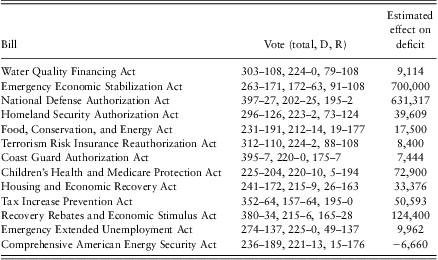
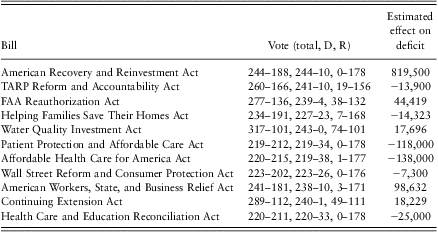
We coded all CBO cost estimates for 110th and 111th Congresses that were listed as having at least a $500,000 effect on the deficit. We recorded the estimated ten-year impact on the deficit for the 155 such cost estimates from the 110th Congress and the 96 cost estimates from the 111th Congress. We reduced this list to cost estimates that had an estimated positive or negative effect on the deficit of at least $5 billion.Footnote 26 We eliminated all duplicate cost estimates for the same bills, retaining the one that most closely corresponds to the versions upon which a roll call vote was taken. We were forced to eliminate a large number of bills for which no recorded votes were held. We were left with a list of 13 bills that had a significant effect on the deficit for the 110th House and 11 bills for the 111th House. These bills are listed in Tables 1 and 3.
Deficit-impacting bills, 110th House
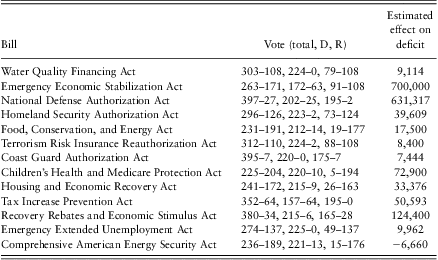
Note: Included are deficit-impacting bills that received a recorded vote in the 110th House. To be considered deficit impacting, the CBO had to estimate that a bill would have a ten-year positive or negative effect on the deficit of at least $5 billion. Vote gives the total yeas and nays for each vote and vote breakdown for Democrats and Republicans. Estimated effect on deficit is in millions of dollars.
Results
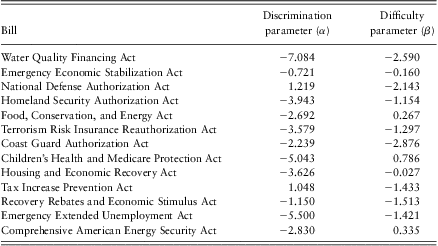
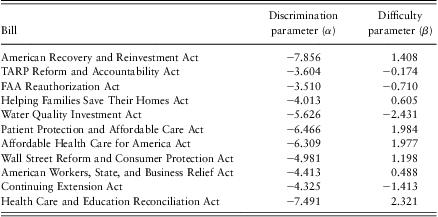
The IRT model described above was estimated using roll call voting data from both the 110th and 111th Houses, respectively.Footnote 27Tables 2 and 4 report information on the item parameters for the 110th House and 111th House.
Deficit-impacting bills’ item parameters, 110th House

Note: The absolute value of α indicates the ability of the vote to distinguish between liberals and conservatives. Negative and positive values merely indicate whether a yea vote (+) or a no vote (−) is considered to be a conservative vote.
Deficit-impacting bills, 111th House
Note: Included are deficit-impacting bills that received a recorded vote in the 110th House through 15 May 2010. To be considered deficit impacting, the CBO had to estimate that a bill would have a ten-year positive or negative effect on the deficit of at least $5 billion. Vote gives the total yeas and nays for each vote and vote breakdown for Democrats and Republicans. Estimated effect on deficit is in millions of dollars. The estimated effect of HR 4872 is the reduction relative to cost of HR 3590 (Patient Protection and Affordable Care Act) without changes enacted by the passage of HR 4872.
Deficit-impacting bills’ item parameters, 111th House
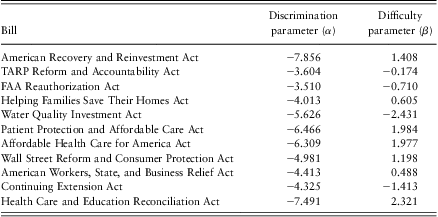
Note: The absolute value of α indicates the ability of the vote to distinguish between liberals and conservatives. Negative and positive values merely indicate whether a yea vote (+) or a no vote (−) is considered to be a conservative vote.
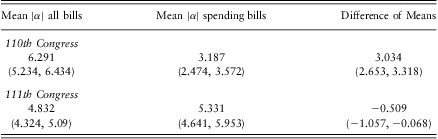
We argue that parties will show more unified voting on traditional brand name issues when one party controls unified government. The need to effectively govern will temper these voting patterns when a party controls or shares power. These hypotheses imply that spending bills should explain liberal-conservative differences poorly when the Democratically controlled 110th Congress shared power with President George W. Bush. While some deficit-impacting bills in the 110th House did a good job of delineating members’ ideologies on the primary liberal/conservative dimension, most did not. The absolute value of only one vote – HR 720, the Water Quality Refinancing Act – exceeded the average α value of 6.291 for all 110th House roll call votes. We report Bayesian difference of means for the mean discrimination parameter values in Table 5. The average α value of deficit-impacting votes, 3.187, was significantly lower than the average for all bills. The difference between the posterior distributions for the mean of all bills and the mean of spending bills averaged 3.034. The 95 per cent Bayesian credible interval ranged from 2.653 to 3.318 and did not contain 0.Footnote 28
Examining difference of means
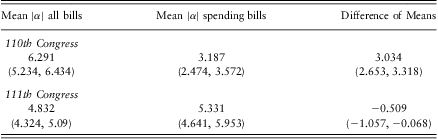
Note: The above table reports the mean of the absolute value for the posterior distribution of estimated α parameters. 95 per cent Bayesian credible intervals are reported in parentheses. Difference of means are calculated by estimating a posterior distribution of difference. The absolute value of α for spending bills was calculated by subtracting from the absolute value of α for all bills to generate this posterior density.
Figure 1 show kernel density plots for the absolute value of α values for all bills and for deficit-impacting votes. The distribution of α values for all bills shows that these votes are in general much more informative about the liberal/conservative dimension than are α values for the deficit-impacting bills. The intuition from the densities is further confirmed by the much lower means and medians of the deficit-impacting group of bills. These figures provide clear evidence that bills that significantly affected the deficit were much less informative about liberal/conservative differences than are other votes conducted in the 110th House.
Density of discrimination parameters, 110th House. Note: The figure displays density plot of the absolute value of item discrimination parameters (α) for all bills and deficit-impacting bills with aggregate means and medians included. The mean α value for all bills is 4.621 (the median value is 3.340). The α values for deficit-impacting bills are significantly lower (mean value of 2.275 and median value of 1.993), indicating that votes on deficit-impacting bills in the 110th House are not good at delineating between liberal and conservative legislators.
These analyses provide strong evidence that deficit-impacting votes are not exhibiting clear differences in voting between liberal and conservative members. In general, fiscal issues do not do a good job explaining traditional liberal-conservative differences during the 110th House. The item with the lowest α value was the Emergency Economic Stabilization Act of 2008, the federal bailout bill discussed in the introduction. This vote split both parties, with 63 of 235 majority-party Democrats recording a no vote, and 91 of 199 opposition-party Republicans voting for the bill. Some spending bills not only failed to explain liberal/conservative differences; they ran counter to it. For three bills the α values indicate that a vote to increase the deficit or a vote to prevent a reduction of the deficit was a conservative vote, contrary to the fiscal-conservative mantle held by the Republican party. An example of this is the positive α value for HR 1585, the National Defense Authorization Act. This positive value means that a yes vote is consistent with the conservative position, even though the measure was estimated to add $631 billion to the federal deficit over the next ten years. This particular bill provides a nice example of Republicans in a power-sharing position supporting increased spending, in this case to support national defense, despite the bill's negative effect on the deficit and its potential damaging impact to the Republicans’ fiscal-conservative name brand.
The results from the 111th House model paint a much different picture. When Democrats controlled the Congress and the presidency during the 111th Congress, the α values reported in Table 4 indicate that spending issues did a much better job of capturing differences between liberal and conservative members. In fact, spending votes in the 111th Congress did a better job of explaining ideological differences than did other bills. The average value for deficit-impacting votes of 5.331 is larger than the 4.832 average for all other bills. The difference between the posterior distributions for the mean of all bills and the mean of spending bills averaged −0.509. The 95 per cent Bayesian credible interval ranged from −1.057 to −0.068 and did not contain 0. This analysis, combined with the density plots presented in Figure 2, show that spending bills do an excellent job of delineating liberal and conservative ideologies.
Density of discrimination parameters, 111th House. Note: The figure displays density plot of the absolute value of item discrimination parameters (α) for all bills and deficit-impacting bills with aggregate means and medians included. The mean α value for all bills is 2.871 (the median value is 2.412). The α values for deficit-impacting bills are slightly larger (mean value of 3.208 and median value of 3.122).
While this indicates that deficit issues are good items to delineate liberal and conservative members during the 111th House, the meaning of “liberal” and “conservative” is still a little muddled. While the party splits are clear, these splits have little to do with the impact of the votes on the deficits. Of the 11 votes considered, a conservative vote – as indicated by the sign of the α value – is only consistent with a vote to reduce spending or increase revenues in five of the 11 votes. The Republican Party's opposition to these measures seems to have much more to do with their opposition to Obama and Democratic objectives than with concern over deficit-spending. There is no evidence that either Republicans or Democrats are consistently voting to limit deficit spending.
Conclusion
In this manuscript, we have argued that consistency while voting on key issues will be significantly related to shared control of the government. Specifically, votes on deficit items will not accurately capture liberal/conservative differences when the government is under shared control – despite the prominence of economic issues in American politics and the non-zero sum nature of deficit politics. Conversely, we have argued that votes on deficit items will accurately expose ideological differences during periods where one party controls both branches of Congress and the presidency. The results from our analysis are supportive of these claims. Unified party control should lead to greater accountability on the part of voters. As such, the majority has no incentive to compromise with their minority party colleagues. This increases their ability to stay unified on floor votes and protect its brand name. The minority – knowing that the majority is likely to be held accountable for unpopular legislation – will pursue a strategy of forcing the majority to cast difficult votes. The difficult votes will be publicised come election-time in an effort to “rebrand” the majority.
The fact that party differences should be the most visible during unified government has clear implications for the content of the policies being made by legislatures. Party-based motivations give both majority and minority members of the US House less incentive to compromise when a single party controls the levers of government, leading to less moderate policy. When both parties share control of government, members must be more reliant on compromise and moderation to successfully confront emerging political problems. However, as scholars have pointed out, the necessity for moderation required by shared power can lead to gridlock and ineffective legislative reactions to various crises (Binder Reference Binder2003).
These results contribute to the existing literature on shared governance in democratic legislatures. Existing literature demonstrates that shared governance will lead parties to change their agendas, leading to parties being less successful in fulfilling their electoral pledges relative to single-majority party governments. The weak party discipline of the US Congress provides an opportunity to see how varying levels of shared governance affects the cohesiveness of parties. This analysis implies that parties are not only less successful in legislating under shared government; they are also less capable of collectively acting as a unified party. The temptation for individual members to defect from their party is simply stronger during periods of shared governance.
This research also highlights the need for additional exploration of co-governance in its various forms. Most literature on co-governance currently focuses on power sharing within parliaments. This initial exploration of co-governance within in a separation-of-powers framework highlights the other types of co-governance that are possible. Work like Shugart and Carey's (Reference Shugart and Carey1992) examination of various institutional forms of shared powers between presidents and assemblies implies a future research agenda that considers how co-governance changes parties’ strategies and behaviour under various types of power-sharing arrangements.
Despite the strong differences seen in party voting between the 110th and 111th Houses, a few caveats should raised about the generalisability of our results. First, the analysis relies on data from only four years of policymaking from a single country. While there are clear differences between the shared governance of the 110th Congress and the unified Democratic control of the 111th, it is still unclear if the conclusions drawn from these two Houses are indicative of trends present in policy-making across a longer time period and across other governments. Additional data collection and analysis will be able to further assess the validity of partisan control's impact on issue consistency.
Second, the analysis presented focuses solely on issues that have a significant impact on the federal deficit. Additional work should be done to see if the trends present in deficit votes generalise to other issue areas as well. Fiscal issues are often frequently characterised as unidimensional and variation in the parties’ consistency on them likely suggests similar variation on unrelated issues. Moreover, these results are consistent with recent scholarship tracking the increasing propensity of coalition builders to package several different issues into an omnibus bill (Baumgartner et al. Reference Baumgartner, Jones and MacLeod2000; Krutz Reference Krutz2001). These omnibus bills can make supporting the underlying measure more palatable to members who may be inclined to oppose it on unidimensional grounds. Finally, this implies that majority leaders in each chamber likely face a more difficult balancing act in selecting policies to prioritise during periods of divided government.
Appendix A Estimation procedure for IRT model
An IRT model is estimated for all votes in a certain period of interest. The IRT model is estimated using a one-dimensional scale of ideology. We use a two-parameter item response model to estimate the latent variable of ideology (θ). In addition to estimating ideology, a two-parameter item response model estimates α and β coefficients, where α is the item discrimination parameter and β is the item difficulty parameter.
The data in the estimation model consists of n legislators voting on m different roll call votes. For each roll call j = 1, …, m, legislator i (where i = 1, …, n and n is the total number of legislators) chooses between voting “yea” or “nay”. Let yi,j = 1 if the ith legislator votes “yea” on the jth roll call, and let yi,j = 0 if the ith legislator votes “nay” on the jth roll call. If the legislator does not vote, then yi,j is missing. Because votes are not identified as being “liberal” or “conservative”, the IRT model estimates whether the items are “liberal” or “conservative”. If the α value for an item is negative, then a liberal legislator would be expected to vote “yea” on the item. If the α value for an item is positive, then a conservative legislator would be expected to vote “yea” on the item.  $$)(--><$> {\bf {{Y}}} <$><!--$$
is the n × m matrix of observed roll call votes, containing yi,j for all i and j. Legislators are assumed to have quadratic utility functions over the
 $$)(--><$> {{\Re }^{\rm{1}}} <$><!--$$
policy space, such that
 $$)(--><$> {{U}_i}{\rm{(}}{{\psi }_j}{\rm{)}}\, = \,{\rm{ - }}\parallel {{\theta }_i}\,{\rm{ - }}\,{{\psi }_j}{{\parallel }^{\rm{2}}} \, + \,{{\eta }_{i,j}} <$><!--$$
and
 $$)(--><$> {{U}_i}{\rm{(}}{{\zeta }_j}{\rm{)}}\, = \,{\rm{ - }}\parallel {{\theta }_i}\,{\rm{ - }}\,{{\zeta }_j}{{\parallel }^{\rm{2}}} \, + \,{{\nu }_{i,j}} <$><!--$$
, where
 $$)(--><$> {{\theta }_i}\, \in {{\Re }^1} <$><!--$$
is the ideal point of the ith legislator, ηi,j and νi,j are the errors of utility, and
 $$)(--><$>\parallel \parallel <$><!--$$
is the Euclidean norm. Let
 $$)(--><$> y_{{i,j}}^{\ast} \, = \,{{U}_i}{\rm{(}}{{\zeta }_j}{\rm{)}}\,{\rm{ - }}\,{{U}_i}{\rm{(}}{{\psi }_j}{\rm{)}} <$><!--$$
. Through utility maximisation:
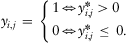 $${{y}_{i,j}}\, = \,\left\{ {\matrix{ {{\rm{1}} \Leftrightarrow y_{{i,j}}^{\ast} \, \gt \,{\rm{0}}} \hfill\cr {{\rm{0}} \Leftrightarrow y_{{i,j}}^{\ast} \,\leq \,{\rm{0}}.} \hfill\right$$
This gives the following equation for  $$)(--><$> y_{{i,j}}^{\ast} <$><!--$$
, which can be rearranged and substituted to form the second equation (see Clinton et al. Reference Clinton, Jackman and Rivers2004),
 $$y_{{i,j}}^{\ast} \, = \,{\rm{ - }}\parallel {{\theta }_i}\,{\rm{ - }}\,{{\zeta }_j}{{\parallel }^{\rm{2}}} \, + \,\parallel {{\theta }_i}\;\:{\rm{ - }}\:\;{{\psi }_j}{{\parallel }^{\rm{2}}} \, + \,{{\nu }_{i,j}}\,{\rm{ - }}\,{{\eta }_{i,j}}$$
 $$y_{{i,j}}^{\ast} \, = \,\alpha _{j}^{'} {{x}_i}\,{\rm{ - }}\,{{\beta }_j}\, + \,{{{\epsilon}}_{i,j}}$$
where  $$)(--><$> {{\alpha }_j}\, = \,{\rm{2(}}{{\zeta }_j}\,{\rm{ - }}\,{{\psi }_j}{\rm{)}},{{\beta }_j}\, = \,\psi _{j}^{'} {{\psi }_j}\,{\rm{ - }}\,\zeta _{j}^{'} {{\zeta }_j} <$><!--$$
, and
 $$)(--><$> {{{\epsilon}}_{i,j}}\, = \,{{\eta }_{i,j}}\,{\rm{ - }}\,{{\nu }_{i,j}} <$><!--$$
. Given binary roll call data, these equations produce a probit model.
The likelihood is,
 $$L{\rm{(}}\alpha, \beta, \theta {\rm{|}}{\rm Y}{\rm{)}}\, = \,\prod\limits_{i\, = \,{\rm{1}}}^n \prod\limits_{j\, = \,{\rm{1}}}^n \phi {{(\theta _{j}^{'} {{\alpha }_j}\,{\rm{ - }}\,{{\beta }_j})}^{{{y}_{i,j}}}} {{{\rm{(1}}\,{\rm{ - }}\,\phi {\rm{(}}\theta _{j}^{'} {{\alpha }_j}\,{\rm{ - }}\,{{\beta }_j}{\rm{))}}}^{{\rm{1}}\,{\rm{ - }}\,{{y}_{i,j}}}} $$
where α is an m × 1 vector of discrimination parameters (αj is the discrimination parameter for the jth roll call), B is an m × 1 vector of discrimination parameters (βj is the discrimination parameter for the jth roll call), and θ is an n × 1 vector of ideal points (θi is the ideal point parameter for the ith legislator).