The syntactic bootstrapping hypothesis proposes that children use the syntactic frame surrounding a verb as a cue to that verb's meaning (Landau & Gleitman, Reference Landau and Gleitman1985; Gleitman, Reference Gleitman1990; Naigles, Gleitman & Gleitman, Reference Naigles, Gleitman, Gleitman and Dromi1993; Fisher, Hall, Rakowitz & Gleitman, Reference Fisher, Hall, Rakowitz, Gleitman, Gleitman and Landau1994). Syntactic bootstrapping operates via the differing numbers and arrangements of noun phrases (NPs) and other syntactic elements that co-occur with different verbs; i.e. some verbs are transitive while others are intransitive; some take prepositional phrases (PPs) while others co-occur with sentence complements. These syntactic elements are informative regarding the lexical semantics of the verb. Questions have arisen, though, concerning how broadly and deeply syntactic bootstrapping applies across the different language typologies of the world (e.g. Bowerman & Brown, Reference Bowerman and Brown2007). For example, is the bootstrapping of verb form to verb meaning purely a syntactic phenomenon, or do similar processes apply with the morphological aspects of sentences? Moreover, how might syntactic bootstrapping operate in the plethora of languages with free word order, and/or those that permit massive noun ellipsis (e.g. Rispoli, Reference Rispoli, Tomasello and Merriman1995; Goldberg, Reference Goldberg2004; Narasimhan, Budwig & Murty, Reference Narasimhan, Budwig and Murty2005; Allen, Reference Allen, Bowerman and Brown2007; Brown, Reference Brown, Bowerman and Brown2007; Wilkins, Reference Wilkins, Bowerman and Brown2007)? In this paper, we address both of these questions via an empirical study of verb acquisition in children learning Turkish, a language that captures thematic roles via nominal case morphology and allows for frequent null arguments. In particular, we will argue that the process of bootstrapping form to meaning does operate in Turkish verb learners, who make use of both morphological and syntactic frame information when making conjectures about verb meaning.
The syntactic bootstrapping hypothesis is motivated by both logical and empirical arguments that mere observation of events by verb learners leads to multiple interpretations of the meanings of new verbs (Gleitman, Reference Gleitman1990; Gillette, Gleitman, Gleitman & Lederer, Reference Gillette, Gleitman, Gleitman and Lederer1999). The additional information given by the syntactic context associated with the verb then assists the learner in homing in on the right meaning. For example, while gorp in single-participant sentences such as the boy is gorping implies the absence of causation, in dual-participant sentences such as the boy is gorping the book the same verb is likely to involve causation (Jackendoff, Reference Jackendoff1990; Levin, Reference Levin1993; Talmy, Reference Talmy2000). This is a distinction captured, for example, in the difference between the two verbs go and carry in English. In other words, different verbs have different argument structures and syntactic bootstrapping proposes that the learner relies on a differential analysis of verb argument structures to figure out the meanings of different verbs.
There is substantial evidence that young children learning English are able to utilize syntactic cues provided by the sentential context to infer verb meaning (e.g. Gleitman, Reference Gleitman1990; Naigles, Reference Naigles1990; Fisher et al., Reference Fisher, Hall, Rakowitz, Gleitman, Gleitman and Landau1994). For example, two-year-olds presented with two novel actions and a single novel verb select the causative action as the referent of the verb when it is presented in a transitive frame, and the non-causative action when the verb is presented in an intransitive frame. The effect also emerges when young English-speaking children are asked to enact (i.e. act out sentences with toys) familiar verbs placed in sentences with too many overt arguments, such as (a) *the zebra goes the lion, or too few overt arguments, such as (b) *the zebra brings. That is, they prefer to follow the number of NPs in the sentence rather than the lexical semantics of the verb, enacting (a) causatively (the zebra makes the lion go) and (b) non-causatively (the zebra moves by itself) (Naigles, Fowler & Helm, Reference Naigles, Fowler and Helm1992; Naigles et al., Reference Naigles, Gleitman, Gleitman and Dromi1993). Thus, when the meaning of the verb (i.e. causative or non-causative) is presented as at odds with the information provided in the frame (i.e. the number of explicit arguments), young English learners follow the information encoded by the frame. In contrast, grade schoolers and adults act out these sentences according to the lexical semantics of the verbs, enacting (a) as the zebra goes to/with the lion and (b) as the zebra brings something. Thus, with development, children change from relying primarily on general features of syntax when interpreting verbs, to relying primarily on verb-specific lexical semantics (Naigles et al., Reference Naigles, Fowler and Helm1992). A subsequent study with French five-year-olds (Naigles & Lehrer, Reference Naigles and Lehrer2002) found the degree of frame compliance in English and French to be comparable.
This brief survey of the evidence supports Naigles & Swensen's (Reference Naigles, Swensen, Hoff and Shatz2007) contention that child verb learners pay attention to broad differences in sentence configuration such as the number and arrangement of noun phrases. However, the relative value of a cue such as number of arguments for detecting the meaning of the verb might be specific to certain languages, such as English and French, where syntactic relations are canonically expressed through the ordering of overtly expressed noun phrases. Research of a cross-linguistic nature is needed to determine the manifestations of syntactic bootstrapping in the many languages of the world which (a) do not rely on word order to assign grammatical relations in a clause and/or (b) allow extensive argument ellipsis (Rispoli, Reference Rispoli, Tomasello and Merriman1995; Narasimhan et al., Reference Narasimhan, Budwig and Murty2005; Bowerman & Brown, Reference Bowerman and Brown2007). We next address how each of these characteristics might impact the process of bootstrapping meaning from form.
The role of morphology
Many languages from a variety of language families mark thematic relations such as agent, patient, recipient, source and goal as case inflections on the relevant nominals of the sentence. In such languages, word order is not required to indicate thematic relations, and so varies more or less freely. Such free word order manifests a potential problem for syntactic bootstrapping because the order of nouns, by themselves, does not reveal who is doing what to whom. Thus, the distinction between chase and flee, or give and receive, can only be gleaned from the case markings on the nouns, not their order in the sentence, as demonstrated in the following contrastive pair of sentences from Turkish:
(1) Ali kitab-ı Mine-ye ver-di.Ali book-ACC Mine-DAT give-PAST.3SG‘Ali gave the book to Mine.’
(2) Ali kitab-ı Mine-den al-dı.Ali book-ACC Mine-ABL take-PAST.3SG‘Ali took the book from Mine.’
In case-marking languages, the patterns of distribution of nominal case-marking might be reliable indicators of grammatical relations in the clause (Croft, Reference Croft1990). In Turkish, the use of case-marking is governed by obligatory rules, and caregivers do not systematically leave out nominal case-marking in child-directed speech. Thus, the accusative case, for example, systematically signals the status of undergoer that is affected by some actor, which is in nominative case if mentioned. The nominal case-markers themselves, then, could be used as information concerning the meanings of the verbs. Continuing the example, verbs accompanied by nouns in accusative case would be considered more causative than verbs accompanied only by nominatively case-marked nouns.
In highly inflected languages, semantic information about the verb can also be carried on its verbal morphology. For example, it is fairly common for verbs to vary in valency based on the presence or absence of a ‘causative’ morpheme that is attached to the verb, as in Turkish:
(3) Kız oyuncağ-ı koş-tur-du.Girl toy-ACC run-CAUS-PAST.3SG‘The girl made the toy run.’
The causative morpheme can also be used to make a transitive verb causative (Kornfilt, Reference Kornfilt1997), such as in (4):
(4) Kız-a elma-yı vur-dur-du.Girl-DAT apple-ACC hit-CAUS-PAST.3SG‘He/She made the girl hit/shoot the apple.’
In short, while the causative morpheme is the only systematic way of increasing the valency of a non-causative verb, it can be used for double or triple causativization with inherently causative verbs in Turkish (Kornfilt, Reference Kornfilt1997). Thus, one might expect the causative morpheme to be another source of information for young verb learners in determining the meanings of sentences that include unfamiliar verbs.
The evidence to date concerning whether children use nominal or verbal morphology in verb acquisition is both scant and mixed. Two studies have addressed possible roles for verbal morphology – one in English (ironically) and one in Kannada, a Dravidian language spoken in southwestern India. Behrend, Harris & Cartwright (Reference Behrend, Harris and Cartwright1995) exploited the tendency across languages for verbs describing processes or actions to be used primarily with progressive aspect (-ing in English) whereas verbs describing results are used more frequently with completive aspect (-ed in English; see Shirai & Anderson (Reference Shirai and Anderson1995) for a review). They demonstrated that preschoolers who were taught novel verbs with the -ing suffix extended them best to events of similar manners, whereas those taught verbs with the -ed suffix extended them best to events of similar results.
The other relevant study is by Lidz, Gleitman & Gleitman (Reference Lidz, Gleitman and Gleitman2003), who studied three-year-old and adult speakers of Kannada. In Kannada, the causative morpheme can be added to any verb and is a reliable indicator of semantic causativity for adult speakers of the language. Lidz et al. pitted causal morphology and number of arguments against each other in a replication of Naigles et al. (Reference Naigles, Gleitman, Gleitman and Dromi1993), asking Kannada-speaking three-year-olds and adults to enact ungrammatical 1-NP frames lacking another NP and ungrammatical 2-NP frames lacking the required verbal causative morphology, as in the following examples:
- (5)
a. aane tall-is-utt-adeelephant push-CAUS-NPST-3SG‘The elephant pushes.’
b. ghenda mruga dumbi-yannu bar-utt-aderhinoceros beetle-ACC come-NPST-3SN‘The rhinoceros comes the beetle.’
Lidz et al. found that the Kannada-speaking children performed similarly to their English-speaking counterparts, to the point of slavishly adhering to the cue of number of NPs and ignoring the language-specific causative morpheme. In other words, they enacted (5a) non-causatively, moving the elephant by itself, and enacted (5b) causatively, making the rhinoceros push the beetle. Adults, as expected, were more sensitive to the presence or absence of the causative morpheme.
Lidz & Gleitman (Reference Lidz and Gleitman2004) explicated their findings by suggesting that the cue of number of arguments is so universally robust that another potential cue, such as the language-specific causative morpheme, is ignored in the initial stages of verb learning by young speakers of Kannada. This preference is exercised even though the number of arguments is a probabilistic cue to causativity of events, as opposed to the deterministic cue of the verbal causative morpheme. However, Lidz et al. overlooked another potential cue to verb meaning that existed in their test sentences; namely the accusative case-marker. Because animate direct objects strongly prefer to be case-marked with the accusative (Lidz, Reference Lidz2006), and Lidz et al. used animals in their experiment, all the 2-NP sentences in their study presented the second NP in the accusative case (e.g. (5b), above). Single-NP sentences, on the other hand, were never presented with accusative case-marking. This introduces a potential confound to their findings: the participants' causative vs. non-causative interpretations might have been influenced by the presence of the accusative case-marking in 2-NP sentences and its absence in 1-NP sentences. In other words, the accusative case-marking in 2-NP sentences might have strengthened the causative interpretations, and its absence in 1-NP sentences might have been used as a signal for a non-causative meaning.
What is the potential for nominal case-markers to provide independent clues to verb meaning? Only two studies have addressed this question, but both have found effects only in children past preschool: Imai, Haryu, Okada, Kajikawa & Saalbach (Reference Imai, Haryu, Okada, Kajikawa and Saalbach2007) investigated whether Japanese-speaking two- to five-year-olds made use of the contrastive morphological case-marking of subjects in discriminating causative from non-causative verbs in an event-selection task with novel verbs. In Japanese, single-NP clauses with nominative case-marking indicate non-causative verbs, whereas those with accusative case-marking indicate causative verbs. Only the Japanese five-year-olds consistently made use of differential case-marking cues in selecting videos of causative vs. non-causative verbs; two- and three-year-olds did not. This developmental pattern may be understandable given that case-marking is not obligatory in Japanese, with child-directed speech reported (albeit with minimal corpora analysis) as being especially sparse in respect to nominal case-marking (Clancy, Reference Clancy and Slobin1985; Rispoli, Reference Rispoli, Tomasello and Merriman1995, but see also Matsuo, Sinya, Kita & Naigles, Reference Matsuo, Sinya, Kita and Naigles2007). In other words, case-marking morphology might not be such a reliable cue to verb meaning in Japanese. Lidz & Musolino (Reference Lidz and Musolino2006) investigated whether four-year-old Kannada learners used the accusative marker to highlight a specific reading on indefinite NPs, and also found a null result; however, they did not investigate whether these learners used the accusative marker to detect the more general semantic notion of patient or undergoer, which might be a clue to the verb's involving causation.
In sum, the potential role of morphology, especially nominal case-marking, as part of the procedure for bootstrapping verb meanings from verb forms, has yet to be investigated in depth. What is needed is an investigation with a language that includes nominal case-marking and whose child learners acquire this case-marking early and effortlessly. Turkish is such a language, as it designates grammatical relations through nominal morphology in a regular and transparent case-marking system. There is a complicated relationship between the use of accusative case-marking and definiteness and/or specificity status of the argument (Erguvanlı-Taylan, Reference Erguvanlı-Taylan1984; Dede, Reference Dede, Slobin and Zimmer1986; Enç, Reference Enç1991), but direct objects that have indefinite or non-specific status do not carry accusative morphology (-(y)I) (Erguvanlı-Taylan, Reference Erguvanlı-Taylan1984; Ketrez, Reference Ketrez2004). However, the presence of the accusative case morphology on a noun phrase is a strong signal for the status of undergoer in relation to the action indicated in the verb, and therefore for the verb to include semantics that are appropriate for the presence of both an actor and an undergoer. Even very young children have been shown to be sensitive to this grammatical role of the accusative marker in Turkish; it is one of the earliest emerging morphemes and is used productively often before age two (Ekmekçi, Reference Ekmekçi1979; Aksu-Koç & Slobin, Reference Aksu-Koç, Slobin and Slobin1985; Aksu-Koç & Ketrez, Reference Aksu-Koç and Ketrez2003). In comprehension experiments conducted by Slobin & Bever (Reference Slobin and Bever1982), two-year-old children were shown to use the accusative case as an indicator of the grammatical relation of direct object, even when the sentence was presented in non-canonical word orders (see also Batman-Ratyosyan & Stromswold, Reference Batman-Ratyosyan, Stromswold, Skarabela, Fish and Do2002). Despite its early emergence as a marker of grammatical relations, Ketrez (Reference Ketrez2005) found that the adult-like comprehension of the accusative as a marker of specificity is not mastered until six years of age in Turkish learners.
In addition, Turkish encodes causativity in verbs through a morphological causative morpheme suffixed to the verb stem. Some verbs are inherently causative (e.g. it ‘push’), but many are derived from intransitive verbs in a productive fashion through the causative morpheme (e.g. yat ‘lie down’ can be causativized to yat-ır lie.down-CAUS ‘lay down’; see also (3) above). The acquisition of the causative morpheme in Turkish has not been studied extensively; however, case studies of individual children suggest that it is productively used as a grammatical item around two years of age (Aksu-Koç & Slobin, Reference Aksu-Koç, Slobin and Slobin1985; Ketrez, Reference Ketrez1999; Aksu-Koç & Ketrez, Reference Aksu-Koç and Ketrez2003). Turkish, then, affords an ideal case to investigate the relative influences of accusative case-marking and causative morphology on children's bootstrapping from form to meaning.
The role of number of NPs
Several theories have provided explanations for why the number of arguments plays a role in children's interpretations of verbs. The universalist position (Lidz et al., Reference Lidz, Gleitman and Gleitman2003, based on Chomsky, Reference Chomsky1981) has suggested that speakers of all languages abide by a universal principle of one-to-one correspondence between the syntactic positions of arguments and their semantic roles. Fisher (Reference Fisher1996), circumventing criticisms of accounts that necessarily place such syntax–semantics correspondences in the innate knowledge repertoire that the child brings to the world, offered a slightly modified version: young children anticipate a correspondence between the number of event participants and number of noun phrases that are associated with a verb. And according to Goldberg's (Reference Goldberg2006) construction grammar approach, speakers display frame effects because of ‘pragmatic mapping generalizations’ (p. 190) in which relevant participants that are non-recoverable from context must be overtly indicated, and those participants that are linguistically expressed are relevant to the event described. All of these accounts might have difficulty, though, with languages that permit pervasive omission of the surface expression of the participants. That is, in many languages (e.g. Inuktitut, Japanese, Mandarin, Turkish) subjects, objects, sources and goals can all be elided in situations where discourse–pragmatic factors allow recovery of or inference about the referents (Allen & Schroder, Reference Allen, Schroder, Du Bois, Kumpf and Ashby2003; Clancy, Reference Clancy, Du Bois, Kumpf and Ashby2003; Lee & Naigles, Reference Lee and Naigles2005). For example, in Turkish it is perfectly acceptable to say getir ‘bring’ without mentioning either who is to do the bringing or what is to be brought within the same utterance when the arguments can be implied extralinguistically or from prior discourse. Moreover, utterances referring to multiple participant events but containing no or one explicit noun phrase are frequently attested in Turkish child-directed speech (Küntay & Slobin, Reference Küntay, Slobin, Slobin., Gerhardt, Kyratzis and Guo1996; see also Lee & Naigles, Reference Lee and Naigles2005).
Argument ellipsis has frequently been noted as a problem for syntactic bootstrapping approaches (Rispoli, Reference Rispoli, Tomasello and Merriman1995; Narasimhan et al., Reference Narasimhan, Budwig and Murty2005; Bowerman & Brown, Reference Bowerman and Brown2007), but little direct empirical data has been brought to bear. Recently, though, Lee & Naigles (Reference Lee and Naiglesin press) reported that two- and three-year-old learners of Mandarin did show sensitivity to the number of overt arguments in a sentence. Specifically, they enacted sentences with intransitive verbs more causatively in 2-NP frames and sentences with transitive verbs less causatively in 1-NP frames. Thus, even though child learners of Mandarin rarely hear transitive verbs in 2-NP sentences, and usually hear both transitive and intransitive verbs in sentences with only one or zero NPs, they still differentiated the semantic implications of 1-NP versus 2-NP frames. Turkish, of course, presents a different situation because, while it also allows NP ellipsis, child learners of Turkish are given a grammatical system in which thematic role assignment is based mostly on nominal case-marking. Thus, Turkish learners have even less reason than Mandarin learners to pay attention to the number of arguments in a sentence. The current study asks, then, whether and at what ages Turkish speakers may show sensitivity to number of NPs when making conjectures about verb meaning.
Summary and prospectus
Syntactic bootstrapping was originally proposed as a process by which children exploit the number and arrangement of NPs in sentences to make conjectures about the meanings of verbs. In the current study, we investigate whether this conception of syntactic bootstrapping can be extended to include roles for nominal and/or verbal morphology in verb learning. Moreover, we investigate the extent to which the number of arguments plays a role in a language which allows for numerous situations when the relevant NPs are absent from the surface sentence. Our main question concerns whether and to what extent Turkish speakers interpret verb constructions differently depending on (a) the number of NPs in the sentence, (b) the presence or absence of nominal case-markers and (c) the presence or absence of the verbal causative morpheme. Thus, we extend both Naigles et al. (Reference Naigles, Gleitman, Gleitman and Dromi1993) and Lidz et al. (Reference Lidz, Gleitman and Gleitman2003) and accommodate all the devices that might potentially contribute to an interpretation of causativity in simple sentences (i.e. number of explicit arguments, verbal causative morphology and nominal morphology), attempting to determine the effects of all these devices in the determination of verb meanings by Turkish-speaking preschoolers (two- to five-year-olds) and adults. Our expectations were as follows:
We anticipate that the number of arguments will play a role in the participants' interpretations of causativity in the sentences they are asked to act out. Thus, 2-NP constructions should lead to more causative interpretations in Turkish speakers than 1-NP constructions. However, because of the extensive nominal ellipsis in Turkish, and the existence of a case-marking based grammatical system, we predict that the Turkish speakers should not rely on number of NPs to the great extent found in English speakers (Naigles et al., Reference Naigles, Gleitman, Gleitman and Dromi1993). Moreover, because Turkish speakers should learn – at some point – that some 1-NP constructions (i.e. those that involve transitive verbs) are to be interpreted as causatively as 2-NP constructions, we expect the effect of number of NPs to decrease with age.
We also expect that the presence of accusative case will increase the number of causative enactments, based on earlier studies that show very early emergence of productive use of, and sensitivity in comprehension to, nominal case-marking in Turkish child language (Slobin & Bever, Reference Slobin and Bever1982; Aksu-Koç & Slobin, Reference Aksu-Koç, Slobin and Slobin1985). Because the role of accusative case is so pervasive in the adult language, we expect its effects on verb meaning in Turkish speakers to increase with age.
Finally, we expect that verbs that appear with the causative morpheme -DIr should be enacted more causatively than those that appear without it. And because this morpheme is supposed to manifest the most explicit cue to verb causativity, the effect of the causative morpheme should also increase with age.
In sum, Turkish will be a critical case study to assess the roles of both language-specific cues and language-general syntax–semantics mappings in determining the meanings of verbs in novel sentences. By laying out how language-specific aspects of Turkish affect the processes of syntactic bootstrapping, we will be able to provide suggestions about how mechanisms of bootstrapping should be expanded.
METHOD
Participants
A total of 60 middle- and high-SES children were tested in preschools and kindergartens in Istanbul, Turkey. The children were all monolingual Turkish speakers and were separated into four age groups: 14 two-year-olds (7 girls, 7 boys, ranging from 2 ; 1 to 2 ; 10, M=2 ; 7, SD=3·3 months), 15 three-year-olds (8 girls, 7 boys, ranging from 3 ; 0 to 3 ; 8, M=3 ; 4, SD=2·5 months), 16 four-year-olds (8 girls, 8 boys, ranging from 4 ; 0 to 4 ; 9, M=4 ; 5, SD=3·3 months), 15 five-year-olds (9 girls, 6 boys, ranging from 5 ; 0 to 5 ; 7, M=5 ; 3, SD=2·4 months).
An adult group of 16 undergraduate students (8 females, 8 males, ranging in age from 19 to 29, M=22, SD=3 years) also participated. All were native speakers of Turkish, enrolled in an Introduction to Psychology course. They participated in the experiment to obtain course credit.
Materials: linguistic stimuli and toy props
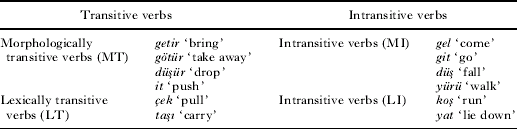
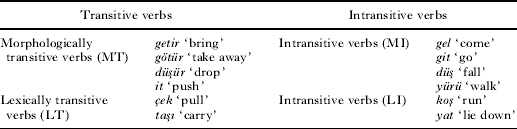
The task was an adaptation of the act-out studies conducted by Naigles et al. (Reference Naigles, Gleitman, Gleitman and Dromi1993; see also Naigles & Lehrer, Reference Naigles and Lehrer2002; Lidz et al., Reference Lidz, Gleitman and Gleitman2003; Lee & Naigles, Reference Lee and Naiglesin press). The linguistic stimuli included twelve verbs, six of which were intransitive (gel ‘come’, git ‘go’, düş ‘fall’, yürü ‘walk’, koş ‘run’, yat ‘lie down’) and six were transitive (getir ‘bring’, götür ‘take away’, düşür ‘drop’, it ‘push’, çek ‘pull’, taşı ‘carry’). The first three among the transitive verbs include the morphological causative morpheme (morphologically transitive verbs (MT)), which are derived forms of the intransitive verbs by adding the causative morpheme -DIr. For example, getir ‘bring’ is derived from gel ‘come’ by adding -dir (gel-dir).Footnote 1 The last three transitive verbs are lexically transitive (lexically transitive verbs (LT)). In the intransitive verb group, half (gel ‘come’, git ‘go’, düş ‘fall’) are the intransitive versions of the MT verbs (morphologically intransitive verbs (MI)). The remaining three intransitive verbs, yürü ‘walk’, koş ‘run’, yat ‘lie down’ (lexically intransitive verbs (LIFootnote 2)), were only given in their intransitive forms without being presented in their derived transitive forms (see Table 1). Four additional sentences with zıpla ‘jump’, dön ‘turn’, döndür ‘rotate/spin’ and okşa ‘pet’ were used to familiarize the participants with the task before the testing started. In total, each participant was asked to enact 52 sentences presented in a list.
Transitive and intransitive verbs used in the study
Because pilot testing showed that the two-year-old group could not complete the entire set of 48 sentences within two sessions, the two-year-olds were exposed to only 40 sentences, including the familiarization trials. Only the three MI verbs (gel ‘come’, git ‘go’, düş ‘fall’), instead of the entire six intransitive verbs used with the older participants, were given to the two-year-old group.
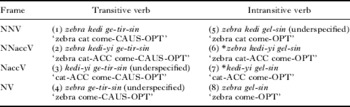
Each verb was presented in four different frames. Two of the frames included two NPs, while the other two included only one NP. One of each of the 2-NP and 1-NP frames included the accusative case-marking. Thus, the 2-NP frames were of the form NNV and NNaccV, and the 1-NP frames were of the form NV and NaccV. Table 2 presents a summary of the types of sentences presented to the participants, with an example from each type. (See the Appendix for a complete list of the sentences.)
Sample test sentences in each frame with a transitive (getir ‘bring’) and an intransitive (gel ‘come’) verbFootnote 3

These types of sentences vary with respect to how grammatical they are and how much context they presuppose. Naigles et al. (Reference Naigles, Gleitman, Gleitman and Dromi1993) called transitive verbs placed in intransitive frames, and intransitive verbs placed in transitive frames, ‘ungrammatical’. However, such a characterization is not quite appropriate for Turkish. As described earlier, elliptical sentences such as (3) and (4) in Table 2 are simply infelicitous in a discourse context where there is no previously mentioned participant that can be presupposed; otherwise, they are completely grammatical. Moreover, sentence (5) is merely unusual in the sense that it can be read as a conjoined-subject construction that is lacking the connection word ile ‘with’. Following Sanford & Sturt (Reference Sanford and Sturt2002) and extending Lahiri & Marslen-Wilson (Reference Lahiri and Marslen-Wilson1991), we term such sentences, which yield less than complete representations in the current context, underspecified, and their counterparts with the appropriate number of arguments fully specified. Sentences (6) and (7), on the other hand, can be comfortably deemed ungrammatical because intransitive verbs should not co-occur with accusative case-marking.
The participants were asked to enact the sentences on a stage made up of wood (30 cm width, 40 cm length, and 5 cm depth) with fourteen plastic toy animals, which were similar in size. For the two-year-olds, seven smaller wooden animals, which were exactly the same as in Naigles et al.'s (Reference Naigles, Gleitman, Gleitman and Dromi1993) study, were used instead of plastic toy animals. This was because the plastic animals were bigger in size, making them harder for the two-year-olds to manipulate.
Procedure
The procedure was adapted from Naigles et al. (Reference Naigles, Gleitman, Gleitman and Dromi1993; see also Naigles & Lehrer, Reference Naigles and Lehrer2002). Each participant was tested individually on a table or on the floor in a quiet room, where a video camera was set on a tripod in a corner and a microphone was placed on the table or on the floor. For some of the two- and three-year-olds, the testing was distributed to two sessions (each session took approximately thirty minutes) when it could not be completed within one session (approximately one hour). When the child entered the room, s/he was asked to identify all the animals. If the child gave an incorrect name for a certain animal, the experimenter corrected it. If the child insisted on using a different label, the experimenter used that label in the test sentences, which happened in less than 1 percent of the trials. The stage was put on the table or on the floor and all the animals were placed near the left side of the stage in view of the camera. The experimenter sat on the left side of the child. Then, the child was told that the experimenter would say a sentence and s/he would act out the action specified in the sentence by using the animals next to the stage.
All the sentences were read to the participant by the first author, who attempted to place no stress on any of the constituents. The participant was first given the pretest sentences in fully specified syntactic frames (2-NP constructions with one NP in accusative case-marking) so that s/he would become familiar with the task. Following these sentences, the 48 test sentences (36 for the two-year-olds) were administered. Two orders of presentation were used; approximately half of the children heard the sentences in a randomly determined order and the others heard the sentences in the exact opposite order. In both presentation orders, the first four sentences were always grammatical. After each sentence was enacted, the animals were placed back in their initial place, making sure that children had easy access to all of the toys. Each sentence was repeated at most twice for the four- and five-year-olds and adults, and at most three times for the two- and three-year-olds. If the participants were hesitant or looked puzzled about enacting the sentence, they were encouraged to do whatever they thought was right. Moreover, when they asked a question to clarify ungrammatical or underspecified sentences (e.g. ‘what does it bring?’), they were told to do whatever they found appropriate. After each act-out, the child was praised, regardless of the actions s/he performed. All the sessions were videotaped by the experimenter for later coding.
Coding procedures
The coding procedure was adapted from Naigles et al. (Reference Naigles, Gleitman, Gleitman and Dromi1993), with consideration of the language-specific aspects of Turkish. Enactments were coded as causative, non-causative or other. The causative enactments were those in which one animal acted upon the other animal by changing its state or position. For example, for the sentence domuz köpeğ-i düş-sün ‘pig dog-ACC fall-OPT’, if the child made the pig make the dog fall down (i.e. the pig knocks over the dog), the sentence was coded as causative. In addition, to count as causative in NNaccV sentences where the accusative marker was on the second noun, the first N had to be used as the agent of the enactment. Likewise, in a 1-NP frame with the accusative marker (NaccV), the introduced animal had to be used as the agent. If these did not occur, the enactment was coded as other. The non-causative enactment category included the enactments in which the animals were manipulated as moving alone towards the same place or moving independently from one another. For example, in the above example domuz köpeğ-i düş-sün ‘pig dog-ACC fall-OPT’, if the children put/laid the animals on the stage simultaneously, or made only one of the target characters fall down (e.g. making the pig fall onto the dog), then the sentence was coded as non-causative. The other category included using wrong animals, missing trials due to experimenter error or the child's reluctance, using the second noun as the agent in NNaccV frames, and using three or more animals to enact a sentence. Instrumental and benefactive interpretations such as the pig using the dog as an instrument or giving the dog something were not observed.
The child's utterances produced while enacting the sentence were also transcribed. In elliptical transitive sentences such as köpeğ-i itsin ‘(X) dog-ACC push-OPT’, if the child asked which animal pushes the dog, it was clear that the child inferred causativity. Such utterances led the entire response to be coded as causative. In some cases (only 0·49 percent of all the enactments), there were mismatches between the child's utterance and the enactment. In those cases, we used the child's verbal response to decide whether the code was causative, non-causative or other.
The enactments for all the sentences were initially coded by the first author. In order to determine the reliability of the coding procedure, an undergraduate assistant, who was not aware of the goals of the study and did not know what the test sentences were, coded 52% of the videotaped enactments with the audio turned off. The inter-coder agreement rate was 94·9%, with a Cohen's kappa of 92·3.
We first examined the participants' interpretation of the 12 fully specified sentences (i.e. those similar to (2) and (8) from Table 2; 9 sentences for the two-year-olds) to confirm that they performed with a reasonable understanding of the task. As mentioned above, we set a threshold of correct enactment of at least 75% of the fully specified sentences to consider the data of a certain participant as valid, and replaced the participants who did not fulfil this criterion. Fifteen two-year-olds and 4 three-year-olds were eliminated because of their inability to complete the test trials or failing to enact at least 75% of the fully specified sentences correctly. Among two-year-olds, only four children actually finished the task and were eliminated due to failing to meet this criterion; the other eleven were eliminated because they enacted fewer than 15 of the test sentences. The attrition rates are comparable to those obtained by Naigles et al. (Reference Naigles, Gleitman, Gleitman and Dromi1993). We think that in both samples the two-year-olds are eliminated more frequently, because they tend to find the task socially more challenging compared to older age groups rather than reasons that have to do with their cognitive–linguistic competence. On the other hand, the eliminated three-year-olds were all excluded because they did not meet the criterion of 75% correct enactment of the fully specified sentences. For the remaining participants, the average percentage of correct responses were 88%, 91%, 92%, 93% and 99% for two-, three-, four-, five-year-olds and adults, respectively.
Design summary
The study had a (5) Age (two-, three-, four-, five-year-olds, adults)×(2) Number of arguments in the frame (1-NP frames vs. 2-NP frames)×(2) Accusative marking (present vs. absent)×(2) Lexical valency of verb (morphologically vs. lexically transitive and intransitive) mixed design. Age was a between-subjects variable; all the remainder were within-subjects variables.
RESULTS
The main question that will be addressed is: did the children enact the verbs differently depending on the frame in which they were placed? For this study, frame includes both number of NPs and presence/absence of the accusative marker. Thus, we investigate whether the participants enacted verbs in 2-NP frames more causatively than verbs in 1-NP frames, and whether they enacted verbs with NPs including the accusative marker more causatively than verbs with bare NPs. We also investigate the degree to which the frame effects were modulated by verb type (i.e. either participated in the alternation +/− causative morpheme (MT and MI verbs) or not (LT and LI verbs)) and age. We will report these effects of frame, verb type and age first for the transitive verbs, and then for the intransitive verbs.
Preliminary analyses
The percentages of responses coded as ‘other’ did not exceed 12% of total responses in any of the age groups; this is comparable to the 11% ‘other’ rate in previous studies with the same age groups (Naigles et al., Reference Naigles, Fowler and Helm1992, Reference Naigles, Gleitman, Gleitman and Dromi1993). Thus, this category was omitted from further analyses and the remaining types of enactments (i.e. causative and non-causative), which constituted 88% of all the enactments, were included in the subsequent analyses.
A four-way ANOVA with Age (5) and Gender (2) as between-subject variables, and Frame (4) and Verb type (4) as within-subject variables yielded no main effect of gender, nor any significant interactions with gender. Thus, gender was not considered as a separate factor in the subsequent analyses.
Transitive verbs
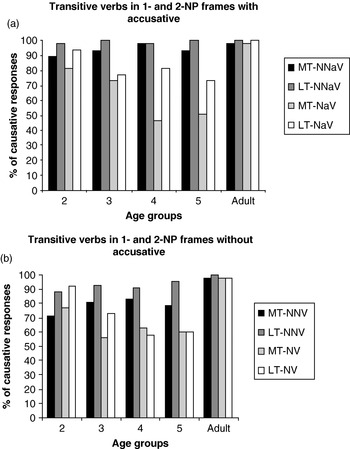
Figures 1a and 1b present the percentages of causative enactments for sentences containing the transitive verbs. As Figure 1a shows, when the sentence included two NPs and the immediately preverbal noun was marked with accusative case, participants enacted most of the verbs causatively; when the sentence included only one NP (also marked with accusative case), fewer enactments were causative. A similar pattern can be seen in Figure 1b: when the sentences included two NPs and both nouns were unmarked, participants enacted most of the verbs causatively, whereas when the sentences included only one NP, the causative enactments were fewer. Our statistical analyses first considered the enactments of the verbs in 2-NP frames, followed by the enactments of the verbs in 1-NP frames.
Panel (a) shows the percentage of causative enactments in frames with transitive verbs having the accusative marker. Panel (b) shows the percentage of causative enactments in frames with transitive verbs lacking the accusative marker.

Transitive verbs in 2-NP frames
A mixed ANOVA with Frame (2: +accusative, −accusative) and Verb (2: MT vs. LT) as within-subject variables, and Age (5) as a between-subject variable revealed main effects of Age (F(4, 71)=3·564, p=0·010) and of Verb type (F(1, 71)=21·625, p<0·001), as well as a significant Age×Frame interaction (F(4, 71)=3·56, p=0·001). A post-hoc Scheffé test indicated a significant difference between the two-year-olds and adults, with the adults making more causative enactments (mean difference=11·99, p<0·001). Moreover, more of the LT verbs were enacted causatively than the MT verbs (t(75)=4·499, p<0·001). The Age×Frame interaction can be traced to the fact that, while the adults enacted both the NNV and NNaccV frames equivalently, the children consistently enacted more verbs in the NNaccV frame causatively than verbs in the NNV frame (F(1, 56)=31·818, p<0·001).
We also compared, using t-tests, the participants' percentage causative performance to the chance level of 50%. For both the NNV and NNaccV frames, all five age groups, and both verb types, these comparisons yielded significant effects (ts>3·5, ps<0·05), indicating that both children and adults predominantly enacted transitive verbs in 2-NP frames causatively.
In sum, when our children and adults were given transitive verbs in 2-NP frames to enact, they overwhelmingly enacted them causatively. However, for the children, even this strong effect was modulated by the presence or absence of the accusative marker, as frames with nouns in the accusative case were enacted more causatively than frames without. Moreover, all age groups demonstrated an effect of verb type, as more LT verbs were enacted causatively than the MT verbs.
Transitive verbs in 1-NP frames
These utterances were grammatical, but underspecified in our task because of the absent context.
Effects of number of NPs
Two three-way mixed-effect ANOVAs (Frame: 2-NP vs. 1-NP, Verb type and Age) were conducted, one comparing percentage causative enactments in the NNV and NV frames, and the other comparing causative enactments in the NNaccV and NaccV frames. For the NNV–NV comparison, a main effect of Frame was found (F(1, 71)=15·76, p<0·001), as well as a significant Age×Verb type interaction (F(4, 71)=3·249, p=0·017). That is, when both nouns were bare, the participants enacted significantly fewer of the verbs causatively in the 1-NP frames than in the 2-NP frame; moreover, the children but not the adults enacted more LT verbs causatively than MT verbs.
For the NNaccV–NaccV comparison, a main effect of Frame was again found (F(1, 71)=33·37, p<0·001), as well as significant Age×Verb type and Age×Frame×Verb type interactions (F(4, 71)=4·497, p=0·003 and F(4, 71)=3·408, p=0·013, respectively). Again, when the accusative marker was present, significantly fewer transitive verbs in 1-NP frames were performed causatively than in 2-NP frames, and for the children, more LT verbs were enacted causatively than MT verbs. The three-way interaction reveals a puzzling developmental pattern, though: the two-year-olds and the adults performed equivalently causatively with both LT and MT verbs in 2-NP frames and 1-NP frames. In contrast, the three- and five-year-olds enacted both types of verbs causatively significantly more often in the 2-NP frame than the 1-NP frame (ts>2·21, ps<0·05). Finally, the four-year-olds enacted only the MT verbs more causatively in 2-NP than 1-NP frames (t(15)=5·42, p<0·001). This developmental pattern is puzzling because it appears that the two-year-olds are behaving as verb compliantly as the adults, enacting more transitive verbs in 1-NP frames causatively, whereas the three- and four-year-olds are behaving more frame compliantly, enacting more transitive verbs in 1-NP frames non-causatively.
Effects of the accusative marker
A three-way mixed-effect ANOVA was conducted, comparing the percentage of causative enactments performed with the NV and NaccV frames by verb types and age groups. A significant Frame×Verb×Age interaction was obtained (F(1, 58)=10·911, p<0·001). As can be seen by comparing Figures 1a and 1b, the four- and five-year-olds provided more causative enactments with the LT verbs in the NaccV frames in comparison to NV frames, (t(15)=2·200, p=0·044 and t(14)=2·449, p=0·028, respectively). In contrast, the four-year-olds enacted relatively more MT verbs causatively as a response to NV frames compared to NaccV frames (t(15)=3·162, p=0·006).
Comparisons with chance
T-tests were conducted comparing the participants' percentage causative enactments with the chance level of 50%, for each verb type and 1-NP frame separately. For the NaccV frame, all age groups enacted more LT verbs causatively than would be expected by chance. The four- and five-year-olds showed chance performance in enacting the MT verbs causatively in the NaccV frame whereas the two- and three-year-olds and adults enacted them causatively at above-chance rates. For the NV frame, the two- and three-year-olds and adults again enacted more LT verbs causatively than would be expected by chance and again, the four- and five-year-olds enacted the LT verbs causatively at only chance rates. Additionally, only two-year-olds and adults enacted the MT verbs causatively at above-chance rates in the NV frame. The three-, four- and five-year-olds enacted those verbs causatively at chance rates.
Transitive verbs summary
Three main findings are noted. First, the number of arguments in the frame played a role in Turkish speakers' enactments of transitive verbs, such that they enacted these verbs less causatively in 1-NP frames than in 2-NP frames. This finding must be qualified by two others, though: the effect of number of NPs was not seen for either adults or two-year-olds; moreover, for all age groups, most enactments of transitive verbs, even in 1-NP frames, were causative. Even for the three- to five-year-olds, who showed the strongest effect of number of NPs, the twelve comparisons with chance (two verb types, two frame types, three age groups) yielded five cells with predominantly causative enactments and seven cells with enactments at chance levels; no cells yielded predominantly non-causative enactments. Second, the presence of the accusative marker played a significant and independent role in Turkish speakers' enactments of transitive verbs: in 2-NP frames for all verb types and age groups and in 1-NP frames for the four- and five-year-olds with LT verbs, frames with nouns marked for accusative case were enacted more causatively than frames with bare nouns. Moreover, for the three- to five-year-olds enacting the 1-NP frames, the NaccV frame yielded predominantly causative enactments for four out of the six relevant cells. And third, we note the consistent finding that the LT verbs yielded more causative enactments than the MT verbs.
Intransitive verbs
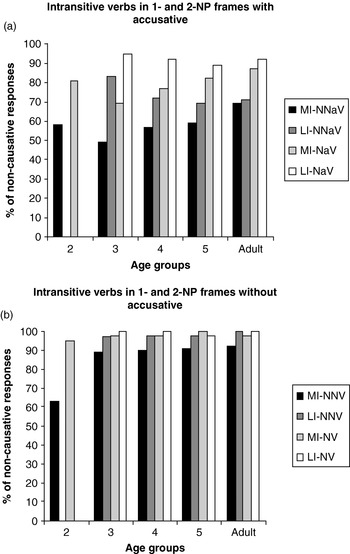
Figures 2a and 2b present the percentages of non-causative enactments for sentences containing the intransitive verbs. As Figure 2a shows, when the sentence included one NP, which was marked with accusative case, participants overwhelmingly enacted the verbs non-causatively; when the sentence included two NPs (the immediately preverbal one marked with accusative case), more enactments were causative. A similar pattern can be seen in Figure 2b: when the sentences included one unmarked NP, participants enacted the verbs non-causatively, whereas when the sentences included two NPs, the causative enactments increased. Our statistical analyses first considered the enactments of the verbs in 1-NP frames, followed by the enactments of the verbs in 2-NP frames.
Panel (a) shows the percentage of non-causative enactments in frames with intransitive verbs having the accusative marker. Panel (b) shows the percentage of non-causative enactments in frames with intransitive verbs lacking the accusative marker.

Intransitive verbs in 1-NP frames
A mixed ANOVA with Frame (2: +accusative, −accusative) and Verb (2: MI, LI) as within-subject variables, and Age (5) as a between-subject variable revealed only a main effect of Frame (F(1, 71)=39·30, p<0·001) and no other significant effects or interactions. Thus, more NaccV sentences were acted out causatively than NV sentences.
We also compared, using t-tests, the participants' percentage causative performance to the chance level of 50%. For both the NV and NaccV frames, both verb types and four of the five age groups, these comparisons yielded significant negative effects (ts>4·4, ps<0·05), with performances below chance, indicating that most children and adults enacted intransitive verbs in 1-NP frames non-causatively. The one exception was the three-year-olds enacting the MI verbs in the NaccV frame; their percentage of causative enactments (31·1) approached being significantly less than chance (t(14)=1·99, p=0·07).
In sum, when our children and adults were given intransitive verbs in 1-NP frames to enact, they overwhelmingly enacted them non-causatively. However, for both children and adults, even this strong effect was modulated by the presence or absence of the accusative marker, as somewhat more frames with nouns in the accusative case were enacted causatively than frames without.
Intransitive verbs in 2-NP frames
These utterances were either underspecified (i.e. NNV sentences were missing a connector word ‘ile/ve’) or ungrammatical (i.e. NNaccV; see Table 2).
Effects of number of NPs
Two three-way mixed-effects ANOVAs (Frame: 2-NP vs. 1-NP, Verb type, and Age) were conducted, one comparing percentage causative enactments in the NNV and NV frames, and the other comparing causative enactments in the NNaccV and NaccV frames. For the NNV–NV comparison, a main effect of Frame was found (F(1, 58)=13·636, p<0·001) as well as a significant Frame×Verb type interaction (F(1, 58)=6·171, p=0·016). More MI verbs were enacted causatively in the NNV frame compared to the NV frame (t(61)=3·562, p<0·001). For the NNaccV–NaccV comparison, a main effect of Frame was again found (F(1, 58)=32·014, p<0·001), and no other significant effects or interactions were observed. In sum, the addition of a second NP to sentences with intransitive verbs prompted both children and adults to produce more causative enactments.
Effects of the accusative marker
A three-way mixed-effect ANOVA was conducted, comparing the percentage of causative enactments performed with the NNV and NNaccV frames by verb types and age groups. A main effect of Frame was obtained (F(1, 58)=84·598, p<0·001), but no other significant effects or interactions. As can be seen by comparing Figures 2a and 2b, both children and adults provided more causative enactments for intransitive verbs in 2-NP frames when the immediately preverbal noun was marked with accusative case, than when it was unmarked.
Comparisons with chance
T-tests were conducted, comparing the participants' percentage causative enactments with the chance level of 50%, for each verb type and 2-NP frame separately. For the adults, all comparisons yielded significant effects below chance, indicating that they predominantly enacted all of the intransitive verbs in 2-NP frames non-causatively (ts>2·4, ps<0·03). In contrast, the three-, four- and five-year-olds enacted the MI verbs in the NNaccV at chance (ts<1·2, ns) and were below chance with the LI verbs in both frames and the MI verbs in the NNV frame (ts>2·7, ps<0·02). The two-year-olds enacted the MI verbs (the only ones they were given) in both 2-NP frames at chance levels (ts<1·1, ns).
Intransitive verbs summary
Three main findings are noted. First, the number of explicit arguments in the frame played a role in Turkish speakers' enactments of intransitive verbs, such that they enacted these verbs more causatively in 2-NP frames than in 1-NP frames. This finding is again qualified by two others: the effect of number of NPs was not seen for the adults; moreover, for all age groups, enactments of intransitive verbs, even in 2-NP frames, were predominantly non-causative. Even for the three- to five-year-olds, who showed the strongest effect of number of NPs, the twelve comparisons with chance (two verb types, two frame types, three age groups) yielded nine cells with predominantly non-causative enactments and three cells with enactments at chance levels; no cells yielded predominantly causative enactments. Second, the presence of the accusative marker played a significant and independent role in Turkish speakers' enactments of intransitive verbs: in both 1-NP and 2-NP frames, for all verb types and age groups, more frames with nouns marked for accusative case were enacted causatively than frames with bare nouns. Thus, intransitive verbs in 2-NP frames with the immediately preverbal noun marked for accusative case were sometimes enacted as the first NP causing the second NP to perform the relevant action. In contrast, intransitive verbs in 2-NP frames with bare nouns were more often enacted as the two NPs carrying out the relevant action in parallel. Third, we note a small but noticeable finding that MI verbs were more likely to be enacted causatively than LI verbs.
DISCUSSION
The purpose of this study was to assess the extent to which (a) the number of NPs, (b) the presence of nominal case morphology and (c) the presence of verbal morphology (causative morpheme) in sentences affected the nature of Turkish speakers' enactments of verbs at different ages. We found evidence for both number of NPs and nominal morphology as cues for children's interpretations of verbs; however, our effects of verb type supplied little evidence for a role for verbal morphology. Below, we elaborate on these findings and discuss how they point to expanded syntactic bootstrapping mechanisms for children operating in a language with inflectional morphology and extensive argument ellipsis.
Effects of number of NPs
With both transitive and intransitive verbs, our Turkish speakers showed sensitivity to number of NPs, such that more transitive verbs in 1-NP frames were enacted non-causatively and more intransitive verbs in 2-NP frames were enacted causatively, than when heard in fully-specified frames. Notice that these novel enactments were not inevitable, even in our context-free task. That is, it would have been perfectly appropriate for children hearing zebra aslan gelsin ‘the zebra the lion come’ to make the zebra and lion each move separately, as ‘the zebra comes with the lion’. The presence of two NPs with the verb ‘come’ gel still afforded possible non-causative enactments. Nonetheless, our Turkish speakers still chose, at significantly enhanced levels, to enact these sentences causatively. Thus, even a language like Turkish, in which word order and the number of arguments have little to do with thematic role assignment, the number of explicit arguments still has relevance for speakers. This finding supports the claims of theories as diverse as Lidz et al. (Reference Lidz, Gleitman and Gleitman2003) and Goldberg (Reference Goldberg2006) that number of NPs is a very basic aspect of sentence organization. The number of linguistically expressed participants clearly influenced the nature of enactments, whether the explanation stems from a putative hard-wired universal grammar or learned pragmatic principles. This finding thus supports the universality of a central tenet of syntactic bootstrapping, that children pay attention to the number of arguments that a verb appears with, and use this cue to make conjectures about the meaning of the verb. This central tenet has now been shown to apply to languages such as Turkish, which allow for massive NP ellipsis and which exploit inflectional morphology to reveal who did what to whom. It appears that the prevalence of a rich morphological system does not completely preclude speakers' ability to take advantage of the cue of number of NPs.
That being said, it must also be acknowledged that the frame effects, while significant, were not overwhelming. That is, transitive verbs in 1-NP frames were never enacted primarily non-causatively, nor were intransitive verbs in 2-NP frames ever enacted primarily causatively (i.e. in a way that follows the frame more than the verb in both cases). In fact, for almost half of the relevant comparisons, the participants still significantly followed the verb, enacting transitive verbs primarily causatively and intransitive verbs primarily non-causatively (for the other comparisons, the participants' enactments were at chance levels, exhibiting equivalent degrees of frame and verb compliance). Thus, the effect of number of NPs in Turkish seems weaker than in English, whose speakers – especially at young ages – do primarily follow the frame (i.e. they enact intransitive verbs in 2-NP frames causatively 65–75% of the time (Naigles et al., Reference Naigles, Gleitman, Gleitman and Dromi1993)). Indeed, statistical comparisons of the ‘bare’ (i.e. without the accusative marker) 2-NP frame conditions in both languages have revealed that the Turkish speakers performed significantly less frame compliantly than previously studied English speakers (Naigles, Küntay, Göksun & Lee, Reference Naigles, Küntay, Göksun, Lee, Bamman, Magnitskaia and Zaller2006). It seems, then, that frequent NP ellipsis and morphological markers do serve to diminish the strength of the number of NPs cue in bootstrapping from form to meaning. For example, perhaps from hearing so many utterances with object ellipsis, speakers of Turkish seem to realize quite strongly that zebra ge-tir-sin ‘zebra come-CAUS-OPT’ involves a patient even when there is no overt reference to one. Moreover, perhaps high-frequency markers such as ile/ve ‘together/accompaniment’ (and the fact that the plural marker on verbs is usually omitted) also helped our Turkish speakers interpret ayı aslan git-sin ‘bear lion go-OPT’ as ‘the bear and the lion go’. Of course, a stronger test of the relative uses of number of NPs across languages would involve the use of nonsense verbs in both 1-NP and 2-NP frames (cf. Naigles, Reference Naigles1990; Imai et al., Reference Imai, Haryu, Okada, Kajikawa and Saalbach2007; Matsuo et al., Reference Matsuo, Sinya, Kita and Naigles2007). With no previously available verb knowledge, all children should still show effects of number of NPs, but those learning English would be expected to rely more on number of NPs than those learning Turkish.
A second caveat to the general effect of number of NPs is developmental: as predicted, the Turkish adults showed little effect of frame whereas the children relied on number of NPs much more. Interestingly, the three- to five-year-olds showed consistent (albeit small) effects of frame across verb classes whereas the two-year-olds only showed the effect for the intransitive verbs in 2-NP frames.Footnote 4 As expected, the most knowledgeable speakers (i.e. adults) know enough about the verbs to realize that their presence in different frames does not change their meanings; this effect has also been observed in adult speakers of Kannada, and speakers of English as young as grade school age (Lidz et al., Reference Lidz, Gleitman and Gleitman2003; Naigles et al., Reference Naigles, Fowler and Helm1992; Naigles et al., Reference Naigles, Gleitman, Gleitman and Dromi1993; Pinker, Reference Pinker1989). But why does the developmental trend within childhood appear to proceed in the wrong direction, with younger children more verb compliant – with transitive verbs – than older children? It is possible that the two-year-olds had not yet learned the frame–meaning correspondences of one- versus two-argument and non-causative/causative events; however, we find this unlikely given their robust ability to follow the frame with the intransitive verbs in 2-NP frames. Instead, we believe these very young children were demonstrating a causative bias, which was enabled because we (inadvertently) asked them to enact more transitive verbs than intransitive verbs. That is, recall that these children were given the MI but not the LI verbs, in addition to both LT and MT verbs (and the pretest sentences were all transitive as well). The resulting set of sentences was thus tilted towards eliciting causative enactments, and the children might have simply gotten into a ‘set’ where they treated most test sentences as invitations to show how one animal manipulates another. To fully determine developmental changes in the use of number of NPs in verb learning, then, two-year-olds would need to be tested in a completely balanced design.
In summary, our hypotheses concerning the role of number of NPs in syntactic bootstrapping by Turkish speakers have been supported: Turkish speakers do exploit number of NPs in making conjectures about verb meaning, and they use this more at younger ages. Importantly, though, their use of this cue is strikingly less than that of English speakers. One limitation of this study is that we did not vary the arrangement of NPs along with number; thus, in English, the 2-NP sentences were NVN whereas in Turkish they were NNV (the default order). Pilot work has hinted that in Turkish, where all orders are possible, some orders elicit more frame compliance than others. Comparisons of children's performance with intransitive and novel verbs in NNV vs. NVN frames is also important for fleshing out when children treat NPs as arguments (our preferred syntactic explanation of our findings) versus when they may treat NPs solely as markers of participants (a possible supplementary pragmatic explanation of our findings (Goldberg, Reference Goldberg2006)). With NNV frames, the two NPs may be treated as one argument but two participants (verb compliance in our framework) or as two arguments (when the second NP is the patient, this would be frame compliance in our framework). With NVN frames, the latter interpretation may be preferred even with older age groups. Possible influences of NP arrangement, then, need to be followed up systematically and may introduce yet another component to the mix of structures and experiences that enable children to learn about verb meaning.
Effects of accusative marker
The second question we addressed concerned whether the presence of accusative case-marking elicited more causative interpretations – that is, whether Turkish speakers could do ‘morphological bootstrapping’. And indeed, a significant effect of the accusative marker was revealed both for transitive and intransitive verbs in 2-NP frames and for intransitive verbs in 1-NP frames. In all of these situations, the participants performed more causative enactments with the accusative marker than without. Thus, it appeared that the accusative morpheme strengthened causative interpretations for transitive verbs in 2-NP constructions, and led the participants to extend the meanings of constructions with intransitive verbs. Even when confronted with previously unattested (and ill-formed) constructions such as kedi-yi gel-iyor ‘cat-ACC come-PROG’, participants of all ages conjecture a new causative meaning for the intransitive construction. In this way, the Turkish speakers were, indeed, doing morphological bootstrapping. We should note here that Turkish adults never creatively use accusative case-marking with intransitive verbs in ordinary conversations. That is, it is highly unlikely that Turkish children could have been exposed to such constructions.
To what extent did the accusative marker override the conventional verb interpretation? This can only be assessed with the intransitive verbs; Figures 2a and 2b present the relevant comparisons. While it is clear that the presence of the accusative marker led the children to enact the verbs less non-causatively, in no case did they enact these intransitive verbs predominantly causatively. That is, children were either at chance or enacted the verbs predominantly non-causatively. Interestingly, the children thus appeared to follow the demands of the accusative marker more than the adults, because the former's enactments were indeed more causative with these frames than the latter's. At first blush, this goes against our prediction that the effect of the accusative marker should only strengthen with age. However, notice that the predicted developmental trend was found for the transitive verbs, where the accusative marker is wholly appropriate. The reason that the adults showed less sensitivity to the accusative marker with the intransitive verbs was precisely because of their increased knowledge that such markers are inappropriate with intransitive verbs.
In this regard, it is important to point out that the causative interpretation was not the only one plausible in either NaccV or NNaccV frames with the intransitive verbs. That is, given that the accusative case-marker is ungrammatical when used with intransitive verbs, speakers could have altered other elements of the sentence to preserve the meaning of the verb. And in fact, some did – the two most common alterations appeared to modify the nominal morphology, with either the ‘accompaniment’ marker ve/ile or dative markers (-e/-a) apparently replacing the accusative. Thus, in many instances speakers who heard ayı aslan-ı git-sin ‘bear lion-ACC go-OPT’ enacted ‘the bear going to the lion’ or ‘the bear going with the lion’ rather than ‘the bear making the lion go’. In this way, speakers were able to acknowledge the presence of nominal morphology while still maintaining the inherent meaning of the verb. Especially for the children, though, the modal (although not majority) response was to follow the nominal morphology, and enact sentences with the accusative marker causatively.
These findings thus provide the first evidence of morphological bootstrapping with nominal rather than verbal morphology in preschool-aged children. Their systematicity leads to a number of implications. First, they allow us to suggest an alternative interpretation for the findings of Lidz et al. (Reference Lidz, Gleitman and Gleitman2003), who found robust causative enactments of intransitive verbs in 2-NP frames in Kannada. We suggest that the robustness of the 2-NP frame effect in that study, as compared with ours, was partially due to the consistent presence of accusative case-markers in the Kannada sentences (recall that all of the Kannada 2-NP sentences carried accusative case whereas only half of ours did). We do not deny a role for number of NPs, which we have found in Turkish as well, but conjecture that number of NPs was only one reason why Lidz et al.'s sentences were enacted so causatively. (Unfortunately, our verb-class effects, discussed below, preclude any direct comparison with the Kannada data.) More generally, our findings show that children and adults are able to use nominal morphological information, as well as number and arrangement of arguments, when making conjectures about verb meaning. And this information is available quite early in development, at least in languages where the morphological system in question is regular and transparent. We have thus found that the procedure of syntactic bootstrapping for acquiring verb meaning can indeed be extended to include morphology and suggest the phenomenon should be renamed morphosyntactic bootstrapping to accommodate this larger tent.
Morphosyntactic bootstrapping should work best with languages with a regular case-marking system that reliably indicates grammatical roles, such as Turkish. In contrast, languages with split ergative case-marking, which allow subjects of transitive verbs and intransitive verbs to take both ergative and absolutive case-marking, might raise additional challenges. Thus, further studies about morphosyntactic bootstrapping should include such languages where case-marking is not uniform and argument omission is common. A standard bootstrapping account that links subjects to a single case is likely to prove inadequate for such languages.
Effects of verb type
Our third question concerned the role of the causative morpheme in Turkish speakers' causative enactments, and here we had our most surprising findings. That is, with transitive verbs, the causative morpheme apparently had a negative effect, with the LT verbs (lacking the causative morpheme) being enacted more causatively than MT verbs (which included the causative morpheme). At the very least, this finding corroborates Lidz et al.'s (Reference Lidz, Gleitman and Gleitman2003) results with Kannada that the causative morpheme plays at best a subordinate role in children's conjectures about the meanings of the verbs with which it appears. Clearly, both number of NPs and accusative case-marking are attended to more strongly. Possibly, the SOV frame itself enabled the strength of the accusative case cue because the accusative case was heard before the causative marker. Fleshing out such an information-processing account will require detailed parsing studies of both adult and child Turkish speakers.
It is also possible that our test of the causative morpheme was not as clear as it could have been, because the verbs we paired with the causative morpheme are very highly frequent in Turkish (getir/götür/düşür, ‘bring’/‘take’/‘fall’). While the facts of the linguistic system show that the transitive form is derived from the intransitive via the addition of -DIr, current speakers of Turkish may not represent these verbs as derived forms. Instead, they may be represented as wholes, not different from lexical transitives such as it ‘push’. Perhaps a better investigation of the role of the causative morpheme would involve nonsense verbs, or low-frequency verbs that engage in the causative morpheme alternation more explicitly.
That being said, what might be the basis for the verb type effects that were found? One basis might have to do with the generality of the verbs' meanings. That is, it seems that the verbs that showed more sensitivity to both number of NPs and accusative marker might fall into the category of ‘light’ verbs, which refer to relations that are less imageable and apply to a broad range of events (Clark, Reference Clark, Johnson and Gilbert1996; Goldberg, Reference Goldberg and MacWhinney1999; Snedeker & Gleitman, Reference Snedeker, Gleitman, Hall and Waxman2004). Both the intransitive verbs that elicited more causative enactments (gel, git, düş, ‘come’, ‘go’, ‘fall’), and the transitive verbs that elicited fewer causative enactments (getir, götür, düşür, ‘bring’, ‘take’, ‘fall’) might be considered ‘light’ verbs. In contrast, the verbs that showed less sensitivity to frame, broadly defined, were the specific ones (the LT verbs: it, çek, taşı, ‘push’, ‘pull’, ‘carry’, and the LI verbs: yat, koş, yürü, ‘lie down’, ‘run’, ‘walk’). It is possible that more general intransitive verbs are easier to conceive of as causative, and more general transitive verbs are easier to conceive of as non-causative. Pinker (Reference Pinker1989) has proposed, for English, that general verbs are more likely to alternate among argument structures than specific verbs, and Snedeker & Gleitman (Reference Snedeker, Gleitman, Hall and Waxman2004) have demonstrated with English-speaking adults that light verbs are more susceptible to misinterpretation without syntactic information than highly imageable verbs. Thus, our findings might be considered an example of how verbs with more general or broad meanings show more sensitivity to morphosyntactic changes.
CONCLUSIONS
The present study conducted in Turkish has illuminating findings for the support of both universal and language-specific influences on verb learning and the acquisition of verb argument structure. Particularly, this study supports and extends the broad role of the syntactic bootstrapping mechanism of ‘following the syntax to infer the meaning of a verb’. More remarkably, morphosyntactic cues such as nominal case-marking are supportive in learning verbs and their argument structures in nominative–accusative languages such as Turkish; in contrast, the verbal causative morpheme is less effective. As a result, a ‘frame’ in a free-order, agglutinative language that also has frequent noun ellipsis is more than just the number and configuration of arguments. In sum, the extension of the bootstrapping of form to meaning to morphology (i.e. morphosyntactic bootstrapping) makes such bootstrapping a more universal process in children's verb acquisition.
Appendix: practice and test sentences
Practice sentences
(1) Köpek dön-sün (dog turn-OPT.3SG) ‘let the dog turn/rotate’
(2) Kedi maymun-u okşa-sın (cat monkey-ACC pet-OPT.3SG) ‘let the cat pet the monkey’
(3) Zürafa kediy-i dön-dür-sün (giraffe cat-ACC rotate/spin-CAUS-OPT.3SG) ‘let the giraffe rotate/spin the cat’
(4) Kaplan zıpla-sın (tiger jump-OPT.3SG) ‘let the tiger jump’
Test sentences
(1) Koyun koş-sun (sheep run-OPT.3SG) ‘let the sheep run’
(2) İnek maymun-u it-sin (cow monkey-ACC push-OPT.3SG) ‘let the cow push the monkey-ACC’
(3) Aslan yat-sın (lion lie down-OPT.3SG) ‘let the lion lie down’
(4) Zürafa koyun-u çek-sin (giraffe sheep-ACC pull-OPT.3SG) ‘let the giraffe pull the sheep-ACC’
(5) İnek it-sin (cow push-OPT.3SG) ‘let (x) push a cow/let the cow push (x)’
(6) Köpeğ-i düş-ür-sün (dog-ACC drop-CAUS-OPT.3SG) ‘let (x) drop the dog-ACC’
(7) Ayı aslan gö-tür-sün (bear lion take away-CAUS-OPT.3SG) ‘let the bear take away a lion’
(8) Kediy-i ge-tir-sin (cat-ACC bring-CAUS-OPT.3SG) ‘let (x) bring the cat-ACC’
(9) Zebra gel-sin (zebra come-OPT.3SG) ‘let the zebra come’
(10) Aslan domuz yat-sın (lion pig lie down-OPT.3SG) ‘let the lion the pig lie down’
(11) Kaplan-ı taşı-sın (tiger-ACC carry-OPT.3SG) ‘let (x) carry the tiger-ACC’
(12) Domuz köpeğ-i düş-ür-sün (pig dog-ACC drop-CAUS-OPT.3SG) ‘let the pig drop the dog-ACC’
(13) Kediy-i gel-sin (cat-ACC come-OPT.3SG) ‘let the cat-ACC come’
(14) Maymun-u it-sin (monkey-ACC push-OPT.3SG) ‘let (x) push the monkey-ACC’
(15) Zebra kediy-i ge-tir-sin (zebra cat-ACC bring-CAUS-OPT.3SG) ‘let the zebra bring the cat-ACC’
(16) Köpeğ-i düş-sün (dog-ACC fall-OPT.3SG) ‘let the dog fall-ACC’
(17) Ayı aslan git-sin (bear lion go-OPT.3SG) ‘let the bear the lion go’
(18) Aslan domuz-u yat-sın (lion pig-ACC lie down-OPT.3SG) ‘let the lion the pig-ACC lie down’
(19) Zürafa koyun çek-sin (giraffe sheep pull-OPT.3SG) ‘let the giraffe pull a sheep’
(20) Ayı git-sin (bear go-OPT.3SG) ‘let the bear go’
(21) Kaplan-ı koş-sun (tiger-ACC run-OPT.3SG) ‘let the tiger run-ACC’
(22) Domuz köpek düş-sün (pig dog fall-OPT.3SG) ‘let the pig the dog fall’
(23) Zebra ge-tir-sin (zebra bring-CAUS-OPT.3SG) ‘let (x) bring a zebra/let the zebra bring (x)’
(24) At ördek yürü-sün (horse duck walk-OPT.3SG) ‘let the horse the duck walk’
(25) Zebra kedi gel-sin (zebra cat come-OPT.3SG) ‘let the zebra the cat come’
(26) Ördeği yürü-sün (duck-ACC walk-OPT.3SG) ‘let the duck-ACC walk’
(27) Keçi kaplan taşı-sın (deer tiger carry-OPT.3SG) ‘let the deer carry a tiger’
(28) Ayı aslan-ı gö-tür-sün (bear lion-ACC take away-CAUS-OPT.3SG) ‘let the bear take away the lion-ACC’
(29) Koyun-u çek-sin (sheep-ACC pull-OPT.3SG) ‘let (x) pull the sheep-ACC’
(30) Zebra kediy-i gel-sin (zebra cat-ACC come-OPT.3SG) ‘let the zebra the cat-ACC come’
(31) Koyun kaplan koş-sun (sheep tiger run-OPT.3SG) ‘let the sheep the tiger run’
(32) Aslan-ı git-sin (lion-ACC go-OPT.3SG) ‘let the lion-ACC go’
(33) Domuz köpek düş-ür-sün (pig dog drop-CAUS-OPT.3SG) ‘let the pig the dog drop’
(34) Zebra kedi ge-tir-sin (zebra cat bring-CAUS-OPT.3SG) ‘let the zebra bring a cat’
(35) Domuz köpeğ-i düş-sün (pig dog-ACC fall-OPT.3SG) ‘let the pig the dog-ACC fall’
(36) Aslanı gö-tür-sün (lion-ACC take away-CAUS-OPT.3SG) ‘let (x) take away the lion’
(37) İnek maymun it-sin (cow monkey push-OPT.3SG) ‘let the cow push a monkey-ACC’
(38) Domuz düş-ür-sün (pig drop-CAUS-OPT.3SG) ‘let (x) drop a pig/let the pig drop (x)’
(39) Ayı gö-tür-sün (bear take away-CAUS-OPT.3SG) ‘let (x) take away a bear/let the bear take away (x)’
(40) Zürafa çek-sin (giraffe pull-OPT.3SG) ‘let (x) pull a giraffe/let the giraffe pull (x)’
(41) Keçi kaplan-ı taşı-sın (deer tiger-ACC carry-OPT.3SG) ‘let the deer carry the tiger’
(42) Domuz-u yatsın (pig-ACC lie down-OPT.3SG) ‘let the pig-ACC lie down’
(43) Koyun kaplan-ı koşsun (sheep tiger-ACC run-OPT.3SG) ‘let the sheep the tiger-ACC run’
(44) At yürü-sün (horse walk-OPT.3SG) ‘let the horse walk’
(45) Keçi taşı-sın (deer carry-OPT.3SG) ‘let (x) carry a deer/let the deer carry (x)’
(46) Ayı aslan-ı git-sin (bear lion-ACC go-OPT.3SG) ‘let the bear the lion-ACC go’
(47) Domuz düş-sün (pig fall-OPT.3SG) ‘let the pig fall’
(48) At ördeğ-i yürü-sün (horse duck-ACC walk-OPT.3SG) ‘let the horse the duck-ACC walk’