Introduction
Chyle fistula is defined as leakage of the lymphatic fluid from the lymphatic vessels. It is a rare complication of neck dissection, affecting 0.5–5.8 per cent of the patients.Reference Jain, Singh, Singhal, Sharma and Grover1–Reference Ahn, Sohn and Jeong3 A chyle fistula may increase the risk of morbidities such as electrolyte imbalance, protein loss, delayed wound healing, skin flap necrosis, vascular rupture, infection and life-threatening complications, subsequently prolonging hospital stays.Reference Jain, Singh, Singhal, Sharma and Grover1–Reference Ahn, Sohn and Jeong3 However, the criteria for diagnosing a chyle fistula are subjective, and they include changes in the drainage volume or wound swelling. Recently, chyle fistula has been diagnosed by measuring the triglyceride levels in the drainage, but this is considerably time-consuming.Reference Jain, Singh, Singhal, Sharma and Grover1–Reference Campisi, Boccardo, Piazza and Campisi7
Thus, early and objective diagnostic methods for detecting a chyle fistula after neck dissection are required. The authors have found that the portable SD LipidoCare test system (SD Biosensor, Suwon, South Korea) can be used for quick and accurate screening for chyle fistula. The SD LipidoCare test system is a portable instrument that can measure various lipid profiles (total cholesterol, triglycerides, high-density lipoprotein and low-density lipoprotein), all within 3 minutes. The SD LipidoCare test has also been compared with other reference equipment, and it showed the best results in terms of accuracy, reproducibility and total error.
The current study aimed to analyse the results of chyle fistula testing using the SD LipidoCare system in patients who underwent neck dissections performed in our hospital in 2019.
Materials and methods
Approval to carry out the study was obtained from the Institutional Review Board of Chonnam National University Hwasun Hospital. Seventy-one patients who underwent neck dissections from March to November 2019 were identified based on their medical records. Only patients who underwent surgery ranging from level I to level V were included; patients who underwent selective neck dissections or revision surgery, or those who refused the triglyceride test, were excluded from the study. A final total of 60 patients were included in this study.
The clinical data of the 60 patients who had undergone neck dissection were analysed, including age, sex, primary carcinoma site, neck lymph node status, pre-operative radiotherapy history, surgical method, triglyceride level in the drainage fluid, presence of chyle fistula and chyle fistula treatment method.
Triglyceride levels in the drainage fluid were examined at 1, 3 and 5 days after surgery using the SD LipidoCare test system (Figure 1). The triglyceride levels ranged from 45 to 650 mg/dl; the SD LipidoCare machine displayed ‘low’ for values under 45 mg/dl. If triglycerides were detected in the drain fluid, a formal triglyceride test was carried out by the diagnostic laboratory.
Triglyceride testing method using the SD LipidoCare system (SD Biosensor, Suwon, South Korea). (a) Fluid is aspirated with a mini-pipette at the drain, (b) fluid is dropped into the SD LipidoCare test system, and (c) the result is checked.

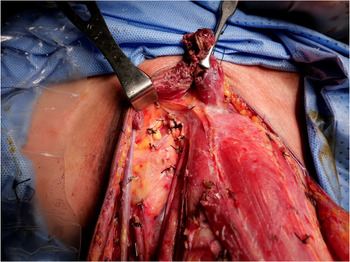
A posterior approach was performed to reduce chyle leaks during neck dissection, and ligation was performed during level IV surgery (Figure 2). However, dissections for identifying lymphatic ducts were not routinely performed because of the increased risk of iatrogenic damage to the ducts. At the end of the operation, a Valsalva manoeuvre was performed to determine if there was a chyle leak, and fibrin glue was applied to the level IV site for reinforcement.
Intra-operative photograph of a 56-year-old female who had a post-operative chyle leak following left-sided radical neck dissection shows no leak after performing level IV ligation.

A chyle fistula was defined as triglyceride concentrations in the drainage fluid of more than 100 mg/dl, with clinical signs or symptoms of a chyle fistula, such as an increase in the drainage volume, milky drainage production and wound swelling. All patients with chyle fistulas underwent conservative treatment, including suction drainage, compression dressings, bed rest and nutritional modifications.
The Fisher's exact test was used to determine associations between two categorical variables. SPSS software, version 20.0, was used for all statistical analyses. Statistical significance was set at p < 0.05.
Results
The study comprised 60 patients (43 males and 17 females; gender ratio of 2.5:1) who underwent neck dissection. The clinical data are summarised in Table 1. Neck dissection was performed on a total of 70 neck sides; dissections were right-sided in 29 patients, left-sided in 21 and bilateral in 10. Regarding neck lymph node (N) stage, N1 was most common, followed by N2, N0 and N3. Six patients received pre-operative radiotherapy. The primary site of carcinoma was the thyroid gland, followed by the oropharynx. Modified radical neck dissection (82.9 per cent, 58 out of 70) was the most frequently performed neck dissection type.
Clinical data of 60 patients who underwent neck dissection

SD = standard deviation; RT = radiotherapy
Post-operative chyle fistula was observed in 3 of the 60 patients (5 per cent) (Table 2). All patients who developed chyle fistulas had undergone left-sided neck dissections. One chyle fistula occurred 1 day after surgery, and the other two occurred 3 days after surgery.
Clinical findings of patients with post-operative chyle fistula

*The SD LipidoCare machine displayed ‘low’ for values under 45 mg/dl. Y = years; pre-op = pre-operative; RT = radiotherapy; post-op = post-operative; lab = laboratory; mins = minutes; M = male; L = left; MRND = modified radical neck dissection; TPN = total parenteral nutrition; RND = radical neck dissection
Within 3 minutes, the SD LipidoCare test system produced triglyceride results of 49, 56 and 207 mg/dl in the three patients. The remaining 57 patients measured ‘low’ for triglycerides on the SD LipidoCare test. The results of the formal triglyceride test conducted in the diagnostic laboratory for the three patients highlighted by the SD LipidoCare test system were 131.1, 129.5 and 210.3 mg/dl. All three patients had triglyceride levels of more than 100 mg/dl on the formal triglyceride test, confirming chyle fistula. The formal triglyceride test took an average of 84 ± 31.8 minutes (range, 57–119 minutes) to perform, much longer than the SD LipidoCare test.
All three chyle fistula patients improved with conservative treatment. These patients received nutritional modifications for an average of 6.0 ± 1 days (range, 5–7 days), and were hospitalised for an average of 10.3 ± 3.2 days (range, 8–14 days). The maximum drainage volumes ranged from 60 to 110 ml per 24 hours (mean ± standard deviation, 90 ± 26.5 ml).
Discussion
In this study, the incidence of chyle fistula was 5.0 per cent (3 out of 60). All three patients were male and the incidence occurred after left-sided neck dissections. Although it has been reported that up to 31.8 per cent of chyle fistulas develop in right-sided neck dissections, most papers have reported occurrence on the left side, as in this study.Reference Ahn, Sohn and Jeong3,Reference Campisi, Boccardo, Piazza and Campisi7
Chyle fistulas can cause severe nutritional, metabolic and immune disturbance, wound problems, and life-threatening complications. Thus, early and accurate diagnosis is crucial.Reference Jain, Singh, Singhal, Sharma and Grover1–Reference Campisi, Boccardo, Piazza and Campisi7 A sudden increase in drainage volume, change in the milky appearance of the drainage fluid, or swelling and erythema of the surgical site may indicate a chyle fistula.Reference Jain, Singh, Singhal, Sharma and Grover1–Reference Chen, Chen, Shiau, Liang, Chang and Chen6 However, diagnosis based on the presence of these signs is not accurate, and objective diagnostic methods are required for detecting chyle fistulas. Additionally, early diagnosis of a chyle fistula is difficult without a sudden increase in the drainage volume, as with our patients. In the biochemical analysis of drainage fluid, triglyceride concentrations above 100 mg/dl are considered to indicate a chyle fistula.Reference Jain, Singh, Singhal, Sharma and Grover1–Reference Campisi, Boccardo, Piazza and Campisi7 Although the numbers were limited in this study, it took at least 1 hour for the formal test results to be available.
Thus, we investigated the possibility of diagnosing chyle fistulas using the SD LipidoCare test system, which analyses lipid profiles in the blood within 3 minutes. As a result, all three patients with chyle fistulas were diagnosed correctly within a short time. In all cases, triglycerides of more than 100 mg/dl were confirmed by a formal triglyceride test conducted by the diagnostic laboratory. The remaining 57 patients measured low for triglycerides on the SD LipidoCare test; triglyceride levels of less than 100 mg/dl were confirmed by a formal triglyceride test performed by the diagnostic laboratory.
The best treatment for a chyle fistula is prevention.Reference Jain, Singh, Singhal, Sharma and Grover1–Reference Ahn, Sohn and Jeong3,Reference De Felice, Musio, Musella, Tombolini and Tombolini5,Reference Chen, Chen, Shiau, Liang, Chang and Chen6 The clamping and ligation of all divided tissues during neck dissection may minimise the occurrence of a chyle fistula.Reference Chen, Chen, Shiau, Liang, Chang and Chen6 The surgeon should carefully examine the neck for any chyle leaks at the end of the neck dissection, while increasing intrathoracic pressure via a Valsalva manoeuvre, especially on the left side of the neck at level IV.Reference Roh, Kim and Park2,Reference Chen, Chen, Shiau, Liang, Chang and Chen6 If a chyle fistula is found during surgery, it should be treated immediately by direct ligation, suture, local flap rotation and the use of fibrin glue.Reference Jain, Singh, Singhal, Sharma and Grover1–Reference Ahn, Sohn and Jeong3,Reference De Felice, Musio, Musella, Tombolini and Tombolini5,Reference Chen, Chen, Shiau, Liang, Chang and Chen6
• Chyle fistula is defined as leakage of the lymphatic fluid from the lymphatic vessels
• Chyle fistula is a rare complication of neck dissection
• This study analysed chyle fistula testing using the SD LipidoCare system in patients who had undergone neck dissection
• The SD LipidoCare test system was able to quickly and accurately diagnose chyle fistulas in neck dissection patients
The management of a post-operative chyle fistula could be either conservative or surgical.Reference Jain, Singh, Singhal, Sharma and Grover1–Reference Campisi, Boccardo, Piazza and Campisi7 Conservative treatment, including adequate drainage, pressure dressing and nutritional modification, is the first-line management for a chyle fistula. All patients in this study showed improvement of chyle fistulas with these conservative treatments. Additionally, octreotide has been used in the treatment of chyle fistulas for reducing chyle production.Reference Jain, Singh, Singhal, Sharma and Grover1–Reference Ahn, Sohn and Jeong3,Reference Chen, Chen, Shiau, Liang, Chang and Chen6,Reference Campisi, Boccardo, Piazza and Campisi7 If conservative treatment fails or the drainage volume is too large, surgical treatment should be considered.Reference Jain, Singh, Singhal, Sharma and Grover1–Reference Ahn, Sohn and Jeong3,Reference De Felice, Musio, Musella, Tombolini and Tombolini5–Reference Campisi, Boccardo, Piazza and Campisi7 Surgical management includes therapeutic percutaneous lymphography guided thoracic duct cannulation and embolisation, thoracic duct ligation, excision and imbrication of leaking lymphatics, surgical or microsurgical chyle fistula repair, fistula closure by loco-regional flaps, video-assisted thoracoscopic surgery, and thoracotomy.Reference Campisi, Boccardo, Piazza and Campisi7
There were limitations to this study. First, the patient population size was small; it will be necessary to confirm that the SD LipidoCare system test can be used to diagnose chyle fistulas in a larger study population. The second limitation was the criteria used to diagnose chyle fistula using the SD LipidoCare test. It will be necessary to establish the accuracy and diagnostic criteria for chyle fistulas using the SD LipidoCare test system through multicentre research.
Conclusion
We demonstrated that the SD LipidoCare test system can quickly and accurately diagnose chyle fistulas in neck dissection patients. All patients improved with conservative treatment following the early diagnosis of chyle fistulas.
Acknowledgement
This study was supported by a grant (number: HCRI 19022) from the Chonnam National University Hwasun Hospital Institute for Biomedical Science.
Competing interests
None declared