Introduction: fishery reforms and the problem of overcoming inertia
It is a commonplace that fisheries around the world are in crisis; that the fishing industry is plagued with overcapacity resulting in low profitability and declining fish stocks. This again has led to a declining number of fishers and processing plants, with severe negative impacts on employment and livelihood in fishery-dependent communities. Most countries have been unable to carry through major reforms of their fisheries governance system, with few exceptions such as New Zealand and Iceland. The EU Common Fisheries Policy (CFP) is a very good example of a fisheries governance system that has been impossible to reform (Raakjær Reference Raakjær2009). The CFP is subject to decennial review, and previous reforms (1992, 2002) have been characterised by a lack of radical change, as only incremental, path-dependent change has been the result of the reform attempts, which has compounded its problems rather than cured them (Raakjær and others Reference Raakjær, Degnbol, Hegland and Symes2012); and the prospects for the 2012 reform are not more promising.
This is not a new phenomenon. In the northeast Atlantic Fisheries from 1945 onwards, crises and discontent with the implementation of conservation measures have been identified as key drivers behind demands for reform. However, key obstacles such as the costs of agreement among diverse participants over decisions regarding distribution generally tend to create a default situation of institutional inertia (Gezelius and others Reference Gezelius, Raakjær and Hegland2010). Some governance systems have had more success than others in overcoming inertia. Raakjær (Reference Raakjær2009) provides detailed analyses of why it has been so difficult to reform the EU CFP. Raakjær (Reference Raakjær2009: 147–148) notes that there has been a persistent lack of political will in the council and the member states to reform the CFP and a lack of commitment to ensure sustainable fishing. Attempts to introduce elements of ‘New modes of governance’ have not been successful. Member states have generally emphasised domestic interests reflecting the fact that the EU fishing industry is fragmented and often has little in common, leading to a fragmented interest structure. Furthermore, a clash between the ways administrators and fishermen view the goals and means of the management regime has added to the resistance towards policy reforms.
On the surface, the situation in Greenland is no different in terms of a need for reform and difficulties in actual implementation. During the last decade, various attempts have been made to reform the Greenland fishery according to some clearly defined goals, but reform has been halted and postponed. Nonetheless, the fishery reform process took a leap forward in 2011 as two amendments to the Greenlandic fishery bill and a new regulation on Greenland halibut were adopted in congruence with the envisioned reform. Greenland thereby offers an example of a fisheries governance system partly overcoming reform inertia, and so this article aims to distil the lessons to be learned from Greenland in relation to existing theory of policy networks, reform drivers and reform obstacles in fisheries and marine governance.
The analytical question of drivers and obstacles tends to gain relevance from the perspectives of those who see a need for a reform. On the other hand, the analysis of fishery reform processes and the way they are able to move forward or not can also, as an end in itself, provide a study of ‘who manages’ and the power relations between old and new stakeholders in fisheries. This aspect speaks to a general theme in the Arctic. Most Greenlanders today are not fishers. As is the case with much of the Arctic, the majority of Greenland's workforce has entered a post-industrial stage as defined by the Arctic Human Development Report: ‘Typical for this period has been the growth of the information and service sectors, including telecommunications, education and tourism. State welfare institutions have played a major role in many Arctic communities. For some regions, this has also been marked with de-industrialization, when old manufacturing industries closed down or departed’ (AHDR 2004: 123). While fisheries is the most important industry in Greenland in terms of export (83 per cent in 2010), and thus has the nation depending on it to finance its public welfare institutions (together with an annual grant from Denmark), it employs a decreasing share of the population. The total population of Greenland is around 56,000, of which about 48,000 live in towns (byer) and 8.000 in smaller coastal settlements (bygder), which are known to be particularly dependent on fishing and hunting. Only 4.8 and 3% of the population is directly employed in ‘fishery’ and ‘industry’ respectively. The actual numbers may be higher as the fishery may create a significant, but not readily assessable, level of indirect employment (Greenland 2004). The fact that the national economy depends so heavily on the fishery, while only a relatively small part of it engages directly in it, may lead to changes in the representations of the relevant reform problems as well as the relevant stakeholders that ought to participate in the design of fishery reform.
The analytical perspective: the power of discourses and policy networks
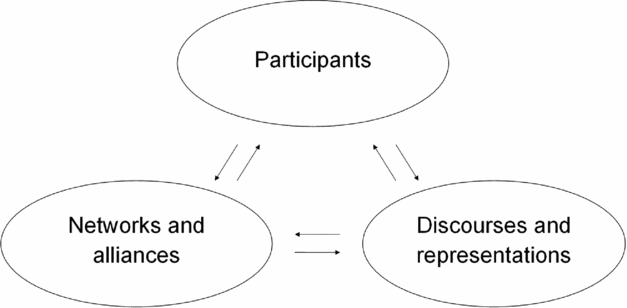
This paper is based on the perception that Greenland fishery reform can be understood as a decision-making process, and our research question is as follows. How have different participants been able to shape the fishery reform process according to their interpretations of relevant problems and right solutions and how have the decision-making participants been re-defined in the process? In answering our question we apply the analytical framework (inspired by Raakjær Reference Raakjær2009) illustrated in Fig. 1.
Decision-making occasions in Greenlandic fisheries governance.

The framework shares Raakjær's argument that insights into the governance process can be obtained by paying attention to the way participants form policy networks around similar or compatible interests and to the way participants apply dominant lines of reasoning in the form of discourses to promote their interest. In this case, the concept of discourse is primarily used to denote a largely closed and self-referential mode of rationalising that has the effect of strengthening that very mode of rationalising within itself. This definition is inspired by Foucault's analysis of power and knowledge (Foucault Reference Foucault1976) by which power is defined in terms of the discursive production of truths. Here, discourse becomes an analytical tool to denote a type of power that is intentional, yet not subjective. In our analysis, the subjects of intentions are re-introduced into the analysis in the sense that we try to identify the participants who promote and reproduce certain discourses to the extent that they come to have a truth-producing and material effect on Greenland law and fisheries governance. Because Greenlandic fisheries governance is characterised by open conflict between different groups and goals in the fishery, we find it relevant to ask the question: exactly which of the discursively constituted subjects managed to shape the truths about problems, solutions and each other that came to matter?
In order to answer this question we start by envisaging the fishery bill reform as a ‘decision-making occasion’ as presented by the ‘garbage can model’ in organisational theory (Cohen and others Reference Cohen, March and Olsen1972). The garbage can model depicts decision-making as an anarchistic process that cannot be captured by simply referring to the rational formulation and strategic pursuit of goals. Decision-making occasions are instead described as ‘garbage-cans’ circulating in an organisation wherein participants, solutions and problems are already present and on the look-out for an occasion to make themselves relevant. A solution from this perspective is not the end product of a rational decision-making process; it is instead a pre-existing fact awaiting the formulation of a matching problem within emerging decision-making occasions. We approach the occasion of the reform of the fishery bill as such a ‘window of opportunity’ for different participants to activate some pre-existing preferred solutions. We are also particularly interested in the way ‘preferred solutions’ are grounded in different discourses about fisheries, necessity and development. The power exerted by policy networks is approached as deriving from the power of the discourses that form ‘existing solutions’ and from the participants’ abilities to apply discourses strategically in new situations. But, as different participants subscribe to different discourses and solutions in the fishery, competing definitions of relevant stakeholder groups also arise. In this model, therefore, ‘participants’ is also a changeable category that too can be affected by the discursive articulation of new identities.
The analytical value of this model is that it connects fishery reforms with power. It is an alternative to the way participants in the field represent problems and solutions as simply being about promoting the, objectively defined, best solution for all. In this perspective, reform is never just necessary. Necessity has to be interpreted. And it is with interpretation that power comes into the equation. Power is here understood as the power to interpret something as problematic or necessary and to represent oneself and others in such a way that new patterns of exclusion and participation become ‘democratic’. Successful participation in fisheries governance is exerted when participants’ preferred interpretations, often grounded in a shared discourse, materialise into actual reform.
The empirical data in this article consists of summaries of parliament debates, fishery bill reform drafts, background reports, stakeholder consultation answers, parliamentary fishery committee summaries and recommendations, coverage of the reform process in the media, observations of public discussions in the media, personal observation of fishery council meetings relating to the fishery reform, personal observations of the Greenland fishery department's work with the reform and informal conversations with stakeholder representatives and fishery managers. The data has been collected during one and a half year of fieldwork (July 2010–January 2012) in Nuuk focusing on the Greenland fisheries governance institutions. We construct a summary of the process from 2000 to 2009 based on document studies, and from 2010 onwards the summary is supplemented by data obtained through participant observation of work within the Ministry of Fishing, Hunting and Agriculture and informal conversation with the managers of the Ministry.
The case of the Greenland fishery bill reform: a history of a fishing society
Fish have played an economic role for Greenland Inuit as a subsistence activity and a local market activity before and during colonial times (Sørensen Reference Sørensen1996; Marquardt Reference Marquardt, Marquardt, Holm and Starkey1999). As a commodity on the world market, fish only started to play a role in the late nineteenth century. The systematic cultivation of fishing along the coast of West Greenland had been advocated in the eighteenth century, but the colonial administration prioritised hunting more or less exclusively from the 1850s (Marquardt Reference Marquardt, Marquardt, Holm and Starkey1999). It was not before the late nineteenth century when the demand in seal and whale products declined, that fishing became the most important economic activity of the then Danish colony of Greenland (Friis and Rasmussen Reference Friis and Rasmussen1989). With the coming of the cod-fishing boom in the 1920s, the fishing industry turned into the most important activity of the colonial trade, represented by the ‘Royal Greenland Trade Company’ and it remained the primary economic colonial and state activity around which Greenland modernisation and welfare policies would come to evolve throughout the 20th century and well into the 21st.
Greenland achieved formal ‘home-rule’ in 1979 and ‘self-rule’ in 2009. At the assumption of fisheries governance responsibilities in 1979, Greenland politicians submitted the fisheries to the dual goal of promoting a self-sustaining national economy while also supporting a Greenland way of life closely bound to the use of natural resources and the settlement pattern of small villages spread out along the coast (Rasmussen Reference Rasmussen1998). The access rights to the Greenland fisheries have been in Greenland hands since Greenland chose to leave the European Community in 1985. The largest sea-food company in Greenland, Royal Greenland Ltd. is the descendant of the colonial ‘Royal Greenland Trade Company’ and has been owned by Greenland self-rule since 1990. Greenland fisheries governance decision-making formally rests with the Greenland self-rule government in consultation with the fishery council in which fishers and industry are represented through their professional interest organisations. A range of self-rule ministries, the Greenland municipalities and the Greenland Institute of Natural Resources have observer status and they are commonly included in the consultation processes as well. It has been argued that actual decision-making is best described by means of paying attention to the informal networks of subject-positions that do in fact transcend these formal categories and channels of participation (Jacobsen and Raakjær Reference Jacobsen and Raakjær2012). This article proposes a similar approach as it aims to understand the coming into being of the 2011 reform of the Greenland fishery bill.
A history of gradual reform
The development of Greenland fisheries and fishery regulations can be read as the history of Greenland national development policy and nation building. Since the early 20th century, the way of administering access to, processing and sales of cod (Gadus mahua), Greenland halibut (Reinhardtius hippoglossoides), cold water prawn (Pandalus borealis) and crab (Chionocetes opilio) have had impacts on the development of Greenland society that cannot be overestimated. During the 1950s and 1960s, central planning sought to transform Greenland into an industrial fishing society, which spurred industrialisation, and the following modernisation defined as increased urbanisation, centralisation of settlements, the development of fish-factory labour, the level of welfare services and nation state building.
The Greenland fisheries have undergone considerable technological development throughout the 20th century, and fishery policy reforms have been implemented gradually (for historical overviews see Skydsbjerg Reference Skydsbjerg1999; Hamilton and Rasmussen Reference Rasmussen and Hamilton2001; Marquardt and others Reference Marquardt, Holm and Starkey1999). Greenland has mandate to elaborate its own fishery bill, the first version of which stems from 1967. Amendments have been gradually included into the bill, some of which have been explicit conservation measures such as the introduction of total allowable catch (TAC) and licences, while others concerned restructuring the fishing fleet. One of the more significant examples of the latter relates to the offshore cold water prawn fishing fleet which was reduced from about 40 participants to 7 from 1990 to 2005 (Greenland 2005). The offshore prawn fishery is today conducted from about 8–10 high-efficient, capital-intensive factory trawlers; a restructuring facilitated by the introduction of individual transferrable quotas (ITQs) in 1990.
Our case study focuses on a structural reform of the coastal fisheries primarily for prawns and Greenland halibut. Coastal fisheries tend to target different species depending on the season. In Greenland, coastal fisheries can also be undertaken in combination with hunting for sea mammals and birds primarily for the domestic market and/or for subsistence. Therefore the socio-economic and cultural value of coastal fisheries may in many cases also be most accurately assessed by considering the role it plays in relation to both the formal market economy and informal local economies, one example is the case of Greenland halibut fisheries in Upernavik district (see Delaney and others Reference Delaney, Hendriksen and Jacobsen2012).
Greenland fisheries reform: the emergence of a ‘grand reform’ discourse
The idea of reforming the fishery bill of 1996 emerged from several concerns, and decision-making followed a unique history. The official version dates the beginning of the reform process to 2003 with a home-rule parliament discussion on some critical effects of the recently introduced ITQ system on the prawn fishery. This system had been introduced in 1990 and 1996 for the offshore and coastal segment respectively with time-unlimited licenses, and a concern was raised in 2003 that the new system granted de facto permanent quotas to the participants involved. The quotas, which hold considerable value as the exclusive right to fish and sell a part of the formerly shared national resource, had been granted to existing Greenland fishing companies and fishers. An expert committee was established to investigate alternative licence systems, but it eventually concluded that the current system of permanent ITQs generally worked as intended and ought to be preserved (Greenland 2005). In 2004, the government presented a structural policy in the fishery to the parliament. It identified a context of global markets and increased competition and foresaw a need for the coastal fishery to develop into a more profitable industry characterised by growth, fewer and larger vessels equipped with newer technology and a better educated workforce. State subsidies to the fishery and concerns for local politics and employment were identified as challenges to these visions (Greenland 2004). The report claims to be largely based on the Government's structural-political action plan ‘A vision for the future’ from 2000 (Greenland 2000) and the foci of the vision for the report strongly reflect those of the plan. Fishery stakeholders had been consulted at a conference held in June 2004, but the influence of this consultation is not clear from available historical sources.
In 2007, the government published a proposal for a fishery bill reform that it presented for consultation with fishery stakeholders. A foreword to the proposal states that the proposal attempts to incorporate the concerns expressed in parliament in 2003 and to consider the above mentioned structural-political action plan, the structural policy in the fishery and the conclusions of the expert committee concerning the ITQ system. This amendment tried to reconcile a critical concern about the de facto ownership constellations emerging from the ITQ system with a continued vision of increased privatisation, profitability, concentration and growth in the industry. The proposal included eleven amendments of which six offered a more precise formulation of the ITQ system including a specification of the state's right to withdraw them. Other amendments included a demand for fisher ownership of fishing vessels, user fees, data collection from users and less emphasis on local employment when such is at odds with biological sustainability. 43 per cent of the TAC for prawns had been reserved for the coastal fleet-segment which is as a rule obliged to sell all of their catch to land-based processing facilities, thus facilitating local employment along the coast. The offshore fleet segment on the other hand is allowed to process its 57 per cent of the TAC on-board the vessels. The proposal included a merge of the divided TAC in order to allow for even greater consolidation within the coastal prawn fishery.
The proposal was met with criticism from both fisher interest organisations. The Association of Hunters and Fishers in Greenland (KNAPK) that represents the larger number of coastal fishers, mostly Greenlandic speaking, criticised the proposal for not being available in Greenlandic. Both KNAPK and the Employers’ Association of Greenland (GA) found that the recommendations were rushed through, and the parliament urged the government to postpone the decision and establish a fishery commission. In 2007, a comprehensive reform was thus postponed and a fishery commission was established.
The commission comprised fourteen members: an economist from the University of Southern Denmark was appointed chairman of a working group consisting primarily, but not entirely, of the common consultation partners in Greenland fisheries governance, namely the members of the fishery council. The organisations represented were: KNAPK; GA; the Greenlandic Workers Union (SIK); Arctic Green Food; Royal Greenland; Polar Seafood; the Greenlandic Institute of Natural Resources (GINR); the Greenlandic Fisheries Licence Control (GFLK); the organisation of Greenlandic Employers (NUSUKA); each of the (two) banks operating in Greenland; the Economy and Personnel Agency under the Ministry of Finance; the Ministry of Finance iself; and the Ministry of Fishing, Hunting and Agriculture. We note the fact that out of fourteen participants, the small-scale coastal fishers and the workers at the processing factories were only represented by one member each. None of the municipalities, which express concerns for local employment, were represented though their umbrella organisation (KANUKOKA) which is a member of the fishery council. In turn, two banks were represented although not being members of the fishery council. The ministries did not convert their fishery council membership into fishery commission participation either. The Ministry of Finance on the other hand, took on a far stronger representation than it normally does in relation to other aspects of Greenland fisheries governance (see also Jacobsen and Raakjær Reference Jacobsen and Raakjær2012). Altogether, this indicates a decision-making occasion attracting the heavyweights of the Greenland financial sector.
This distribution of representation in the commission is interesting because one of the core ‘solutions’ proposed by the commission was to merge fishing quotas and to abolish the obligation to land, thus affecting factory workers negatively, and allowing for larger concentration of ownership which will probably also mean the exclusion of the many smaller-scale fishers in the long term. One may also notice that the Ministry of Finance and the Personnel Agency (under the Ministry of Finance) was represented by two top-level administrators in Greenland self rule who are commonly known to be among the most influential officials in the Greenland administration. The relationship of the commission members will be analysed later in connection with the 2010 consultation where it becomes clear that a network consisting of about half of the fishery commission members, the Ministry of Finance, the large-scale industry and the banks, supported the changes suggested by the fishery commission, whereas the remaining participants disagreed with one or more of the key problem-solution constructions.
Further attempts at reform awaited the conclusions of the commission that reported in January 2009. The foreword of the report formulates the problem in a new context, namely the need to reconsider the 2003 political discussions. The reason was that parts of the industry estimated that the abolishion of the ITQ system would have a long-term negative effect on the development of Greenland fisheries (Greenland 2009: 6). In accordance with a discourse on the relatively larger national-economic contribution of large scale offshore fishing operations vis-à-vis the small scale coastal segment, the commission concluded that in order to make the Greenlandic fishery more profitable and create more public revenue, it is necessary to (a) facilitate a take-over of the capital-intensive offshore fleet from the existing owners. The value of the offshore trawler had reached such a level that it was deemed difficult to find buyers within Greenland. They therefore suggested to change the fishery bill so that it allowed for non-Greenland participants to buy into the fishery. The second conclusion was to (b) allow for foreign ownership and investment in Greenland fisheries. The report also concluded that it was necessary to (c) allow for processing on board or landings abroad and thus abolishing at least partly the obligation to supply land-based factories; (d) impose a resource rent to increase state revenue from the fisheries and; (e) abolish the fixed allocation of the prawn TAC between the coastal and offshore segment. Overall the commission and its mandate played an important role in formulating a need for a reform of the fishery bill that could support the development of the industry with the help of increased capitalisation, consolidation and ownership concentration (Greenland 2009). In spite of the fact that these issues are controversial, considering the effect they are likely to have on the coastal segment of the fishery, the fish factory workers and local fishing-dependent communities and municipalities, the report did not prompt any public debate at the time.
The commission's recommendations were pursued by the new government that came into office in 2009. In 2010, they proposed a reform of the fishery bill that was in congruence with the commission's recommendations to maintain the ITQ system and abolish the obligation to land the catches to land-based processing in Greenland. This government represented a considerable shift in the party political make-up, having included the parties Inuit Ataqatigiit (IA), Demokraatit and Kattusseqatigiit Partiiat and left the Siumut party to the opposition for the first time in the history of Greenland home- and self-rule. Atassut formed part of the opposition in 2010 as well. The party-political landscape was originally structured around standpoints vis-à-vis Danish rule and independence, and it has been argued that this has remained the only stable point of orientation for Greenland political parties today (Andersen and Tonsgaard Reference Andersen, Tonsgaard and Winther2003). In that respect, Siumut and IA were both important vehicles for the independence movement leading to home rule in 1979, while the Atassut party represented a more conservative stance. Still, most Greenland parties also have a Danish sister party, which are organised along a left-right continuum. The Demokraatit party (established in 2002) and the Atassut party consider themselves liberal, whereas both IA and Siumut are respectively leftist and centre-leftist (compared to Danish standards). The most common analysis of the electoral shift leading to a new government in 2009 is however not so much related to aspirations to a new balance of left-right politics as to fatigue with the Siumut regime. The IA stated the day before the election that it would bypass Siumut if it won. Thus, the most left wing party joined forces with the most liberal party in Greenland, bypassing the centre-leftist party in the middle. In Jacobsen and Raakjær (Reference Jacobsen and Raakjær2012) this coalition is described as a ‘new paradigm’ in Greenland fisheries governance. It represents itself as a break with former decision-making practice in conservation (TAC) policy connected with the former Siumut-led government. The Siumut party represents itself and is represented by others as being very responsive to fisher demands and willing to grant, on demand, TACs that are higher than biologically advised. We observe that this new government also participated in the discourse of the ‘grand reform’ when it presented the 2010 proposal for a new fishery bill.
Policy networks and the grand reform
In understanding the policy-making process we have followed the use of network analyses in Nedergaard (Reference Nedergaard2007) and Raakjær (Reference Raakjær2009) and believe we can strengthen our analysis by supplementing it with a policy network analysis in order to capture the political and economic interests of the participants and understand their policy positions.
The 2010 proposal for a new fishery bill, heavily influenced by the recommendations of the fishery commission but also by the 2003 debate, went into consultation with the stakeholders’ organisations of the fishery council. These consulted parties comprised various ministries, KNAPK, GA, NUSUKA, SIK, KANUKOKA, GFLK, GINR, the private sea-food company Polar Seafood as well as the self rule owned sea-food company Royal Greenland Ltd. Additional parties outside the fishery council were also consulted: the European Directorate-General for Maritime Affairs and Fisheries (DG-MARE), the two banks operating in Greenland and two Greenlandic auditing companies (Deloitte and Grønlands Revisionskontor). One might observe that this seems a formidable list for a country of only 56,000 inhabitants.
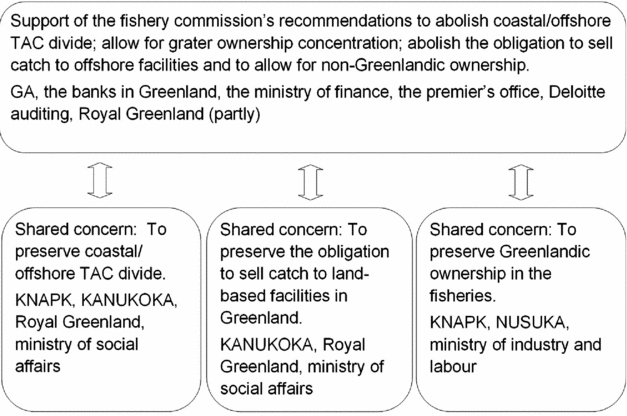
Fig. 2 presents our policy network analysis in 2010 in relation to the proposed changes in the new fisheries bill. The large-scale industry, the Ministry of Finance and the banks, corresponding to about half of the original members of the fishery commission, together with the two auditing companies and now also the premier's office jointly supported the major changes: to facilitate sale of the existing capital-intensive fishing companies by allowing for non-Greenlandic ownership; increase profitability of the fishers/fishing companies by allowing for the coastal and offshore segments to buy up quota from each other; and increase profitability of the fishing companies by removing the obligation to land the catches to processing facilities located in Greenland.
Grouping of participants based on key points of contest over the 2010 proposal for reform of the Greenlandic fishery bill; the upper part of the figure represents the actors supporting the ‘grand reform’.
As shown in Fig. 2, two different political positions were expressed by two different networks: the ‘grand reform’ and the ‘protectors of coastal fisheries’ although the latter was not as united as the former.
The ‘grand reform’ network comprised the Premier's Department, the Ministry of Finance and GA on behalf of its members in the fishing industry, the two banks operating in Greenland and the auditing company Deloitte. This network actively advocated comprehensive reform of the coastal fishery that would lead to greater concentration and liberalisation in support of prevailing scientific opinion that fishing effort needed to be reduced to avoid over-exploitation. Thus, they had a strong interest in adopting radical reforms to accommodate conservation concerns and firmly believed in ITQs as the most appropriate tool rooted in what Degnbol and others (Reference Degnbol, Gislason, Hanna, Jentoft, Nielsen, Sverdrup–Jensen and Wilson2006) have described as a technical fix, often leading into a tunnel vision and diverting attention from other potential solutions by focusing exclusively on ITQs. Fisheries reforms will always produce winners and losers (Jentoft Reference Jentoft2006). It is obvious that reform largely based on introducing ITQs in all Greenland fisheries would provide the ‘grand reform’ network a great victory, because the reform of the fishery bill would be hugely beneficial for the larger fishing companies, improve the value of collateral for the banks.
Although we portrayed the ‘protectors of coastal activities’ network as one grouping in disagreement with one or more of the suggested amendments, the reality was the network faced internal disagreement over the most central amendments. Thus, this network did not present a unambiguous and coherent policy as did the ‘grand reform’ network. The different participants in the ‘protectors of coastal activities’ network presented a range of individual suggestions of some have not been included in the figure. A full understanding of the interests of each group of participants would demand a more detailed presentation than is offered here. For example, KNAPK had 19 suggestions ranging from new financing options including public investments, better administration, further restriction on ownership concentration and a new allocation key between offshore and coastal TAC that raised the coastal quota from 43 to 50 %. None of the protectors of the coastal activities argued for allowing non-Greenland ownership, but some left this topic uncommented upon. The obligation to land, however, was an internal point of contestation. KNAPK supported the abolition of the obligation to land. The fishers, KNAPK argued, have an interest in receiving as good a price as possible for their fish, and the monopoly of land-based processing plants (mostly owned by Royal Greenland) is a problem to the fishers who have often sought to establish private and fisher-owned alternatives. In its consultation statement, KNAPK explained that since most of the landed catch is frozen and sold for export without greater local refinement, the price received for landed fish is so low that it hardly makes sense for fishers to sell the fish. The municipalities, however, have a strong interest in the employment that local fishing activities and land-based processing industries create and to which there is little alternative at present. In their consultation statement they express a strong wish to preserve the obligation to land until a secure and real development of the non-renewable natural resource extraction industry has evolved. This position is in direct contrast to the judgements that inform the ‘grand reform’ discourse and the 2010 proposal: that employment concerns should no longer dominate fishery policy and that labour should be released for the extraction industry.
Royal Greenland was against both the abolition of both the coastal/offshore TAC division and the obligation to land. But as a participant already engaged in ITQ fisheries, Royal Greenland also supported the ‘grand reform's resistance towards a specification of the state's right to take back the ITQs (here with eight-year notice). They argued that the right to take back the ITQs would have a negative impact on attracting new financing in the fisheries. Royal Greenland was also against further reduction of ITQ concentration as this would imply that they had to sell some of its shares in vessels and companies and thus, limit and decrease their financial activities. Royal Greenland supported an increase of the offshore quota from 10 to 15 % and an allowance of up to 25 % foreign ownership in the fishery. In that way, Royal Greenland had a foot in each policy network depending on the issue; a circumstance that reflects the historical role of Royal Greenland in Greenland's industrial history very well as a state-owned company simultaneously engaged in offshore industry and the coastal fishing and processing activities. Royal Greenland had stakes in both the offshore and the coastal fisheries as well as in on-board, coastal and international sea-food processing.
None of the networks backed the 2010 proposal in its entirety, and after the 2010 consultation process and the first reading, the new fishery bill was postponed to the next parliament session in spring 2011. In the Ministry of Fishing, Hunting and Agriculture there was still a will to facilitate fishery reform in line with the ‘grand reform’ discourse: the new permanent secretary of the ministry took up his position in 2010, and one of his primary ambitions was to facilitate the reform of the fishery bill. In this process, the ministry was reorganised bringing all fishery related administration under one hat and located in the same building. The minister worked at creating a broad political support for the next proposal within and across political parties. Building support within IA presented a challenge. The fishery department under the ministry worked to engage the relevant fishing organisations in dialogue (RG, KNAPK, Polar Seafood and GA) and invited them to meetings. But these meetings neither managed to build consensus among the diverse stakeholder groups presenting very conflicting interests, nor, as the managers had hoped, made them come up with concrete suggestions for new amendments for the next proposal (R.B. Jacobsen, personal observation at the Ministry of Fishing, Hunting and Agriculture. September-November 2010). Still, the government was pushing the fishery department to continue the reform process.
The minister was able to present a revised fisheries bill to parliament in spring 2011. This bill was much less radical and comprehensive, presenting only two amendments to the current bill. The paragraph known as the ‘rubber boot paragraph’, in which the fishery bill only allowed for investments in fishing by non-fishers, was removed. Another paragraph constraining maximum quota ownership to 10% was amended to allow for 15% ownership. We observe that these two amendments support the interests of the ‘grand reform’ network. Meanwhile, the obligation to land was not abolished, the TAC remained divided and foreign ownership was not allowed. Nevertheless, it was exactly the concerns of the ‘grand reform’ and not the concerns of the ‘protection of coastal activities’ network that set the agenda and which was to be further promoted or resisted. With the 2011 amendments it was Royal Greenland, positioned across the two policy networks, which appeared as the participant which had most of its interests met and this makes it a very interesting actor in Greenland fisheries governance. However, the minister stressed that this was only to be the first round of amendments to the fishery bill, and that they would be followed up with amendments relating to aforementioned issues in spring 2012. However, no new amendments were presented to the parliament (January 2013).
This summary leads to several conclusions in regard to the participants, discourses and networks influencing the fishery reform process. The process started in 2003 with a critical reaction to the ownership effects of previous ITQ reforms introduced in 1990 and 1996. But a ‘grand reform’ discourse had emerged and manifested itself from early structural policy reports in 2000 and 2004 to a positive evaluation of the ITQ system in 2005 and the fishery commission report in 2009. The establishment of the fishery commission in 2009 was prompted by a reaction of ‘parts of the industry’ to political unease about the existing quota system, expressed in 2003. With the establishment of the ITQ expert committee (Greenland 2005) and the fishery commission, the original agenda for fishery bill reform was turned around, promoting continued concentration and liberalisation. The problems and solutions identified by the fishery commission laid out a ‘grand reform’ discourse that managed to set the agenda for the fishery reform work in 2011. The commission included a wide range of stakeholders, yet there was an overweight of state departments, large scale companies and auditing firms: the exact same group of participants that supported the ‘full proposal’ in the 2011 consultation.
While the discourse of the ‘grand reform’ was fixed in terms of problems and solutions, our observations of the process after 2010 also reveal that the participants interested in this reform worked for an even broader political backing of the reform among the political parties as well as among the coastal fishers’ organisations. But such consensus did not materialise. From 2010 to 2012, however, some but not all central aspects of the ‘grand reform’ were pushed through anyway. The ‘grand reform’ was not introduced all at once. Instead, only few amendments to the actual fishery bill were made to allow for larger concentration in ownership and greater investment in the fishery as well as for the sale of existing quota shares and fishing companies. Meanwhile, the discourse on the necessity of change and the prospects of larger-scale operations also informed a new regulation on Greenland halibut that was produced by the ministry. This new regulation introduced the ITQ system into the coastal fishery for Greenland halibut (See Jacobsen Reference Jacobsen2013a for an analysis of this process), thus expanding the ITQ system considerably. Furthermore, the discourse of the fishery commission continues to make itself relevant to new decision-making occasions: from 2010 to 2012 one of the authors participated in a working group under Greenland's self rule that was to provide an analysis of possible adaptation strategies in the fishing and hunting professions. In this group none of the members of the aforementioned ‘grand reform’ network were present. The final report briefly discussed pros and cons of the structural reform promoted by the fishery commission without providing any final conclusion as to what was the ‘best’ development, recognising that questions of access rights to fishery resources is also a question of interests and politics. When the report was sent out for consultation, the Ministry of Finance asked the working group to formulate its suggestions for adaptation in line with the government's political strategy for fishery reform. The group chose not to do this. The Minister of Housing, Infrastructure and Transport (under the auspices of which the report was written) and the Minister of Fishing, Hunting and Agriculture eventually wrote a foreword for the report through which the ‘grand reform’ discourse was re-activated. The last paragraph states that further strategic recommendations based on the report ‘shall be closely linked to existing plans for making the fishery and hunting more efficient and to strategies for development in the regions, the tax and welfare commission, the fishery commission and that they should be integrated into the broader sustainability work’ (Greenland 2012). A picture thus emerges of a ‘grand reform’ being implemented by gradual reform as windows of opportunity opened up in the form of new decision-making occasions within but also outside the forum of a fishery bill reform.
While the stakeholders in this analysis are approached on the level of interest organisations and thus as somewhat stable categories, they can also be analysed as subjects-in-the-making during the reform process. The implications of the reform and the relative power of different groups to influence the reform process was in fact vividly debated in parliament in connection with the two amendments to the fishery bill in 2011. The next section analyses the way participants represent each other as participation and democracy became objects of contestation.
The end to inertia and the redefinition of participants and democracy
In spite of the reduced number of amendments, ‘grand reform’ did become actual with the 2011 parliamentary proposal. This represents an end to years of reform inertia, at which point the 2011 parliamentary decision-making event becomes theoretically interesting: what brought an end to inertia after eight years of proposed and rejected proposals?
The political party composition in the parliament played a key role as the amendments were eventually decided upon by a majority vote where all parties in the coalition government voted in favour of the proposal, but the opposition parties, Atassut and Siumut, voted against. When the coalition government presented the 2011 proposal, it was met with great resistance from the opposition. KNAPK had expressed its non-support and arranged demonstrations in front of the parliament, a mode of participation that has proved efficient on previous occasions (Jacobsen and Raakjær Reference Jacobsen and Raakjær2012). The main concern of Siumut and KNAPK was the risk of fishers being squeezed out of the fishery and of an independent profession being submitted to dependence on financially stronger others; they were concerned that independent fishers would be reduced to deck men. They also presented a range of what they perceived as the deeper structural problems within the fishery, problems that the current reform would not address.
Still, parliamentary majority was secured without the support of Siumut, and arguably also without the support of small-scale fishers, and the government eventually pushed the reform through by majority vote. The party-political schism can be analysed as a conflict between two discursive positions expressing two different tendencies in Greenland development discourses. One represents the pre-2009 election system in which the coastal fishers were given more or less direct access to political decision makers (see also Jacobsen and Raakjær Reference Jacobsen and Raakjær2012) and in which continuous postponing of any fishery bill reform was accepted. The other represents a new paradigm in which biological sustainability received prioroty over immediate (or what is represented as immediate) socio-economic concerns and where ‘hard decisions’ are believed to be necessary in order to secure economic and biological sustainability of the fishery. But as the new government so openly pushed for this structural reform, this paradigm also echoed the discourse underpinning the conclusions of the fishery commission and it has thus positioned itself within the ‘grand reform’ network, though not completely. It has been unwilling to move forward without the full support of Royal Greenland, and Royal Greenland came to play an important part in the final battle over meaning fought in parliament.
The decision of the government to reform the fishery bill was followed by an intense debate in parliament during the first reading of the 2011 amendment (R.B. Jacobsen, personal observation, 13 April 2011). The debate soon hardened as the opposition attacked the democratic legitimacy of the government's decision-making on two grounds: 1) It failed to take into account the perspective of those most directly impacted, who they defined to be the coastal fishers and 2) it represented only the interests of ‘large capital’.
Members of the government who promoted the reform, in turn presented various counter-arguments in which they re-interpreted democratic legitimacy as synonymous with parliamentary representation. Moreover, they emphasised the need to move ahead, as opposed to the opposition's alleged lack of will to do so.
Later in the debate, the coalition government was again confronted with Siumut's accusations of undemocratic behaviour, which made the IA spokesperson emphasise the legitimacy of a voted-in government and the concerns of the general public.
The Minister of Fishing, Hunting and Agriculture presented a different representation of democratic behaviour by re-interpreting the participants in the large-scale industry. She reinterpreted ‘the impacted coastal fishers’ as a category as she argued that while GA members may not outnumber non-GA members among the country's fishermen, GA members do however have a majority of ownership of the quota. In this way, majority is no longer based on number of humans but on relative quota possession, which, arguably, changes the field in favour of participants with strong economic interests.
For the second reading, the Minister of Fishing, Hunting and Agriculture had composed a new argument in response to the accusation of not listening to the fishers. In her opening presentation she contested the very definition of fishers as she redefined the category of fishers to include large-scale companies and their office employees as well. In the same vein she redefined what ownership de-concentration meant, namely several owners of a given fishing company (R.B. Jacobsen, personal observation, 7 November 2011).
The decision of the government to go through with the prepared reform was debated publicly. The decision was already made, but the parliament became an important scene for a different type of negotiation: now that the end to reform inertia so obviously represented a shift in the balance of stakeholder influence, participation and democracy itself became the object of negotiation. Siumut in opposition represented the government as undemocratic because it did not listen to the fishers and because it only served the interests of ‘large capital’. Members of the government (primarily IA) responded to this representation with various counter-interpretations. Firstly, they stated that the proposal was to the fishers’ advantage, as it would facilitate a better economy in the fisheries. Secondly, they represented the resistance of opponents as non-cooperativeness. Thirdly, they redefined what coastal fishers and ‘majority’ really meant. The opposing discourses resonated with a century old discussion of democracy, that of the legitimacy of the representative government versus more direct modes of participation. But claiming majority and cooperation seemed to be the most important party-political strategy still.
Conclusion
The reform of the Greenlandic coastal fisheries had been long underway and is continuing. The need for reform in the coastal fishery slowly came to be defined mainly by large-scale fishery participants, the two banks operating in Greenland, self rule ministries and auditing companies. This need for reform, identified as ‘the grand reform’ relies on a certain economic rationality promoting private ownership, market mechanisms, effectiveness but also ownership concentration. This discourse has broadened into an alliance with the 2009–2013 government. Paradoxically, political debates in the parliament started with a critical examination of the existing ITQ system, but with the expert committee on ITQ and the fishery commission report, the agenda changed into a cementation of the development discourse that promotes further concentration and capitalisation in the fishery. A ‘grand reform’ discourse emerged. Yet, it was repeatedly blocked by deliberative politics until a change in Greenlandic voting behaviour brought a new government to power in 2009. This represented itself as a break with former practice in fisheries governance regarding biological sustainability. But the government also appeared to represent a break regarding fishery reform inertia: in 2011 the ‘grand reform’ took a significant leap forward through the amendment of two paragraphs in the fishery bill and the new regulation on Greenland halibut.
The ‘grand reform’ could not be implemented in its entirety through parliament decision-making on a new fishery bill, but has been gradually introduced at other decision-making occasions within the more administrative sphere of the Ministry of Fishing, Hunting and Agriculture. In 2012 a new regulation introduced ITQ into the coastal Greenland halibut fishery in order to make it more profitable and efficient; a solution that had been intensely promoted by the participants of the ‘grand reform’ network (see Jacobsen Reference Jacobsen2013a). Furthermore, the ‘grand reform’ network continues to insert the recommendations of the fishery commission, and thus the ‘grand reform’ discourse, into new decision-making occasions such as climate change adaptation strategies. The ‘grand reform’ discourse only partly succeeded in the fishery bill reform process, but it did succeed in the implementation process, and the effect is almost the same: Greenland's two most important fisheries, those for prawn and Greenland halibut, are now being managed through ITQs in line with the logic of the ‘grand reform’ discourse which aims at reforming Greenlandic fisheries into a more efficient and capital intensive industry benefitting from large-scale organisation.
We thus conclude that this fishery reform did not start from a collective recognition of a problem in marine resource use. Instead, the fishery reform is analysed as eventually ‘belonging’ to an identified policy network within the broad ensemble of participants in the Greenland fisheries governance institutions. Secondly we conclude that, when confronted with a lack of broad support, it took the will to make use of majority parliamentary power and a redefinition of stakeholder-ship and democratic participation to overcome fishery reform inertia. But the reform was also pushed through as the ‘grand reform’ discourse influenced new regulations and continues to direct the formulation of other structural strategies such as climate change strategies. Thirdly, this ending of inertia involved the exclusive inclusion of some stakeholders, the voter's majority and the large-scale industry, as well as the bypassing of participants that have traditionally had more influence: the many coastal fishers represented by Siumut and KNAPK. Not surprisingly, the emergence of this new relationship of power was followed by contestations over participation and democratic legitimacy in which participants were re-defined.
Perspectives: the role of new stakeholder constructs in fisheries reform
Greenland can, together with other Arctic regions, be characterised as post-industrial in the sense that a very small percentage of the population is employed in fishery and industry. Internationally, talks of new fishery constituencies have arisen, inviting various non-fisher stakeholders onto the scene of legitimate fisheries governance decision-making. Such new stakeholder constructs particularly tends to include as new participants those with environmentalist interests and public concerns for biological sustainability. In addition, the concern of how best to develop Greenland's general welfare services is intimately bound to fisheries governance due to its economic importance, whereby the profitability of each entity in the fishery, as the case shows, becomes interpreted as the concern of all citizens.
The tendency to expand the legitimate stakeholders in fishery matters has been described as a ‘paradox of participation’, marginalising some of the traditional ones (Suárez de Vivero and others Reference Suárez de Vivero, Mateos and Florido del Corral2007). This is evident in our case with regard to smaller scale coastal fishers. Meanwhile, the increase in stakeholders in Greenland has seemingly strengthened the influence of other traditional stakeholders such as large-scale fishing companies. So one may add that in the Greenland case, the paradox of participation does not impact equally on traditional fishery stakeholders where larger scale stakeholders, represented by GA, have successfully engaged in alliances with the new stakeholders and achieved outcomes that were blocked before. Others (Mikaelsen and Jentoft Reference Mikaelsen and Jentoft2003) have argued that there is a moral need to invite a broader range of interests into fisheries governance decision-making otherwise monopolised by industry and fishers’ interests. One may argue that Greenland is already in the process of out-living this vision; the constituency of the new government was represented as the democratic fishery stakeholder par excellence during the debates referred to above. The lack of efficiency has been suggested as one of the main drawbacks of an increase in stakeholders. However the case of Greenland fisheries reform shows that it was the coming into being of a powerful new stakeholder construct, which facilitated a reform flow after a long period of inertia. But as the efficiency of this new stakeholder construct in implementing the reform also relied on the exclusion of alternative discussions and of the influence of other stakeholders, it becomes difficult to assess whether what emerged was an expansion stakeholder numbers or a replacement of some by new ones. What is more clear is that if we perceive fishery reform as always being someone's reform, the question of how to overcome inertia in fisheries governance today may be approached by paying attention to policy networks and the ability of participants to defend new patterns of participation and exclusion of fisheries stakeholders through the very re-construction of participants, participation and democratic decision-making.
The challenges of a small society, which has a major stake in fishing, is a unique contribution that the example of Greenland makes to the literature on fishery policy making. In contrast to larger polities such as the EU, fishery reforms in Greenland are immediately recognised by local participants as representing a democratic challenge that transcends fishery policy. The policy networks defined as the ‘grand reform’ and the ‘protectors of coastal activities’ are not retained to issues of fisheries, but expand into the heart of democracy and national development. The ‘grand reform’ network is generally supporting economic reforms focusing on the market and globalisation using economic forces to foster development, whereas the ‘protectors of coastal activities’ network in general is concerned with upholding coastal communities and maintaining status quo. That fisheries policy is intimately bound to political outcomes at a national level became clearly evident in March 2013 when a new government was elected and Siumut returned to power. The change of power echoed the words of IA politician Aqqaluk Egede when he defended the two fishery bill amendments in parliamentary debate: ‘if things do not go according to the will of the people, then others will be elected. That is where democracy is anchored’. Policy networks such as the ‘grand reform’ network are generally influential, but still at the mercy of the very institution of national parliament elections. Space does not allow for a detailed discussion of democracy and fishery policy in Greenland here, but the subject is pursued in Jacobsen (Reference Jacobsen2013b), in which it is argued that through the formation of fishery policy networks, Greenland is deeply engaged in a process of radical democratic politics (as defined by Laclau and Mouffe Reference Laclau and Mouffe1985) in which the very constitution, promotion and out-phasing of identities are at stake.
Acknowledgements
This research was supported by the Faculty of Engineering and Science at Aalborg University and by the Greenland Climate Research Centre. We are thankful to staff at the Greenland Ministry of Fishing, Hunting and Agriculture and the Greenland Institute of Natural Resources for allowing us to observe meetings and work within the realm of Greenland fisheries governance institutions. We thank Maria Nakhshina, Franz Krause and the anonymous reviewers for their dedicated review of the original manuscript. Nevertheless, any omission or error in the manuscript reflects upon the authors alone.