Introduction
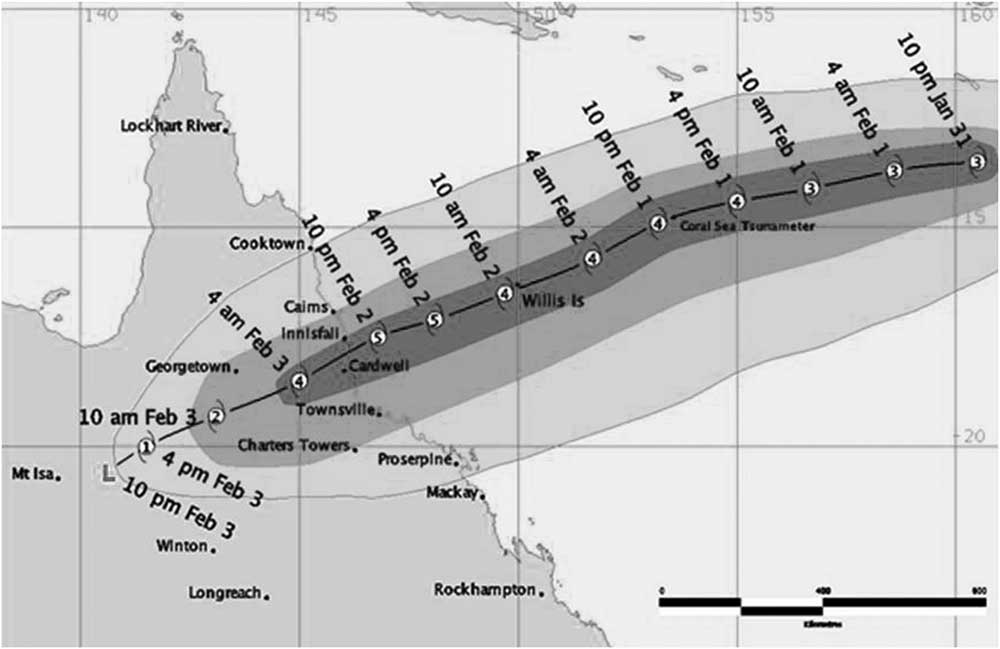
Tropical cyclone (TC) Yasi is thought to be the largest and most severe cyclone to cross the Queensland coast since 1918.1 In February 2011, the cyclone made landfall on the southern tropical coast near Mission Beach and continued to track westward across Northern Queensland, Australia before weakening to a tropical low near Mount Isa (Figure 1, color online). The associated damaging winds and rain wreaked havoc across the region, affecting coastal areas between Townsville and Cairns. In particular, the towns of Tully, Cardwell and Mission Beach suffered major damage to both infrastructure and vegetation.1 No one died as a result of TC Yasi but a number of coastal towns suffered significant infrastructure damage.
Tropical Cyclone Yasi forecast track map released by the Australian Bureau of Meteorology at 6pm February 1, 2011.1 Darkest shade indicates very destructive winds, medium shade indicates destructive winds, and light shade indicates gale force winds. Creative Commons (CC) Attribution 3.0 Australia License

The warning and response model (WRM) suggests that situational factors (physical cues, social behavior, risk communications); personal characteristics (age, education, disaster experience); and social contextual variables (family, relationships, community involvement); influence the degree of threat perceived and protective actions taken.Reference Hobfoll2–Reference Perry and Mushkatel5 Basically, the model predicts that individuals will take protective actions if: (1) they believe the disaster threat exists and poses significant risk; (2) taking protective action is feasible; and (3) they have the traits (for example, self-efficacy), skills and access to resources to effectively implement protective strategies.Reference Sattler, Preston, Kaiser, Olivera, Valdez and Schleter6 According to WRM theory, Sattler et al (2000) proposed that when confronted with a disaster, persons with previous experience will be  $$$\raster="fx1"$$$
1) more likely to acknowledge a disaster threat; (2) readily experience psychological distress; and (3) choose an appropriate course of action.Reference Sattler, Kaiser and Hittner7 In addition, persons who have experience with disasters are more likely to prepare adequately when a disaster threatens. However, at times experience can lead to complacency resulting in experienced people taking a more relaxed attitude to the perceived threat and leaving preparation to later.Reference Sattler, Kaiser and Hittner7
This study examines preparation for this impending natural disaster by residents of the affected regions, and identifies the residents’ resource losses and symptoms of psychological distress following TC Yasi.
Method
Sample and Procedure
This study utilized a cross-sectional design. Six to 12 months after TC Yasi occurred, a survey was made available to affected residents after approval from a university human ethics research committee (HERC H4116). The survey was available electronically and in hard copy at local libraries for those unable to access the electronic version of the survey. Requests for residents to complete the survey were distributed through the local media including newspapers and radio, signs at local community venues including libraries and events such as local markets, as well as through a web page hosted by the local university.
Measurement Tool
The survey tool was adapted from the questionnaire used to study survivors of Hurricane Georges (see Appendix online).Reference Sattler, Preston, Kaiser, Olivera, Valdez and Schleter6 The survey consists of 11 sections, as follows:
(1) demographic questions (eight questions);
(2) questions about the timing of preparedness efforts, including one question that assessed perceived level of preparedness (nine questions);
(3) two questions about property damage and insurance;
(4) five questions about loss of services and return to work or study;
(5) six questions about personal characteristic resources (eg, sense of optimism, feeling that you have control over your life);
(6) five questions about condition resources (eg, family stability and closeness with friends);
(7) three questions about object resource loss (sentimental possessions and transport);
(8) two questions regarding energy resources (free time and time for sleep);
(9) three questions about object resources (food, medication and money);
(10) five questions related to psychological distress (eg, “I avoid things that remind me of the cyclone”); and
(11) two open-ended questions about overall thoughts regarding the cyclone and current feelings about the cyclone.
The questions in sections seven to nine relating to losses and changes in resources experienced due to TC Yasi were scored on a four-point scale from 1 (no change), 2 (minor change), 3 (moderate change) to 4 (major change), or 1 (no loss) to 4 (major loss). The questions in section 10 relating to emotional changes caused by TC Yasi were scored on a four-point scale from 1 (no change) to 4 (major change). The initial version of the survey was piloted with 10 volunteers and revised prior to distribution.
Statistical analysis was conducted using SPSS version 20 (IBM SPSS Inc, Chicago, Illinois, USA). Categorical characteristics were described using sample size and percentages. Approximate 95% confidence intervals (95% CI) for binomial variables were calculated for main results.
Results
A total of 433 responses were received; 223 (51.5%) electronically and 210 (48.5%) in hard copy. The 433 respondents were residents of towns affected by TC Yasi and located between Cairns (n = 139; 32.1%) and Townsville (n = 62; 14.3%) (Figure 1) including the coastal communities of Babinda (n = 12; 2.8%), Innisfail (n = 42; 9.7%), Mission Beach (n = 72; 16.6%), Tully (n = 52; 12.0%), Cardwell (n = 35; 8.1%), and Ingham (n = 19, 4.4%).
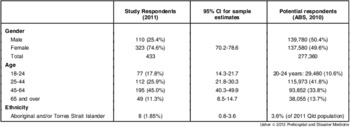
Of the 433 respondents, 323 (74.6%) were female. The age distribution of respondents was bimodal with 17.8% aged 18 to 24 years and 36.3% aged 45 to 59 years. The majority of respondents identified as Caucasian (90.8%), while eight respondents (1.8%) were of Aboriginal and/or Torres Strait Islander descent. A comparison of survey respondents with potential respondents (Table 1) shows that the survey over-represented female residents and people aged 18-24, as well as people aged 45-64 years. People aged 25-44 years were under-represented by approximately 15%. People aged 65 years or older were correctly represented, as was ethnicity. The majority of respondents was married or in a de-facto relationship (65.1%). Of all respondents, 84 (19.4%) were students, 255 (58.9%) were employed, 13 (3.0%) were unemployed and 81 (18.7%) were retired.
Comparison of Demographics of Survey Respondents to Total Potential Study Population

Abbreviations: ABS, Australian Bureau of Statistics; Qld, Queensland
When TC Yasi made landfall, most respondents (n = 254; 58.7%) were at home, 94 (21.7%) were with family and/or friends in the same town as their home, 66 (15.2%) were in another town, and 19 (4.4%) were in a cyclone evacuation center.
Preparedness
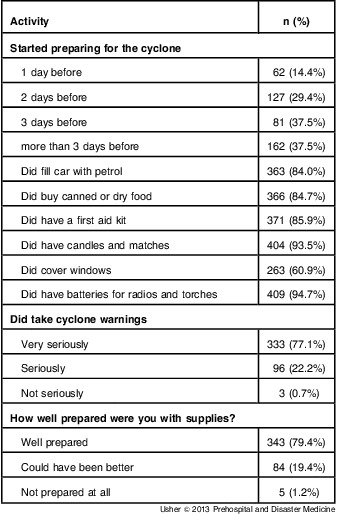
Almost all respondents (n = 429; 99.3%; 95% CI, 98.5%-100%) took the cyclone warning as serious or very serious (Table 2). More than a third (n = 162; 37.5%; 95% CI, 32.9%-42.1%) of respondents started preparing for the cyclone at least three days before landfall and a majority (n = 343; 79.4%; 95% CI, 75.6%-83.2%) felt well prepared.
Activities of 433 Respondents to Prepare for TC Yasi, February 2011, North Queensland, AustraliaFootnote a

a One person did not answer these questions.
Impact on Basic Resources
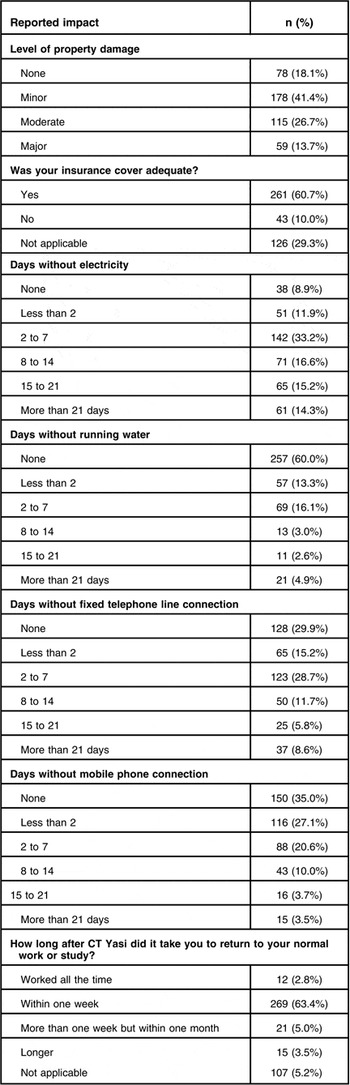
Of the 433 respondents, 115 (26.7%; 95% CI, 22.6%-30.9%) reported moderate and 59 (13.7%; 95% CI, 10.5%-17.0%) reported major property damage caused by TC Yasi (Table 3). Overall, 61 (14.3%; 95% CI, 10.9%-17.6%) participants were without electricity, 21 (4.9%; 95% CI, 2.9%-7.0%) were without running water, and 9 (2.1%; 95% CI, 0.7%-3.5%) were without any (mobile or fixed) phone contact for more than 21 days.
Impact on Basic Resources Caused by TC Yasi, February 2011, as Reported by 433 Respondents, North Queensland, AustraliaFootnote a

a 3-9 persons did not answer these questions.
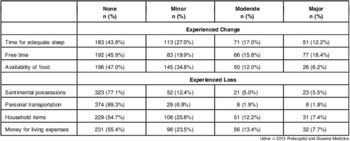
Of all participants, 51 (12.2%; 95% CI, 9.1%-15.3%) reported major changes in their time for adequate sleep and 77 (18.4%; 95% CI, 14.7%-22.1%) reported major changes to their free time due to TC Yasi (Table 4). Thirty-two (7.7%; 95% CI, 5.1%-10.2%) respondents experienced a major loss in money available for living expenses.
Losses and Changes Experienced Due to TC Yasi, February 2011, as Reported by 433 Respondents from North Queensland, AustraliaFootnote a

a 14-16 persons did not answer these questions.
Emotional Impact and Symptoms of Acute Stress
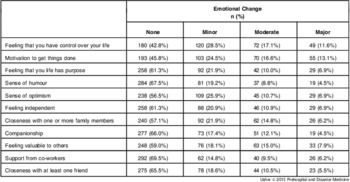
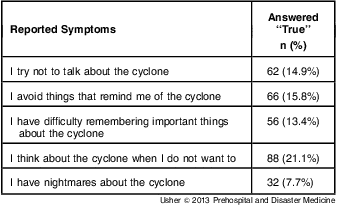
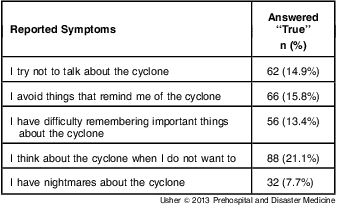
Of the participants, 72 (17.1%; 95% CI, 13.5%-20.7%) reported a moderate and 49 (11.6%; 95% CI, 8.6%-14.7%) reported a major change in their feeling of whether they have control over their life (Table 5). Fifty-five (13.1%; 95% CI, 9.8%-16.3%) participants reported a major change in their motivation of getting things done; while 33 (7.9%; 95% CI, 5.3%-10.4%) report a major change in their perception of feeling valuable to others. Overall 88 (21.1%; 95% CI, 17.2%-25.0%) respondents said that they think about the cyclone when they do not want to and 32 (7.7%; 95% CI, 5.1%-10.2%) said that they had nightmares about the cyclone (Table 6). A total of 142 (34.1%; 95% CI, 29.5%-38.6%) respondents documented at least one of the five symptoms of acute distress.
Emotional Changes Caused by TC Yasi, February 2011, as Reported by 433Respondents from North Queensland, AustraliaFootnote a

a 12-13 persons did not answer these questions.
Symptoms of Acute Stress Disorder Due to TC Yasi, February 2011, as Reported by 433 Respondents, February 2011, North Queensland, AustraliaFootnote a
a 16 persons did not answer these questions.
Medication
Of all participants, 178 (42.7%, 95% CI, 37.9%-47.4%; 16 missing values) reported to having been on regular medication. Of these 178 participants, 17 (9.6%; 95% CI, 5.2%-13.9%) reported a disruption of the availability of their medication due to TC Yasi. Twelve (75.0%) participants reported a disruption of less than two days, two (12.5%) a disruption of three to seven days and another two participants reported a disruption of eight days to two weeks.
Discussion
This study explores preparedness, loss of resources, and psychosocial distress after TC Yasi. Almost all respondents considered the cyclone warning as serious or very serious and more than a third started preparing for the cyclone at least three days before it reached landfall. Overall most respondents feel they were well prepared for the impending event. These findings support the WRM theory that people take threatening disasters seriously.Reference Sattler, Kaiser and Hittner7 One can assume that many respondents had lived through similar experiences before with, for example, TC Larry (Category 4) crossing the North Queensland coast near Innisfail in March 2006. The results also support previous research on cyclone preparedness in Australia that found a high rate of preparedness.Reference King, Goudie and Dominey-Howes8 However, some participants in this study prepared for the cyclone late considering TC Yasi was a predicted category 5 system with a very large front. It is possible that those respondents who reported undertaking relatively little preparation may have undertaken a significant amount of preparation early in the season and thus believed they needed to do little more. Alternatively, the lack of preparedness by some respondents may indicate a level of complacency resulting from previous experience with cyclones. It is however important that future studies investigate this result further given the importance of preparedness to eventual recovery.Reference Usher9
Only small numbers of respondents reported moderate or severe property damage as a result of TC Yasi. However, some participants were without electricity, running water, and telephone of any sort (mobile or fixed) for more than 21 days. Hence, although respondents were well prepared, the locally existing infrastructure, including the electricity grid and local water supplies, was not. Given that researchers are predicting cyclones will become more severe and more frequent because of climate change,10 local councils of cyclone-affected areas might need to consider, for example, putting the electricity grid of their communities underground. In a recent decision, a million dollar settlement was reached in a class action of survivors of the 2009 Victorian bushfires who sued an electricity company as it was alleged that the fire started when a tree fell across a powerline.11
From a public health perspective, it is disturbing that 32 respondents reported being without running water for more than two weeks. It is understood that emergency support was hindered as road and rail access were severely disrupted; however, this will be a likely consequence of any major cyclone and further studies are required to investigate reasons for prolonged disruption of basic infrastructure in order to prevent similar situations in the future.
The prevalence of psychological symptoms such as stress, grief, depression, anxiety and dissociative symptoms over varying time periods following natural disasters has been well documented.Reference Raphael12–Reference Bourque, Siegel, Kano and Wood16 Differences in the level of emotional distress and the emergence of psychological problems following a disaster are dependent upon the extent of exposure to the traumatic event, the amount of devastation, loss of family or friends, homelessness, loss of personal possessions, disruption to social support systems, and the overall disruption to normal daily activities.Reference Rubonis and Bickman17–Reference Bolin and Bolton19 Secondary stressors include delays in obtaining resources (shelter, food, water) and services (electricity, phone), relocation, delays in returning to work, employment difficulties, delays in insurance and rebuilding efforts, and financial difficulties. These secondary stressors can take a toll on personal characteristic (feelings of control over your life, motivation, sense of humor, optimism, feeling independent), energy (time for adequate sleep, free time), and social support systems (closeness with family members and friends, companionship, feeling valuable to others, support from co-workers) and contribute to a downward spiral of psychological distress.Reference Sattler, Preston, Kaiser, Olivera, Valdez and Schleter6, Reference La Greca, Silverman, Vernberg and Prinstein15, Reference Lima, Pai, Santacruz and Lozano20, Reference Norris and Uhl21 These findings support the current study which found participants in the hardest-hit areas were more likely to report one or more symptoms of psychological distress. Key factors in determining the long-term impact on psychological health post disaster are personal characteristics such as resilience and coping skills.Reference Leon22 However, individuals with a pre-existing mental illness are likely to experience an exacerbation of symptoms post disaster.Reference Vijaykumar, Thara, John and Chellappa23–Reference Weisler, Barbee and Townsend25 Re-establishing normalcy and routines, and organizing support groups to develop or boost personal characteristics and energy resources may alleviate the downward spiral of psychological distress.
Limitations
The limitations of this study must be considered. The data collection relied on retrospective self-report six to 12 months after TC Yasi had occurred. While the turmoil and trauma in the community immediately post disaster prevented data collection earlier, data collected at six to 12 months post the event may mean the respondents’ recollections were less accurate. In addition, the representativeness of the sample is varied. All researcher-assisted data collection occurred in the affected coastal towns, and even though the survey was available online, no respondents from the Tablelands area responded to the survey. These communities may have experienced the cyclone differently.
Conclusion
These findings of this study are consistent with past research that indicated a link between loss of property and distress. The results are consistent with the WRM theory, which proposes that people with previous experience take threatening disasters seriously. It appears that those without disaster knowledge and experience are a disadvantaged vulnerable population. These findings are useful for disaster planners and educators in that those without prior disaster experience (eg, younger university students, those new to the region) should be targeted for public health messaging. Future research needs to explore why some people do not prepare sufficiently for an impending disaster even though the threat is extreme.