Implications
This study investigated the effect of feeding a mixed-species green fodder on intake and milk production in dairy goats. Goats were housed indoors and fed either fresh-cut mixed-species green fodder (comprising grasses, legumes and herbs) or standard green fodder (consisting of perennial ryegrass and white clover). When fed mixed-species green fodder, goats consumed 13% more dry matter than when they were fed standard green fodder, leading to a 7% increase in milk yield. Feeding mixed-species green fodders also affected the proportions of beneficial fatty acids in milk. The findings demonstrate that mixed-species green fodders improve dairy goat milk production.
Introduction
In New Zealand, dairy goats are predominantly housed in free stall barns and fed a diet based on either fresh-cut green fodder or fodder silage (Prosser and Stafford, Reference Prosser, Stafford and Stafford2017). The diet is further supplemented with concentrate feeds, minerals and vitamins to optimise health and milk production (Prosser and Stafford, Reference Prosser, Stafford and Stafford2017). To date, there is little information available regarding the most appropriate fodder strategy for dairy goats within a cut-and-carry system. Most dairy goat farmers have adopted fodder based on cultivated pastures used in New Zealand dairy cow-grazing systems, which are dominated by perennial ryegrass (Lolium perenne L.) and white clover (Trifolium repens L.). Goats are considered opportunistic feeders and are adept at utilising a far more diverse range of forages compared with cows (Avondo et al., Reference Avondo, Biondi, Pagano, Bonanno, Lutri, Cannas and Pulina2008a). New Zealand farmers’ accounts suggest that goats exhibit improved performance when offered a more diverse diet, and New Zealand dairy goat farmers have supported fodder diversity, with the addition of other grass, legume and herb species as a strategy to increase milk production. Although several studies have demonstrated a positive effect of feeding mixed pastures on both cow and sheep milk production (Pembleton et al., Reference Pembleton, Hills, Freeman, McLaren, French and Rawnsley2016; Kenyon et al., Reference Kenyon, Morel, Corner-Thomas, Perez, Somasiri, Kemp and Morris2017; Minneé et al., Reference Minneé, Waghorn, Lee and Clark2017), there is no scientific evidence to validate these observations in lactating dairy goats. Another advantage of including a more diverse range of species, such as red clover (Trifolium pratense L.), lucerne (Medicago sativa L.), chicory (Cichorium intybus L.) and plantain (Plantago lanceolata L.), within a fodder is better nutritive values of these species compared with perennial ryegrass during dry summer periods typically seen in the main goat-farming regions of New Zealand (Brown et al., Reference Brown, Moot and Pollock2003; Moorhead and Piggot, Reference Moorhead and Piggot2009).
A majority of research investigating goat dry matter intake (DMI) of forages and the effects on milk production have predominantly focused on conserved feeds, which is the favoured method of feeding in intensive dairy goat systems in most other countries (reviewed in Goetsch et al., Reference Goetsch, Zeng and Gipson2011). Several studies have examined the effects of green forages on the DMI of dairy goats but under grazing rather than housed systems (Collins and Nicol, Reference Collins and Nicol1986; Avondo et al., Reference Avondo, Bonanno, Pagano, Valenti, Grigoli, Luigia Alicata, Galofaro and Pennisi2008b; Lefrileux et al., Reference Lefrileux, Morand-Fehr and Pommaret2012). Huguet et al. (Reference Huguet, Broqua, Dufour, de Simiane and Beguin1979) investigated the feeding of different grass varieties in an experiment analogous to a cut-and-carry system and demonstrated that lactating goats performed better when fed Italian ryegrass (Lolium multiflorum Lam.) compared with the other grass species examined.
To our knowledge, there is no research showing the benefits of mixed-species green fodder (MF) on dairy goat intake and milk production compared with more conventional green fodder under experimental conditions analogous to New Zealand dairy goat farming systems. The aim of this experiment was to test the hypothesis that offering a diverse multi-species green fodder mix would increase dietary intake and milk production in mid-lactation dairy goats.
Materials and methods
Green fodder establishment and management
The fodder swards for the experiment were sown in autumn (April 2016) at Ruakura Research Centre, Hamilton, New Zealand (37°46′41.1″S 175°18′49.2″E; average annual rainfall 1072 mm) into a 7-ha block on light-medium sedimentary soils (pH 5.9 and an Olsen P 35). Three hectares were sown with standard ryegrass and white clover green fodder (SF) – perennial ryegrass (cultivar (cv.) Base AR 37 at 25 kg/ha) and white clover (cv. Tribute at 2.5 kg/ha and cv. Mainstay at 2.5 kg/ha); and 4 ha were sown with MF – perennial ryegrass (cv. Base AR 37 at 10 kg/ha), timothy (Phleum pratense L. cv. Charlton at 4 kg/ha), prairie grass (Bromus willdenowii Kunth cv. Atom at 6 kg/ha), white clover (cv. Tribute at 3 kg/ha), red clover (cv. Sensation at 4 kg/ha), lucerne (cv. Torlesse at 8 kg/ha), chicory (cv. Choice at 1 kg/ha) and plantain (cv. Tonic at 1 kg/ha). To reduce the risk of gastrointestinal worm infection and feed avoidance by the goats, no animals were grazed on these fields from sowing. The fodder was mechanically harvested from sowing until the end of the trial at target covers of 2400 ± 200 kg DM/ha with a consistent residual of 1600 kg DM/ha. To maintain soil fertility, 40 kg/ha NutriGro 13 k (N 13.5, P 11.2, K 12.5, S 4.9 plus Co, Se) was applied after each harvest. During the experiment the green fodder was cut once a day at approximately 1400 h using a SIP DISC S ALP 300 disc rotary mower (SIP Strojna Industrija d.d, Šempeter v Savinjski dolini, Slovenia). A portion was collected using a Bergmann Royal Loader Wagon (Ludwig Bergmann GmbH, Goldenstedt, Germany) and fed the same day at afternoon milking (1500 h). The remainder was left in the paddock overnight, collected using a Bergmann Royal Loader Wagon and fed the following morning (0700 h).
Animal management
The experiment was conducted in mid-lactation during spring to early summer (October to December) of 2016 with 36 multiparous Saanen goats (mean live weight (LW), 60.2 kg (range 44.0 to 75.5 kg); mean body condition score (BCS), 2.5 (range 2.0 to 3.0); mean milk yield, 3.5 kg/day (36 g/kg fat and 29 g/kg protein) and mean days of milking, 118 (range 109 to 123) at the start of experiment) that were sourced from a commercial dairy herd and housed at the Ruakura Goat Research Facility (Hamilton, New Zealand).
The goats were housed indoors in individual pens (3 m2) for 30 days before the start of the experiment to allow for acclimatisation to their new surroundings. At the beginning of the experimental period, the goats were paired, and the size of pens was increased to 6 m2 to accommodate the pairs. This pairing was an ethical requirement, to allow sufficient space to move per goat. Pairing was based on current LW, milk production and intake to minimise variation between pairs. For the entire experiment, goats were milked twice a day (approximately 0700 h and 1500 h). While the goats were out of the pens for milking, feed refusals were collected and a new ration of fresh fodder was offered at 120% of expected intake. A formulated mineral–vitamin mix was sprinkled over each pair’s fodder allocation in each feed bin within the pen – 60 g NaCl, 30 g lime flour, 8 g Image goat mineral and vitamin premix (Image Holding Limited, Auckland, New Zealand), 2 g magnesium, 2 g vitamin B12, 0.5 g biotin, 1 g yeast extract, 0.4 mg iodine and 0.4 mg selenium per pair per day. In addition, the goats were each fed 215 g DM of pelleted supplement at each milking (900 g/kg maize, 100 g/kg wheat, 14.8 MJ/kg metabolisable energy (ME); 88 g/kg crude protein (CP) by DM).
Experimental design
Prior to allocation to treatments, the experiment began with a uniformity period (day 1 to 6) in which goat pairs (experimental unit) were fed a combination of both green fodder treatments (MF at morning and SF at afternoon) to allow the goats to adapt to the treatments and being housed in pairs. The pairs were then assigned into two groups (A and B), which were balanced for milk yield and composition, DMI, LW and BCS, as measured during the uniformity period. The study was designed as a simple cross-over experiment split over two treatment periods (P1, days 7 to 18; P2, days 19 to 30). The treatment periods were further split into an adaptation period (day 7 to 13 for P1 and days 19 to 25 for P2) and a measurement period (days 14 to 18 for P1 and days 26 to 30 for P2) in which data were collected. During P1 group A was assigned the MF treatment and group B was assigned the SF treatment. The treatments were switched for P2 (group A fed SF and group B fed MF).
Feed intake
The weight of fresh feed offered to and refused by each goat pair was recorded at each feeding. A sample (~150 g) was collected at each feeding of both fresh green fodder offered and refusals from the previous feeding. These samples were oven-dried (65°C for 48 h) to determine DM percentage. The goats were offered a total of 430 g DM per day of supplement pellets, with no refusals. Daily DMI was calculated for each pair of goats by subtracting the refused DM from the offered DM plus supplement pellet DM.
Fodder botanical composition and nutritive characteristics
During the measurement periods (days 14 to 18 for P1 and days 26 to 30 for P2), subsamples of fodder from each feeding and refusals were collected for determining botanical composition. Samples were mixed thoroughly and a portion containing approximately 400 pieces was selected, which was between 50 and 100 g depending on the gross botanical composition. This was separated into categories: perennial ryegrass, timothy, prairie grass, other grasses, white clover, red clover, lucerne, chicory, plantain, other non-grass species and dead matter. Each sample category was oven-dried (65°C for 48 h) and the percentage of each component was calculated on a DM basis.
A subsample of fodder from each feeding during the measurement periods was stored at −20°C and then freeze-dried and ground. These samples were pooled into representative samples for MF and SF spanning each measurement period and were analysed for fodder quality and fatty acid profile.
Green fodder quality analysis was conducted by an International Accreditation New Zealand–accredited laboratory (Hill Laboratories Ltd, Hamilton, New Zealand). Attributes measured were CP (Dumas combustion using conversion factor nitrogen × 6.25; AOAC 968.06; AOAC, 1990), acid detergent fibre (ADF; modified National Forage Testing Association method adapted for Ankom auto analyser; Ankom Technology, Macedon, New York, USA; National Forage Testing Association, 1997), neutral detergent fibre (NDF; National Forage Testing Association method adapted for Ankom auto analyser; Ankom Technology; National Forage Testing Association, 1997), ash (AOAC 942.05; AOAC, 1990), digestible organic matter in dry matter (DOMD; calculated from organic matter digestibility in vitro; Australian Fodder Industry Association (AFIA) pepsin-cellulase procedure using AFIA standard equation; Method 1.7R; AFIA, 2011), ME (DOMD × 0.016; AFRC, 1993), soluble sugars (80:20 ethanol:water extraction and colorimetric determination; Dubois et al., Reference Dubois, Gilles, Hamilton, Rebers and Smith1956; Hall et al., Reference Hall, Hoover, Jennings, Miller and Webster1999), starch (removal of free sugars, enzymic hydrolysis of starch, colrimetric determination of glucose; Dubois et al., Reference Dubois, Gilles, Hamilton, Rebers and Smith1956; Hall et al., Reference Hall, Hoover, Jennings, Miller and Webster1999), crude fat (CF; petroleum spirit extraction by Ankom auto analyser, AOCS Official Procedure AM-5-04; AOCS, 2017), non-structural carbohydrate (100 − (CP + ash + CF + NDF)).
Fatty acids from the fodder samples were isolated by a method modified from Toledo et al. (Reference Toledo, Andrén and Björck2002). Briefly, 2 ml of sample was mixed with 4 ml 2-propanol, and 3 ml hexane was added. The sample was mixed vigorously and the hexane layer was removed. The sample was evaporated to dryness and then resuspended in 4 ml hexane. Extracted fatty acids were methylated by a method modified from Christie (Reference Christie1989). Briefly, 100 µl 0.5 M sodium methoxide was added to the fatty acid sample, which was then incubated for 10 min with periodic mixing. Glacial acetic acid (5 µl) was added and the sample was mixed before the addition of anhydrous calcium chloride. The sample was mixed vigorously and then incubated at room temperature for 60 min. The top layer was collected and analysed by gas chromatography with flame ionising detection using Shimadzu GC 2010 (Shimadzu, Kyoto, Japan).
Milk yield and composition
Daily milk yield was recorded using in-line milk meters (TruTest, Auckland, New Zealand). Milk samples were collected at each milking in the final 2 days of the uniformity period (days 5 and 6) and for each day of the measurement period (days 14 to 18 for P1 and days 26 to 30 for P2). Samples were analysed by infrared spectrometry for fat, protein and lactose concentration and by flow cytometry for somatic cell count (SCC; Fossomatic equipment, LIC Herd Testing Station, Hamilton, New Zealand). Milk samples from 1 day of each measurement period (day 16 for P1 and day 28 for P2) were collected for analysis of fatty acid profiles following the method described above.
Live weight and body condition score
Live weights and BCS of goats were recorded after morning milking during the uniformity period (day 5) and at the end of treatment periods – P1 (days 17 and 18) and P2 (days 29 and 30). The BCS of goats was assessed on a scale of 1 to 5, where 1 signifies emaciated and 5 obese (National Animal Welfare Advisory Committee, 2012).
Blood glucose, protein, urea, and non-esterified fatty acids
On the final day of each measurement period (day 18 for P1 and day 30 for P2), goats were restrained and blood was collected from the jugular vein after morning milking and prior to being returned to their pens. Blood was collected from each goat into sodium fluoride (grey top) and plain (red top) vacutainers. Grey top samples were kept chilled on ice for 1 h and centrifuged at 1500×g for 10 min at 4°C. The plasma was collected into aliquots and then stored at −20°C. Red top samples were incubated at room temperature for 2 h to allow clotting to occur and spun at 1500×g for 10 min at 20°C. Serum was collected into aliquots and then stored at −20°C. Plasma and serum samples were analysed at the New Zealand Vet Pathology Laboratory (Hamilton, New Zealand) for the following metabolites. Plasma glucose concentrations were measured with a colorimetric assay (Beckman Coulter Glucose Kit; Beckman Coulter Inc., Brea, CA, USA) using the Beckman Coulter AU680 Chemistry Analyzer (Beckman Coulter). Serum concentrations of non-esterified fatty acids (NEFAs) were measured with a colorimetric assay (Wako Non-Esterified Fatty Acid kit; FUJIFILM Wako Diagnostics U.S.A. Corporation, Mountain View, CA, USA) using the Beckman Coulter AU680 Chemistry Analyzer with reference to the Wako NEFA ACS-ACOD method for use on automated analysers. Total protein in serum was measured with a colorimetric assay (Beckman Coulter Total Protein Kit) using the Beckman Coulter AU680 Chemistry Analyzer. Total urea in serum was measured with a colorimetric assay (Beckman Coulter Urea Nitrogen Kit) using the Beckman Coulter AU680 Chemistry Analyzer.
Statistical analysis
Differences in botanical composition between offered and refused diets were determined by two-way ANOVA (Genstat 18; VSN International Limited, Hemel Hempstead, UK) with treatment and period as factors, and blocked for feeding (date and time). Differences in gross botanical composition (grass, legume, herb) between the treatment diets were analysed by two-way ANOVA (Genstat 18) with treatment and period as factors. The differences in nutritive quality and fatty acid content between diets were determined by two-way ANOVA (Genstat 18) with treatment and period as factors. Differences between DMI, milk yield, milk composition, LW, BCS, log10-transformed SCC, individual fatty acids in the milk and blood metabolites (glucose, protein, urea, and NEFA) were analysed by two-way ANOVA (Genstat 18) with pair as the experimental unit, treatment and period as factors and blocked for pair. Differences between means were considered significant at P<0.05.
Results
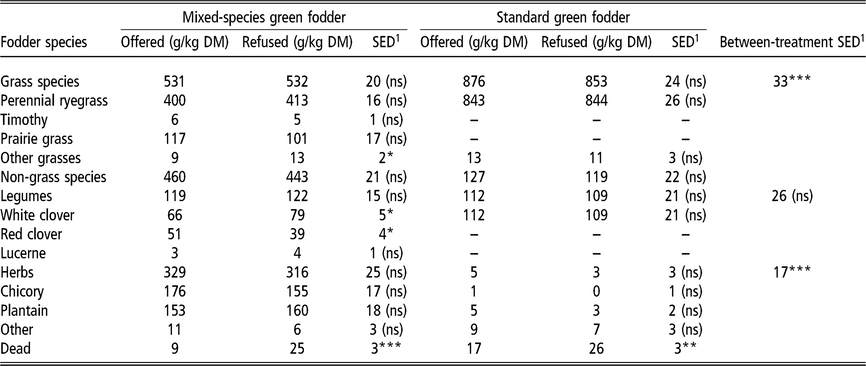
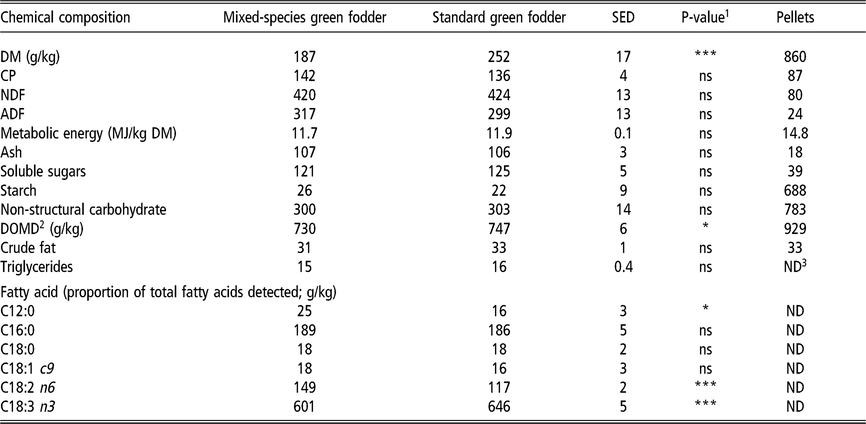
As expected, there was a substantial difference in botanical composition of MF and SF during the measurement periods (Table 1). The proportion of legume was similar between treatments, but approximately one-third of MF comprised herb species, and this treatment consisted of less grass compared with SF (Table 1). The botanical composition of MF refusals revealed a greater proportion of other grasses, white clover and dead material and a lesser proportion of red clover compared with MF (Table 1). Whereas, for SF only the proportion of dead material was higher in the refusals compared with the feed offered (Table 1). The levels of CP, NDF, ADF, ME, ash, soluble sugars, starch, non-structural carbohydrates, DOMD and CF measured in the MF and SF samples were similar (Table 2). However, the DM% of MF was lesser than that of SF (Table 2). There were also differences in the fatty acid profile between green fodder types, with the proportion of lauric acid (C12:0) and linoleic acid (C18:2 n6) being greater in MF compared with SF, and the proportion of α-linolenic acid (C18:3 n3) being lesser in MF compared with SF (Table 2).
Botanical composition of mixed-species green fodder and standard green fodder fed to dairy goats during measurement periods (days 14 to 18 for measurement period 1 and days 26 to 30 for measurement period 2)

1 Significance is reported in parentheses after the SED, where ns=P>0.05
* P<0.05
** P<0.01
*** P<0.001.
Chemical composition (g/kg of DM unless otherwise stated) of green fodder and supplements (pellets) fed to dairy goats during measurement periods (days 14 to 18 for measurement period 1 and days 26 to 30 for measurement period 2)

1 ns=P>0.05
* P<0.05
*** P<0.001.
2 Digestible organic matter in dry matter.
3 Not determined.
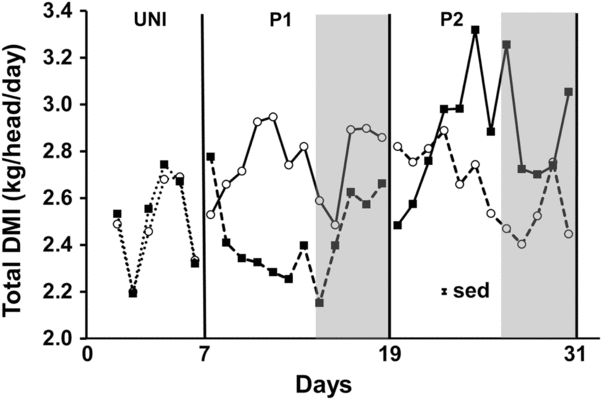
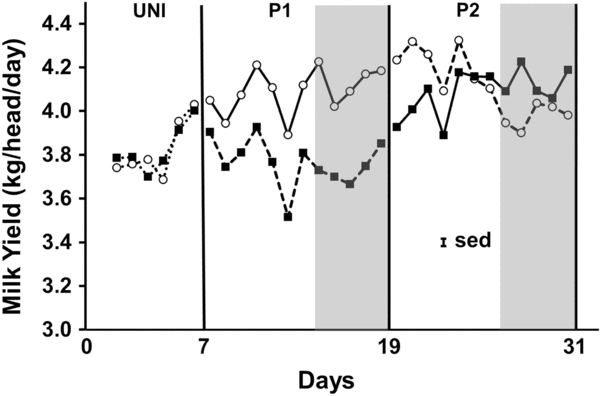
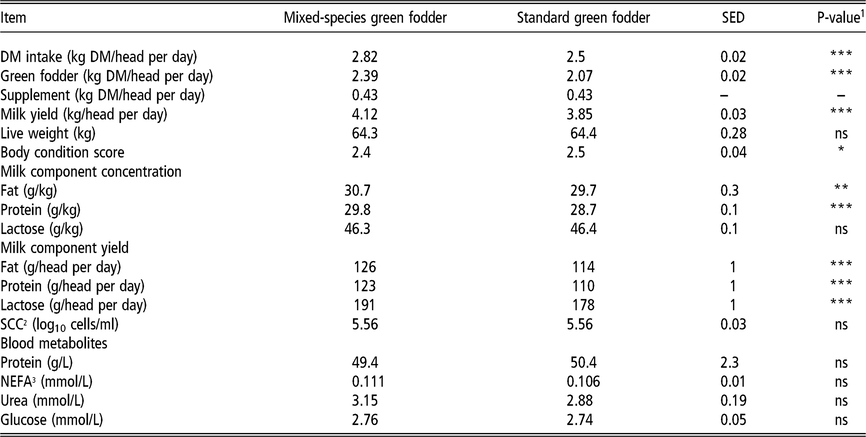
When the goats were fed MF their total DMI (green fodder plus supplement) was 13% higher (Figure 1 and Table 3) and their milk yield was 7% higher than when the goats were fed SF (Figure 2 and Table 3). In addition, the BCS of goats was lesser when they were fed MF compared with SF (Table 3). No effect of treatment on LW was observed (Table 3).
Mean daily dry matter intake (DMI) of green fodder and concentrate by lactating dairy goats housed in pairs and fed standard green fodder (SF; perennial ryegrass and white clover) or mixed-species green fodder (MF; perennial ryegrass, timothy, prairie grass, white clover, red clover, lucerne, chicory and plantain). During the uniformity period (UNI) goats were fed a combination of both SF and MF. During treatment period 1 (P1) group A (open circles, solid line) were fed MF and group B (closed squares, dashed line) were fed SF. During treatment period 2 (P2) group A (open circles, dashed line) were fed SF and group B (closed squares, solid line) were fed MF. Shaded areas indicate 5-day measurement periods. Bar represents SED between treatments (SF and MF).

Mean daily milk yield from dairy goats housed in pairs and fed standard green fodder (SF; perennial ryegrass and white clover) or mixed-species green fodder (MF; perennial ryegrass, timothy, prairie grass, white clover, red clover, lucerne, chicory and plantain). During the uniformity period (UNI) goats were fed a combination of both SF and MF. During treatment period 1 (P1) group A (open circles, solid line) were fed MF and group B (closed squares, dashed line) were fed SF. During treatment period 2 (P2) group A (open circles, dashed line) were fed SF and group B (closed squares, solid line) were fed MF. Shaded areas indicate 5-day measurement periods. Bar represents SED between treatments (SF and MF).

Mean daily feed intake, milk yield and composition, and blood metabolites of goats fed either mixed-species green fodder or standard green fodder and supplemented with concentrate during measurement periods (days 14 to 18 for measurement period 1 and days 26 to 30 for measurement period 2)

1 ns=P>0.05
* P<0.05
** P<0.01
*** P<0.001.
2 Somatic cell count.
3 Non-esterified fatty acid.
The concentrations of milk protein and milk fat were 1.1 and 1.0 g/kg higher, respectively, when the goats were fed MF compared with SF (Table 3). No difference between treatments for milk lactose concentration was observed. Overall yield of milk solids was greater (protein increased 13 g/head per day, fat increased 12 g/head per day and lactose increased 13 g/head per day) for goats on MF compared with SF (Table 3). Somatic cell count was not affected by the different green fodder diets (Table 3).
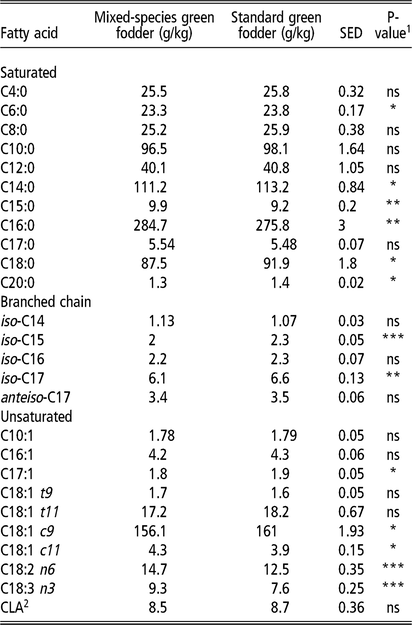
Levels of blood protein, glucose, urea and NEFA were not affected by green fodder type (Table 3). Green fodder type did, however, affect the fatty acid profile of milk (Table 4). The proportions of pentadecylic acid (C15:0), palmitic acid (C16:0), cis-vaccenic acid (C18:1 c11), linoleic acid (C18:2 n6) and α-linolenic acid (C18:3 n3) were higher when goats were fed MF compared with SF. Whereas, caproic acid (C6:0), myristic acid (C14:0), stearic acid (C18:0), arachidic acid (C20:0), iso-C15, iso-C17, ginkgolic acid (C17:1) and oleic acid (C18:1 c9) proportions were lower in the milk of goats fed MF compared with SF.
Fatty acid profiles of milk from goats fed either mixed-species green fodder or standard green fodder

1 ns=P>0.05
* P<0.05
** P<0.01
*** P<0.001.
2 Conjugated linoleic acids.
Discussion
The DMI of goats was higher when they were offered a more diverse fodder species mix. Our results demonstrated that the increase in milk production observed was predominantly driven by increased DMI. The underlying mechanism for increased DMI in goats on MF diet was not investigated in this study but could be explained by previous works in other ruminant species. Herbs such as plantain and chicory and clover species are rapidly degradable in the rumen in comparison to grass species typically used in New Zealand farms (Burke et al., Reference Burke, Waghorn, Brookes, Attwood and Kolver2000). Gregorini et al. (Reference Gregorini, Minnee, Griffiths and Lee2013) demonstrated that cows grazing chicory and plantain, compared with perennial ryegrass, showed increased mastications per bite and reduced ruminative chewing. Their results suggest that the herbage particle size swallowed, when feeding on chicory and plantain compared with perennial ryegrass, was smaller and therefore may contribute to an increase in rumen turnover rate (Gregorini et al., Reference Gregorini, Minnee, Griffiths and Lee2013). Hence, the high proportion of herbs and legumes in MF compared with SF could have facilitated a more rapid emptying of the rumen, stimulating greater intakes on MF.
The botanical analysis of refused feed demonstrated that the goats were selective in what fodder species they ate when given a more diverse choice – more of red clover and less of white clover and other grasses. In addition, the goats also avoided dead material in both treatment feeds. Goats have an innate ability to pick out different plant species and parts of plants containing high concentrations of protein or having higher digestibility (Provenza et al., Reference Provenza, Villalba, Dziba, Atwood and Banner2003). Therefore, a diverse diet, like the MF tested in this study, at an ad libitum allowance could potentially increase the ability to select dietary components conducive to higher intakes and milk production. A similar effect has been demonstrated in grazing lactating cows offered adjacent monocultures of perennial ryegrass, plantain and white clover (Pembleton et al., Reference Pembleton, Hills, Freeman, McLaren, French and Rawnsley2016) and in grazing lactating sheep offered adjacent monocultures of perennial ryegrass and white clover (Champion et al., Reference Champion, Orr, Penning and Rutter2004). Given an opportunity, ruminants naturally adjust intakes of different pasture/fodder species, which can positively influence overall milk production (Champion et al., Reference Champion, Orr, Penning and Rutter2004; Pembleton et al., Reference Pembleton, Hills, Freeman, McLaren, French and Rawnsley2016). However, whether the resulting increase in DMI when goats were offered MF compared with SF was due to the increased diversity of species alone or due to the presence of specific species within the mix is not clear and requires further research.
The two green fodder treatments investigated in this experiment had similar nutritive attributes, as demonstrated by chemical analyses of the feed and blood metabolites of the goats on each diet. Therefore, the observed increase in milk yield was most likely a direct consequence of increased DMI (Table 3). Along with a higher milk yield, the yields of all milk components also increased when the goats were fed MF. Increased milk production in response to feeding a more diverse pasture, including herbs and legumes compared with ryegrass-dominant pastures, has previously been demonstrated in cows (Waugh et al., Reference Waugh, Clark, Harris, Thom, Copeman and Napper1998; Chapman et al., Reference Chapman, Tharmaraj and Nie2008; Roca-Fernández et al., Reference Roca-Fernández, Peyraud, Delaby and Delagarde2016) and sheep (Hutton et al., Reference Hutton, Kenyon, Bedi, Kemp, Stafford, West and Morris2011). Dairy cows grazing a mixed-species pasture, comprising grass, clover and herbs, had higher DMI and milk yields compared with cows grazing either perennial ryegrass alone or a perennial ryegrass and white clover mix (Roca-Fernández et al., Reference Roca-Fernández, Peyraud, Delaby and Delagarde2016). Dairy cows showed increased milk production when grazing chicory compared with ryegrass-based pastures (Waugh et al., Reference Waugh, Clark, Harris, Thom, Copeman and Napper1998), and Chapman et al. (Reference Chapman, Tharmaraj and Nie2008) demonstrated that cows grazing a chicory and white clover pasture in late summer showed higher milk production than cows grazing predominantly grass pastures. Similarly, Hutton et al. (Reference Hutton, Kenyon, Bedi, Kemp, Stafford, West and Morris2011) established that ewes grazing a mixed pasture (consisting of chicory, plantain and red and white clover) in spring produced more milk and exhibited higher weight gains for both the ewe and her lamb compared with ewes grazing a ryegrass/white clover pasture. In addition, Harris et al. (Reference Harris, Auldist, Clark and Jansen1998) demonstrated that lactating dairy cows were more productive as the proportion of white clover in their diet was increased and that of perennial ryegrass was lowered.
The reason for higher protein and fat concentrations in milk from goats fed MF compared with SF was not determined in this study but may be related to a higher total energy and protein intake in goats due to a higher intake of DMI. A similar, although small, increase in milk protein and fat concentration in response to increased protein and energy intake has previously been reported in cows (Emery, Reference Emery1978; Cragle et al., Reference Cragle, Murphy, Williams and Clark1986). However, it remains to be demonstrated whether goats can elicit the same response.
It has been well established that diet can affect the fatty acid profile of milk produced by ruminants (reviewed in Chilliard et al., Reference Chilliard, Ferlay, Rouel and Lamberet2003), with some evidence of forage species effects (reviewed in Dewhurst et al., Reference Dewhurst, Shingfield, Lee and Scollan2006). The results of this study on goats demonstrate that a lower proportion of grass or a higher proportion of herbs within the green fodder diet increased the concentrations of linoleic and α-linolenic acids, which are both essential fatty acids. These findings are consistent with what has been demonstrated in cows feeding a diverse pasture (Soder et al., Reference Soder, Sanderson, Stack and Muller2006) or silage containing a higher proportion of legumes over grasses (Dewhurst et al., Reference Dewhurst, Fisher, Tweed and Wilkins2003a and Reference Dewhurst, Evans, Scollan, Moorby, Merry and Wilkins2003b). Cows cannot synthesise these long-chain unsaturated fatty acids and therefore must obtain them from dietary sources. In the diets, the proportions of fatty acids within the two green fodder treatments were different, with MF being higher in lauric and linoleic acids and lower in α-linolenic acid compared with SF.
Oleic acid can either be derived directly from the diet or synthesised within the mammary gland from stearic acid. Another important source of oleic acid in milk is the adipose tissue, which will be mobilised by the mammary gland during periods of decreased energy intake (Jakobsen, Reference Jakobsen1999). This is plausible, as the proportion of this fatty acid was higher in goat’s milk when they were fed SF, of which they ate a lesser amount.
Odd and branched chain fatty acids in milk fat are predominantly derived from rumen bacteria (Fievez et al., Reference Fievez, Colman, Castro Montoya, Stefanov and Vlaeminck2012). It has been demonstrated that changes in the proportions of these fatty acids in cows are related to relative proportions of cellulolytic and amylolytic bacteria present in the rumen. It has also been determined to be a marker indicating changes in the rumen microbiome that occur when the diet is switched from predominantly forage-based to concentrate-based as well as for dietary imbalances such as subacute ruminal acidosis (SARA). The present study demonstrated an increase in pentadecylic acid and a decrease in ginkgolic acid, iso-C15:0 and iso-C17:0 in response to MF treatment relative to SF treatment. These changes in milk fat composition suggest a shift towards amylolytic bacteria enrichment or the onset of SARA in response to the MF diet. The reason for this shift is unclear as both diets are similar in nutritive levels and may be a consequence of the difference in plant species within the diet being processed differently within the rumen. Again, further investigation is required to understand how the rumen and its microbiome process different plant species.
The diet also had a small effect on the proportions of several saturated fatty acids, with palmitic acid proportion being higher when the goats were fed MF, and caproic, myristic, stearic and arachidic acid proportions being higher when the goats were fed SF. The short- to mid-chain fatty acids (caproic and myristic) are predominantly produced by de novo synthesis within the mammary gland, whereas de novo synthesis of palmitic acid accounts for 50% of its presence in milk, the remainder being provided by the diet. Long-chain fatty acids in milk fat are predominantly derived from the diet, stearic acid being the product of biohydrogenation of unsaturated fatty acids, including linoleic and α-linolenic acid. Although these differences are present in the milk fat profiles between the treatment diets, overall the differences were relatively minor and probably did not significantly affect the attributes of the milk.
Conclusion
To our knowledge, this is the first study to investigate the effects of diverse multi-species green fodder on the DMI, milk production and milk fatty acid profiles of goats. Under these experimental conditions, feeding MF compared with SF stimulated a higher DMI in goats. The underlying mechanism for this increase was not determined. Feeding goats a diversity of green fodder mix altered milk fatty acid profiles, with increase in beneficial n-3 and n-3 fatty acids in response to the MF diet. Overall, the increased sward diversity of MF had a positive effect on goat milk production and represents an important additional management tool to increase milk production in green fodder-based dairy systems.
Acknowledgements
The authors would like to gratefully thank Goatland Farm Limited for permitting to use their goats for the duration of the experiment. In addition, the authors would like to thank the technical and farm staff of the AgResearch Ruakura Research Centre for their assistance in the planning and execution of the experiment – particularly to Kathryn Hutchinson and Trevor Watson, and the statistical advice of Catherine Cameron (AgResearch) and Harold Henderson (AgResearch). This research was funded by the Ministry of Business, Innovation and Employment (Wellington, New Zealand) research grant C10X1307 in conjunction with the Dairy Goat Co-operative (NZ) Limited.
R. Murney 0000-0002-8409-5750
Ethics statement
All animal manipulations were conducted in compliance with the rules and guidelines of the AgResearch Ruakura Animal Ethics Committee (Hamilton, New Zealand).
Declaration of interest
Authors declare no conflict of interest pertaining to the research described in this manuscript.
Software and data repository resources
None of the data were deposited in an official repository.