INTRODUCTION
Altica is the earliest-known settled village in the Teotihuacan Valley, and a rare first-farming village site in the Basin of Mexico that has survived to modern times (Stoner and Nichols Reference Stoner and Nichols2019b). The settlers were already farmers, but the village provides a glimpse into life during the Early–Middle Formative period, as people continued to adapt to an agricultural lifestyle newly introduced into the northeast Basin. Although small in size and population compared to some other Formative sites in the Basin, Altica was also an important node in exchange networks and received goods from distant areas in Mesoamerica at this early date (Stoner and Nichols Reference Nichols and Stoner2019a; Stoner et al. Reference Stoner, Nichols, Alex and Crider2015).
Skeletons provide a distinct perspective on the past, as they contain information about individuals and populations that are not obtainable otherwise, especially hints about life history and lifeways (Larsen Reference Larsen2015). Therefore, it would have been informative to have more than four burials, comprising four adult individuals, recovered from the excavations. This sample is too small to characterize the residents of Altica, but the skeletons will be described and analyzed here osteologically and biogeochemically for what can be learned. These individuals do give a particularly human dimension to interpretations of the site and reinforce the insights gleaned from other archaeological analyses, although the small sample size limits the conclusions that can be reached.
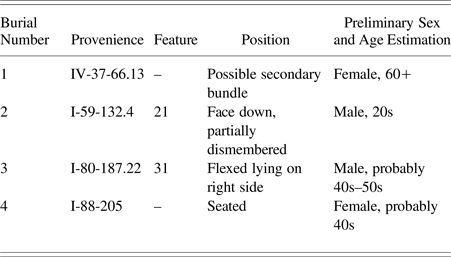
These burials were all in pits dug into the bedrock, a clue as to how they were preserved given the extensive disturbance and erosion the site has endured. With that being said, even with these four individuals being buried in bedrock, the preservation of the skeletal material was only fair but did allow for osteological and geochemical analysis. Osteological analysis involves age and sex estimation, based on standard morphological indicators of the pelvis, skull, and dental wear, as available for each individual (Buikstra and Ubelaker Reference Buikstra and Ubelaker1994). Paleopathological analysis of indicators of significant morbidity or stress are important in detailing life histories because, while such indicators rarely are the cause of death, they reveal potential health risks in the daily environment and cultural milieu (Larsen Reference Larsen2015). Additionally, to date, strontium isotopic analysis of tooth enamel and carbon and nitrogen isotopic analysis of bone collagen has been successful, although it took several attempts to reach this juncture. Strontium allows us to trace the movement of people over their lifetime, essentially providing information about immigration patterns into a region, while carbon and nitrogen allow us to understand individual diet. It was also possible to retrieve accelerator mass spectrometry (AMS) radiocarbon dates from bone collagen to support the dating of the site previously determined by artifact analysis. These data will be discussed following an osteological analysis of each individual recovered from Altica (see Table 1 for a summary description of each one).
Descriptions of the burials from Altica.

INDIVIDUAL SKELETAL ANALYSIS
Two burials were in deep cylindrical pits that had could have been used for storage or water retention and then repurposed and quickly filled in when burials were placed; they also may have been excavated as tombs (Stoner and Nichols Reference Stoner and Nichols2019b). Burial 1 was an older female, probably over age 60. Part of the skull was found first, with three long bones and pelves found at the bottom of the pit. The pelvis was preserved enough to indicate female, including possible parturition pits in the preauricular sulcus area, although not all osteologists agree on this interpretation for those marks (Jurmain Reference Jurmain1999). It is likely, however, that this individual was a mother and probable grandmother given her age. Excavators thought the burial was seated but, since many skeletal elements were missing, this perhaps was a secondary bundle. As for grave goods, there were large fragments of a ceramic olla above the skull and a metate and mano around the skeleton. If the individual was seated or was a secondary bundle, the metate would have been placed just to the side. As Altica is an early maize-farming village, the metate is an early one, smooth on one side but unfinished on the other, but with squared corners, already identified with women and women's work. The metate may have been only recently adopted for maize processing (Stoner and Nichols Reference Stoner and Nichols2019b) and so its presence as a grave good indicates that it was already revered. The metate appears to be made from a nonlocal pink porphyry different from other metates recovered at the site (Nichols and Stoner Reference Nichols and Stoner2019). This seems to support that this female had some prestige in the village.
Burial 4 was a middle-aged female, probable in her 40s and at the end of her reproductive period. This was thought to be the secondary interment of several individuals, but turned out to be just one individual. When excavated, the skeletal elements looked as if they were bundles and thus the individual could have been a secondary interment. The skeleton is fairly complete, however, so it was more likely seated with cranial elements on top and legs/feet at the bottom. There were no imperishable grave goods, although a drain appears to be present in the pit, which may have channeled water away from the interment. The pelvis indicated female, with some possible parturition pits on the on the dorsal side of the pubis.
It should be noted that burial into bedrock pits was probably a relatively prestigious location, as only a few of the extant pits held interments. The bedrock, tepetate, is a consolidated sedimentary rock of volcanic tephra that may be semi-welded, similar to a tuff soft enough to chip with stone and wood tools but by no means easy to excavate. If these pits were intentionally excavated for these individuals upon death and not just repurposed water or storage pits (Stoner and Nichols Reference Stoner and Nichols2019b), then these individuals would have merited the extra effort to dig into the bedrock. But even without much evidence of imperishable grave offerings and the use of possibly repurposed pits, these women most likely commanded respect within the community as mothers at the end or past their reproductive years, rather than as young wives or mothers.
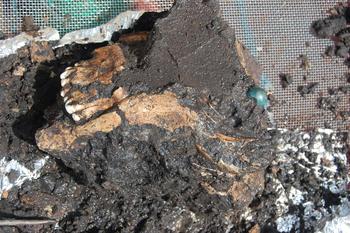
Burial 3 is a middle-aged male and indicates that there were high-status individuals among the village residents (Figure 1). Unlike the cylindrical pits that contained the female burials, the pit intentionally excavated into bedrock for the purpose of interring this individual was rectangular (Nichols and Stoner Reference Nichols and Stoner2019). This individual was flexed on the right side. His imperishable offerings included a tlacuache (opossum) effigy bottle, a severely eroded cylindrical vase, and a jade bead hypothesized to have been placed in the mouth during the initial interment but found towards the right side near the back of the skull when excavated, probably due to postmortem movement. There was a large sherd under the skull and two perforated sherd disks in matrix around the bones. The opossum-style effigy bottle was a common type of zoomorphic vessel during the Early and Middle Formative periods near the Basin of Mexico (Plunket and Uruñuela Reference Plunket and Uruñuela2006; Valliant Reference Vaillant1931) and appears to be most common in Tlaxcala (Carballo Reference Carballo2016). López Austin (Reference López Austin1993) describes indigenous Mesoamerican myths that illustrate opossums bringing fire to people in their pouches (a unique physiological feature in the Americas) or on their tails. The jade bead is tangible evidence of the ability of Altica to access valuable artifacts from long distance and also of definite status differences this early in a small village (Nichols and Stoner Reference Nichols and Stoner2019). Perhaps Burial 3 was an influential village leader during his lifetime, a man who brought security and protection to his people.
Photograph of Burial 3: skull with jade bead. Photograph by Stoner.

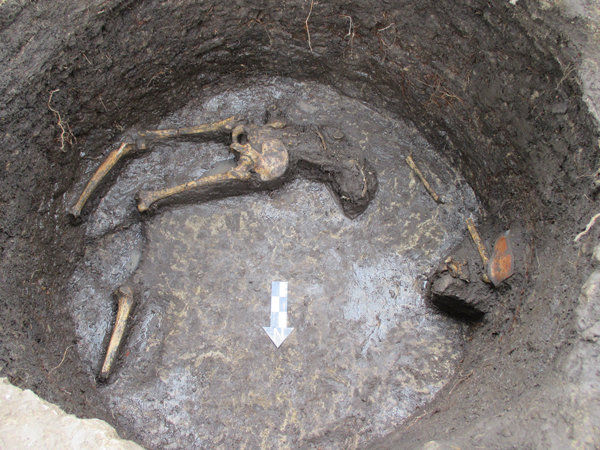
The final individual presents a mystery. Burial 2 was a young male buried in a deviant manner, suggesting possible foul play. The body was in very unusual position: face down, with possible detachment of the right leg below the knee (Figure 2). This individual was buried in a bedrock pit and basalt rocks covered the body and were piled all the way to the top, as if a big pile of rocks were pushed in on him after interment, a pattern unlike any of the other interments. The right tibia, however, was placed nearby but both feet were missing. Some of the skeleton was very well-preserved, but other parts were missing. This could be due to the vagaries of preservation, but possibly some bones were removed as trophies or, if the feet were deliberately removed, to prevent the individual from walking. This individual has evidence of trauma. There are probable cutmarks or gashes on an ulna, a humerus, distal left femur, and tibia. There is no evidence of healing, but whether these were part of a fatal attack or done postmortem is not possible to determine. When cleaning the bones, areas of what appeared to be yellow and some red pigment were found on both tibias and as spots on other long bones where skin is close to the bone and might be fortuitously preserved from body paint. It is possible that these marks are not pigments and are perhaps due to taphonomic processes. If they are a product of the postmortem environment, we would expect these indicators to be more widespread on additional skeletal parts for Burial 2 on the other interments since they were all buried in a similar environment. The body of Burial 2 seems to have been subjected to some manipulation after death, with leg dismembered, skeletal elements removed, and the body potentially painted. These characteristics also point to what is called a deviant burial in mortuary analysis. Regardless of whether this individual was murdered or died of natural causes, we hypothesize that what or whom he represented in life was feared among the village. Therefore, in death he was buried face and head down with basalt piled on top of body to make sure the individual or his spirit did not return. More reflection on this individual can be found in the geochemical analysis.
Photograph of Burial 2: body in prone position with right lower leg detached. Photograph by Stoner.

Each skeleton had paleopathological indicators of significant morbidity during life. All have evidence of healed infection, periosteal reactions on the surface of bones, which are often the result of bacterial infection that secondarily affects the skeleton as a result of other illness or trauma (Weston Reference Weston2008). These are called nonspecific because they have many possible causes but become more common in societies that have recently become sedentary agriculturalists (Larsen Reference Larsen2015). This is because sedentary communities have more trouble with sanitation and, if involved in trade and exchange as Altica was, can become more exposed to new pathogens from trading partners. Both Burial 2 and 3 had moderate periosteal reactions on several bones, indicating systemic infection, and Burial 3's lesions were not healed at time of death, which might have contributed to cause of death. Burials 1 and 4 also had slight healed reactions on several bones, so this appears to be a general problem for individuals at Altica.
All individuals also have evidence of healed cribra orbitalia, an area of porosity on the tops of orbits caused by inflammation. This can be the result of anemia but has also been linked to scurvy (Larsen Reference Larsen2015). This is somewhat puzzling, as scurvy should be rare in tropical populations, because fresh food should have been available most of the year. Perhaps anemia is a better candidate, although given the more arid and high-altitude location in the Basin of Mexico, residents may have been too dependent on maize during colder times of the year. The surface of the cranial vault is where porotic hyperostosis (PH) is found, porosity replacing the outer surface because of marrow expansion caused by certain anemias as the body tries to increase red blood cell production (Walker et al. Reference Walker, Bathurst, Richman, Gjerdrum and Andrushko2009). PH is healed and slight in Burials 1 and 3, and more severe and healed in Burial 2 (Burial 4's cranial fragments had no evidence). Both cribra and PH can occur only during childhood and indicate a general problem with sufficient nutrition, perhaps due to an overdependence on maize, as the population learned to adapt to agriculture. Also pertinent is that PH is linked to lack of Vitamin B12 (Walker et al. Reference Walker, Bathurst, Richman, Gjerdrum and Andrushko2009), a necessity available only from animal protein (Widmer and Storey Reference Widmer and Storey2017), and there was a general lack of animal bone at the site (Stoner and Nichols Reference Stoner and Nichols2019b), perhaps explaining the overdependence on maize and plants at this early date.
Another paleopathological indicator during childhood are dental hypoplasias or dents in the enamel, result of serious stress to that causes growth arrest and thins the enamel as teeth are forming (Larsen Reference Larsen2015). These stresses can be nutritional, from disease, or often both. Perhaps not surprisingly, Burial 3, the high-status individual, had none on his 18 recovered teeth, indicating at least some buffering during childhood. Burial 4 had four on 23 teeth. Burial 2 had the most serious ones, on 11 out of 32 teeth, along with the most serious PH, indicating that the individual survived some ill-health during childhood.
Besides infection and anemia, Burial 1 had some arthritis but not excessive for her age, and Burial 3, a robust male, also had only slight indications of arthritis. Burial 3 had caries in his teeth, and Burial 1 had no teeth preserved— perhaps given her age she had lost all teeth antemortem. Thus, there is evidence of some episodes of significant morbidity to all adults at some point in their lives. All such stresses, however, except the infection to Burial 3, were clearly survived, and actually were relatively slight, except for Burial 2, the most impacted by these morbidity indicators. Problematic nutrition and sanitation were challenges to these early agriculturalists, although there is no way to know whether mortality suddenly increased in the population in childhood or adulthood.
BIOGEOCHEMICAL ANALYSIS
Radiocarbon Dating in Early–Middle Formative Contexts in the Basin of Mexico
In addition to osteological and paleopathological analysis, high-resolution AMS radiocarbon dating (14C; Kennett et al. Reference Kennett, Culleton, Dexter, Mensing and Thomas2014, Reference Kennett, Thakar, VanDerwarker, Webster, Culleton, Harper, Kistler, Scheffler and Hirth2017a) was conducted on bone collagen from all four individuals excavated at Altica. While it has been established that Altica is the earliest-known village in the Teotihuacan Valley occupied during the Early–Middle Formative period (Nichols Reference Nichols2015) based on ceramic and lithic analysis (Stoner et al. Reference Stoner, Nichols, Alex and Crider2015), radiocarbon dating is crucial for improving site chronologies (Culleton et al. Reference Culleton, Prufer and Kennett2012; Ebert et al. Reference Ebert, Culleton, Awe and Kennett2016; Hanna et al. Reference Hanna, Graham, Pendergast, Hoggarth, Lentz and Kennett2016; Hoggarth et al. Reference Hoggarth, Culleton, Awe and Kennett2014; Kennett et al. Reference Kennett, Culleton, Voorhies and Southon2011, Reference Kennett, Thakar, VanDerwarker, Webster, Culleton, Harper, Kistler, Scheffler and Hirth2017a; Watson et al. Reference Watson, Plog, Culleton, Gilman, LeBlanc, Whiteley, Claramunt and Kennett2015). Additionally, radiocarbon dating of human remains is particularly important at Altica, because the pits are the only intact features and the bones will provide the most accurate dates for their final use. There is also a lack of burials excavated from Early–Middle Formative contexts in and around the Basin of Mexico. By analyzing the 14C dates from the four Altica burials, our objective is to examine and describe how these individuals fit into the Early–Middle Formative occupational scheme and if this can shed light on settlement patterns during this time in the Teotihuacan Valley. We also cross-examine 14C dates with the small number of burial offerings associated with each individual. A more extensive examination of ceramic wares recovered during excavation can be found in Stoner and Nichols (Reference Stoner and Nichols2019a).
Carbon and Nitrogen Isotope Analysis of a First-Farming Village
Bone collagen was also processed for stable carbon (δ13C) and nitrogen (δ15N) isotope analyses to establish past individual dietary consumption patterns at this site and to further test the hypothesis that Altica was one of the earliest agricultural villages in the northern Basin of Mexico (Nichols Reference Nichols2015). To test this hypothesis, we identify if stable carbon isotope signatures in human remains reflect diets high in maize (C4 plant) consumption rather than plants commonly exploited in foraging practices (C3 and crassulacean acid metabolism [CAM] plants). δ13C and δ15N analyses of human bone collagen are widely used to reconstruct the paleodiets of ancient individuals (Ambrose and Krigbaum Reference Ambrose and Krigbaum2003; DeNiro and Epstein Reference DeNiro and Epstein1978, Reference DeNiro and Epstein1981; DeNiro and Schoeninger Reference DeNiro and Schoeninger1983; Hedges and Reynard Reference Hedges and Reynard2007; Hedges et al. Reference Hedges, Stevens, Koch and Leng2006; O'Leary Reference O'Leary1988; Schoeninger and DeNiro Reference Schoeninger and DeNiro1984) and have been successfully analyzed by this team of researchers in the Basin of Mexico (Storey et al. Reference Storey, Buckley and Kennett2019). The central assumption in stable isotope analysis is that chemical signatures in plant and animal species are incorporated into skeletal tissues when directly consumed by humans. Furthermore, animals incorporated into the human diet eat a potentially broad range of plant species, which affects the δ13C value in human remains (DeNiro and Epstein Reference DeNiro and Epstein1978). Carbon isotope ratios from animal proteins are absorbed into human bone collagen with a shift of around 5‰ (Ambrose and Norr Reference Ambrose, Norr, Lambert and Grupe1993).
Plants fall into three broad categories defined by different photosynthetic pathways including C4, C3, and CAM plants. Maize (Zea mays) is an agricultural staple across Mesoamerica and one of the most regularly consumed C4 plants within settled, farming communities. C3 plants common to Mesoamerica mostly include wild species of plants, trees, nuts, fruits, and vegetable cultigens. While C4 and C3 plants are bimodal (O'Leary Reference O'Leary1988), CAM plants have more flexible photosynthetic processes that tend to overlap with ratios of C3 and C4 plants (Bender Reference Bender1971; Bender et al. Reference Bender, Rouhani, Vines and Black1973). The baseline for CAM plants in the Teotihuacan Valley ranges from −11.9‰ to −20.0‰ and consists of nopal cactus (Opuntia ficus-indica) and maguey (Agave americana; Lounejeva Baturina et al. 2016; Morales Puente et al. Reference Morales Puente, Alvarado, Manzanilla, Otero and Manzanilla2012). Baseline samples of C4 plants in this region suggest a range of −11.5‰ to −15.1‰ (Morales Puente et al. Reference Morales Puente, Alvarado, Manzanilla, Otero and Manzanilla2012). Metabolic fractionation for human consumers produces δ13C for bone collagen of −7.0 ± 1.0‰ and results in expected C4 signatures as high as −6‰ to −7‰. These enriched carbon isotope ratios have been demonstrated in previous studies of diet in the Teotihuacan region, although more so during Late Formative and Classic period occupation (Casar et al. Reference Casar, Morales, Manzanilla, Cienfuegos and Otero2017; Nado et al. Reference Nado, Zolotova and Knudson2017; Storey et al. Reference Storey, Buckley and Kennett2019; White et al. Reference White, Storey, Longstaffe and Spence2004).
Extensive research of macro- and microbotanicals in the Basin of Mexico (McClung de Tapia et al. Reference McClung de Tapia, Serra Puche and Limón de Dyer1986; Niederberger Reference Niederberger1976, Reference Niederberger1979; Serra Puche Reference Serra Puche1988; Tolstoy et al. Reference Tolstoy, Fish, Boksenbaum, Vaughn and Earle Smith1977) in addition to survey (Sanders et al. Reference Sanders, Parsons and Santley1979) identified early sedentary villages and agricultural subsistence practices as first occurring in the southern Basin—a region high in moisture and favorable for farming—during the Early Formative. McClung de Tapia et al. (Reference McClung de Tapia, Serra Puche and Limón de Dyer1986) proposed that freshwater (lacustrine) resources were possibly more important than cultigens at this time. Additionally, Rosenswig and colleagues (Reference Rosenswig, VanDerwarker, Culleton and Kennett2015) have argued that, although the cultivation of maize in Mesoamerica began during the Archaic period (8000–2000/1000 cal b.c.), the use of maize as a cultigen did not become a crucial subsistence practice until after 1000 cal b.c. during the transition from the Early to Middle Formative. Additionally, these researchers argue that the adoption of maize as a primary food resource was a slow and gradual process that supplemented foraging practices for thousands of years.
It is during the Early–Middle Formative that population, and with it early farming practices, expanded in the northern Basin. The spread of agriculture into the northern Basin is extraordinary because this region is semiarid, prone to drought, and susceptible to early fall frosts (Nichols Reference Nichols2015), all conditions that inhibit the production of maize and other cultigens. Due to these obstacles, irrigation systems were later implemented in these northern villages to create risk-reduction strategies for household producers (Hirth Reference Hirth2009), although agricultural intensification of this nature was unlikely during the initial occupation of Altica. Altica has been identified as the first and only early-farming village in the Teotihuacan Valley to span this proposed Early–Middle Formative transition to agriculture (Tolstoy et al. Reference Tolstoy, Fish, Boksenbaum, Vaughn and Earle Smith1977) and also to survive changes in land use from modern disturbance Therefore, this site provides crucial information and an essential framework for understanding the spread of agriculture from the southern to the northern Basin, and for pinpointing the shift from dominant foraging subsistence practices to the cultivation of maize as a primary food source in Mesoamerica.
In contrast to carbon, stable nitrogen isotopes in human bone collagen are introduced during the process of protein digestion, increasing incrementally by 3–5‰ between trophic levels (Hedges and Reynard Reference Hedges and Reynard2007) and can be impacted by environmental and climatic factors (Warinner Reference Warinner2010; Zanden and Rasmussen Reference Zanden and Rasmussen2001). Differentiation of protein digestion for an individual identified by δ15N is derived from the consumption of a primarily vegetarian diet versus a diet made up of terrestrial or marine vertebrates, with marine species having the highest δ15N signatures (DeNiro and Epstein Reference DeNiro and Epstein1981). Compared to freshwater and terrestrial organisms, marine organisms are enriched in δ15N by 6–10‰ (Schoeninger and DeNiro Reference Schoeninger and DeNiro1984). Additionally, although nitrogen cycling systems are complex compared to carbon cycling in plants, differentiating the consumption of land verses lacustrine plants from their δ15N values may also be possible. This is because variability exists due to differences in organic and inorganic nitrogen sources and fractionation rates between terrestrial and freshwater ecosystems (Finlay and Kendall Reference Finlay and Kendall2007; Milligan et al. Reference Milligan, Pretzlaw and Humphries2010). For example, an overview by France (Reference France1995) suggests that δ15N values of freshwater plants tend to be about 4‰ more positive than terrestrial plants. Unfortunately, in the majority of these studies to date, the differences in δ15N values are too slight and variable to be considered applicable tracers of diet in the food web (Finlay and Kendall Reference Finlay and Kendall2007; France Reference France1995). Additionally, the scope of investigation required to test the differences between freshwater and lacustrine resources in the Basin of Mexico is beyond the scope of this preliminary research. Although it is known that lacustrine resources were a significant source of subsistence materials for early villages in the southern Basin (McClung de Tapia Reference McClung de Tapia, Acosta-Ochoa, Martínez-Yrizar, Adriano-Morán, Cruz-Palma and Chaparro-Rueda2019), we focus primarily on the identification of δ15N values that indicate terrestrial versus marine diets for individuals at Altica. Given that Altica is based in the central Highlands of Mexico, a landlocked area devoid of local, easily accessible marine resources, we predict these four individuals will have primarily terrestrial herbivore diets, identified by DeNiro and Epstein (Reference DeNiro and Epstein1981) as having δ15N values ranging from 9‰ to 12‰.
Paleomobility and Strontium Isotope Ratios
Lastly, radiogenic strontium isotopes signatures (87Sr/86Sr) were analyzed from tooth enamel to recognize the geographic origins of the Altica individuals and to identify evidence of residential mobility. The introduction of 87Sr/86Sr analysis has revolutionized studies of migration and paleomobility in archaeology (for a full review, see Bentley Reference Bentley2006) and is now an established tool that is frequently used to study the movements of ancient people (Bentley et al. Reference Bentley, Buckley, Spriggs, Bedford, Ottley, Nowell, Macpherson and Pearson2007; Hodell et al. Reference Hodell, Quinn, Brenner and Kamenov2004; Knudsen et al Reference Knudson, Douglas Price, Buikstra and Blom2004; Makarewicz and Sealy Reference Makarewicz and Sealy2015; Marsteller et al. Reference Marsteller, Knudson, Gordon and Anbar2017; Price et al. Reference Price, Manzanilla and Middleton2000, Reference Price, Tiesler and Burton2006, Reference Price, Burton, Fullagar, Wright, Buikstra and Tiesler2008; Schroeder et al. Reference Schroeder, O'Connell, Evans, Shuler and Hedges2009; Solís Pichardo et al. Reference Solís Pichardo, Schaaf, Treviño, Lailson, Manzanilla, Horn and Manzanilla2017; Wright Reference Wright2005). 87Sr/86Sr varies in a given region based on the initial composition and the age of the bedrock (Bentley Reference Bentley2006; Faure Reference Faure1986). Runoff from bedrock is transferred to soil and absorbed into the human body via the food and water an individual consumes over the lifetime. Unlike stable carbon and nitrogen isotopes that fractionate when moving through trophic levels, 87Sr/86Sr has not been found to fractionate as it is transferred from the bedrock to the soil, plants, and animals in the same ecosystem (Aberg Reference Åberg1995; Blum et al. Reference Blum, Hank Taliaferro, Weisse and Holmes2000; Graustein Reference Graustein, Rundel, Ehleringer and Nagy1989; Slovak and Paytan Reference Slovak, Paytan and Baskaran2012). Therefore, strontium ingested by an individual reflects the local 87Sr/86Sr of a geological region from which food (plants and animals) and water originated. Thus, the assumption is made that 87Sr/86Sr can trace individual patterns of residential mobility when inhabitants of a region consume primarily locally sourced foods and water (Ericson Reference Ericson1985; Sealy et al. Reference Sealy, van der Merwe, Sillen, Johan Kruger and Krueger1991). Once ingested, strontium substitutes for calcium in hydroxyapatite [Ca5(PO4)3OH], the crystalline structure that makes up the matrix of bone mineral (the inorganic phase of bone) and tooth enamel. While bone is continuously remodeling at unknown rates, tooth enamel forms at known ages (Hillson Reference Hillson2005; Schroeder et al. Reference Schroeder, O'Connell, Evans, Shuler and Hedges2009) and provides an 87Sr/86Sr signal that matches the geological signature of an individual's place of residence during childhood.
In this study, 87Sr/86Sr is analyzed from tooth enamel rather than the inorganic phase of bone. Tooth enamel is extremely nonporous, making it less susceptible to digenesis (Ericson Reference Ericson1985; Slovak and Payton Reference Slovak, Paytan and Baskaran2012) and has known crown formation and completion rates that permanently lock in chemical signatures at the time of crown completion (Hillson Reference Hillson2005; Schroeder et al. Reference Schroeder, O'Connell, Evans, Shuler and Hedges2009: Table 2). In contrast, bone mineral has unknown remodeling rates but is thought to reflect the same turnover as bone collagen, which provides a biochemical signature for diet approximately 10–15 years prior to death, although this has yet to be scientifically proven. In this study, we chose two specific teeth (the permanent first molar and the third molar) from the same individual, when available. The first molar (M1) is the first permanent tooth that begins crown formation at birth and is complete by five to six months of age. A first molar provides the 87Sr/86Sr signal of geological residence at birth. Residents born outside of the region of study will exhibit an M1 87Sr/86Sr signature that falls outside of the local range of variation, generally established by analyzing local soils, water, and faunal remains from a site (Price et al. Reference Price, Manzanilla and Middleton2000, Reference Price, Burton, Fullagar, Wright, Buikstra and Tiesler2008; White et al. Reference White, Storey, Longstaffe and Spence2004). A third molar (M3) is the last permanent tooth to begin crown formation at seven to nine years of age and completes formation between the ages of 12 and 16, thereby providing a signal of geological residence towards the beginning of adolescence. An 87Sr/86Sr signature from M3 that falls outside the local range of variation suggests that an individual did not move into the local region until after adolescence when tooth formation ceased. Conversely, a nonlocal 87Sr/86Sr signature of an M1 and a local M3 signature infer that an individual was born outside of the local region but moved into the area by adolescence. Given the results of the carbon and nitrogen stable isotope analysis (see section Results and Discussion), it appears that local agricultural produce and wild game were the primary food sources exploited at this site. Therefore, we are confident that residents of Altica subsisted on a diet of locally produced foods, providing tooth enamel 87Sr/86Sr that match the geological signal of the region.
Materials and Methods
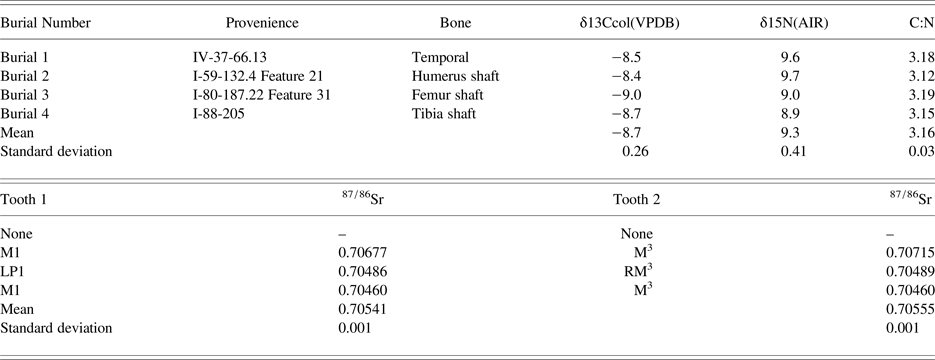
Bone collagen from the cranium or long-bone fragments from all individuals recovered from the Altica excavations was successfully analyzed for AMS 14C dating and stable isotope analysis (n = 4). Results are reported in Tables 2 and 3, respectively. Additionally, two teeth from Burials 2–4 were analyzed for 87Sr/86Sr analysis. Unfortunately, no teeth were available for analysis from Burial 1. As stated above, only tooth enamel was targeted for 87Sr/86Sr analysis, rather than bone, to avoid issues of digenesis.
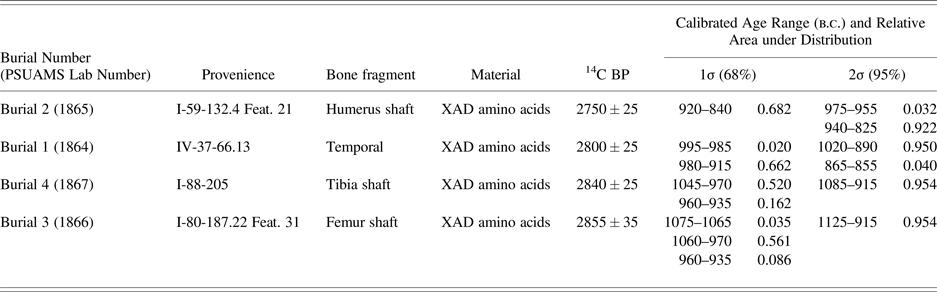
Calibrated AMS 14C dates for the four Altica burials.

Stable carbon and nitrogen isotopic data and the radiogenic strontium isotope ratios for three burials.

All bone collagen samples were prepared for δ13C and δ15N measurement and AMS 14C dating at the Human Paleoecology and Isotope Geochemistry Laboratory at The Pennsylvania State University (Kennett et al. Reference Kennett, Thakar, VanDerwarker, Webster, Culleton, Harper, Kistler, Scheffler and Hirth2017a). Inner and outer surfaces of all bone fragments were manually cleaned using a sterilized X-ACTO blade to remove surface contamination and trabecular bone. The bone was then cut into small pieces, yielding 1,000 mg of material. Bone samples were demineralized for 48–72 hours in 0.5 N HCl at 5°C, then neutralized through multiple rinses of Nanopure (18 MΩ) water. Following the revised Longin method (Brown et al. Reference Brown, Early Nelson, Vogel and Southon1988), the remaining collagen was gelatinized in one to two mL of 0.01 N HCl at 60°C for 10 hours and lyophilized for 24–48 hours. Samples were then weighed to determine the percent crude gelatin yield. All sample yields were between one and three percent, indicating poor preservation. Therefore, the gelatinized solution of all samples was purified using XAD-2 resin (styrene-divinylbenzene) chromatography, which retains polar molecules, such as contaminating humic and fulvic acids (Lohse et al. Reference Lohse, Madsen, Culleton and Kennett2014; Stafford Reference Stafford, Brendel and Duhamel1988, Reference Stafford, Edgar Hare, Currie, Timothy Jull and Donahue1991).
Carbon and nitrogen concentrations and stable isotope ratios were first measured at the Yale Analytical and Stable Isotope Center with a Costech elemental analyzer (ECS 4010) and Thermo DeltaPlus analyzer. Sample quality was evaluated by % crude gelatin yield, %C, %N, and C/N ratios before AMS 14C dating. C/N ratios for all samples fell between 3.1 and 3.2, indicating good collagen preservation (DeNiro Reference DeNiro1985; van Klinken Reference van Klinken1999) and are reported in Table 3. Radiocarbon samples were combusted for three hours at 900°C in vacuum-sealed quartz tubes with CuO wire and Ag wire to produce sample CO2. CO2 samples were then reduced to graphite at 550°C using H2 and Fe catalyst, with reaction water drawn off with C-9 Mg (ClO4)2 (Santos et al. Reference Santos, Southon, Druffel-Rodriguez, Griffin and Mazon2004). Graphite samples were pressed into targets in A1 cathodes and loaded on a target wheel with standards and backgrounds for AMS analysis in the Penn State Accelerated Mass Spectrometry Facility. Dates were then calibrated with OxCal v.4.2.4 (Bronk Ramsey Reference Bronk Ramsey2017) using the IntCal13 Northern Hemisphere curve (Reimer et al. Reference Reimer, Bard, Bayliss, Warren Buck, Blackwell, Ramsey, Buck, Cheng, Lawrence Edwards, Friedrich, Grootes, Guilderson, Haflidason, Hajdas, Hatté, Heaton, Hoffmann, Hogg, Hughen, Felix Kaiser, Kromer, Manning, Niu, Reimer, Richards, Marian Scott, Southon, Staff, Turney and van der Plicht2013). All dates in Table 2 are reported as conventional 14C ages corrected for fractionation, with measured δ13C following Stuiver and Polach (Reference Stuiver and Polach1977).
Tooth enamel samples for 87Sr/86Sr were prepared and analyzed in the Laboratory for Isotopes and Metals in the Environment at The Pennsylvania State University. Two teeth from each burial were examined (n = 6). Teeth were first sonicated for 15 minutes in 18MΩ water in acid-washed (seven percent HCl and 10 percent HNO3) plastic centrifuge vials. Enamel was then drilled from the tooth with a Diamond Head Dremel tool and crushed into a fine powder using a sterilized mortar and pestle. Enamel powder was collected across a tooth's buccal, lingual, mesial, and distal service, avoiding dental caries or other lesions, and then homogenized to average out any potential fluctuations in 87Sr/86Sr during crown mineralization.
Forty mg of enamel powder was sonicated in 18MΩ water in a baked, disposable test tube for 15 min, and centrifuged at 20 RPM for 10 minutes. Water was then pipetted from the sample. For every 10 mg of sample, one mL of five percent CH3COOH was added. This solution was sonicated for 15 min and allowed to soak for four hours. The CH3COOH was pipetted out of the sample and washed three times in 18MΩ water. Samples were placed on a heater block and allowed to dry for eight hours at 80°C until all liquid was evaporated. Enamel powders were transferred to weighed quartz tubes that had been soaked in hot ultrapure concentrated HNO3 for six hours. Samples were ashed in a muffle furnace for eight hours at 825°C.
After pretreatment, all samples were transferred to a clean lab environment where they were hot digested in concentrated HNO3. Samples were then diluted in two percent HNO3, and an aliquot of this solution was run on a Thermo X-Series II Quadruple Inductively Coupled Plasma Mass Spectrometer (ICP-MS) to determine the concentration (ppb) of strontium isotopes in each sample. Strontium in each sample was then separated using cation-exchange ion chromatography to reduce mass interference by other elements and compounds, specifically 87Rb. After separation, each sample was analyzed on a Thermo-Scientific Neptune Plus MC-ICP-MS along with NIST SRM987 strontium carbonate standard (200 ppb). The average NIST SRM987 87Sr/86Sr value for this analysis was 0.71025 ± 0.00002 (n = 27). Internal precision for strontium carbonate runs is typically 0.0002–0.0005 percent standard error based on 175 dynamic cycles of data collection.
RESULTS AND DISCUSSION
Site Occupation
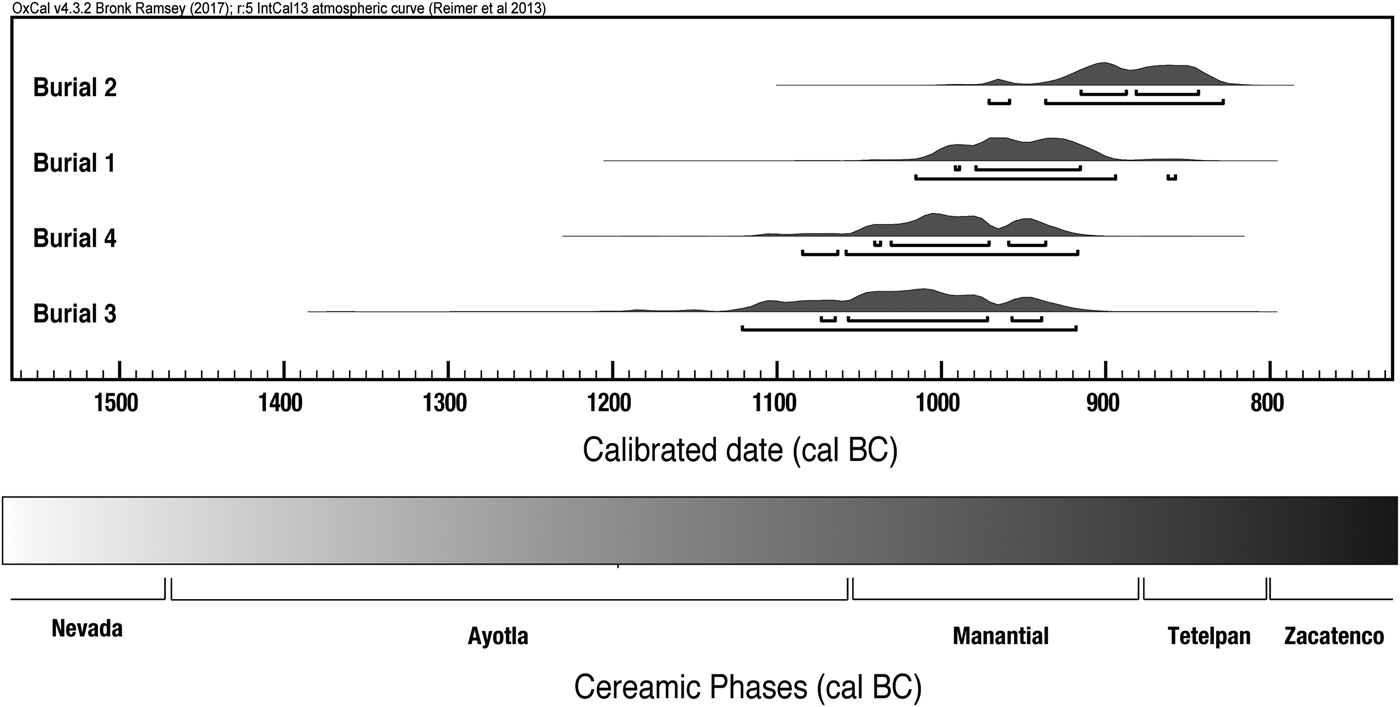
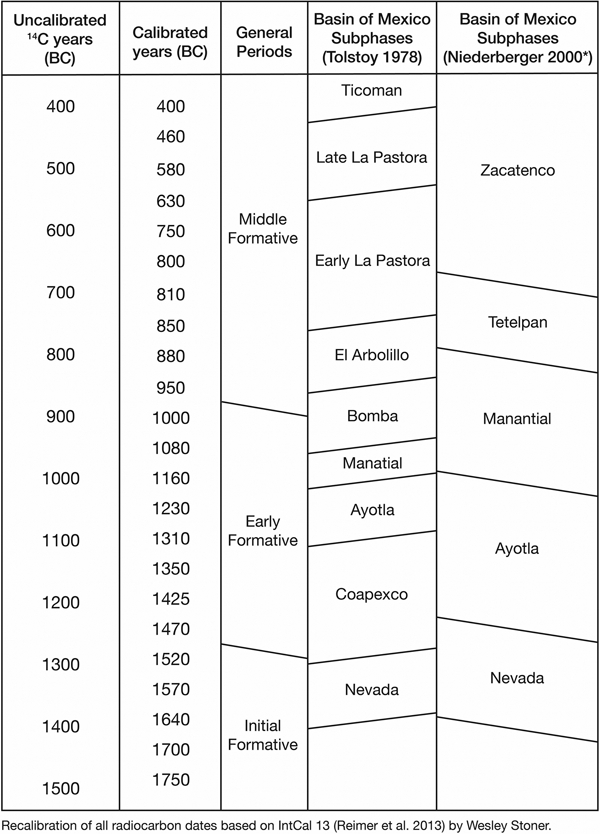
Data from the bone collagen of the four individuals recovered at Altica result in 2-sigma 14C dates that range from 1125–825 cal b.c. (Table 2). These 14C dates from the burials support earlier reports of occupation in Altica starting in the Manantial phase during the Early Formative (Niederberger et al. Reference Niederberger, Clark and Pye2000) and ending about 100 years into the Tetelpan phase, which is the transition period into the Middle Formative, according to Niederberger's calibrated chronology (Figure 3). Ceramic chronologies were calibrated by Stoner (Stoner and Nichols Reference Stoner and Nichols2019b), using the IntCal 13 curve in OxCal (Figure 4). Both Niederberger's and Tolstoy's ceramic phases recognize the end of the Manantial phase as coinciding with the end of the Early Formative. The significant difference is that Tolstoy identifies the end of the Manantial phase as occurring around 1080 cal b.c., while Niederberger situates its termination around 900 cal b.c. Ceramic and figurine analyses place occupation of Altica primarily in the Manantial phase (Stoner and Nichols Reference Stoner and Nichols2019b), including the ceramics associated with the individual burials. This evidence, combined with 14C dates from burial contexts, better supports the ceramic chronology put forth by Niederberger.
Two-sigma calibrated AMS 14C dates of the four Altica burials. Images by Gina Buckley.

Comparison of ceramic chronology phases with calibrated and uncalibrated dates in the Basin of Mexico. Chart by Stoner.

Sixteen additional 14C dates were analyzed using wood charcoal samples and are addressed in Stoner and Nichols (Reference Stoner and Nichols2019b:Figure 9 and Table 1). What is noteworthy is that the 2-sigma 14C dates from all 20 samples (burials and wood charcoal combined) range from 1379–804 cal b.c., a significantly earlier occupation than the burials suggest, and potentially place the initial settlement of Altica in the earlier Ayotla phase. As stated previously, however, ceramic evidence supports a majority Manantial-phase occupation with very few ceramics coming from the earlier Ayotla phase. It is possible that preservation or site erosion has resulted in a loss of earlier ceramics. It must also be noted that all wood charcoal samples came from fill contexts within features, as no intact living surfaces were uncovered. Therefore, the 14C dates from the burials can be considered more accurate regarding dating the termination of features, but additional excavation will be necessary to better understand the initial occupation.
As for the individual burials at Altica, a small number of ceramic grave goods can be cross-examined to identify periods of residential occupation at this site. As stated above, although the number of burials is small, the lack of burial contexts that have been recovered from Early–Middle Formative sites is a crucial addition to our knowledge of this time period in the Teotihuacan Valley. The fill from these pits suggests the interment of the burials was followed by a single infill event, making these burials reliable indicators of the timing of interment, construction, and use and associating grave goods—primarily the ground stone tools—with the same time period as the burials.
The earliest individual interred from the Altica excavations is Burial 3 dating to 1125–915 cal b.c. (2σ), placing interment during the Manantial phase following Niederberger's (Reference Niederberger, Clark and Pye2000) chronology. As discussed in section Individual Skeletal Analysis, this individual is a middle-aged male and had the most unequivocal evidence of nonperishable grave offerings, including a polished black cylindrical vase, a tlacuache (opossum) effigy bottle, and a jadeite bead. We hypothesize that burial context in addition to the quality of burial offerings suggest evidence of higher status within the Altica community, and he was possibly an early leader of the village. This evidence is supported by Plunket and Uruñuela's (Reference Plunket and Uruñuela2006) description of opossums as a common Early to Middle Formative decoration in villages near the Basin of Mexico and their use to depict the deliverance of fire to the community (described in section Individual Skeletal Analysis).
Burial 4 was the next earliest burial interred at Altica (2-sigma range 1085–915 cal b.c.), again during Niederberger's Manantial phase. Unfortunately, this individual had no clear evidence of grave goods associated with the interment. Within the fill of burial pit, however, were the remains of several ground stone implements and traces of maize grains associated with at least three metates (McClung de Tapia et al. Reference McClung de Tapia, Acosta-Ochoa, Martínez-Yrizar, Adriano-Morán, Cruz-Palma and Chaparro-Rueda2019). Additionally, Burial 1, an elderly woman, was buried with a large metate, placed at her side, with a smooth top surface and a ribbed appearance on the bottom with no supports. Here, starch grains from maize and a maize kernel fragment were recovered from the metate and sediment of the pit, respectively. In his comparison of Formative period cultures across Mesoamerica, Ford (Reference Ford1969) indicates that milling stones used to process maize and other organic materials were replaced by the metate approximately 900 cal b.c. If this hypothesis is correct, the ground stone evidence from these burial contexts corroborates the 14C date from Burial 1 (2-sigma range 1020–890 cal b.c.) and Burial 4, suggesting early metate use during the transition from the Early to Middle Formative. Additionally, innovation in maize-growing technology during this transitional period also supports the earlier discussed postulation that maize crops were not the primary subsistence strategy until at least 1000 cal b.c. (Rosenswig et al. Reference Rosenswig, VanDerwarker, Culleton and Kennett2015).
The last individual to be interred among this sample was Burial 2 (2-sigma range 940–825 cal b.c.) and appears to be the only Middle Formative period burial. This individual had no immediate grave goods associated with him, which is unsurprising given the disrespectful nature of the burial. As we discuss in section Evidence of Paleomobility, this individual grew up in an older geological terrain and was likely an outsider.
Overall, radiocarbon dates from individual burials recovered from Altica suggest a late Early Formative settlement of the site with continual occupation during the transition to the Middle Formative. Combined with the 14C dates from wood charcoal (Stoner and Nichols Reference Stoner and Nichols2019b), it appears this site was occupied for a time period of 450 years primarily between Niederberger's Manantial phase into Tetelpan. The recovery of more burials in future excavations and more extensive 14C dating of other organic materials will help further define settlement chronology at Altica.
Paleodietary Patterns at Altica
Our original hypothesis was that the four individuals from Altica ate a primarily maize-based (C4 plant) diet as part of a farming community that had fully transitioned to agricultural practices. While paleoethnobotanical analysis at Altica (McClung de Tapia et al. Reference McClung de Tapia, Acosta-Ochoa, Martínez-Yrizar, Adriano-Morán, Cruz-Palma and Chaparro-Rueda2019) confirms the presence of maize in diverse contexts at Altica, highlighting the importance of this cultigen for early diets, the overall narrative at this site concerning subsistence practices appears to be more complicated.
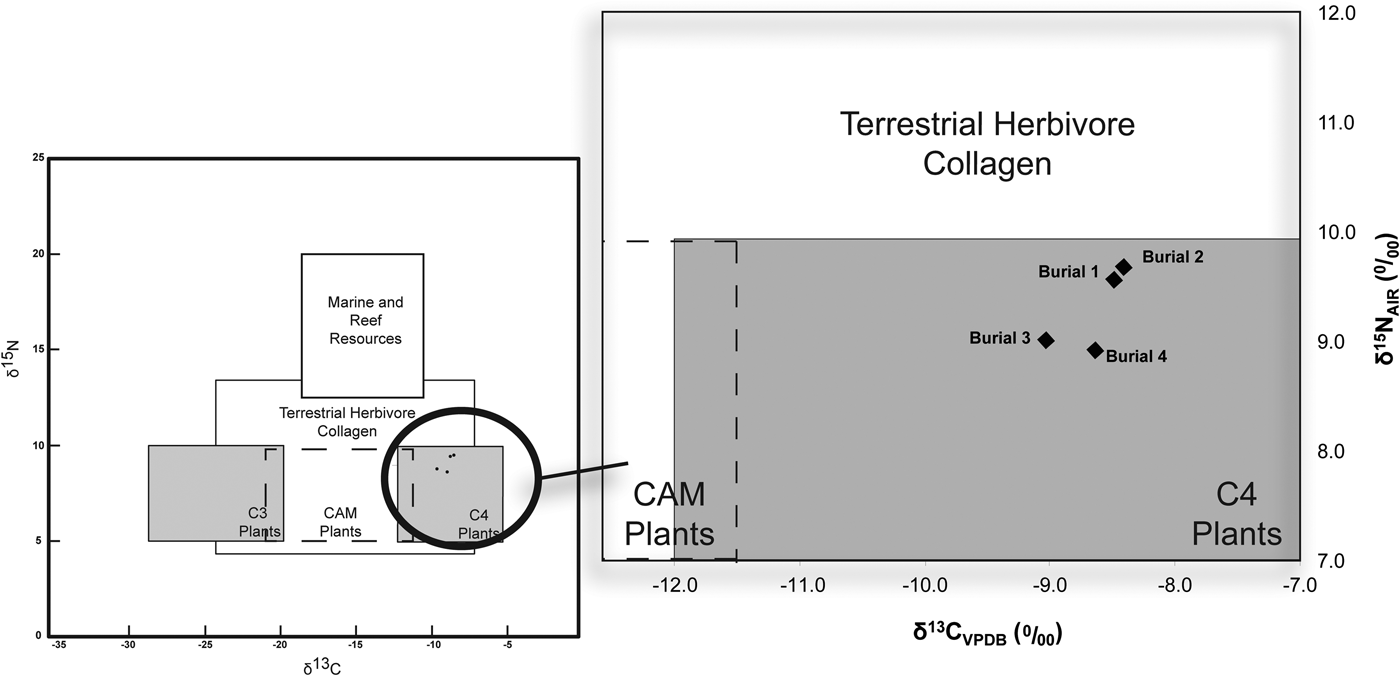
First, a summary of the stable isotope analysis is found in Table 3. As hypothesized initially, results of the δ13C analysis suggest all four Altica individuals were highly dependent on a C4 plant diet, most likely dominated by maize (mean = −8.7 ± 0.26‰, range −8.4‰ to −9.0‰, n = 4). Stable nitrogen isotope ratios range from 8.9‰ to 9.7‰, indicating that all four individuals also consumed similar quantities of terrestrial, animal-derived proteins, as predicted (mean = 9.3 ± 0.41‰, n = 4). Marine foods were not regularly consumed in this region, as has also been demonstrated by previous studies of diet in the Basin of Mexico (Casar et al. Reference Casar, Morales, Manzanilla, Cienfuegos and Otero2017; Nado et al. Reference Nado, Zolotova and Knudson2017; Storey et al. Reference Storey, Buckley and Kennett2019; White et al. Reference White, Storey, Longstaffe and Spence2004). Widmer and Storey (Reference Widmer and Storey2017) hypothesize that people in other parts of the Basin during the Classic period consumed foods such as insects and rodents rather than more usual sources of meat protein found in the Basin, like ducks and deer. This form of protein consumption may also be important in Formative Altica, which was not near the lakes. Additionally, the availability of lacustrine resources at Altica, if any, needs to be studied in the future to test for significant differences between freshwater and terrestrial sources of food at this site (Finlay and Keller Reference Finlay and Kendall2007).
Figure 5 combines baseline isotopic data of plants and human and faunal remains collected throughout Mesoamerica (Lounejeva Baturina et al. Reference Lounejeva Baturina, Puente, Cabadas Báez, Alvarado, Sedov, Gómez and Rebolledo2006; Morales et al. Reference Morales Puente, Alvarado, Manzanilla, Otero and Manzanilla2012; White et al. Reference White, Healy and Schwarcz1993) and plots where the diets of the four individuals from Altica fall within this scale. As shown here, the stable carbon and nitrogen isotope values from all individuals cluster within C4 plants and terrestrial herbivore proteins as the primary sources of diet. It is important to keep in mind that the burial sample from Altica is small. Therefore, we cannot make definite conclusions concerning paleodietary patterns across the entire site based on isotopic evidence alone. Instead, we can confidently state that these four individuals ate similar foods in the years before their deaths. Further excavation and recovery of additional individuals will contribute significantly to understanding the overall dietary practices at this site.
The distribution of δ13C and δ15N values of the four Altica burials in relation to the signatures across Mesoamerica (adapted from White et al. Reference White, Healy and Schwarcz1993).

Combined with paleoethnobotanical analysis, mainly from mortuary contexts (for a full analysis, see McClung de Tapia et al. Reference McClung de Tapia, Acosta-Ochoa, Martínez-Yrizar, Adriano-Morán, Cruz-Palma and Chaparro-Rueda2019), Altica does have the earliest evidence for maize cultivation in the Teotihuacan Valley. There was also a diverse array of other plants, however, most likely wild species, critical to the traditional diets of these people. These plants include amaranth (Amaranthus sp.), chenopods (Chenopodium sp.), and shrubs and annuals (Salvia sp.), among others (McClung de Tapia et al. Reference McClung de Tapia, Acosta-Ochoa, Martínez-Yrizar, Adriano-Morán, Cruz-Palma and Chaparro-Rueda2019). McClung de Tapia and colleagues (Reference McClung de Tapia, Acosta-Ochoa, Martínez-Yrizar, Adriano-Morán, Cruz-Palma and Chaparro-Rueda2019) suggest this array of domesticates and wild taxa found at Altica are consistent with an established “milpa-based agroecological system,” which is indicative of a combination of the production of multiple cultigens while also maintaining a foraging subsistence regime. A combination of agricultural production and foraging practices in tandem with radiocarbon dates from this site support the characterization of Altica as early transitional agricultural village and the Rosenswig et al. (Reference Rosenswig, VanDerwarker, Culleton and Kennett2015) hypothesis that reliance on maize agriculture was not fully established until after 1000 cal B.C
Evidence of Paleomobility
The highlands of Mesoamerica, where the Altica site is located, are composed of geologically young volcanic fields formed during the late Cenozoic Era. In this region, geological 87Sr/86Sr ratios are generally below 0.706 but above 0.704 (Price et al. Reference Price, Burton, Fullagar, Wright, Buikstra and Tiesler2008; Torres-Alvarado et al. Reference Torres-Alvarado, Verma and Carrasco-Nuñez2000). Rocks with 87Sr/86Sr ratios above 0.706 tend to appear in areas of Mesoamerica where older, sedimentary, metamorphic, or plutonic rocks have formed, such as the northern Maya region, the area surrounding Monte Alban, and locations closer to Altica including Xochicalco and Puebla (Price et al. Reference Price, Burton, Fullagar, Wright, Buikstra and Tiesler2008; Solís Picardo et al. Reference Solís Pichardo, Schaaf, Treviño, Lailson, Manzanilla, Horn and Manzanilla2017).
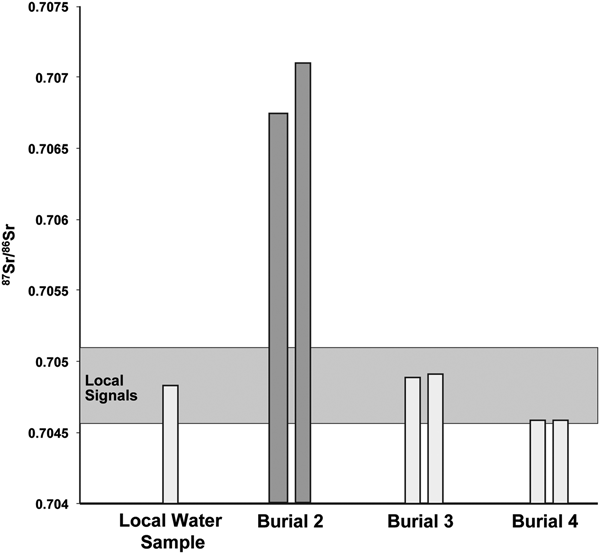
While understanding the strontium isotope signatures of the underlying bedrock for all of Mesoamerica, it is also crucial in paleomobility studies to focus on bioavailable 87Sr/86Sr signatures surrounding the site of interest. In the Basin of Mexico, Price and colleagues (Reference Price, Manzanilla and Middleton2000) examined the bones of rabbits (n = 9) from both modern and archaeological contexts in and near the site of Teotihuacan. The average strontium isotope ratio of the rabbit bones is reported at 0.7046 ± 0.00005, while the range of variation of local human burials for the Basin of Mexico is from 0.7046 to 0.7051, thus establishing a baseline for this region. Altica is about 20 kilometers to the southeast of Teotihuacan; therefore, we need to understand if this same 87Sr/86Sr benchmark also represents the Altica region. We hypothesize that the Teotihuacan 87Sr/86Sr baseline represents the entire underlying geology of the Basin of Mexico. To test this baseline, we analyzed a standing water sample taken from a local reservoir near the Altica site, resulting in an 87Sr/86Sr signal of 0.70477 ± .00006, well within the range of the previously established baseline. Therefore, we accept the 87Sr/86Sr range first recognized by Price and colleagues and will identify local individuals from Altica as having 87Sr/86Sr ratios between 0.7046 and 0.7051 (Figure 6).
87Sr/86Sr ratios of water and human tooth enamel samples analyzed for this study. Chart by Gina Buckley.

The only nonlocal individual among the Altica burial samples was Burial 2, the young man with evidence of trauma (Table 3). This individual has M1 and M3 tooth enamel 87Sr/86Sr signals well above the local baseline (0.70677 and 0.70715, respectively). We know from the stable carbon and nitrogen isotope analysis this individual did not consume marine resources but had a similar diet of local resources like the other individuals recovered from Altica. If his diet indicated the intake of marine foods, we could make the argument that this individual was local but ate food imported from a distant source such as the Gulf Coast, resulting in the elevated strontium isotope ratios well above local signals. In other words, 87Sr/86Sr suggest that the individual in Burial 2 was not born in Altica, nor did he come from the Basin of Mexico. Additionally, he did not live in the Basin of Mexico before his adolescent years. It appears this individual came to Altica as an adult and, given the unusual nature of his death and the contemptible treatment of his burial remains, was possibly an intruder that was met with a violent end. Alternatively, we hypothesize that he was a powerful and feared outsider, who was tolerated only for a short time by the village residents. This is because basalt rocks were situated and piled on top of this man after he was buried, suggesting Altica residents wanted to guarantee this individual could not be accessed or moved once “discarded” (Stoner and Nichols Reference Nichols and Stoner2019b).
Although we cannot pinpoint the exact location of origin of the individual from Burial 2 from strontium isotope ratios alone, compositional analysis of ceramic vessels imported to Altica provide possible links to his place of birth. Further explored in other articles in this issue (Nichols and Stoner Reference Nichols and Stoner2019; Stoner and Nichols Reference Stoner and Nichols2019b) and prior texts (Nichols Reference Nichols2015; Stoner et al. Reference Stoner, Nichols, Alex and Crider2015), Altica is hypothesized to have played an important role in efficient regional exchange systems of Otumba obsidian (Healan Reference Healan2019), as well as ceramics and other exotic goods from locations outside of the Basin. Nodes of exchange, like Altica, were created due to the vast diversity of natural resources spread across Mesoamerica and the difficulty of traveling directly to the source to trade for these goods. Whether or not Altica was the transshipment node spreading Otumba obsidian to other sites in the region is uncertain (Healan Reference Healan2019), but we do observe a more efficient system of procurement, processing, and exchange develop in the Teotihuacan Valley at this time. The significant quantity of white-ware pottery from southwestern Puebla found at the site is further evidence of Altica taking part in this exchange system. Compositional analysis including instrumental neutron activation analysis, laser ablation inductively coupled plasma mass spectrometry, and strontium isotope analysis (Alex et al. Reference Alex, Nichols and Glascock2012) places imported pottery as originating probably from the Las Bocas region of southwestern Puebla, a metamorphic region with 87Sr/86Sr signatures in the same range as the individual in Burial 2. To date, combined strontium isotope ratios from human tooth enamel and compositional evidence of imported white-ware pottery provide the most persuasive evidence of likely origin of this individual.
Incorporating additional isotopic elements to studies utilizing strontium isotope signatures for paleomobility can and should be used to detect poor preservation or contamination of a sample (Dudas et al. Reference Dudás, LeBlanc, Carter and Bowring2016). To enrich this study, tooth enamel from each individual is undergoing stable oxygen phosphate (δ18Ophos) isotopic analysis at Western Ontario under the direction of Dr. Fred Longstaffe. Oxygen isotope values in human tooth enamel reflect the geographical origin of water sources imbibed by an individual during crown formation (Longinelli Reference Longinelli1984). Once we have these results, we can begin to build more confidence in our current paleomobility data while also obtaining more information concerning the origin of Burial 2. It is important to note here that it is impossible to determine the exact location of birth of a nonlocal individual based on isotopic evidence alone.
COMPARISONS WITH CONTEMPORARY SITES
With such a small sample, it is hard to make any conclusions, and there are not many contemporary early sites with human interments that have been excavated for comparison. The settlements during the Early–Middle Formative in the Basin are concentrated in the south where it is warmer, wetter, and more favorable for agriculturalists (Stoner and Nichols Reference Stoner and Nichols2019b). These settlements that overlap with Altica, like El Arbolillo and Zacatenco, were generally small excavations with few burials. Excavations that have taken place at other Early Formative sites near the Basin of Mexico such as Las Bocas (Paillés Reference Paillés H.2008) and Chalcatzingo (Grove Reference Grove1987) resulted in very few, if any, mortuary finds.
It is possible to make some comparisons with Tlatilco, a larger and more prominent site in the southern Basin on the western edge of the lakes that chronologically overlaps with Altica. A large skeletal sample was recovered from excavations between 1942 and 1969, although the site was originally thought to be a cemetery and later analysis indicated these are probably subfloor and storage-pit burials (Tolstoy Reference Tolstoy, Sharer and Grove1989). Tolstoy's analysis focused on burial orientation, age, sex, and social rank as determined through grave goods. There were definitely some status differences, as some of the burials contained exotic goods of iron-ore mirrors and shell and greenstone objects and jewelry. Tolstoy (Reference Tolstoy, Sharer and Grove1989:117–119) concluded that there were two moieties, corresponding to Olmec versus Tlatilco cultural grave goods, and that Olmec pottery, although present in 50 percent of the burials, did not indicate higher social status and wealth. Joyce's (Reference Joyce and Chesson2001) analysis of the Tlatilco burials finds identifies females as the stable core within the village, and Tolstoy (Reference Tolstoy, Sharer and Grove1989) suggested that the importance given female burials indicated a matrilocal postmarital residence, so these females would have been very local (Joyce Reference Joyce and Chesson2001). Tlatilco provides evidence of past lives that is just not possible with only four individuals, although Altica does have status differences and women with probable prestigious interments.
The Tlatilco burials (between 200–300 individuals) have been investigated for paleopathological indicators (Márquez Morfin and Storey Reference Márquez Morfin, Storey, Cohen and Crane-Kramer2007; Márquez Morfin et al. Reference Márquez Morfin, McCaa, Storey, del Angel, Richard H and Rose2002), and there are some interesting similarities with Altica. The most common pathology was also periosteal reactions from infection, with 64 percent of all scorable skeletons (261 individuals) affected. For enamel hypoplasias, a more moderate 44 percent of scorable individuals were affected. For PH, only 11 percent had lesions on the cranial surface but, as at Altica, cribra orbitalia was more common, with 25 percent having evidence. Cribra was particularly prevalent in children (zero to 15 years of age) with 43 percent affected (Márquez Morfin et al. Reference Márquez Morfin, McCaa, Storey, del Angel, Richard H and Rose2002), indicating that perhaps it was common to survive that particular morbidity during the time of Altica in the Basin. Thus, early agriculturalists did have stresses from moderate malnutrition and unsanitary conditions from adopting a sedentary lifestyle.
SUMMARY
Although comprising only four individuals, the Altica skeletons have evidence of status differences and how women might have been venerated as ancestors. These early agricultural villages in the Basin of Mexico are smaller and less dense than later settlements which are expected to have sanitation and infection problems. Altica's individuals generally had slight cases of the paleopathological indicators. Yet there were problems with infections and anemia, perhaps indicating that in the transition to sedentary living and agriculture, sanitation and some malnutrition were new stresses in even small settlements which the residents were not yet able to totally avoid. Foragers generally have well-rounded diets, without overdependence on a crop like maize, and are mobile enough to not live with their garbage (Barnes Reference Barnes2007), so presence of paleopathological indicators are further evidence of the different lifestyle that maize agriculture with perhaps less protein resources brought to these early settlers. For Altica, anyway, the individuals were able to survive these probable slight morbidity episodes.
From a biogeochemical standpoint, all four individuals recovered from Altica represent the Early–Middle Formative period, as predicted when excavations initially took place. Diets were heavily reliant on maize crops and terrestrial herbivores, which were also common to both the time period and the region. What was not predicted is that Burial 2, the young man buried in a deviant nature, was nonlocal to the Altica region and possibly originated from the southern region of Puebla based on strontium isotopes ratios of human tooth enamel and compositional analysis of imported white-ware pottery. All other individuals have isotopic evidence of lifelong residency at Altica. Burial 2 may have been a feared individual, or a physical representation of a dreaded or despised entity from another land, who was not tolerated by the village residents for very long.
RESUMEN
Altica es la aldea más antigua del Valle de Teotihuacan conocida por los investigadores, y es un primer sitio agrícola raro en la Cuenca de México que ha sobrevivido hasta tiempo moderno. Proporciona una visión de la vida durante el período formativo temprano–medio, ya que las personas se adaptaron a un estilo de vida agrícola. Aunque pequeño en comparación con algunos otros sitios del formativo en la Cuenca, Altica también fue un lugar importante en las redes de intercambio y recibió bienes de áreas distantes en Mesoamérica.
En este estudio, examinamos los cuatro individuos humanos (dos mujeres y dos hombres) recuperados durante las excavaciones. Las mujeres fueron enterradas en tepetate, aunque no está claro si son paquetes primarios o secundarios. Pocas ofrendas graves se encontraron con las mujeres, pero el entierro en tepetate puede indicar que eran personas respetadas en el pueblo. Los marcadores en el hueso del pubis sugieren que ambos eran madres. La evidencia del estado social ocurrió con el Entierro 3, un hombre enterrado en un pozo de tepetate intencional. Aquí, se recuperaron múltiples objetos de valor cerca del esqueleto sugiriendo un posible líder de la aldea. Por último, se encontró un entierro desviado. El Entierro 2 muestra signos de trauma, incluido el desprendimiento de las extremidades. Este individuo fue enterrado boca abajo en un pozo de tepetate con piedras de basalto que lo cubren. Además, pigmento amarillo y rojo pintado en los huesos.
El análisis muestra que los individuos de Altica generalmente tenían casos leves de los indicadores paleopatológicos. Hay evidencia de infecciones y anemia. Estos datos pueden indicar que el saneamiento y la malnutrición fueron nuevos problemas causados por la transición a la vida sedentaria y la agricultura que los residentes no pudieron contrarrestar en ese momento.
El análisis biogeoquímico indica que los cuatro individuos recuperados de Altica representan el período formativo temprano–medio. Las dietas dependían de los cultivos de maíz y los herbívoros terrestres, que también eran comunes tanto en el período como en la región. Entierro 2, el joven enterrado en una naturaleza desviada, nació fuera de la Cuenca de México, mientras que todos los demás enterramientos tienen evidencia de la residencia de por vida en Altica. Las proporciones de esótopos de estroncio del esmalte dental sugieren que este individuo llegó a Altica como adulto, quizás involuntariamente. Además, el Entierro 2 puede haber sido un individuo temido o era una representación física de una entidad temida o despreciada de otra tierra, que no fue tolerado por los residentes de la aldea por mucho tiempo.
ACKNOWLEDGMENTS
This material is based upon work supported by the National Geographic Society – Committee for Research and Exploration (9432-14) and the National Science Foundation (collaborative proposal: Nichols 1424132 (Dartmouth) and Stoner 1424184 (Arkansas). We are thankful for the financial assistance from Deborah Nichols and Wesley Stoner allowing us to explore this type of research at Altica and to Wes for his helpful comments on the text. The authors would like to thank Matthew Gonzales of Laboratory for Isotopes and Metals in the Environment at The Pennsylvania State University (PSU) for providing assistance with the strontium isotope analysis and Brendan Culleton of the PSU AMS Facility for assistance with 14C dates. All osteological observations and paleopathological research was conducted by Rebecca Storey. AMS 14C dating and isotope analysis was conducted by Gina M. Buckley.