INTRODUCTION
During the fifth millennium BCE some of the prehistoric cultures of the Iranian Plateau, such as Bakun in Fars, Cheshmeh Ali in the Central Plateau, and Dalma in the Central and Northern Zagros range, grew up and occupied a vast area. Transformed and emerged from the earlier, usually localized Neolithic societies, each of these Chalcolithic cultures had a remarkable homogeneity in their distinct ceramic assemblages, indicating some sort of cultural coherence within their societies. During this period, Bakun culture, characterized by its fine buff painted ceramics, flourished in the Southern Zagros range; Cheshmeh Ali culture, with its characteristic black-on-red painted ceramics, dominated the entire Central Plateau and vast parts of northeast Iran; and Dalma Culture, with its distinct ceramic assemblages, occupied most of the Central and Northern Zagros in western Iran. Of these three prehistoric cultures, the temporal framework of the first two is, to a large extent, clear thanks to available radiocarbon (14C) dates (e.g., Alizadeh Reference Alizadeh2006; Pollard et al. Reference Pollard, Fazeli Nashli, Davoudi, Sarlak, Helwing and Saeidi Anaraki2013), but that of Dalma Culture has been remained questionable because of the lack of reliable absolute dates.
Dalma Culture was first recognized through excavations conducted by the Hasanlu Project’s team members in the late 1950s and early 1960s at the type site, Tappeh Dalma, on the southern coast of Lake Urmia in northwest Iran (Young Reference Young1963; Hamlin Reference Hamlin1975). C. Hamlin, who several years later compiled a report on these excavations, classified the ceramic assemblage of the site into four groups: Dalma Impressed, Dalma Monochrome, Dalma Red Slip, and Dalma Plain Ware; the first two were the most typical ceramics of this period (Hamlin Reference Hamlin1975). In the chronological chart established by the Hasanlu Project for the Lake Urmia Basin cultural region, Dalma Period (Hasanlu IX) succeeds the 6th millennium Neolithic of Haji Firuz (Hasanlu X) and precedes the Late Chalcolithic Pisdeli Period (Hasanlu VIII) (Voigt and Dyson Reference Voigt, Dyson and Ehrich1992). Still, regarding the obvious difference between ceramics of these three periods, it is likely that some transitional phases are yet to be identified between them (see also Voigt and Dyson Reference Voigt, Dyson and Ehrich1992:174).Footnote 1 After recognition of the Dalma ceramic assemblage at the type site, the same materials were identified at some sites on the southern and western Lake Urmia, such as Haji Firuz (Voigt Reference Voigt1983) and Tappeh Seavan (Solecki and Solecki Reference Solecki and Solecki1973).
A major development in prehistoric archaeology of the Central Zagros in general and characterization of Dalma Culture in particular, was associated with the Royal Ontario Museum expedition in the Kangavar Valley in eastern part of the Central Zagros. This expedition, known as the Godin/Seh Gabi Project, led by T. C. Young and L. D. Levine, conducted a five-year excavation at these two key sites of the region from 1965–1973 (Young Reference Young1969; Young and Levine Reference Young and Levine1974). At Godin, ceramics identical to those of Tappeh Dalma were uncovered from the XYZ Trench (Spits 50–63) dug in the deep, eroded north face of the site. In Seh Gabi, a site consisting of six individual mounds, identical ceramics to those of the XYZ Trench were revealed in the lower levels of Mound B (Levels 7–5). These ceramic assemblages were recognized as Dalma by the excavators and were labeled Godin X period in the chronological chart established for the Kangavar Valley. It succeeds the poorly defined phase of Godin XI (Shahn Abad Phase) and precedes Godin IX (Seh Gabi Phase) (Henrickson Reference Henrickson1983; Young and Levine Reference Young and Levine1974). While there is some continuity between ceramic assemblages of Dalma Period and the succeeding period of Seh Gabi, there is almost no recognizable ties between the ceramic assemblage of Dalma and that of the preceding phase (see Voigt and Dyson Reference Voigt, Dyson and Ehrich1992:159).
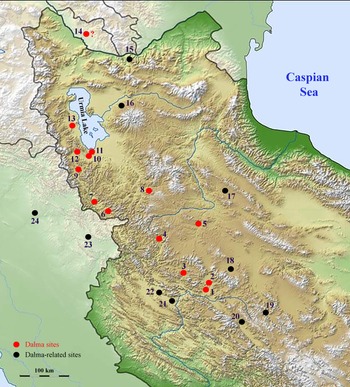
The 1979 Iranian Revolution brought a long hiatus in prehistoric investigations of the Central Zagros region. Since the mid-1990s, however, an increasing number of fieldworks have been conducted in the region which contributes to our understanding of the cultural development of the region from the 10th to 5th millennium BCE. (see Matthews and Fazeli Reference Matthews and Fazeli Nashli2022). Some of these investigations, including excavations at the sites of Kani Mikaeil Cave (Roustaei et al. Reference Roustaei, Rezvani and Heydari2002), Lavin Tappeh (Hejebri Nobari et al. Reference Hejebri Nobari, Binandeh, Neyestani and Vahdati Nasab2012), Qeshlagh (Motarjem Reference Motarjem2014; Sharifi Reference Sharifi2020), Baghi (Falahian and Nozhati Reference Falahian and Nozhati2016), Namshir (Saed Moucheshi et al. Reference Saed Moucheshi, Zamani Dadaneh, Ghasemi and Karimi2017), and Chapar Abad (Bahranipoor Reference Bahranipoor2022, Reference Bahranipoor2023), have provided a corpus of material culture of Dalma Period, but they failed to reveal useful information on architecture of this period due to the small exposures (Figure 1). Furthermore, neither of these excavations provided a reliable absolute date for the Dalma Period. Recent excavations at Tappeh Nad Ali Beig in the Central Zagros provided both some information on the architecture of Dalma Period and, more importantly, provided the first reliable 14C dates for this period.
Location of the excavated sites of Dalma- and Dalma-related period in the Central Zagros and the Northwest Region: 1. Godin; 2. Seh Gabi; 3. Nad Ali Beig; 4. Gryashan; 5. Qeshlagh; 6. Namshir; 7. Tappeh Baghi; 8. Kani Mikaeil Cave; 9. Lavin; 10. Tappeh Dalma; 11. Pisdeli; 12. Chapar Abad; 13. Seavan; 14. Nakhchivan Tappeh; 15. Kul Tepe; 16. Yanik; 17. Soha Chai; 18. Taze Kand; 19. Sarsakhti; 20. Qela Gap; 21. Siahbid; 22. Chogha Maran; 23. Kani Shaie; 24. Surezha.

The aim of this paper is to enhance our understanding of the Dalma period through presenting some new information on absolute dates, ceramic assemblages, and architecture of the Dalma period which have been obtained from two seasons of excavations at Nad Ali Beig, a typical Dalma site in the Central Zagros. We try to put new insights from the site in a wider geographical perspective, referring to the Dalma- and Dalma-related sites in northern Mesopotamia, northern Zagros, and Caucasia.
THE CENTRAL ZAGROS CHALCOLITHIC
The Central Zagros covers approximately the current areas of the provinces of Kermanshah and Ilam, and parts of Lorestan, Hamedan, and Kordestan in western Iran. Archaeologically this region has been divided into two main zones: Western Lorestan and High Road and Eastern Lorestan. The High Road has been divided into two sequences of Mahidasht in the west and Kangavar in the east (Voigt and Dyson Reference Voigt, Dyson and Ehrich1992; Gopnik and Rothman Reference Gopnik and Rothman2011). Most information on the Chalcolithic period of the Central Zagros comes from the Royal Ontario Museum excavations at two key sites of Godin and Seh Gabi in the Kangavar Valley. Although Young and Levine, the directors of Godin/Seh Gabi Project, outlined the prehistoric cultural sequence of the region from the late Neolithic to the Iron Age (Levine and Young Reference Levine and Young1987), it was Elizabeth Henrickson who established a well-articulated sequence of the Chalcolithic Period of the Central Zagros based on detailed ceramic analyses (e.g., Henrickson Reference Henrickson1983, Reference Henrickson1985, Reference Henrickson and Kingery1986; Henrickson and Vitali Reference Henrickson and Vitali1987). During her studies on the Zagros Chalcolithic, Henrickson used different methods for subdivision of the period and proposed different time-ranges for each phase, but in her latest publication (1992) she divided the Chalcolithic period of the region into three phases: Early Chalcolithic, Middle Chalcolithic, and Late Chalcolithic. Middle Chalcolithic was further subdivided, from early to late, into three subphases I, II, and III; subphase I represents the Dalma period.
During the Chalcolithic period, the two areas of the Central Zagros, i.e., Mahidasht in the west and Kangavar Valley in the east, had mostly their own cultural developments and interaction spheres. In general, the Mahidasht area, due to its proximity to the Mesopotamia, had strong cultural ties with the lowland to the west, while the Kangavar Valley formed its own cultural character with increasing interaction with the Central Plateau to the east and the Northwest Region to the north. For instance, while the Early Chalcolithic in the Mahidasht area is characterized by a distinct and widespread ceramic, called J-Ware, bearing close similarities with the Late Halaf ceramic assemblages of northern Mesopotamia, the eastern part of the Central Zagros (Kangavar Valley) is poorly characterized by a monotone, highly localized ceramic tradition known as Shahn Abad, which was first documented in excavation at Mound C of Seh Gabi (Young and Levine Reference Young and Levine1974; Levine and Young Reference Levine and Young1987). During the Middle Chalcolithic phase, the relative separation between the material cultures of the two areas of the Central Zagros continues, but its earliest phase, represented by the Dalma Period, occupies a surprisingly vast area stretching from the northern Lorestan to the Lake Urmia Basin in northwest Iran. In the Late Chalcolithic phase, Kangavar Valley shows increasing interaction with the Central Plateau in the east, as evidenced by close ceramic similarities between the two regions during Godin VII and VI periods (Roustaei and Azadi Reference Roustaei and Azadi2017).
Our information about the social structure of the Middle Chalcolithic societies of the Central Zagros is scanty. The known Dalma sites of the Central Zagros and the Northwest Region show no hierarchy in terms of settlement size; they all represent small hamlets and villages between 1–2 ha in area. Except for a handful of simple seals recovered from the Middle Chalcolithic contexts (Henrickson Reference Henrickson1988; Henrickson and Vitali Reference Henrickson and Vitali1987), no artifact suggestive of social complexity is reported from Dalma sites. Despite this apparent lack of social complexity, these societies should not be viewed as isolated from their neighboring regions, but they were part of a web for transferring materials, ideas, and people. The existence of some exotic materials, such as lapis lazuli, turquoise, obsidian, and copper, at contemporaneous sites both in the Central Zagros (such as Nad Ali Beig) and adjacent areas (such as Tepe Gawra in northern Mesopotamia, and Chogha Mish in lowland Susiana) indicate that there was some degree of communication between these societies during the fifth millennium BCE (cf. Tobler Reference Tobler1950:176–200; Alizadeh Reference Alizadeh2008:20).
Dalma and Dalma-Related Ceramic Assemblages
Since defining Dalma as a distinct ceramic tradition in the 1960s and 1970s in the northern and central Zagros regions, many sites in surrounding areas, such as the western piedmonts of the Zagros in northern Mesopotamia, have been identified as having Dalma materials. This caused some confusion about this cultural entity and its cultural sphere. In such situations, it is important to differentiate the genuine cultural materials of a given culture from its “related” ones. Regarding Dalma culture, we should look into its ceramic assemblages at key sites in its heartland, which is the Zagros highlands (see Henrickson Reference Henrickson1983). These key sites are Tappeh Dalma in the southern Lake Urmia and Godin and Seh Gabi (Mound B) in the Kangavar valley in the eastern Central Zagros.
As mentioned before, the site Tappeh Dalma produced four ceramic types according to Hamlin (Reference Hamlin1975): Dalma Impressed (surface-manipulated), Dalma Monochrome, Dalma Red Slip, and Dalma Plain Ware. In the Central Zagros sites, however, the Dalma contexts revealed eight ceramic types: the four types already known from Tappeh Dalma plus four other ceramic types: Dalma Bichrome, Dalma Streaky, Black-on-Buff (BOB), and Dalma Ubaid/Untempered (DUP). The latter four types have a limited distribution and are mainly documented, with low frequencies, at a few sites only in the Central Zagros. So far, Dalma Bichrome, which thought to be a variant of Dalma Monochrome (Henrickson and Vitali Reference Henrickson and Vitali1987:38), is found in excavations at only two sites, Seh Gabi (Level 7) and Nad Ali Beig; in the latter it comprises just 0.1% of the whole assemblage.Footnote 2 It is possible that Dalma Bichrome imitated the polychrome painted J Ware in the Mahidasht to the west which has related to the Late Halaf ceramic of northern Mesopotamia (Renette Reference Renette2022). Dalma Streaky has also a limited geographical distribution and low frequencies and is mostly confined to a few sites, including Seh Gabi, in the Central Zagros. This ceramic type is present throughout the Nad Ali Beig sequence but in very low frequency (less than 0.3% of the whole assemblage). Henrickson (Reference Henrickson1983:600) has suggested that Dalma Streaky is a local development inspired from J Ware in the Mahidasht.
While Dalma Streaky and Dalma Bichrome seem to be local development, both BOB and DUP can be considered as the consequence of increasing westward interaction with the lowland Mesopotamia through Mahidasht. As Henrickson and Vitali (Reference Henrickson and Vitali1987:39) have pointed out, stylistically and technically, both BOB and DUP are not part of the highland classic Dalma assemblage; rather, they bear a generic resemblance to the lowland Mesopotamian Ubaid ceramic tradition. They are relatively thin, highly fired unslipped ceramics with fine mineral and chaff temper. The Mesopotamian origin of these wares is supported by their much more frequencies in ceramic assemblages of the western part of Central Zagros (Mahidasht) which is in fact the gate to the Iranian Plateau from the lowland Mesopotamia along a natural communication corridor known as the High Road or the Great Khorasan Road (e.g., Henrickson Reference Henrickson1983; Gopnik and Rothman Reference Gopnik and Rothman2011; Renette et al. Reference Renette, Abu Jayyab, Gibbon, Lewis, Abdullkarim Qadir, Cabral and Tomé2021a). Diffusion of Ubaid-related buff wares along the High Road into the Central Zagros can be seen as part of a northward expansion of the black on buff ceramic tradition from southern Mesopotamia into the Zagros highlands. This type of ware was introduced into the Deh Luran Plain in southwest Iran in the second half of the 6th millennium BC, where is represented by Chogha Mami Transitional phase, related to the Samarra culture (Hole Reference Hole1977), in the Central Zagros around late sixth millennium BC, and in the Northwest Region in mid-fifth millennium onwards (Voigt and Dyson Reference Voigt, Dyson and Ehrich1992:175). These lowland-related buff ceramics should not be seen as an integrated components of the classic Dalma ceramic assemblages, because they appear on a few Dalma sites, mostly along the High Road in the Central Zagros, such as Godin, Seh Gabi, and Nad Ali Beig.
Considering the foregoing discussion, it is obvious that these four ceramic types are not necessary components of every Dalma assemblage. Rather, the essential components of a given ceramic assemblage to be labeled Dalma are Dalma Red Slip, Dalma Plain, Dalma Monochrome, and Dalma Surface-Manipulated (Impressed). Of these, Dalma Monochrome stands as the most basic one, because of its distinct physical characteristics, and because, contrary to Dalma Red Slip, Dalma Plain, and Dalma Impressed, is confined strictly to the likely time-range for the Dalma period, ca. 5200/5100–4600 BCE (see below; see also, Renette et al. Reference Renette, Abu Jayyab, Gibbon, Lewis, Abdullkarim Qadir, Cabral and Tomé2021a:36). Dalma Impressed, though characteristic, has a much wider temporal and spatial range than that of Dalma Monochrome and continues into the later periods and surrounding area, although with some modifications. Because of its vast distribution, Dalma Impressed, or its related variants, have caused some confusion on ascribing some sites to the Dalma period. For example, finding of a few Dalma-related Impressed ceramics in otherwise different assemblages of Tazeh Kand in the northern Hamedan Plain (Balmaki Reference Balmaki2017) and Qala Gap in the northeastern Lorestan Province (Abdolahi et al. Reference Abdolahi, Niknami, Hesari and Sardari2014) has prompted the excavators to ascribe these sites to Dalma period (Figure 1). Therefore, the existence of Dalma Impressed alone in a ceramic assemblage does not necessarily indicate that the assemblage belongs to the Dalma period (cf. Renette Reference Renette2022). In other word, a given ceramic assemblage could be considered as Dalma, providing Dalma Impressed coexists with Dalma Monochrome as the characteristic components, along with Dalma Red Slip and Dalma Plain which usually comprise the bulk of a Dalma ceramic assemblage. As we will see below, this condition does not work for Dalma Monochrome, because its appearance in Dalma contexts slightly precedes that of Dalma Impressed; so, it is possible that at some sites it occurs not associated with Dalma Impressed, though such cases are not yet documented.
Dalma Red-Slipped ware has an even longer duration than that of Dalma Impressed in archaeological contexts of the Central Zagros. It starts in the late 7th millennium BCE contexts of the Neolithic, such as Guran (e.g., Mortensen Reference Mortensen2014) to at least the mid-fourth millennium contexts of the Late Chalcolithic (Voigt and Dyson Reference Voigt, Dyson and Ehrich1992; Henrickson Reference Henrickson1983:171; see also Renette Reference Renette2022:133).
The second factor for identifying a certain ceramic assemblage as Dalma is the frequency of occurrences of the foregoing classic Dalma ceramic types in it. Recently, Renette rightfully pointed out that a Dalma archaeological assemblage should consist of at least 90% classic Dalma pottery and other aspects of Dalma material culture (Renette Reference Renette2022:144). Considering these two factors, several sites outside the “core area” of the Dalma culture that have been ascribed to this period should be overruled. Such sites are, in fact, Dalma-related, which usually contain a small amount of Dalma Impressed ware in their otherwise different ceramic assemblages. Following these requirements, none of the Mahidasht sites, such as Siahbid and Chogha Maran, with Red-Slipped and Dalma Impressed components belong to the Dalma period, because, first, they are lacking the characteristic Dalma Monochrome (Henrickson Reference Henrickson1983; Renette et al. Reference Renette, Abu Jayyab, Gibbon, Lewis, Abdullkarim Qadir, Cabral and Tomé2021a, Reference Renette, Lewis, Wencel, Farahani and Tomé2022), and second, the quantities of these two Dalma ceramics in their ceramic assemblages are small, highly outnumbered by local ceramic types (e.g., Renette et al. Reference Renette, Lewis, Wencel, Farahani and Tomé2022:29, Figure 3). This is the case also for several sites in the east of the Tigris which either contain only small amount of Dalma Impressed, such as Kani Shaei, Phase VII and VIb (Renette et al. Reference Renette, Abu Jayyab, Gibbon, Lewis, Abdullkarim Qadir, Cabral and Tomé2021a), or contain a small amount of both Dalma Impressed and Dalma Monochrome, such as Surezha (Stein Reference Stein2018:43; Stein and Fisher Reference Stein and Fisher2020:142).
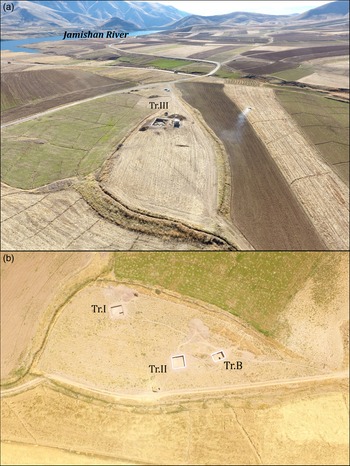
(a) Drone photo of Nad Ali Beig and its immediate landscape; (b) location of the excavated trench in the first season.

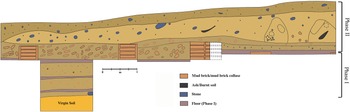
Trench 3, profile of the south wall.

With these considerations in mind, we would be able to define to some extent the cultural zone occupied by Dalma culture, as represented by sites with full assemblages of characteristic Dalma ceramics. It seems likely that Dalma culture did not extend in the western piedmonts of Zagros; neither of sites in the Hamrin and “Trans-Tigridian areas” provided full and prevailed assemblages of Dalma ceramics (Renette Reference Renette2022). To the south, the full Dalma ceramic assemblages are present in the Kangavar Valley; further south, in Lorestan, no certain Dalma assemblage, except sporadic Dalma Impressed-related and Red Slip sherds, is reported (Goff Reference Goff1971). To the east, the hilly terrains to the east of Kangavar Valley, Hamedan, and Zanjan produced no full ceramic assemblages of this period (e.g., Swiny Reference Swiny1975), but few Dalma Impressed- or Monochrome-related sherds in otherwise different ceramic assemblages, such as Qela Gap (Abdolahi el at. Reference Abdolahi, Niknami, Hesari and Sardari2014), Taze Kand (Balmaki Reference Balmaki2017), Sarsakhti (Abedi et al. Reference Abedi, Eskandari, Khatib Shahidi, Sharahi and Shirzad2014a), and Soha Chai (Rahimi Sorkhani and Eslami Reference Rahimi Sorkhani and Eslami2018). To the north, the situation of Dalma settlements is not clear enough. The northernmost known site with actual Dalma ceramics is Tappeh Seavan (Solecki and Solecki Reference Solecki and Solecki1973). From this site to the border with the Republic of Azerbaijan, no certain Dalma sites are reported. Nevertheless, both Dalma Impressed and Dalma Monochrome are recently recovered from Nakhchivan Tepe in the Republic of Azerbaijan (Bakhshaliyev Reference Bakhshaliyev2018, Reference Bakhshaliyev2020), along with local ceramics. As there is almost no information on the probable Dalma presence in the western Lake Urmia (from Tappeh Seavan in the south to the border with Nakhchivan region in the north), and as the detailed excavation report of Nakhchivan Tepe is not yet published, it is difficult to interpret the material from Nakhchivan Tepe in a wider cultural sphere of Dalma, though the excavator claims that Dalma culture has been originated from Caucasia then spread southward (Bakhshaliyev Reference Bakhshaliyev2018), a claim that needs further evidence to be verified. It seems that the situation of Dalma culture in the eastern Lake Urmia is similar to the periphery areas of the Dalma heartland, such as the western piedmonts of the Zagros, where usually scattered Dalma Impressed or a handful of Dalma Monochrome sherds are found in otherwise different ceramic assemblages, such as Yanik Tappeh (e.g., Burney Reference Burney1964:58, Pl. XV.3).
Chronology of the Dalma Period
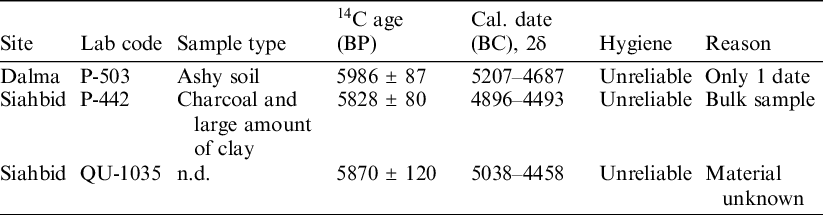
One of the main issues of Dalma culture has been its chronology. Until our excavations at Nad Ali Beig, our information on the absolute chronology of Dalma period relied primarily on a handful of 14C and Thermoluminescence dates both from the 1960s–1970s excavations and the fieldworks carried out from the 2000s onward. Those from earlier excavations were obtained from Tappeh Dalma (1 date) in the Lake Urmia Basin (Hamlin Reference Hamlin1975, Table 2), Mound B at Seh Gabi (1 date) in the Kangavar Valley (Henrickson Reference Henrickson1983, Table 71), and Dalma-related deposits of Siahbid (2 dates) in the Mahidasht Plain (Marshall Reference Marshall2012:258–259). In an attempt to reevaluate and assess the 14C dates from the prehistoric contexts of Iran, J. Marshall (Reference Marshall2012) concluded that neither of these dates can be considered with confidence because of the lack of necessities involved in extraction and scientific procedure on 14C samples (Table 1). Obviously, one of the main problems with these dates is that they show a wide time-range (between 400–500 years), making them unreliable. The sample from Seh Gabi Mound B (Level 6) produced a 14C date of 4565–4410 BC (1δ) (Voigt and Dyson Reference Voigt, Dyson and Ehrich1992, Table 2), which, as we will discuss below, is out of the likely time-range of the Dalma period. As for the sample from Tappeh Dalma and Siahbid, these dates might also be problematic, because they were taken before the 1980s and the material is unknown.
Radiocarbon dates from Tappeh Dalma and Siahbid (Marshall Reference Marshall2012:246–247, 258–259).

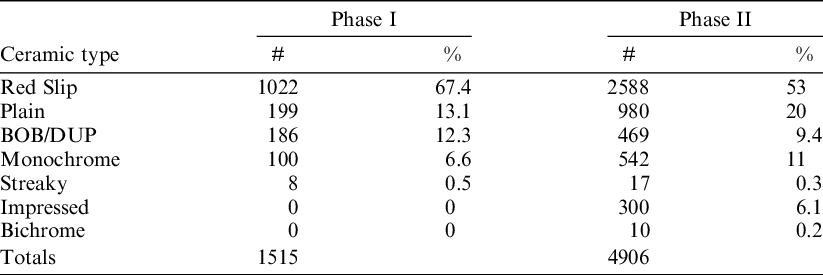
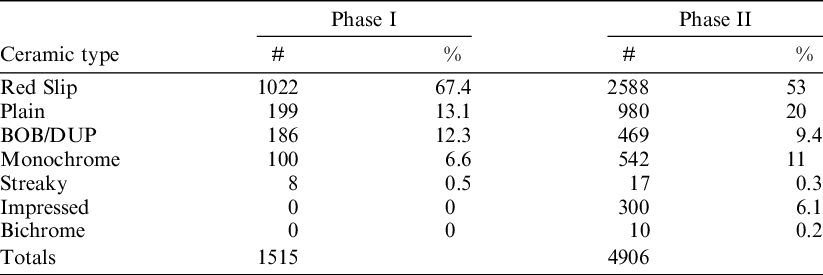
Frequencies of different types of Dalma ceramics in the ceramic assemblage of Phase I and Phase II of Trench 3.
These confusing dates made researchers suggest different time ranges for the Dalma Period. For example, Hamlin suggested a time-range between 5000–4000 BCE for this period based on relative stratigraphy of Hasanlu and the available 14C dates for Haji Firuz and Pisdeli period at that time which bracket Dalma deposits (Hamlin Reference Hamlin1975:120). As we now know, though this wide time-range covers most of the Dalma period, its later half (i.e., 4500–4000 BCE) is irrelevant. In a review of the prehistoric cultures of western Iran, F. Hole suggested a reasonable time-range for Dalma period in Azerbaijan based on relative chronology, ca. 5200–4700 BCE, while he put Dalma period roughly in 4500 BCE in the Kangavar sequence (Hole Reference Hole and Hole1987, Table 2). E. Henrickson, who carried out one of the most intensive studies on the Dalma period, suggested different time ranges for the period on different occasions. She suggested, in 1985, that the period spans the range 4100–3700 BC (Henrickson Reference Henrickson1985:50), but several years later she changed it to 5100–4000 BC (Henrickson Reference Henrickson, Henrickson and Thuesen1989:369). Finally, she suggested the range 5000–4800 BC for the period based on comparative studies (Henrickson Reference Henrickson1992:287). Although the latter has a limited duration, it properly fit in the chronological framework of the Dalma period based on our 14C dates (see below).
While most researchers proposed a time-range for the Dalma period that essentially covers the fifth millennium, Tonoike on several occasions mentioned a sixth millennium BCE date for this period (e.g., Tonoike Reference Tonoike2009:26, Figure 18; Reference Tonoike2012:65). Although it is likely that Dalma culture began in the last centuries of the sixth millennium BCE (see below; also, Renette Reference Renette2022), it essentially covers the first half of the fifth millennium BCE.
During the last two decades some Chalcolithic sites have been excavated both in the Central Zagros and northwest region. Of these, three sites are relevant to our discussion: Tappeh Qeshlagh near Bijar, Soha Chai near Zanjan, and Kul Tappeh near the border between Iran and Republic of Azerbaijan. Tappeh Qeshlagh is a typical Dalma settlement which produced all four common Dalma ceramic types, occuring at the type-site, Tappeh Dalma. Two thermoluminescence dates are available for Dalma contexts of the site: 5500 ± 250 BC and 5000 ± 350 BC (Sharifi and Motarjem Reference Sharifi and Motarjem2018, Figure 4). The dates are problematic because the field requirements needed for this type of dating have not been applied. More importantly, they are not calibrated, thus showing a wide time range as much as 600 years which makes them unreliable.
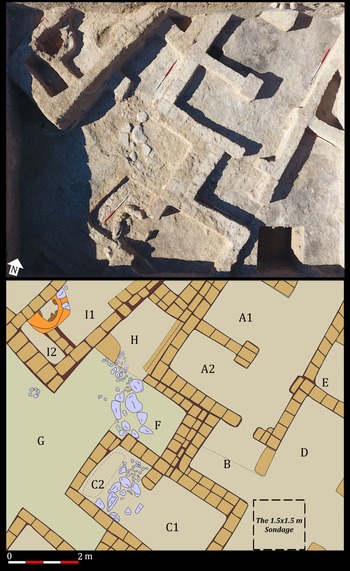
Drone photo of the architecture of Phase I of Trench III and the corresponding plan.

The two sites of Soha Chai and Kul Tappeh have been claimed to contain Dalma levels. The putative Dalma deposits of Soha Chai have been 14C dated to 4269–3968 BC (Rahimi Sorkhani and Eslami Reference Rahimi Sorkhani and Eslami2018:220). The point is that, based on the published materials (Rahimi Sorkhani et al. Reference Rahimi Sorkhani, Niknami and Eslami2016; Rahimi Sorkhani and Eslami Reference Rahimi Sorkhani and Eslami2018; Aali Reference Aali2007), no typical Dalma ceramic, such as Dalma Impressed or Dalma Monochrome, is seen in the ceramic assemblage. Based on the author’s examination of both published and unpublished materials of the site, the Soha Chai ceramic assemblage has an eclectic nature, showing similarities with Godin VII materials of the Central Zagros on one hand, and with Qabrestan I in the Central Plateau on the other hand. It is also worth noting that the single absolute date of Soha Chai is far younger than the proposed dates for Dalma period which put it essentially in the first half of the fifth millennium BC (cf. Zamani Dadaneh et al. Reference Zamani Dadaneh, Renette and Saed Moucheshi2021:22, footnote 6). Therefore, in our opinion, based on ceramic similarities, Soha Chai might be dated to the Godin VII/Qabrestan I period. In fact, new 14C dates from Tappeh Qabrestan (ca. 4200–3900 BCE) conforms very well with those from Soha Chai (Pollard et al. Reference Pollard, Davoudi, Mostafapour, Valipoor and Fazeli Nashli2012, Table 17).
Kul Tappeh is a 19-m-high, multi-period mounded site located at the northernmost tip of the Northwest Region. The site contains a long sequence of settlements spanning mid-fifth millennium BC to the Achaemenid period (ca. 550–330 BC). The sequence has been divided into eight major periods, from I to VIII, top to bottom. The excavator has claimed that the earliest period, VIII, 14C dated to around mid-fifth millennium BC, represents the Dalma period (Abedi et al. Reference Abedi, Khatib Shahidi, Chataigner, Niknami, Eskandari, Kazempour, Pirmohammadi, Hosseinzaeh and Ebrahim2014b, Figure 61; Abedi Reference Abedi2016, Table 2). Like Soha Chai, however, no typical Dalma ceramic, such as Dalma Impressed or Dalma Monochrome, occur in the Kul Tappeh ceramic assemblage (cf. Abedi et al. Reference Abedi, Omrani and Karimifar2015, Figure 5 with Hamlin Reference Hamlin1975, Figures 4–7; see also, Zamani Dadaneh et al. Reference Zamani Dadaneh, Renette and Saed Moucheshi2021:2, footnote 6; Renette Reference Renette2022). There are no plausible similarities between the forms and painted motifs of Kul Tappeh ceramics to those of typical Dalma ceramic assemblages (cf. Hamlin Reference Hamlin1975; Levine and Young Reference Levine and Young1987, Figures 4–6).
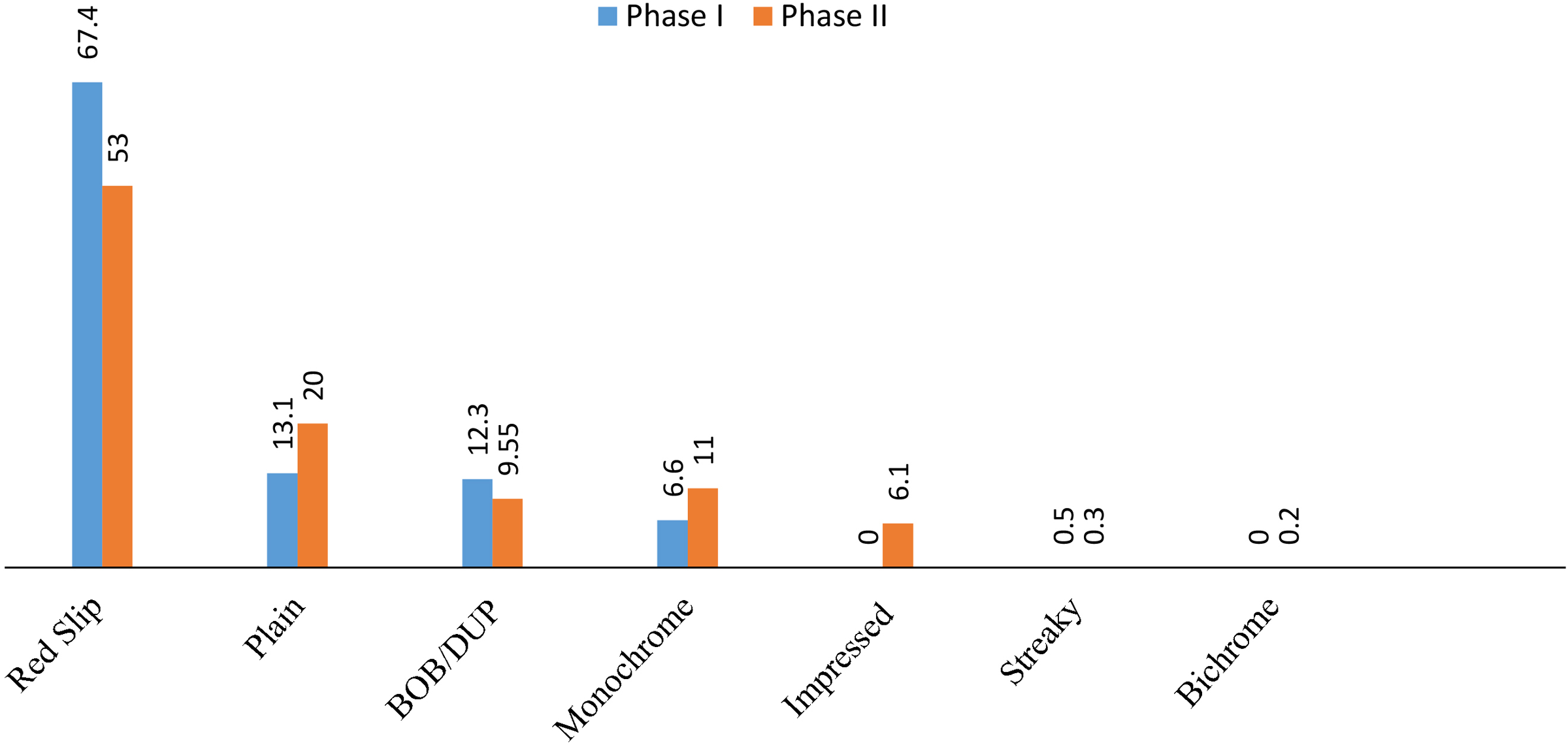
Frequencies of different types of Dalma ceramics in the ceramic assemblage of Trench 3.

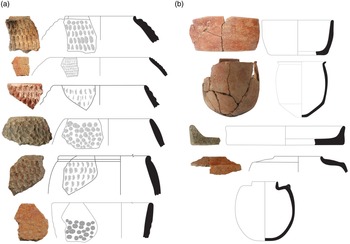
(a) Dalma Impressed; (b) Dalma Red Slip.

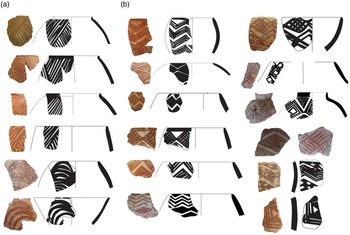
Dalma Monochrome. (a) Early Phase, (b) Late Phase.

To sum up this discussion, no reliable absolute dates have been available so far for typical Dalma contexts in the Central Zagros and Northwest Region. The available dates, discussed above, are either problematic or simply irrelevant to the Dalma period. However, those researchers who conducted in-depth studies on the prehistory of the Zagros Mountain (e.g., Henrickson Reference Henrickson1992; Hole Reference Hole and Hole1987; Rothman and Badler Reference Rothman and Badler2011, Table 4.1; Renette Reference Renette2022) concur that the Dalma period falls within the first half of the fifth millennium BC, a notion that is firmly approved by new 14C dates from Nad Ali Beig.
EXCAVATIONS AT NAD ALI BEIG
Nad Ali Beig (N 3845934 E 724965) is a single-period, badly damaged, small mound site situated at 1612 m above sea level in the Songhor Plain in the Central Zagros region (Figures 1, 2b). The site, ca. 2 ha in area, was excavated over two seasons in 2016 and 2017 by opening five trenches of various sizes (Bahranipoor Reference Bahranipoor2018). In the first season, four trenches were opened: two trenches (Tr. 1 and Tr. 2) in the northern and eastern part of the site to gain an impression on architectural remains of the settlement, and two step trenches (Tr. A and Tr. B) for stratigraphic purposes (Figure 2b). Tr. 1, 5 × 5 m, was excavated to a depth of 120 cm below the ground surface and from this depth it was dug to virgin soil at 222 cm in a small 2 × 2 m sounding (Figure 2b). The excavated sequence consisted of an upper 60-cm-thick pile of cobble collected by modern local farmers underlying a series of loose deposits rich in ash, charcoal, animal bones, potshards, indicating daily refuse. No trace of architecture was found in this trench. Tr. 2, 5 × 5 m, was excavated to a depth of 140 cm below the ground surface and proved to be highly disturbed by two modern burials (Figure 2b). Excavation at this trench was halted without reaching virgin soil. Excavation at Tr. A, 2 × 3 m, was stopped at a depth of 80 cm due to the damage occurred by an illegal digging overnight. Tr. B, 3 × 5 m, was excavated to a depth of 260 cm below the ground surface in two steps and then was dug in a small 1 × 1 sounding to depth 395 cm, where virgin soil was reached (Figure 2b). The upper one meter was disturbed due to modern agricultural activities and a recent burial, but in lower levels we could identify remains of a partial mud brick architecture and beaten earth floor.
Most information regarding the architecture, stratigraphy and ceramic sequence of the site was obtained from Trench 3 (10 × 8 m) excavated in the second season (Figure 2a). Excavation at this trench went down to a depth of 170 cm below the ground surface, where it was continued to the virgin soil at 275 cm in a small, 1.5 × 1.5 m sounding (Figure 3). Based on both architectural remains and ceramic developments, the excavated sequence of Trench 3 can be divided into two phases. Phase I from the virgin soil to a depth of 135 cm below the mound’s surface, and Phase II from that depth to the surface. Each of these phases is characterized by architectural remains and associated deposits.
Phase I
This phase contains the occupational deposits from virgin soil to a depth of 135 cm below the mound’s surface. While the lower half of this phase was excavated in a small sondage, the upper part provided a well-articulated architectural remain consisting of several spaces (Figure 3). These remains were much better preserved than those of the upper Phase II.
Architecture
Phase I provided a well-preserved mud brick architecture, including living rooms associated with storage bins and open areas (Figure 4). The architectural features were constructed using two sizes of mud bricks; 40 × 38 × 10 cm, and 60 × 35 × 10 cm. Both mud bricks seem to be made by use of a mold. The mortar used between mud bricks was a mixture of mud and chaff, about 2 cm thick. The walls are constructed simply on the preexisting ground with no foundation. As a rule, the walls of indoor spaces were coated by light gray clay plaster; in a few instances, the plaster was renewed several times. The focal architectural space of Phase I is a modest rectangular space (A) which is divided into two parts by a T-shaped wall and connected to a small square room (B) to the south through a doorway (Figure 4). Space C appears to be a food storage area as evidenced by three pithoi broken in situ, one of them contained several chipped-stones made of obsidian. This space was divided into two smaller spaces (C1 and C2) by a short mud brick wall. The floor of Space C2 against its western wall was partly paved by large potsherds (Figure 4, upper). Seemingly, a large part of Space G was deliberately leveled and paved by small river gravels and sand, greenish in color. More than 30 pieces of chipped-stones and associated debris was found on this floor, which may point to its function as a stone tool workshop. Space I in the northwestern corner of the trench was probably a room for preparing food. This space was divided into two smaller spaces by a short mud brick wall. A semicircular oven was built on a low mud brick platform against the western wall of this space. A groundstone and a handstone were found in Space I2. Perhaps some of the indoor spaces were covered with matting as evidenced by faint white traces of decayed material, resembling matting, on the floor of Space B.
Ceramics
More than 20000 shards were collected during two seasons of excavations at Nad Ali Beig, but here we only deal with the ceramic collection from Trench 3, because it provided the longest sequence and best-preserved architectures among the excavated trenches, and also because all 14C dates are from this trench. Altogether, 6421 sherds were recovered from Trench 3; 1515 pieces from Phase I and 4906 pieces from Phase II (Table 2). All eight Dalma ceramic types that were documented in the Kangavar Valley at Godin (the XYZ Trench) and Seh Gabi, Mound B (Levels 7–5) were recovered from Nad Ali Beig.
The ceramic collection of Phase I includes six ceramic types: Dalma Red Slip, Dalma Plain, Dalma Monochrome, Dalma Streaky, Black-on-Buff (BOB), and Dalma Untempered Painted (DUP) (Table 2, Figure 5). The most frequent ceramic type of Phase I is Dalma Red Slip which constitutes more than three-quarters of the ceramic collection of Phase I (67.5%; # 1022) (Figure 5). This ware, and its variant, Dalma Plain ware which comprises 13.1% (# 199) of the ceramic collection of Phase I, are heavily chaff-tempered, usually poorly fired and has a rather coarse fabric. The Red Slip ware, as its name implies, bears a rather thick clay slip ranging in color from light orange to deep red and purple (Figure 6b). There is a variant of Red Slip Ware which has a double slip. In such cases, a deep red or purple clay slip has been applied on a cream or buff slip. The common vessel forms of both Red Slip and Dalma Plain include hemispherical bowls, large and small jars, shallow trays or basins, large shouldered jars, footed vessels, and short-necked jars and pots (Figure 6b). Dalma Plain ware has often a buff fabric, usually without a recognizable slip or any other surface treatment. Its surface is usually smoothed, but in many cases the coarse chaff tempers are visible on it.
Dalma Monochrome has a heavily chaff-tempered fabric which ranges in color from light buff, light brown, to light red. Dalma Monochrome, as the most typical ware of Dalma Period, comprises 6.6% (# 100) of the ceramic collection of Phase I (Table 2, Figure 5). This ceramic usually bears a thick clay slip, mostly light buff in color, but also light brown and sometimes dark red to purplish, on the outer surface and a light buff or cream slip on the inner surface, yet some specimens show no recognizable slip. The painted decoration of Dalma Monochrome in this phase are exclusively linear, including parallel, oblique, or concentric curvilinear bands in brown, black and red; it seems that the latter design is a local development, because it is not reported from other Dalma sites (Figure 7a). Sometimes the painted bands are so closely arranged that it may be mistaken with Dalma Streaky. The most common vessel forms of Dalma Monochrome include globular pots, shallow open-mouth bowls, and hemispherical bowls.
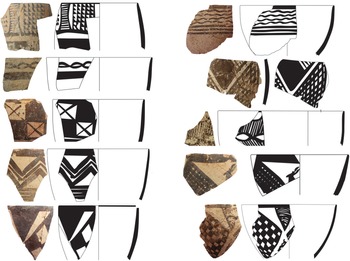
Dalma Streaky has the least frequency among the ceramic types of Phase I (about 0.5%; # 8; Table 2, Figure 5). In many respects, this ware is very similar to Dalma Monochrome, except it is harder, better-fired, and denser (see also, Henrickson and Vitali Reference Henrickson and Vitali1987:38). The fabric color ranges from light buff to light red. This ceramic usually bears a buff or cream slip, on which the dense painted bands, usually in red or dark brown, are applied. The common vessel forms of this ceramic are open-mouth bowls with everted body and open-mouth, deep bowls (Figure 8b).
(a) Dalma Bichrome; (b) Dalma Streaky.

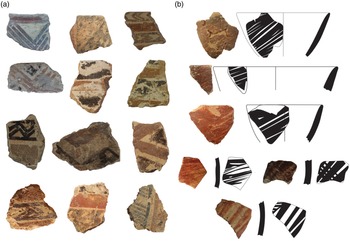
Two fine wares of BOB and DUP together constitute 12.3% (# 186) of the ceramic collection of Phase I (Table 2, Figure 5). In almost every attribute, they differ from the rest of the Dalma ceramic assemblages (Figure 9). Both are thin, highly fired, unslipped, decorated essentially with linear or geometric, and rarely animal, designs in black or dark brown which show some influence from the lowland Mesopotamian Ubaid ceramic tradition (Henrickson Reference Henrickson1983, Reference Henrickson1992). Like Dalma Bichrome and Dalma Streaky, these ceramics are restricted to the Dalma sites of the Central Zagros area, mostly along the High Road. No clear-cut distinction criteria have been posited to discern these two wares from each other, and because of this, they are usually cited together (e.g., Henrickson Reference Henrickson1983; Levine and Young Reference Levine and Young1987). Both painted and plain versions occur. The tempering agent is a fine mineral, but in many instances, it is not visible. The color of these wares in Phase I is exclusively cream, but in Phase II there are more hues. The painted designs are rendered horizontally and in both positive and negative manners. The most common vessel forms of BOB and DUP are various shapes of bowls: open-mouth, deep bowls, bowls with a flaring body, and straight-sided bowls.
Black-on-Buff (BOB) and Dalma-Untempered Wares (DUP).

Phase II
The remains of this phase were uncovered from a depth of 135 cm to the surface of the site. The badly eroded architectural remains of this phase and underlying Phase I was separated by a 50-cm-thick architectural debris layer, probably of both phases’ origin.
Architecture
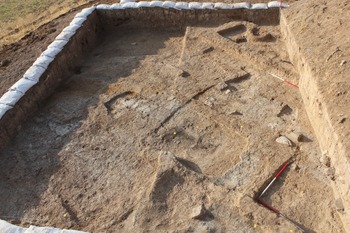
The architectures of Phase II are badly damaged due to soil removing activities by local villagers during past decades (Figure 10). What can be said about the constructions of this phase from its faint mud brick remains is that in terms of general plan and other architectural attributes, the architectural remains of Phase II seem to be similar to those of Phase I, having a rather large room, divided into two smaller spaces by a mud brick wall, and surrounded by several small rooms. Part of the floor of the central room was burnt to orange with a concentration of ash, burnt animal bones, and smudged potsherds.
The badly eroded construction remains of the Phase II of Trench III.

Ceramics
In total, 4906 sherds were recovered from Phase II (Table 2, Figure 5). The most significant change in the ceramic collection of Phase II is the appearance of two new ceramic types: Dalma Impressed and Dalma Bichrome; both start from the debris layer which separates the architectures of Phase I and Phase II. There are, however, several developments in the preexisting ceramic types that continue through the Phase II to the end of occupation at Nad Ali Beig.
Dalma Impressed. This characteristic ware constitutes 6.1% (# 300) of the ceramic collection of Phase II (Table 2, Figure 5). The heavily chaff- and mineral-tempered fabric of this ware ranges from light red, orange, light brown to buff. Both exterior and interior surfaces are covered by a clay slip, usually in red or orange, but light brown and buff do occur. Sometimes the color of the interior surface differs from the exterior. Impressed decorations on these vessels are dense, usually covering the entire exterior surface except ledged-rim and the bottom (Figure 6a). They appear in different shapes, but mostly as fingertip impressions and horizontal or oblique nail impressions. A large number of this ware in our collection show blackened patches on the exterior surface which suggest they were used for cooking (see also, Hamlin Reference Hamlin1975:118). Comparing other Dalma assemblages, the Impressed ware in the Nad Ali Beig collection show a rather wide range of vessel forms, including different shapes of pots, deep bowls with slightly flaring body, basins, low-necked jars, spherical bowls, and cups.
Dalma Bichrome. This rare ware is so far known only from excavation at two sites, Seh Gabi (Level 7) and Nad Ali Beig, with low frequency (Levine and Young Reference Levine and Young1987:21). It constitutes only 0.2% (# 10) of the ceramic collection of Phase II (Table 2, Figure 5). The fabric of this ware is usually buff to light brown and is tempered only with fine chaff. Both exterior and interior surfaces bear a thick clay slip, usually cream-buff/white to light brown in color (Figure 8a). The painted designs are geometric and appear in any of these three pairs: black-red, black-white, or red-brown. The recognizable vessel forms of this ware are pots, open-mouth bowls, and spherical bowls.
In addition to the foregoing changes in the ceramic assemblages of Trench 3, there are a series of changes in the preexisting ceramic types. Appearance of Dalma Impressed seems to be in expense of the reduction of the Dalma Red Slip frequency, which diminished from 67.4% in Phase I to 53% in Phase II. Interestingly, Dalma Plain Ware increased by almost 7% in frequency in Phase II. Dalma Monochrome also exhibits a significant development through the Trench 3 sequence. While in Phase I, the painted designs of this ceramic are exclusively linear, including parallel, oblique, or concentric curvilinear bands (Figure 7a), in Phase II they are replaced by a series of complex, geometric designs using motifs such as checkered or hachured lozenges, zigzags, and triangles (Figure 7b). In addition, new vessel forms appear in Phase II, including plates and jars; the former is usually painted on both interior and exterior.
The BOB and DUP underwent a series of changes from Phase I to Phase II. While in Phase I the color of these wares is exclusively cream, in Phase II they appear in several hues, such as light buff, greenish- and brownish-buff. In addition, both BOB and DUP specimens in Phase II are coarser than those of Phase I. There is also a slight decrease in frequencies of these ware in Phase II (Table 2).
Generally speaking, as most researchers have pointed out, Dalma ceramics show a striking homogeneity throughout the northern and central Zagros sites (e.g., Henrickson Reference Henrickson1983; Renette Reference Renette2022).Footnote 3 This is true as far as the ceramic types, vessel forms, and surface decoration is considered, but laboratory analyses on Dalma ceramics have shown that despite this homogeneity, there are a significant variability among the different types of Dalma ceramics both between sites and among the individual wares of a site in terms of raw materials and technologies (Tonoike Reference Tonoike2009). Therefore, it is now clear that Dalma ceramics were essentially a household product, with no verified evidence of exchange between sites. Considering these studies, the apparent homogeneity of Dalma ceramics throughout its territory might have a cultural explanation.
The Dalma ceramic assemblages of Nad Ali Beig are almost identical to those of the key sites of the Central Zagros, i.e., Godin (the XYZ Trench) and Seh Gabi (Mound B, Levels 7–5). Nevertheless, there are some differences between ceramic assemblages of different locales in the Dalma territory (for more details see Bahranipoor Reference Bahranipoor2021). The most apparent difference between ceramic assemblages of Nad Ali Beig and those of the northern Zagros is the presence of four ceramic types of BOB, DUP, Dalma Streaky, and Dalma Bichrome in the former and their lack in the latter. As mentioned before, these four ceramics are found essentially in the sites along the High Road in Central Zagros. The second major difference between Dalma sites of the Central Zagros and those of northern Zagros is seen in the painted designs of Dalma Monochrome ceramic. In the northern Zagros, the painted, solid bands occur frequently (Bahranipoor Reference Bahranipoor2021, Figures 2–3), but they are lacking in Nad Ali Beig. Moreover, the geometric designs of Nad Ali Beig ceramics are rendered with much more details than those of the northern Zagros sites (Bahranipoor Reference Bahranipoor2021, Figure 4). Regarding the details of painted designs of Dalma Monochrome, the sites of Godin, Seh Gabi, Nad Ali Beig, and Gheshlagh are differentiated from the northern sites, including Tappeh Dalma, Baghi, Lavin, Chapar Abad, and Seavan (Figure 1).
Finds
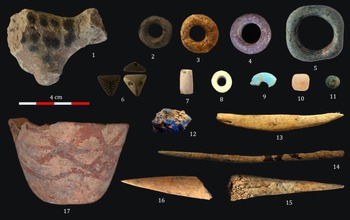
During two seasons of excavations at Nad Ali Beig a variety of artifacts were recovered including chipped stones, groundstone, stone vessels, beads, seal, clay tokens, figurines, and spindle whorls (Figure 11). The materials used for making these items were mostly locally available, such as chert, flint, sandstone, and limestone, but there are some items in the assemblage which were made from exotic materials including obsidian, lapis lazuli, turquoise, and copper, indicating incorporation of the site in a wide interregional network of trade from northeastern Iran and Afghanistan to eastern Anatolia. Altogether, 30 pieces of obsidian were found, mostly as bladelets and debitage. No certain obsidian source is yet found in Iran, but there are numerous outcrops of the volcanic glass in Caucasia and eastern Anatolia. Normally, obsidian is rarely reported from the post-6th millennium sites of Iran, except the Central Zagros and the Northwest Region which are closer to the source areas (Barge et al. Reference Barge, Azizi Kharanaghi, Biglari, Moradi, Mashkour, Tengberg and Chataigner2018). Like obsidian, lapis lazuli source is not yet reported from the Iranian Plateau. Five small chunks of this material that were found in Trench 3 might have reached the site from Badakhshan Valley in Afghanistan, which hosts rich sources of this material (Figure 11.12). Other exotic material from Nad Ali Beig is turquoise (Figure 11.9) with no known sources in western Iran. This mineral is found in eastern Iran, especially near Neishabour in the Northeast Region (Gubelin Reference Gubelin1966). The only metal artifact from our excavation is a small copper needle recovered from Trench I (Figure 11.14). Copper resources are numerous in the Central Iran zone, around Kerman, but there are some mines in the Northwest Region as well.
A selection of various finds from Nad Ali Beig. 1. Painted clay animal figurine; 2-5. Stone rings; 6. Stone stamp seal; 7-8, 10-11. Stone beads; 9. Turquoise bead; 12. Lapis lazuli lump; 13, 15-16. Bone awls; 14. Copper needle; 17. Ceramic cup. (2-3, 6, 8-9, 13, and 15-16. Phase I; 1, 4-5, 7, 10-12, 14, and 17. Phase II).

A stamp seal was found in Trench 3, which is the only example of such finds from the site (Figure 11:6). The seal, pyramidal in shape, bears a small hole in its tip, probably for hanging, and bears three groups of incised parallel lines on the flat surface. Stamp seals have been rarely reported from the Middle Chalcolithic of the Central Zagros. The only published example comes from the lower levels of Mound B at Seh Gabi which exhibits a zoomorphic pattern (Henrickson Reference Henrickson1988, Figure 1). The closest parallel to our sample comes from the surface of Chogha Mish in lowland Khuzestan, tentatively dated to Late Susiana phase (4900–4000 BCE) (Delougaz and Kantor Reference Delougaz and Kantor1996, Plate 234:HH).
THE 14C DATES
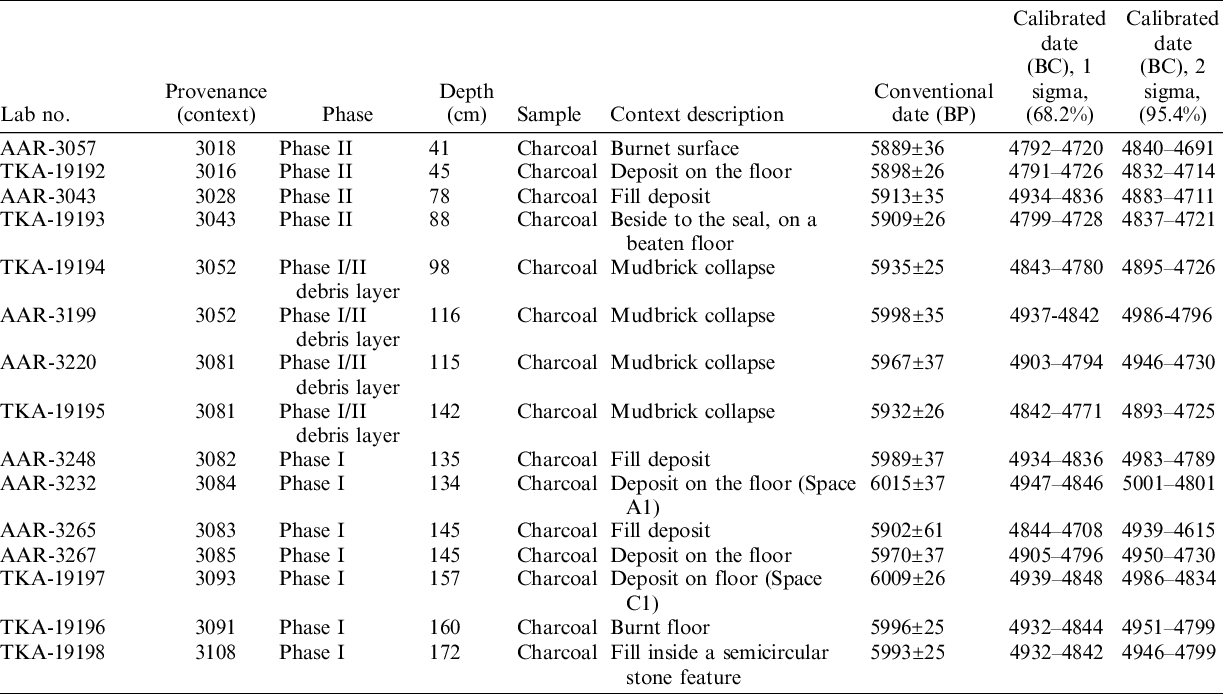
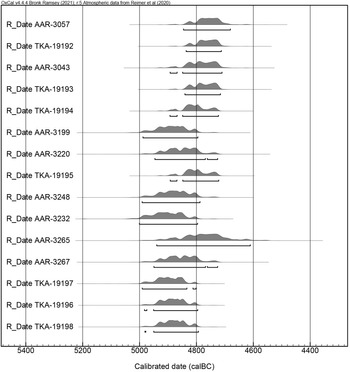
A series of 15 charcoal samples was submitted for 14C dating; eight samples were analyzed by The University of Tokyo Carbon Dating Laboratory and seven samples by Aarhus AMS Center, Aarhus University, Denmark. All samples, wood/bush charcoal, were taken from Trench 3 sequence, from the depth 41–172 cm below the mound’s surface; there is no date for the lowest one meter of the sequence which was excavated in the small sounding. Overall, the dates are in good accordance with their stratigraphic position and they are also rather well fitted with the two phases, including the debris layer separating the two phases (Table 3; Figure 12). Nevertheless, there are some minor discrepancies in the sequential dates that need some explanation. In fact, only two dates, AAR-3265 (Locus 3083) and TKA-19195 (Locus 3081), show a little discordance with the rest of the sequence. Before dealing with these discrepancies, it is worth noting that, first, these 15 dates come from only a 130 cm stratigraphic column, and second, they show a good time overlap.
Radiocarbon dates for Nad Ali Beig sequence. Dating performed at University of Tokyo (TKA) and Aarhus AMS Center (AAR); TKA dates are calibrated by OxCal v.4.2 using IntCal13 calibration curve (Bronk Ramsey Reference Bronk Ramsey2009; Reimer et al. Reference Reimer, Bard, Bayliss, Beek, Blackwell, Bronk Ramsey, Buck, Cheng, Edwards and Friedrich2013), and AAR dates are calibrated by OxCal v.4.4.2 using IntCal20 (Bronk Ramsey Reference Bronk Ramsey, Heaton, Schlolaut, Staff, Bryant, Brauer, Lamb, Marshall and Nakagava2020; Reimer et al. Reference Reimer, Austin, Bard, Bayliss, Blackwell, Bronk Ramsey, Butzin, Cheng, Edwards and Friedrich2020).

Calibrated radiocarbon dates for the Trench 3 sequence, arranged by phases.

The date from the sample AAR-3265, taken from Locus 3083 of Phase I, although overlaps with the other dates of this phase, is a little younger than them. This locus, more than 30 cm thick, was a deposit mixed with some mud brick collapse and daily refuse which lay on a stone-paved floor of Phase I. The locus immediately underlies Locus 3052, a mud brick/fills of the 50-cm-thick debris layer separating Phase I from Phase II. As the nature of these two deposits were alike, it is likely that Locus 3083 was in fact part of, and therefore contemporaneous with, Locus 3052 deposit (TKA-19194).
The two dates from Locus 3081, a 30-cm-thick mud brick collapse, filling an architectural space of Phase I, are not in order with their stratigraphic position, although they show only 50 years difference. The sample TKA-19195 taken from a deeper depth than the sample AAR-3220 shows a younger age than the latter. Although no clear sign of disturbances was observed during the excavation, it should be remembered that Locus 3081 belongs to the debris layer which could have been built up through a various way, either during Phase I or Phase II, or both. Meanwhile, we should bear in mind the possibility of old wood effect too, as all of our samples dated were charcoal which could have originated from various wood sources with different ages. This plausible factor could have been the cause of the discordant date of Locus 3083 too.
Despite some minor discrepancies in the 14C dates of the Trench 3 sequence, no hiatus is seen in the sequence (Figure 12); all dates show a good overlap. Except for the two dates (AAR-3265 and TKA-19195), there is a rather good consistency between the dates of each phase. In general, Phase I can be dated to ca. 5000–4800 BCE and Phase II to ca. 4850–4700 BCE, with some temporal overlap as their cultural materials suggest. The four, somehow inconsistent dates of deposits ascribed to the debris layer, separating Phase I from Phase II, are comparable with those of Phase I and Phase II. This situation can be interpreted as such: while the buildings of Phase I in our excavation area were abandoned and started to crumble, occupation continued in adjacent homes and the location of the Phase I buildings was used as a dumping area by the neighbors. Therefore, the debris layer is a mixed deposit with a complex history of deposition of both Phase I and Phase II materials.
DISCUSSION AND CONCLUSION
Although the excavated sequence of Trench 3 is not too long, it provides significant evidence on the ceramic developments of Dalma Period in the Central Zagros. With the 14C-dated sequence of Nad Ali Beig and given the changes through its ceramic assemblage, we can suggest the sequential appearance of different types of Dalma ceramic in the sequence. Based on these data and observation, we may suggest that the earliest types of Dalma ceramic are Red Slip/Plain Ware, Streaky, DUP, BOB, and Monochrome with simple, linear painted designs, all seen from the very beginning of the Trench 3 sequence around 5000 BC or a little earlier. Obviously, these ceramic types might be present in even earlier, but not yet discovered, sites. By ca. 4900 BC, or somewhat later, two new types of ceramic appeared, including Dalma Bichrome and Dalma Impressed, along with a new version of Dalma Monochrome characterized by more complex, geometric painted designs.Footnote 4 Regarding the latter development, it should be noted that Henrickson had already noted some changes through the Dalma ceramic sequence of the XYZ Trench at Godin Tappeh (Henrickson Reference Henrickson1983). The trench, approximately 2 × 3 m, was dug largely unsupervised in eighty 20-cm-thick spits during the last season in 1973. Dalma materials were recovered from Spits 63–50, ca. 2.8 m in thickness. Based on her observations, Henrickson tentatively divided the Dalma deposit of the trench into three “phases”: Early Phase (Spits 63–59), Middle Phase (Spits 57–55), and Late Phase (Spits 54–50). In summary, according to Henrickson, Dalma Monochrome exists almost throughout the Dalma sequence of the XYZ Trench, first with simpler motifs similar to those of Dalma Streaky during the Early Phase to more complex motifs in the Middle Phase. It starts to diminish in number through the Late Phase and by the end of the phase it disappears completely. Dalma Streaky, which exists from the very early of the sequence, disappears in the early stage of the Middle Phase while in the later part of this phase Dalma Impressed appears which culminates during the Late Phase (Henrickson Reference Henrickson1983:173). In general, Henrickson’s observation on ceramic change in the small collection of the XZY Trench is consistent with what we observe in Trench 3 at Nad Ali Beig. There are, however, some differences between these two insights. For instance, apparently Dalma Bichrome is absent in the XYZ sequence but it is present in the Late Phase at Nad Ali Beig. Or, while Henrickson observed no Dalma Streaky from the mid-sequence upwards, in Nad Ali Beig this ware is present throughout the sequence, although in a very low percentage. Comparing the Henrickson observation of the XYZ Trench ceramic developments and what we observe from Nad Ali Beig sequence, it may be possible that Nad Ali Beig lacks the Henrickson’s Late Phase, because the frequency of Dalma Monochrome in relation to Dalma Impressed in our assemblage is still high, not diminishing to disappearance as she observed in the Late Phase of the XYZ Trench (Henrickson Reference Henrickson1983:174).
The new 14C dates from Tappeh Nad Ali Beig are the first reliable absolute dates for the Dalma period in both Central Zagros and the Northwest Region. However, as Nad Ali Beig is a single-period site which covers apparently part of this period, the available dates do not represent the whole duration of Dalma Period. The earliest available dates of Nad Ali Beig, from the floor of the architecture of Phase I, points to the turn of the sixth millennium BCE, but we should bear in mind that there are no dates for the lowest 1-m-thick deposits excavated in the small sounding to virgin soil. Based on this reasoning, the lowest deposits of Trench 3 could likely be dated to the pre-5000 BCE. As such, and also considering the fact that the beginning of the occupation at Nad Ali Beig is not necessarily coincided with the beginning of the Dalma period, we may suppose that this period started sometime around 5200/5100 BCE in the Central Zagros, if not earlier. Moreover, it should be noted that the relationship between Dalma and its preceding period, i.e., Shahn Abad, in the Central Zagros is not clear. None of the excavated sites in the Central Zagros provided these both periods in a single stratigraphic column. Besides, the time-range of the Shahn Abad period is still debated. There are only three 14C dates for this period from Mound C in Seh Gabi. Based on Marshall’s analyses, these dates are “unreliable” (Marshall Reference Marshall2012:261); they show a general time-range of 5400–4800 BCE. Evidently, part of this time-range which falls in the early fifth millennium is not true for Shahn Abad period, because, based on the Nad Ali Beig dates, we know that Dalma period was already present around 5000 BCE.
The same problem exists for the ending time-range of the Dalma period. The Seh Gabi and Pisdeli periods succeed the Dalma period in the Central Zagros and Northwest Region, respectively. Recalibration of old dates from these periods give a time-range ca. 4600–4000 BCE (Renette and Mohammadi Ghasrian Reference Renette and Mohammadi Ghasrian2020, Figure 5). Therefore, based on the foregoing chronological considerations and the new 14C dates for the Nad Ali Beig sequence, we may put the Dalma period between ca. 5200/5100–4600 BCE (see also, Renette Reference Renette2022).
ACKNOWLEDGMENTS
I would like to thank my colleague, Abolfazl Aali, from Zanjan Office of Cultural Heritage, Handicraft and Tourism Ministry, who allowed me to use the unpublished excavation report of Soha Chai. I would also like to thank the authorities of the Research Center for Cultural Heritage and Tourism who facilitated the administrative works for the radiocarbon dating performed in Tokyo and Copenhagen.
FUNDING STATEMENT
The excavations at Nad Ali Beig were funded by Iranian Centre for Archaeological Research.