Introduction
Since its formal establishment in 2003 as the International DOHaD Society, the field of Developmental Origins of Health and Disease (DOHaD) has grown considerably – both in terms of the size of its research community as well as the scientific and social recognition it receives. Historically, DOHaD arose from a merging of epidemiological studies linking constrained fetal development, measured using the proxy of low birthweight, with cardiometabolic disease in the elderly, and basic animal model research in developmental physiology.Reference Hanson and Gluckman 1 At its inception, DOHaD mainly focussed on the importance of development – from the early embryo through infancy and childhood – for individual and population health and disease development. Today, however, DOHaD research aims to offer a comprehensive perspective on health and disease that traces how different life experiences shape health and disease risks over the entire life course, ranging from the preconception period to advanced age. Research is undertaken in various settings, linking variations in patterns of development and exposure to a wide range of non-communicable diseases (NCDs). As NCDs today account for about 72% of deaths globally,Reference Horton and Sargent 2 the life course approach fundamental to DOHaD is receiving increasing attention by health policymakers globally.Reference Hanson and Cooper 3 , Reference Kuruvilla, Sadana and Montesinos 4
This integrative perspective on the development of health and disease across the life course is a particular strength of the DOHaD approach.Reference Godfrey, Gluckman and Hanson 5 It opens up distinct possibilities for improving health by recognizing and better understanding how different life environments shape trajectories of health and disease across the life course. At the same time, these innovative characteristics raise questions regarding potential specific social responsibilities of DOHaD as a field and about pathways to a socially just and scientifically robust implementation of DOHaD knowledge in society, particularly as research in this field is receiving increasing recognition from health policymakers.
In this article, we review the history and key characteristics of DOHaD as a field of scientific knowledge production. We argue that based on its key assumptions – that life circumstances, health and disease are closely linked on a molecular scale – DOHaD is an inherently political research field. When tracing how life environments affect health and disease, it is of utmost social and political importance to specify how DOHaD understands and frames these life environments, which aspects of life worlds are included and which excluded, and how research results are interpreted and translated into health recommendations at individual, societal and policy levels. We suggest a number of ways by which the DOHaD community can constructively and responsibly meet the demands that these inherent characteristics place on knowledge production and dissemination in the field.
Origins
The history of DOHaD as a research field reached a milestone with David Barker’s work on the fetal origins of disease. His early observations concerned cohorts of individuals born in the United Kingdom in the first half of the 20th century, and linked low birthweight to death from cardiovascular disease, hypertension, type 2 diabetes and the metabolic syndrome in adult life.Reference Barker 6 Barker realized that the geographical distribution of cardiovascular disease in the United Kingdom was more closely related to early childhood mortality than to adult standard of living, and that individuals carried with them the disease risk characteristic of their birthplace even if they moved subsequently. These observations followed those of Forsdahl and othersReference Barker 1 in showing that poor childhood conditions cast a long shadow in health terms across life, and focussed attention firmly on the prenatal period. There followed a considerable amount of animal research, conducted on a range of species, which not only confirmed the principle that aspects of fetal life affected cardiometabolic function in adulthood but also elucidated some important underlying mechanisms, such as epigenetic processes.Reference McMillen and Robinson 7 , Reference Wadhwa, Buss, Entringer and Swanson 8
Around 2003 the field of fetal origins of adult disease morphed into DOHaD, mainly because of two reasons: First, the recognition that the phenomenon clearly concerned not only fetal life but also development, extending back into the early embryonic period and forward into infancy and early childhood.Reference Fleming, Watkins and Velazquez 9 The second reason for the change to DOHaD was the realization that development affected the health of individuals in later life, not just their risk of disease, because health and disease are not simply opposite sides of the same coin. This insight has made it clear that DOHaD processes affect all members of the population, in many different ways, and that they are a part of fundamental human biology, not just of disease aetiology, which linked DOHaD to basic research in developmental biology.Reference Gilbert and Epel 10
Understanding DOHaD as offering insights into fundamental processes of human biology also helped to clarify one common misunderstanding: it is often assumed that DOHaD proposes that NCDs actually start in utero and that the developmental shifts observed in response to environmental exposures constitute inherently pathological processes. Yet, it is more appropriate to understand DOHaD as proposing that certain developmental pathways can influence individual responses to later-life health challenges in terms of susceptibility and resilience – not that they inevitably lead to disease. This perspective aligns DOHaD with perspectives from fields such as life course epidemiology.Reference Ben-Shlomo, Mishra and Kuh 11
Today, DOHaD seems to increasingly fit with the current ‘post-genomic’ zeitgeist in biology that is characterized by a growing recognition of the complexities involved in gene regulation and biological function.Reference Richardson and Stevens 12 During the last few decades, developmental perspectives were often overshadowed by approaches from genetics and genomics that primarily focused on genetic variants as the main heritable causes of disease development. However, when the sequencing of the human genome did not result in the hoped-for leap in understanding NCD aetiology, perspectives that de-centred the gene and foregrounded the complex interactions between genes and their environments gained attention and momentum.Reference Gluckman, Hanson, Buklijas, Low and Beedle 13 , Reference Fox Keller 14 This shift might constitute the inversion of a trend that has profoundly characterized much of biomedicine in the second half of the 20th century: locating the causes of health and disease mainly within individual bodies and their molecular composition. For DOHaD, this shift towards post-genomic perspectives constitutes an important window of opportunity. At the same time, the longstanding mismatch between DOHaD and dominant perspectives in biomedicine means that DOHaD is today not yet institutionally well-established in terms of dedicated research centres or departments. This issue is complicated by the fact that DOHaD research often moves across a range of different academic disciplines, organ systems and medical specialties. Its institutionalization thus requires specific attention to and accommodation of this inherently interdisciplinary character of the field.
Current opportunities
In recent years, the number of diseases that have been linked to developmental origins has expanded enormously. They now include a wide range of NCDs, such as cardiovascular disease, diabetes, chronic lung disease and some forms of cancer;Reference Gluckman, Hanson, Cooper and Thornburg 15 most ageing-related diseases, for example osteoporosis, sarcopenia and cognitive decline;Reference Hanson, Cooper and Aihie Sayer 16 and more recently, a number of mental illnesses.Reference O’Donnell and Meaney 17 This makes DOHaD an increasingly important field for public health policy. The growing recognition of DOHaD perspectives in health policy in recent years was heightened by an increased focus on NCDs within the international health policy community. In 2011, the General Assembly of the United Nations held its first high-level political meeting on the Prevention and Control of NCDs. 18 The discussion at this meeting was informed by the perception that, despite the achievements of the Human Genome Project, a substantial proportion of NCD risk at the population level was not attributable to fixed genetic factors. At the same time, lifestyle interventions to reduce the incidence of NCDs in adults were also achieving disappointing results. Although they were only referred to specifically in one clause (No. 26) in the UN Political Declaration in 2011, the General Assembly addressed the importance of developmental factors for NCD risks for the first time in this meeting.
It was also acknowledged that NCDs are no longer primarily a burden for high-income countries. In fact, 80% of deaths from NCDs occur in low- and middle-income countries, and the World Health Organization (WHO) predicts that the increasing burden of NCDs that is predicted for the future would fall disproportionately on such countries, potentially negating the economic and humanitarian benefits of communicable disease prevention.Reference Nugent, Bertram and Jan 19 Consequently, global perspectives have become increasingly important in DOHaD research, and studies are investigating how specific local life contexts and histories affect health and disease risk.Reference Hanson, Gluckman, Ma, Matzen and Biesma 20 Interestingly, such studies receive the most attention from governmental and non-governmental health policy actors who operate on a global scale, for example, as part of the Sustainable Development Goals (particularly Goals 2, 3 and 5), the UN Global Strategy for Women’s, Children’s and Adolescents’ Health (2015) and the WHO Nurturing Care Framework (launched May 2018). Yet, national and local health policy actors are often less involved with DOHaD research. There is, to some extent, also a growing interest in DOHaD knowledge by private sector actors, and by organizations which aim to represent or engage the private sector more positively and responsibly (e.g., UN Global Compact; ILSI). Notably, clinical groups which formerly did not see the relevance of DOHaD to practice are now more engaged: for example, the International Federation of Gynecology and Obstetrics (FIGO) has established a committee to address NCD issues, with a focus on pregnancy and women’s health.
DOHaD thus appears to move increasingly into a position where insights from the field could influence clinical practice and public health policy to a certain extent. This is an important moment for the field that should encourage the community to pause and reflect on how to best address these novel opportunities. Markedly, this should include a reflection on the scope, scale and character of the interventions to improve health that are currently being conceived and promoted by researchers in the DOHaD field. To date, and perhaps following the field’s history of research on the fetal origins of disease, interventions proposed by DOHaD often largely focus on behavioural aspects and lifestyle changes (in particular on parental behaviour).Reference Warin, Moore, Zivkovic and Davies 21 Suggestions for interventions on the level of social structure often remain sparse despite a growing recognition of the significant influence of the wider social and material environment on developmental processes, including factors such as environmental toxins or social stressors that can hardly be contained or managed by individuals alone. Pharmacological interventions during pregnancy and infancy have largely been eschewed, and the concept that DOHaD processes operate in a graded manner across the entire population lends support for such caution. It is also clear that no single ‘golden bullet’ intervention is likely to be effective, even in those situations where the risk trajectory is high. Moreover, the question arises of whether interventions should be targeted at parents or their children, and when. The most comprehensive reviews of these questions, for example in relation to preventing childhood obesity, 22 have concluded that a multifaceted approach is necessary, starting before conception in both men and women, and continuing through pregnancy, infancy and childhood and into adolescence and the reproductive years of the next generation. This makes evident that while DOHaD has its roots in epidemiological studies and related basic scientific investigations of underlying mechanisms, it has today evolved into a research field that is increasingly involved with questions of public health policymaking, social responsibility and public outreach.
Novel responsibilities
This emergent social and political role of DOHaD research raises the stakes for addressing questions of social responsibility in the field. In the remainder of this article, we will thus lay out three important perspectives that we consider crucial for the field in order to actively create pathways for implementing DOHaD knowledge in society and policy in socially just and scientifically robust ways.
Maintaining the complexity of the social determinants of health and disease
What makes DOHaD unique is that it attends to how a range of environmental factors can affect health by inducing changes in the organism during particular periods of life. These factors include the availability of certain nutrients, toxic exposures, social stress or infectious disease agents. Yet, while research focuses on studying these factors at the level of their molecular and clinical effects, in the social world the distribution of potentially negative exposures and experiences is significantly shaped by patterns of social stratification and inequality. Access to high-quality foods, clean air, clean water or regular healthcare, for example, often depends on income, social status and global location. This inherent connection between DOHaD and questions of social and environmental disparities and justice is a vital aspect of its political potential.
Considerations of the social determinants of health and disease were present in DOHaD from the outset. For example, Barker and Osmond argued in their comparative study of mortality patterns in three English towns that the differences they found were the result of living conditions during early life, in particular infant breast feeding, housing and overcrowding.Reference Barker and Osmond 23 Crucially, Barker and Osmond discussed the differences in the duration of breast feeding not simply as a question of different maternal behaviour but in terms of how this behaviour was linked to social and economic factors: the economic need to work in mills caused women in one of the towns to wean their infants earlier than in the other places. Barker and Osmond’s early work thus already pointed to what is a crucial insight: while the developmental origins of adult health and disease can be mediated by parental behaviour, the available options for change are often shaped and limited by social and economic conditions.
In the subsequent decades, however, discussions of the social determinants of health and disease often played a minor role within DOHaD research.Reference Warin, Moore, Zivkovic and Davies 21 Complex social contexts disappeared behind more simplistic variables such as ‘duration of breastfeeding’ or ‘high-fat diet’. The environment of the developing organism often became reduced to the maternal body and maternal behaviours that were discussed in a socially decontextualized manner.Reference Kenney and Müller 24 , Reference Richardson 25 This had at least two problematic consequences. On the one hand, a focus on mothers without adequate discussion of social, political and economic contexts increased historically entrenched sexist tendencies to ‘blame the mother’, that is to hold mothers disproportionately responsible for the health and well-being of their children.Reference Richardson, Daniels and Gillman 26 Other potent actors, ranging from fathers to employers, food producers or policymakers, often faded out of sight. This led, on the other hand, to a tendency to frame and discuss problems and potential solutions on the level of the individual rather than on a more collective scale, such as the family, the community or the state.Reference Müller, Hanson and Hanson 27 Yet, as DOHaD knowledge becomes more relevant for health policymaking, it is vital to bring the more complex social dimensions back in 28 to avoid over-simplistic attributions of responsibility.Reference Ismaili M’hamdi, de Beaufort, Jack and Steegers 29 , Reference Pentecost, Ross and Macnab 30 For example, appeals to mothers to adopt healthier diets for themselves and their children will inevitably fail if mothers lack access to affordable healthy foods, are overworked due to unequal distribution of care duties between the genders, remain the target of predatory food marketing and cannot rely on public food infrastructures to support healthy eating (e.g., workplace or school cafeterias).
Bringing such dimensions back into DOHaD research means considering them as important aspects of the social fabric that need to be taken into account at all stages of DOHaD research, from the design, through the implementation and to the interpretation of studies. This might require expanding the range of professionals who work together on DOHaD studies to include experts from different fields of the social sciences. This is equally relevant for research on human cohorts and studies in animal models as both require the translation of social worlds into aspects of the study design. By broadening its understanding of relevant determinants of health, DOHaD can provide knowledge that paints a more accurate picture of the multiple interactions between social life and biology that shape long-term chances of health and disease risks.
Considering the social contexts of health messages
Acknowledging that health behaviours are always tied to wider life circumstances also provides highly relevant insights for the communication of health messages by researchers and others engaged with DOHaD research. On the one hand, while health is unquestionably an important value and a basic human right, it is also important to acknowledge that it is only one social value among others. For example, the beneficial developmental effects of breastfeeding are well documented in DOHaD.Reference Geddes and Prescott 31 However, a public health focus on promoting breastfeeding runs the danger of quickly coming into conflict with other social and political values – such as a focus on gender equality in society, a woman’s right to make her own decisions about her own body and equal workforce participation of women at all levels of employment. Researchers and others who engage in health messaging should consider these broader social contexts and scrutinize the effects their messages might have in a larger social context.
For this purpose, it can be rewarding to draw on research from other fields to better understand how people engage with and are affected by health messaging in the context of their specific life worlds. For example, social science research has shown that if health messages centre excessively on bodyweight as a proxy for health, they can easily contribute to the stigmatization of fatness, fat shaming and the promotion of body image issues.Reference Bordo 32 – Reference Greenhalgh 34 This is especially the case if losing weight is depicted mainly as a question of personal choice and individual behaviour. Many people who are classified as overweight or obese have already undergone numerous unsuccessful attempts to lose weight, which is in line with recent scientific evidence against the long-term efficacy of diets.Reference Mann, Tomiyama and Westling 35 Yet, they are still often held responsible, blamed and shamed for being overweight as individuals, for example by relatives, friends, colleagues and even by health professionals.Reference Greenhalgh 34 The latter aspect is particularly problematic: many people with high bodyweight have had the experience that doctors tend to explain most of their health issues as being a result of their weight, which can increase the risk of overlooking other underlying problems in overweight or obese patients.Reference Wright and Harwood 33 Health messages that frame differences in bodyweight primarily as the result of individual choices thus run against current scientific evidence and can aggravate the cultural stigma surrounding high bodyweight and contribute to an increase in body anxiety and eating disorders in society.Reference Bordo 32
Issues surrounding bodyweight are but one example of how health messaging that focuses predominantly on behaviour can easily complicate the lives of those it aims to assist.Reference Crawford 36 A first step towards more context-sensitive health messaging should thus be to scrutinize the vocabulary used and remove potentially harmful simplifications (such as using bodyweight as a proxy for discussions about health). A second step should be to recontextualize health messaging in terms of the structural factors that affect human health beyond individual choices, a process that requires a detailed understanding of the life worlds of the respective publics that researchers aim to reach.
Engaging communities
One way of achieving greater cultural and social sensitivity in the design of studies and the dissemination of results is to engage actively with the relevant public and communities that research seeks to address throughout the research process. The idiom of co-creationReference Gudowsky and Peissl 37 aims to introduce the idea that by considering study participants or other stakeholders as partners in the knowledge creation process, research stands to benefit from the expert knowledge they hold about their specific life worlds. This requires rethinking the classical ‘expert’ model that is often prevalent in biomedicine, in which only researchers and health professionals hold knowledge that is relevant for addressing health risks and disease aetiology. Such knowledge is then transmitted in a unidirectional manner to the public, who is supposed to act on the information it receives. If laypersons fail to act accordingly, this is often interpreted as irrational and irresponsible behaviour. Yet, a rich corpus of studies about the public uptake of scientific information shows that the reasons why members of the public might not act on new scientific knowledge are much more complex and varied.Reference Irwin and Wynne 38 , Reference Davies and Horst 39 In many cases, the information provided fails to take into account relevant aspects of their lives, and hence it remains largely non-actionable. This may concern economic limitations, competing social norms, values and life goals or the lack of necessary infrastructures. Each of these factors might make it impossible or undesirable to put the information provided to good use. At the same time, a study design that is not based on a detailed understanding of the life worlds of the study participants might be unaware of many contributing variables in the first place. For example, a study of premature epigenetic ageing among African-American women, who were the main providers of income for their families, showed that chronic financial stress is the most significant predictor of faster ageing and is much more significant than nutrition, smoking or exercise habits.Reference Simons, Lei and Beach 40 Similarly, studies show a significant correlation between experiences of racism and pre-term labour in African-American women that overrides, for example, socio-economic status.Reference Slaughter-Acey, Sealy-Jefferson and Helmkamp 41
These are complex social factors that are important parts of the study participants’ life worlds which are, however, often overlooked in study designs that do not sufficiently engage with these life worlds but primarily focus on variables that are already on the researchers’ radar. A co-creation approach works to involve these publics right at the outset of the study and includes them in the design and implementation of the research. While co-creation approaches have been applied by a number of DOHaD studies already,Reference Tinati, Lawrence and Ntani 42 , Reference Skau, Nordin and Cheah 43 this perspective could be highly relevant for the field on a larger scale as it can assist in maintaining complexity and context-sensitivity with regard to study parameters and health messaging. Historically, involving affected communities has been shown to improve research protocols and clinical applications significantly. An iconic example was the ACT UP movement in the 1980s, a collective of AIDS patients and allies that influenced the course of HIV/AIDS research in important ways by pressing for more patient-centred perspectives.Reference Epstein 44
DOHaD research finds itself in the peculiar position that its respective public could be considered to be the entire population, while at the same time some groups in society, who might be at risk, might not consider themselves ‘affected’. Actively engaging different sections of the public is thus of utmost importance, as could be partnerships with social movements that, for example, work for the improvement of living conditions of underprivileged groups. Ultimately, DOHaD perspectives are inextricably entangled with questions of social and environmental justice. Finding ways to ally with such struggles on local and national levels could be an important way for DOHaD to create a positive social impact.
Conclusions
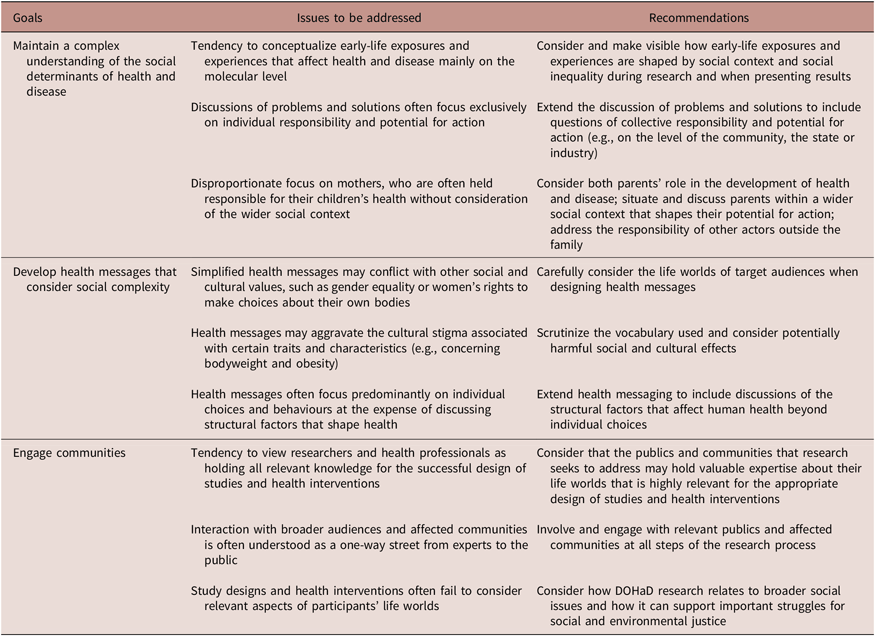
DOHaD research can provide powerful insights into how life exposures and experiences can affect health and disease across the life course and across generations. In this article, we have argued that the distinct perspective on health and disease that DOHaD proposes lends an inherently political character to the field. As its insights become increasingly important for health policymaking and clinical practices, it is thus crucial to carefully consider how the field frames the social and environmental factors that it relates to health outcomes and how it communicates its findings to a wide range of stakeholders (see Table 1
Key goals, issues and recommendations

for an overview). We have stressed the importance of maintaining complexity when studying the social determinants of health and disease and of engaging in interdisciplinary collaboration to succeed in this endeavour. We have outlined the necessity of considering social context when constructing health messages to avoid negative effects in terms of aggravating social stigma or discrimination, for example, against women or people with high bodyweight. We have discussed co-creation approaches as an important tool for involving relevant publics in the design and conduct of studies and the interpretation of research results in order to obtain a more fined-grained understanding of the participants’ life worlds, which in turn can ensure that complexity and context-sensitivity are maintained during research and in the communication of research results and possible implications.
We are aware that in many countries worldwide, health policymaking, just like policymaking in general, shows tendencies towards delegating the responsibility for health and disease to the individual, framed as a consumer–patient who is required to make ‘healthy choices’ based on the health messages provided.Reference Wright and Harwood 33 , Reference Crawford 36 However, many studies have shown that this framing is flawed and that much more attention needs to be paid to structural factors that crucially influence health behaviour beyond individual choice 28 and that often reflect social inequality. DOHaD as a field offers an opportunity to make visible how complex and stratified life worlds influence chances for health and risk of disease. At this important moment in time, when the challenge of preventing NCDs is widely recognized and DOHaD research is receiving increasing attention in the policy field, we urge DOHaD researchers to resist the temptation to generate simplified causal narratives and individual-level solutions, but rather to work to make the complex social contexts of developing health and disease visible to policymakers, health care professionals, patients and the wider society.
Acknowledgements
M.A.H. is supported by the British Heart Foundation and the EU Horizon 2020 programme LifeCycle. The idea for this review arose in part from discussions at a workshop held at the DOHaD Congress in Rotterdam in November 2017.