

According to theories of retrospective voting, voters evaluate the past government's performance and make their vote choice accordingly. While satisfied voters support the incumbent, dissatisfied voters are more likely to support an opposition party (Key, Reference Key1966; Lewis-Beck and Stegmaier, Reference Lewis-Beck and Stegmaier2000). Retrospective voting is not only one of the most investigated topics in voting behaviour research (Fiorina, Reference Fiorina1981; Healy and Malhotra, Reference Healy and Malhotra2013), it is also a key concept in normative work on the functioning of representative democracy. That is, by voting retrospectively, voters can hold incumbents accountable—ensuring citizen control over how representatives act while in office (Przeworski et al., Reference Przeworski, Stokes and Manin1999).
Given that it is normatively desirable that citizens vote retrospectively and hold the government to account, researchers have voiced concern about the apparent instability of mechanisms of retrospective voting (Anderson, Reference Anderson2007), leading to a stream of publications on the conditions that allow for reward and punishment (Duch and Stevenson, Reference Duch and Stevenson2008; Silva and Whitten, Reference Silva, Whitten, Arzheimer, Evans and Lewis-Beck2017). These studies have focused mostly on identifying formal institutional rules that make it more or less easy for voters to attribute responsibility for the country's state of affairs (Nadeau et al., Reference Nadeau, Niemi and Yoshinaka2002; Powell and Whitten, Reference Powell and Whitten1993; Schwindt-Bayer and Tavits, Reference Schwindt-Bayer and Tavits2016; Whitten and Palmer, Reference Whitten and Palmer1999). In a recent contribution to this vast literature, Hobolt et al. (Reference Hobolt, Tilley and Banducci2013) break with the traditional approach of focusing on static institutional factors by distinguishing between a static dimension and a more dynamic one. They find the latter to be a more important factor for explaining contextual variation in retrospective voting. We build on their work by studying how characteristics of who is in power moderate retrospective voting and also by drawing attention to the role of the opposition—and how different it is from the government. In doing so, we take into account that the alternative options voters have matter when voters make a decision about whether or not to punish an incumbent (Anderson, Reference Anderson2000).
Our focus is on how ideologically different—that is, polarized—government and opposition are. We derive two contrasting expectations. On the one hand, if the government and the opposition are more ideologically distinct, this will make it easier for voters to distinguish both. Furthermore, if incumbent and opposition parties have a distinct ideological position and adhere to different policies, a higher degree of polarization implies that a vote for an opposition party ensures different policies to be pursued in the future (Hellwig, Reference Hellwig, Dalton and Anderson2010). Following the literature on clarity, this might strengthen retrospective voting because voters can recognize more clearly which party or parties they should reward or punish for the government's track record (Powell and Whitten, Reference Powell and Whitten1993; Silva and Whitten, Reference Silva, Whitten, Arzheimer, Evans and Lewis-Beck2017). On the other hand, work on valence issues has argued that when parties are ideologically close, voters cannot distinguish between parties in spatial terms, leading them to take into account valence attributes instead (Green and Hobolt, Reference Green and Hobolt2008). Hence, the valence literature leads to the expectation that retrospective voting will be weaker when government and opposition are more ideologically distant.
In order to investigate whether and how the polarization between government and opposition moderates retrospective voting, we make use of the data of the second and third module of the Comparative Study of Electoral Systems (CSES) project, covering 52 elections in 30 countries. We study the moderating effect of the ideological distinctness of government and opposition by means of a novel measure of what we call the “polarization of alternatives.” The results show a strong positive moderation effect: the more ideologically distinct the government and the opposition are, the larger the impact of retrospective performance evaluations on the vote. Our findings suggest that ideologically distinct alternatives make it easier for voters to vote according to their evaluation of the government's performance, which is in line with the clarity of responsibility literature.
Theoretical Background: Retrospective Voting in a Comparative Perspective
Retrospective voting theory argues that the vote choice is influenced by the performance of the incumbent party or parties. It stipulates that voters retrospectively evaluate the government's performance and that these evaluations subsequently influence their party choice (Key, Reference Key1966; Lewis-Beck and Stegmaier, Reference Lewis-Beck and Stegmaier2000; Strøm, Reference Strøm2000). A wealth of literature shows empirically that those who are satisfied are more likely to support the incumbent, while the dissatisfied are more likely to support an opposition party (Duch and Stevenson, Reference Duch and Stevenson2008; Fiorina, Reference Fiorina1981; Healy and Malhotra, Reference Healy and Malhotra2013). Citizens’ evaluations of government performance can relate to different issues. Many scholars study the impact of citizens’ evaluations of the state of the economy (Nannestad and Paldam, Reference Nannestad and Paldam1994), but others have shown that perceptions of corruption (Ecker et al., Reference Ecker, Glinitzer and Meyer2016), war casualties (Karol and Miguel, Reference Karol and Miguel2007) or natural disaster management (Gasper and Reeves, Reference Gasper and Reeves2011) also influence support for the incumbent party. In addition to these performance evaluations that relate to a specific domain or policy issue, evaluations of the government's performance, in general, have been shown to be strong predictors of the vote choice (de Vries and Giger, Reference de Vries and Giger2014; Stiers, Reference Stiersforthcoming).
Overall, there is strong evidence that retrospective performance evaluations affect voters’ choices, but there is substantial heterogeneity in their effect. At an individual level, factors such as citizens’ level of political knowledge or their partisanship moderate the impact of performance evaluations. Voters with higher levels of knowledge appear to hold governments accountable to a larger extent (de Vries and Giger, Reference de Vries and Giger2014; Duch, Reference Duch2001), while partisanship biases perceptions of how governments perform (Tilley and Hobolt, Reference Tilley and Hobolt2011).
Most work on heterogeneity in the effect of retrospective evaluations, however, has focused on differences between countries (Duch and Stevenson, Reference Duch and Stevenson2008). Notably, the literature on clarity of responsibility has shown that complex institutional rules blur the lines of responsibility and decrease the impact of performance evaluations on the vote (Silva and Whitten, Reference Silva, Whitten, Arzheimer, Evans and Lewis-Beck2017). In their seminal study on the topic, Powell and Whitten (Reference Powell and Whitten1993) argue that institutional political rules moderate the impact of economic performance on the vote. They state that “the greater the perceived unified control of policymaking by the incumbent government, the more likely is the citizen to assign responsibility for economic and political outcomes to the incumbents” (398). They find empirical support for their expectations, as they find evidence of economic voting in “high clarity” settings but not in “low clarity” ones.
Inspired by the work of Powell and Whitten (Reference Powell and Whitten1993), many others have studied how institutional factors—for example, the specifics of an electoral and political system or whether a government is unitary or federal—moderate the attribution of responsibility and the impact of incumbents’ performance on electoral results (Bengtsson, Reference Bengtsson2004; Nadeau et al., Reference Nadeau, Niemi and Yoshinaka2002; Whitten and Palmer, Reference Whitten and Palmer1999). Reviewing earlier work on clarity of responsibility and its impact, Hobolt et al. (Reference Hobolt, Tilley and Banducci2013) have argued for the need to distinguish between two dimensions of clarity: institutional clarity and government clarity.
The institutional clarity dimension is about the institutional concentration of power. This captures the formal division of powers both horizontally between the executive and the legislature, and vertically between different levels of government. … By contrast to the institutional clarity dimension, the government clarity dimension is not directly concerned with formal institutional rules, but rather the “cohesiveness” of the incumbent government at a particular time. (169–170)
Testing the impact of institutional and government clarity empirically, Hobolt et al. (Reference Hobolt, Tilley and Banducci2013) find that it is the latter that matters most. Hence, their results indicate that government clarity, which is the more dynamic of both dimensions, better captures contextual variation in retrospective voting. In this article, we build on their work and argue that another possibly important—and dynamic—moderator of retrospective voting should be taken into account: whether or not voters discern a valid alternative to the governing parties.
In fact, the role of available alternatives has received remarkably little attention in work on retrospective voting. In one of the few studies on this topic, Anderson (Reference Anderson2000) analyzes whether economic voting is moderated by what he calls the “clarity of available alternatives.” He argues that voters are more likely to punish the incumbent government if there is a clear and viable alternative to the government available. If there are many parties running in the election, he explains, it is less clear which opposition party might throw the governing party out of office and take over incumbent control. If there are few alternative parties, however, it is more likely that there is a clear alternative—that is, that voting for the main opposition party makes for a high probability of replacing the current incumbent. Hence, he argues: “A more clearly defined set of viable alternatives to the incumbent government should lead citizens to more readily express content or discontent with the ruling party or parties” (Anderson, Reference Anderson2000: 156).
Using the effective number of parliamentary parties as a measure of the clarity of available alternatives, Anderson (Reference Anderson2000) finds that a larger set of available alternatives attenuates the effect of economic perceptions on the vote. Furthermore, he also finds a direct effect: the higher the effective number of parliamentary parties, the higher the support for the incumbent government, all other things being equal.
Second, Bengtsson (Reference Bengtsson2004)—who builds on the work of Anderson (Reference Anderson2000)—states that “a greater number of effective parties is assumed to make it more difficult for voters to estimate what an alternative government would look like, since more parties are competing for power” (756). Using aggregate-level data in a sample of elections in Western democracies, she finds support for the hypothesis that economic effects are stronger when there are only a few viable alternatives to support. This analysis is in line with the results reported by Hellwig (Reference Hellwig, Dalton and Anderson2010: 162), as he finds that voters are better able to link their retrospective performance evaluations to their vote when administrative power is concentrated in the hands of fewer actors.
Previous studies thus have argued that the presence of alternatives to the government conditions retrospective voting. Both Anderson (Reference Anderson2000) and Bengtsson (Reference Bengtsson2004) have tested this argument by means of an indicator of the effective number of parties. For characterizing the available alternatives the voter can choose from and its impact on retrospective voting, however, we argue that it is important to take into account how different those alternatives are. We focus on the ideological distinctiveness of incumbent and opposition parties, which, as we argue, affects whether or not the opposition parties can be clearly distinguished from the incumbent parties. In doing so, we take into account insights from the party systems literature that note that the “quality of party competition” (that is, its polarization) is often a more important factor than the quantity of parties (Dalton, Reference Dalton2008).
Expectations
Polarization and clarity
Different expectations can be drawn regarding the impact of ideological polarization between the government and the opposition on retrospective voting.
In line with the work on the importance of clarity of responsibility, the polarization of available alternatives should make it easier for voters to distinguish government parties from opposition parties. If that is the case, stronger polarization between the incumbent and the opposition should strengthen the reward-punishment mechanism. Previous work has indicated that a certain degree of polarization helps voters to perceive the political landscape more clearly (Lachat, Reference Lachat2008; Lupu, Reference Lupu2015). If the focus is on retrospective voting, the main distinction in the political landscape is the contrast between “the incumbent” and “the opposition” (Key, Reference Key1966). It can be expected that the mechanism of retrospective voting will be facilitated if incumbent and opposition parties are more ideologically distinct, as this will help voters to differentiate parties in government from parties in opposition. Indeed, “the further apart the political parties, the easier it may be for citizens to distinguish among their electoral options” (Lupu, Reference Lupu2015: 356). When the opposition is ideologically similar to the government, voters may have a hard time distinguishing between the ideologies of incumbent and opposition parties—reducing their ability to reward or punish the incumbent. If the parties are ideologically distinct, on the other hand, voters can more easily decide to reward parties for good performance or punish them for bad performance.
More polarization should increase the clarity of responsibility to an even greater degree because it should make clearer to voters to what extent choosing an alternative (opposition) party can affect future policies in the country. As Gélineau and Singer (Reference Gélineau, Singer, Carlin, Singer and Zechmeister2015) argue, abandoning the incumbent party if it did not manage the economy well is less viable if it is not clear to the voter that other parties would have better economic policies. If voters cannot clearly distinguish different parties because they are ideologically similar, they are unlikely to express dissatisfaction with incumbent policies by supporting the opposition. As Hellwig (Reference Hellwig, Dalton and Anderson2010) argues: “If the voter perceives little or no policy differences among party competitors, she has less reason to expect a reversal in policy outcomes even if a new government takes office” (155; see also Gélineau and Singer, Reference Gélineau, Singer, Carlin, Singer and Zechmeister2015). Polarization in general, then, can be understood as rendering more clear the “issue packages” that parties offer (Dalton, Reference Dalton2008; Ensley, Reference Ensley2007; Lachat, Reference Lachat2008). A higher degree of polarization makes it clearer to voters which policies each party would pursue if that party were in power and thus also makes clearer to voters how they can have similar policies if they are satisfied with a government's performance—or change policies if they are dissatisfied (Hellwig, Reference Hellwig, Dalton and Anderson2010).
In summary, if voters are not satisfied with the way the country was governed during the last electoral term, they will want to change the direction of the government's policies in the future. This change is more likely to occur if they are able to vote for a party that they see as ideologically distinct from the governing party. When the opposition is ideologically distinct from the government, voters feel that they can change the future direction of the government by punishing the incumbent and voting for the opposition. It is should be noted that we do not argue that dissatisfied voters will be more likely to vote for a certain party just because it is more ideologically distinguishable from other parties—that is, right-wing voters voting for a left-wing party when they are dissatisfied, or vice versa—as this would be a spatial consideration. Rather, we argue that valence considerations will become more salient in deciding which party to vote for when parties are more easily distinguishable. While some voters might shift their vote to an ideologically different party, not all voters have to shift their votes from the incumbent to the opposition for there to be a punishment mechanism. Previous incumbent voters might be demobilized when the economy deteriorates, while the opposition mobilizes supporters to turn out to vote. Furthermore, those who previously voted for minor or centrist parties also might strategically vote for another party to realize change. As a result, even if not a single voter switches ideological blocks, the mechanisms of mobilization and demobilization might result in the incumbent losing votes and the opposition winning votes.
For these reasons, our expectation is that ideological polarization between the incumbent and the opposition will strengthen retrospective voting:
Hypothesis 1:
The more ideologically distinct the opposition parties are from the government, the larger the effect of retrospective performance evaluations on the vote.
While the hypothesis is based on a clarity argument, it should be acknowledged that work in the field of social psychology would lead to a different hypothesis. Authors that conceive of partisanship as a social identity argue that polarization is associated with strong partisan identities, which—among other factors—lead to higher levels of bias and activism (Mason, Reference Mason2014). As a result of this bias, partisans may not be able to evaluate an incumbent's work fairly, weakening performance voting.
Valence versus proximity
In addition to the literature on clarity of responsibility, the valence literature also can be looked at for theorizing about the impact of polarization of available alternatives on retrospective voting. Indeed, the performance of the incumbent can safely be considered a valence issue (Green and Jennings, Reference Green and Jennings2012; Stokes, Reference Stokes1963).
From their introduction in the literature by Stokes (Reference Stokes1963) onward, valence issues have been contrasted with spatial models of voting that presume ideological proximity guides the vote choice (Sanders et al., Reference Sanders, Clarke, Stewart and Whiteley2011). The relative importance of valence and spatial issues has always intrigued electoral scholars, and it has been argued that contextual factors play an important role for understanding the extent to which valence issues matter.
In particular, it has been claimed that valence considerations gain importance when parties (and voters) converge (Green, Reference Green2007). In a series of analyses that focus on the British context, for example, the ideological convergence of parties has been found to co-occur with a growing weight of valence considerations in voters’ choices (Green, Reference Green2007; Green and Hobolt, Reference Green and Hobolt2008). The mechanism linking party convergence and voting on the basis of valence considerations is the following: “Voters who cannot determine which party is closer to them in policy terms, because parties offer similar policies, will more likely choose between parties on the basis of which can deliver” (Green and Hobolt, Reference Green and Hobolt2008: 461). Thus, when parties take diverse ideological positions, voters’ ideological predispositions are an important determinant of their vote. If, however, parties cannot be ideologically distinguished, policy preferences cannot be used to distinguish between parties, and valence issues gain in importance (Buttice and Stone, Reference Buttice and Stone2012). Along these lines, we can formulate an alternative hypothesis about the moderating role of polarization of alternatives on retrospective voting:
Hypothesis 2:
The more ideologically distinct the opposition parties are from the government, the smaller the effect of retrospective performance evaluations on the vote.
This hypothesis is in line with findings from the above-cited studies on valence issues. It is important to point out, however, that not all empirical work on the link between ideological convergence and valence voting supports the claim that when parties are ideologically more proximate, valence issues will matter more. Clark and Leiter (Reference Clark and Leiter2014), investigating the conditioning effect of party polarization on character-based attributes in nine Western democracies, find that ideological polarization strengthens the impact of valence. Likewise, Pardos-Prado (Reference Pardos-Prado2012) studies the determinants of voting behaviour in a set of European countries and finds that valence effects are stronger when party polarization is high—in contrast to his expectations.
Data and Methods
To test the hypotheses empirically, we use the data of the second and third module of the CSES project (CSES, 2015a, 2015b). Using these data allows us to test our hypotheses using a large sample of election studies from different countries representing different political contexts.Footnote 1 The CSES data allow us to investigate retrospective voting with a focus on general performance evaluations (see below). For the dependent variable, we follow standard practice in the retrospective voting literature by distinguishing voters who voted for an incumbent party (code 1) and voters voting for an opposition party (code 0) (Lewis-Beck and Stegmaier, Reference Lewis-Beck and Stegmaier2000).Footnote 2
To test our hypotheses, two independent variables are of interest. The first is the voter's retrospective evaluation of the government's performance. Most previous research has focused on evaluations of the economy to investigate retrospective voting (Lewis-Beck and Stegmaier, Reference Lewis-Beck and Stegmaier2000, Reference Lewis-Beck, Stegmaier, Dalton and Klingemann2007). However, the economy is not the only issue that voters care about, and previous research has shown that there is substantial variation in what issues voters consider the most important (Singer, Reference Singer2011). We use a general performance question that has also been used by previous research on retrospective voting (de Vries and Giger, Reference de Vries and Giger2014). The item asks voters to evaluate the performance of the government “in general”: “Now thinking about the performance of the [government in [capital]/president] in general, how good or bad a job do you think the [government/president in [capital]] has done over the past [number of years since last government took office, before the current election] years? Has [it/he/she] done a very good job? A good job? A bad job? A very bad job?” This scale has been reversed so that higher values denote a more positive performance evaluation.
The second independent variable of interest is the moderating variable: the ideological polarization of available alternatives. In the CSES questionnaire, voters were asked to position all main parties on an ideological axis running from 0 (“left”) to 10 (“right”). Following previous research, we calculate ideological positions using voters’ placements on this axis (Dassonneville and Dejaeghere, Reference Dassonneville and Dejaeghere2014; Hooghe and Stiers, Reference Hooghe and Stiers2017; Kölln and Polk, Reference Kölln and Polk2017; Lupu, Reference Lupu2015).Footnote 3 As there might be concerns for endogeneity between voters’ perceptions of the parties’ ideological position, party choice and perceptions of performance, we use the mean position of respondents within each election study as the party's position.
To test our arguments, we introduce a measure of polarization of available alternatives that takes into account the polarization between government and opposition within the political system. To construct this measure, we build on the polarization measure of Lupu (Reference Lupu2015) (which built on Dalton [2008]). Lupu measures polarization by calculating the sum of the weighted squared distance of each party to the weighted average position of all parties. Similarly, we calculate the sum of the weighted squared distance of all opposition parties to the weighted government position:

in which

in which V i denotes the vote share of the party in the previous election, and p i the position of the party on the left-right scale. While m denotes the set of opposition parties, n denotes the parties in government. Theoretically, this scale of polarization of alternatives runs from 0 (all opposition parties have the same position as the governing parties) to 100 (the weighted government position is 0 [10], while all opposition parties are positioned on 10 [0]). The observed range is 0.197 to 30.699.Footnote 4
This operationalization of polarization comes closest to our theoretical argument. While the theory of Anderson (Reference Anderson2000) and Bengtsson (Reference Bengtsson2004) focused on an alternative government being available, our main focus here is on the alternative parties—that is, opposition parties—that the voter can choose from. By weighting the ideological positions by parties’ vote shares, the relative size of all parties is taken into account. Furthermore, as Lupu (Reference Lupu2015: 338–39) states, it acts as a proxy measure for each party's prominence in the system and prevents artificially high values caused by small fringe parties—which most voters would most likely not assume to be viable alternatives. Finally, it takes into account previous research showing that the main opposition party is likely to receive more support from dissatisfied voters than smaller opposition parties (Williams at al., Reference Williams, Stegmaier and Debus2017; Plescia and Kritzinger, Reference Plescia and Kritzinger2017).
After investigating the effect of our measure of polarization of available alternatives, we test whether it contributes to explaining variation in retrospective voting when accounting for the explanations previous studies have offered. First, to test whether our measure explains heterogeneity in retrospective voting when accounting for standard indicators of clarity of responsibility, we include in our model the measure of government clarity as proposed by Hobolt et al. (Reference Hobolt, Tilley and Banducci2013). This measure includes (1) whether or not there was a coalition government, (2) whether or not there was cohabitation in semi-presidential regimes, (3) the ideological cohesion of the government and (4) the dominance of the main governing party. We derive this information from ParlGov (Döring and Manow, Reference Döring and Manow2018). As this measure is expected to moderate retrospective voting, we include it in the model in interaction with the retrospective performance evaluations. Second, we test whether our measure explains variation in retrospective voting when accounting for the findings of Anderson (Reference Anderson2000). To do so, we include an interaction between retrospective performance evaluations and the effective number of parliamentary parties (ENPP)—derived from Gallagher (Reference Gallagher2017).
Next to these variables of interest, we include additional covariates to control for their impact on the party choice. First, we include standard socio-demographic variables. Age is included as the respondent's age in the election year. Sex is included with male voters as reference category. Educational level is included as categorical variable distinguishing (1) voters who did not complete secondary education (reference category), (2) respondents who completed secondary education, (3) respondents who received post-secondary vocational training and unfinished university training and (4) respondents who obtained a university degree. We also include an indicator of whether or not the respondent is religious.Footnote 5 Next, we include the income category of the respondent, divided in quintiles. Finally, we control for the voter's own ideological position, as the self-placement on an ideological scale running from 0 (left) to 10 (right).
Given the binary nature of the dependent variable, we use logistic regression models to predict the respondent's vote for an incumbent party. However, our data come from different election studies, and the observations within elections cannot be considered to be independent of each other. We take this clustering into account by estimating multilevel models (Gelman and Hill, Reference Gelman and Hill2007). More specifically, we estimate random-intercept models with individual voters nested in election studies. As we expect that the polarization of available alternatives moderates retrospective voting, we interact our measure of polarization with the voter's retrospective performance evaluation. We add a random slope for the individual-level performance evaluations in the models including cross-level interactions. Furthermore, to rule out effects of differences in distributions between countries, we centre all continuous individual-level variables around their respective group means.
Results
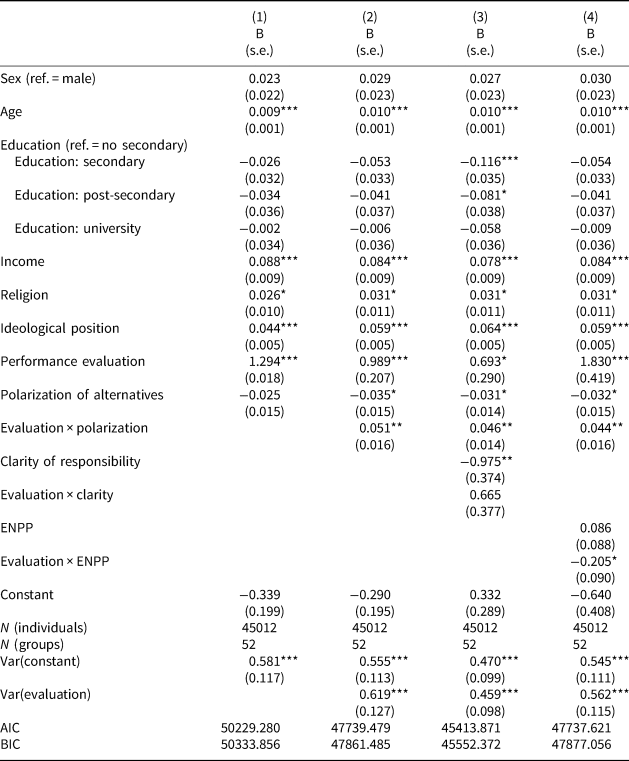
The results of our multilevel logistic regression models are summarized in Table 1. First we investigate the effect of the polarization of alternatives on retrospective voting. Then we test the robustness of the findings when controlling for variables that previous research has found to moderate retrospective voting.

In model 1 of Table 1, we investigate the direct impact of our variables of interest. The results suggest a strong and positive impact of retrospective performance evaluations on the vote: the more satisfied a voter is with the government's performance, the more likely this voter will be to vote for an incumbent party. While a voter who has the most negative evaluation of the government's performance has a predicted probability of 4.27 per cent to vote for the government, this increases up to 90.80 per cent for the most positive voters. Hence, the classic retrospective voting theory is supported by the analyses.Footnote 6
We are mainly interested in the conditional effect of retrospective performance evaluations by the polarization of available alternatives. To test our hypotheses, we include an interaction between retrospective performance evaluations and our polarization measure (model 2). The interaction coefficient is significantly positive—indicating that the larger the degree of ideological polarization between government and opposition, the larger the impact of retrospective performance evaluations on the vote for an incumbent. And vice versa: dissatisfied voters will punish the incumbent parties to a larger extent when the alternatives are clear.
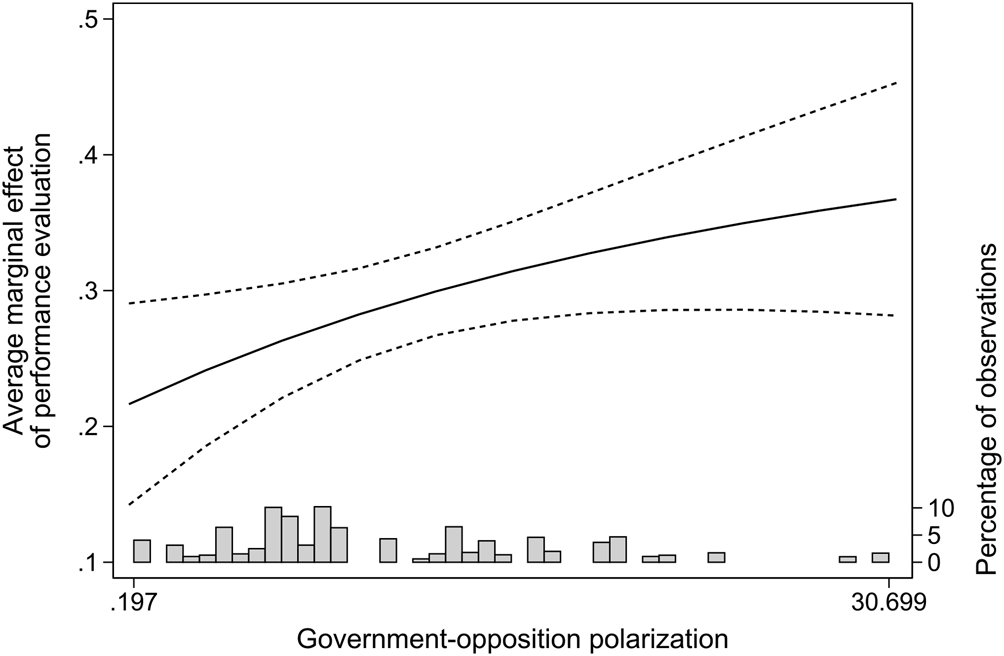
As coefficients of logistic models are hard to interpret at face value, we calculate conditional marginal effects. Figure 1 displays the average marginal effect of retrospective evaluations of the government's performance at different levels of polarization, which further clarifies the positive interaction effect.Footnote 7 Retrospective performance evaluations have a positive impact on the vote for an incumbent party, and the higher the degree of ideological polarization between government and opposition, the larger the effect of performance evaluations on the vote. Hence, both reward and punishment of the incumbent government is facilitated by high levels of ideological polarization between incumbent and opposition parties.
Average Marginal Effect of Performance Evaluations at Different Values of Ideological Polarization between Government and Opposition

Our results are in line with our first hypothesis, which is inspired by the clarity of responsibility literature. In contrast, our analyses lead us to reject the second hypothesis. Like earlier comparative work on the interaction between ideological positions and the effect of valence issues, we fail to find that such issues matter most when parties are ideologically close.
Next we turn to investigating whether our measure of polarization helps explaining variation in retrospective voting when controlling for the measures that were proposed by earlier research. In model 3 in Table 1, we test whether our measure of polarization has an effect separate from the clarity of responsibility of the political context. To do so, we include an interaction between performance evaluations and the clarity of the context. If the polarization of available alternatives matters only because it increases the clarity to the voter, the interaction between performance evaluations and polarization should be rendered nonsignificant. While the interaction between performance evaluations and polarization remains significant, the interaction of evaluations and clarity of responsibility is not significant.Footnote 8 Hence, our results seem to be robust to controlling for government clarity. Next we test whether our argument differs from previous findings of the effective number of parliamentary parties to moderate retrospective voting. The results of model 4 show that our measure of polarization helps explaining variation in retrospective voting on top of this measure. Hence, polarization adds to explaining heterogeneity in retrospective voting and complements the roles of the clarity of the context and the effective number of parliamentary parties in the country.
Besides the analyses presented here, we conducted a series of additional analyses to test the robustness of our findings. As most previous research on retrospective voting focused on the economy, we replicated our models using economic perceptions. We also tested a series of alternative measures of the key variables of interest in our models—that is, the polarization of available alternatives, government clarity and control variables. We also tested whether our results hold in different subgroups. The results of these robustness tests are summarized in the online appendix and provide support for the findings presented here.
One issue that deserves special attention, however, is that of endogeneity in subjective perceptions of the government's performance. While we model performance evaluations as a predictor of incumbent or opposition party support, others have argued that the relationship might be reciprocal and that party preferences influence perceptions of performance. Instead of being a true evaluation of the government's performance, the evaluation item could thus be tapping partisan differences in feelings toward the incumbent parties (Evans and Andersen, Reference Evans and Andersen2006; Evans and Pickup, Reference Evans and Pickup2010). To verify that our results reflect actual differences in retrospective voting rather than the reciprocal relationship between party support and perceptions of performance, it is important to account for such endogeneity. To test whether our results are subject to endogeneity, we purged the performance evaluation (Duch et al., Reference Duch, Palmer and Anderson2000; Duch and Stevenson, Reference Duch and Stevenson2008). This method consists of three steps, in which the biased part of performance evaluations are separated from the reality-based part by means of a series of consecutive regression models. The results of this additional test are reported online in appendix H and show that, when relying on purged performance evaluations, we still find that higher levels of ideological polarization facilitate retrospective voting.
Conclusion
This study set out to investigate the impact of the polarization of available alternatives on retrospective voting. Previous research on clarity of responsibility has already indicated that characteristics of a political system—and of the incumbent government in particular—can facilitate retrospective voting. However, one aspect that remained largely unstudied is the role of the alternative parties the voter can choose from. In this article, we argue that the ideological distinctness—that is, the polarization—of government and opposition parties influences the extent to which voters relate their performance evaluations to their vote.
The literature on the influence of polarization on voting behaviour led us to two alternative hypotheses. First, the literature on retrospective voting leads to the expectation that polarization should enhance retrospective voting. If government and opposition are more ideologically distinct, it is easier for voters to distinguish incumbent from opposition parties and hence to vote according to their evaluation of the incumbent's track record. Furthermore, if government and opposition are more ideologically distinct, a voter who is dissatisfied with the government's past policies has a better opportunity to change the future direction of policies. Hence, if government and opposition are polarized, a vote for the opposition becomes a more efficient tool to punish the government. However, theoretical accounts on the role of valence issues on the vote lead to the opposite expectation—that valence issues gain in importance when parties converge ideologically—and hence that they have less importance in polarized settings.
Our analyses on the data of the second and third module of the CSES project provide support for our first hypothesis. By relying on a novel measure of the polarization of available alternatives, we find strong positive moderation effects: the larger the degree of polarization between government and opposition, the larger the effect of retrospective performance evaluations on the vote. Furthermore, we find that this measure helps to explain variation in retrospective voting on top of the measures previous research has identified. Hence, including the polarization of available alternatives adds to our understanding of the heterogeneity in retrospective voting. Furthermore, while this finding is in contrast with the theoretical accounts on the importance of valence issues on the vote, it is in line with recent empirical research in this field that showed that valence issues seem to matter more in polarized settings.
Our study is subject to some limitations. Most importantly, while some previous studies on the importance of valence issues in the vote choice process take a longitudinal approach, we are limited to using cross-sectional data. Second, while we argue that higher clarity of responsibility helps voters to distinguish parties and that voters get a better choice for alternative policies in the future, we remain unsure of the causal underpinnings of our results. Future research could examine the causal process behind the moderating effect of polarization documented here. Finally, we did not take into account the possible reciprocal relationship between polarization and differences in performance evaluations between out- and in-partisans. While we argue that retrospective voting is inhibited or facilitated by polarization, increasing levels of polarization between parties might also affect the extent to which partisans are willing to credit incumbents from another party or to punish their own. While Donovan et al. (Reference Donovan, Kellstedt, Key and Lebo2019) provide evidence for this hypothesis in the US case, it is up to future research to investigate the effects of this trend for the findings presented here.
Despite these limitations, the results hold strong implications for the way in which elections work as a means of rewarding or sanctioning incumbents for their policies. From the point of view of democratic governments, retrospective voting is a desirable mechanism, as it provides a venue for voters to ensure that parties are responsive to their demands. While negative accounts of increasing levels of polarization between political parties are plenty, our results allow for more optimism. At least with the data at hand, it seems like a larger degree of ideological polarization between the government and the opposition makes it easier for voters to reward and punish the incumbent government according to its performance.
Supplementary material
To view supplementary material for this article, please visit https://doi.org/10.1017/S0008423919000556