INTRODUCTION
Early macro-level research on Islam and democracy favored a cultural incompatibility thesis that puts Muslim faith at odds with democratic governance (Gellner Reference Gellner1991; Huntington Reference Huntington1993; Kedourie Reference Kedourie1994; Lewis Reference Lewis2010). Scholars of Islam have refuted this essentialist approach by searching for pluralistic ideas in conceptions of Islamic legal methodology such as ijma (consensus of scholars) and ijtihad (independent legal reasoning) or in the principle of shura (consultation) (Esposito and Voll Reference Esposito and Voll1996; Sachedina Reference Sachedina2001; Kemal Reference Kemal2002; El Fadl Reference El Fadl2004; Ramadan Reference Ramadan2004). The burgeoning quantitative public opinion literature has also challenged this essentialist line of theorizing (Tessler Reference Tessler2002; Bratton Reference Bratton2003; Jamal Reference Jamal2006; Meyer, Rizzo, and Ali Reference Meyer, Rizzo and Ali2007; Rizzo, Abdel-Latif, and Meyer Reference Rizzo, Abdel-Latif and Meyer2007; Ciftci Reference Ciftci2010; Fish Reference Fish2011; Tessler, Jamal, and Robbins Reference Tessler, Jamal and Robbins2012). The net contribution of this scholarship to this important debate on Islam and democracy can be summarized in a single statement: Muslim religiosity is not necessarily at odds with democratic orientations. However, after more than a decade of research, much ambivalence remains about the precise mechanisms linking religiosity to support for democracy in Muslim-majority societies.
Following in the footsteps of these latter studies, this paper attempts to shed some light on the ambivalence surrounding the “religiosity-democratic support nexus” by approaching the puzzle from a different perspective: Can religiously inspired social justice values lead to pluralistic ideals and inform democratic orientations among the world's Muslims? Do such values mediate the effect of religiosity on support for democracy?
Some studies have already tested the effects of certain values on democratic orientations including those related to tolerance (Spierings Reference Spierings2014a), secular-Islamist cleavage (Ciftci Reference Ciftci2013), gender views (Tessler Reference Tessler2015), and social inequalities (Fish Reference Fish2011). These studies, however, do not test the intermediate mechanisms linking religiosity to democratic support, such as benevolence and economic egalitarianism that are among the constitutive elements of various Islamic social justice conceptions. This paper examines the direct and mediated effects of religiosity through social justice values on support for democracy. This inquiry is important because Muslim-majority societies demonstrate high levels of religiosity and at the same time “social justice” has historically been a pillar of legitimate governance in the Muslim world (Abdelkader Reference Abdelkader2000; Sachedina Reference Sachedina2001; Feldman Reference Feldman2007; el-Affendi Reference El-Affendi2008; Yenigun Reference Yenigun2017).
I propose that social justice values will inform democratic orientations and mediate religion's effect on regime preferences through two distinct mechanisms. First, there is strong emphasis on charity, zakat (almsgiving), and helping the poor in Islamic orthodoxy (Davis and Robinson Reference Davis and Robinson2006). Since democratic institutions are more conducive to distributive justice policies through taxation of wealthy individuals than other governance systems (Acemoglu and Robinson Reference Acemoglu and Robinson2006), all else equal, individual preferences favoring charity and distributive schemes should be compatible with support for democracy.
A second mechanism is inspired by the Islamic legal theory. In this theory, social benevolence (ihsan) is instrumental for attainment of the end goal of Islamic law, that is, public interest (maslahah) (Abdelkader Reference Abdelkader2000). It is argued that religiously inspired benevolent act is widely promoted by Islamic moral authority and it may serve as a consensus forming ideal among the devout Muslims toward establishing a just order (i.e., maslahah). This is akin to obtaining a majority agreeing on the parameters of public interest by virtue of non-separable preferences and deliberation in democratic systems (Sen Reference Sen1977; Reference Sen1999; Oppenheimer and Frohlich Reference Oppenheimer and Frohlich2007). Subsequently, I argue that social benevolence, as a virtue of Islamic justice should generate support for democracy through democracy's capacity of generating public interest through deliberative means. Finally, since scripture and prophetic tradition places strong emphasis on zakat, charitable act, and egalitarian distribution (Singer Reference Singer2008), one can argue that such social justice values are likely to act as mediators in the “religion-support for democracy” nexus.
I use the sixth wave of the World Values Surveys to test these hypotheses in 18 Muslim-majority countries. A series of seemingly unrelated regression (SUR) estimations accounting for multiple mediation mechanisms show that both social justice preferences, economic egalitarianism and benevolence, engender democratic orientations directly and through the indirect effect of religiosity. Using mediation analysis and by confirming statistically non-significant alternative paths, the results reveal a very robust direct effect of social justice values on democratic orientations. Benevolence and egalitarian distributive preferences engender support for different types of democratic systems, but they have no impact on support for authoritarianism. Religiosity increases the propensity of holding both benevolent attitudes and egalitarian distributive preferences and being religious indirectly increases favorability of democracy through these mediators.
This paper expands our understanding of regime preferences among the world's Muslims by showing that religion plays an indirect role in shaping political attitudes through mediating effect of such values as benevolence (ihsan) and egalitarian distributive preferences. These intermediate mechanisms may explain some of the ambivalence surrounding the “Islam-democratic orientations” nexus. Therefore, next to the conceptions of legal methodologies (ijtihad-independent legal reasoning and ijma-consensus of scholars) and scriptural principles like shura (consultation) (Esposito and Voll Reference Esposito and Voll1996; El Fadl Reference El Fadl2004; Ramadan Reference Ramadan2004), benevolence and egalitarian values may be among the constitutive elements of pluralist ideas in Islam. This study contributes to our understanding of the pluralistic roots of Islamic religiosity, Muslim democratization, and the relationship between religious-economic preferences and democratic governance.
RELIGION AND SUPPORT FOR DEMOCRACY
According to the global opinion surveys, citizens in Muslim-majority countries are highly supportive of democracy (Bratton Reference Bratton2003; Esposito and Mogahed Reference Esposito and Mogahed2007; Jamal and Tessler Reference Jamal and Tessler2008; Hassan Reference Hassan2008; Fish Reference Fish2011). Similarly, quantitative public opinion literature on this subject finds that Muslim piety is not necessarily incompatible with democratic values and when a negative effect is found, it is either inconsistent or negligible (Rose Reference Rose2002; Tessler Reference Tessler2002). Collins and Owen (Reference Collins and Owen2012) find that devout individuals are supportive of Islamic democracy and the caliphate but are less enthusiastic about secular democracy in Central Asia. The pooled analysis of survey data from the Muslim world, however, does not reveal a clear picture regarding the religiosity variable (Ciftci Reference Ciftci2010). Overall, despite vigorous research spanning more than a decade, much ambivalence remains about the association between religiosity and support for democracy in the Muslim world.
In addressing this ambivalence, some scholars argue that context is an important determinant of preferences about secularism (Karakoc and Baskan Reference Karakoc and Baskan2012), shari'a, and democracy (Ciftci Reference Ciftci2013; Driessen Reference Driessen2018). Others (Fish Reference Fish2011; Spierings Reference Spierings2014a) look at religiously informed values such as trust and tolerance to explain democratic orientations in the Muslim world. Spierings (Reference Spierings2014a, Reference Spierings2014b), however, finds that personal religiosity neither informs support for democracy nor for tolerance of other groups in the Arab region. Ciftci's (Reference Ciftci2013) study looking into values related to the secular-Islamist cleavage as determinants of political attitudes finds contrasting effects about the relationship of religiosity and support for democracy and shari'a. Overall, while there have been attempts to resolve the ambivalence about the relationship of Muslim faith and democracy, research generally neglected the direct and mediated mechanisms linking religion to democratic attitudes.Footnote 1 This paper looks into the explanatory power of social justice values as determinants and mediators of religion's effect on support for democracy among the world's Muslims.
THE TWO AXES OF SOCIAL JUSTICE AND REGIME PREFERENCES
Social justice is an important virtue in Islamic ethico-political system and it is regarded as one of the main pillars of legitimate governance in Islam (Hasan Reference Hasan1971; Shariati Reference Shariati1979; Qutb Reference Qutb2000; Abdelkader Reference Abdelkader2000). Feldman (Reference Feldman2007, 113) argues that modern Islamist thinking has been dominated with different conceptions of “justice” and that this term serves as the “leitmotif” for the social and political incarnations of Islamist worldviews. According to Fish (Reference Fish2011, 222), “justice occupies pride of place in Muslim moral thinking. In broadest general terms, it is the essence of the Muslim ideal and message, much as the essence of the Christian ideal and message is love.”
Despite its salience in Islam, there have been no empirical studies examining the formative effects of Islamic social justice values on political preferences. Theoretical scholarship finds justification for democratic governance in conceptions of Islamic legal methodology such as ijma and ijtihad or from the scriptural principles like shura (consultation) (Esposito and Voll Reference Esposito and Voll1996; Kemal Reference Kemal2002; Ramadan Reference Ramadan2004). Can social justice values validate democratic governance in the cognition of ordinary Muslims just as historical significance of tolerance in Muslim civilization is thought to justify pluralism? Do religious individuals take cues from Islamic social justice principles to inform their regime preferences?
Social justice has been a central concept of political debates not only in the Muslim world but also in the West. In his seminal work, Rawls (Reference Rawls1971) conceptualizes justice as a notion encompassing both procedural and distributive mechanisms. Recent scholarship has focused on the roots of distributive justice (Aalberg Reference Aalberg2003; Reisch Reference Reisch and Reisch2014) and the psychological origins of justice as a primitive motive generating feelings of benevolence (Sabbagh and Schmitt Reference Sabbagh, Schmitt, Sabbagh and Schmitt2016). Although one can expect to observe cross-cultural differences about the conceptions of justice, these two dimensions are especially prominent in the Islamic justice discourses.
The first axis of Islamic social justice concerns the egalitarian distributive preferences. While social justice has political, economic, and legal meanings, distributive aspects involving charity, almsgiving, and social welfare occupy a central position in Islamic conceptions (Hasan Reference Hasan1971; Abdelkader Reference Abdelkader2000). For example, Qutb (Reference Qutb2000) criticizes Western materialism for its consumption habits and proposes an economic model imposing limits on the use of wealth to ensure distribution from the wealthy to the most disadvantaged. In a similar vein, Shariati (Reference Shariati1979) believes that prosperity does not come from accumulation of wealth, but rather it can be achieved by removing class differences and inequalities through charity and benevolence.
Islamic scripture, too, places strong emphasis on charity and redistribution. Wealthy individuals are expected to pay a certain portion of their income (generally 2.5%) as Zakat (obligatory almsgiving) to those in need: “The good that you give should be to the parents, the close ones, the orphans, the needy and the homeless, and any good that you do, God is knowledgeable thereof” (Qur'an 2:215). There are numerous reports encouraging zakat, charity, and redistribution in the Hadith collections that report the sayings of Mohammad. For example, Al-Bukhari reports that Prophet is heard saying: “Allah has made it obligatory for them to pay zakat from their property; it is to be taken from the wealthy among them and given to the poor” (Al-Bukhari n.d., 2:24:537). Adi bin Hatim reported that he heard the Prophet saying, “Save yourself from Hell-fire even by giving half a date-fruit in charity” (Al-Bukhari n.d., 2:24:498). This strong emphasis on charity has given way to the collection and redistribution of zakat by the state during the early and modern periods of Islam (Davis and Robinson Reference Davis and Robinson2006).Footnote 2
Davis and Robinson (Reference Davis and Robinson2006, 167) argue that religiously orthodox “are disposed toward economic communitarianism, whereby the state should provide for the poor, reduce inequality, and meet the community needs via economic intervention.” They find support confirming the primacy of egalitarian distribution among Muslims. Exploiting this doctrinal tendency about distributive justice, many Islamist movements and parties including Muslims Brothers and Hezbollah have capitalized on the appeal of Islam's orthodox principles to provide social services to widen their support base (Clark Reference Clark1995; Wickham Reference Wickham2002; Cammettt and Issar Reference Cammett and Issar2010). The most commonly used word in the names of Islamist parties, justice (adala), further signifies the prevalence of this notion in the political scene.Footnote 3
Do egalitarian social justice values mediate religion's formative effect on democratic orientations? Recent advances in democratization literature provide some insights about the direct and intermediate mechanisms linking distributive preferences to democratic orientations. According to one view, democracy emerges as a result of the struggle between wealthy elites and impoverished masses over redistribution of a nation's wealth (Acemoglu and Robinson Reference Acemoglu and Robinson2006). The masses want democracy, because the universal suffrage allows them to have some influence on policies ensuring a higher tax rate to be imposed on wealthy individuals, which is assumed to favor egalitarian redistribution of the national wealth (Boix Reference Boix2003; Acemoglu and Robinson Reference Acemoglu and Robinson2006). An observable implication of this theory is that those favoring equitable redistribution and progressive tax policies are more likely to support democracy.Footnote 4
If pious Muslims are more likely to hold egalitarian distributive preferences, do they utilize these to inform their regime preferences? According to the logic of “democracy and redistribution” (Davis and Robinson Reference Davis and Robinson2006) the answer is “yes” whereas Pepinsky and Welborne (Reference Pepinsky and Welborne2011) find no clear relationship between piety and redistributive preferences. However, in their statistical analysis of surveys in Muslim majority countries, the latter find that religious Muslims somehow support government's intervention to reduce poverty. Fish (Reference Fish2011), also, finds some empirical evidence conforming that Muslims are distinctive in their preferences for egalitarian distribution and that income inequality is lower in Muslim majority countries.
All else equal, religious Muslims should prefer political arrangements that serve the ultimate social justice goal of economic egalitarianism, and hence be supportive of democratic governance. This is because, in democracies where free and fair elections are the norm, policy implementation in accordance with the distributive preferences of the masses is more likely. At a minimum, we can reasonably expect that, regardless of democracies ameliorative effect on inequality, religious individuals are likely to favor democratic institutions thanks to their expectations about democracy's redistributive capacity.
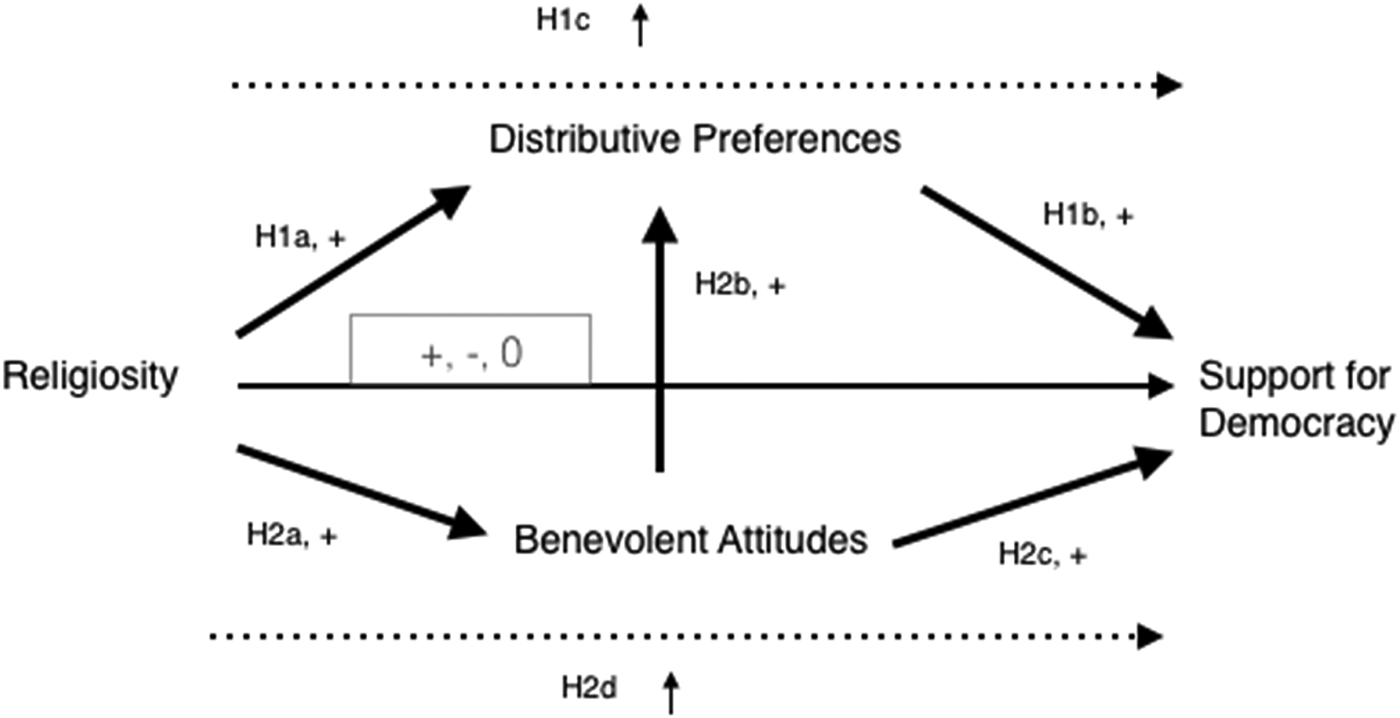
Hypothesis 1a:
Religious individuals will be more likely to hold egalitarian distributive preferences than non-religious.
Hypothesis 1b:
Individuals holding favorable views toward distributive justice will be more supportive of democracy.
Hypothesis 1c:
The effect of religiosity on support for democracy will be mediated by distributive justice preferences in the positive direction.
The second axis of Islamist social justice conception is benevolence (ihsan). Benevolence toward others may be essential in attainment of egalitarian social justice, an outcome that can be justified in the name of public interest (maslahah). One of the best-known hadiths that came to be a maxim of siyasa shar'iyya (i.e., governance according to Islamic law)Footnote 5 shows the importance of benevolence and kindness toward others: “There should be neither harming [darar] nor reciprocating harm [dirar] (La Darar Wa La Dirar)” (Imam Nawawi n.d., 32). Similar to the emphasis placed on charity and redistributive schemes, one can find ample references to benevolence and altruism in the Islamic scripture. For example, the following verse is cited during Friday sermons in many parts of the Muslim world:
Verily, Allah commands “Adl (fairness, equity, justice) Ihsan (excellence in servitude to Allah, benevolence towards people, graciousness in dealings) and giving to those close to you, while He forbids fahshaa (lewdness, indecency, licentiousness, immorality), munkar (bad actions, undesirable activities, generally unaccepted behavior, not fulfilling one's obligations), and baghy (rebellion, transgressing limits, exploiting or violating others’ rights, abuse of authority or freedom).” He admonishes you so that you heed the advice (Quran, 16:90).Footnote 6
A central concept in Islamic law, maslahah, plays an important role in reaching social justice goals. Maslahah can be translated as “public good”, “utility”, or “public interest”. Ghazâlî (Reference Ghazâlî1998) defines this term as “the preservation of the religion, life, mind, offspring, and wealth,” and broadens its scope to include the necessity of benevolence toward the others. In this regard, benevolence justifies the policies that benefit the larger public such as economic policies that increase egalitarianism. Given its doctrinal significance as an Islamic value, what are the implications of benevolence and the related maxim of maslahah for understanding devout Muslims’ political preferences? I argue that the relationship between social justice values like benevolence and support for democracy is related to the ideal of the “achievement of the common good” in an Islamic society, an end result that is bigger than each individual's own interest. I elaborate on this statement below.
In democracies, certain institutional mechanisms empower citizens to choose according to their interests and general welfare (Frohlich Reference Frohlich2007, 256). However, it is necessary to consider the needs of others and avoid the free rider problem for translating preferences about distributive justice into maximal general welfare (Frohlich Reference Frohlich2007, 257). Free and fair elections and executive accountability, two institutional pillars of democratic regimes, are instrumental in attainment of public interest. This, however, is no easy task, because according to Arrow's (Reference Arrow1963) “general possibility theorem”, no “rank-order decision-making rule” will satisfy two conditions of fairness: efficiency and need. Given this constraint, non-separable preferences that tie individual interest to the relative gains of the others increase the likelihood of transition from self-interest to public interest, especially, in democracies where deliberation is likely to facilitate the achievement of common good through formation of a “majority consensus” (Sen Reference Sen1977; Reference Sen1999; Oppenheimer and Frohlich Reference Oppenheimer and Frohlich2007). As Frohlich (Reference Frohlich2007, 257) states:
People seem to care not only about what they get in any situation but how their payoffs relate to what others get, and to the relative merit and/or need of the others. This bespeaks some non-separable preferences: preferences that depend not only on the individual's payoff, but also on the pattern of payoffs and the particular agency whereby that pattern is achieved.
However, even in the existence of strong non-separable preferences, it will be necessary to agree on what constitutes social justice so that at least the majority's preference represents something akin to the common good. This is not a trivial problem to the extent that any dimension of social justice as it relates to the choice of political procedures necessitates a consensus about what is “good” for the individual and the society. In Muslim communities, such consensus may be achieved by religious values such as the scripturally justified benevolence and the related legal maxim of maslahah. Thanks to religious moral authority it enjoys, values emanating from this second axis of social justice will be crucial for ensuring altruistic behavior.
Two observable implications will follow the discussion up to this point. First, benevolent individuals will lean favorably toward charity and egalitarian redistributive policies, because such values are encouraged by Islamic religious authority. That is, benevolent attitudes should be more likely among the devout than the less religious. Second, given the deliberative nature of democratic governance and the representative logic of free and fair elections, it is more likely that public interest, —or at least a perceptional consensus about what constitutes it—, can be realistically achieved in democracies than other regimes. Subsequently, such attitudes should engender a bias toward democratic support rather than for authoritarian governance models among the religious.
One can find ample evidence in the scripture and the Islamist intellectual tradition about these proposed mechanisms. Many students of Islam and democracy focus on the linkages between benevolence, altruism, and public interest. For example, some students of Islam have defined benevolence and its collective outcome maslahah as a significant principle of democratic governance complementing such principles of shura and ijma (Sachedina Reference Sachedina2001; Browers Reference Browers2006). Abdelkader (Reference Abdelkader2000) found evidence supporting the link between the maxim of maslahah and the increased Islamic social activism in the 1990s. Ramadan (Reference Ramadan2004) has employed maslahah in conjunction with ijtihad as a foundational principle in establishing democratic ideals for Muslims in the West and elsewhere.
Benevolence emerges as a central idea in attainment of social justice also in the works of early (e.g., Namik Kemal of Turkey) and late (Qutb and Shariati) Islamists of modern age. For example, a common theme in Shariati's (Reference Shariati1979) lectures is the importance of ithar (love, benevolence) as a founding principle of Islamic just society. For Qutb (Reference Qutb2000, 99), on the other hand, charitable act matters a great deal, because “it is the outward sign of charity and brotherly feeling, to both of which Islam attaches a supreme importance; it is an attempt to establish the mutual ties of mankind and social solidarity by means of an individual perception of what is necessary and a personal concept of charity.” Since human nature is inclined toward selfishness and love of money, the charitable act works its way toward purification of human consciousness by helping the man to give up what is dearly to him and that what has a powerful grip on him (Qutb Reference Qutb2000).
This emphasis on benevolence and maslahah also helps the religious justification of political innovations. For example, political reform ((e.g., pluralistic institutions) can be justified in the name of maslahah (Ramadan Reference Ramadan2004) or social solidarity (Qutb Reference Qutb2000). Thus, a general sense of justice and benevolence geared toward public interest would be compatible with democratic orientations to the extent that democracy is perceived, as a regime that has a comparative advantage in implementing distributive justice. This study also argues that maslahah is more likely to be attained through deliberation, fair elections, and in regimes with institutional guarantees for protection of rights. As such, democracy will be perceived as a desirable alternative for individuals holding benevolent attitudes relative to less democratic regimes. This effect should be especially prevalent for religious individuals insofar as Islamic orthodoxy and Islamist ideology encourage benevolence. Based on this discussion, I propose the following hypotheses:
Hypothesis 2a:
Religious individuals will be more likely to hold benevolent attitudes than less religious.
Hypothesis 2b:
Individuals holding benevolent attitudes will be more supportive of distributive justice than those who do not.
Hypothesis 2c:
Individuals holding benevolent attitudes will be more supportive of democracy than those who do not.
Hypothesis 2d:
The effect of religiosity on support for democracy will be mediated by benevolent attitudes in the positive direction.
Figure 1 shows the paths for the direct and mediating effects of social justice values on support for democracy. The dashed lines represent the expected net effect of the mediated mechanisms.
Direct and mediated effects of religiosity and social justice values.
ALTERNATIVE EXPLANATIONS
The crux of my argument is that religious individuals will lean favorably toward democratic governance thanks to its perceived likelihood of redistributive policy. An essential component of this relationship is religion's proposed role in generating pro-distribution preferences thanks to Islam's focus on charity and zakat. However, there are alternative accounts of the link between piety and distributive preferences. While religion is likely to increase charitable behavior, religious individuals may prefer a lesser role for government in redistributive policies. This is because religious belief and participation (in form of charitable behavior) act as insurance in times of hardships reducing the need for state-led distributive policies (Iannaccone Reference Iannaccone1992; Chen and Lind Reference Chen and Lind2005; Pepinsky and Welborne Reference Pepinsky and Welborne2011). By extension, the devout might be less inclined than less religious in favoring redistributive egalitarian policies, and subsequently the proposed mediating effect of religiously informed social justice values may be null.
A second theoretical mechanism predicts that religious individuals will be favorably inclined toward democracy, because they hold benevolent attitudes. This mechanism operates through the central role of benevolence in achievement of maslahah (public interest) and the comparative advantage of democracy in realizing “benevolence-public interest connection” vis-à-vis its non-democratic alternatives. The applicability of this argument to the modern Muslim-majority societies can be challenged from two fronts. First, one can argue that shari'a principles no longer apply and that the encroachment of modern law might have rendered the underlying ethical values of shari'a futile by limiting its applicability to the matters of family and criminal punishment (Hallaq Reference Hallaq2005). This alternative theory will predict no significant paths from religiosity to benevolence and then to support for democracy. However, there is some research that challenges this view and finds that ethical principles that used to be part of shari'a continue to inform Muslim political attitudes and behavior in the realm of Islamic activism (Abdelkader Reference Abdelkader2000; Yenigun Reference Yenigun2017).
A third criticism may be brought against the “benevolence-democracy nexus” due to the “double-edged sword” quality of benevolent attitudes. Insofar as any regime guarantees the achievement of public interest, its democratic or autocratic qualities might be of secondary importance for the pious. Religiously informed benevolence, thus, may engender support for a “benevolent dictator” to the extent that an authoritarian regime manages to deliver public interest.
RESEARCH DESIGN
I use the Muslim-only sample from the sixth wave of the World Values Survey (WWS) including Algeria, Azerbaijan, Iraq, Egypt, Jordan, Kazakhstan, Kuwait, Kyrgyzstan, Lebanon, Libya, Malaysia, Morocco, Nigeria, Pakistan, Qatar, Tunisia, Turkey, Uzbekistan, and Yemen.Footnote 7 This wave includes questions that allow testing of the direct and mediated effects hypotheses presented above. I use SUR models while also incorporating the mediation mechanisms into the estimations to account for the possible endogeneity problem. This estimation technique runs several regression models with correlated error terms to account for dependency between equations. I use the following three models in statistical estimations:Footnote 8
 $${\rm Benevolent}\,{\rm Attitudes} = {\rm \alpha} + {\rm \beta} _{\rm 1}\,{\rm Religiosity} + {\rm \beta} _{\rm 2}\,{\rm Fixed\;} \,{\rm Effects} + {\rm \varepsilon} _{\rm 1}$$
 $$\eqalignb{{\rm Distributive\;} \,{\rm Preferences} =\,& {\rm \alpha} + {\rm \beta} _{\rm 1}\,{\rm Religiosity} + {\rm \beta} _{\rm 2}\,{\rm Benevolent\,Attitudes} \cr &+ {\rm \beta} _{{\rm 3\;}} \,({\rm Control}\,{\rm Variables}\,{\rm 1}) \cr &+ {\rm \beta} _{{\rm 4\;}} \,{\rm Fixed}\,{\rm Effects} + {\rm \varepsilon} _{\rm 2} \quad\quad\quad\quad\quad\quad\quad\lpar2\rpar}$$
 $$\eqalignb{{\rm Support}\,{\rm or}\,{\rm Democracy} =\,& {\rm \alpha} + {\rm \beta} _{\rm 1}\,{\rm Religiosity} + {\rm \beta} _{\rm 2}\,{\rm Benevolent}\,{\rm Attitudes} \cr & + {\rm \beta} _{\rm 3}\,{\rm Distributive}\,{\rm Preferences\;} \cr & + {\rm \beta} _{{\rm 4\;}} \,({\rm Control}\,{\rm variables}\,{\rm 2}) \cr & + {\rm \beta} _{{\rm 5\;}} \,{\rm Fixed\;} \,{\rm Effects} + {\rm \varepsilon} _{\rm 3}} \!\!\lpar3\rpar$$
I use three measures of support for democracy to capture different dimensions of democratic attitudes. Intrinsic support (or overt support) is an index measuring individual preferences that range from solid support to non-commitment to democracy (Klingemann Reference Klingemann and Norris1999; Inglehart and Welzel Reference Inglehart and Welzel2003). One question asks the respondents whether having a democratic political system is good or bad (four-point scale). In the sample, 89% of the respondents report that having a democratic system is fairly or very good. With little variation in the responses, this question alone is not sufficient for separating the ardent supporters of democracy from those who just hold a positive opinion about democracy. To account for this, I take the difference between this question and another question asking the respondents whether it is good or bad to have a strong leader who does not have to bother with the parliament or elections (four-point scale). The resulting subtractive index is recoded to range from 1 (low support) to 7 (high support) and differentiates ardent supporters of democracy who dislike an authoritarian alternative from the weak and non-supporters. Looking at the distribution of responses for the highest and lowest values in this index, 30% of the respondents can be classified as most supportive and 4% as least supportive of democracy.
I use two additional measures to capture the preferences regarding the distributive performance and procedural aspects of democracy. The surveys include some questions asking the respondents to evaluate whether certain statements are essential characteristics of democracy or not (10-point scale). Three items were used to create an average index of support for distributive democracy: governments tax the rich and subsidize the poor, people receive state aid for unemployment, and the state makes people's income equal. All three items load strongly on a single dimension according to the factor analysis and the alpha coefficient remains at moderate strength (0.56).
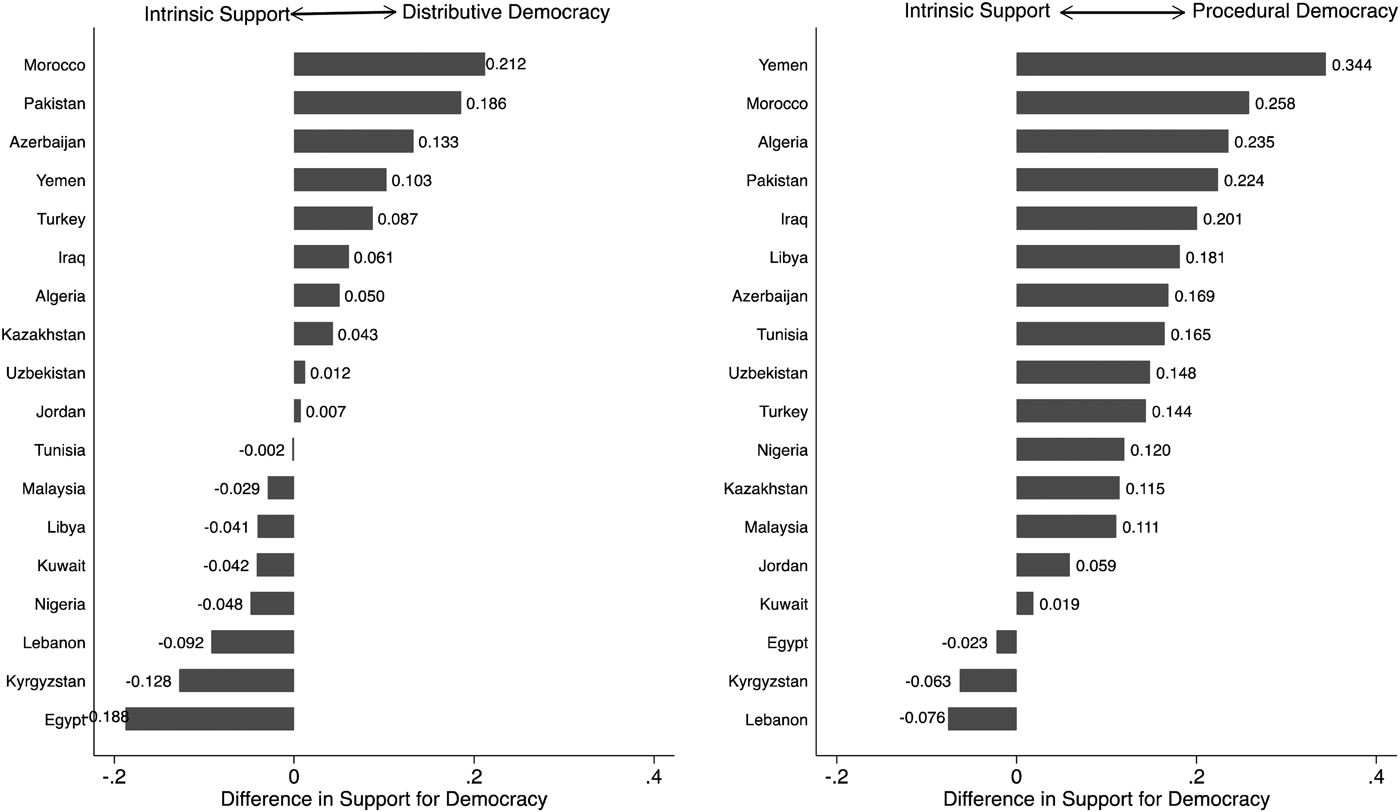
I used a third measure of support for democracy (procedural) that asks respondents whether “people choosing their leaders in free elections” is an essential characteristic of democracy (10) or not (1). Since free and fair elections are among the central elements of democratic systems, this measure should serve as a proxy for evaluating responses about procedural aspects of democracy. In the surveys, about 4% of the respondents believe it is not essential whereas 40% think free and fair elections are essential to democracy. Figure 2 presents the cross-national variation in these three measures of support for democracy. The figure shows the difference between intrinsic support and support for distributive democracy/support for procedural democracy with higher values (positive) showing preferences toward the latter. Both measures are standardized to a 0–1 index to allow comparison.
Distribution of three measures of support for democracy. The bars represent the difference in country averages between support for distributive/procedural forms of democracy and intrinsic support. Negative values indicate higher preference for intrinsic support. Source: Inglehart et al. (Reference Inglehart, Haerpfer, Moreno, Welzel, Kizilova, Diez-Medrano, Lagos, Norris, Ponarin and Puranen2014).

Since the bars show the average tendency toward one type of support over the other, negative values do not imply that publics in these nations are less supportive of democracy. Rather, they show the difference between their degree of support for distributive or procedural forms of democracy and the intrinsic support. No clear geographical or cultural pattern emerges across the sample. Strongest preferences toward distributive democracy can be observed in Morocco, Pakistan, and Azerbaijan whereas average intrinsic support is highest in Egypt, Kyrgyzstan, and Lebanon. When individuals are asked about the importance of elections (procedural democracy), on average, they lean more strongly in their support for this dimension of democracy compared to intrinsic support. Strongest preference toward procedural forms of democracy emerges in Yemen, Morocco, Algeria, Pakistan, and Iraq whereas publics have stronger tendencies to intrinsically support democracy in Egypt, Kyrgyzstan, and Lebanon. Overall, Figure 2 demonstrates that there is sufficient cross-national variation in the types of supportive attitudes to warrant analysis of three dependent variables.
World Values Surveys includes several questions about distributive preferences, altruistic behavior, charity, helping the others, and government involvement in provision of welfare. Based on the results of factor analysis,Footnote 9 two indices are created from four questions that return the highest factor loadings on two dimensions. First, the distributive justice dimension is measured by adding two items asking the respondents whether they agree with the statement that incomes should be made more equal and whether government (or people) should take more responsibility to provide for people (each item is recoded to range between 0 and 1). Second, benevolent attitudes are measured with two items from the Schwartz index (2012). These items ask the respondents whether they identify with a person who would do something for the good of society and whether they identify with a person helping the people nearby (1, not at all like me and 6, very much like me).Footnote 10 While these measures are not perfect, they tap the underlying dimensions of distributive preferences and benevolent attitudes.
Religiosity is operationalized through an additive index of five items: religion is important in life (4-point scale), self-reported religiosity (3-point scale), importance of religiosity as a desirable quality in children (2-point scale), importance of god in life (1–10 scale), and the frequency of religious service attendance ranging from 1 (never) to more than once a week (7). These items were rescaled to range between 0 and 1 and then added to create an index of religious belief. Of the 19 countries in the sample, about a dozen have an average religiosity score greater than 0.80. Average religiosity score is lower in formerly communist central Asian republics, Turkey, and Lebanon, but it remains above the 0.50 threshold.
I also include controls for education (eight-point scale), income (ten-point scale), and age in models predicting distributive justice preferences and support for democracy. Personal trust and egalitarian gender attitudes are included only in the third regression model on support for democracy (Jamal Reference Jamal2006; Rizzo, Abdel-Latif, and Meyer Reference Rizzo, Abdel-Latif and Meyer2007, Ciftci Reference Ciftci2010; Spierings Reference Spierings2014a; Reference Spierings2014b; Tessler Reference Tessler2015). The former is measured with an item asking the respondents whether most people can be trusted. An additive index of three items is created to account for egalitarian gender beliefs: university education is more important for a boy than a girl, men make better political leaders, and when jobs are scarce men should have priority to employment. A list of survey questions used in the analysis, operationalization strategies for each index, and summary statistics are presented in the supplemental file.
RESULTS
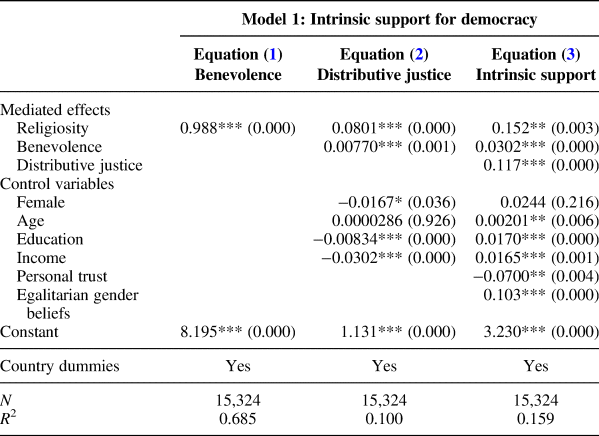
The results corroborate my theoretical expectations. Table 1 presents the results from the first model predicting intrinsic support for democracy. As expected, religiosity is positively related to benevolent attitudes (H1a) and distributive justice preferences (H2a). Both justice values, in turn, increase intrinsic support for democracy (H1b, H2c). A third mediation mechanism linking benevolence to distributive preferences is also significant and positive (equation (2), H2b).
Seemingly unrelated regression estimations: intrinsic support for democracy

Standard errors are in parentheses. *p < 0.05, **p < 0.01, ***p < 0.001.
Country dummies are reported in the Supplementary file Table S1 and can be found at https://doi.org/10.1017/S1755048318000810.
All else equal, I find that benevolence engenders preferences toward egalitarian distributive mechanisms such as equalization of income or government taking responsibility in helping the people. The effects of benevolence and distributive preferences on intrinsic support for democracy remain robust after controlling for religiosity and its mediated effects (equation (3) in Table 1). Religiosity also has a positive effect on democratic orientations. Subsequently, controlling for the possible endogeneity issues through mediation mechanisms and simultaneous regressions, we can resolve some of the ambivalence about the effect of religiosity on support for democracy (Tessler Reference Tessler2002; Ciftci Reference Ciftci2010), at least in this sample of vastly different 18 Muslim-majority countries.
As for the control variables, no consistent effects are detected for gender and personal trust in equations (2) and (3). However, in accordance with the findings of past studies, egalitarian gender beliefs consistently increase support for democracy (Rizzo, Abdel-Latif, and Meyer Reference Rizzo, Abdel-Latif and Meyer2007; Ciftci Reference Ciftci2010; Spierings Reference Spierings2014b; Tessler Reference Tessler2015). Individuals with high levels of education and income are highly supportive of democracy, a finding echoing the main predictions of modernization theory (Inglehart and Welzel Reference Inglehart and Welzel2005), but they appear to be less likely to favor egalitarian distributive mechanisms.
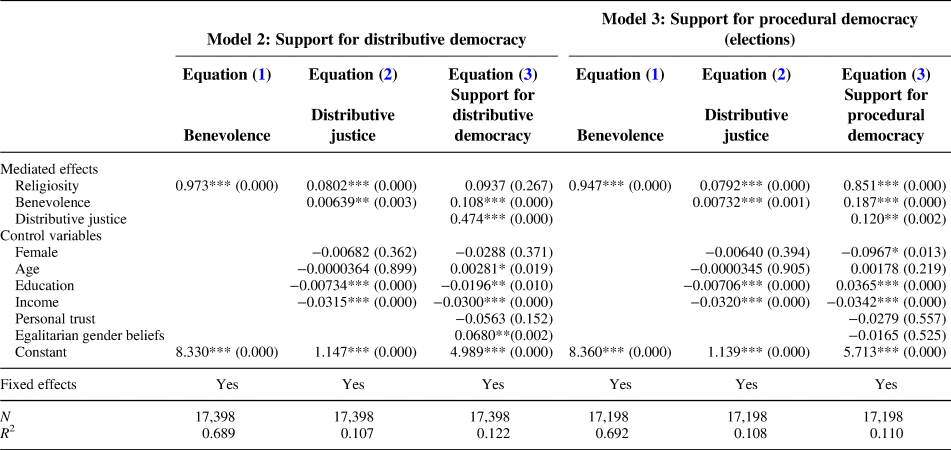
Next, I provide additional tests of theoretical mechanisms by examining support for distributive and procedural forms of democracy. To reiterate, items that ask the respondents to evaluate democracy by its welfare provision performance are used to measure respondents’ views about distributive democracy. Respondents’ views about whether elections are essential or not for democracy (10-point scale) are used to measure support for procedural democracy. The results in Table 2 remain very similar to those in Table 1 with respect to the mediated effects of religiosity through social justice values and the direct effects of the latter on support for different forms of democracy.
Seemingly unrelated regression estimations: Muslim support for distributive democracy and procedural democracy (elections)

Standard errors are in parentheses. *p < 0.05, **p < 0.01, ***p < 0.001.
Country dummies are reported in the Supplementary file Table S2 and can be found at https://doi.org/10.1017/S1755048318000810.
Religiosity, however, does not appear to be a statistically significant predictor of favorability of distributive forms of democracy. The consistency of the results in models with different measures of support for democracy lend strong support to the hypotheses about the direct and mediating effects of social justice values (Hypotheses 1a–1c and 2a–2d). Figure 3 provides a visual summary for the mediated effects for the models presented in Tables 1 and 2.
Mediated effects of religiosity (mediators: social justice values) Source: The chart shows average mediated effects and percentage of indirect effects explained. Source: Inglehart et al. (Reference Inglehart, Haerpfer, Moreno, Welzel, Kizilova, Diez-Medrano, Lagos, Norris, Ponarin and Puranen2016).

According to Figure 3, the indirect effects associated with mediating mechanisms are statistically significant and their impact is larger on support for distributive democracy than on intrinsic support and support for procedural forms of democracy. Indirect effects constitute 21 and 78% of total effect of religiosity in the first and second model respectively. In the third model, total indirect effects are the smallest at 18%. The indirect effect of religion through benevolence on intrinsic support is 16% and on support for procedural democracy is 17% of the total effect of religiosity, whereas the same figure reaches to 57% in predicting support for distributive democracy.
In all models, the indirect effects through distributive justice values are somehow less pronounced (4.4, 19.4, and 1%) than the effects of benevolent attitudes, nonetheless they remain statistically significant. Given these results, can we establish a robust statistical association between the direct and mediating effects of social justice values and support for democracy? Is it possible to rule out alternative explanations that foresee a positive association between benevolence and support for authoritarian system or those that propose a negative relationship between egalitarian distributive preferences and support for democracy? The next section presents additional analyses to check the robustness of these initial results.
ROBUST ANALYSIS
Several additional models test the robustness of the results as presented below and in the supplemental file. The first robustness test aims to rule out the possibility of a positive correlation between benevolence and support for authoritarianism. The operationalization of intrinsic support indirectly accounts for attitudes toward authoritarian regimes by using a survey item that probes the respondents’ views about desirability of a leader that does not have to bother with a parliament or elections. However, the statistical analysis does not provide a direct test of support for authoritarian political systems. As discussed above, religious individuals may prefer a benevolent dictator who can implement social justice policies to a democratic leader who is less pro-justice.
It is well known that in some Muslim-majority countries, authoritarian leaders use welfare generating distributive mechanisms to quell popular discontent and they make references to religion as they implement these policies (Yom and Gause Reference Yom and Gause2012). Since authoritarian governments may target charity and economic redistribution benefiting the poor for boosting regime legitimacy, religiously inspired social justice values may lead to support for these governments if citizens perceive these benevolent policies with a positive outlook. Thus, it is imperative to carry this additional test to rule out any spurious relation concerning the statistical significance of direct and mediating effects of social justice values on support for democracy.
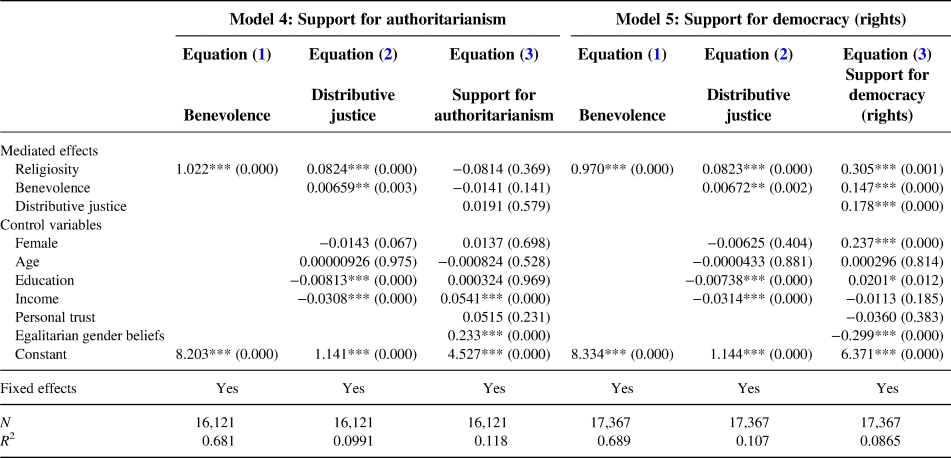
To that end, I created an additive index measuring support for non-democratic political systems using three questions that ask the respondents whether they believe it is very good or very bad (four-point scale) to have (i) a strong leader who does not have to bother with parliament and elections, (ii) military rule, and (iii) experts making decisions.Footnote 11 Table 3 reports the results of this SUR estimation using support for authoritarian systems as the dependent variable in the third equation (model 4).
Seemingly unrelated regression estimations: Muslim support for authoritarianism and democracy

Standard errors are in parentheses. *p < 0.05, **p < 0.01, ***p < 0.001.
Country dummies are reported in the Supplementary file Table S3 and can be found at https://doi.org/10.1017/S1755048318000810.
The results for the first part of the mediation analysis linking religiosity to benevolence and distributive preferences (H1a, H2a) and for the third mediation between benevolence to distributive justice (H2b) remain unchanged. However, neither religiosity nor distributive justice orientations and benevolent attitudes exert any direct effect on support for authoritarianism. This result confirms the robustness of the correlation between these indicators and support for democracy by ruling out any formative effect of religiosity and social justice values on support for authoritarianism.
To further probe into the robustness of the results, I follow two strategies. First, assuming that mediation does not rule out endogeneityFootnote 12 between the two variables measuring social justice perceptions and possibly introduce bias in the direction of the statistical effects, I run two alternative specifications including only one indicator of social justice values in each model. In these specifications, the direct effects of religiosity and benevolence/distributive preferences as well as the indirect effects remain unchanged corroborating the effect of economic egalitarian values on regime preferences. Second, I added a fourth equation predicting support for authoritarianism to the original model estimations (Tables 1 and 2) to account for possible dependency between support for democracy and authoritarianism. The results remain robust to these alternative strategies and confirm that the direct effects of religion on both benevolence and distributive preferences and mediating effect of these values on support for democracy is positive and statistically significant.
Another criticism can be directed toward the content validity of the dependent variables. The three measures of support for democracy used in the estimations represent perceptions about the political, economic, and electoral dimensions of democracy. This operationalization strategy neglects the civil rights dimension. Among the most important criterion of democracy are “legal freedom to formulate and advocate political alternatives with concomitant rights to free association, free speech, and other basic freedoms of the person” (Linz Reference Linz1978, 5). Egalitarian preferences may be related to socioeconomic rights that are necessary for exercising all political rights, because individuals with material resources are expected to have higher level of political cognition (Inglehart and Welzel Reference Inglehart and Welzel2005). Egalitarian preferences and benevolent attitudes may increase support for democracy through this indirect mechanism enabling the exercise of political rights.
To account for the “rights” dimension of support for democracy, I created an alternative measure combining responses to two questions: civil rights protect people's liberty against oppression, and in democracies women have the same rights as men (each question has a scale ranging from essential (1) to not essential for democracy (10)). The results in Table 3 (model 5) lend further support to the theoretical mechanisms proposed here. Regardless of the dimension of democratic support, Islamic social justice values increase support for democracy directly and through mediation mechanisms.
Additional analyses include model specifications that use the same control variables for both models predicting social justice values (in equations (1) and (2) of the SUR system). The results also remain robust to these alternative model specifications. Overall, we can be quite confident that Muslim religiosity is positively related to intrinsic support for democracy when we account for the mediating mechanism of religiously informed social justice values. Religion induces egalitarian distributive preferences and holding these values in turn engender support for democracy in Muslim-majority societies.
CONCLUSION
Benevolence and egalitarian distributive preferences lies at the heart of Islamic social justice conceptions (Shariati Reference Shariati1979; Qutb Reference Qutb2000; Ramadan Reference Ramadan2004). This study shows that these social justice values are highly relevant in explaining support for democracy in the Muslim world. In addition to their direct effects, benevolent attitudes and egalitarian preferences mediate the effect of religiosity on democratic orientations. This is an important finding, because it resolves some of the ambivalence found in quantitative studies of Muslim political attitudes dealing with the micro foundations of Islam and democracy (Tessler Reference Tessler2002; Ciftci Reference Ciftci2010).
The analysis presented here also validates a positive association between Muslim religiosity and intrinsic support for democracy. The results imply that religious Muslims are supportive of democracy not only for extrinsic reasons, but also for democracy's intrinsic value and its certain qualities like free and fair elections or protection of rights. Subsequently, the empirical analysis allows the author to refute the claims of the essentialist argument putting Islam and democracy at odds (Gellner Reference Gellner1991; Huntington Reference Huntington1993; Kedourie Reference Kedourie1994; Lewis Reference Lewis2010).
A second contribution of this paper concerns the relevance of values in explaining Muslim political attitudes (Ciftci Reference Ciftci2013; Spierings Reference Spierings2014a). Social justice is one of the central concepts of Islamic ethico-political system. This study finds that two Islamic social justice principles, benevolence and attitudes toward economic egalitarianism, engender pluralistic ideas among the pious Muslims. The analysis finds a robust relationship between both perceptions of benevolence and egalitarian distributive preferences and democratic orientations. As such, they lend further credence to the instrumental role of religiously inspired values in forming Muslim political attitudes.
Theoretical scholarship on Islam and democracy argues that principles of legal methodology like ijtihad and ijma or scriptural principles like shura can form the basis for democratic governance (Esposito and Voll Reference Esposito and Voll1996). These principles are used to justify flexible interpretations of Islam that makes human-made legislation possible according to the evolving political conditions (Sachedina Reference Sachedina2001; Ramadan Reference Ramadan2004). This study adds to this literature by showing that social justice values promoting egalitarian distributive principles and benevolence (ihsan) can also form the basis of pluralistic ideas among ordinary men and women in Muslim-majority societies.
In an age of global inequality and massive discontent where demands about human dignity and social justice became widespread in the Muslim world, this study opens a new window into understanding Muslim political preferences toward democratic governance. It implies that authoritarian regimes repressing Islamist movements or violent models of Islamic statehood with authoritarian credentials may have no resonance among the ordinary Muslim men and women. Muslim publics prefer democracy and rather than being impediments, religiously inspired social justice principles can engender the pluralistic ideas underlying democratic governance in the Muslim world.
SUPPLEMENTARY MATERIAL
The supplementary material for this article can be found at https://doi.org/10.1017/S1755048318000810.