Introduction
Bread wheat (Triticum aestivum L.) is the most important crop in Central Asia and is directly linked to regional food security. Winter wheat, cultivated in all countries of Central Asia, is often affected by stripe (yellow) rust, caused by Puccinia striiformis f. sp. tritici (Pst), and there have been frequent occurrences of stripe rust epidemics in many parts of the region, including four epidemics during 2009–2014 (Absattarova et al., Reference Absattarova, Baboev, Bulatova, Karabayev, Koishibayev, Kokhmetova, Kuklacheva, Morgounov, Rsaliev, Sarbayev, Urazaliev, Yessimbekova, Wellings, Johnson, Yahyaoui, Wellings, Saidi and Ketata2002; Ziyaev et al., Reference Ziyaev, Sharma, Nazari, Morgounov, Amanov, Ziyadullaev, Khalikulov and Alikulov2011; Sharma et al., Reference Sharma, Rajaram, Alikulov, Ziyaev, Hazratkulova, Khodarahami, Nazeri, Belen, Khalikulov, Mosaad, Kaya, Keser, Eshonova, Kokhmetova, Ahmadov and Mougounov2013, Reference Sharma, Morgounov, Akin, Bespalova, Lang, Litvinenko, Mustatea, Ozturk, Postolatiy, Rajaram and Braun2014). The frequent epidemics of stripe rust are primarily driven by large-scale cultivation of susceptible wheat varieties, which can incur 20–40% grain yield losses due to stripe rust (Morgounov et al., Reference Morgounov, Yessimbekova, Rsaliyev, Boboev, Mumindjanov and Djunusova2004, Reference Morgounov, Tufan, Sharma, Akin, Bagci, Braun, Kaya, Keser, Payne, Sonder and McIntosh2013; Sharma et al., Reference Sharma, Nazari, Amanov, Ziyaev and Jalilov2016). Since leading commercial wheat cultivars possess low levels of resistance (Ziyaev et al., Reference Ziyaev, Sharma, Nazari, Morgounov, Amanov, Ziyadullaev, Khalikulov and Alikulov2011), the disease is primarily managed by fungicide spray, and less frequently by the deployment of resistant varieties.
Stripe rust infection can occur anytime from one-leaf seedling stage to green plants at maturity stage (Chen, Reference Chen2005). In Central Asia, stripe rust epidemics have previously occurred at different growth stages, depending on weather factors. In 2009 a large-scale stripe rust epidemic began with early infection prior to booting stage, due to mild and wet winter conditions (Sharma et al., Reference Sharma, Amanov, Khalikulov, Martius, Ziayaev, Alikulov, Yahyaoui and Rajaram2009). Several recently released or pre-released varieties are reported to possess high yield, stripe rust resistance, and satisfactory agronomic and quality-related traits (Sharma et al., Reference Sharma, Rajaram, Alikulov, Ziyaev, Hazratkulova, Khodarahami, Nazeri, Belen, Khalikulov, Mosaad, Kaya, Keser, Eshonova, Kokhmetova, Ahmadov and Mougounov2013). Diversity in Yr genes in commercial cultivars could play an important role in managing frequent stripe rust epidemics in the region. Kokhmetova et al. (Reference Kokhmetova, Chen and Rsaliyev2010) reported that the most effective resistant genes against stripe rust in Kazakhstan are Yr2+, Yr4+, Yr5, Yr10 and Yr15.
Previous studies have reported variations in Pst populations in Central Asia (Yahyaoui et al., Reference Yahyaoui, Hakim, Nazari, Torabi, Wellings, Johnson, Yahyaoui, Wellings, Saidi and Ketata2002; Nazari et al., Reference Nazari, Hodson, Yahyaoui, Singh, Wellings, Afshari, Rattu, Ramdani, Murat, Ibrahimov, Haque, Sailan, Yahyaoui and Rajaram2009). It is therefore necessary to periodically evaluate resistant varieties and advanced breeding lines against Pst races in order to monitor resistance breakdown and plan the replacement of susceptible varieties with resistant ones. Both seedling and adult plant responses of leading cultivars and advanced breeding lines to Pst pathotypes also needs to be assessed in order to understand the nature of resistance. While there is information available on wheat adult plant resistance (APR) (Ziyaev et al., Reference Ziyaev, Sharma, Nazari, Morgounov, Amanov, Ziyadullaev, Khalikulov and Alikulov2011; Sharma et al., Reference Sharma, Rajaram, Alikulov, Ziyaev, Hazratkulova, Khodarahami, Nazeri, Belen, Khalikulov, Mosaad, Kaya, Keser, Eshonova, Kokhmetova, Ahmadov and Mougounov2013), there is limited understanding of seedling resistance to stripe rust in commercial varieties and advanced breeding lines from Central Asia (Nazari et al., Reference Nazari, Hodson, Yahyaoui, Singh, Wellings, Afshari, Rattu, Ramdani, Murat, Ibrahimov, Haque, Sailan, Yahyaoui and Rajaram2009).
Two recent reports listed a number of released cultivars and advanced breeding lines of winter wheat in Central Asia with resistance to stripe rust (Sharma et al., Reference Sharma, Rajaram, Alikulov, Ziyaev, Hazratkulova, Khodarahami, Nazeri, Belen, Khalikulov, Mosaad, Kaya, Keser, Eshonova, Kokhmetova, Ahmadov and Mougounov2013, Reference Sharma, Morgounov, Akin, Bespalova, Lang, Litvinenko, Mustatea, Ozturk, Postolatiy, Rajaram and Braun2014), but their reactions to the diverse Pst races of Kazakhstan is not known. This underlines a gap in the understanding of host resistance and Pst populations in identifying new cultivars resistant in different countries of the region. This study therefore aimed to: (i) examine current pathotype variability of Pst races collected from Kazakhstan and Uzbekistan and (ii) evaluate stripe rust resistance in leading cultivars and advanced breeding lines targeted to those region.
Materials and methods
Race identification
Race identification was performed under controlled greenhouse conditions at the Research Institute for Biological Safety Problems (RIBSP), Zhambyl region, Gvardeysky, Kazakhstan. Leaf samples infected with stripe rust were randomly collected during the main winter wheat growing season from Almaty, South Kazakhstan region, and Zhambyl regions in Kazakhstan. Eighty to 100 rust-infected leaves with sporulating pustules were collected from the research stations and farmers’ fields from susceptible cultivars (Steklovidnaya 24, Krasnovodopadskaya 25, Bogarnaya 56, etc.). The diseased leaf samples were pressed in the folds of newspaper, placed in an envelope, and stored at 4°C until further analysis. Spore collection, storage, and reproduction was then conducted in accordance with the methods of Roelfs et al. (Reference Roelfs, Singh and Saari1992). Race identification of P. striiformis was carried out using a standard method (Johnson et al., Reference Johnson, Stubbs, Fuchs and Chamberlain1972) on the two sets of differentials: international (Chinese 166, Lee, Heines Kolben, Vilmorin 23, Moro, Strubes Dickkopf, and Suwon 92 ×Omar) and European (Hybrid 46, Reicherberg 42, Heines Peko, Nord Desprez, Compare, Carstens V, Spaldings Prolific, and Heines VII). This system is based on two identifiers: resistant type (R) indicated by ‘0’, and susceptible (S) as ‘1’. The first number was according to the international number, then followed by the number in the European set indicated by letter ‘E’ between the two numbers (Johnson et al., Reference Johnson, Stubbs, Fuchs and Chamberlain1972). Numbering of race was done using first number in decimal system on the international, then European set with a prefix E.
Multiplication and preservation of inoculum
The inoculum was multiplied and maintained on the universally susceptible variety Morocco-55, provided by International Maize and Wheat Improvement Center (CIMMYT). For all seedling tests, seeds were sown in 12 cm pots and placed at 18°C until germination. The two-leaf stage seedlings of Morocco-55 (five plants per pot) were inoculated with fresh urediniospores from individual rust samples using a spatula. Inoculated seedlings were kept in a dew chamber at 10°C for 24 h and then placed on greenhouse benches with temperatures 15–18°C and 90% humidity before being transferred to the glasshouse with temperatures of 9–13°C (day) and 12–15°C (night). Photoperiod extended to 16 h. Pustules of stripe rust appeared on the leaves 8–10 d after inoculation, from which inoculum was collected on the 12th day using a mechanical cyclone collector in a zero size capsule. Inoculum was then preserved in vacuum glass vial and later transferred to a refrigerator until further use.
Single spore culture
Morocco-55 seedlings (8–9 d old) were inoculated by spraying the urediniospores previously increased and suspended in light paraffin mineral oil (70 ether: 30 oil). Plants were allowed to dry for 1 h before they were placed in dew chamber overnight at 18–20°C and then transferred to the greenhouse where temperatures were maintained at 9–13°C and 12–15°C during day and night, respectively. Eight to 9 d after inoculation the leaves segments with just a single uredium remained and preserved with purity (Roelfs et al., Reference Roelfs, Singh and Saari1992). Urediniospores were collected 12–14 d after inoculation using a vacuum powered cyclone spore collector. Single pustule inoculum was increased on cultivar Morocco-55 grown in pots, using the method described above.
Virulence analysis
A set comprised of 10 near-isogenic Avocet S lines developed by Dr Wellings (Sharma-Poudyal et al., Reference Sharma-Poudyal, Chen, Wan, Zhan, Kang, Cao, Jin, Morgounov, Akin, Mert, Shah, Bux, Ashraf, Sharma, Madariaga, Puri, Wellings, Xi, Manninger, Wanyera, Ganzález, Koyda, Sanin and Patzek2013), each possessing a single Yr gene (Yr1, Yr5, Yr6, Yr7, Yr8, Yr9, Yr10, Yr15, Yr17 and Yr18), was used for virulence analysis as differentials. These lines were planted in plastic trays measuring 28 × 34 × 6 cm3 and containing soil, silt and compost in a 2:1:1 ratio (Green et al., Reference Green, Knott, Watson and Pugsley1960), with each tray containing 10 seeds sown at uniform depth and distance. Seedlings of Avocet near-isogenic lines (8–9 d old) were inoculated with single pustule inoculum from different stripe rust samples using the method described above. After inoculation, seedlings were transferred to the growth chamber with a 12 h day/night cycle of 15–18 and 10–4°C, respectively, using light intensity of 5000–6000 Lx. Races were determined by their infection type (IT), based on the scale described by Gassner and Straib (Reference Gassner and Straib1929), in which i = immune (no visible infection); 00 = highly resistant (necrotic/chlorotic flecks, no sporulation); 0 = resistant (necrotic/chlorotic stripes, no sporulation); 1 = moderately resistant (necrotic/chlorotic stripes, trace, light and intermediate sporulation); 2 = moderately susceptible (necrotic/chlorotic stripes, moderate and abundant sporulation); 3 = susceptible (abundant sporulation, with chlorosis); 4 =highly susceptible (abundant sporulation, without chlorosis). IT was scored 15–16 d after inoculation when the rust was fully developed on Morocco.
Screening of cultivars and advanced breeding lines and gene postulation
A set of 62 winter wheat genotypes of diverse genetic background and origin was used in this study. These included 32 advanced breeding lines (originating from the International Winter Wheat Improvement Program (IWWIP) and selected for high yield and adaptation in Central Asia), 27 improved varieties (11 from Uzbekistan, 4 from Azerbaijan and 12 from Kazakhstan), one international check (Bezostaya 1 provided by CIMMYT), one highly susceptible international check (Morocco-55 provided by CIMMYT), and one susceptible local check (Steklovidnaya 24). Seedlings were tested for resistance to 10 races of Pst from Kazakhstan (86 + Е16, A-8/5, 31/1.5, X/1.5, 39E158, 10Е191, 86Е16, 7Е16, 79Е187 and 7Е151). The resistance genes were postulated from comparison of ITs on tested lines with near isogenic Yr-lines of wheat cv. Avocet infected with 10 Pst pathotypes.
Field evaluation of APR
A field study was conducted at the experimental station of Kazakh Research Institute of Farming (KazRIF), Almalybak, Almaty region, Kazakhstan, during the 2012–2013 cropping season. The experiment was conducted using a randomized complete block design with three replications and recommended cultural practices were used for trial management. Each genotype was planted in a 1 m2 plot in the middle of September. The stripe rust susceptible cultivars Morocco and Steklovidnaya 24 were planted in every 10th row and as a spreader border around the nursery to ensure uniform infection. In mid-April 2013, Morocco-55 and Steklovidnaya 24 were inoculated with mixture from field samples collected above at the seedling stage. Severity (percentage of rust infection on the plant) and plant response (type of infection) were recorded in late May when the plots reached booting stage and in early June, when the plots had reached milk stage following the procedure explained by Roelfs et al. (Reference Roelfs, Singh and Saari1992). There were five ITs, described as follows: 0 = immune; R = resistant; MR = moderately resistant; MS = moderately susceptible; and S = susceptible. Stripe rust severities were recorded using three replications, and the means of the replicated data was calculated.
The field experiment in Uzbekistan was conducted in 1 m2 plots of individual genotypes at Kibray planted in two replicates. Plants were inoculated at the booting stage with spores of a mixed population of Pst collected from different regions of Uzbekistan. Disease scoring was started when stripe rust severity reached >60% on the susceptible check Morocco-55. Stripe rust severity was recorded twice between heading and early grain filling stage, and the last scores have been reported.
Statistical analysis
Genotype and genotype × environment (GGE) biplot analysis (Yan and Kang, Reference Yan and Kang2002) was used to identify the most resistant genotypes and most virulent pathotypes (Yan et al., Reference Yan, Hunt, Sheng and Szlavnics2000). The GGE biplot shows the main genotype effect (G) and the genotype × environment interaction (GE) of data from multiple environments, and also enables comparison among a set of genotypes with an ‘ideal’ genotype, which will have the lowest disease severity of all genotypes and be absolutely stable. A set of concentric circles are created using the ideal genotype at the concentric centre, which is then considered a reference for ranking the experimental genotypes. Genotype superiority is measured as a GGE rank with the genotype closest to the ideal genotype ranked the highest. GGE biplot analysis was also used to identify the most virulent pathotype. The line connecting each pathotype to the origin in the biplot is called the vector. Pathotypes with longer and shorter vectors are considered more and less discriminative, respectively, of the genotypes. The GGE biplot analysis also permits ranking of pathotypes, with pathotypes closer to the centre of the concentric rings more virulent than those further away.
Results
Races of Pst and their virulence pattern
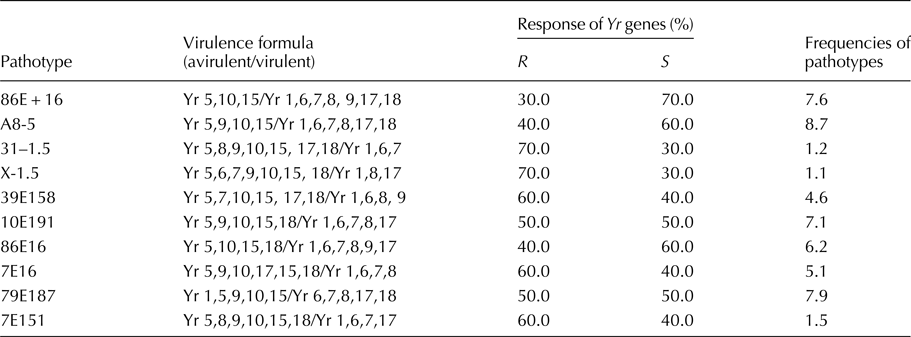
Ten different pathotypes of Pst were identified from the stripe rust-infected leaf samples collected during 2011–12 in Kazakhstan (Table 1). The virulence patterns of the pathotypes ranged from least virulent ‘31–1.5’ and X-1.5 (virulent on 3 of 10 Avocet S isogenic lines) to highly virulent ‘86 + E16’ (virulent on 7 of the 10 differentials). The isogenic lines Avocet S with Yr5, Yr10 and Yr15 were immune to all 10 isolates.
Virulences of the 10 pathotypes of Puccinia striiformis from Kazakhstan, determined using a subset of near isogenic differentials in an Avocet background

R, resistant response of Yr genes to Pst pathotypes; S, susceptible response of Yr genes to Pst pathotypes.
Seedling test
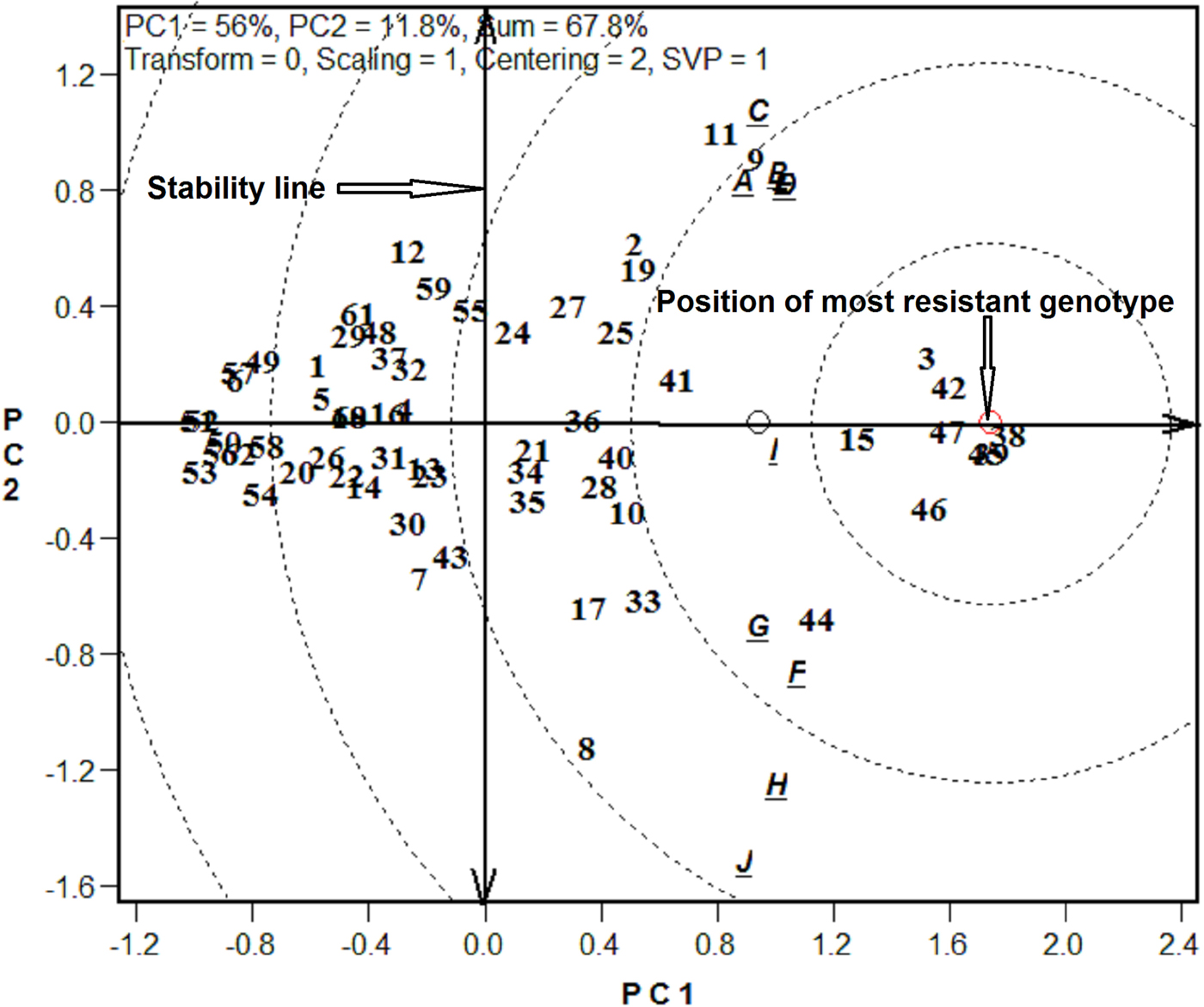
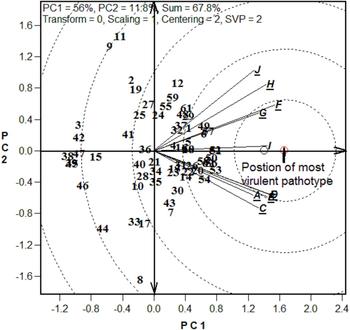
Seedling reactions of the 62 wheat genotypes to the 10 Pst pathotypes differed greatly (Table S1). Cultivars Bunyodkor (#38), Barhayot (#39), Shafag-2 (#45) and Murob-2 (#46) were resistant to all pathotypes whereas Jaikhun (#3), Hisorok (#42) and Egana (#47) were resistant to 9 of the 10 pathotypes. KR12-09 (#15) was resistant to 9 of the 10 pathotypes and Layagati 80 (#44) was resistant to 7 of the 10 pathotypes. The 10 pathotypes showed arrays of virulence patterns across 62 wheat genotypes. Based on IT across 62 genotypes, A8-5 and 10E191 were the most virulent pathotype (74% of genotypes shown susceptible IT), followed by 7E16 and 86E + 16 (Table S1, Figure 1). Pathotypes 31–1.5 and X-1.5 were the least virulent. The biplot analysis showed that – based on reactions of all 10 pathotypes – genotypes with the most stable resistance were Bunyodkor (#38), Barhayot (#39), Shafag-2 (#45), Egana (#47), Hisorok (#42), Murob-2 (#46), Jaikhun (#3) and (KR12-09 #15) (Figure 2).
GGE biplot analysis of 10 pathotypes of Pst based on the disease score across 62 genotypes in the seedling stage (the numbers represent 62 genotypes; the letters represent 10 pathotypes A = 86Е + 16; B = A8-5; C = 31–1.5; D = X-1.5; E = 39E158; F = 10E191; G = 86E16; H = 7E16; I = 79E187 and J = 7E151).
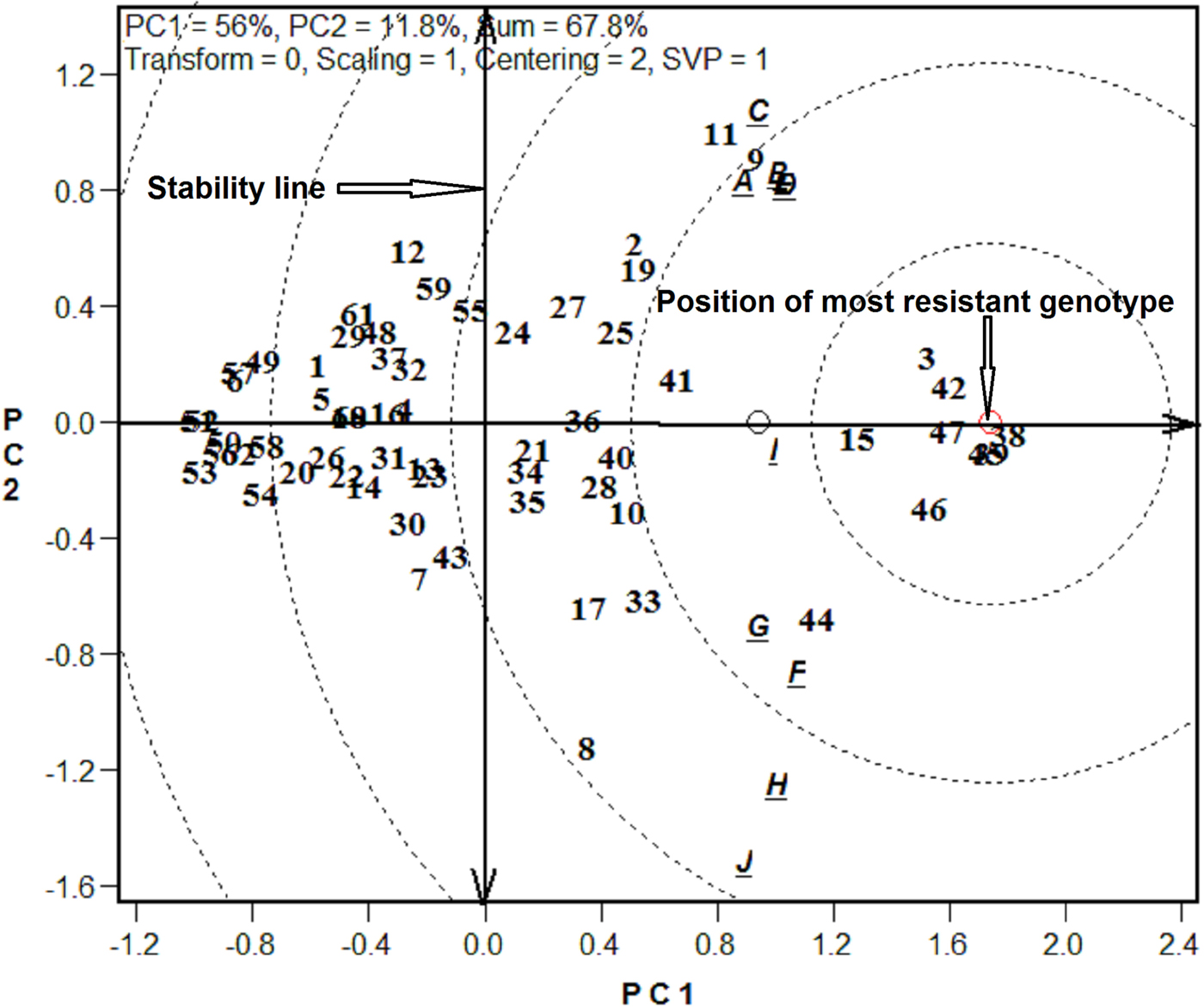
GGE biplot analysis of 62 wheat genotypes based on stripe rust score across 10 pathotypes in seedling stage (refer to Table S1 for the full name of the genotypes).

Field evaluation
There were arrays of variation for resistance to stripe rust under field conditions (Table S1). Of the 62 genotypes, 34 were considered as resistant in adult plant stage under field conditions in Kazakhstan. Similarly, 24 genotypes were resistant in Uzbekistan and 20 genotypes showed resistance in both countries. Sixteen and four genotypes showed ≤5% disease severity in Kazakhstan and Uzbekistan, respectively. Among the genotypes with the most stable resistance in the seedling stage, Bunyodkor (#38), Barhayot (#39), Hisorok (#42) and KR12-09 (#15) were resistant in adult plant stage under field conditions in both countries. The comparison of test cultivars with isogenic lines of cv. Avocet in their reaction to the infection allowed postulation of the presence of Yr-genes and their combinations in the genotypes. Five resistance genes Yr1, Yr6, Yr5, Yr10 and Yr15 were revealed. Gene Yr1 was postulated in KR12-5075, gene Yr6 – in genotypes KR11-03 (#5) and KR12-5003 (#26). The resistance gene Yr5 combined with Yr10 and Yr15 genes were determined in cultivar Bunyodkor (#38).
Discussion
Stripe rust is a perennial problem for winter wheat in Central Asia and the Caucasus (Ziyaev et al., Reference Ziyaev, Sharma, Nazari, Morgounov, Amanov, Ziyadullaev, Khalikulov and Alikulov2011; Sharma et al., Reference Sharma, Rajaram, Alikulov, Ziyaev, Hazratkulova, Khodarahami, Nazeri, Belen, Khalikulov, Mosaad, Kaya, Keser, Eshonova, Kokhmetova, Ahmadov and Mougounov2013) and Pst populations are diverse and highly virulent (Sharma-Poudyal et al., Reference Sharma-Poudyal, Chen, Wan, Zhan, Kang, Cao, Jin, Morgounov, Akin, Mert, Shah, Bux, Ashraf, Sharma, Madariaga, Puri, Wellings, Xi, Manninger, Wanyera, Ganzález, Koyda, Sanin and Patzek2013). This study provides additional information by presenting 10 diverse Pst races with wide virulence patterns on 10 international differentials of stripe rust and 62 genetically diverse genotypes in both seedling and adult plant stages. Each of the 10 races showed diverse reaction patterns on the wheat genotypes with virulence varying from resistant to highly susceptible. Biplot analysis of the pathogen reactions on 62 wheat genotypes in seedling stage confirmed the differences in virulence pattern among the 10 races. Yr10 and Yr15 were the most effective genes in Kazakhstan, with resistance to 10 races, yet these two genes have been found to be ineffective against pathogen populations from Uzbekistan (Sharma-Poudyal et al. Reference Sharma-Poudyal, Chen, Wan, Zhan, Kang, Cao, Jin, Morgounov, Akin, Mert, Shah, Bux, Ashraf, Sharma, Madariaga, Puri, Wellings, Xi, Manninger, Wanyera, Ganzález, Koyda, Sanin and Patzek2013).
Many genotypes showed high levels of seedling resistance to each of the 10 Pst races, thus confirming genotypic diversity. Two genotypes Bunyodkor (#38), and Barhayot (#39) were highly resistant to all 10 Pst races and several other genotypes – Shafag-2 (#45), Egana (#47), KR12-09 (#15) – were resistant to more than seven races. A biplot analysis of genotypic responses to the 10 Pst races confirmed differences in resistance patterns among the 62 genotypes. Bunyodkor (#38), Barhayot (#39), Shafag-2 (#45), Egana (#47), Hisorok (#42), Murob-2 (#46), Jaikhun (#3) and KR12-09 (#15) were identified as the most stable genotypes for seedling resistance. Among these, Bunyodkor (#38), Barhayot (#39), Hisorok (#42) and Jaikhun (#3) are new varieties in Uzbekistan, and Shafag-2 (#45), Egana (#47) and Murob-2 are new varieties in Azerbaijan. Most of the varieties from Kazakhstan were susceptible in the seedling stage. Stripe rust epidemics do occur in the seedling stage in some pockets of Central Asia when temperatures during November and December are favourable.
The wheat genotypes differed greatly in stripe rust severity recorded at the adult plant stage in the field in both Kazakhstan and Uzbekistan. Certain genotypes KR11-03 (#5), KR11-9014 (#6), KR11-9025 (#12), KR12-9012 (#21) and KR12-9023 (#24) varied in disease severity in Kazakhstan and Uzbekistan, suggesting differences in the Pst populations in these two countries. This supports previous reports on varietal resistance (Sharma et al., Reference Sharma, Rajaram, Alikulov, Ziyaev, Hazratkulova, Khodarahami, Nazeri, Belen, Khalikulov, Mosaad, Kaya, Keser, Eshonova, Kokhmetova, Ahmadov and Mougounov2013) and variation among Pst populations in Central Asia (Sharma-Poudyal et al., Reference Sharma-Poudyal, Chen, Wan, Zhan, Kang, Cao, Jin, Morgounov, Akin, Mert, Shah, Bux, Ashraf, Sharma, Madariaga, Puri, Wellings, Xi, Manninger, Wanyera, Ganzález, Koyda, Sanin and Patzek2013). However, several genotypes KR11-29 (#9), KR12-08 (#14), KR12-09 (#15), KR12-9010 (#19), GN-158/2004 (#34), Gozgon (#37), Bunyodkor (#38), Barhayot (#39), Layagatli-80 (#44), Shafag-2 (#45) and Murob-2 (#46) showed low stripe rust severity in both countries, suggesting their potential value as sources of resistance. Additionally, a number of genotypes were resistant in individual countries. These findings support previous reports that stripe rust resistant improved winter wheat germplasm are becoming increasingly available in Central Asia (Ziyaev et al. Reference Ziyaev, Sharma, Nazari, Morgounov, Amanov, Ziyadullaev, Khalikulov and Alikulov2011; Sharma et al., Reference Sharma, Rajaram, Alikulov, Ziyaev, Hazratkulova, Khodarahami, Nazeri, Belen, Khalikulov, Mosaad, Kaya, Keser, Eshonova, Kokhmetova, Ahmadov and Mougounov2013, Reference Sharma, Morgounov, Akin, Bespalova, Lang, Litvinenko, Mustatea, Ozturk, Postolatiy, Rajaram and Braun2014).
A number of varieties from Kazakhstan – Ramin (#56), Mereke70 (#53), Naz (#54) – were susceptible in the seedling stage but moderately resistant to resistant in the adult plant stage. Similarly, Gozgon and Starshina varieties cultivated in Uzbekistan were also susceptible in seedling stage but resistant in adult plant stage. Six advanced breeding lines KR11-20 (#4), KR12-07 (#13), KR12-08 (#14), KR12-10 (#16), KR12-18 (#18) and KR12-5003 (#26) were also resistant in the adult plant but not in the seedling stage. Such lines are valuable in terms of potential sources of APR (McIntosh et al., Reference McIntosh, Wellings and Park1995). If the presence of both seedling stage resistance and APR and only APR represent major and minor gene control of resistance, respectively, the set of 62 genotypes of this study are indicative of the both types of resistance. Testing of 62 wheat genotypes against 10 test-pathotypes of stripe rust identified Yr resistance genes. Five resistance genes Yr1, Yr6, Yr5, Yr10 and Yr15 were revealed. Gene Yr1 was postulated in KR12-5075 (#31), gene Yr6 – in genotypes KR11-03 (#5) and KR12-5003 (#26). The resistance gene Yr5, Yr10 and Yr15 genes were determined in cultivar Bunyodkor (#38). Data on gene postulation allowed identifying interesting lines that may enable further genetic studies on the inheritance and the genetic status of the accessions. Pedigree of cultivar Bunyodkor is DORADE-5//KS82117/MLT. The source of the germplasm carrying postulated Yr genes is the International cooperative wheat improvement programme, IWWIP, that is jointly coordinated by CIMMYT and ICARDA (International Center for Agricultural Research in the Dry Areas). The source of these breeding lines – KR12-5075 (carrier of Yr1), KR11-03 and KR12-5003 (carriers of Yr6) is the IWWIP programme. In comparison with so far released varieties for Kazakhstan and Uzbekistan selected cultivars and line are characterized by higher resistance to stripe rust.
The stripe rust population in many regions and countries is characterized by a variety of physiological races and pathotypes. Some Pst races from the south and south-east of Kazakhstan were identical with races from Uzbekistan (Absattarova et al., Reference Absattarova, Baboev, Bulatova, Karabayev, Koishibayev, Kokhmetova, Kuklacheva, Morgounov, Rsaliev, Sarbayev, Urazaliev, Yessimbekova, Wellings, Johnson, Yahyaoui, Wellings, Saidi and Ketata2002). In most cases, however, the Kazakh population of stripe rust is different from the population of the North Caucasus, Iran, Lebanon and Syria (Yahyaoui et al., Reference Yahyaoui, Hakim, Nazari, Torabi, Wellings, Johnson, Yahyaoui, Wellings, Saidi and Ketata2002; Nazari et al., Reference Nazari, Hodson, Yahyaoui, Singh, Wellings, Afshari, Rattu, Ramdani, Murat, Ibrahimov, Haque, Sailan, Yahyaoui and Rajaram2009). According to recent data two significant new races having unique stripe rust genotypes were detected across wide areas in Europe/North Africa and East Africa/Central Asia, respectively. One new race was detected in Morocco, Italy and countries in Northern Europe. Another new race of a unique genotype was prevalent in epidemics in Ethiopia, Uzbekistan and Afghanistan (http://wheatrust.org). Our data are consistent with these results: resistance to the most pathotypes from Central Asia was contributed by the Yr5, Yr10 and Yr15 and susceptibility was contributed by Yr1, Yr6 and Yr8. The pedigrees of the more resistant wheat genotypes contained sources of Yr5, Yr10 and Yr15.
The Pst population in Kazakhstan is diverse, as indicated by the range of virulence shown by the 10 different races analysed in this study. Wheat breeding lines and recently released cultivars possess a range of variability for response to Pst races and a number of genotypes differed in their level of disease severity in Kazakhstan and Uzbekistan. Most of the new wheat cultivars and advanced breeding lines showed lower disease severity compared with widely grown commercial cultivars, indicating an improvement in breeding for stripe rust resistance.
This study identified many wheat genotypes highly resistant to stripe rust that could be further evaluated for release as new varieties. The genotypes KR12-18 (#18) and KR11-03(#5) have been identified as new varieties in Uzbekistan and Georgia, respectively. The cultivation of new stripe rust-resistant varieties could help reduce disease epidemics in the region. Resistant genotypes could also be used as improved parents in crossing programs to develop new varieties.
Supplementary material
The supplementary material for this article can be found at https://doi.org/10.1017/S1479262117000132
Acknowledgements
This work is supported by the Project of Ministry of Education and Science of Republic Kazakhstan (Grant No 2120/GF4). Editing assistance from E. Quilligan is appreciated.