

The effect of traditional institutions on development outcomes has attracted considerable attention. According to one view, customary forms of governance are related to elite capture and patronage networks that undermine democracy (Acemoglu et al. Reference Acemoglu, Reed and Robinson2014; Nathan Reference Nathan2019), that reinforce existing inequalities (Mattingly Reference Mattingly2016), or that are otherwise inconsistent with the demands of a modern state (Scott Reference Scott1977). By contrast, other scholars have documented that different types of informal self-governing institutions could enhance the accountability of local elites (Tsai Reference Tsai2007; Díaz-Cayeros et al. Reference Díaz-Cayeros, Magaloni and Ruiz-Euler2014) and facilitate local policy implementation (Murtazashvili Reference Murtazashvili2014; Baldwin Reference Baldwin2015), having a positive effect on local development outcomes.
However, an important distinction must be made between the formalization of these institutions as a part of the existing decentralized bureaucratic governance system and their informal presence. In Mexico, the institutional recognition of indigenous governance in the state of Oaxaca in 1995 at the municipal level created a fascinating possibility to evaluate the effect of formalization of customary institutions (usosy costumbres) on local development outcomes. Yet customary institutions, such as community assemblies, communal labor, and citizen committees, are widely used informally in governance across southern and central Mexico without any official recognition.Footnote 1 While in most places outside Oaxaca these institutions do not have formal connections with municipal governments, they have a considerable governance role in the submunicipal hamlet communities within municipalities (Fox Reference Fox2007).Footnote 2 The literature has so far largely neglected the effects of the informal operation of these institutions.
This article explores the impact of informal customary institutions on development at the level of submunicipal communities in Mexico. This question is important, given that levels of socioeconomic development, public goods coverage, and presence of customary institutions vary considerably in different communities, even within the same municipality. In particular, this article focuses on the effects of customary institutions on the distribution of decentralized social development funds controlled by municipal governments. These transfers allow crucial investments in improving the coverage rates of services, such as potable water, sewerage, electricity, infrastructure, and schools, in submunicipal communities.
The article argues that the presence of informal customary institutions offers localities considerable advantages in local distributive politics. The village communities with dense customary institutions have higher collective action capacity to organize small-scale protests that demand development resources from municipal centers. Local institutions constitute important communication networks and asso- ciational spaces, providing community leaders with a set of already participating members who are willing to contribute to community welfare. The high collective action potential in some communities operates as a power resource and bargaining chip, allowing community leaders to demand resources from policymakers.
This article therefore suggests a novel theoretical mechanism through which customary institutions affect development outcomes: collective contentious action. While previous literature has focused on the role of these institutions in providing accountability for officials at the municipal level (Díaz-Cayeros et al. Reference Díaz-Cayeros, Magaloni and Ruiz-Euler2014), communal arrangements are considerably more likely to exist and affect political processes in submunicipal villages than in municipalities and provincial governments. Given that the latter control most of the decentralized development resources, protests and other type of collective action could operate as a strategy for accessing resources for submunicipal communities that are nested within local governments.
This study draws on original survey data from submunicipal communities in the Mexican states of Puebla and Tlaxcala. The research randomly chose 23 municipalities in Puebla and 13 municipalities in Tlaxcala, where altogether 160 community presidents were surveyed. The survey instrument was designed after 12 months of fieldwork in 11 municipalities across Puebla and Tlaxcala. Using evidence from the within-municipality disbursements of the Mexican Municipal Social Infrastructure Fund (Fondo de Infrastructura Social Municipal, FISM), a government program for local infrastructure projects, the results show that municipal politicians provide more resources to communities with stronger village customary institutions, signaling local collective action capacity. It also finds evidence for the main mechanism driving this result. The presence of customary institutions has a positive association with local protests but a weaker connection with other aspects of local collective action, such as community labor and resource mobilization supporting development projects. While the distributive politics literature—both in Mexico and elsewhere in the developing world—has stressed the importance of partisan alignments in resource distribution (Díaz-Cayeros et al. Reference Díaz-Cayeros, Estévez and Magaloni2016), this study finds only weak evidence that these variables affect the distribution of decentralized development resources.
This article is structured as follows. The second section introduces the debate on Mexican customary institutions. The following section presents the theoretical argument about the connections between local institutions, collective action capacity, and transfers of development resources. Subsequent sections give an overview of the research design, methods, and data and outline the empirical results. Then two qualitative case studies are presented from the municipality of Pahuatlán in Puebla that shed light on the causal mechanisms of the theory.
The Debates on Customary Institutions in Mexico
Usos y costumbres (hereafter UC) in Mexico include a series of interconnected local governance practices in indigenous and mestizo village communities since colonial times. They include mandatory community service, citizen committees for organization of religious festivities, community assemblies, and elder councils (Brandes Reference Brandes1988).
Communal labor takes two forms: citizens are expected to fulfill cargos— unpaid, village-level public positions—and contribute to the system of short-term public works in the community (called tequio or faena in different regions) (Eisenstadt Reference Eisenstadt2011; Bailón Corres and Sorroza Polo Reference Bailón Corres and Polo2019).Footnote 3 In the cargo system, citizens are involved in different committees (comités) dedicated to local affairs (religious festivities, coordinating public services, policing the streets, etc.).Footnote 4 Regular community assemblies take place to select these local leaders and decide other everyday matters. These meetings set priorities regarding how and where to spend resources destined to communities by municipal presidents, settle land and business disputes, and deliberate over other issues of importance. Councils of village elders are informal groupings of prestigious individuals in the community, who exercise important influence on village matters, due to their moral authority achieved through participation in the most important cargos in the past.Footnote 5
An unprecedented reform in the indigenous state of Oaxaca in 1995 gave citizens an opportunity to adopt UC as a local government system at the municipal level. In essence, the Oaxacan municipalities were able to select between the customary governance—which was already used informally in many, but not all, municipal centers and submunicipal localities—and the formal governance system, with elected municipal presidents and councilmembers (these are usually called party municipalities). Over the next 3 years, 418 (out of 570) municipalities in the state opted for UC systems, and this number has remained stable since 1998 (Eisenstadt Reference Eisenstadt2011). The most important practical change was the selection of municipal presidents in community assemblies, while the real governance implications of the formalization depended on the prereform informal presence of these institutions in different municipalities (Cleary Reference Cleary2012).
By comparing the customary and party municipalities, scholars have used the Oaxacan experiment to study the effects of formalization of customary institutions on different political and socioeconomic outcomes. This literature has documented a positive effect of UC formalization on government accountability, citizen participation, and local public goods provision (Díaz-Cayeros et al. Reference Díaz-Cayeros, Magaloni and Ruiz-Euler2014). However, research on other outcomes portrays a more skeptical view of customary rule, both in Oaxaca and in other Mexican states. For instance, early research on the Oaxacan case documented that customary assemblies and citizen committees maintain discriminatory gender practices, although they have become more egalitarian since the 1990s (Bailón Corres and Sorroza Polo Reference Bailón Corres and Polo2019). Localities governed by UC may be also more prone to political conflicts. For instance, Eisenstadt and Ríos (Reference Eisenstadt and Viridiana2014) show that such localities experienced more electoral conflicts during the 1990s and 2000s.
While this literature has been extremely useful for understanding the effects of formalization of customary institutions, the assignment procedures did not necessarily coincide with the informal presence of customary institutions in municipalities and submunicipal communities within them (Cleary Reference Cleary2012; Eisenstadt Reference Eisenstadt2011). Several works show that municipalities were not sorted into customary and noncustomary categories according to ethnic or linguistic composition. The assignment of municipalities to different governance arrangements was considerably affected by political factors (Recondo Reference Recondo2007; Benton Reference Benton2017). For instance, it has been argued that usos assignment was affected by attempts to halt the decline of PRI dominance in some municipalities in Oaxaca (Benton Reference Benton2016). This allows for the possibility that some partisan municipalities have denser informal customary institutions than others in the UC system (Cleary Reference Cleary2012).
The effects of the informal presence of these institutions on different socioeconomic outcomes have not been addressed in the extant literature. This omission is important because customary institutions have a crucial governance role in the submunicipal village communities throughout Mexico. While conventional wisdom holds that municipalities are the “most local” branch of government in Mexico, most municipalities also have submunicipal, hamlet, or community governments that mediate between the localities outside of the municipal center and municipal administration (Fox Reference Fox2007). The submunicipal community leaders (henceforth community presidents) have a crucial role in channeling citizen demands for public works, preparing applications to municipal governments, and facilitating public works locally.Footnote 6
It is logical to think that local communal institutions, such as community assemblies, communal labor, and citizen committees, affect governance patterns, accountability, and collective action in these communities. Unlike community presidents themselves, they have no formal connections with the municipal and state-level bureaucratic structure and are not regulated by any legislative acts. This is a sharp contrast to the municipal-level UC formalization in Oaxaca, where community assemblies and citizens’ committees have acquired formal governing functions within municipal policymaking, directly replacing municipal bureaucracies and legislative councils (cabildos). As the original survey evidence will demonstrate, the presence of customary institutions varies significantly, even between different submunicipal communities in the same municipality.
Explaining Community-Level Public Goods Provision in Mexico
How do informal customary institutions affect the distribution of social development funds across submunicipal communities? This question is relevant because, as elsewhere in the developing world, submunicipal communities do not control development resources themselves and largely depend on investment priorities at higher levels of government. Development needs in submunicipal communities are greater than in municipal centers, and the coverage of public services is considerably lower (Hernández-Trillo and Jarillo-Rabling Reference Hernández-Trillo and Brenda2008). A stable access to decentralized development funds allows crucial improvements in rural electrification, access to potable water and sanitation, and advancements in health and education infrastructure and roads (Díaz-Cayeros et al. Reference Díaz-Cayeros, Estévez and Magaloni2016; Rodríguez Castelán et al. Reference Rodríguez-Castelán, Cadena and Moreno2017).
A large part of Mexican municipal investment is channeled through FISM, an earmarked federal fund for investment in basic public goods, such as electricity, water, sewage, roads, and health and education infrastructure, created in 1996.Footnote 7 Although the fund is transferred from the federal level to states and municipalities through predetermined poverty formulas, its use is largely at the discretion of municipal presidents within local governments.Footnote 8 Disbursement patterns depend not only on the development necessities but also on the local political circumstances, most notably the ability of different communities to lobby for resources and their potential to affect the electoral fortunes of politicians.
Anecdotal evidence suggests that infrastructure funding is often distributed according to partisan alignments and personal connections between municipal politicians and community presidents. Municipal presidents also look at electoral maps, either to cater to their core voters or to sway swing voters in particular communities (Cox and McCubbins Reference Cox and McCubbins1986; Dixit and Londregen Reference Dixit and John1996). The submunicipal community leaders play a crucial role in channeling citizen demands for public works, preparing the FISM applications for municipal governments, and facilitating development programming locally.
The central argument of this article is that the presence of informal customary institutions in communities crucially affects the collective action capacity to demand resources from politicians in municipal centers. While the previous literature— which has assumed that customary institutions operate at the same level as municipal governing structures (Díaz-Cayeros et al. Reference Díaz-Cayeros, Magaloni and Ruiz-Euler2014)—has already documented their role in providing accountability, these institutions could also serve as a means to organize demandmaking at the level of communities. Informal community institutions constitute important communication networks and associational spaces, which solve local collective action problems among community members (Eisenstadt Reference Eisenstadt2011; Díaz-Cayeros et al. Reference Díaz-Cayeros, Magaloni and Ruiz-Euler2014).
Customary institutions provide community leaders—interested in increasing their bargaining power with the municipal government—with a set of motivated community members already participating and contributing to local welfare. These citizens are likely to have an established structure of “solidary incentives”—“the system of interpersonal rewards” that provide the motivation for participation in these institutions in the first place (McAdam Reference McAdam1999, 11). These established patterns of involvement could be used to mobilize people to take part in collective action of different types. In addition, local leaders elected in customary assemblies enjoy greater social legitimacy and have greater capacity to mobilize people for collective tasks (Díaz-Cayeros et al. Reference Díaz-Cayeros, Magaloni and Ruiz-Euler2014).
There are two principal channels through which local collective action can attract resources for communities. First, collective participation in customary institutions allows local leaders to mobilize community labor and monetary contributions, which facilitates the implementation of public works programs. A vast literature has documented how communities and government programs “coproduce” local public goods (Baldwin Reference Baldwin2015). Although most public works are undertaken by private contractors hired by municipal governments, interviews with community presidents indicate that citizens participate through communal labor to support the projects involving less skill-intensive tasks.Footnote 9 In addition, customary assemblies and citizens’ committees might allow community leaders to better identify local demand and conduct development programming. Given the better implementation capacity in customary localities, these assemblies and committees might be especially attractive to municipal politicians making discretionary decisions about resource targeting. Community members also contribute to development projects with monetary support, which further increases the attractiveness of these localities to municipal politicians.
Second, customary institutions might be very suitable for organizing small-scale protests to demand development resources for their communities. Recent literature on community-level development has documented that villages and slums across the developing world use small-scale mobilizations to bring attention to their grievances and foster community development (Lee and Zhang Reference Lee and Yonghong2013; Auerbach Reference Auerbach2016). In Mexico, the contentious conflicts between municipal centers and community presidencies tend to be very common. They usually take the form of some sort of public manifestation in the municipal center, where the local government offices are located. In other instances, communities make use of other tactics, such as roadblocks or kidnapping municipal officials.
For instance, Hernández-Díaz and Martínez (Reference Hernández-Díaz and Víctor2007) and Eisenstadt and Ríos (Reference Eisenstadt and Viridiana2014) trace several resource conflicts between municipal centers and community governments (agencias) in Oaxaca. While such works have often viewed the protests—and the violence that often accompanies them—as irrational and detrimental for local political and social development, these actions might well operate as important instrumental strategies for achieving different goals of communities. In other words, they could be deployed deliberately by community leaders to access discretionary resources from higher levels of government.
Local customary institutions serve well in mobilizing people for small demonstrations and protests, operating as important “mobilizational structures” (McAdam Reference McAdam1999). In communities where customary institutions—community assemblies, citizens’ committees, communal labor, and elders’ councils—are present, leaders have access to the member base that is already contributing to community welfare and strong social networks that facilitate collective action. While these local demonstrations are usually peaceful, the threat of a violent clash between the protesters and local government officials and police always exists in the background.Footnote 10 The escalation has the potential to lead to major disruptions in local political dynamics.
Given this possibility, and as will be demonstrated with the case study of Pahuatlán here, politicians tend to pacify these protests with discretionary financial resources. These concessions usually include infrastructure investments, construction materials, and donations for religious festivities (Eisenstadt Reference Eisenstadt2011; Trejo Reference Trejo2012).Footnote 11 The expanding fiscal decentralization provides municipal politicians with discretionary resources, such as the FISM, that could be used to satisfy protesters.
The ability to mobilize people for collective action might produce not only short-term concessions but also long-term advantages in municipal distributive politics. The high contentious action potential is likely to operate as a power resource and bargaining chip for community presidents to demand resources from policymakers. When communities succeed in demonstrating protest potential, deals of favoritism in terms of receiving public works are likely, sometimes at the expense of other localities that do not have a similar protest capacity. While partisan and personal connections are likely to play an important role in the distribution of resources between communities, the presence of customary institutions—and the collective action potential they entail—could constitute an important avenue for augmenting the political relevance of some communities.
Summarizing, I expect that more development resources are transferred to localities with denser informal customary institutions. In addition, I hypothesize that the localities with stronger customary institutions are more likely to able to mobilize more labor and monetary contributions, as well as to organize their citizens for protest in the municipal centers. Although this study does not test the direct link between collective action patterns and resource disbursements in the statistical analysis, it will demonstrate the plausibility of this connection in the case study.
Research Design, Methods, and Data
The goal of the following empirical analysis is to test whether the presence of customary institutions affects FISM spending patterns and to assess the plausibility of different mechanisms through which this relationship might operate. Studying the effects of community institutions on socioeconomic outcomes is difficult, due to the lack of reliable disaggregated data at the level of villages and urbanized communities within local governments. To rigorously test the hypotheses on the relationship between local institutions, protest behavior, and public services, this study designed an original survey of community presidents in the states of Puebla and Tlaxcala. While the previous studies of local public goods provision in Mexico have centered on the municipal level (Cleary 2010; Díaz-Cayeros et al. Reference Díaz-Cayeros, Magaloni and Ruiz-Euler2014; 2016), this original survey with 160 community presidents collected information on the presence of different local customary institutions, collective action, and protest behavior at the community level.
Village presidents were selected as survey subjects because they are the most reliable informants regarding community-level politics and institutions. The survey instrument was designed after 12 months of ethnographic research in 11 municipalities across the states of Puebla and Tlaxcala. Altogether, 150 interviews were carried out with submunicipal community presidents, municipal- and state-level officials and politicians, and local residents.
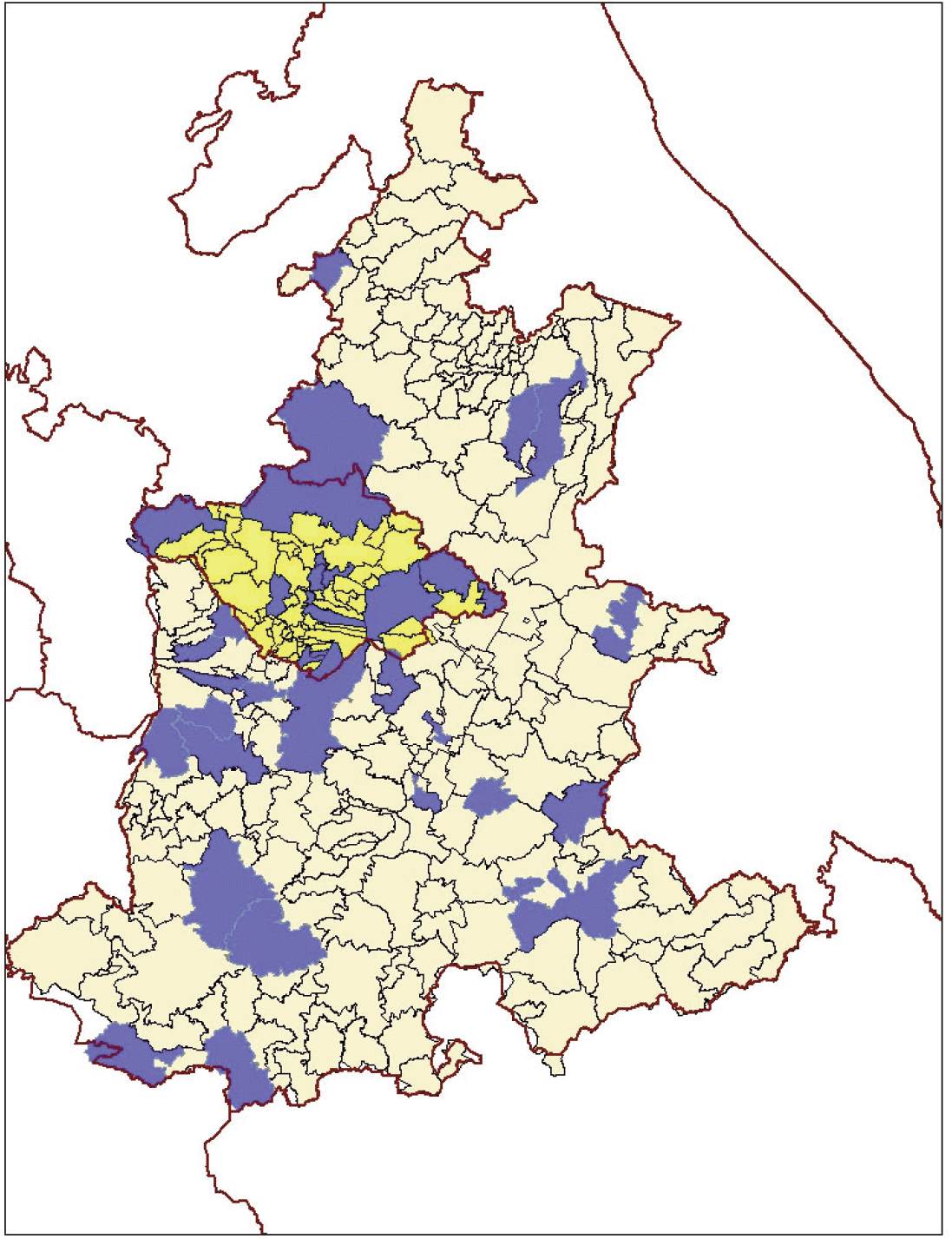
The 23 municipalities in Puebla and 13 municipalities in Tlaxcala were chosen through randomized selection, where the community presidents were surveyed (see map 1).Footnote 12 More municipalities were included from Puebla than Tlaxcala, as the former has considerably more municipalities overall, 217 compared to 60 in Tlaxcala. Map 1 shows the geographical dispersion of surveyed municipalities across the two states. The survey was based on 15-to-45-minute phone interviews with village presidents. They were contacted through official landline or cellphone numbers.Footnote 13 The survey was conducted either by the author or by three research assistants based in Puebla and Mexico City. When contacting community presidents via phone, we requested the possibility of conducting an interview according to IRB procedures, assuring the respondents complete anonymity.
Methods
The main hypothesis on the relationship between customary institutions and intervillage development investments was evaluated using time series cross-sectional OLS regression models with data from 2014 to 2018. The analysis created a panel dataset including all 160 surveyed communities across these 5 consecutive years. To understand whether the effect of customary institutions operated through collective action capacity, the analysis tested whether customary institutions were related to labor and resource mobilization and protests using logit models.
Some potential issues result from the time series nature of the data. Given the short time period, dynamic models with a lagged dependent variable to check for serial correlation are not advisable (Beck Reference Beck2001). One possibility is to use subject-specific estimators, like random effects and fixed effects, which handle unit heterogeneity and within-unit correlation by using the repeated observations to generate different intercepts for each cross-sectional unit. Because the fixed-effects estimator relies on community-level within-case variance only, its use is inadvisable for this dataset, dominated by cross-sectional variation (T = 5, N = 160) with several time-invariant or “sluggish” independent variables. For instance, the crucial independent variables—the presence or absence of community-level customary institutions and protest capacity— do not vary across time periods (Clark and Linzer Reference Clark and Drew2015). Random effects models are better suited for these data, assuming that the random constants and the independent variables are uncorrelated. However, fixed effects were added for the 36 municipalities to account for unobserved heterogeneity between higher-level units.
Municipalities in Puebla and Tlaxcala

Accounting for the Endogeneity of Institutions: The Change and Persistence of Customary Institutions
Although the analysis controlled for a range of socioeconomic and political variables to account for the fact that omitted variables might bias the results, assessing the independent effect of customary institutions statistically requires a serious consideration of selection issues. Informal customary assemblies, religious festivities committees, communal labor, and elders’ councils are not randomly assigned across Mexican communities. It is possible that the presence or absence of these institutions is endogenous to the levels of local public goods provision and collective action patterns.Footnote 14
However, it should be noted that these institutions are largely stable over time, which makes it unlikely that the present-day levels of public transfers and collective action patterns affect the presence of customary institutions (collective action was measured during 2019 and social infrastructure transfers from 2014 through 2018). When they do change—in many cases they erode or even disappear from lack of citizen participation—it tends to be a byproduct of slow-moving population growth and migration processes, which are unlikely to be affected by current collective action and government transfers. Interviews with community presidents and municipal and state officials and reading of archival documents created over decades provide evidence of the relative stability of these local governance arrangements.
Community assembly protocols—which I was granted access to in many com- munities—offered an especially valuable source for understanding institutional change. For instance, the revision of these protocols in several communities in the municipality of Chiautempan, Tlaxcala showed the extraordinary persistence of local organization, assembly voting methods, and meeting agendas over the 1990s, 2000s, and 2010s. It is notable that this time period coincided with some radical political transformations in the local political landscape: the decline of electoral hegemony of the long-ruling PRI, electoral reforms, and decentralization of decisionmaking to the municipal level, which all intensified struggles over municipal resources. Yet none of these transformations had a visible impact on the functioning of community-level institutions. Various interviews at state-level institutions in Puebla and Tlaxcala (Escobar Carrasco Reference Escobar Carrasco2019; Montiel Maguez Reference Montiel, Jorge and Former2019; Trujillo Reference Trujillo2019)—most notably, the state electoral institutes that send officials to monitor community assembly elections—confirmed the relative stability of these institutions over a larger swath of municipalities in both states.Footnote 15 It is very unlikely, therefore, that the dependent variables of the study—current municipal resource flows and collective action patterns—could directly shape the density of these institutions.
However, customary institutions do change; they can weaken and even disappear over longer time frames. The death of these institutions tends to be associated with a long-term decline in citizen participation in them (Eisenstadt Reference Eisenstadt2011). Both the primary evidence and secondary literature point out that the reduction in participation rates is particularly associated with slow-moving demographic changes: population growth associated with inmigration to a community, which is usually a byproduct of economic growth. As García and García (Reference García and Néstor2013, 101) note for the locality of Xochimilco in Oaxaca, community institutions “do not have the same meaning for the new inhabitants as for natives” and are on a path of slow erosion because of that.Footnote 16 Although it is certainly possible that these institutions could be revived once they disappear in a community, these cases are very rare. In some newer localities, which came about through population movements during the twentieth century, customary institutions are absent altogether.
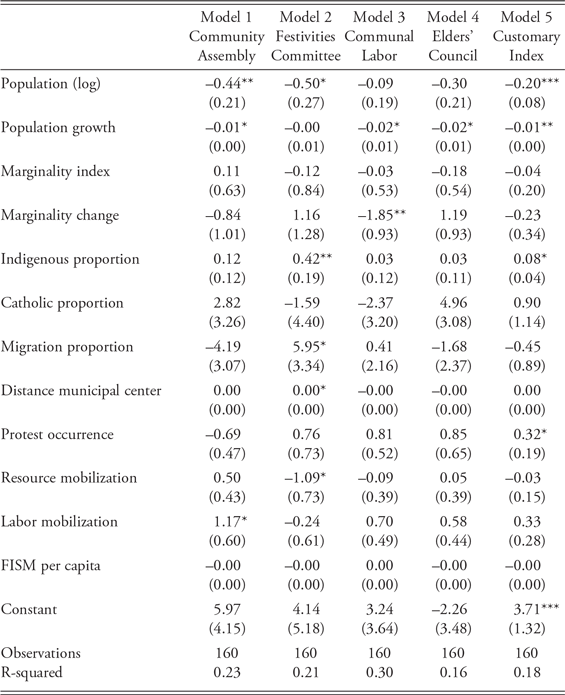
The explanatory power of these slow-moving variables is demonstrated in the statistical analysis in the appendix (table 5). The results indicate that population growth in recent decades and other modernization indicators figure as the strongest predictors. The analysis also shows that neither current municipal FISM transfers nor collective action patterns have any systematic association with these institutions, after accounting for the slow-moving socioeconomic determinants. These observations thereby alleviate endogeneity concerns.
Data
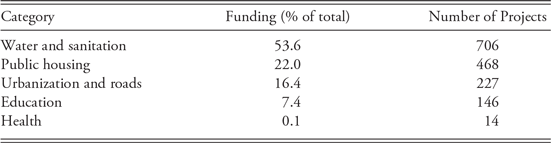
Municipal Public Goods Transfers. FISM per capita grants from 2014 to 2018 were used to measure the distribution of development resources across localities. The data on FISM grants come from the Secretariat of Welfare database (Matriz de Inversión para el Desarrollo Social, MIDS) (Secretaria de Bienestar 2019). The MIDS database reports projects at the locality (localidad) level, nested within 2,448 municipalities, which allows for analysis of how projects are distributed within local governments.Footnote 17 Table 1 presents the distribution of social development projects according to different spending areas in the 160 survey communities. The square root is taken from the yearly per capita amount to account for outliers and right-hand skew in the data.Footnote 18
FISM Development Projects (2014–18) in Survey Communities

N = 160
Source: MIDS, Secretaría de Bienestar 2019
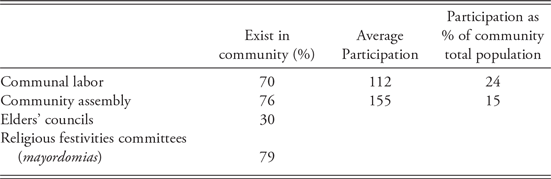
Customary Institutions. The main independent variables are informal customary institutions—community assemblies, mandatory community labor, religious festivities committees, and councils of village elders—at the community level, measured dichotomously. These variables come from the original survey with community presidents. As noted, these variables capture the most important aspects of the Mexican informal customary institutions. Table 2 demonstrates the variation in customary institutions across communities. An additive index of these four variables was also created (Customary Index), varying from 0 to 4, to test if these institutions matter more in combination. For instance, in communities having village assemblies and communal labor systems but lacking religious festivities committees and elders’ councils, leaders’ access to the base of potential protest participants is smaller, while the communication networks and associational spaces are more limited.
Presence and Participation in Customary Institutions in Puebla and Tlaxcala

N = 160
Note: The survey included questions on the number of participants in the last faena and the community assembly.
Source: Original survey with village presidents in Puebla and Tlaxcala, May–June 2019.
Collective Action. The variables Resource Mobilization and Labor Mobilization were measured through survey questions. The survey asked community presidents if their localities mobilized labor and monetary resources to support local development projects in the past year. Local mobilization of labor and monetary contributions tends to be rather common. A quarter (26 percent) of the community presidents reported mobilizing local labor for supporting local public works undertaken through FISM in the past year. Another 23 percent of the community presidents noted that they had mobilized community monetary contributions for public works in the past year. While the question did not specify whether these efforts were used to supplement FISM projects, these monetary contributions were used for various purposes, such as improving water systems, repairing streets and roads, and undertaking maintenance work in local classrooms. Another 7 percent of communities mobilized resources for the maintenance of churches and temples, which were not classified as public works.
Protest was measured through a question on the occurrence of protest in the municipal center in the past year. Twenty-one percent of the community presidents noted that their community members had organized a protest in the municipal center.Footnote 19 All three indicators took a value of 1 if a community experienced a particular type of collective action, and 0 otherwise.
Control variables. The analysis controlled for several factors that might account for distributive allocations of politicians. Most important, partisan alignments are likely to affect the FISM transfers (Brollo and Nanniccini 2012). Given that community presidents often make formal or informal alliances with parties, I expect that municipal politicians transfer more resources toward copartisan community presidents. To capture partisan dynamics, survey questions were designed to ask community presidents if they were aligned with a political party (as of June 2019), and in the case of aligned presidents, which party they were aligned with. The same information was collected about the previous community president (community presidential elections took place in Puebla in 2019 and in Tlaxcala in 2016). Three dummy variables were created for independent (nonaligned), aligned (when community president and municipal president are from the same party), and opposition (when community president and municipal president are from different parties) community presidencies.
The analysis also controlled for previous voting patterns at the locality level. It used electoral data from municipal elections (local elections were held in Tlaxcala in 2013 and 2016 and in Puebla in 2013 and 2018). To operationalize swing and core hypotheses, indicators were generated of margin of victory (swing voter) and share of governing party vote share (core voter) in the municipal elections (Cox and McCubbins Reference Cox and McCubbins1986; Dixit and Londregen Reference Dixit and John1996). Localities—the level at which socioeconomic data on communities are reported—do not match exactly with the smallest electoral units, electoral precincts (secciones electorales), as defined by the National Electoral Institute (Instituto Nacional Electoral, INE). However, given that localities in this dataset are bigger than electoral precincts—or in some cases, match closely with localities—electoral data were aggregated to the locality level. The data come from state electoral institutes. To capture possible increases of spending according to electoral cycles, dummies were added for municipal election years (2016 in Tlaxcala and 2018 in Puebla).
To capture developmental needs at the community level, the analysis controlled for the Marginality Index of CONAPO (Consejo Nacional de Población), which captures the life quality and the coverage of basic services in the community (CONAPO 2010).Footnote 20 Also included were other socioeconomic control variables: log of population, log of population growth during 1995—2010 (percent), share of population illiterate, proportion of out-of-state migrants, and distance from the municipal center (in meters).Footnote 21 These data came from the Instituto Nacional de Estadística y Geografía 2010 census (INEGI 2019).
Results
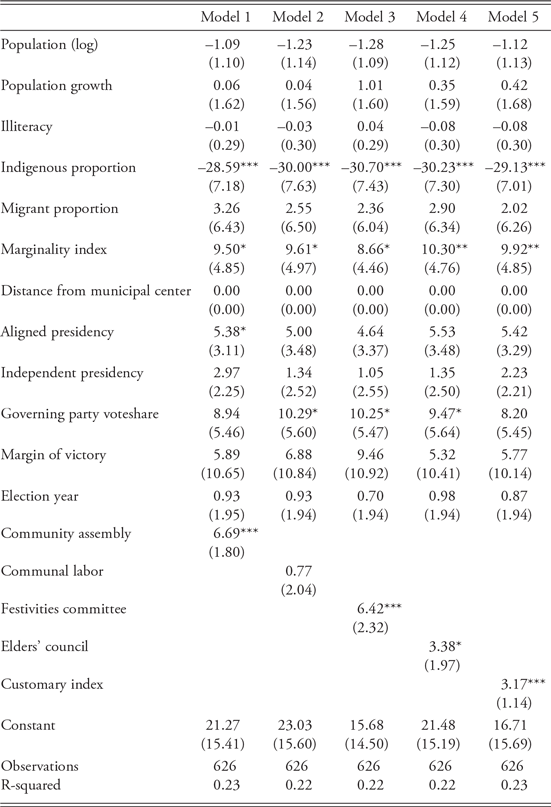
Table 3 presents the effects of customary institutions on FISM per capita transfers during 2014—18. Community Assemblies, Festivities Committees, and Elders’ Councils demonstrate a significant relationship with FISM transfers while controlling for other covariates. Community Assembly is related to a 49-peso increase in transfers in annual FISM per capita spending (model 1). Adding a Religious Festivities Committee to a community results in a 37-peso increase in transfers (model 2). Communal Labor does not achieve significance in the models, but takes a positive sign. The Customary Index is statistically significant and positive (model 5). Moving from having only one customary institution to all four results in an almost 100-peso increase in development funding.
Customary Institutions and FISM Transfers

*** p < 0.01, ** p < 0.05, * p < 0.1
Note: Time series cross-sectional OLS regression. Models 1–4 display the effects of individual dummy variables capturing four customary institutions. Model 5 presents the effect of Customary Index variable. Robust standard errors in parentheses.
Do these effects matter for real world development outcomes? These results add up to an important impact on local public service delivery in the medium and long term. A locality with a population of 1,300 (median value) would receive a yearly funding boost of 63,700 pesos, due only to the presence of a community assembly (and 130,000 when having all customary institutions present versus having only one), holding everything else constant (table 3). The first figure, in turn, translates to over 1.3 million pesos (US$76,000 at the 2016 exchange rate) additional development funds in a ten-year period.
This additional spending has a tangible effect, given that the values of median FISM water and sewerage projects were 300,000 and 385,000 pesos, respectively, in 2016. These projects led to a considerable increase in local coverage rates, providing access to, on average, 290 and 125 new users, respectively. The 1.3 million additional pesos over a 10-year period would also have an impact in terms of local healthcare and transport. The average cost of the FISM road-paving project is 600,000 pesos, while the construction of a small rural health clinic has the approximate cost of 1 million to 2 million pesos. These examples provide evidence of the possible long-term impact of these institutions (Secretaria de Bienestar 2019).
Table 3 also indicates that more development projects tend to flow to villages with a higher Marginality Index. This is not surprising, given that the FISM has an important goal of providing funding for marginalized localities within municipalities. After controlling for marginality, Indigenous Proportion takes a negative sign, indicating that in equally poor localities, indigenous populations are less favored. Indigenous populations might have special difficulties in accessing municipal institutions, even if they usually have vibrant customary institutions.
Last, variables capturing the effect of partisan politics appear to have weaker effects. Governing Party Voteshare takes a positive sign and achieves significance in three out of the five models, albeit only at the 0.1 level. Partisan-aligned or independent community presidencies are not more likely to receive resources, compared to opposition ones. This indicates that local partisan targeting might be less prevalent than previously thought, providing evidence for the relevance of the protest mechanism.
Mechanisms
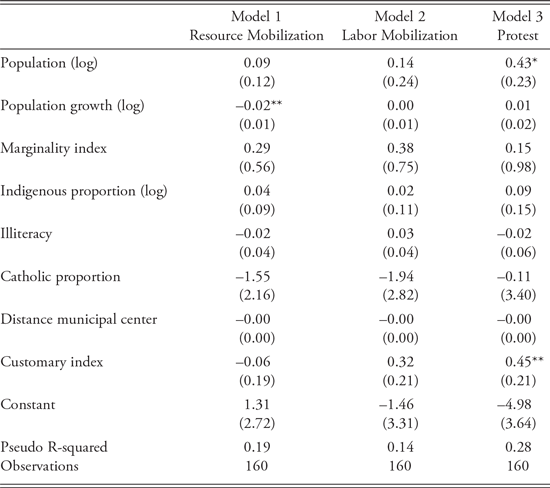
The results in table 3 provide considerable evidence that customary institutions attract more decentralized transfers. However, through which channels do customary institutions attract municipal transfers? To answer this question, the study tested statistically whether the presence of customary institutions is related to larger community contributions, the mobilization of local labor for development projects, and the occurrence of protest in the municipal center. Given that the dependent variable is dichotomous, logit models were used. The analysis controlled for basic socioeconomic variables—population, population growth, illiteracy, migration, indigenous proportion, marginality—and distance from the municipal center. For reasons of limited space, only models with Customary Index as the independent variable are provided here.
Table 4 presents the effects of the Customary Index variable on these three outcomes. Customary Index does not have a significant effect on Resource Mobilization and Labor Mobilization in models 1 and 2. These models indicate, therefore, that no systematic patterns exist between customary institutions and local resource and labor mobilization for development projects. By contrast, Customary Index has a positive and significant effect on Protest in model 3. This effect is substantively important; moving from the absence of customary institutions to having all four of them increases the predicted probability of protest from .03 to .40. This indicates that protest capacity might figure as an especially important mechanism for attracting municipal transfers. The interviews provided ample evidence that communities are likely to see access to resources from municipal governments as their main development strategy, which dominates the local mobilization of labor and resources. This mechanism is examined further through case studies from the municipality of Pahuatlán.
Customary Institutions, Labor and Resource Mobilization, and Protest

*** p<0.01, ** p<0.05, * p<0.1
Note: Cross-sectional OLS regressions. All models include municipal fixed effects. Standard errors are clustered at the municipal-level.
Case Study: Pahuatlán
The following brief case studies of the communities of San Pablito and Xolotla in the municipality of Pahuatlán, Puebla highlight the reality that policymakers tend to be responsive to protests organized through customary institutions. The absence of these institutions, in turn, makes it difficult to put pressure on local governments to deliver local public goods. San Pablito and Xolotla are the two largest auxiliary presidencies in Pahuatlán, a poor municipality of about 21,000 inhabitants. Roughly equal in size (each with a population of 3,000), both communities date to precolonial times. San Pablito is located 12 kilometers and Xolotla 14 kilometers from the municipal seat, and the driving time to both communities is approximately 40 minutes on the narrow, mountainous roads. Nearly 90 percent of the inhabitants in both communities speak an indigenous language.
While submunicipal communities in general have lagged behind the municipal seat in infrastructure and public services, significant differences in the coverage of public services exist between these two localities, especially in policy areas that are a direct responsibility of the municipal government. In San Pablito, only 9 percent of households lacked access to potable water, 8 percent lacked access to drainage, and 7 percent to electricity in 2010. In Xolotla, 32 percent lacked access to a potable water source, 35 percent to sewerage, and 17 percent to electricity. It is remarkable that these differences are less salient in other indicators of human development— such as education—that are less likely to be affected by municipal governments, indicating that these differences are likely to be produced by unequal access to municipal development funds. Both localities have an almost identical share of population without completed basic education (70 percent in San Pablito and 69 percent in Xolotla), while the rate of illiteracy is higher in San Pablito (36 percent) compared to Xolotla (23 percent) (INEGI 2019).
These development differences created the expectation that more FISM development funding would be targeted to Xolotla than to San Pablito during the 2013— 18 period (for which the most recent data on disbursements are publicly available). However, San Pablito managed to secure a larger amount of development funding per capita than Xolotla. In 2014—18, San Pablito received 2,810 pesos per capita for development projects, compared to 1,712 pesos for Xolotla (Secretaria de Bienestar 2019). I argue that these differences in both short-term transfer dynamics and longterm development outcomes are likely to be explained by the two localities’ divergent political resources to demand development resources controlled by municipal politicians.
Citizens in San Pablito are organized through a dense network of customary institutions, such as community assemblies, elders’ councils, and a vigorous commu- nal labor tradition organized around citizen committees. Community assemblies— which are the center point of a community’s associational life—convene four or five times a year. Citizens regularly participate in cleaning roads, doing maintenance in local churches, and other tasks through the communal labor (faena), assigned once every two weeks by the community president. Citizens also serve on yearlong permanent committees in charge of schools, potable water, and religious festivities. The community presidential candidates are expected to have served in the most important committee positions.
Community presidents in San Pablito periodically organize protests to demand more development resources for their locality. In 2014, a series of mobilizations occurred in front of the municipal palace after a sharp reduction in transfers from the federal participaciones fund, which is used to pay the salaries of the community president and village councilmembers (Juárez Reference Juárez2018). However, the collective action took an especially contentious form during a protest against the plan to construct a gas pipeline on ancestral territories in Pahuatlán, which the municipal government initially sanctioned in October 2016 (Ayala Martínez Reference Ayala Martínez2019).Footnote 22 The political group associated with the auxiliary president organized a large-scale mobilization in the municipal center and kidnapped the municipal president, Arturo Hernández Santos, along with several other public officials while they were attending a public meeting in San Pablito (Municipal Attorney of Pahuatlán 2019). Afterward, community members blocked the roads to the community to avoid the entrance of state and municipal police forces (Municipal Councilmember of Pahuatlán 2019). These incidents made headlines in the most important news outlets in Puebla and considerably affected the political calculations of municipal policymakers (Pskowski Reference Pskowski2019).
How were the community presidents in San Pablito able to mobilize their citizens? The fieldwork evidence points to two mechanisms. First, tight citizen networks, formed through collective participation in community labor and organization of festivities through committees, assured a large number of willing participants. The October 2016 mobilizations were carefully planned and executed through a series of community assemblies, where, on average, three hundred to four hundred people participated. In the words of one of the closest collaborators of the community president in San Pablito, “People here take enormous pride in participation in community traditions. We do things together, and this unity helps people to mobilize when the municipal president denies public works that the people deserve” (Community Councilmember of San Pablito 2019).
Second, these informal institutions equipped San Pablito with leaders with considerable social legitimacy, which they had acquired through current and previous leading roles in these institutions. The assembly meetings—where the contentious actions arose—were spearheaded by a leadership group of 30 to 40 individuals, composed of leaders of committees of religious festivities (mayordomos, carnevaleros) and traditional healers (curanderos), along with the community president. These individuals—who often have veto power over decisions taken in the community assembly—control important loyalties in the community and instill fear in municipal politicians (Community President of San Pablito 2019).
Since the 2016 mobilizations, municipal politicians have generally paid greater attention to the demands of San Pablito compared to other communities. Hernández—who was preparing his candidacy for the 2018. elections to Puebla’s State Congress for the PAN (Partido Acción Nacional)—quickly realized that the escalation of protest activities would pose a considerable threat to his electoral and career prospects (Municipal Attorney of Pahuatlán 2019). Persuaded by the mobilizational potential of San Pablito, Hernández rewarded the community with several new projects from the FISM at the expense of other communities, which is well reflected in the FISM budgetary data presented earlier. San Pablito community leaders interviewed were also surprisingly cognizant of their bargaining power, while trying to increase their power through further protest threats. In addition, for the political fortunes of Hernández, these events had a negative effect—he was forced to withdraw his state congressional candidacy in 2017 (Municipal Councilmember of Pahuatlán 2019).
Although the resource grievances have been greater in Xolotla, community leaders have not been able to pose considerable threats to municipal policymakers, due to the lack of strong customary institutions, and the locality has received fewer development projects in recent years. Although Xolotla has a functioning community assembly and people participate in a communal labor system, the community lacks the strong authority structures present in San Pablito, related to the leaders of religious festivities committees, making it more difficult to mobilize citizens locally. In personal interviews, community leaders of Xolotla expressed a certain envy of San Pablito leaders’ advantage in organizing contentious events (Community President of Xolotla 2019). The different trajectories of these two communities, San Pablito and Xolotla, exemplify well the differences in bargaining power resulting from the presence or absence of customary institutions.
Conclusions
This article has focused on the effects of informal customary institutions on the distribution of decentralized social development funds controlled by municipal governments in Mexico. Drawing on original evidence for the informal presence of customary institutions in submunicipal communities in Mexico, it has argued that the presence of customary institutions offers localities considerable advantages in distributive politics. The village communities with dense customary institutions have a higher collective action capacity to organize small-scale protests to demand development resources from municipal centers. This research has not found evidence that customary institutions are associated with other types of local collective action, such as the mobilization of citizen monetary and labor contributions for social development projects.
These conclusions have important implications for the mechanisms through which the traditional authority structures affect development. Recent literature has shed light on the positive role of traditional authority structures—e.g., chiefs in Africa and Afghanistan (Murtazashvili Reference Murtazashvili2014; Baldwin Reference Baldwin2015), lineage institutions in China (Tsai Reference Tsai2007), and usos y costumbres formalization in Mexico (Díaz-Cayeros et al. Reference Díaz-Cayeros, Magaloni and Ruiz-Euler2014)—in increasing the accountability of local officials. According to this reasoning, local government officials can be subject to unofficial rules and norms— stemming from socialization through local informal institutions—that establish and enforce their public obligations (Tsai Reference Tsai2007).
Yet previous works stressing the accountability channel have assumed that the administrative level where customary institutions operate coincides with the level of government that controls the decentralization resources (the level at which local officials need to be “held accountable”). Communal arrangements are considerably more likely to exist and to affect political processes in submunicipal villages than in municipalities and provincial governments, which control most decentralized development resources. This reality reduces the ability of village-level customary authorities to exercise informal accountability, and attention must be given to more complex mechanisms through which “customary” accountability might operate across different levels of government. In these contexts, contentious collective action serves as one of the tools to access resources controlled by politicians in higher levels of government.
Appendix: Determinants of Customary Institutions
Table 5 presents results from logit models with the presence of four customary institutions—community assemblies, mandatory community labor, religious festivities committees, and councils of village elders—and Customary Index as dependent variables (models 1—5). While no variable is significant across all models, Log of Population, Population Growth, and Marginality Change achieve statistical significance in two or more models. Population Growth seems to be the strongest predictor across the models and has consistently a negative sign. These effects are also substantively important: increase in Population Growth from the 10th to the 90th percentile (from —21 percent to 26 percent) would reduce the likelihood of having a communal labor system by 16 percent (model 3), while the average number of customary institutions declines from 2.9 to 2.5 (model 5).
Determinants of Customary Institutions

*** p<0.01, ** p<0.05, * p<0.1
Standard errors in parentheses.