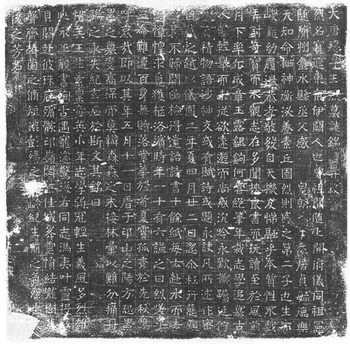
On a spring day in 677, a sixteen year-old boy named Wang Baode 王寶德 took his own life by drowning himself. Wang was born to an ordinary family and his father never held an office. Nevertheless, the boy loved books and admired the great ancients. If the depiction in “Funeral Inscription with Preface for the Shang-son Wang Lie of the Great Tang” (Da Tang shangzi Wang Lie muzhiming bing xu 大唐殤子王烈墓誌銘並序)Footnote 1 is to be believed, he may have been a bit neurotic. Lie 烈, or “heroic,” is the posthumous name (shi 謚) his parents bestowed on him, as they considered the word embodied their beloved son's character. Devastated by their loss, the parents had a finely written epitaph carved onto a stone slab (Figure 1) to “record the heroic character he displayed” (ji shengqian zhi qilie 紀生前之氣烈), in the hopes that “his fine reputation can be passed on after his death” (chui mohou zhi fangming 垂殁後之芳名). The parents lamented that “a perennial flower drops in the beginning of summer, a singular blossom falls at first touch of autumn” (luo changhua yu shouxia yun guxiu yu xianqiu 落常華於首夏, 霣孤秀於先秋); they declared that “one hundred lives cannot redeem” that of Wang Lie (baishen wu shu 百身無贖).
Ink rubbing of “Funeral Inscription with Preface for the Shang-son Wang Lie of the Great Tang”

The epitaph for Wang Lie is one of the 118 extant Tang dynasty (618–907) epitaphs dedicated to young people who died before the age of twenty without marrying. These texts provide historians with an excellent opportunity to uncover perceptions of childhood and youth experiences in medieval China, and, more importantly to this study, to examine a rarely explored aspect of Tang parent–child relationships: parents’ mourning of their children who died young.
The parent–child relationship has been an integral part of the study of the history of childhood ever since French historian Philippe Aries published Centuries of Childhood in 1960.Footnote 2 Aries set out to convince historians that the history of childhood is an important field that can help uncover how a particular set of beliefs about childhood and practices of child-rearing came into being and evolved. Responding to his call, many social and cultural historians have explored various topics on children and youth, ranging from the perceptions of childhood as seen in legal codes, religion, and literature to child mortality and infanticide in different societies throughout world history.Footnote 3 Scholars of Chinese history have dabbled in the field since the 1990s. The 1995 publication of Chinese Views of Childhood, an anthology edited by Anne Behnke Kinney, was a pioneering effort to survey the history of childhood. Its essays cover research by eleven scholars on topics from the Han dynasty (202 BCE–220 CE) to the present.Footnote 4 In addition, two monographs on childhood in Chinese history greatly expanded our understanding of the perception of childhood in early China and late imperial China (1368–1911). Anne Kinney's Representations of Childhood and Youth in Early China (2004) explored the cultural conditions that made childhood an important topic of intellectual inquiry, as well as depictions of and perspectives on the “precocious child” and the “aristocratic child” in Han writings.Footnote 5 A Tender Voyage: Children and Childhood in Late Imperial China (2006) by Ping-Chen Hsiung investigated new views and practices concerning childhood developed after the heyday of the Wang Yangming School.Footnote 6
Studies of the parent–child relationship in Tang China are abundant as well, thanks to the copious sources available to scholars, including literature, the arts, ritual and didactic texts, religious texts, and law codes.Footnote 7 Researchers on medieval China also benefited greatly from a large quantity of epitaphs (muzhiming 墓誌銘) and Dunhuang manuscripts.Footnote 8 However, most of the existing scholarship on the subject, mostly concerning adult children, has focused on how filial piety was defined, sanctioned, and practiced.Footnote 9 The earliest scholarship that explored mourning those who died young is Pei-yi Wu's 1995 survey of literature from the Tang to the Ming era (1368–1644).Footnote 10 In a close analysis of Han Yu's 韓愈 (768–824) requiem (jiwen 祭文) and grave notice (kuangzhi 壙誌) for his daughter, Wu argues that children were written about more in China than in Europe, and that, from the ninth century on, grieving and mourning went considerably beyond what ritual demanded, especially by fathers for their daughters.
This paper expands on Wu's study to survey all available Tang epitaphs for children. It not only investigates how Tang parents remembered and recounted their children's lives, but also examines factors that contributed to the rise of intense outward mourning of loved ones who die young. It finds that, while descriptions in epitaphs for adults largely followed Confucian ideals of life courses and gender roles for men and women with their lives cut short, the epitaphs for the young are much less formulaic, allowing space and latitude for parents and families to impart anecdotes and convey emotions. I argue that Buddhism greatly influenced how Tang parents mourned the loss of their children. During the Tang, along with the spread of Buddhist concepts of the netherworld and afterlife, the Forty-Ninth Day Memorial Rites (zuoqi 做七) became widely popular, as did the copying of sutras (xiejing 寫經) and building of pagodas (qita 起塔), all intended to amass merits (zhuifu 追福) for the departed, regardless of their age and gender. As a result, Tang parents gradually broke from the restrictions set by The Book of Rites and utilized epitaphs to express their profound sorrow and grief.
Tang Epitaphs for Those Who Died Young
Childhood and youth were well defined in ritual texts, legal codes, and imperial decrees throughout Chinese history. In 624, for example, Emperor Gaozu (r. 618–626) decreed that children between one and three sui were to be grouped into huang 黄 (yellow, infant); those between four and 15, xiao 小 (small); at sixteen, they reached zhong 中 (middle); and by twenty-one, a male reached adulthood, ding 丁. It is worth noting that the Tang imperial court twice changed the age for male adulthood: it first increased to twenty-two sui in 705 and then to twenty-three sui in 763.Footnote 11 The Tang Code (Tanglü shuyi 唐律疏议) also divided children and young adults into three groups: under fifteen (xiao), under ten (youruo 幼弱 young and weak), and under seven (dao 悼, minor).
How should early death be addressed and mourned? The Book of Rites (Yili 儀禮) prescribed a set of strict rules. It divided shang 殤, or family mourning for those dying before adulthood, into three categories: zhangshang 長殤 (mourning ritual for older youth) was designated for children who died between the ages of sixteen and nineteen; zhongshang 中殤 (mourning ritual for middle youth) for those between twelve and fifteen; and xiashang 下殤 (mourning ritual for young children) for children eight to eleven years old. It specified that parents should mourn a zhangshang child for nine months and a zhongshang child for seven months. In addition, children who die before reaching the age of eight can be mourned by the parents, but without outward ceremony (wufu zhishang 無服之殤). The length of the mourning period for those who died younger than eight depends on the specific age of the child. For each month the child lived, a day of mourning is added. A father may weep at the death of a child with a name (usually aged three months). He will not weep if the child has not yet been named.Footnote 12
The data set for this study consists of 118 Tang epitaphs for those who would be considered zhangshang or younger. Among them, twelve are from Quan Tang wen 全唐文 (QTW),Footnote 13 seven from Da Tang Xishi Bowuguan cang muzhi 大唐西市博物館藏墓誌 (XSMZ),Footnote 14 eleven from Xi'an Beilin Bowuguan xincang muzhi huibian 西安碑林博物館新藏墓誌匯編 (BLMZ) and Xi'an Beilin Bowuguan xincang muzhi huibian xuji 西安碑林博物館新藏墓誌續編 (BLMZHB),Footnote 15 one is from the private collection of the contemporary Liu Xiufeng 刘秀峰,Footnote 16 and the rest are from Tangdai muzhi huibian 唐代墓誌彙編 (MZHB) and Tangdai muzhi huibian xuji 唐代墓誌彙編續集 (XJ).Footnote 17 As to age groups, 65 epitaphs are those of zhangshang (16–19), 34 are of zhongshang (12–15), 11 are of xiashang (8–11), and seven are dedicated to those who died between four and seven sui. One mentions only that the deceased had passed away before she had become engaged to be married.Footnote 18 In terms of gender, 55 epitaphs or 47 percent were for daughters, and 63 epitaphs or 53 percent were for sons. The number of epitaphs for children increased dramatically in the Tang dynasty. A total of 17 (14 percent) of the extant epitaphs dedicated to those who died young date from the seventh century; 33 (28 percent) date from the eighth century; and 56 (48 percent) are from the ninth century. This trend does not seem to match the overall distribution of epitaphs during the Tang dynasty. Among the 5,807 epitaphs collected in QTW, MZHB, and XJ, for example, 2,090 of them, or 36 percent, date from the seventh century; 2,127 or 37 percent from the eighth century, and only 1,590 or 27 percent from the ninth century. Most noticeably, the increase in epitaphs for children during the ninth century is also the result of a dramatic increase in the number of epitaphs for daughters, while the number of epitaphs for sons remained unchanged (15 epitaphs for the seventh century, and 22 and 19 for the eighth and ninth centuries, respectively).
Illness is the leading cause of these early deaths. Among 79 epitaphs naming a cause of death, 67 reported that the deceased died after becoming sick. Some contracted a sudden vicious illness (yu baoji er yao 遇暴疾而夭)Footnote 19 or untreatable skin ulcers (chuangwei 瘡痏) that erupted everywhere (qinyin kuifa 侵滛潰發)Footnote 20; others were afflicted by “chronic ailments” (mianli jibing 綿歷疾病).Footnote 21 The second common cause of early death was travel-related illness or accident (8 cases). Cui Qun's 崔群 (772–832) younger sister, Cui Yang 崔楊, for example, died in 805 at the age of thirteen after becoming ill during a journey accompanying her brother to a new official assignment.Footnote 22 Han Yu's daughter, Na 挐, died at the age of twelve during his family's move from the capital to Chaozhou (Guangdong) as a result of his demotion and exile.Footnote 23
In reading the epitaphs of those who died young, it is apparent that depression constituted a grave concern for the families. An epitaph from 816, for example, reported that the deceased had suffered prolonged distress at the age of ten after being separated from his father.Footnote 24 An epitaph dated 774 for a young woman who died at the age of eighteen cited her constant anguish as the cause of her illness, which led to her demise (ji you cheng ji yizhi yunshen 積憂成疾,以至殞身).Footnote 25 Other epitaphs commemorated teenage boys who had succumbed to violence. In 702, a boy named Du Bing 杜並, sixteen, was killed seeking revenge for his father, the poet Du Shenyan 杜審言 (645–708), after he assassinated one of the officials who framed the elder Du.Footnote 26 In 757, a seventeen-year-old named Zhou Xiao 周曉 was murdered by the Turks while he was a hostage.Footnote 27
Tang epitaphs for those who died young were unique in two ways. First, they were mostly written by a family member or a close relative: 23 of them by a father, 12 by a brother, 9 by an uncle, 6 by a cousin, one by a grandfather, one by a granduncle, one by a brother-in-law, and 7 by a relative or a family friend. The rest of the epitaphs either did not identify the author (36) or the relationship (22) between the author and the deceased, though it is clear that most of these authors were very close to the family. The author of the “Epitaph for Wang Lie,” for example, did not identify his name or his relationship with the Wang family, but the description clearly reflects an intimate knowledge of the boy. Because of such close relationships between the author and the deceased, the accounts of the deceased's childhood and youth are much more vivid than childhood and youth experience in epitaphs for those who died much later, when their early experiences were largely unknown to the descendant, let alone to colleagues or friends.
The second unique aspect of these epitaphs is that the narrative pattern is quite different from that of the epitaphs for adults. Epitaphs for those who had experienced all stages of life habitually portrayed the deceased in accordance with Confucian ideals of life course and gender roles: men strove to fulfill the ideal of “cultivate the self, regulate the family, govern the state, then lead the world to peace” (xiushen qijia zhiguo pingtianxia 修身齊家治國平天下); women modeled themselves after Chunyu Yi 淳于意's (216–150 BCE) filial daughter, Liang Hong's 梁鴻 (27–90) submissive wife, and Mencius's (372–289 BCE) wise mother. In the 806 epitaph for Yuan Zhen's 元稹 (779–831) mother Zhengshi 鄭氏 (Lady Zheng), for example, after detailing her virtuous conduct as a daughter, wife, and mother, the author Bai Juyi 白居易 (772–846) commented:
Alas! People such as Qishi and Tiying of the olden days were righteous women, yet they were unknown after they became wives. The wives of Bozong and Liang Hong were wise women, yet they were unknown after they became mothers. The mothers of Wenbo and Mencius were virtuous exemplars, yet they were unknown as well when they were daughters and wives. Now Lady Zheng possessed much daughterly grace, wifely virtue, and motherly presence. She performed all three roles beautifully; she was truly the finest woman in history from the past to the present.
噫!昔漆室、緹縈之徒,烈女也,及為婦則無聞;伯宗、梁鴻之妻,哲婦也,及為母則無聞;文伯、孟氏之親,賢母也,為女為婦時亦無聞。今夫人女美如此,婦德又如此,母儀又如此,三者具美,可謂冠古今矣。Footnote 28
Such formulaic descriptions of the deceased persisted throughout the Tang dynasty, though some late Tang authors would add a few anecdotes to exemplify the deceased's character. In contrast to this, Tang epitaphs for those who died young often gave vivid descriptions of parent–child interactions and were filled with profound expression of sorrow. Consider the epitaph from 851 written by Cui Yan 崔巖 for his daughter, who died at the age of thirteen. Entitled “Funeral Inscription for Zhongshang Daughter Guangniangzi” (Zhongshangnü Guangniangzi muzhiming 中殤女廣娘子墓誌銘), the epitaph recounts that Guangniangzi 廣娘子 was a much cherished child: she was Cui Yan's first child and possibly the first grandchild of his parents. Her grandmother often commented: “ever since this grandbaby was around me, the joy and comfort she brought surpassed those of her aunts.” (自吾有是孫,慰悦於前,過其諸姑矣). Guangniangzi seemed to have spent every waking moment with her grandmother, “eating, playing, and resting at the grandmother's side” (shiyin dongxi yichuyu xixia 食飲動息,一出於膝下). The epitaph reports that Guangniangzi had the inborn ability to discern everyone's emotions; by the time she learned to talk, she could immediately sense if an elder expressed the slightest unpleasantness. Thus she never did anything that would displease her elders. At the age of seven or eight, she was reportedly very amiable, gentle, and peaceful, like a grown woman. And at the age of ten, she was “even more filial, loving, obedient, and respectful” (xiao ai shun jing yudu 孝愛順敬愈篤). When her mother was gravely ill, Guangniangzi cared for her meticulously. When her grandmother asked her to stay near, she agreed, but was worried sick about her mother. Because of the stress, she did not eat and rest regularly (shen mei guajie 膳寐乖節), causing her to become extremely emaciated and weak. After losing her mother, she was “brought down by a mixture of grief and ailments” (qi yu ji xiangcheng 慼與疾相乘) and died twenty-eight days after her mother passed away.Footnote 29
The “Funeral Inscription with Preface for Late Son Pangyu” (Wang nan Pangyu muzhiming bing xu 亡男龐玉墓誌銘並序), dated 808, was written by Pangyu's father Dou Yizhi 竇易直 (d. 833). It provides another example of such parent–child interaction and grief:
I had you when I was already thirty-eight. From your birth you were afflicted by many illnesses. You did not walk until the age of five. At the age of ten you studied with teachers, beginning with The Classic of Filial Piety, and then moving on to The Classic of Documents, The Book of Rites, and completing all six classics. You were kind, filial, reticent, and calm. You were also extremely cautious; the slightest admonishing would immediately send you into sustained fear and trembling, as if you could not find a place to hide yourself. I trusted that you would surely become well established and bring glory to our family. Who would expect that, despite all the protection and nourishment, you would contract a minor illness. At the age of fifteen, on the fourth day of the first month in the third year of the Yuanhe reign (808), you suddenly took the journey to the other world. How can a sorrow be this extreme! Due to transportation difficulties at the time, we arranged a temporary burial southwest of the Xiangji Buddhist Temple in Guodu village, Ju'an township, Chang'an county, on the thirtieth day of that month. Once the transportation is easier, we will take you back to our clan cemetery in Xianyang. Filled with sorrow I compose this essay, suffocated by grief I complete my last words. The elegy says: “the tomb passage is dark and deep, it rapidly took you away.” Sorrowfully we wait for a good year to consign you to the old cemetery.
吾年三十八方有汝,汝之始生即多病,五歲而後能行,十歲從師誦孝經,何論尚書禮記至第六。性仁孝,寡言而靜,加又小心競慎,每微訓示,即度日恐慄,行上無容。心謂汝必能成立,光大吾門。豈圖勞此保養,暫遘微疾,以元和三年正月四日享年一十有五,奄然長往,哀何可極。時未通便,故以其年月三十日權宅於長安縣居安鄉郭杜村香積佛寺之西南,候歲月通便將歸汝於咸陽大塋。銜悲為文,悲塞絕筆。銘曰:神道冥深,何促爾生,悲俟通年,歸汝舊塋。Footnote 30
Another example is this epitaph from 818 for a daughter named Li Desun 李德孫, who died at the age of four. It recounts a toddler's short life with a very gentle touch:
My daughter was born on the twentieth day of the seventh month, the yiwei year of the Yuanhe reign (815). She died on the eighteenth day of the seventh month, the wuxu year of the Yuanhe reign (818) in my official residence in Tongzhou's inner city. On the twenty-seventh day, she is to be buried at the southland of the west gate of the Yinsheng Temple's Buddhist Pavilion, located in Longshou township, Wannian county. The tomb is next to her late uncle's; the wind meets the pine trees in the west cemetery. With that, I hope my baby's soul will not be afraid of the dark world. The elegy says: Her family name is Li, she was born to Miss Cui. She was bright and divine; her countenance was endowed with heavenly blessing. Even though her speech was not yet perfect, she had the inborn nature of loving her parents. Her glances were radiant, her expressions expansive. While playing, she vomited and became ill; her breath was suffocated, her organs bled. The wind of dark spirit blows stealthily, and her vitality could not prevail. As she lay gently on my bosom, our pleading and wailing met with no response. She had yet to reach the age of shang; who asked for the longevity of a Pengzu?Footnote 31 My heart is exploding with such grief that I cannot bear it.
女生元和乙未歲七月廿日,亡戊戌歲七月十八日於同州內城官舍,來廿七日己酉,瘞京兆府萬年縣龍首鄉因聖寺佛閣西門之南地。土接亡叔之墓,風接西塋之松,冀爾孩魂, 不怕幽壤。銘云:姓李氏,生崔氏,聰明神光,骨髮天祉。言語未正,自解親親,顧瞻溢彩,顏色沆人。走弄之間,嘔吐生疾,氣噎深喉,血流中質。玄風潛吹,元精不凝,柔閒在抱,呼哭莫應。既未及殤,詎可等彭,肝腸熻起,無奈此情!Footnote 32
As the above three epitaphs show, while epitaphs for those who died young routinely attribute filial piety, cleverness, and intuition to the deceased, overall, the descriptions of their personalities and experiences are quite different from the formulaic descriptions of childhood and youth in epitaphs for adult men and women. The stories are much more detailed, and the youngsters’ unique experiences are dutifully noted: Guangniangzi was torn between pleasing her grandmother and caring for her mother, Dou Pangyu did not walk until the age of five, and Li Desun died in her father's embrace. Most importantly, the texts center on the deceased's relationship with family members, especially their interactions with the parents.
These patterns are evident in the epitaph for Wang Lie as well. While the text did not provide the author's identity or name, most likely it was written by a close family friend or a relative on behalf of the parents. As most seventh-century epitaphs did not list their authors’ names, we cannot rule out the possibility that it was penned by Wang Lie's father. From the text we learned that Wang Lie's parents cherished the fact that he loved literature and was an admirer of Qu Yuan 屈原 (ca. 340–278 BCE):
[Wang Lie] was born majestic and intelligent. At a young age he conducted himself with modesty and humility. His filiality and reverence derived from his inborn nature; his respect for brothers was fused in his innate character. He was not interested in having fun and playing games and was unconcerned when facing marvelous treasures. He set his mind on broad learning, and always carried fine books to ponder and savor. Thus, he could spontaneously compose a short piece when catching a breeze or in the light of the moon; holding wine cup and ink brush, he never stopped writing. At the age of fifteen, he admired the ancients.
生而岐嶷, 幼履溫恭, 孝敬發自天機, 友悌融乎本質。性不戲弄, 對奇寶而不觀; 志在多聞, 挾良書而玩讀。至於風前月下, 率爾成章, 玉露銀鈎, 何嘗絕筆。年裁志學, 追慕古人。
Wang Lie's literary pursuit was so fervent that his parents suspected he was communicating with the spirit of Qu Yuan:
He looked as if he contained spirits; he spoke as if he were communicating with the celestial. Sometimes he would compose poems; and sometimes he would write “farewell.” He secretly hid away all that he had written.
狀有精物, 語涉神交, 或有賦詩, 或題永訣。凡所述作, 密自藏之。
Then one day “he suddenly took off on his own” (huer sixing 忽爾私行). When his parents opened his casket of letters, they found more than ten pages of farewell poems and letters, making repeated reference to “pursuits of the river” (fu shui er qu 赴水而去). With that clue, they searched for him in panic, and eventually found out that he had drowned himself in the Luo River. In eulogizing Wang Lie, the parents again emphasized Wang Lie's fascination with Qu Yuan:
Did these epitaphs reflect a common practice in commemorating those who died young? To what extent did the parents and Tang society follow the traditions extolled in The Book of Rites? Among the extant Tang epitaphs, the “Epitaph for Wang Lie” is the only epitaph that recorded a posthumous name for a child, so it may be a unique case. However, addressing their sons and daughters as shang was quite common and possibly a new phenomenon. Among the thirty pre-Tang epitaphs for those who died young I have collected, none of them called the deceased a shang. Footnote 36 On the other hand, among the 118 Tang epitaphs for the young, twenty-three of them addressed the deceased as shang, with the earliest one dated to 686.Footnote 37 The usage of shang probably denoted the expanding role of epitaph writing in the Tang: epitaphs were not only a medium of commemorating the dead but also an important venue for the living to express their moral values and ideals. In other words, shang accentuated the values inherent in the parent–child relation. In addition, the renewed reverence toward Confucian ritual texts, embodied in the Rites of the Kaiyuan Period of the Great Tang (Da Tang Kaiyuan li 大唐開元禮) issued by the Tang court in 732, might also have influenced the popularity of such usage.
Indeed, the way Tang parents addressed their children in the epitaphs seems highly complex and wrought with emotion. Among the epitaphs for children that addressed the deceased as shang, some specified the age ranks (zhang 長 or shang 上, zhong 中, xia 下): five are listed as Zhangshang or Shangshang 上殤, their ages are between sixteen and nineteen; Footnote 38 two are zhonghang, ages thirteen and fifteen,Footnote 39 and two are Xiashang, ages ten and eleven.Footnote 40 Others were simply addressed as shangzi 殤子 (shang son) or shangnȕ 殤女 (shang daughter). The epitaph written by Quan Deyu 權德輿 (759–818) for his grandson who died at thirteen addressed him as shangsun 殇孫 (shang grandson).Footnote 41 In addition, some epitaphs did not specify in the title, but mentioned the age rank in the text. For example, the epitaph written by Bai Juyi for his brother who died at the age of nine begins with this sentence: “The Xiashang of the Bai family was named Youmei” (Baishi Xiashang yue Youmei 白氏下殇曰幼美).Footnote 42
It is worth noting that while The Book of Rites discourages parents from displaying outward mourning for those who died before the age of eight, and insists that the younger the child, the less time the parents should mourn his or her passing, quite a few Tang epitaphs addressed their young children, some as young as four and five, as shang. The epitaph for Zheng Xingzhe 鄭行者 who died at the age of four, for example, was titled “Epitaph for Shang son Zheng Xingzhe” (Tang Shangzi Zheng Xingzhe 唐殤子鄭行者墓誌).Footnote 43 It was authored by the father, Zheng Su 鄭肅, who wrote with intense sorrow and grief:
The shang son's family name is Zheng; his given name Xingzhe; he was my eldest son. He truly possessed the quality of majesty and brilliance and a nature of talent and intelligence. He treated his elders with full devotion. In conversations and interactions, he was always quick and deft. He understood the gist of all human affairs. The only thing he did not get a chance to attain was schooling. Neighbors and friends were all astounded at his prodigiousness and considered him a precious treasure. Everyone thought he would amaze the world with brilliant feats and rise to the top in no time. Who could anticipate that this would not come to pass? He died at the tender age of four. Alas, how painful this is! Editor Li Dai who excels at writing once wrote “Record of a Child Prodigy,” recounting Xingzhe's stories and conduct. Alas, he died in the tenth month, third year of the Yuanhe reign (808) and was temporarily buried in Mongshan. It has been twenty-one years! My guilty crime caused Heaven to abandon me, and now I have lost both parents. Our ancestral cemetery is located in the northern plain of Boyi township, Yanshi country. In a few days, we will conduct a joint burial of your grandfather and bury you next to his tomb. You are a sensible child and will surely be a good grandson to him. You will serve him on my behalf, and please him in the underworld. How happy may that be! I am old, weak, sad, and sick, and I wail in front of you. What can I say! What can I say!
殤子姓鄭氏,行者其名,余之元子也。實有岐嶷之資,聰慧之性,奉尊上曲盡其情,意備應對,每見其敏捷,大凡人事,盡得機要。所闕者未知書耳。繇是鄉黨驚視,目為奇重,咸以為異時必能飛鳴驚人,一舉千里。豈期不實,四歲而夭,嗚呼痛哉!校書郎李戴工為文,嘗錄其行事為異童志。嗚呼!爾夭於元和三年十月權窆於邙阜之別墅,逮今廿一年矣。余罪畔不天,再集荼蓼,偃師縣亳邑鄉北原,吾先人之所宅,越翌日,合祔上先府君之塋,是用歸爾骨於大墓之側,爾其有知,當為弄孫,代吾左右,承顏泉隧,其樂如何。吾殘骸哀瘵,臨爾一慟,竟何言哉!竟何言哉!
Zheng Xingzhe died at the age of four, and if The Book of Rites were to be followed should not have been addressed as shang, let alone in a lengthy commemoration twenty-one years after his death, More interestingly, some parents also addressed their children who were older than nineteen as shang. In “Funeral Inscription with Preface for the Late Shang Daughter of the Yang clan of Hongnong” (Tang gu Hongnong Yangshi shangnu muming bing xu 唐故弘農楊氏殤女墓銘並序), for example, the deceased was a twenty-year-old young woman named Yang Hui 楊慧. At the age of the hairpin (fifteen), she lost her father. After the mourning period for him ended, she became ill and never got a chance to marry. As the title indicates, the family addressed her as “shang,” possibly to emphasize the pain of losing a daughter.Footnote 44
Buddhist Influence on Mourning the Young
In his study of early perception of childhood as seen in early art, Wu Hung points out that mourning the young before the Tang largely focuses on didactic themes, though parental love and sorrow did appear in some forms of writing. Wu Hung cites a eulogy inscribed beside a relief portraying a child who died in 170 CE as a rare example of such a parent–child bond.Footnote 45 Writing about mourning a child gradually increased during the era of disunion. One of the most well-known literary pieces is Jiang Yan's 江淹 (444–505) “Rhapsody on Grieving over My Beloved Son” (Shang aizi fu 傷愛子賦). In addition, the number of epitaphs for those who died young increased as well, though most of the texts are concise and abstract, having been authored by literati or officials outside of the family. The Tang dynasty would witness a dramatic increase in writings about mourning a child. Poems expressing the sorrow of losing a child began to appear in the eighth century; the most well-known piece is Du Fu's 杜甫 (712–770) poem memorializing the loss of his young son to starvation.Footnote 46 During the ninth century, poems solely dedicated to those who died young became popular. Yuan Zhen, who lost seven of his twelve children, for example, left two poems mourning his young daughtersFootnote 47 and composed ten poems mourning his only son.Footnote 48 Bai Juyi also wrote several poems mourning his young daughter Jinluanzi 金銮子, who died at the age of two. In addition to poems, many literati composed requiem jiwen.Footnote 49 Therefore, it comes as no surprise that that epitaph writing for those who died young became distinctively intimate and expressive.
The popularity of writing about mourning a child might be closely linked to the increasing importance of a proper burial for children, resulting from the popularity of Buddhist ideas of the afterlife and nether world. Scholars have long established that Tang people often consciously sought a Buddhist way to die, either taking Buddhist names (fahao 法號) before their death or opting for cremation. The Buddhist influence on Tang perspectives on death was also reflected in the development of the concept of purgatory. As the Scripture of the Ten Kings (Fo shuo shiwangjing 佛說十王經)Footnote 50 and Emperor Taizong Enters the Netherworld (Tang Taizong ruming jin 唐太宗入冥記)Footnote 51 show, Tang people envisioned visiting the underworld, where ten powerful officials oversaw the judgment of a deceased person's deeds in his or her past life. As a result, every individual's dying became a very important matter.
Evidence of parents’ concerns for the wellbeing in the afterlife of their children who died young is the popularity of afterlife marriage (minghun 冥婚), which was well documented in Tang epitaphs and Dunhuang guidebooks, as well as in Tang vernacular stories.Footnote 52 Among Tang epitaphs for those who died young but recorded as married, for example, fourteen listed their marriage as minghun. From the sample prayers for the minghun ceremony (when the coffins of the minghun bride and groom were buried jointly) we learned that the major concern for the parents who arranged a minghun was that their children would sleep alone in the dark world and lack the intimacy between man and woman (獨寢幽泉,每移風月).Footnote 53 Even after the burial, Tang parents resorted to various ways to ensure their children were well protected on their journey to the West Paradise. A colophon on a copy of Sutra of Golden Light (Jinguangming Jing 金光明經) discovered in Dunhuang, noted that the copy was commissioned by a mother for her deceased son (wangnan 亡男), in the hopes that the son might avoid all calamities and reside merrily in paradise (三塗八難,願莫相過,花臺蓮宮,承因遊喜).Footnote 54 Among Dunhuang sutra copies that record dedications, at least eight were dedicated to a deceased daughter or son.Footnote 55 Tang Parents also commissioned images of the BuddhaFootnote 56 and Buddhist statuesFootnote 57 for their deceased children.
All these examples show that, while The Book of Rites set restrictions on how parents should mourn their children, Buddhist teaching did not have such rules of constraints. In fact, it encouraged the mourning of all deaths.Footnote 58 In addition, Dunhuang texts show that Buddhism had a great influence in Tang funeral procedures for children, which became much more detailed and complex than The Book of Rites stipulated.Footnote 59 A poem written by the Tang dynasty monk Wang Fanzhi 王梵志, which described a family saying goodbye to a deceased child, for example, not only does not distinguish rank by age but also offers an outpouring of emotion:
Related to these practices were Buddhist services for the deceased. In multiple Dunhuang sample prayers for deceased children, it becomes very clear that age ranks were not distinguished. The death of an infant was mourned as sorrowfully as the death of an older child. One sample prayer to be recited at Buddhist services by a monk on behalf of a mother supposed that the child “just began to walk three to five steps” (nengxing sanbu wubu 能行三步五步). The prayer was recited on behalf of the “loving mother” (cimu 慈母) who had also lost her husband.Footnote 62 Another sample prayer, possibly for services at home, was clearly written for a toddler. It reads:
You had just started learning to walk, but had yet to distinguish between sitting and standing. You could form sentences and words, but had yet to appreciate propriety. We hoped you would be filial like [Meng Zong 孟宗], whose cry in the winter made bamboo shoots grow, or like [Wang Xiang 王祥], who lay on the ice to catch fish.Footnote 63 Who could expect that the emerald branch's fragrance would be scattered by wind, and the moon's brightness buried by clouds. Father and mother are grief-stricken and pained by the fact that you will never return. The netherworld is vast; where will your soul rest?
學步起坐未分, 乍語乍言,尊卑未辨。將冀永抽林笋,常臥冰魚;豈期翠枝芳而風折高柯,蟾月朗而雲埋玉質。父母有斷腸之痛, 念子無再返之期。玄夜茫茫, 魂兮何託?
In addition to prayers for the very young, Dunhuang sample prayers also provided guidance to families who lost their sons and daughters in their teens with similar language and the same emphasis on the sorrow of the parents. These prayers are mostly entitled “Prayer for a Deceased Daughter” (wangnüwen 亡女文) or “Prayer for a Deceased Son” (wangnanwen 亡男文). These texts are very similar to Tang epitaphs for those who died young. The only difference is that the prayers do not provide family background and funeral arrangement. Otherwise, both describe the character quality of the son or daughter, as well as the parents’ sorrow and grief. For example, in Dunhuang manuscript S.1441, one of the texts is a ninth-century wangnüwen, to be recited during one of the Forty-Ninth Day Memorial Rites.Footnote 64 The prayer reads:
Our deceased daughter was in her prime and had ravishing features. She was beautiful and charming: her face was more alluring than red lotus, her countenance as gentle as willow leaves.Footnote 65 As she grew to be a full moon, bright in both dawn and evening, the moonlight was just shining through, reflected clearly on the water. Just when we hoped she would be with us for a long time, serving her mother and respecting the elders, who would expect that her karma arrived suddenly and she would return to the netherworld? Therefore her mother longs for her beautiful figure; her father recalls her flowery face. Their bodies are filled with sadness and sorrow, their hearts broken into pieces.
亡女乃芳年艷質,綺歲妖妍,臉奪紅蓮,顏分柳葉。始欲桂枝茂盛,皎皎於晨昏,瞻(蟾)影方輝,澄澄於水面。將謂夕流(久留)世塵,侍母恭尊,□(何)圖業運奔臨,奄歸大夜。所以母思玉質,父憶花容,五內哀悲,肝腸寸絕.Footnote 66
It is very likely that such expressions of sorrow for children of all ages, widely performed in Buddhist rituals, propelled Tang parents to expand their mourning repertoire for their children. In reading Tang epitaphs for children, it is clear that the phrases and tones in the texts are quite similar to those of the Buddhist prayers for deceased children, pointing to the intersection of the two genres. An epitaph of 801 for a girl named Dugu Baosheng 獨孤保生 is another excellent example. It describes Baosheng's “appearance and virtues” (rong de 容德) as “superior to others” (guoren 過人), yet, unexpectedly “Heaven endowed her with beautiful features but without granting her longevity” (天与茂質,而不降永年). Baosheng died at the age of fifteen sui. The author, Baosheng's father Dugu Shiheng 獨孤士衡, lamented:
Alas, the joy of having you still feels so real, yet the contentment of seeing you in front of me is no more. Moreover, when you passed away, I was away on an official duty; thus, seeing you off now multiplies my sorrows. Grief-stricken and in deep sorrow, my mind and spirit are at a complete loss.
嗚呼!膝下之歡,依然如在;目前之慰,今則無期。况喪尔之時,吾從吏役;送汝之際,倍切常情。哀傷痛悼,心神失墜。
The elegy exclaims:
The way of heaven is fair, only kindness can bring fortune. Yet such a beautiful daughter perishes like a candle in the wind. In the past you comforted my mind; now my heart aches for you. Caressing the coffin I wail loudly, tears drench my shirt. The wild field is desolate, the houses dreary; your loved ones long for you, saddened by the loss. A cherished jade is sunk away. The pain and sorrow are hard to forget; it is our hope that your fine reputation will be passed down for tens of thousands of years.
天道無親,惟善是福。如何淑女,掩隨風燭。昔慰我懷,今悲我心。撫棺慟哭,涕淚盈襟。原野蕭條兮閭里悽涼,親愛念結兮目斷心傷。片玉將沉兮痛恨難忘,千秋万歲兮永播餘芳。Footnote 67
Even though the elegy itself does not necessarily reflect Buddhist perceptions of death and the afterlife, it reads very similarly to the Buddhist prayers cited above. An in-depth analysis of the intersection of the two genres would require a close comparison of two large data sets, which is beyond the scope of this investigation; suffice it to say, both prayers for teenage daughters (wangnüwen) and epitaphs for zhongshang and zhangshang daughters seem to share an emphasis on a girl's appearance and deep sorrow when she has died during her youthful prime. It is noteworthy that these two texts are also very similar to Han Yu's requiem and grave notice for his daughter Na, especially in terms of the outward expression of utter despair.Footnote 68 A leading representative of the Tang Confucian revival known for his anti-Buddhist views, Han Yu probably would not have attributed the rise of mourning for daughters to Buddhism. In fact, in his requiem, Han Yu recounted that he was exiled to the south due to his attack on the Tang imperial house's devotion to Buddhism. By then Na was already gravely ill, and she died during the journey. The fact that his requiem and grave notice closely resemble wangnüwen shows that during the ninth century a father's mourning for his daughter and the expression of parental love through literary composition were widespread and common to the extent that they became disassociated with Buddhism.
In addition to expression of grief, Tang epitaphs for those who died young also reveal aspects of parent–child relations that have been overlooked by scholars. The epitaph for Dugu Baosheng, for example, points to a father who was away on official assignment, and as a result could not bid farewell to a dying child. Such a mixture of sorrow and guilt also appear in several other epitaphs for those who died young. Some epitaphs reveal that, when the father's death preceded the child's, it was often his brother who took care of burial arrangements and authored the funeral biography. The “Funeral Inscription for the Shang Son Mu Ruoyu” (Shangzi Mu Ruoyu muzhi 殤子穆若愚墓誌), for example, was written by Mu Yuan 穆員 (fl. 750–810), younger brother of Ruoyu's father. Ruoyu died at the age of seven and was to be buried next to his father.Footnote 69 In other cases, paternal uncles who arranged clan reburials were most likely to pen the epitaphs for all family members, including those who died young. In “Funeral Inscription for the Shang Son Dugu Weiba” (Shangzi Weiba muzhi 殤子韋八墓誌), we are told that the young boy was a son of a military official. He died of an illness at the age of five, on the twenty-second day of the twelfth month in the sixth year of the Dali reign (771). The author Dugu Ji 獨孤及 (725–777), was Weiba's zhongfu 仲父 (oldest uncle, but younger than Weiba's father). He arranged Weiba's reburial a year and half after his death.Footnote 70 The 829 epitaph for the youngest daughter of the Khitan General Wang Chengzong 王承宗 (d. 820) reveals that her funeral was arranged by the general's younger brother Wang Chengyuan 王承元 (801–834) who raised her after her father passed away. Her youngest uncle Wang Chengtai 王承泰penned the epitaph's narrative section, and Wang Chengyuan composed the elegy.Footnote 71 In the “Funeral Inscription for the Late Shang Son Xiangwu Marquis Li Yuan of the Great Tang” (Da Tang gu shangzi Xiangwuhou Li Yuan muzhiming 大唐故殤子襄武侯李願墓誌銘), dated 720, we are told that Li Yuan, who died at the age of fifteen, lost his father when he was just seven. His funeral and burial were arranged by his uncles after consulting with clan members (bo xi zhong xi juzu er mou 伯兮仲兮聚族而謀). Though the epitaph did not list the author's name, very like it was written by one of his uncles.Footnote 72
In some cases, maternal relatives seemed to have played a big role as well. The “Funeral Inscription for the Shang Son of the Li Family, the Tang Dynasty” (You Tang Li shangzi muzhi zhi ming” 有唐李殤子墓誌之銘) reports that the deceased, Li Hongjun 李洪鈞, was a descendant of the imperial clan. He was said to be a prodigy who began to talk when he was just seven months old. Li became sick when he was only five, and he died at his maternal grandfather's residence.Footnote 73 We also learn that when a deceased son was close to marriage age his parents would arrange to find an heir for him. A 690 epitaph entitled “Funeral Inscription for Mr. Gao, the Third Son of Duke of Shen of the Great Tang” (Da Tang Shenguogong disanzi Gaojun muzhi 大唐申國公第三子高君墓誌) was dedicated to Gao Xu 高續, the great grandson of the Tang founding hero Gao Shilian 高士廉 (575–647). The epitaph reports:
On the third day of the fifth month, the first year of the Wenming Reign (684), at the young age of nineteen, you passed away at the private residence in Chongren Lane. That year, you were temporarily buried at the Bailu Plain. On the twenty-eighth day of the first month in the first year of the Zaichu Reign (690), you were reburied at the clan cemetery in Shaoling Plain. Your elder brother's son Shouyi will continue your line.
君甫年十九,以文明元年五月三日,終於崇仁里之私第,其年權殯於白鹿原。以載初元年歲次庚寅壹月己卯朔廿八日景午,遷窆于先塋少陵原,禮也。兄子受益爲嗣。Footnote 74
An epitaph for Gao Fan 高璠, another descendent of Gao Shilian, points to the fact that children born to concubines were much mourned as well. The epitaph, however, showered praises on the principal mother, having been authored and calligraphed (shu 書) by her cousin Cui Tan 崔坦 and nephew Cui Yuangui 崔元龜. The epitaph, entitled “Funeral Inscription for the Eldest Son of Gao Chuo of Bohai, the Late Vice Director of Bureau of Sacrifices, with Preface” (Tang gu shangshu cibuyuanwai Bohai Gao Chuo zhangnan muzhiming bing xu 唐故尚書祠部員外渤海高綽長男墓誌銘并序), reads:
The ancestors of Mr. Gao were descendants of the Duke of Xiu in Bohai. The Vice Director's name is Chou. He had two sons: the eldest is named Fan; the younger one is named Zan. Both sons were born to a concubine. Gao Fan's mother was Miss Cui of Boling; she was the daughter of my fourth uncle. Her wifely virtue and motherly manner were unmatched. Her effort in raising and educating the two sons surpassed those who raise and educate their own children. How can it be that Fan, as young as sixteen, contracted illness, and a half year later died on the eighth day of the seventh month, the sixth year of the Xiantong reign (865) in the capital? On the twenty-fourth day of the eighth month of the same year, he was buried in his ancestors’ cemetery in Dazuo Village, Yishan Township, Wannian County. It was in accordance with the Rites. Alas, you were fond of learning at a young age, and soon excelled in poetry. In the spring before your death, you had already passed the subject of Filial and Incorrupt.Footnote 75 The Vice Director's father was Gao Jiang, Administrator of the Personnel Evaluation Section in Huzhou (Henan). The Administrator's father was Gao Xun, Counselor to Lingnan Commander, acting Investigating Censor. Vice Director [Gao Jiang] had passed the Advanced Scholar examination and was a vice commander in several important regions. Since his promotion to the Department of State Affairs, his fine reputation had prospered. What a pity that fortune and merits were transient, and his misfortunate also affected his majestic son. The family should be glorious and prominent, and this will be realized by Gao Zan, yet we are unable to foretell. I am not particularly good at fancy words, but since you were my nephew, I dare to be straightforward in recounting the events. Worrying about the changing landscape, we inscribe the epitaph onto a stone slab. The Elegy: Mountains are high, rivers deep, how come people of abundant virtues do not live long? The only thing that lingers on is the white sun. The son of the Gaos is no more; this is another proof.
高氏之先,起於渤海蓨公之裔也。祠部諱綽,有子二人,長曰璠,次曰瓚,皆出于側室。太夫人博陵崔氏,第四房也。婦道母儀,世稱罕比。撫育二子,過於己出。而何璠年纔十六,遘疾半歲,以咸通六年七月八日,殁于京師,其年八月廿四日,葬於萬年縣義善鄉大作村,祔先塋之禮也。嗚呼!尔早歲好學,復善篇什,謝世之春,已擢孝廉科。祠部之先曰夅,湖州功曹參軍。功曹之先曰訓,嶺南節度參謀,攝監察御史。祠部進士上第,累佐名藩,洎昇臺閣,雅望鬱然。何福善之不永,復夭及於令子,將來榮顯,希在於瓚,而未可知也。余非留心於文字,以尔諸甥,直叙其事。紀陵谷之變,刻石爲銘曰:山之高,水之深,何碩德之不永,空留白日之長。已矣高子,用此釋之。Footnote 76
From the title it is clear that Gao Fan's father had died before him, and therefore could not write his epitaph as most Tang fathers did. Probably because of that, this 865 epitaph lacks the sorrow and grief that are so apparent in other ninth-century epitaphs for children.
Yet, epitaphs also reveal that a living father could be too distressed to compose an epitaph for his child and would have to rely on those near and dear to take on the task. An 867 epitaph for a young girl named Lu Xin'er 路心兒 recalls that the father was so grief-stricken that he thought only his closest friend Zheng Yue 鄭嶽 could possibly express his sorrow (dao shangyan 道傷咽) and allow her beauty and virtue (xiuhui 秀惠) be known to later generations (bu mianyu houzhe 不泯于後者).Footnote 77 In some cases, parents hesitated to ask a more famous writer, even if it had been their dying child's request. According to Liu Zongyuan 柳宗元 (773–819), before her death due to illness at the age of fifteen in 810, a young girl named Ma Leiwu 馬雷五, Liu's distant relative, had this request: “I heard that Mr. Liu used to praise me for being charming and clever. Now I had the misfortune of dying. Could he possibly write something to be inscribed on my tomb?” (吾聞柳公嚐巧我慧我,今不幸死矣,安得分之文誌我於墓?) However, the parents did not dare to inform the well-known Tang intellectual. After hearing about the request on the day of burial, Liu Zongyuan wrote the text, had it scribed onto a tile, and “entombed it after the funeral” (zhui er na zhu mu 追而納諸墓).Footnote 78
Reading epitaphs for those who died young, especially epitaphs from the ninth century, it is quite clear that Tang parents’ open display of sorrow and grief for their children, regardless of age and gender, represents an acceptance of Buddhist practices of mourning. While they addressed their children as shang in accordance with The Book of Rites, the emphasis is on mourning their own child rather than on proprieties of age and ranges of expression. And probably because of such emphasis, epitaphs for those who died young do not reflect a clear difference in how boys and girls were portrayed or mourned. The gender difference in these texts seem to be less prominent than those in epitaphs for adult men and women. Nevertheless the popularity of mourning sons and daughters through epitaph writing, as well as the complex pictures these epitaphs present, allow us to explore a dimension of Tang parent–child relationship that has been largely understudied.
Conclusion
A survey of Tang epitaphs for those who died young makes it clear that funerary writing had increasingly become a medium for parents to cope with the loss of a child. Compared to epitaphs from pre-Tang eras, the epitaphs discussed in this article are distinctive in several ways. First, Tang epitaphs routinely used shang, a mourning term defined in The Book of Rites. While such change is reflection of a broader revival of Confucian rites, it also indicates that, during the Tang, the function of funeral writing expanded to include both the commemoration of the dead and the expression of the parent–child bond. Second, as most epitaphs for those who died young were authored by fathers or other family members, the narratives of their childhood and youth experiences are much more detailed and vivid than those in pre-Tang epitaphs of the same age group and much less formulaic than Tang epitaphs for men and women who died in their later years. More importantly, the rise of epitaphs for children (especially for daughters in the ninth century) reflected a strong influence of Buddhist perceptions of death and Buddhist mourning rituals. As a result, Tang parents ignored the restrictions and decorum stipulated in The Book of Rites and mourned their children with outward grief, regardless of their age and gender. In this regard, we can argue that Buddhism not only reshaped Tang mourning practice, but also parent–child relationships.
Competing interests
The author declares none.