Introduction
This paper develops an approach to understanding state failure rooted in the predatory theory of the state. Predatory theory encompasses a number of approaches that consider the ruler as a predator seeking to maximize his revenues subject to a variety of constraints. These approaches were developed in disciplines across the social sciences in order to explain the emergence and development of the modern state. While early applications of predatory theory focused on historical examples, it has also been applied to contemporary developing states both as a foil for competing approaches and as an explanatory approach of its own. The paper explores the relevance of predatory theory for understanding state failure. The fiscal capacity of the state is central to predatory theory, and also to a common sense understanding of empirical reality. States cannot accomplish any task if they lack a solid revenue foundation. States should rise and fall/fail with the ability to extract revenues.
The paper investigates the central hypothesis that state failure results from a lack of revenue in the context of the post-1960 era. The paper suggests that the relationship between state fiscal capacity and state failure is an enduring feature of the international system. The paper tests this argument with the use of a two-stage least-squares time-series analysis, since the risk of state failure is endogenous to state fiscal capacity. This approach produces some intriguing findings. First, higher levels of state fiscal capacity do not appear to decrease the risk of state failure onset, while state failure onset reduces the level of state fiscal capacity. Second, state fiscal capacity does not reduce the incidence of state failure, while state failure incidence reduces state fiscal capacity. Finally, state fiscal capacity and state failure incidence have a simultaneously negative relationship in the subsample of African states. The paper concludes with some suggestions about future research on state failure from a predatory theory approach, including an examination of state failure duration and ‘turnarounds’ in state failure. In general, the paper suggests that a strong theoretical approach is necessary to guide work on state failure.
A predatory theory approach to state failure
The lack of strong theoretical foundations has plagued the study of state failure. In part, this is a result of efforts to establish an early warning system for state failures that search for correlates or predictors without a theoretical framework guiding inquiry. The Political Instability Task Force (PITF), formerly known as The State Failure Task Force, was set up in 1994 as a partnership between the US government and academic institutions. The motivating goal of the project was to forecast state failures based on quantitatively analyzed data (e.g. Esty et al., Reference Esty, Goldstone, Gurr, Surko and Unger1995, Reference Esty, Goldstone, Gurr, Harff, Surko, Unger and Chen1998a, Reference Esty, Goldstone, Gurr, Harff, Levy, Dabelko, Surko and Unger1998b; Goldstone et al., Reference Goldstone, Gurr, Harff, Levy, Marshall, Bates, Epstein, Kahl, Surko, Ulfelder, Unger, Dabelko, Esty and Parris2000; Bates et al., Reference Bates, Epstein, Goldstone, Gurr, Harff, Kahl, Knight, Levy, Lustik, Marshall, Parris, Ulfelder and Woodward2003). The PITF defined a ‘state failure’ as consisting of revolutionary wars, ethnic wars, adverse regime changes, and genocides or politicides according to a coding scheme described later in this paper (Marshall et al., Reference Marshall, Gurr and Harff2001). The work of the task force was largely unnoticed until Gary King and Langche Zeng (Reference King and Zeng2001) published a stinging methodological critique of the project in World Politics. That critique served to discourage many academics from pursuing the quantitative study of state failure for many years. The work of the task force continued regardless, alongside that of qualitatively oriented scholars who continued to make contributions to the literature (e.g. Beissinger and Young, Reference Beissinger and Young2002; Rotberg, Reference Rotberg2003a, Reference Rotbergb; Fukuyama, Reference Fukuyama2004; Chesterman et al., Reference Chesterman, Ignatieff and Thakur2005; Krasner and Pascual, Reference Krasner and Pascual2005). A number of quantitative approaches have also begun to appear again quite recently (e.g. Bates, Reference Bates2008a, Reference Batesc; Carment et al., Reference Carment, Samy and Prest2008; Howard, Reference Howard2008; Iqbal and Starr, Reference Iqbal and Starr2008), though their conceptual approaches and operational measures exhibit no consistency. The goal of this paper is to develop a theoretical approach to state failure based on predatory theory that can be tested empirically, while considering the contributions of this existing literature.
The ruler’s search for revenue has always been a central concern of predatory theories of the state. Olson’s (Reference Olson1993) tale of roving versus stationary bandits illustrates that the way in which predation for revenues occurs is central to both state building and state failure. In an anarchical environment, roving bandits move from place to place engaging in an uncoordinated, competitive theft of wealth. In such an environment, there is little incentive for individuals to engage in productive activities beyond subsistence and there is no incentive for a roving bandit to leave anything behind. Yet, when a roving bandit settles down in one location to monopolize and regularize his theft from the population, we see the beginning of the state. The anarchical environment is replaced by a ruler who now has an incentive to take only a portion of the wealth produced by the population in the form of taxation. The ruler also has an incentive to protect his subjects from predation by other bandits. The subjects have incentives to produce and accumulate wealth knowing that they must exchange only a portion of their wealth for protection from other bandits who would take all of their wealth. This simple tale illustrates the origin of modern states.
The term ‘predatory state’ bothers Olson (Reference Olson1993: 569) since he believes it obscures the tremendous advantages of stationary bandits over roving bandits. The language of predation might also sound quite harsh and unnatural to those concerned with ameliorating contemporary state failure. Yet, is not the problem of state failure in part driven by excessively predatory or kleptocratic rulers who prey off of their subject populations (e.g. Goldstone, Reference Goldstone2008: 290)?Footnote 1 Examples like Ferdinand Marcos of the Philippines or Mobuto Sese Seko of Zaire immediately come to mind. How can a theory of state predation help to explain the problems faced by failed and failing states, other than in a very banal way? As Olson (Reference Olson1993: 569) himself suggests, a stationary bandit ‘is not like the wolf that preys on the elk, but more like the rancher who makes sure that his cattle are protected and given water’. Margaret Levi (Reference Levi1988: 3) is careful to note, ‘rulers are predatory in the sense that they are revenue maximizers’. Further, ‘they do not always plunder, pillage, and exploit’ (Levi, Reference Levi1988: 10). They will ‘attempt to act like a discriminating monopolist, separating each group of constituents and devising property rights for each so as to maximize state revenue’ (North, Reference North1981: 23). North, Olson and Levi all recognize that there are constraints on the ability of rulers to maximize their revenue.
Rulers maximize their revenue subject to the constraints of their relative bargaining power vis-à-vis the subject population, their transaction costs, and their discount rates (Levi, Reference Levi1988: 10). In terms of relative bargaining power, rulers will have an upper hand whenever they monopolize the coercive, political and economic resources of a society. Whenever challengers within society possess these resources, then their bargaining power increases relative to the ruler. Rulers also attempt to minimize their transaction costs, including the costs of creating, measuring, monitoring and enforcing compliance with their revenue demands. Finally, a ruler’s discount rate (the extent to which they value the future relative to the present) is a function of internal and external rivals to their rule. High discount rates reflect insecurity due to the presence of rivals, while low discount rates reflect security and the lack of rivals. It should be clear that these constraints are the product of a society’s economic structure, international context, and form of government (Levi, Reference Levi1988: 13).
The self-identified ‘predatory or exploitation theory’ developed by North (Reference North1981: 21) is grounded in a discussion of property rights. North (Reference North1981: 21) defines the states as ‘an organization with a comparative advantage in violence, extending over a geographic area whose boundaries are determined by its power to tax constituents’. Further, ‘the essence of property rights is the right to exclude, and an organization which has a comparative advantage in violence is in the position to specify and enforce property rights’. The three characteristics of the state with a wealth maximizing ruler are: (1) the state exchanges protection and justice for revenue; (2) the state acts like a discriminating monopolist to devise property rights that maximize its revenue; and (3) the state is constrained by the opportunity cost of its subjects, since there are always rivals to its rule that could provide protection and justice as well (North, Reference North1981: 23). The state attempts to reduce its transaction costs in securing revenue through the design of property rights. Property rights and related tax burdens are subject to the relative bargaining power of groups in society as a result of internal and external rivals.
The four main activities carried out by the state are more starkly defined in Tilly’s (Reference Tilly1992: 96–97) model. First, the state engages in statemaking to neutralize or eliminate internal rivals to its rule. Second, the state engages in warmaking to attack external rivals to its rule. Third, the state engages in protection of those groups in society that support its continued rule from internal and external rivals. Finally, the state must engage in extraction to obtain the revenue needed to support statemaking, warmaking and protection. Both warmaking and statemaking led to extraction from the subject population, who the state wished to protect from predation by neighboring states. Tilly (Reference Tilly1985) also suggests that rulers are often running a protection racket – the subject population must pay the ruler for protection. While the threats to the subject population emanating from external and internal rivals may be real, they may also be manufactured to allow the state to ratchet up its revenue extraction. Over time, Tilly suggests that states found themselves taking on other activities such as adjudication of disputes, distribution of goods, and production of goods within society. In the contemporary world, the ruled expect a variety of public goods in exchange for the revenue they provide the state. Security and public order is the basic public good stressed by historical approaches to predatory theory, but fiscal contract versions of the theory make it clear that an open political system, functioning economy, education, transportation infrastructure, health care, and any number of other public goods are expected in particular societies (e.g. Timmons, Reference Timmons2005).
Theorists such as Olson, Levi, North, and Tilly thus create complementary predatory theories of the state. These theories have been used to explain state building in the developing world. For example, in a series of articles Thies (Reference Thies2004, Reference Thies2005, Reference Thies2006, Reference Thies2007) finds that external rivals tend to drive up the amount of tax revenue extracted in developing countries, which he argues is a result of the state running a protection racket. Most contemporary developing states have stable or fixed borders, so that actual threat posed by external rivals is minimal. In most cases, the external rivalries rarely result in many casualties. Yet, rulers are able to manipulate this external threat toward the goal of increasing revenue. On the other hand, these studies find that internal rivals mostly reduce tax revenues, perhaps as a result of their abilities to bargain over their tax payments to the ruler. These findings travel across Central America, South America, Sub-Saharan Africa, as well as an analysis that pooled all developing regions. In addition to the constraints posed by the bargaining power of internal and external rivals (also reflected in the discount rate), these statistical models also considered factors affecting the transaction costs associated with extraction (e.g. structure of the economy, trade, etc.). If predatory theory speaks to state building in contemporary times, then it may also shed light on state failures.
Robert Bates (Reference Bates2008a, Reference Batesc) has been instrumental in leading a revival of the quantitative study of state failure focused specifically on Sub-Saharan Africa. Bates (Reference Bates2008a: 5) also develops a version of predatory theory through a formal model of political order based on a fable about a predatory ruler (Bates et al., Reference Bates, Greif and Singh2002; Bates, Reference Bates2008a). In this fable, a community contains a ruler, or what he terms a ‘specialist in violence’, and two groups of individual citizens led by their respective patrons. The ruler seeks to obtain revenue by either seizing the wealth of individuals or charging them for protection. The individual citizens are protected from the ruler to some extent by their patrons, yet those same patrons may also mobilize them to prey on the wealth of others or defend the wealth they generate. The patrons and the ruler interact repeatedly through time in the formal model. The equilibrium outcome of political order that can give rise to the state occurs when the ruler uses violence to protect individuals in exchange for tax revenue. If the ruler chooses to switch from protection to outright theft, or the patrons withhold tax payments or steal from each other, then this equilibrium of political order breaks down.
Whether the ruler will continue to engage in protection or theft depends upon the expected payoff of returns from those activities. If tax revenues are too low, the immediate benefits of outright theft too high, and/or the ruler discounts the future heavily because he is greedy or insecure, then state failure is quite likely. According to Bates (Reference Bates2008a: 20–29), all three of these conditions were met in Africa during the late 20th century. The oil shocks of the 1970s induced a global recession that resulted in reduced demand for African commodity exports. Since most African rulers relied heavily on taxes on those exports, the situation produced a crisis in public revenues. The wave of democratization that spread through Africa in the 1980s left many authoritarian rulers with increased, unanticipated political risk; hence, they began to discount the future heavily. Finally, many African states were blessed/cursed with natural resource such as oil, minerals and gemstones that proved tempting for rulers to steal. The stylized fable derived from predatory theory seemed to eerily predict reality, as rulers began to steal from the citizenry, and patrons organized the individuals to take up arms against the rulers in retaliation (Bates, Reference Bates2008a: 124–125).
State failure, or ‘political disorder’ in Bates’s approach, is a result of a crisis in public revenues. The ruler’s decision to engage in theft fosters the rise of rival patrons. Ethnic conflict is also a product of political disorder in this version of predatory theory. Many patrons turn to land rights and regional claims on central government revenue to organize their opposition among the citizenry. Since ethnic groups often occupy distinct territories, these clashes over land rights and regional revenue redistribution can easily assume the guise of ethnicity. Bates (Reference Bates2008a: 134) strongly argues that ethnicity is not the cause of state failure, but may seem so since it may be correlated with it as ethnic tensions rise during periods of failure (Bates, Reference Bates2008a: 134). His work can be read as a direct critique of the quantitative civil war literature that has debated findings that link various measures of ethnic concentration to the onset of civil conflict. Furthermore, Bates suggests that qualitative accounts that link the presence of natural resources to the onset of civil war also have the causal order mistaken. According to Bates (Reference Bates2008a: 135), the state fails first, then rival patrons attempt to seize control of natural resource wealth. Quantitative accounts that fail to find robust correlations between ethnicity and civil war, and natural resources and civil war therefore suffer from a lack of strong theoretical foundations to guide their understanding of the causal connections.
While Bates has produced a model of predatory theory that is specific to the African context, the goal of this paper is to think about predation and state failure more globally. The general hypothesis explored in the paper is increased state fiscal capacity should deter state failure, while state failure should simultaneously reduce state fiscal capacity. State fiscal capacity is conceptualized in terms of tax revenue extracted from society. Taxes are the foundation of the modern state since without them rulers could not accomplish any other tasks. Granted, there are other sources of revenue in the contemporary world (e.g. rents from resources or state-owned enterprises, foreign aid), but taxation is still the basis for the bargain between the ruler and the ruled. State failure is conceptualized using a public goods approach consistent with predatory theory, especially its fiscal contract variant (Rotberg, 2003: 2). According to Rotberg (2003: 2 ‘Nation-states exist to provide a decentralized method of delivering political (public) goods to persons living within designated parameters (borders)’. Rotberg’s approach allows one to assess how strong or weak a state is based on its ability to provide public goods, including the most basic good of public security and order. In this approach, a failed state is ‘a polity that is no longer able or willing to perform the fundamental jobs of a nation-state in the modern world’ – that is providing key public goods (Rotberg, 2003: 6). States undergoing failure typically see public security and order degrade first, then other public goods, such as transportation infrastructure, education, a functioning economy, vibrant civic associational life, and an open political process degrade and disappear as well.
Unfortunately, existing statistical analyses of state failure offer limited guidance in further specifying the statistical model of state failure. The dependent variable – state failure – is itself measured differently in these studies. Bates (Reference Bates2008a: 165–169, Reference Bates2008c: 306) uses the presence of militia groups in a given year to indicate state failure. Iqbal and Starr (Reference Iqbal and Starr2008: 317) use the −77 code ‘Interregnum Periods’ from POLITY IV to indicate state failure as a way to avoid the endogeneity they argue plagues other statistical models. Howard (Reference Howard2008: 132–133) uses the PITF’s component measures that she then aggregates into dummy variables representing failing and failed states. Howard (Reference Howard2008: 134) actually uses Iqbal and Starr’s measure of the dependent variable as one of her independent variables. This is an example of what Iqbal and Starr see as the typical endogeneity problem facing this literature – the independent variables are often a component of the dependent variable. Even Goldstone’s (Reference Goldstone2008) efforts to identify pathways to state failure produce paths that look like the failures themselves (e.g. succession or reform crisis, democratic collapse, regional or guerilla rebellion, communal group conflict).Footnote 2 Carment et al. (Reference Carment, Samy and Prest2008: 354–358) develop a concept of state fragility, which is operationalized as an index representing authority, legitimacy, capacity and seven other component indicators. Of course, the PITF uses their own measures, which King and Zeng (Reference King and Zeng2001) used in their reanalysis and critique.
The independent variables used to predict state failure are as wide ranging as the dependent variables in these analyses. Most can be grouped into socioeconomic indicators, regime type indicators, measures of internal political behavior and institutions, and measures of the external political environment. Most studies incorporate some measure of gross domestic product (GDP) per capita, trade openness, and some measure of the size or density of the population as socioeconomic indicators, though some also include measures of literacy, infant mortality, urban population, and economic growth (e.g. Bates, Reference Bates2007; Carment et al., Reference Carment, Samy and Prest2008). Regime type indicators include incorporating the Polity index and its squared term (Iqbal and Starr, Reference Iqbal and Starr2008), including the separate autocracy and democracy indices (Howard, Reference Howard2008), or distinguishing between no-party, one-party and multi-party systems (Bates, Reference Bates2008a, Reference Batesc). Measures of internal political behavior and institutional characteristics may include riots, strikes, and demonstrations (Howard, Reference Howard2008), corruption (Howard, Reference Howard2008), legislative effectiveness (King and Zeng, Reference King and Zeng2001), and elections (Bates, Reference Bates2007). Measures of the external political environment may include the number of state borders experiencing conflict (Howard, Reference Howard2008), collapse in a contiguous state, state failures in the system, and distance-weighted state failures in the system (Iqbal and Starr, Reference Iqbal and Starr2008), or number of neighboring states reporting militias, civil or interstate wars (Bates, Reference Bates, Greif and Singh2008b). Revenues and petroleum exports are used only in Bates (Reference Bates2008a, Reference Batesc), sometimes with squared terms (Bates, Reference Bates2007). In part, this plethora of independent variables represents the forecasting origin of the state failure literature. Forecasting does not require a coherent causal story that links independent and dependent variables, so one simply looks for the best predictor variables.
This paper builds on Bates’s work for the analysis of state failure, since his causal story most closely matches the one presented in this paper. The mechanism that translates fiscal capacity into failure is common across Bates’ and other predatory theorists’ approaches: ruler choices in service of maximizing revenue in the face of constraints. As Rotberg (2003: 10) notes, ‘failure is preventable, particularly since human agency rather than structural flaws or institutional insufficiencies are almost invariably at the root of slides from weakness (or strength) toward failure and collapse’. For example, in Bates’ approach if tax revenues are too low, the immediate benefits of outright theft too high, and/or the ruler discounts the future heavily because he is greedy or insecure, then state failure is much more likely’ (Rotberg, 2003: 10). Ruler choices, especially self-interested choices that come at the expense of public goods, are thus the link between declines in state fiscal capacity and state failure.
Data and method
This paper more properly specifies the relationship between state failure and revenue extraction by analyzing them as endogenous covariates in a system of simultaneous equations. This means that there are two equations each with a dependent variable, but since these dependent variables are thought to be related, they are treated as endogenous covariates. This methodological innovation allows us to overcome the endogeneity problem Bates (Reference Bates, Greif and Singh2008b: 168) notes in his own work incorporating revenue extraction to predict state failure. One of the equations represents state failure and the other state fiscal capacity. The technique I use to analyze this system of equations was originally developed by Maddala (Reference Maddala1983) and more practically implemented by Keshk (Reference Keshk2003). This method is designed for simultaneous equation models where one of the endogenous variables is continuous (state fiscal capacity) and the other is dichotomous (state failure). This two-stage estimation technique creates instruments for the endogenous variables and then substitutes them for their endogenous counterparts in the structural equations. This is accomplished by using all of the right hand side variables to predict the endogenous variable, stripping away the explained variance portion of the endogenous variable, then substituting the unexplained portion of the endogenous variable as the instrument in the other equation. The instrumented version of state fiscal capacity is used to predict state failure, and the instrumented version of state failure is used to predict state fiscal capacity. The continuous variable (state fiscal capacity) is estimated with ordinary least squares and the dichotomous variable (state failure) with probit. This technique has previously been applied to studies of trade and conflict (Keshk et al., Reference Keshk, Pollins and Reuveny2004), and democracy and conflict (Reuveny and Li, Reference Reuveny and Li2003). There are 157 countries included in the dataset with a maximum number of 5269 observations during the years 1960–99. The introduction of fiscal and other economic measures reduces the maximum number of observations to 4413, as can be expected in a pooled analysis of developing and developed states.Footnote 3 Data for the control variables is from the World Bank (2001), unless otherwise specified.
State failure equation
State failure onset is a dichotomous indicator based on the four components of state failure identified by the PITF: revolutionary wars,Footnote 4 ethnic wars,Footnote 5 adverse regime changes,Footnote 6 and genocides or politicidesFootnote 7 (Marshall et al., Reference Marshall, Gurr and Harff2001). These components indicate failures in the provision of basic public goods. The onset of any one of these indicators in a given year is recorded as a state failure onset. There are 197 onset years in this dataset. I follow the norm in the civil war literature to separate onset from incidence (e.g. Fearon and Laitin, Reference Fearon and Laitin2003; Lujala et al., Reference Lujala, Gleditsch and Gilmore2005). It is quite plausible that the factors that lead to the onset of state failure may be somewhat different from the factors that maintain a state in a condition of failure. For example, as discussed previously, while ethnic cleavages may not lead to failure, after failure ethnicity may be activated by other factors and contribute to the ongoing situation of failure. However, since the quantitative state failure literature is still largely measuring its varied dependent variables in terms of incidence I will also test state failure incidence as an endogenous covariate in a second series of models. Incidence is measured as a dummy variable coded ‘1’ for each year in which a state failure episode is ongoing and ‘0’ otherwise. There are 995 incidence years in this dataset. My theoretical argument suggests that higher levels of state fiscal capacity should deter both state failure onset and incidence.
As mentioned above, the array of potential control variables to include in the models are quite large. I select some of the common indicators for socioeconomic indicators, regime type indicators, measures of internal political behavior and institutions, and measures of the external political environment. In term of socioeconomic indicators, I include per capita income (thousands of 1985 US dollars, lagged 1 year), trade openness (imports plus exports divided by GDP) and population (logged population size, lagged 1 year). Higher per capita incomes and trade openness are expected to reduce the risk of state failure, while larger populations should increase state failure. I create dichotomous dummy variables to reflect different types of regimes: democracy, anocracy, or autocracy. According to the Polity IV Dataset Users’ Manual, a democracy reflects a polity index score of +6 or higher, an autocracy is −6 or lower, and anocracies occupy the middle stratum of −5 to +5. The autocracy score is always the reference group in the analyses. We would expect that democracies are less likely to fail than autocracies, while anocracies are more likely to fail than autocracies. I do not include any other measures of internal political behavior (e.g. strikes or riots), since they may also be endogenous to state failure (Iqbal and Starr, Reference Iqbal and Starr2008). I do follow Bates (Reference Bates2008a, Reference Batesc) and include a measure of elections to reflect internal institutional features of a country, since electoral competition might precipitate state failure. It is ironic that elections also represent the public good of an open political system, yet the function that elections play is part of the larger context in which the ruler and rules are interacting. The elections variable is a dichotomous measure reflecting whether or not there was a presidential or legislative election in a given year (Golder, Reference Golder2005).
I control for two potential sources of income for the state above and beyond normal taxation – nontax revenue and Official Development Assistance (ODA) as a percentage of GDP. While Bates (Reference Bates2008a, Reference Batesc) controls for oil revenue in his analysis of Africa, I follow recent literature to broaden the source of rents that the state may use at its discretion. For example, Morrison (Reference Morrison2009) finds that both autocracies and democracies are able to use nontax revenues from a variety of sources to produce regime stability. This argument stands in contrast to the older resource curse literature that suggests political and economic decay set in once natural resources rents are in abundance within a country (e.g. Karl, Reference Karl1997). Chauvet and Collier (Reference Chauvet and Collier2008: 340–343) find empirical evidence that natural resource rents reduce the likelihood of state failure turnaround. We therefore have mixed expectations for the nontax revenue variable. The nontax revenue data is from an ongoing data collection effort by Johnson and Rabinowitz (Reference Johnson and Rabinowitz2005). ODA may serve the purpose of producing stability by propping up a regime or providing assistance to the population, thus staving off state failure. Chauvet and Collier (Reference Chauvet and Collier2008: 339–344) find that aid and other forms of technical assistance can produce a turnaround in state failure. The ODA data is from the OECD. Finally, I include a control dummy for high income OECD countries based on the World Bank’s classification scheme. These countries generally represent states that have achieved high levels of autonomy, legitimacy, and state fiscal capacity. I do not include any variables designed to measure the external environment in this equation, since I believe that external factors will work their effects primarily on state fiscal capacity.Footnote 8 The state failure models are identified by the exclusion condition (e.g. Gujarati, Reference Gujarati2003): the population measure is unique to these equations.Footnote 9 I also use Beck et al.’s (Reference Beck, Katz and Tucker1998) technique to address the problem of serial correlation by including a counter for the number of peace years and three cubic splines.
State fiscal capacity equation
I use two different measures of state fiscal capacity. First, I use the tax ratio measured as the state’s tax revenue as a percentage of GDP, which is the conventional gauge of the state’s extractive capacity (e.g. Campbell, Reference Campbell1993; Cheibub, Reference Cheibub1998; Fauvelle-Aymar, Reference Fauvelle-Aymar1999; Thies, Reference Thies2005). The tax ratio is a measure of state strength reflecting the ability to extract resources from individuals and groups in society. It is the measure most closely associated with the predatory theory tradition that forms the basis for this empirical test. States with higher tax ratios should deter state failure. Second, I use total revenue, which is a measure of the government’s income that includes both tax and nontax revenue as a percentage of GDP. Since it includes nontax revenue, the older resource curse literature would expect total revenue to be less a measure of the strength of the state than the tax ratio. Yet, if recent work by Morrison (Reference Morrison2009) is correct, then nontax revenues may not be diminishing the strength of the state. Total revenue may therefore reflect greater capacity to deter state failure. This is the measure used by Bates (Reference Bates2008a, Reference Batesc) in his study of Africa. The tax ratio and total revenue variables are from an ongoing data collection effort by Johnson and Rabinowitz (Reference Johnson and Rabinowitz2005).
The state capacity equation uses many of the standard control variables for predictions of revenue extraction (Cheibub, Reference Cheibub1998; Fauvelle-Aymar, Reference Fauvelle-Aymar1999; Thies, Reference Thies2004, Reference Thies2005). A number of the control variables overlap with those found in the civil war equation, including democracy, anocracy, election, GDP per capita, trade openness, nontax revenue, and high income OECD. The democracy, anocracy, and election measures all tap into the discount rate and transaction costs of rulers. Elections increase the discount rate and transaction costs of rulers due to the uncertainty they represent. The net effect for both is probably reduced revenue extraction. Democracy may also affect the discount rate, since true democrats are conditioned to expect regular elections while rulers of anocracies may have uncertain tenures. Previous empirical research finds mixed effects for the relationship between democracy and state capacity (Cheibub, Reference Cheibub1998; Fauvelle-Aymar, Reference Fauvelle-Aymar1999; Thies, Reference Thies2004).
Per capita income, trade openness, mining, and agriculture as a percentage of GDP are all standard indicators of transaction costs. The first three measures are thought to increase state revenues since they reduce transaction costs, while agriculture should reduce revenues since it increases transaction costs (Cheibub, Reference Cheibub1998). ODA as a percentage of GDP, public and publicly guaranteed debt as a percentage of GDP, and nontax revenue as a percentage of GDP are included in the model as the literature suggests that these sources of international funds have prevented states from increasing domestic resource extraction (Bates, Reference Bates2001). The high income OECD dummy should also reflect the reduced transaction costs of extracting tax revenues in societies with relatively established and corruption-free administrative structures.
Finally, in terms of the external environment, I adopt Klein et al.’s (Reference Klein, Goertz and Diehl2006) updated measures of enduring rivalry and proto rivalry. Enduring rivalries are long-term militarized competitions between states, while proto rivalries tend not to have lasted as long or contained as many militarized disputes. Both measures of rivalry are coded ‘1’ if a state is experiencing one or more rivalries in any given year, and ‘0’ otherwise. These measures reflect the discount rate of rulers, and the possibility that they may be running a protection racket. Given Thies’s (Reference Thies2004) previous findings, I expect that the discount rate is low for rulers experiencing rivalries in the contemporary era. This low discount rate means that they are able to use the rivalry instrumentally to extract additional revenues from their population, reflecting Tilly’s notion of a protection racket. Enduring rivalries should have a positive effect on revenue extraction, while proto rivalries may have a similar effect or non-significant effect since they do not reach the level of ‘threat’ posed by their enduring counterparts. The state fiscal capacity equations are also identified by the exclusion criterion (Gujarati, Reference Gujarati2003): the agriculture, mining, debt, enduring, and proto rivalry measures are unique to this equation.
Analysis
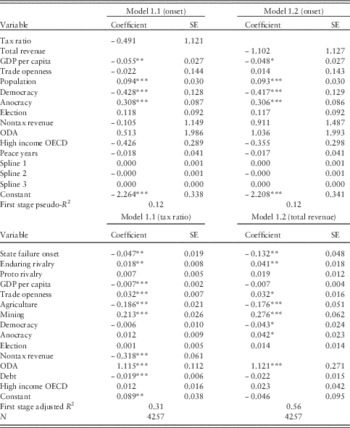
The use of the two-stage estimation technique for the system of simultaneous equations modeling state failure and state capacity produces some interesting results. In all models, the instrumented variables produced in the first stage estimation exhibit good fit as indicated by relatively high R 2 values (Staiger and Stock, Reference Staiger and Stock1997). The quality of these instruments is also reinforced by the fact that there is little difference between the standard errors produced by the Maddala (Reference Maddala1983) procedure in the second stage of estimation or if we obtain White (Reference White1980); Newey and West (Reference Newey and West1987) robust standard errors at the conclusion of the first stage.Footnote 10 I only present the results from the Maddala (Reference Maddala1983) procedure produced in the second stage of the estimation procedure in the tables discussed below. Table 1 present the results from the simultaneous equation models of state fiscal capacity and state failure onset. The top half of Table 1 shows the first part of these models by demonstrating the effect of both measures of state fiscal capacity on state failure onset.
The simultaneous effects of state fiscal capacity and state failure onset

GDP=gross domestic product; ODA=Official Development Assistance.
Two-tailed test, *P<0.10, **P<0.05, ***P<0.01.
The top half of Table 1 demonstrates that state fiscal capacity does not deter state failure onset, whether measured in terms of the tax ratio (Model 1.1) or total revenue (Model 1.2). The signs are in the expected direction, but the standard errors indicate that these coefficients are far from statistical significance. This finding is inconsistent with predatory theory’s expectations that higher levels of revenue extraction, reflecting higher levels of state fiscal capacity, are likely to prevent state failure.Footnote 11 Several of the typical control variables are significant as expected. GDP per capita reduces state failure onset. Democracy reduces state failure onset compared with autocracy, while anocracy increases the likelihood of state failure compared with autocracy.Footnote 12 Both of these findings are typical in the quantitative state failure literature, thus lending confidence to the models themselves. Contrary to Chauvet and Collier (Reference Chauvet and Collier2008), neither nontax revenue nor ODA have a significant effect on state failure onset.
The bottom half of Table 1 shows the second half of these models by demonstrating the effect of state failure onset on both measures of state fiscal capacity. State failure onset reduces state fiscal capacity, whether it is measured in terms of the tax ratio (Model 1.1) or total revenue (Model 1.2). This finding was expected from our discussion of predatory theory. It reflects the fact that challengers to the state are able to reduce their revenue contribution, or that they are able to prevent revenue extraction generally during these episodes. The bargaining power of the state is weak as at the onset of state failure. State rulers are able to use enduring rivalries to increase the extractive capacity of the state, whether measured by tax revenues or total revenues. As expected, the discount rate of rulers faced with contemporary enduring rivalries is low. This enables rulers to run a type of protection racket to ratchet up their revenue extraction. Proto rivalries are not significantly related to revenue extraction, most likely due to their shorter time frames and less frequent militarized disputes. These two findings are generally consistent with Thies’s (Reference Thies2004) previous work.Footnote 13
A number of other control variables exert significant effects on the tax ratio and total revenues. Higher levels of GDP per capita reduce revenue extraction, which is not expected given its anticipated effect in reducing transaction costs. Yet, it is possible that our sample of developed and developing states may have complicated this relationship, since we might expect reduced extraction at the upper levels of GDP per capita (although the high income OECD variable is not significant). Trade openness and mining both increase revenue extraction as expected, while agriculture reduces revenue extraction as expected. Regime type and elections are not significantly related to revenue extraction, thus failing to bring sense to the previous mixed empirical findings (e.g. Cheibub, Reference Cheibub1998). The alternative sources of ruler revenue are significantly related to the tax ratio especially. Both nontax revenue and debt reduce the level of tax revenue extraction, since they are substitutes for taxes.Footnote 14 These revenues are known to provide rulers with often poorly regulated sources of income. Unfortunately, as the previous models demonstrated, nontax revenues do not help to deter state failure onsets as Morrison (Reference Morrison2009) might expect. Curiously, official development assistance actually increases both the tax ratio and total revenue, suggesting rulers may actually be putting such funds to good use. Yet, again the previous models indicated that none of those uses was to deter state failure onset.
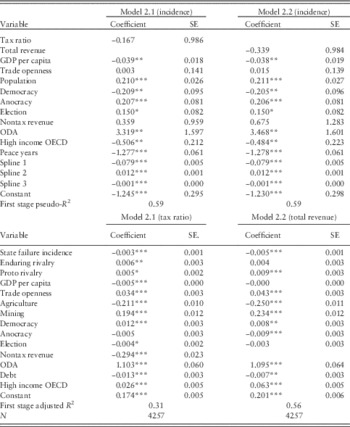
Table 2 considers the simultaneous relationship between state fiscal capacity and state failure incidence. Recall that onset measures only the beginning of a state failure episode, while incidence measures each year that an episode is ongoing. The top half of the table demonstrates that neither measure of state fiscal capacity significantly reduces state failure incidence, though the signs are in the expected negative direction. This finding again contradicts our expectations from the predatory theory approach. GDP per capita, population, democracy, and anocracy all exert the same statistically significant effects that were found in the models of state failure onset. Elections are found to have a significantly positive effect on state failure incidence, as expected from Bates’ work. Interestingly, elections did not precipitate state failure onset, but once in a failure situation, elections seem to be a focal point for unresolved discord and conflict. ODA has a somewhat unexpected positive effect on state failure incidence, though it is consistent with some of Chauvet and Collier’s (Reference Chauvet and Collier2008) findings. The role of ODA in the state failure process clearly needs more theoretical and empirical specification, since it seems to delay resolution of state failure. The dummy variable for high income OECD countries is also negatively related to the incidence of state failure, suggesting that these states are able to recover from failure faster than others.
The simultaneous effects of state fiscal capacity and state failure incidence

GDP=gross domestic product; ODA=Official Development Assistance.
Two-tailed test, *P<0.10, **P<0.05, ***P<0.01.
The bottom half of Table 2 confirms our theoretical expectation that state failure incidence also reduces state fiscal capacity, whether measured by the tax ratio (Model 2.1) or total revenue (Model 2.2). Enduring rivalry, GDP per capita, trade openness, agriculture, mining, nontax revenue, ODA and debt all have similar effects on incidence as they had on onset. Proto rivalry now also produces a positive effect on state fiscal capacity in the incidence equations. Democracy produces higher levels of state fiscal capacity, while anocracy produces lower levels. Some evidence of a political business cycle is found through the negative effect of elections on the tax ratio. In general, the incidence models are somewhat more robust than the onset models, since the number of onset years is much lower than incidence years.
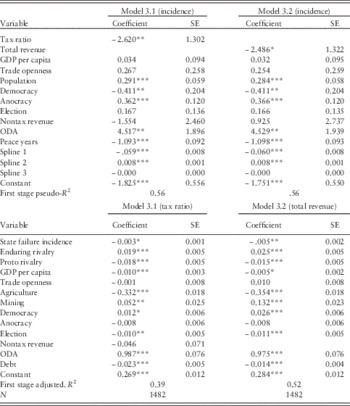
Given that Bates’s (Reference Bates2008a, Reference Batesc) work has found that total revenue reduces the incidence of state failure, I reanalyze the findings from the incidence equations in the subsample of sub-Saharan African states in Table 3. The top half of Table 3 shows that state fiscal capacity reduces state failure incidence in sub-Saharan Africa, whether measured by the tax ratio (Model 3.1) or total revenue (Model 3.2). This evidence is consistent with the results from Bates’s (Reference Bates2008a, Reference Batesc) single equation models of state failure incidence. This evidence confirms Bates’s work despite the fact that he measured state failure incidence in terms of the presence of militia groups, rather than use the PITF data as in the present study. Yet, my simultaneous equations framework also expands that finding to include the negative effect of state failure incidence on state fiscal capacity as found in the bottom of Table 3. A few other findings are notable in the African subsample as well. Enduring rivalry has a positive effect, while proto rivalry has a negative effect, on state fiscal capacity. This finding replicates Thies’s (Reference Thies2007) results for Africa. Democracy reduces state failure incidence and increases state fiscal capacity in Africa, while anocracy tends toward the opposite effects. Elections do not significantly affect state failure incidence, though they reduce state fiscal capacity similarly to the models in Table 2. Curiously, ODA both increases state failure incidence and state fiscal capacity. Again, this puzzling finding requires additional theoretical and empirical work. The good news is that a more general predatory theory-informed model was able to replicate Bates’ findings for Africa using different variables, measures, and statistical techniques. This is much more than the simple replication we are used to in the literature, and it lends credence to both Bates’ previous work and the results in this study.
The simultaneous effects of African state fiscal capacity and failure incidence

GDP=gross domestic product; ODA=Official Development Assistance.
Two-tailed test, *P<0.10, **P<0.05, ***P<0.01.
Conclusion
This paper developed a generalizable predatory theory approach to the phenomenon of state failure, which has a long tradition in explaining state building from early modern Europe to the contemporary developing world. The causal connection between state building and state failure is argued to be in the revenue generating strategies of the ruler. Rulers acting as rational predators attempt to maximize their revenue subject to constraints in their environment. One important constraint is the presence of internal challengers to the state whose unchecked activities constitute our contemporary understanding of state failure. If the state fails in what Tilly refers to as its ‘statemaking’ activities to neutralize internal rivals, then the state has failed in one of its most important activities. When internal rivals gain the upper hand in their bargaining power with the state, the ruler’s revenue is surely to suffer. Without revenue, how can the state meet the many demands placed upon it from within and without? The short answer is that it cannot, and it is bound to find itself engaged in violent internal struggles that bring widespread normative condemnation in the contemporary international system. In earlier times, the state’s external rivals would use this as an opportunity to gain new territory and population through conquest. Since territorial revisionism and conquest are inconsistent with contemporary norms and international law (e.g. Atzili, 2006/Reference Atzili07), contemporary states facing external rivals often use this threat instrumentally to run a protection racket in order to generate revenue from those segments of the population who support their continued rule. The result of the ruler’s reaction to internal and external rivals often produces states that are too weak to effectively govern, yet strong enough to repress.
The empirical results from the pooled model presented in this paper conform to this rather bleak picture of many contemporary states. While increased state fiscal capacity does not seem to deter state failure onset or incidence, such onsets and incidence reduce state fiscal capacity. Efforts to augment revenue generation through the protection racket of an enduring rivalry with another state appear to be successful, but obviously not to the point of building strong, capable states. The results from the subsample of African states actually conform more closely to our expectations from predatory theory. In Africa, state fiscal capacity deters state failure incidence even though incidence simultaneously reduces state fiscal capacity. The protection racket associated with enduring rivalries is operating in Africa to increase state fiscal capacity, but the less threatening proto rivalries are also decreasing state fiscal capacity. The empirical evidence provides few other policy levers a ruler in Africa or elsewhere can pull to prevent failure or increase fiscal capacity. While official development assistance seems to enhance state revenue generation, it also appears to have no direct effect on state failure onset. More problematic is ODA’s apparent positive effect on both state fiscal capacity and state failure incidence. More work along the lines of Chauvet and Collier (Reference Chauvet and Collier2008) is needed to sort out the theoretical and empirical implications of aid on state failure, while also considering its role in state fiscal capacity. Most of the other variables represented in this analysis are structural features of the economy or the political system that are not easily changed either, even if a ruler would want to change them.
While state fiscal capacity may not deter state failure onset or incidence (outside of Africa), it may affect other aspects of the state failure process. Future work might consider whether state fiscal capacity reduces the duration of state failure episodes. Further research might also consider the contribution of state fiscal capacity to what Chauvet and Collier (Reference Chauvet and Collier2008) call a ‘sustained turnaround’ from being a failing state. It is curious that these authors investigated the impact of certain types of nontax revenue (natural resource rents and aid), but did not examine the overall impact of tax revenue. Enhancing the fiscal and administrative capacity of the state may prove to be a worthwhile investment of aid agency efforts – especially in Africa. Such efforts may produce states that are capable of governing effectively as predatory theory would expect. Regardless of the expected importance of state fiscal capacity in the predatory theory approach, it is clear that future work on state failure must be motivated by a strong theoretical perspective. The current qualitative and quantitative literature lacks coherence and focus with a wide variety of potential explanations of state failure and dramatically different conceptualizations and operationalization of state failure itself. Grounding this work in existing theory about the state is essential to future progress on the subject.
Acknowledgments
The author would like to thank Phil Arena, Jonathan DiCicco, Sara Mitchell, Clayton Thyne, Brandon Valeriano, and the anonymous reviewers for their helpful comments on previous versions of this paper.