Introduction
As with most institutions, a lot can be gleaned from the kinds of reports it writes – both about the organisation or institution itself and the issues with which it is concerned. For example, a charity devoted to heritage or conservation typically produces an annual report, often including a summary financial statement, an account of subscribers or membership, perhaps some snapshot case studies, staffing news, book reviews and usually a welcome or introduction from the chairperson. Such reports can be glossy, highly visual and well-styled. The same charity will also produce its annual accounts. It might also produce other kinds of reports that are more technical and focused on a single issue. With footnotes or endnotes, subheadings, chapters or numbered paragraphs, such reports have the air of findings after an inquiry and are often written by a committee specifically set up to engage with the matter of concern. Some of these are for internal discussion, whilst others are intended to serve as position papers for broader dissemination.
This essay is a report on reports – or rather, to borrow the subtitle from the philosopher Jean-François Lyotard’s The Postmodern Condition Footnote 1 (1979/1984), this is ‘a report on knowledge’. Specifically, we are concerned with what kinds of reports the Church of England produces and what that tells us about the kinds of knowledge English Anglicanism thinks it has. Specifically, our focus is on the ‘consecrated pragmatism’Footnote 2 that has emerged within its ecclesial bureaucracy during the early years of the twenty-first century. I write as someone who has contributed to such Church of England reports in the past, as well as being an established critic of other reports that cover leadership, gender, sexuality, polity, authority, power and the like.
What is offered in this review essay is a kind of ‘deconstruction’ of reports that the Church of England issues, spanning the last 40 years. Correspondingly, this essay can serve as a briefing for those in the Church of England engaged in the work and writing of any future reports. To some extent, this is motivated by an innate curiosity, centred on what particular knowledge the Church of England thinks it brings to the arenas of doctrine, polity, public policy, political issues, education and pastoral praxis. I hold that it rarely brings anything new to these spheres that could be putatively applicable to a broader audience or would command attention in the academy. In short, the very exercise of Church of England report writing is, in and of itself, something that merits attention. Why does the church feel the need to issue reports and statements? To whom does it think it is speaking?
I have taken 1985–2025 as the window, as that stems from the date (1985) when Faith in the City Footnote 3 was published, authored by the Archbishop of Canterbury, Robert Runcie’s Commission on Urban Priority Areas. In so doing, I readily acknowledge that there have been other substantial Church of England reports in the post-war era. For example, The Archbishops’ Commission on Church and State (1970)Footnote 4 – often cited as The Chadwick Report (due to Owen Chadwick’s scholarly input on church-state relations) – proposed reforms that gave the Church of England more internal control of its affairs while retaining Parliament’s final authority. It was, as a report, intellectually rich and robust.
Likewise, the Commission responsible for Faith in the City sought to examine the strengths, insights, problems and needs of the Church’s life and mission in Urban Priority Areas (UPAs) and, as a result, to reflect on the challenge which God may be making to church and nation, and to make recommendations to appropriate bodies. At the time, the report generated significant controversy, particularly for its conclusions that much of the blame for the growing spiritual and economic poverty in British inner cities could be traced to government policies.
For our purposes here, we note that Faith in the City was, like The Chadwick Report, the result of work from a commission that had consulted widely and engaged substantially with the data sets available in previous years. Faith in the City made 61 recommendations, of which 38 were for the Church of England, and 23 were directed towards the government. The areas addressed included levels of unemployment, overcrowding in housing, homes lacking basic amenities, pensioners living alone, ethnicity and racism and single-parent households. It was, as a report, methodologically solid.
Faith in the City probably represents the high-water mark for Church of England reports over the past 40 years. Nothing as extensive, deep and rich has appeared since. But here, it is essential to have some understanding of how commissions in the Church of England initially evolved and eventually dissolved. The Doctrine Commission, as a Church of England body, was established in 1922. In the early years, the Commissions addressed matters of faith within the church through reports such as Doctrine in the Church of England (1938),Footnote 5 Christian Believing (1976)Footnote 6 and The Mystery of Salvation (1995).Footnote 7 Members of the Commission were nominated solely by the Archbishops of Canterbury and York, with many of its reports being published ‘under authority’, even as recently as We Believe in God (1987).Footnote 8 This practice continued into the twenty-first century, but after the completion of Being Human in 2002,Footnote 9 no further Doctrine Commission was nominated.
In 2010, a new body was established, which rolled the former Doctrine Commission and the Faith and Order Advisory Group (FOAG) into a single Faith and Order Commission (FAOC). However, the newly formed ‘FAOC’ was constituted as a sub-committee of the General Synod, taking responsibility for producing theological reports ‘for the House of Bishops’. Perhaps unsurprisingly, the membership of the Commission is weighted towards reflecting the complexion of ecclesial party interests. Thus, representation on FAOC includes those opposed to the ordination of women from either Catholic or conservative evangelical perspectives, others with empathy for complementarian positions and others who may potentially support pro-LBGTQ+ views (though they are less conspicuous). Of the nine theologians on FAOC, fewer than half hold academic positions in English universities. Among the eight bishops selected for FOAC, only one has held an academic post in a university, although some have held positions in theological colleges.
It is beyond the scope of this inquiry to survey other Doctrine Commissions across the Anglican Communion. It is enough for our purposes here to note that the vast majority of Anglican provinces have no such body. Insofar as they take account of Anglican doctrine and its development, they would be reliant on steering and leadership from the Anglican Consultative Council and its subsidiaries. Otherwise, Anglican Doctrine Commissions are primarily confined to Scotland, Ireland and WalesFootnote 10 and other parts of the Anglican Communion where the Church of England was once established or held to be the national church. Thus, the Anglican Church of Australia has a Doctrine Commission,Footnote 11 but it would be peculiar to encounter such a body in South America, most of Africa and the Far East. The Episcopal Church of the USA resorts to its convention to review doctrine, and with predictably bold resolutions.Footnote 12
The evolution and composition of FAOC are essential to understand. Since it now functions as a sub-committee of General Synod, the body is subject to the usual constraints of the growing managerialism that has come to dominate the Church of England in the twenty-first century. Tellingly, the purpose of FAOC and its writings is carefully elucidated as
‘[advising] the House of Bishops, the General Synod, the Council for Christian Unity and the Church of England as a whole on theology. FAOC writes theological resources and reports, to support the church’s work…[it] has up to sixteen members, who are appointed by the Archbishops. Its episcopal members also make up the Episcopal Reference Group…’.Footnote 13
This is entirely consonant with how Church of England dioceses now operate, with parishes, theology, mission and ministry subordinated to the management of a diocesan headquarters, which in turn is subordinated to the singular central ‘command-and-control’ ethos established in London. Thus, Bristol diocese, in recently publishing its new brochure Statement of Needs for its next bishop, clearly did not feel it was strange that almost as many people are working in diocesan HQ (80) as there were clergy serving in the diocese (90), effectively giving a 1:1 ratio of administrators to clergy. The diocese has 193 parishes (a different figure – 166 – is cited earlier, suggesting that the authors may not be clear about the difference between a parish and a benefice). The diocese is serving 1.1 million people and a ‘worshipping community’ of 11,000, which amounts to just 1% of the population. The Statement of Needs brochure reports that the diocese has an income of £11.8 million and an expenditure of £16.6 million, which represents a recurring loss of £5 million per year, which may be a concern.Footnote 14 To fund the diocese in line with its expenditure would therefore require each worshipper to contribute around £1500 per year.
Although all Church of England diocesan headquarters have swelled in size and range over the past 50 years, Bristol’s Statement of Needs petitions for its new bishop to be ‘a strategic leader’ and assumes that the worshippers will already share the diocesan vision and strategy. This seems unlikely. Indeed, it is probably the case that of the 11,000 worshippers in the diocese, few will know anything of its vision and strategy or much care for it.
With 80 personnel working in the diocesan HQ, we also note that very few Anglican provinces have staffing on this scale. Bishops have managed for almost two millennia without an extensive array of diocesan administrators, and their expense and expendability seem to be something that the authors of the Statement of Needs have not entertained. But as they wrote the document, this was not so surprising. It does not occur to the authors of the Statement of Needs to refer to the Ordinal. The traditional fourfold canonical duties for a bishop – caring for clergy in the parishes, educating clergy and laity, leading mission in the locality and being a focus for unity in the church – are barely implied. But a ‘strategic leader’ is deemed essential by the ‘lanyardocracy’ and ecclesiocrats drafting such documents. Their jobs depend on promoting such documents, replete with their managerial grammar of assent.
However, our purpose here is not to offer an elegy for bygone days, but rather to enquire into the state of knowledge (and reports of knowledge) since 1985. Lyotard wrote his highly influential essay in 1979 and assessed the notion of knowledge in postmodern society as the end of what he termed ‘grand narratives’ or ‘metanarratives’, which he considered to be a quintessential feature of modernity. Lyotard appropriated the term ‘postmodernism’, which was previously only used by art critics, into philosophy and social sciences, with the following observation:
‘Simplifying to the extreme, I define postmodern as incredulity towards metanarratives’.Footnote 15
Originally written as a report on the influence of technology in what are termed ‘exact sciences’, what was remarkable about Lyotard’s work was its applicability to literature, philosophy, political discourse and religious statements (including doctrine) and the organisational infrastructures that enforce such statements.
Language, Truth and (Ecclesial) Logic
It was perhaps no surprise that the Church of England made some kind of an attempt to wrestle with postmodernism. In Tomorrow is Another Country, Footnote 16 a Church of England working party attempted to get to grips with the implications of postmodernity for church teachings and theological education. The report is perhaps unremarkable in suggesting that new ideas are superseding traditional educational approaches, that the fundamental goals of education might need re-evaluationand that educators must adapt to a world where universal truths are now being questioned and replaced by diverse perspectives. There is a kind of pining at work in Tomorrow is Another Country. The report acknowledges the emergence of a more relativistic post-truth world and recommends that the church adapt. But at the same time, the report does nothing to address the problems of authority and accountability in an ecclesial ecosystem that resists any challenge to the power of its hierarchy and continues to invest in metanarratives, be they doctrinal or directives on institutional organisation. The result is a very peculiar ‘mash’ of pre-modern assertions grieving over challenges to the certainties of modernity but unable to navigate the emerging contours of postmodernity.
I note with interest that the document follows the pattern adopted by nearly all post-1985 Church of England reports. First, theological engagement with the subject is thin and limited, appearing unaware of developments in education and theology beyond its immediate parameters of concern, and certainly sources outside Great Britain. It is, in other words, quite parochial in character. Second, the trajectory of post-1985 reports shows a steady decline in the range and depth of interlocutors drawn from the wider academy. Third, the interlocutors featured in recent reports increasingly represent a cocktail of ecclesial party positions rather than a wider academic theological pedigree. Fourth, the language of the reports is managerial, highly pasteurised and geared towards a kind of ‘corporate-speak’ but has the added ‘imprimatur’ of a bishop chairing the exercise that produced the report, which seems to function as a code for legitimacy and authority. Put another way, the reports seek to ‘put to bed’ the very issues they address. They present as superficially definitive, or steps along the road to that goal, and are therefore engaged in a kind of pedagogical muting. For the most part, this is implicit and probably the result of some kind of corporate subconscious at work.
Of course, most groups, institutions and societies will have some way of talking around an awkward subject whilst also managing to avoid or confront the presenting issue. ‘The elephant in the room’ is a classic trope for mannered English avoidance. But the English are hardly alone. Anthropologists note the Trobriand people of Papua New Guinea, who use the word mokita to describe a truth everyone knows but no one speaks aloud. It is what everybody knows, but nobody says. ‘The Emperor has no clothes’ would be an exemplar of this. This quiet, cultural acknowledgment of shared-but-suppressed truths reflects something deeply personal, social and institutional. Namely, our tendency to avoid discomfort, preserve harmony and protect ourselves and others from the consequences of open, expressive truth-telling.
In Western psychology, this concept aligns with the phrase ‘polite fictions’ coined in an article by the American social psychologist Tom Burns.Footnote 17 Burns, mokita-like, analysed the unspoken agreements that maintained a socially acceptable version of reality, even if it contradicted what everyone knew to be true. These silent understandings are rarely malicious. Instead, they serve as social lubricants, helping us to maintain relationships, avoid conflict and preserve identity. (Most Church of England reports on sexuality have this characteristic).
Leonard Saxe’s 1991 study of ‘white lies’ concurred.Footnote 18 Saxe saw white lies as ‘social lubricants’ – actions or deceptions that facilitate smooth social interactions. Rather than being malicious, such common behaviours, like telling white lies, are often accepted as necessary to negotiate social life and avoid conflict. Most parent-child, marital and familial relationships accept this as a normal social glue. ‘I’m running a bit late, honey…traffic heavy’ probably means I didn’t leave early enough or on time as I promised. I have lost count of the number of times I have said this to my nearest and dearest. White lies are commonplace, and they are not inherently immoral. Most parents have used a white lie to soothe a child in pain, distress or fear. Sometimes the truth hurts. And even tiny admissions can be painful. White lies can be balm. But they can also be recruited in the service of denial. (Again, most Church of England reports on sexuality share this characteristic).
In John Langshaw Austin’s How to Do Things with Words (1962),Footnote 19 the author offered a foundational exploration of speech act theory, emphasising how language can perform actions rather than merely convey information. Austin introduced the concept of ‘performative utterances’, which do not aim to describe facts but instead affect actions, such as promising or naming. He differentiated these from ‘constatives’, which can be evaluated as true or false. The work outlines the conditions under which performatives can be successful or infelicitous, highlighting that the effectiveness of a performative relies on the context and intentions of the speaker. Austin categorised speech acts into illocutionary acts – those that execute an action through speaking – and perlocutionary acts, which are the effects those utterances have on listeners.
Freddie (A.J.) Ayer might also interject at this juncture and argue through his 1936 manifesto on logical positivism that doctrines are unverifiable propositions.Footnote 20 Ayer advocated his ‘verification principle’: a statement is meaningful only if it is an analytic truth (actual, like in mathematics) or empirically verifiable (testable by sense experience). Ethical, emotional and spiritual statements were not factual assertions. As Ayer saw it, a proposition must be either a tautology (analytic truth) or capable of being verified (or falsified) through sense experience to be considered meaningful. He further clarified this by distinguishing between analytic and synthetic propositions. Analytic propositions, which are true by definition (e.g., ‘all bachelors are unmarried’), and synthetic propositions (e.g., ‘our hearts are restless until we find God’), which assert empirical facts and are validated by experience.
But what happens when words are put to work – intentionally – to avoid truths and issues that might need to be faced? To pick a significant, elephant-like example, compare the coronation of George VI in 1936 with that of Elizabeth II in 1952. George VI was crowned as ‘George VI of Great Britain, Ireland and the British Dominions Beyond the Seas, and Emperor of India’. But after the Second World War, with the British Empire lost and the likes of Australia and Canada not wanting to be grouped in with Africa and the Caribbean, a new form of words was needed. So Queen Elizabeth II was crowned as ‘Queen of the United Kingdom, Northern Ireland and Her Other Realms and Territories’ – with even the label ‘British’ avoided. A small number of critics at the time – notably Enoch Powell – were rather scornful of this, opining that it was tantamount to saying ‘the king is king of his kingdom’, a kind of tortured tautology.
Coronations, of course, are liturgical rites of passage that take the nation into the heart-chambers of its ghetto of sentimentality. The pomp, ceremony and words are there to project a domain that affirms English nativism whilst also embracing internationalism (e.g., ‘the Commonwealth’). Likewise, the enthronement of an Archbishop of Canterbury and the appeal to a worldwide Anglican Communion will perform the same rhetorical devices in parallel. In both examples, the recited words outperform the political, legal and social reality. The entire notion of a ‘realm’ is projected, yet it is not explained. Similar rhetorical devices may be deployed locally (e.g., clergy claiming ‘the cure of souls’ for a parish, irrespective of the consent or composition of the citizenry).
In the same way, the very myth of the Church of England suggests it is always overreaching itself to be more than just an ‘English Church’ or ‘the church established by law within England’. It engages in a kind of ‘serious fiction’. Many view it as Ecclesia Anglicana, the national church that should define the spiritual life of England’s Christians. While questioning its factual accuracy may seem pointless, the myth’s significance endures, regardless of its truth. The Church of England’s evolving identity and the shifting meanings of ‘Anglicanism’ arise from the myth created by the original founding terminology.
Yet the labels ‘Anglican’ and ‘Church of England’ were novel and only gained their new meanings during the very late sixteenth and seventeenth centuries. In so saying, this is simply to note the complex, contested and evolving identity of the Church of England, along with the intricate meanings and boundaries of ‘Anglicanism’, which will tell us a great deal about the kinds of knowledge the church thinks it has. That, in turn, has a significant bearing on the types of reports it writes for itself and who it imagines its readership to be.
From this, I surmise that the term ‘the Church of England’ is not a statement of fact. Furthermore, to pre-empt theological claims by stating that this ‘doctrine of the Church of England’, and then following that with a range of assertions, is more akin to an exercise of rhetoric, using synthetic propositions to persuade the reader or hearer. As we shall see, once such terminology is subjected to more intensive archaeological scrutiny, the claims stemming from ‘a report from (or the doctrine of) the Church of England’ start to feel uneasy. Whilst I do not follow Ayer to his conclusion – that such claims are literally meaningless because they cannot be verified by experience and do not express analytic truths – I do concur that statements or doctrines claiming to be of or from the Church of England are more ethos-related or ethical in character (e.g., ‘kindness is good’ or ‘belonging to church is beneficial’). They do not, in fact, express facts but rather convey sentiments or act as commands.
Explorations in Deconstruction
Before we explore the implicature of this for Church of England reports, let us outline a brief taxonomy of reports that could be considered. The first kind is (following Lyotard) from the realm of technology and ‘exact sciences’. Here we think of statistics (e.g., attendance patterns, numbers of baptisms, weddings and funerals, etc.) and of financial reports (e.g., Church Commissioners’ Annual Reports, Pension Board, etc.). The second kind is externally focused in character and might, for example, be constituted as a response to the emerging climate crisis, environmental concerns or ecological debates.Footnote 21
The third kind is more akin to brochures and tends to be geared towards consolidating impact in spheres where the Church of England continues to act as a stakeholder (e.g., higher education, Church of England schools, etc.). In some cases (e.g., the very glossy Faith in Higher Education, 2020),Footnote 22 these will set out a pre-emptive argument for its continued involvement in various spheres because it is the national church of England. We note that these ‘reports’ are more akin to a ‘pitch’ attired as a brochure and are self-aggrandising in tone and character. Presumptive in orientation, they are often blinkered in how they address the external constituencies they seek to serve. For example, it is very hard to see why vice-chancellors (in England or the rest of the UK) would pay any attention to the Church of England’s vision for higher education.
The fourth kind – and by far the most common – will be concerned with the Church of England’s internal affairs, including vocation and ordination, the role of the laity, sexuality, gender, safeguarding, governance, liturgy, mission and ministry. These reports are, arguably, the ones that are conspicuously indicative of the Church of England’s theological decline. In terms of ‘a report on knowledge’, we can make the following (general) trinity of observations.
First, the writing of such reports will have some air of authority or superiority by virtue of the assemblage of interlocutors. Most likely chairing the report will be a bishop. However, it is highly unlikely that the same bishop will have the necessary theological competence in the relevant field. Any bishops writing about safeguarding with no relevant academic qualifications, professional regulation or externally validated expertise will inevitably produce thin returns. In safeguarding, the Church of England consistently uses internal self-validating interlocutors to reaffirm its positions. The result is an incoherent muddle of claims and assertions, lacking the theology to command respect outside its own points of reference.
Second, the last 40 years have seen an increased trend towards Church of England report writing, justifying expedient and pragmatic decisions and only after that, trying to find some kind of convenient theological gloss and claiming it as the point of origin for the work. To a large extent, nearly all of the Church of England’s output on lay ministry, discipleship and ‘equipping the laity’ would fall into this category. Where it is hard to discern an intelligible philosophy of pedagogy – let alone some complementary theological vision for such – that would suggest an institution not engaged in any serious critical self-reflection.Footnote 23
Third, there is a qualitative unevenness to the post-1985 Church of England reports. Mission-shaped church (2004, 2009, etc.), which launched ‘Fresh Expressions of Church’ (FX), represented the idolising of the new and novel. Lacking any serious ecclesiology or theology from the outset, the FX movement has always been an example of pragmatism desperately seeking some principles in which to be clothed. As with so many policy-oriented reports, the lack of grounded theology eventually emerges to haunt the preferred pragmatics. For example, ‘flying bishops’ (also known as ‘alternative episcopal oversight’) might have seemed like useful politicking to ensure the vote to ordain women to the priesthood went forward in 1992. But experience has shown that the schism sought to be averted has merely legitimised further fractious tendencies.
From these three observations, we can surmise that the same results are likely to emerge with the Church of England’s tussle over same-sex relations and processes initiated under the Living in Love and Faith umbrella, which began in 2017. Typically, contemporary Church of England reports will use an assemblage of persons who represent ecclesial party interests and seek some kind of balance or compromise. Reports rarely, if ever, engage systematically with major theological interlocutors. One has to look back to the likes of Faith in the City or The Chadwick Report and their sponsoring commissions to find theologians engaged in the work who carried significant weight in the academy, besides the church.
As a general rule, reports on education (e.g., the 2016 and 2021 reports on higher and further education) will use derivative theological sources but avoid the likes of Paulo Freire. Virtually all Church of England reports from the George Carey era (1991–2002) onwards have been strongly managerial in character and flavour, and rarely if ever have any theological foundation and doctrine that might unite the interlocutors. They are essentially internal pasteurised ‘position papers’. Arguably, The Turnbull Report: Working As One Body (1995)Footnote 24 , and its attempted review of governance, was an early representative apotheosis for the kind of Church of England reports that emerged in the following 30 years. They can be characterised as pragmatism seeking principles, with a late-applied and light coating of theological gloss. They represent forms of consecrated pragmatism.
This might have been transformed under the Archepiscopal leadership of Rowan Williams (2002–2012), who would widely be regarded as the most substantial theologian and public intellectual to have occupied the See of Canterbury in modern times, and possibly since the Reformation. However, with Rowan’s intellectual prowess, the Doctrine Commission faltered even more under his tenure (what could a committee possibly add to or improve on what he might say?). But perhaps more problematic was Rowan’s unwillingness to address the growing culture of managerialism and centralised bureaucracy, coupled with increasingly specious missional innovations. Unwilling to tackle the political manoeuvring and politicking that ran alongside these developments, a monied evangelical lay-led ecclesiocracy was in the ascendancy and joined by conservative Catholic pressure groups determined to prevent theological leadership of any serious kind.
Under Justin Welby’s (2012–2025) tenure as Archbishop of Canterbury, such reports became even more pronounced in their managerialism. The 2014 Green Report Footnote 25 on senior leadership in the Church of England was an egregious example of this. It does not have a theology, though it does contain a smattering of theological references. At the same time, the Green Report showed absolutely no knowledge of or immersion in the academic literature on leading (voluntary) institutions. A culture of managerialism and pragmatism is what largely drives the work, and in the case of the Green Report, it was largely clear that Welby already knew what his direction of travel was from the outset, so he commissioned a former banker, Stephen Green, to chair the work (though it was probably mainly shaped by Paula Vennells, formerly the CEO of the Post Office).
Only very late in the day, with the plans and policies drafted mainly in the Green Report, did Welby decide he needed some theological gloss and covering fire so that the report could be positioned as ‘theological’. Several theologians were duly drafted in to provide this service but famously declined to oblige. Nonetheless, the Green Report still felt able to list them as ‘consulted’ in a kind of roll call – even though they had refused to participate in the exercise. Their act of self-exclusion was glossed over and not mentioned. The report was subsequently subjected to substantial and sustained criticisms.Footnote 26
Likewise, the recent work attempted by the House of Bishops on trust and confidence in the Church of England’s leadership and episcopacy had to be cancelled due to the lack of trust and confidence in the authorship and remit of the documents. Those who had been engaged in the writing of the report lacked immersion and knowledge in the relevant academic fields, and the work collapsed under the weight of its own inner contradictions.Footnote 27
What we can say in this ‘report on knowledge’ is that light-touch retrospective theological reflection is how most Church of England reports are now written. And to avoid potential offence and hostages to fortune, major theologians drawn from the relevant field will usually not be consulted. Likewise, they will most likely be omitted from the written references cited, and their arguments and insights will not be engaged with. It would be very, very surprising to see any Church of England report on safeguarding mention or engage with major theologians who write about domestic or sexual abuse.
Thus, ‘missing in action’ (so to speak) in Church of England safeguarding reports will be a range of Mujerista theologians, such as Nancy Pineda-Madrid, Ada María Isasi-Díaz and Ivone Gebara, who have all examined abuse by focusing on the trauma and lived experiences of abused Latina women and criticising the patriarchal structures within the church that enable oppression and violence. They will all be excluded. Also missing will be the likes of David Toombs, Marie M. Fortune, Hans Zollner, Rebecca Ann Parker, William Cavanagh, Rita Nakashima Brock, Adrian Thatcher and Jennifer Greenberg, to name but a few. Such writers on sexual abuse will be excluded. However, Lisa Oakley (University of Chester), an ‘approved interlocutor’ for the Church of England and undoubtedly a good writer on abuse, will occasionally be cited in English Anglican safeguarding written materials. However, it should be noted that she does not claim to be a theologian.
In some respects, the Church of England’s written reports, broadly drafted for self-consumption, cannot afford to offend the competing parties and interests that it seeks to homogenise. So an issue such as domestic abuse and violence that might be rooted in complementarian theology will be avoided. Yet it is an established trope of the Church of England’s safeguarding literature that any person in almost any state of ‘temporary vulnerability’ qualifies for definition as a ‘vulnerable adult’. Such a broad definition – it must cover every adult at some stage during any day – seems to fly in the face of basic common sense. But as there is an Ouroboros-type character to these documents (i.e., the ancient symbol of a snake eating its own tail, representing cycles of destruction and unity), their self-consuming character is not at all surprising.
There are also contrary theological positions that the Church of England will decline to address or police. The likes of James Dobson (author of Dare to Discipline, 1970)Footnote 28 advocated physical punishment of children up to puberty as ‘biblical’. Dobson’s views were widely feted in English conservative evangelical Anglican churches. More recently, some Sydney Anglican Evangelicals have argued that cases of domestic abuse in Christian families should ideally be dealt with internally by the church and not involve the secular authorities, such as the police.Footnote 29 Their adoption in conservative evangelical English Anglican churches would likely attract no concern or criticism from their safeguarding officers.
Correspondingly, most scholars assessing the Church of England’s Protecting All God’s Children (2010) and Promoting a Safer Church (2017) would concur that these are just extremely shoddy pieces of work. They avoid reality and shun controversy. Or, they lack curiosity and are self-limiting in their expertise. The report on post-abuse reconciliation (Forgiveness and Reconciliation in the Aftermath of Abuse, 2017)Footnote 30 is a particularly distressing example of very weak theology, and the work demonstrates minimal knowledge of the field that the report seeks to address. The authors seem to be unaware of the fact that Church of England doctrine has never had a settled definition of a child and that such conceptualisation – legal, historical and cultural in England – has evolved significantly over the centuries.
For example, Charles Dickens’ Oliver Twist (1938) records the sale of the young Oliver to an undertaker after being expelled from the workhouse. The age of consent has varied over the last 200 years, as has the age of majority. The Church of England’s writings on safeguarding are quite clueless historically, theologically, legally and socially. Yet this does not prevent the Church of England from extending the label of ‘vulnerable adult’ to any person, irrespective of whether they claim the nomenclature for themselves.
Church of England safeguarding reports are not drafted by persons with expertise in the field who are subject to legal or social work regulation. Nor are the writers noted as academics in a relevant field or theologians. It is difficult to make a case for the documents having any real gravitas or a natural authority one could trust. The managerial culture that produces Church of England reports is bound to reveal the underlying DNA that creates and publishes such work. Typically, the staff drafting these reports lack any civil service, regulatory or government expertise for report writing and drafting policies. So we cannot be surprised at the paucity of their quality and the lack of clarity about who they are writing for – clergy? Laity? Academics?. The authors (ecclesiocrats) rarely explain this, and, probably, they do not know. The documents are thin and confused, precisely because they are ‘neither flesh nor foul’. Are these policy documents, vision statements, general guidelines, briefings or theological works? I venture to suggest that the authors do not themselves know.
A Precarious Polity
The Church of England is undoubtedly in a precarious position at the present time. Declining numbers, plummeting trust and confidence in the leadership, fewer vocations, scandals and crises; to say nothing of the relentless forces of secularisation and consumerism, all adding up to a perfect storm. We usually think of someone or something ‘precarious’ as being in a poor or vulnerable position, stuck in a situation of risk or danger or facing daunting hazards or uncertain futures. But the word has a somewhat richer meaning, which may be of some help to a polity struggling for identity and purpose and floundering in many of its core functions.
‘Precare’ is a legal term, dating from the mid-seventeenth century, meaning ‘to be held through the favour of another’, ‘depending on the goodwill of others’, and even an ‘entreaty’ that might be obtained by ‘asking for prayer or praying’. The potential precarity of Anglican polity is, therefore, not an inherently weak situation to inhabit. But it is one where concerns must be faced with courage, wisdom, honesty and truthful realism. Correspondingly, it is sometimes the case that the challenges and lacunae the Church of England sometimes faces in various spheres will not be convincingly remedied by making assertions that claim the weight of ‘doctrine’ or even necessarily sustain the declaration that this is the theological position which was always held. Two examples illustrate the point: safeguarding and same-sex marriage.
In safeguarding, the Church of England does not have a canonical or doctrinal definition of children. In terms of its reports on safeguarding, these invariably represent a range of pragmatic issues and problem-solving, searching for theological principles. That is essentially the way English Anglicans have proceeded in theological reflection. There are rarely foundational principles or fundamental doctrines for Anglicans. Their theology is almost always ‘reverse-engineered’ (inductive) and not generative from core fundamentals (deductive or reductive).
Yet there are further complications with this modus operandi. Current debates in the Church of England on same-sex marriage are frequently hobbled by claims that ‘doctrine is being changed’, and this should not be permitted. Leaving aside the innovations on ordination that the Church of England and wider Anglican Communion have embarked upon during the twentieth and twenty-first centuries, the question arises, ‘What is the Church of England’s doctrine of marriage?’. It is evident that the practices of the Church of England, like those of the early Reformed churches, have struggled to define the questions and settle on agreed answers. Asserting that there was always one core, agreed-upon definition of marriage is simply untrue.Footnote 31 Despite the lack of a doctrine of marriage, conservative parties in the Church of England consistently claim that this doctrine exists as a standalone Anglican article of faith. Such claims underline the confusions and contradictions that the Church of England labours under.
Yet underlying our concerns in this essay lurks a deeper problem. Namely, what exactly is ‘the Church of England’ in relation to the reports it writes? Posing the question like this may seem peculiar at first sight. After all, the Church of England manifestly exists and has an identity. But as Alec Ryrie has pointed out, the history of the term ‘Church of England’ is more complex and was really only mobilised by Henry VIII. Prior to that, the term was rarely used, and it was only from the sixteenth century that it began to have some nationalistic meanings, which rapidly became more contested.Footnote 32 The term ‘Anglicanism’ is a later seventeenth-century innovation. Ryrie teasingly suggests that much of the Church of England’s self-understanding is ‘myth’ and even questions whether the church in its self-definition exists.
To be sure, part of the myth-making that the Church of England has encouraged might lie in its claim to have been established in 597 with the arrival of Augustine of Canterbury. Be that as it may, the phrase ‘Church of England’ was rarely in use before the 1520s, and even the Latin Ecclesia Anglicana – more common – referred to various customs rather than a specific polity. Ecclesia Anglicana had gained some more common usage by the twelfth century, and Magna Carta refers to the Church of England as a free agent, with its own rights and liberties, thus outside monarchical or state control.Footnote 33 But as Ryrie points out, there was little by way of unified institutional identity or organisational coherence, for York and Canterbury, as provinces, ran their own affairs, and religious houses – monasteries and convents – were largely outside episcopal or monarchical jurisdiction. If anything, up to the eve of the Reformation, Ecclesia Anglicana was a phrase that stressed the freedom of the church and the limits of the crown. It is only when the possibility of separating Ecclesia Anglicana from the Church of Rome began to be discussed – and this was as early as 1529, before the Act of Supremacy of 1534 – that the term ‘Church of England’ gained something like its current currency. That is the point at which Henry VIII becomes ‘the only supreme heed in erthe of the Church of Englande callyd Anglicana Ecclesia’.Footnote 34
The assertion is awkward, because few at the time could have said with confidence what the Church of England actually was. There was no liturgy or doctrine that differed from Rome in 1534, and even by 1537, Henry VIII could still be spoken of as ‘supreme hed…of thys catholyke Church of Englond’. In terms of identity, the newly emergent Church of England was free from Rome, with the monarch as its Supreme Governor. For some critics, this amounted to sectarianism, and it could be argued that Henry VIII’s acts of secession resulted in something that was not the true Ecclesia Anglicana. But even here, as Ryrie notes, it was not uncommon to speak of ‘the churches’ (plural) of a nation, including England, rather than one single authoritative polity.
By the time of Elizabeth I’s reign, the term ‘Church of England’ had come to have four different but interrelated meanings. First, it could refer to the Ecclesia Anglicana of Augustine of Canterbury or Bede’s Ecclesiastical History. But as we have noted, this refers to an alloy of customs and styles, and it was when the church was not divorced from the Church of Rome. Second, it could have some legal leverage and infer the churches of the realm to which people were subject. Here, it is important to remember that in terms of tithes, taxes, laws and jurisdiction, churches were part of the apparatus of civic governance and effectively coterminous with the realm. Nobody in England was outside a parish boundary and its sphere of authority. Third, the term could imply the existence of an actual institution with its own rites, laws, practices, doctrines and the like. But such an existence required the Acts of Parliament from the mid-sixteenth century onwards to create what, eventually, became a Protestant national church ‘established by law’. Fourth, this morphed slowly into the Church of England having its own Articles (42, which then became 39), Book of Common Prayer and episcopal governance.Footnote 35
Yet it is during the seventeenth century that the contested nature of the Church of England began to surface more clearly. During the English Civil War and in its aftermath, it was apparent that there were several rivalrous versions of what Ecclesia Anglicana amounted to. For some, this was a branch of the Church of Rome. For others, more disposed to Puritanism, Quakerism, Presbyterianism or Calvinism, the Church of England was something else. For others still, Ecclesia Anglicana did not exclude the kinds of radical experimental spiritualities and communities expressed by the likes of Gerard Winstanley. The Laudians had tried – and failed – to impose a single polity.
So by the time of the Restoration of the monarchy (Charles II, 1660), the term ‘Church of England’ had eventually come to mean that it was independent of Rome and had its own rites and ceremonies, and with its Thirty-Nine Articles, had some new doctrines – or at least revisions of old doctrines. Even here, it is important to remember that the ambiguity of the term ‘Church of England’ persisted well into the eighteenth century. In the American colonies at the point of revolution (1776 onwards), it was known as ‘the King’s Church’. The term ‘Anglican’ was still nascent and arguably gained little traction until the nineteenth century.
Correspondingly, any sentence that begins ‘The Church of England’s doctrine on this matter is…’ must be taken with a pinch of salt. Which ‘Church of England’ was the sponsor of this doctrine? And stemming from when, exactly? Furthermore, is this a doctrine that has official status as a teaching of the church universal, or is it one of the new or corrected doctrines that emerged from the sixteenth century onwards? Plainly, on matters such as the remarriage of divorcees, the ordination of women, contraception, papal authority, polity and its own self-governance, the Church of England has developed its own doctrinal repertoire that is independent of the Church of Rome.
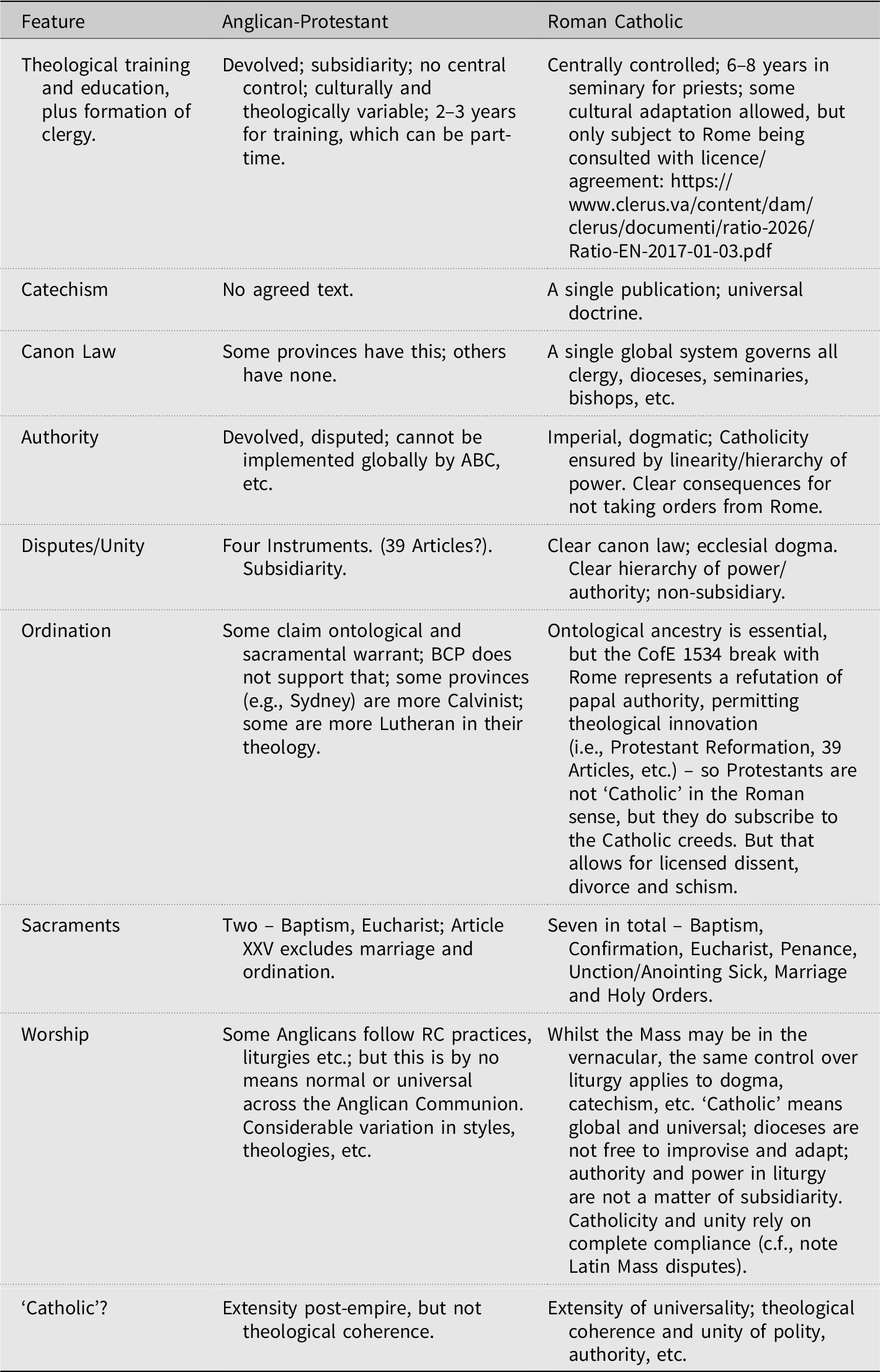
As I have argued before, the Church of England’s polity is essentially Protestant, albeit with an episcopacy and liturgical practices that readopted and then adapted that polity with some distinctive Catholic accents somewhat later. So, in terms of the type of doctrine the Church of England might claim it now holds, and what its authoritative heft might constitute, I venture three observations here that raise important questions for those minded to claim that the Church of England’s doctrine on this or that matter can be any surer than the ambiguity we encounter in its polity and identity. [c.f., see Table 1].
First, doctrine can be understood as a ‘religious text’ that is read and performed. This is a cultural-linguistic understanding of Christianity and its doctrines (following George Lindbeck)Footnote 36 that pays attention to the grounded reality of the church and the cultures that congregations inhabit. Lindbeck’s post-liberal take on doctrine is that it needs to give up its claims to universality, whether that be grounded in some notion of revealed propositional ontology preferred by conservatives or of the preconceptual experiential kind favoured by liberals, in that it expresses the lived experiences of church members. I concur that Lindbeck’s theory of doctrinal knowledge is the grammar which defines and regulates the praxis and polity of ecclesial life. Lindbeck observes that theology and ecclesial life ‘gains power and meaning insofar as it is embodied in the total gestalt of community life and action’.Footnote 37 As Kathryn Tanner likewise notes,
‘religious beliefs are a form of culture, inextricably implicated in the material practices of daily social living on the part of those who hold them…in the concrete circumstances in which beliefs are lived…actions, attitudes and interests are likely to be as much infiltrated and informed by the beliefs one holds as beliefs are to be influenced by actions, attitudes and interests…’Footnote 38
As the Church of England knows from its own lex orandi, lex credendi, doctrines are dramatic scripts which Christians perform and by which they are performed. Doctrines ‘provide a scripted code for the motions of a Christian’s life in much the same way that broader cultural codes and linguistic patterns structure the self’, since ‘practices are what we become as we are set in motion in the space of doctrine’.Footnote 39
Our second observation draws from Peter Berger’s The Heretical Imperative (1980), which notes that theologians usually attempt to tackle problems and issues with three distinct strategies. The first strategy is deductive. Here, the word of God (or the tradition) is the starting point, and there can be no other way of knowing God. The gain of this theological outlook is certainty and mastery in the midst of cultural confusion. The second strategy is reductive, suggesting that the tradition must be rationalised (or perhaps filtered) to be credible in the modern age. In reductionism, the core of the tradition (ethics?) must be rescued from the thick veneers and overlays of myth that have obscured the tradition over time. ‘Faith’ has to be freed from the accrued crusts of ‘religion’ and sediments of tradition.
The third strategy, according to Berger, is inductive, which is the kind of ‘reverse engineering’ most Church of England reports have adopted since 1985. That is to say, they do not begin with fundamentals or core theological doctrines. Instead, they work backwards from the present, starting with an issue or problem, and search retrospectively for principles and biblical texts to confirm what the report seeks to conclude. The Green Report, current safeguarding commentary and other (tentatively?) definitive theological statements all fall into this category.
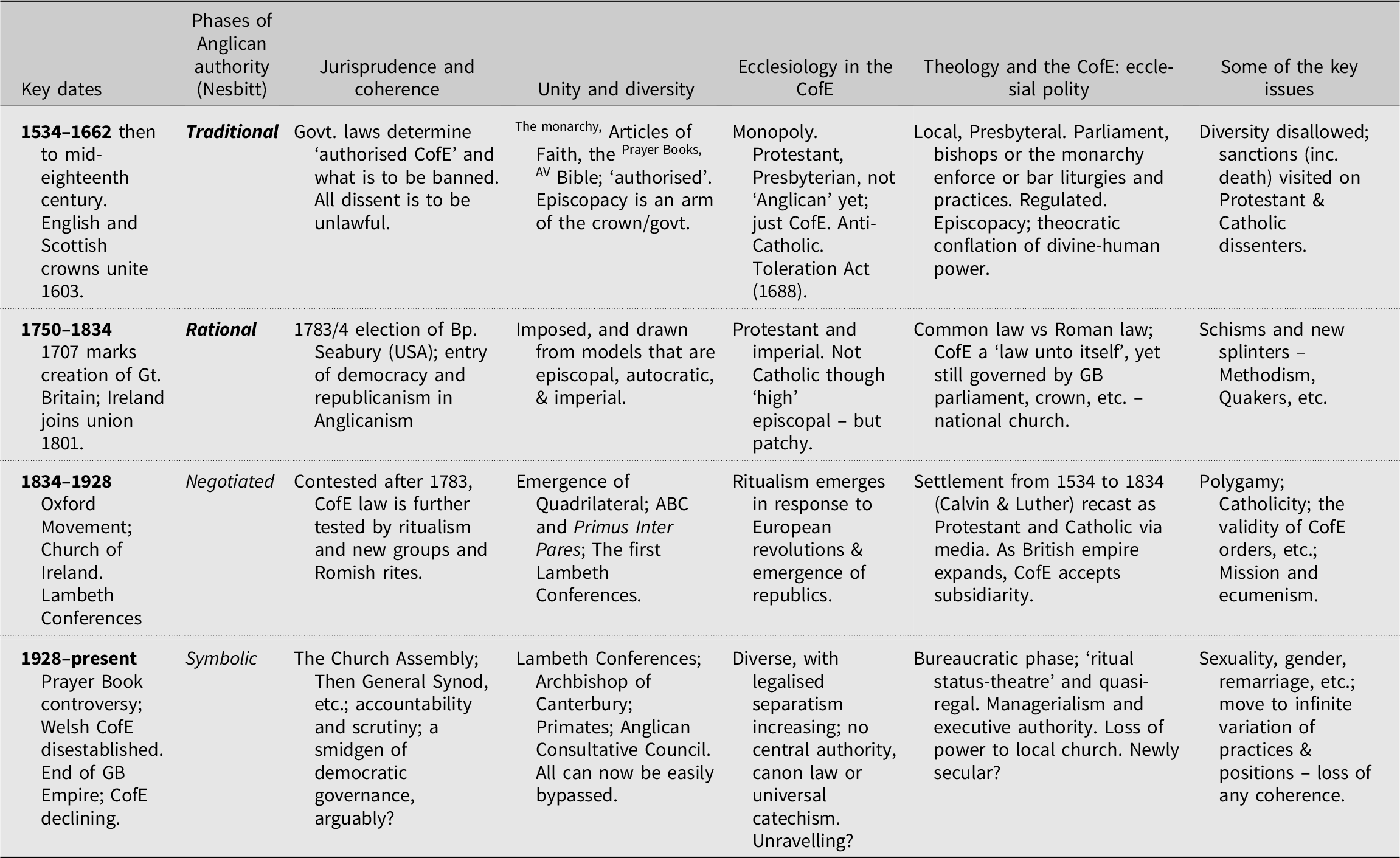
Our third and final observation draws from Paula Nesbitt’s work over the last 40 years, noting how the Anglican Communion has been unable to avoid a gradual split. Caught between increasing cultural diversity and the need to provide coherence and identity, successive Lambeth conferences have moved sequentially from being grounded on traditional authority (i.e., the establishment of outposts during the colonial era) to rational authority (presupposing negotiation through representative constituencies for dominance over meeting outcomes) to negotiated authority (which generally lacks the power to stem the momentum of change). These three types of authority, pursued through the four ‘instruments of unity’ in the Anglican Communion, can enable complex interaction and conversation, but they do not lead to clear and firm resolutions. [c.f., Table 2].
Nesbitt argues that a new, fourth authoritative form has emerged within the Anglican Communion from the late twentieth century: symbolic authority. She writes that ‘[it] could be used to countervail the relativism of cross-cultural alliances…[the] symbol, as a locus of authority, has a tangible and timeless nature’. Yet Nesbitt notes that whilst the symbolic authority of sacraments may create shared bonds and enhance communal cohesion, they cannot regulate or negotiate serious ecclesial conflicts. In contrast, she notes that,
‘…Scripture, when canonized as complete or absolute, becomes symbolic of a particular era or set of teachings and beliefs. However, unlike sacraments, the use of scripture as symbolic authority can be constructed and constituted according to selecting those aspects or passages that address an issue at hand. Furthermore, scripture as symbolic authority can be objectified or absolutized, which transcends cultural boundaries in a way that other forms of authority can less easily do…the appeal of scriptural literalism provides an objectification of authority that is independent of the influence or control of dominant perspectives, social locations and circumstances. As symbolic authority, it can be leveraged against cultural dominance as well as provide common ground for cross-cultural alliances…’.Footnote 40
With scripture now the primary ‘totem’ or focus of symbolic authority in global Anglicanism, episcopal authority is rapidly weakened. English Anglican episcopacy has attempted to counter that trajectory by heavy investment in ecclesial bureaucracy, managerialism and executive powers. However, the ‘ontologising’ of management only causes resentment amongst clergy and congregations, further undermining trust and confidence in the leadership. With traditional, rational and negotiated authority largely exhausted within the polity, and symbolic authority highly contested, coherence and equilibrium are hard to maintain. Fragmentation, federalism (i.e., Protestant) and reconstituted negotiated authority emerge as the only way forward.
Conclusions
As a polity, the Church of England does not originate new doctrine. Instead, magpie-like, the Church of England borrows from Protestant and Roman Catholic fundaments to scope out its theological positions. That said, it would be obvious to state that any appeal to ‘the doctrine of marriage in the Church of England’ could not lead the enquirer to a specified doctrinal text. It might take the enquirer to some liturgy, such as that for matrimony – lex orandi, lex credendi (i.e., the law of prayer is the law of belief) – but hardly much further.Footnote 41
Anglicans possess a rich and intricate history of adapting their beliefs and trading pragmatism with principles. The acceptance of remarriage for divorcees and the ability to engage with cultures that embrace polygamy, as illustrated by the Colenso controversy, reveal that Anglicans can thoughtfully recalibrate their teachings on marriage when faced with dilemmas. We note that the Colenso controversy and debates over polygamy in the nineteenth century were never resolved in Anglican deliberations. This remains the case, with no agreed resolutions from Lambeth Conferences to the present day. While some may cling to a rigid interpretation, insisting on an unyielding ‘doctrine of marriage’, it is crucial to understand that only baptism and the Eucharist are recognised as sacraments within the historic Anglican tradition. Marriage is explicitly omitted as a sacrament in the Thirty-nine Articles, signalling that while it is significant, it is not categorised as a doctrinal necessity.
Article XXV states that matrimony is a ‘state of life allowed in the scriptures’ and expounds on this by saying that ‘those five commonly called Sacraments, that is to say, Confirmation, Penance, Orders, Matrimony and Extreme Unction, are not to be counted for Sacraments of the Gospel, being such as have grown partly of the corrupt following of the Apostles, partly are states of life allowed in the Scriptures’. Article XXXII states of clergy that ‘Bishops, Priests and Deacons, are not commanded by God’s Law, either to vow the estate of single life, or to abstain from marriage: therefore it is lawful for them, as for all other Christian men, to marry at their own discretion, as they shall judge the same to serve better to godliness’.
In summary, the Church of England’s Thirty-nine Articles makes it clear that marriage is not to be counted as a sacrament, and there is no separate doctrinal statement within the Anglican tradition that would establish a definitive doctrine of marriage. This is not to downplay its theological importance but to highlight that marriage exists within a framework of adaptability in Anglican practice – a reality vividly illustrated by the church’s historical endorsement of allowing the remarriage of divorcees. By embracing this capacity for evolution, Anglicans demonstrate not only their commitment to the faith but also their understanding that growth and context are vital in living out their principles in a diverse and changing world. To say otherwise – as some claim – is to imply that theological positions have the weight of established and agreed doctrine.Footnote 42
The impoverished theology that colours debates on marriage, safeguarding and other issues in the Church of England has arisen for a variety of reasons. The gap between the academy and the church is now considerable. The church, meanwhile, has sought to manage its disputes and complex differences by balancing ecclesial party interests. This tends to avoid dense engagement with the serious writers who would be more natural interlocutors. Thus, few of the theologians who write seriously about marriage or domestic or sexual abuse will ever be engaged with. Church of England reports have evolved into a means for maintaining some status quo – and not the place for theological inquiry or for exploring doctrinal development.
If managing risk, reputation and fractious diversity are primary objectives for the Church of England’s report writing, then one would anticipate the published outcome as being quite tame, non-innovative and largely inward-looking. The consecrated pragmatism that usually emerges is evidence of a church that wants to react to its challenges and work out some solution inductively (i.e., trace the present issue back to some biblical or ancient theological warrant) but has little sense of the wider theological fundamentals (including the lack of them) that might have addressed the perceived crisis from the outset. Of course, a non-dogmatic approach to theology and ecclesial polity cannot work like that, and so an ever-tightening inductive ‘loop’ continues to spiral within the Church of England’s fractious polity, developing the ligature-like quality that strangles its very voice. That suggests that the deeper problem underpinning the Church of England reports since 1985 can be summarised as follows.
First, the polity struggles with an ambivalent identity that, until recently, has not needed to confront this. As we noted earlier, American Episcopalians (TEC) have repudiated the English ‘Doctrine of Discovery’ propagated by Henry VII in 1496, which licensed the suppression and conquest of indigenous peoples and the appropriation of their lands as a Christian act. The Church of England has taken no comparable steps here. In the phase of expansionism through the British Empire, the Church of England was able to assert a kind of effortless superiority through its colonial agency. In a postcolonial era, and in the twenty-first century, such assertions are unable to carry conviction, and former colonies can engage in counter-assertion and out-narrate the Church of England’s remnant hubris.
Second, the origins of the post-Reformation Ecclesia Anglicana are non-dogmatic and highly contested, perhaps only concurring with the creeds. As we noted earlier, in the 16th and 17th centuries, ‘the Church of England’ was Catholic, Laudian, Protestant, Lutheran, Puritan, Quaker, Presbyterian, Zwinglian and Calvinist. As with the Church of Scotland in the 16th and 17th centuries, the particular theological identity only began to crystallise in tandem with emerging nationalism. The nomenclature of ‘Anglican’ gradually came to be used. But the eighteenth century witnessed more fissure as Methodists and other splinter groups emerged from within and eventually separated from the Church of England.
Third, because the nature of doctrine is not something the Church of England can independently establish a universal Catholic position on, its reports struggle to find common ground for maintaining unity. Recent attempts to redefine the contours of global Anglicanism exemplify this, with the authors speaking wistfully of their polity as a ‘symphony’ comprising many instruments, yet they are unable to identify who conducts the performance, nor can they say how a wide variety of local and regional appropriations of a musical score are said to constitute a singular symphonic experience. Pronounced differences in eucharistic theologies encountered across the Anglican Communion suggest fragmenting diversity, not growing unity.Footnote 43
Fourth, the Church of England’s reports seem to have a fundamental flaw in their understanding of theology. If bishops and the ecclesiocracy believe theology to be some kind of ‘bolt-on’, or perhaps even marginal to the life of the institution, what exactly is their vocation, and what is the nature of Christianity? From the outset, Christianity was as much an academy as it was a newly formed faith cult and a polity. To paraphrase Descartes’ famous maxim (‘I think, therefore I am’), if Christianity is not about knowing, then it is not. What we can trace in Church of England reports over the last 40 years is a failure to understand the nature of theology as a restless, eternal quest of discovery, not least in searching for and encountering God.
Fifth, theology is not about closure, let alone a gloss for policy guidelines. Theology is, rather, about remaining forever open to the Holy Spirit, from which our perpetual renewal springs. Theology should be ambitious, courageous and sagacious in its searching and discernment of truth, God, virtue and wisdom. So it somehow seems indicative that the last report from the Doctrine Commission was Being Human (2002), which included a prescient chapter on money and human worth. The House of Bishops that received the report ignored this completely and merely fastened onto the chapter that addressed the hoary issue of sexuality, to satisfy themselves that earlier reports and policy statements were not being contradicted.
Finally, perhaps the most serious issue for the Church of England is that the reports and their authors tend to take themselves far too earnestly. Nobody can seriously object to a denomination engaging in the necessary task of theology for its mission and maintenance. But for the Church of England to claim more than this is something of a conceit. Their documents rarely have anything to say of import that would carry weight within the academy, in ecumenical dialogue with larger global denominations (e.g., ARCIC) or can even mandate any authority across the wider Anglican Communion. Their lack of theological capacity stems from their deficiency in self-awareness. As such, they often exhibit worrying ultracrepidarian tendencies,Footnote 44 making pronouncements on issues about which the Church of England is ill-equipped to comment and unable to act upon. Like Lyotard, my reaction to Church of England reports addressing issues of theological or moral concern – and even venturing into matters of doctrine – is one of increasing incredulity.
Comparing Anglican-Protestant ecclesial polity with Roman Catholicism

Table 1 Long description
A table comparing Anglican-Protestant and Roman Catholic features across various aspects. The table has 8 rows and 3 columns. Column headers are Feature, Anglican-Protestant, and Roman Catholic. Row 1: Theological training and education, plus formation of clergy. Anglican-Protestant: Devolved; subsidiarity; no central control; culturally and theologically variable; 2-3 years for training, which can be part-time. Roman Catholic: Centrally controlled; 6-8 years in seminary for priests; some cultural adaptation allowed, but only subject to Rome being consulted with licence/agreement: https://www.clerus.va/content/dam/clerus/document/ratio-2026/Ratio-EN-2017-01-03.pdf. Row 2: Catechism. Anglican-Protestant: No agreed text. Roman Catholic: A single publication; universal doctrine. Row 3: Canon Law. Anglican-Protestant: Some provinces have this; others have none. Roman Catholic: A single global system governs all clergy, dioceses, seminaries, bishops, etc. Row 4: Authority. Anglican-Protestant: Devolved, disputed; cannot be implemented globally by ABC, etc. Roman Catholic: Imperial, dogmatic; Catholicity ensured by linearity/hierarchy of power. Clear consequences for not taking orders from Rome. Row 5: Disputes/Unity. Anglican-Protestant: Four Instruments. (39 Articles?). Subsidiarity. Roman Catholic: Clear canon law; ecclesial dogma. Clear hierarchy of power/authority; non-subsidiary. Row 6: Ordination. Anglican-Protestant: Some claim ontological and sacramental warrant; BCP does not support that; some provinces (e.g., Sydney) are more Calvinist; some are more Lutheran in their theology. Roman Catholic: Ontological ancestry is essential, but the CoFE 1534 break with Rome represents a refutation of papal authority, permitting theological innovation (i.e., Protestant Reformation, 39 Articles, etc.) - so Protestants are not 'Catholic' in the Roman sense, but they do subscribe to the Catholic creeds. But that allows for licensed dissent, divorce and schism. Row 7: Sacraments. Anglican-Protestant: Two - Baptism, Eucharist; Article XXV excludes marriage and ordination. Roman Catholic: Seven in total - Baptism, Confirmation, Eucharist, Penance, Unction/Anointing Sick, Marriage and Holy Orders. Row 8: Worship. Anglican-Protestant: Some Anglicans follow RC practices, liturgies etc.; but this is by no means normal or universal across the Anglican Communion. Considerable variation in styles, theologies, etc. Roman Catholic: Whilst the Mass may be in the vernacular, the same control over liturgy applies to dogma, catechism, etc. 'Catholic' means global and universal; dioceses are not free to improvise and adapt; authority and power in liturgy are not a matter of subsidiarity. Catholicity and unity rely on complete compliance (c.f., note Latin Mass disputes). Row 9: 'Catholic?'. Anglican-Protestant: Extensity post-empire, but not theological coherence. Roman Catholic: Extensity of universality; theological coherence and unity of polity, authority, etc.
Anglican authority, power and polity (after Paula Nesbitt)

Table 2 Long description
The table has six columns: Key dates, Phases of Anglican authority, Jurisprudence and coherence, Unity and diversity, Ecclesiology in the CofE, Theology and the CofE: ecclesiastical polity, and Some of the key issues. It has five rows of data. Row 1: Key dates: 1534-1662 then to mid-eighteenth century. English and Scottish crowns unite 1603. Phases of Anglican authority: Traditional. Jurisprudence and coherence: Govt. laws determine 'authorised CofE' and what is to be unlawful. All dissent is to be unlawful. Unity and diversity: The monarchy, Articles of Faith, The Prayer Books, AV Bible; 'authorised' Episcopacy is an arm of the crown/govt. Ecclesiology in the CofE: Monopoly. Protestant, Presbyterian, not 'Anglican' yet; just CofE. Anti-Catholic. Toleration Act (1688). Theology and the CofE: ecclesiastical polity: Local, Presbyteral. Parliament, bishops or the monarchy enforce or bar liturgies and practices. Regulated. Episcopacy; theocratic conflation of divine-human power. Some of the key issues: Diversity disallowed; sanctions (inc. death) visited on Protestant & Catholic dissenters. Row 2: Key dates: 1750-1834. 1707 marks creation of Gt. Britain; Ireland joins union 1801. Phases of Anglican authority: Rational. Jurisprudence and coherence: 1783/4 election of Bp. Seabury (USA); entry of democracy and republicanism in Anglicanism. Unity and diversity: Imposed, and drawn from models that are episcopal, autocratic, & imperial. Ecclesiology in the CofE: Protestant and imperial. Not Catholic though 'high' episcopal - but patchy. Theology and the CofE: ecclesiastical polity: Common law vs Roman law; CofE a 'law unto itself', yet still governed by GB parliament, crown, etc. - national church. Some of the key issues: Schisms and new splinters - Methodism, Quakers, etc. Row 3: Key dates: 1834-1928. Oxford Movement; Church of Ireland. Lambeth Conferences. Phases of Anglican authority: Negotiated. Jurisprudence and coherence: Contested after 1783, CofE law is further tested by ritualism and new groups and Romish rites. Unity and diversity: Emergence of Quadrilateral; ABC and Primus Inter Pares; The first Lambeth Conferences. Ecclesiology in the CofE: Ritualism emerges in response to European revolutions & emergence of republics. Theology and the CofE: ecclesiastical polity: Settlement from 1534 to 1834 (Calvin & Luther) recast as Protestant and Catholic via media. As British empire expands, CofE accepts subsidiarity. Some of the key issues: Polygamy; Catholicism; the validity of CofE orders, etc.; Mission and ecumenism. Row 4: Key dates: 1928-present. Prayer Book controversy; Welsh CofE disestablished. End of GB Empire; CofE declining. Phases of Anglican authority: Symbolic. Jurisprudence and coherence: The Church Assembly; Then General Synod, etc.; accountability and scrutiny; a smidgen of democratic governance, arguably? Unity and diversity: Lambeth Conferences; Archbishop of Canterbury; Primates; Anglican Consultative Council. Lambeth Conferences. Ecclesiology in the CofE: Diverse, with legalised separationism increasing; no central authority, canon law or universal catechism. Unravelling? Theology and the CofE: ecclesiastical polity: Bureaucratic phase; 'ritual status-theatre' and quasi-legal. Managerialism and executive authority. Loss of power to local church. Newly secular? Some of the key issues: Sexuality, gender, remarriage, etc.; move to infinite variation of practices & positions - loss of any coherence.