Nowadays, a great deal of language learning takes place incidentally. For instance, learners are exposed to foreign language input via a variety of platforms, including apps, podcasts, TV series, and other Internet resources. As this type of language exposure typically prioritizes meaning comprehension, the extent to which it contributes to acquiring second language (L2) grammatical rules remains uncertain. L2 acquisition (SLA) studies have identified several cognitive predictors of SLA including, memory, intelligence, and statistical learning (e.g., Brooks & Kempe, Reference Brooks and Kempe2013; Granena, Reference Granena2016a; Li, Reference Li2016); however, there is a need to disentangle their contributions to learning the grammar of a novel language in different contexts (e.g., Kempe & Brooks, Reference Kempe and Brooks2011). For example, working memory and general IQ have been shown to be highly intercorrelated in both cognitive and linguistic research (e.g., Just & Carpenter, Reference Just and Carpenter1992). Also, it is unclear to what extent nonverbal rule extraction skills, which underpin general intelligence (Spearman, Reference Spearman1927), overlap with language analytic abilities (LAAs). In other words, it is yet to be verified if LAAs are “special abilities” that account for grammar learning beyond general analytic skills (Carroll & Sapon, Reference Carroll and Sapon2002, p. 24). Finally, despite a large body of research on the role of cognitive aptitudes in SLA, our understanding of how they contribute to the automatization of linguistic knowledge is still limited.
Against this backdrop, the present study was designed to investigate the cognitive correlates of learning L2 grammar under incidental exposure conditions. Over two learning sessions, participants were exposed to grammatical rules of a miniature natural language based on standard Italian. Such miniature languages offer unique insights into SLA as they allow for maintaining some ecological validity in language learning (e.g., through communicative tasks) while controlling for major exposure-related variables. Regarding aptitudes, the study focused on working memory, nonverbal intelligence, and LAA, all of which have been shown to predict grammar learning in previous research (e.g., Brooks & Kempe, Reference Brooks and Kempe2013; Brooks et al., Reference Brooks, Kempe and Sionov2006; Li, Reference Li2016). Nevertheless, many specific questions pertaining to their relative involvement in learning L2 grammar and its automatization remain unresolved. To our knowledge, this is the first study to jointly consider the contributions of these three cognitive aptitudes to forming explicit and automatized representations of L2 grammar in the beginner stages of acquiring a novel language while also controlling for various participant- and exposure-related variables.
Literature overview
Incidental learning of L2 grammar and its resultant knowledge
Among various classifications of L2 learning contexts (e.g., implicit, explicit, naturalistic, and classroom-based), incidental and intentional training conditions have been scrutinized by modern SLA research. Schmidt (Reference Schmidt1994, p. 14) defines incidental learning as “learning without the intent to learn” or “learning of one thing (e.g., grammar) when the learner’s primary objective is to do something else (e.g., communicate).” Hulstijn (Reference Hulstijn2005) underscores that in incidental conditions “participants are not forewarned of an upcoming retention test for a particular type of information” (p. 132). In contrast, intentional exposure entails providing the learner with explicit rules regarding the target structures or encouraging them to formulate (i.e., discover) those rules themselves. Intentional grammar learning typically renders the formation of explicit knowledge, which involves the awareness of the target linguistic features (still, the simultaneous growth of implicit knowledge is not ruled out). On the other hand, incidental exposure has been shown to lead to the growth of both implicit and explicit knowledge (e.g., Batterink & Neville, Reference Batterink and Neville2013; Williams, Reference Williams, Ritchie and Bhatia2009). Thus, even without any explicit instruction, some learners tend to self-initiate the conscious analysis of language input and engage in rule discovery, which might be grounded in their previous language learning experience (Hulstijn, Reference Hulstijn2002). According to DeKeyser (Reference DeKeyser1995), exposure conditions do not determine the actual learning mode (implicit or explicit) assumed by the learner. Therefore, the characteristics of acquired L2 knowledge cannot be assumed from the treatment condition alone.
Regarding the constructs of implicit and explicit knowledge, they might be distinguished based on the awareness criterion (Suzuki & DeKeyser, Reference Suzuki and DeKeyser2017), which posits that, unlike implicit knowledge, explicit knowledge involves the awareness of the underlying regularities. Implicit knowledge is thought to involve automatic processing that enhances performance fluency, whereas explicit knowledge relies on controlled processing, which requires more attentional resources and cognitive effort (e.g., DeKeyser, Reference DeKeyser, Long and Doughty2009; Hulstijn, Reference Hulstijn2002; Williams, Reference Williams, Ritchie and Bhatia2009). However, despite its processing advantages over explicit knowledge, implicit knowledge develops gradually, requiring much more input and practice (Ullman, Reference Ullman, Hickok and Small2015). Also, its attainment might be considerably constrained in adulthood (e.g., DeKeyser, Reference DeKeyser2013). Still, learners may automatize explicit knowledge to make it faster. According to Hulstijn (Reference Hulstijn2002, p. 211), automatized explicit knowledge differs in speed but not quality from explicit knowledge, as it still requires access to conscious rules. Because of its functional similarity to implicit knowledge, coupled with its greater accessibility to adult learners, automatized explicit knowledge has received increasing attention in the SLA literature. This provides rationale for advancing research into this construct, including exploring exposure- and participant-related variables that affect its formation.
Importantly, distinguishing experimentally between explicit, automatized (explicit), and implicit L2 knowledge remains a subject of considerable scholarly debate. In his seminal methodological study, Ellis (Reference Ellis2005) proposed time pressure as one of the criteria for designing tests of implicit knowledge. However, the factor-analytic studies by Vafaee et al. (Reference Vafaee, Suzuki and Kachisnke2017) and Suzuki (Reference Suzuki2017) converged on the conclusion that accuracy-based timed tasks (e.g., grammaticality judgment tasks [GJTs] or elicited imitation tasks) load on different latent constructs than meaning-focused psycholinguistic tasks (e.g., word monitoring or self-paced reading). Thus, the latter paradigms were argued to provide better approximations of implicit knowledge, and time-pressured tasks, including timed GJTs, were proposed to tap into automatized explicit knowledge. In another psychometric study, Godfroid and Kim (Reference Godfroid and Kim2021) reinstated the validity of timed GJTs as measures of implicit knowledge by demonstrating their relationship with implicit statistical learning ability. The construct validity of timed GJTs as measures of implicit knowledge was also investigated by Kim and Nam (Reference Kim and Nam2017), who explored different versions of task stimuli, varying in modality (auditory versus written presentation) and grammaticality (grammatical versus ungrammatical sentences). The results suggested that, of the different versions of stimuli explored in their study, ungrammatical items presented aurally were the most likely to tap into implicit knowledge.
The discrepancy in research findings regarding the properties of GJTs can be explained by Dienes and Scott’s (Reference Dienes and Scott2005) proposal that judgment knowledge can be either conscious or unconscious. Reliance on unconscious knowledge can be inferred when language users make confident and accurate grammatical judgments without being able to explain why. In a series of studies on the incidental acquisition of semi-artificial languages, Rebuschat and colleagues used confidence ratings and judgment attributions (rule, memory, guess, or intuition) to differentiate between the types of knowledge underlying grammatical decisions made by participants in the post-test (Rebuschat et al., Reference Rebuschat, Hamrick, Sachs, Riestenberg, Ziegler, Bergsleithner, Frota and Yoshioka2013, Reference Rebuschat, Hamrick, Riestenberg, Sachs and Ziegler2015; Rebuschat & Williams, Reference Rebuschat and Williams2012). The study by Rebuschat et al. (Reference Rebuschat, Hamrick, Sachs, Riestenberg, Ziegler, Bergsleithner, Frota and Yoshioka2013) showed that responses attributed to either guess or intuition (as opposed to rule or memory) reached 71% accuracy. As participants performed well above chance without claiming to have referred to rules or recollections of language chunks, the results suggested that their knowledge might have been at least partly implicit.
As can be seen, the status of knowledge underlying linguistic decisions in such tasks as GJTs may vary depending on a number of factors, both participant and context related (see Plonsky et al., Reference Plonsky, Marsden, Crowther, Gass and Spinner2020, for an overview). In particular, it appears that judgments made under time pressure may recruit both implicit and explicit knowledge. As substantial concerns persist regarding whether the knowledge they tap into can genuinely be classified as implicit, in the present paper, we refer to the results of timed GJTs as indexes of automatized knowledge, without determining their implicit/explicit status.
The role of cognitive aptitude in SLA
Cognitive language learning aptitude (LLA) allows for predicting individual language learning efficiency, provided that other variables (such as type and amount of input and affective factors) are held constant (Doughty, Reference Doughty2019). In this section, we discuss the relationship between cognitive aptitudes and the acquisition of L2 grammar in adulthood. In particular, we focus on how cognitive abilities such as working memory, general intelligence, and LAA intersect with the growth of explicit and automatized knowledge.
Working memory
Working memory capacity (WMC) refers to the ability to store and manipulate information in the mental space while performing higher-order cognitive tasks (e.g., Baddeley, Reference Baddeley2003). Individual differences in WMC have been the focus of keen academic interest in SLA research (e.g., Wen, Reference Wen2016). For instance, the meta-analysis of 79 studies by Linck et al. (Reference Linck, Osthus, Koeth and Bunting2014) found a weak positive correlation (r = .27) between verbal working memory and general L2 performance. In a different meta-analysis, Li (Reference Li2016) found a moderate relationship (r = .37) between working memory and general LLA, measured by whole LLA batteries. With respect to grammar, SLA studies looked at the contributions of cognitive aptitudes to developing different types of grammatical knowledge (i.e., explicit, automatized, and implicit). For instance, Erçetin and Alptekin (Reference Erçetin and Alptekin2013) probed the relationship between the knowledge of grammatical structures in advanced L2 English and working memory, measured with the reading span task (Daneman & Carpenter, Reference Daneman and Carpenter1980). To tap into grammatical knowledge, the study used timed and untimed GJTs and an oral imitation (OI) task, which were all positively linked to the WMC scores. Still, the effect size of the relationship between working memory and untimed GJTs, a measure of explicit knowledge, was larger than for the OI task and timed GJTs, both of which arguably measure automatized knowledge. Similarly, Pawlak and Biedroń (Reference Pawlak and Biedroń2019) looked into whether WMC was linked to the development of explicit and automatized knowledge of the passive voice in L2 English. The study found that verbal working memory, measured by a listening span task, predicted the scores of productive and receptive tasks of explicit but not automatized knowledge (see also Pawlak & Biedroń, Reference Pawlak and Biedroń2021; Suzuki & DeKeyser, Reference Suzuki and DeKeyser2017). Interestingly, Serafini and Sanz (Reference Serafini and Sanz2016) found correlations between WMC (measured by the OSpan and Digit span task) and scores in both an untimed GJT and an elicited imitation task in the groups of beginner and intermediate but not advanced learners of L2 Spanish. These results suggest that with growing proficiency and the automatization of explicit L2 knowledge, the contribution of working memory to L2 performance might be diminishing.
General nonverbal intelligence
The concept of general intelligence was introduced by Charles Spearman, who postulated that performance on various cognitive tasks is underlain by a common cognitive component (i.e., general mental ability), which he called the g factor (Spearman, Reference Spearman1927). In his two-factor theory of intelligence, Spearman proposed that performance on cognitive tasks engages general intelligence as well as task-specific abilities. The g factor is believed to be best measured by tasks tapping into abstract relational reasoning that involves detecting patterns in complex stimuli and is independent of previous learning. In his metanalysis, Li (Reference Li2016) found fairly strong correlations (ranging from r = .50 to r = .64) between intelligence and general LLA, concluding that the two constructs were related but not equivalent. Regarding grammar, the ability to identify abstract patterns in complex nonverbal input has been found to predict learning L2 grammar (Brooks et al., Reference Brooks, Kempe and Sionov2006, Reference Brooks, Kwoka and Kempe2017; Kempe & Brooks, Reference Kempe and Brooks2008; Kempe et al., Reference Kempe, Brooks and Kharkhurin2010). For instance, in their miniature language learning study, Brooks et al. (Reference Brooks, Kempe and Sionov2006) reported that WMC correlated with learning Russian case inflection by adult speakers of L1 English.Footnote 1 The link was observed for both old (i.e., trained) and novel items of a production post-test. However, a multiple regression showed that when nonverbal intelligence was controlled for, the effect of WMC was retained only for the old items. As proposed by the authors, memorization of the old items required greater storage capacity; on the other hand, dealing with novel words involved attention allocation skills related to intelligence. The importance of nonverbal IQ in learning grammar was further supported by Brooks et al. (Reference Brooks, Kwoka and Kempe2017), who found that it was the only cognitive predictor of the ability to extrapolate the case-marking rules of L2 Russian onto novel items. Summing up, general intelligence has been shown to be a strong correlate of learning grammatical rules in L2, often surpassing the role of other cognitive skills.
Language analytic ability, metalinguistic awareness, and prior L2 learning
LAA is the ability to “infer rules of language and make linguistic generalization or extrapolations” (Skehan, Reference Skehan1998, p. 204). Metanalyses by Li (Reference Li2015, Reference Li2016) found moderate correlations between LAA and the learning of grammar. LAA has been shown to predict performance on tasks tapping into explicit knowledge, including the untimed GJT (DeKeyser, Reference DeKeyser2000; Li, Reference Li2013; Li et al., Reference Li, Ellis and Zhu2019; Suzuki, Reference Suzuki2017; Yilmaz, Reference Yilmaz2013); however, its relationship with automatized or implicit knowledge is less clear. For instance, Suzuki and DeKeyser (Reference Suzuki and DeKeyser2017) found links between LAA, measured by the LLAMA F, and automatized explicit knowledge (measured by timed GJTs and gap-filling tasks). No such relationship was showed for tasks tapping into implicit knowledge (e.g., self-paced reading). In contrast, other studies failed to show that LAA is related to performance on the elicited imitation task, regardless of the feedback condition (implicit/explicit), in which the target structures were learnt (Li, Reference Li2013; Li et al., Reference Li, Ellis and Zhu2019).
SLA studies on grammar learning show that participants develop varying rates of metalinguistic awareness of the target structures (e.g., Andringa, Reference Andringa2020; DeKeyser, Reference DeKeyser, Long and Doughty2009; Rebuschat & Williams, Reference Rebuschat and Williams2012). Factors such as input characteristics (e.g., salience of the target features) or previous language learning experience (e.g., more immersive or form-focused) might shape learners’ tendency to focus on metalinguistic information while dealing with L2 input (Li et al., Reference Li, Ellis and Zhu2019). In fact, metalinguistic awareness has been shown to be a powerful predictor of L2 grammar learning, even in incidental exposure conditions (e.g., Brooks & Kempe, Reference Brooks and Kempe2013; Kenanidis et al., Reference Kenanidis, Dąbrowska, Llompart and Pili-Moss2023). Last but not least, knowledge of previous languages should be included in grammar acquisition research, either as a covariate or an independent variable (depending on the study aim). In the former case, its implementation into statistical models helps determine the contribution of the studied variables (e.g., cognitive aptitudes) over and above L2 learning experience (see Kempe & Brooks, Reference Kempe and Brooks2011, for discussion).
The present study
According to Carroll and Sapon (Reference Carroll and Sapon2002), LLA encompasses “special abilities” (i.e., phonetic coding and inferring syntactic rules) that may not be embraced by general IQ (see also Li, Reference Li2016, for a discussion). This aligns with Spearman’s theory that performing a particular cognitive task requires general intelligence coupled with task-specific abilities. As indicated above, there are still many unresolved questions about the interplay of different cognitive abilities in SLA. For instance, studies in both cognitive psychology and language acquisition showed that WMC and general IQ are intercorrelated (e.g., Brooks et al., Reference Brooks, Kempe and Sionov2006; Oberauer et al., Reference Oberauer, Süß, Wilhelm, Sander, Conway, Jarrold, Kane, Miyake and Towse2007). To account for that, Just and Carpenter (Reference Just and Carpenter1992) suggest that the better the ability to hold and manipulate multiple information in the mental space, the more likely an individual is to discover patterns in the input. Another issue is whether language-specific rule inference skills (LAA) can explain success rates in L2 grammar learning over and above nonverbal inductive skills captured by the tasks tapping general intelligence.
In light of these considerations, the aim of the present study was to investigate the relative contributions of cognitive aptitudes (i.e., nonverbal IQ, LAA, and WMC) to learning foreign language grammar in adulthood. We looked at the formation of both explicit and automatized knowledge. The study used a miniature language learning paradigm to expose the participants to three structures of Italian grammar while performing meaning-focused tasks. The learning conditions can be labeled incidental, as the participants did not receive any explicit instruction on the target features nor were they informed about the grammar post-test. To gain insight into their learning, in the post-tests, we asked the participants to indicate the attribution of their responses, i.e., whether their grammaticality judgments were based on rules or intuition. We also monitored their awareness of the study aim and debriefed them regarding the metalinguistic knowledge of the target structures.
The study pursued the following main research questions (RQs):
RQ1. What are the relative contributions of nonverbal IQ, LLA, and WMC to developing the explicit knowledge of grammatical structures of a new foreign language?
RQ1a. In particular, can WMC and LAA account for the explicit knowledge of grammar over and above nonverbal intelligence assumed to represent general cognitive abilities?
RQ1b. Does attributing grammatical judgments to rule knowledge facilitate the performance on the untimed written GJT?
RQ2. What are the relative contributions of nonverbal IQ, LLA, and WMC to developing the automatized knowledge of grammatical structures of a new foreign language?
RQ2a. In particular, can WMC and LAA account for the automatization of grammatical knowledge over and above nonverbal intelligence assumed to represent general cognitive abilities?
Method
Participants
Participants were 45 native speakers of Polish (26 women, Mage = 24.51, SDage = 4.24, age range = 19–35) who had never before learned Italian or any other Romance language. They were recruited from the general public through advertisements placed on the university website and in social media. A majority of them (28 participants) were students, 13 were university graduates, and the remaining 4 participants reported having completed secondary education. All but one participant reported English as their L2, with self-reported proficiency levels ranging from A2 to C2. In addition, 41 participants reported knowledge of at least one additional foreign language. All the participants confirmed that they met study inclusion criteria that encompassed no previous knowledge of any Romance languages; completion of secondary education; no history of language, neurological, or hearing disorders, and normal or corrected-to-normal vision. Education-wise, the participants could not be students or graduates of linguistics or postgraduate students or graduates of psychology. The latter criterion was added to exclude participants familiar with the psychometric test used in the study, typically taught in the postgraduate program in psychology.
Materials
Further information on the study materials, including the training and testing stimuli, can be found in Appendices 1–7 in the supplementary materials online.
Miniature language
For the purposes of the present research, we designed a novel miniature language based on standard Italian (MiniItaliano). MiniItaliano is a computerized language learning tutorial developed as an employee training program at an Italian department store. All the stimuli are presented both visually and auditorily; thus, the training does not incorporate any languages other than Italian, with the exception of one task (i.e., Emergency situations), which additionally comprises a glossary with L1 translations of novel words.
In terms of its lexicon, MiniItaliano is based on 24 concrete nouns, referring to the names of common products available at the store. The products are grouped into three categories: (a) groceries (e.g., una melanzana – an aubergine), (b) stationery (e.g., un quaderno – a notebook), and (c) kitchen utensils (e.g., una padella – a frying pan). The stimuli are balanced in terms of number (i.e., each noun is presented in singular and in plural), gender (there are 12 masculine and 12 feminine nouns), and congruence with grammatical gender in Polish, i.e., 12 nouns have the same gender in both languages and the remaining 12 nouns are cross-linguistically incongruent in that respect. All the 24 nouns follow default inflectional patterns in Italian.
Additionally, MiniItaliano incorporates 15 adjectives, which describe the properties of the 24 products. There are 11 regular adjectives paired with the target nouns, e.g., un quaderno azzurro/grigio – a blue/grey notebook. Additionally, there are four adjectives ending in -e (e.g., verde – green; grande – big), which are inflected according to an alternative rule. Apart from nouns and adjectives, the core vocabulary of MiniItaliano includes 11 verbs, which follow a uniform and regular conjugation pattern in Italian (e.g., costare – to cost; pagare – to pay). The verbs are presented either in the third-person singular or the third-person plural.
Linguistic structures of MiniItaliano
MiniItaliano was designed to illustrate the use of three grammatical rules in Italian: (a) noun-adjective agreement, (b) word order within the determiner phrase, and (c) subject-verb agreement. Regarding the noun-adjective agreement, by default, nouns and adjectives assume the same grammatical suffix depending on the gender and number of the noun. Singular feminine nouns and adjectives ending in -a change to -e in plural (e.g., una cipolla rossa – a red onion; due cipolle rosse – two red onions) and masculine nouns ending in -o change to -i in the plural (e.g., un pomodoro rosso – due pomodori rossi ). To reflect some of the complexities of the Italian language, MiniItaliano also incorporates adjectives with an alternative ending -e in both masculine and feminine singular forms, such as e.g., verde – green. In the plural, -e changes to -i, regardless of the grammatical gender of the noun (e.g., verde – verdi. The second rule of MiniItaliano concerns word order within a determiner phrase. In the majority of contexts in Italian, adjectives follow nouns (e.g., un pomodoro rosso), though there are some exceptions. Notably, this rule is incongruent with the default word order in Polish (participants’ L1) and English (participants’ L2). Finally, the third rule of MiniItaliano concerns subject-verb agreement in the third person singular and plural. MiniItaliano incorporated exclusively those verbs whose infinitives end in -are (e.g., pagare – to pay; rubare – to steal) and which follow regular inflectional patterns.
Training tasks
MiniItaliano tutorials were administered over the course of two experimental sessions (see Appendices 1–4 for the complete list of training stimuli). The training took the form of a computerized game prepared in PsychoPy3 (Peirce et al., Reference Peirce, Gray, Simpson, MacAskill, Höchenberger, Sogo, Kastman and Lindeløv2019). The participants were invited to imagine that they had applied for a summer job at an Italian supermarket and, thus, they needed to complete an employee training. Apart from written stimuli and pictures, the tutorials incorporated auditory input recorded by two native speakers of Italian, which was presented through headphones. At first, the participants completed a pretraining task, during which they were briefly exposed to the 24 core nouns of MiniItaliano. During the pretraining, each noun was displayed twice on the computer screen together with the picture illustrating its meaning and an audio file presenting its pronunciation. Following a 1,500-ms interval, the participants were asked to rewrite each word in a text box. Next, they completed the first tutorial—Taking customer orders—in which they were asked to take customer orders by pressing a key corresponding to the target item. Next, they received visual feedback. For each trial, there was one correct answer and from three to five foils (see Example 1; Figure 1). Each of the 24 core nouns of MiniItaliano was presented twice in the singular and twice in the plural form and was paired with two different adjectives. Some nouns were additionally paired with an adjective ending in -e (e.g., un cavolo grande). In total, there were 114 trials in the task, of which 96 trials included the default inflectional endings and 18 the alternative ending. Since the training items within the task formed dialogues, the order of their presentation was sequential. The task took approximately 20 min.
Example 1. An example item from the MiniItaliano tutorial—Taking customer orders.
Buongiorno. Per Lei?
Mi scusi, vorrei due cavoli bianchi.
Desidera altro?
Sì, un pompelmo rosso.
An example picture display in the first tutorial—Taking customer orders.

The second and final tutorial administered on day 1, called Emergency situations, focused on the use of verbs. The tutorial started with the preteaching of 10 core verbs of MiniItaliano (e.g., rubare – to steal; pagare – to pay). The meaning of the verbs was illustrated with pictures. Each verb was presented twice for 3,000 ms, after which the participants were asked to rewrite it from memory. Once the participants completed the preteaching, they started the proper tutorial, during which they read and listened to announcements regarding problems emerging in the supermarket (e.g., shoplifting; see Figure 2, Example 2). They were instructed to try to decode the meaning of each announcement and choose the right person to report the problem to (e.g., the security, a cashier, a store manager). On each trial, there was one target answer and one distractor. The items were presented in a randomized order.
Example 2. An example item from the second tutorial—Emergency situations.
Attenzione! Reparto frutta e verdura. Una donna RUBA due mele.
1. Cassiere 2. Sicurezza
The illustration of the meaning of the verb “rubare” (to steal).

The task consisted of 20 trials and was untimed. Each of the 10 verbs was presented once in the singular and once in the plural form. To aid task comprehension, the participants were provided with Italian–Polish glosses containing novel vocabulary. Moreover, on each trial, the main verb was written in block capitals and had its meaning illustrated with a picture.
The training on day 2 commenced with the Taking customer orders tutorial administered in exactly the same form as on day 1. Then followed a novel task, in which the participants were asked to answer customer enquiries regarding product prices. In the Prices tutorial, the participants needed to identify the target product and check its price on a visual display (see Figure 3). The participants responded by typing the price into the designated text box, after which they received feedback. The task was untimed and contained 110 trials, 14 of which illustrated the nondefault inflectional rule. On each trial, there was one correct answer and 11 foils. As done in Taking customer orders task, each of the 24 target nouns was displayed four times (twice in the singular and twice in the plural). In total, in the Taking customer orders and Prices tasks, participants were exposed to 288 instances of the target rule for adjective inflection and 46 instances of the nontarget rule (about 14% of the input).
Example 3. An example item from the MiniItaliano tutorial—Prices.
Client: Buongiorno. Quanto costa una padella profonda?
Answer → Feedback
Client: E quanto costano due scodelle grigie?
Answer → Feedback
Client: Grazie!
An example item from the tutorial—Prices.

The final tutorial was the extended version of the Emergency situations task. The task included preteaching and 40 problem situations the participants needed to solve by calling an appropriate person or service. The items included the same 20 sentences that were presented in session one and 20 completely new items (in total, each of the 10 verbs was presented twice in the singular and twice in the plural). All cues about the meaning of the target verbs were removed from this version of the task. In total, the training tasks took approximately 90–110 min to complete.
Grammaticality judgment tasks
Two versions of GJTs were designed to test participants’ knowledge of the target grammatical structures at two levels of processing: explicit and automatized. The GJTs incorporated 104 items, half of which were grammatical and the remaining half ungrammatical. The knowledge of the first structure—the adjective agreement—was assessed via 64 items (32 grammatical and 32 ungrammatical). The items were balanced in terms of grammatical gender (feminine versus masculine), number (singular or plural), and congruence with Polish in terms of gender.Footnote 2 Also, half of the items concerned old nouns (presented during the tutorials) and the other half new nouns, which were pretaught at the beginning of session three but were not incorporated into the main training (e.g., una valigia, un pastello). Moreover, 16 items concerned word order in the adjective phrase (i.e., determiner + noun + adjective), 8 of which were incorrect. Also, in the case of this structure, the stimuli were balanced in terms of number and gender of the noun. The final structure was verb agreement, which was represented by 24 items (12 incorrect), balanced in terms of the grammatical number of the verb (singular versus plural). All the GJT items are available in the supplementary materials online (see also Example 4).
The same items were incorporated into the explicit (written) and automatized (auditory) versions of the task; however, those that were grammatical in the auditory version of the task were ungrammatical in the written version of the task and vice versa (for the complete list of items, see Appendix 5). The task versions were counterbalanced across participants. The order of item presentation was randomized. The timed GJT was always presented before the untimed GJT. Between the GJTs, the participants took the LLAMA B (version 1.0) as a distractor task.Footnote 3
Example 4. Examples of test items in the GJTs.
Adjective agreement: La matita grigia/grigio* costa 1 euro.
Word order: Un bambino mangia un cetriolo corto/corto cetriolo*.
Verbal inflection: La ragazza compra/comprano* una penna rossa.
An auditory timed grammaticality judgment task
An auditory timed GJT was designed to tap into the automatized knowledge of the target structures. Each item was presented auditorily via headphones. The items were recorded by two native speakers of Italian (one male and one female). Immediately after the presentation, participants had four seconds to rate each item by pressing 1 for grammatical and 0 for ungrammatical sentences. Failure to respond within the time limit was considered an error. The presentation of successive items was self-paced, allowing for short breaks between the trials (if such were required). The reliability of the task was Cronbach α = .86 (95% CI, 0.85– 0.87) for version A and α = .79 (95% CI, 0.78–0.80) for version B.
A written untimed grammaticality judgment task
Participants’ explicit knowledge of the structures of MiniItaliano was probed by the untimed GJT. For each item, they were asked to assess its grammatical correctness by pressing 1 for grammatical and 0 for ungrammatical items. Additionally, in each trial, the participants were asked to provide the attribution of their judgment, i.e., whether it stemmed from applying a linguistic rule or relying on intuition (e.g., Dienes & Scott, Reference Dienes and Scott2005). To simplify the procedure, the original four types of source attributions proposed by Dienes and Scott (Reference Dienes and Scott2005)—rule, memory, intuition, or guess—were consolidated into two categories: rule, representing explicit attributions, and intuition, reflecting implicit attributions (see also Rebuschat, Reference Rebuschat2013). Based on these self-reported judgment attributions, for each participant, we calculated the proportion of relying on rules in the untimed GJT (e.g., if, for a given participant, 78 out of 104 judgments were attributed to a rule, the proportion of reliance on rules for that participant was 75%). This index was then used as a predictor in further analyses (see Results). The reliability of this version of GJT was Cronbach α = .89 (95% CI, 0.89–0.90) for version A, α = .93 (95% CI, 0.93–0.94) for version B.
Polish Reading Span
To obtain a measure of verbal working memory, the study used a computerized version of the Polish Reading Span (PRSPAN) test (Biedroń & Szczepaniak, Reference Biedroń and Szczepaniak2012) administered via PsychoPy3 (Peirce et al., Reference Peirce, Gray, Simpson, MacAskill, Höchenberger, Sogo, Kastman and Lindeløv2019). Within 5,000 ms, participants have to simultaneously judge the plausibility of a sentence and memorize an additional word presented next to it. The task consists of eight blocks of increasing length. At the end of each block, participants are asked to recall the words in the exact order in which they were presented. The task scores range from 0 and 52 points (for both word recall and sentence judgement). To determine the final score, we calculated the average scores for the word recall and sentence judgment subtasks. This approach was adopted to capture both aspects of the task’s dual procedure, rather than set participant exclusion thresholds based on control questions (see Walter, Reference Walter2004). Both components of the task showed high reliability, with Cronbach α values of .86 (95% CI, 0.85–0.87) for word recall and 0.82 (95% CI, 0.81–0.83) for sentence judgment. Furthermore, the average PRSPAN scores and the raw word recall scores were strongly correlated, with an r = .85 (p < .001).
Raven’s Advanced Progressive Matrices
As a measure of nonverbal fluid intelligence, the study used Raven’s Advanced Progressive Matrices (see Raven & Raven, Reference Raven, Raven and McCallum2003). The task taps into abstract reasoning and higher-order observation skills. Participants receive booklets with a collection of multiple-choice tasks, whereby they need to choose a piece that best fits each geometric display. After a few sample trials, participants carry out the actual task, which contains 36 matrices of increasing difficulty. They are instructed to solve as many problems as possible within 30 min. Raw scores were calculated based on the instructions in the manual. The reliability of the task, assessed by Cronbach α, was α = .87 (95% CI, 0.86–0.88).
Artificial Language task
To measure inductive language learning ability, the study used the Artificial Language task from the Polish Foreign Language Aptitude Test-TUNJO 18 (Rysiewicz, Reference Rysiewicz2008). In this paper-and-pencil task, participants are instructed to infer the grammatical rules of an artificial language, Doran, whose vocabulary and utterances are presented in the task sheet together with their Polish translations. The first part of the task involves choosing the best translations of Doran sentences into Polish (there is one correct answer and three foils), and the second part involves translations from Polish into Doran. The maximum score is 18. The time limit for the task in the present study was 20 min. The reliability of the task, assessed by Cronbach α, was .84 (95% CI, 0.82–0.86).
LLAMA B
LLAMA B is a test of associate memory in the form of a vocabulary learning task incorporated into the LLAMA battery, version 1 (Meara, Reference Meara2005). The task involves learning the nonword names of 20 creatures. There is a 2-min learning phase followed by an untimed test, during which the participants are asked to pinpoint the creature whose name is shown on the screen. The test consists of 20 trials with a range of scores from 0 to 100. The task was primarily used as a distractor task; however, we also included it as a nonessential covariate to account for vocabulary learning aptitude.
Background questionnaire
The questionnaire elicited basic information about participants’ demographics, such as age, gender, education, and known languages. To explore their language learning experience, participants were asked to enumerate all the foreign languages they knew or had ever learnt and assess their general proficiency in each of those languages on an A1–C2 CEFR scale. For each language, such self-reported proficiency was assigned from 1 to 6 points depending on the indicated CEFR level (A1 = 1, A2 = 2, B1 = 3, B2 = 4, C1 = 5, and C2 = 6). The proficiency points thus calculated were summed to form a subject-level variable—knowledge of foreign languages—which was included in the analyses as a covariate.
Awareness questionnaires
Two awareness questionnaires were used to investigate participants’ awareness of the purpose of the study as well as the target grammatical rules (see Appendix 7). In the first questionnaire, administered right at the beginning of session three, participants assessed to what extent they had focused on different aspects of MiniItaliano during the tutorials (e.g., vocabulary, pronunciation, spelling, grammar rules, and comprehension). The second question asked about their perceived purpose of the study (i.e., which aspects of MiniItaliano, according to the participant, were investigated in the study). Both parts employed a 7-point scale, where 1 corresponded to definitely disagree and 7 to definitely agree. In the second questionnaire, administered after the completion of the GJTs, participants were asked to reflect on the rules of MiniItaliano, describe them in writing, and indicate at which stage of the study they had discovered them. As those open-ended responses were problematic to code quantitatively, only data from the first questionnaire were used in the current analysis.
Procedure
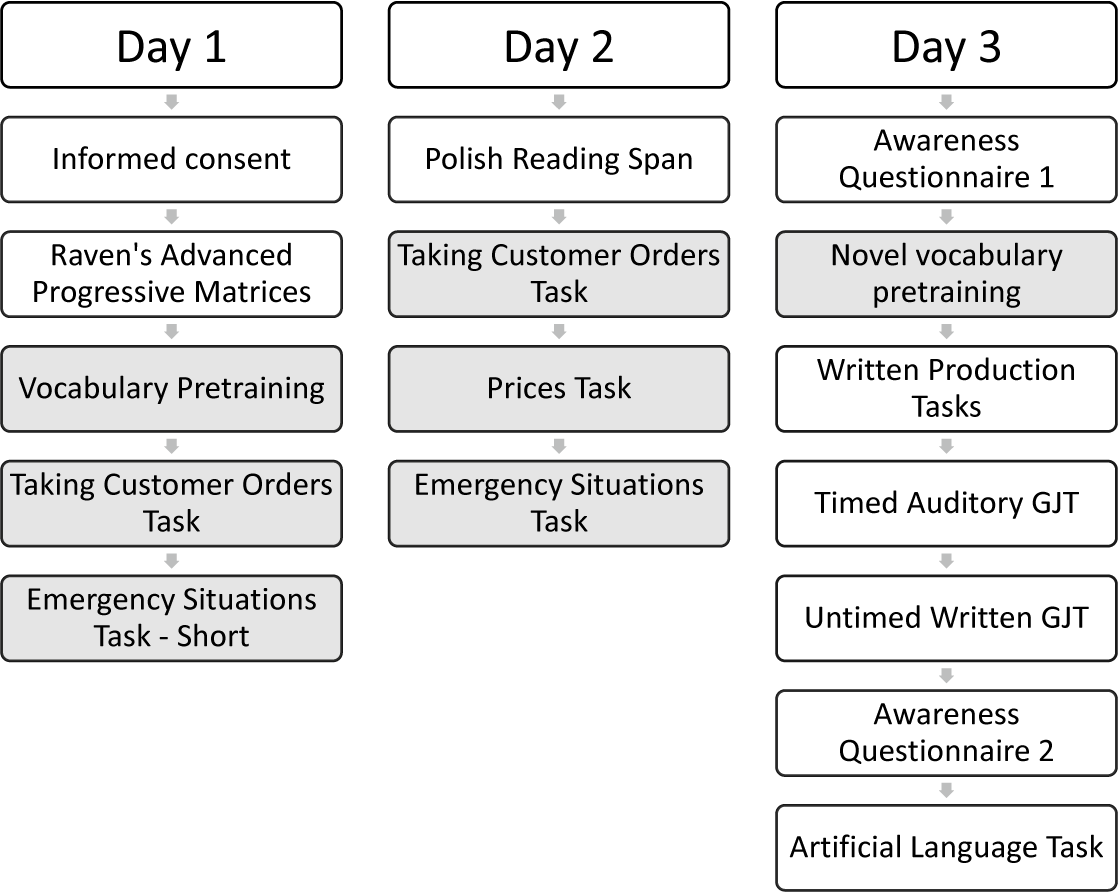
Participants were recruited from the general public through advertisements placed on the university website and social media. They were informed that the study concerned the role of cognitive abilities in the acquisition of a new language in adulthood; however, the focus on grammar acquisition was not disclosed until the post-test. The main experimental procedure consisted of three sessions, spread over the span of 7 days. It took place in a quiet computer room on the university campus. Each session lasted approximately 90–120 min. Depending on the dynamics of participant recruitment, the study tasks were administered to the groups of 2–6 participants, or occasionally on a 1-to-1 basis. The computerized tasks (apart from the LLAMA B) were presented using PschoPy3 (Peirce et al., Reference Peirce, Gray, Simpson, MacAskill, Höchenberger, Sogo, Kastman and Lindeløv2019) on a personal computer. All the tasks contained written instructions, and all the auditory stimuli were presented through headphones. Participants worked at their own pace. At the beginning of each session, they received general instructions from a research assistant, who also supervised study sessions and provided technical support. The first two sessions focused on the MiniItaliano tutorials, supplemented by one cognitive task per day (see Figure 4). In the last session, the participants completed two awareness questionnaires, two written production tasks,Footnote 4 both GJTs, and an Artificial Language task, administered as the last component of the study to limit its influence on other tasks (i.e., by encouraging the use of language-analytic strategies or focus on grammar).
The outline of the experimental procedure. The training components of the procedure have been shaded.

At the beginning of the study, the participants signed an informed consent form. They received monetary compensation for their contribution of 170 PLN (approximately $42). The experimental procedure was approved by the Ethics Committee of the University of Economics and Human Sciences in Warsaw.
Data analysis
The results of the timed auditory and untimed written GJTs were analyzed via generalized linear mixed models (GLMMs) with a logistic link function (lme4 package, Bates et al., Reference Bates, Maechler, Bolker, Walker, Christensen, Singmann, Dai, Eigen and Rcpp2015) in R (R Core Team, 2023). The p values for the model coefficients were estimated with the lmerTest package (Kuznetsova, Brockhoff & Christensen, Reference Kuznetsova, Brockhoff and Christensen2017), and convergence issues were tackled via the Bound Optimization by Quadratic Approximation (BOBYQA) optimizer (Powell, Reference Powell2009). The dependent variable in the models was the correctness of each response in the GJT (i.e., 0 or 1). The independent variables included grammaticality of an item (i.e., grammatical or ungrammatical), nonverbal general intelligence (Raven’s Progressive Matrices), LAA (Artificial Language task), WMC (PRSPAN), reliance on grammatical rules (i.e., based on attributions in the written GJT), associative memory (assessed by the LLAMA B), self-reported knowledge of previous languages, awareness of the aim of the study (assessed by a single questionnaire item), and self-reported attention to grammatical rules during training (assessed by a single questionnaire item). Moreover, as previous research showed that correlations between LAA and grammar knowledge may be moderated by the grammaticality of items (Foryś-Nogala, Reference Foryś-Nogala2021), the initial models included two-way interactions between grammaticality and the following cognitive aptitudes: general intelligence, LAA, and WMC. The categorical predictor (i.e., grammaticality of a GJT item) was deviation coded, and the continuous predictors were standardized. The intercept reflected the grand mean. All the analyses adopted an alpha value of 5%.
Regarding the model building scheme, in the first step, we determined the random-effects structure, as recommended by Meteyard and Davies (Reference Meteyard and Davies2020). Initially, all the random intercepts and slopes were entered simultaneouslyFootnote 5; subsequently, random slopes rendering singularity or with variance close to 0 were removed. Once the random effects had been specified, the fixed effects were added. Finally, for the sake of model parsimony, nonsignificant predictors that were a priori specified as nonessential (i.e., all the two-way interactions between grammaticality and cognitive aptitudes as well as certain covariates whose potential contributions to the model we decided to explore; see Table 1) were removed from the model if it did not hamper its fit, which was checked by likelihood ratio tests. Model diagnostics were carried out based on Cook’s distance (influence.ME package; Nieuwenhuis et al., Reference Nieuwenhuis, Te Grotenhuis and Pelzer2012) to identify potential outliers among subjects and items. Based on Cook’s distance computed for the full final models, with the assumed cutoff value of 4/n (Nieuwenhuis et al., Reference Nieuwenhuis, Te Grotenhuis and Pelzer2012) followed by a sensitivity analysis, one participant was removed from the analysis of the written and two from the auditory GJT. In Appendix 6, we report models computed on the intact dataset (i.e., N = 45). The data and the scripts replicating all the analyses are available at https://osf.io/jwd43/.
Descriptive statistics for the continuous predictor variables

Results
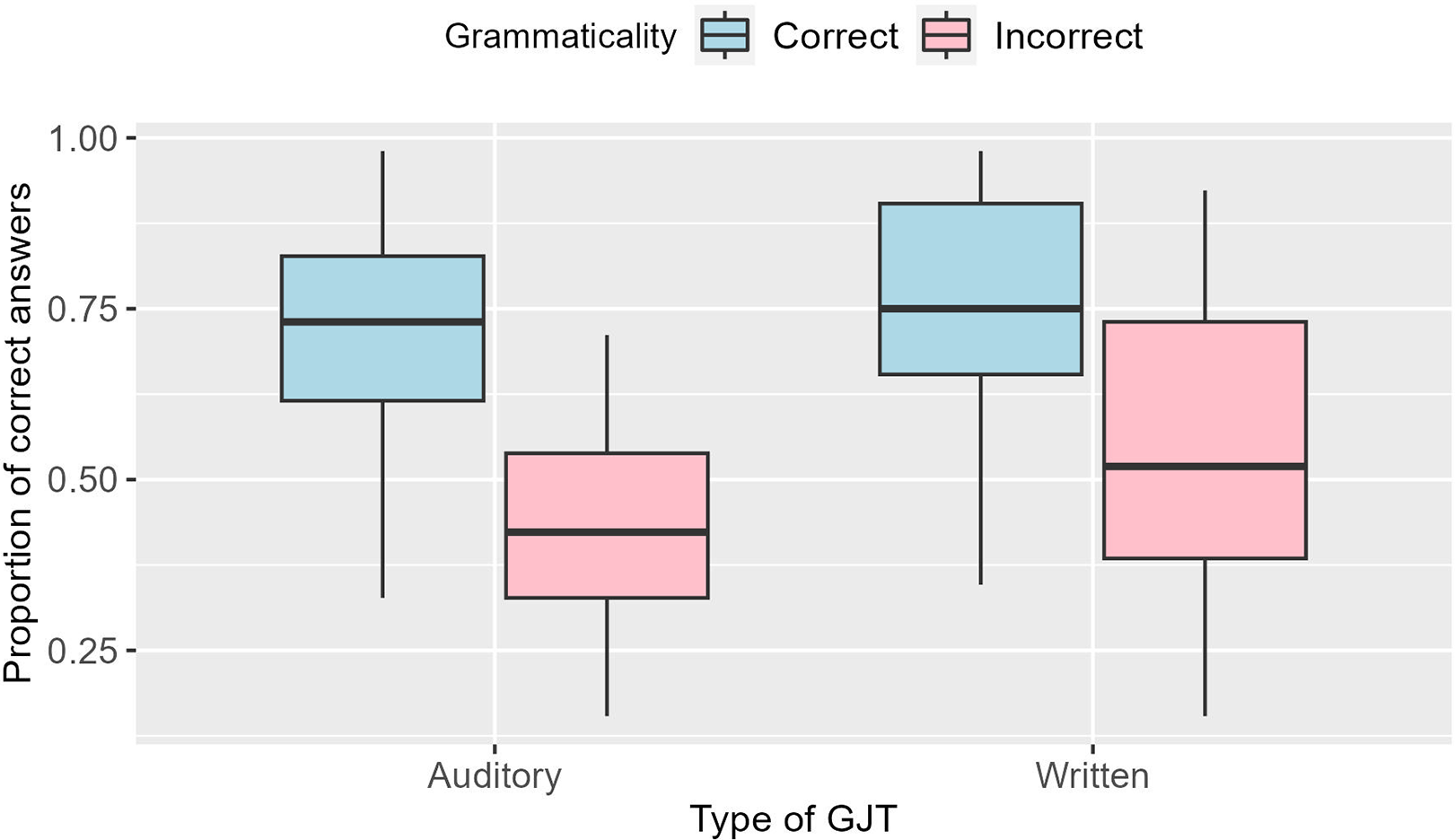
Tables 1 and 2 show the descriptive statistics for all the predictor and outcome variables used in the study (see also Figure 5 for the distribution of the GJT scores). We observed a considerable variability among the participants in mastering the target grammar of MiniItaliano as well as in their cognitive aptitudes, knowledge of foreign languages, or judgment attributions in the written GJT. Moreover, as follows from the correlation matrix of the continuous predictors (see Appendix 6), the correlations between those were negligible to medium (Plonsky & Oswald, Reference Plonsky and Oswald2014).
Descriptive statistics for the performance on two versions of the GJT

The distribution of scores in the auditory and written GJTs broken into grammatical and ungrammatical items.

Untimed written grammaticality judgment task
The results of the mixed-effects logistic regression model (see Tables 3 and 4; Figure 6) computed for the untimed written GJT showed that, when all other variables were held constant, grammatical sentences stood a higher chance of being assessed correctly than ungrammatical sentences. Moreover, the probability of a correct sentence judgment increased with higher LAA (p = .006). Finally, greater self-reported reliance on rules rather than intuition in sentence judgment rendered better performance on the task (p < .001). In contrast, general intelligence, knowledge of previous languages, and working memory were not shown to predict the probability of an accurate response in the untimed written GJT over and above LAA and reliance on rules. Notably, all the two-way interactions between grammaticality and cognitive aptitudes (WMC, LAA, and IQ) were nonsignificant; thus, they were removed from the final model (see Data analysis section), suggesting that those participant-related variables had a comparable impact on both grammatical and ungrammatical items.
Fixed-effects estimates in the model for the untimed written GJT

Note: Number of data points = 4,576; items = 104; participants = 44. The marginal R2 of the model = .19 and its conditional R2 = .27.
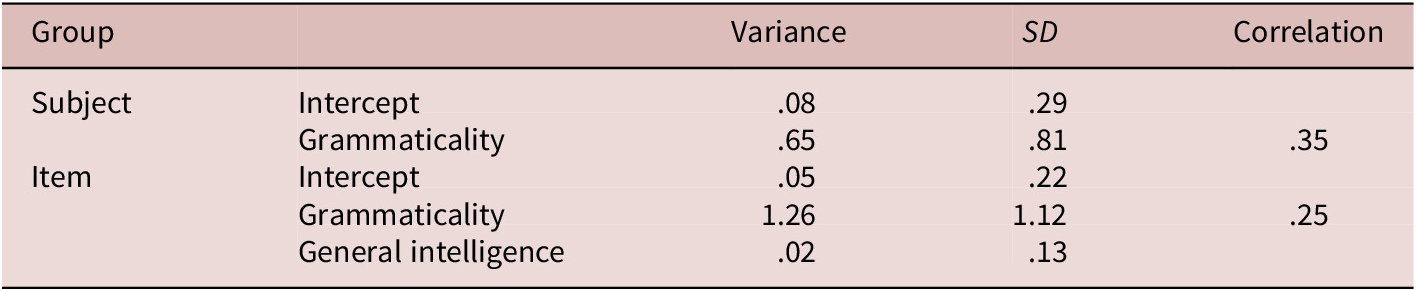
Random-effects estimates in the model for the untimed written GJT

Linear mixed-effects model’s estimates for the relationship LAA and written untimed GJTs (left panel) and between self-reported attribution to rules and untimed GJTs (right panel).

Next, to further explore our RQs (in particular, RQ1a), we ran a supplementary model with residualized LAA and WMC. Each of those variables was regressed on general IQ and one of the two remaining cognitive predictors, and the resultant residuals were used as new variables in a GLMM. Also, to better isolate the contributions of individual cognitive aptitudes to performance on the untimed GJT, we removed knowledge of previous languages from the supplementary model. This was motivated by its moderate collinearity with IQ (r = .42). Other than that, the fixed and random effects were the same as in the model with the original (i.e., not residualized) variables (see Tables 3 and 4). The results showed that intact nonverbal intelligence was now positively related to the untimed written GJT (odds ratio = 1.41; 95% CI, 1.18–1.69; p < .001). Moreover, of the residualized variables, only LAAresid explained some variance in task performance over and above nonverbal IQ (odds ratio = 1.35; 95% CI, 1.12–1.63; p = .002). In contrast, residualized WMC did not reach statistical significance (odds ratio = 1.19; 95% CI, 1.21–1.75; p = .071; for complete model parameters, see Appendix 6). In the final step, we carried out an analogous analysis with intact WMC and residualized general IQ and LAA. As expected, WMC now emerged as a significant predictor of untimed GJT (odds ratio = 1.35; 95% CI, 1.13–1.61; p = .001). However, both LAA and IQ, although stripped of the variance shared with other cognitive skills, were still significant over and above WMC (odds ratio = 1.39; 95% CI, 1.15–1.67; p = .001, and odds ratio = 1.28; 95% CI, 1.06–1.55; p = .009, respectively). These results suggest that WMC does not provide unique contributions to accounting for performance on the untimed GJT beyond the general cognitive capacity it shares with other cognitive variables.
Timed auditory grammaticality judgment task
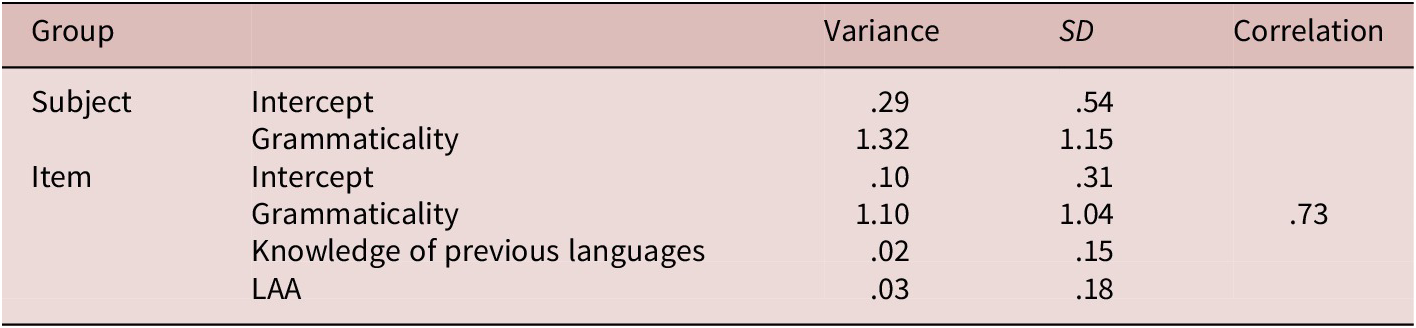
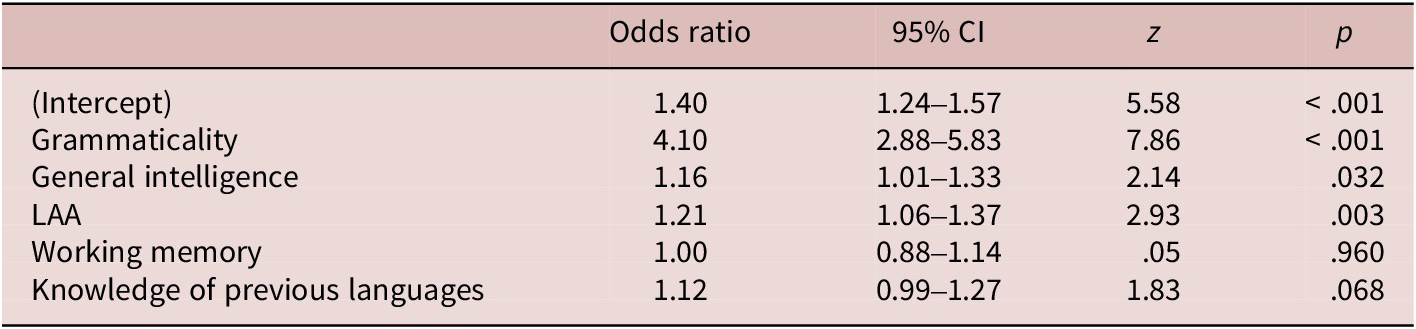
The analyses run for the untimed written GJT were replicated for the timed auditory GJT (Tables 5 and 6; Figure 7). Similar to the untimed GJT, the results showed that grammatical sentences stood a higher chance of being judged correctly than ungrammatical sentences. Moreover, general intelligence and LAA were both positively related to task performance. None of the remaining variables pertaining to individual differences was significant. Finally, similar to the written GJT, all the two-way interactions between grammaticality and cognitive aptitudes were nonsignificant and thus excluded from the final model.
Fixed-effects estimates in the model for the timed auditory GJT

Note. Number of data points = 4,472; items = 104; participants = 43. The marginal R2 of the model = .15 and its conditional R2 = .21.
Random-effects estimates in the model for the timed auditory GJT

Linear mixed-effects model’s estimates for the relationship between LAA and timed auditory GJT (left panel) and between general IQ and timed auditory GJT (right panel).

In the next step, we ran supplementary analyses with residualized variables, paralleling those performed for the untimed GJT. First, LAA and WMC were both substituted with their residualized counterparts, and knowledge of previous languages was dropped from the model. Other than that, the fixed and random effects were the same as in the original model for the auditory timed GJT (Tables 5 and 6). The obtained pattern of results mirrored the one observed in the original analysis. Both intact nonverbal IQ (odds ratio = 1.33; 95% CI, 1.19–1.50; p < .001) and residualized LAA (odds ratio = 1.22; 95% CI, 1.09–1.37; p = .001) showed a positive relationship with the auditory GJT score. In contrast, the effect of WMC was nonsignificant (odds ratio = 1.08; 95% CI, 0.96–1.21; p = .190; for complete model parameters, see Appendix 6). Finally, a model for the timed GJT with intact WMC and residualized general IQ and LAA showed that both residualized variables were significant over and above WMC (odds ratio = 1.26; 95% CI, 1.12–1.41; p < .001, and odds ratio = 1.27; 95% CI, 1.13–1.42; p < .001, for IQresid and LAAresid, respectively). As observed in the analogous model for the untimed GJT, intact WMC was a significant predictor of the task scores (odds ratio = 1.22; 95% CI, 1.09–1.37; p < .001).
Discussion
Carroll and Sapon (Reference Carroll and Sapon2002) define language aptitude as cognitive abilities that are predictive of “how well, relative to other individuals, an individual can learn a foreign language in a given amount of time and under given conditions” (p. 23). In the present study, such exposure-related variables were held constant across participants due to the use of the miniature language paradigm. The training was designed to direct participants’ attention to L2 comprehension without providing any explicit information about the grammatical rules embedded in the input. In the post-test, participants were tested on their knowledge of the target structures via untimed written and timed auditory GJTs. We investigated how far the variability in their performance on both tasks was related to individual differences in cognitive aptitudes, including general intelligence, working memory, and LAA, while controlling for self-reported knowledge of previous languages. Moreover, through self-reports provided during the written GJT, we obtained a measure of the ratio of participants’ reliance on rules compared to intuitions while assessing sentence grammaticality.
In line with the results of the majority of previous studies, we found a positive relationship between untimed written GJT, assumed to tap into explicit L2 knowledge, and LAA. Surprisingly, counter to previous research (e.g., Brooks et al., Reference Brooks, Kempe and Sionov2006, Reference Brooks, Kwoka and Kempe2017), general IQ did not emerge as a significant predictor of explicit knowledge in the main analysis. A supplementary analysis with WMC and LAA, residualized over general IQ, revealed that its null effect in the original model stemmed from the shared variance with other variables. Nevertheless, LAA explained performance on the GJT beyond this shared cognitive capacity, suggesting that the ability to extract verbal rules surpasses nonverbal pattern extraction and WMC in predicting the rates of explicit learning. To our knowledge, to date, only one psycholinguistic study with adult participants by Dąbrowska (Reference Dąbrowska2018) considered both nonverbal IQ and LAA together as predictors of grammatical knowledge. However, that study concerned the role of cognitive aptitudes not in L2 but in L1. Dąbrowska (Reference Dąbrowska2018) found that both aptitude-related variables were significant predictors of L1 grammatical knowledge, measured by sentence-picture matching task, but the effect size of general intelligence was slightly bigger than of LAA.
Apart from cognitive aptitudes, better performance on the written GJT was more probable for the participants who showed higher rates of reliance on rules rather than intuitions in assessing the stimuli sentences. Thus, the use of explicit rule-based knowledge was a better strategy to handle the GJT than reliance on intuition. This might be accounted for by the duration of training, which, though robust, might have not been sufficient for the development of accurate intuitions, which underlie implicit knowledge (e.g., Morgan-Short et al., Reference Morgan-Short, Steinhauer, Sanz and Ullman2012). In contrast, explicit knowledge can be formed even when L2 exposure is limited. Notably, even though grammar learning was never made explicit as the goal of the study, some of the participants were inclined to infer rules from MiniItaliano input, which further corroborated that exposure conditions in linguistic studies do not determine the actual learning strategies adopted by the participants (DeKeyser, Reference DeKeyser1995). Similarly, Li et al. (Reference Li, Ellis and Zhu2019) found that analytic ability predicted learning the L2 passive voice through a meaning-focused task without any focus-on-form component. The authors attributed this result to the learners’ tendency to spontaneously engage in form-focused language learning.
Counter to previous research, our multivariate analyses did not show any links between WMC and explicit grammatical knowledge. Notably, further supplementary analyses showed that working memory predicted grammar learning, but only within the range of variance it shared with other cognitive predictors. In other words, working memory did not significantly predict grammar learning beyond general IQ and language analytic skills. This may explain the discrepancy between our findings and previous research, which often focused solely on measures of WMC (e.g., Erçetin & Alptekin, Reference Erçetin and Alptekin2013; Pawlak & Biedroń, Reference Pawlak and Biedroń2019). Finally, grammaticality did not interact with any of the aptitudes, suggesting that performance on both grammatical and ungrammatical items was similarly influenced by cognitive skills.
The growth of automatized knowledge of MiniItaliano was measured by the auditory timed GJT. Similar to written GJT, LAA predicted the scores in the timed auditory GJT. This finding replicated the result reported by Suzuki and DeKeyser (Reference Suzuki and DeKeyser2017), who found a positive correlation between the LLAMA F and timed GJT. Moreover, another significant predictor of automatized knowledge was general intelligence. This suggests that more general cognitive abilities might gain importance when linguistic knowledge is used in real time. Working memory was not found to be significantly related to scores in the timed GJT over and above other cognitive variables incorporated into the analysis. As mentioned in the literature overview, the results regarding the role of WMC in applying automatized knowledge of L2 are inconclusive. For instance, Erçetin and Alptekin (Reference Erçetin and Alptekin2013) observed significant correlations between a reading span task and measures of automatized knowledge: a timed GJT (r = .35) and elicited imitation task (r = .31). In contrast, Pawlak and Biedroń (Reference Pawlak and Biedroń2019, Reference Pawlak and Biedroń2021) did not find any links between a listening span task and automatized L2 knowledge. Finally, similar to the untimed GJT, no interactions with grammaticality and aptitudes were observed for timed GJT, which replicated findings by Granena (Reference Granena2016b) reported for elicited imitation as a measure of automatized knowledge.
The study is not free from limitations that could be addressed in future research. First, even though the training was designed to bear features of naturalistic language acquisition, it was still a laboratory study with limited ecological validity. In particular, its generalizability on social learning contexts is limited. On the other hand, such a context of exposure may reflect learning a new language via computer programs and applications. Moreover, as suggested by an anonymous reviewer, the simplified binomial format of source attributions used in the study did not account for guessing. As a result, the index they provided was literally limited to the ratio of self-reported reliance on rules. Responses not attributed to rule knowledge were, by default, categorized as intuition due to the lack of alternative options. Furthermore, judgment attributions were not included in the timed version of the task, where they could have been particularly valuable in determining the nature of the knowledge participants relied on. However, incorporating them into the timed task might have inadvertently encouraged the use of metalinguistic knowledge, potentially interfering with the automatized processing that the task was designed to elicit.Footnote 6
Regarding recommendations for further research, it would be useful to control for affective variables, such as motivation, whose exploration might have increased the amount of variance in learning explained by the analyses. Based on informal communication with some participants, we speculate that their source of motivation for participation (i.e., intrinsic—interest in learning languages or extrinsic—financial renumeration) might have influenced the results. Finally, future research should expand the design, so that it can allow for investigating the growth of implicit knowledge with fine-grained psycholinguistic measures (Suzuki & DeKeyser, Reference Suzuki and DeKeyser2017).
Conclusions
In this study, we focused on the contributions of three cognitive aptitudes—working memory, general intelligence, and LAA—to the acquisition of L2 grammar of a miniature language in incidental exposure conditions. In summary, rule inference skills, together with the strategic use of rules, facilitated performance on the untimed GJT, which is assumed to tap into explicit knowledge. Regarding automatized knowledge, measured by the timed auditory GJT, it was predicted by both LAA and general IQ. For both explicit and automatized knowledge, our findings empirically support Carroll and Sapon’s (Reference Carroll and Sapon2002, p. 24) proposal that the ability to “perceive grammatical relationships” is indeed a special skill that predicts the acquisition of L2 grammar beyond general nonverbal IQ. In contrast, no such contributions were observed for working memory. Further analyses indicated that the predictive effect of working memory on grammar learning is confined to the variance it shares with other cognitive predictors used in the study. Replication research with larger samples is needed to further explore the relative involvement of cognitive abilities in the growth of different types of L2 knowledge.
Supplementary material
The supplementary material for this article can be found at http://doi.org/10.1017/S0272263125000117.
Data availability statement
The data are available at https://osf.io/jwd43/.
Acknowledgments
The research was supported by grant no. 2020/04/X/HS6/01277 from the National Science Centre Poland awarded to Małgorzata Foryś-Nogala. We sincerely thank Jacek Rysiewicz for sharing his Polish Foreign Language Aptitude Test - TUNJO with us. We are also deeply grateful to Adriana Biedroń for providing access to PRSPAN and offering valuable guidance on its administration. Lastly, we would like to thank the editors and reviewers of SSLA for their invaluable suggestions and constructive feedback on the previous version of the manuscript.
Competing interests
The authors declare none.