


Height and intelligence are crucial human phenotypic traits. Investigating the mechanisms underlying their correlation has become a classic research topic spanning multiple disciplines such as epidemiology, genetics, and psychology. From early population-based observational studies to modern precision analyses driven by molecular genetics, the academic understanding of this relationship has continuously evolved. However, key questions regarding whether the correlation reflects causality and identifying the core influencing factors remain challenging.
Multiple cohort studies across diverse populations have consistently demonstrated a weak but statistically significant positive correlation between height and intelligence. Twin studies have reported both shared genetic and environmental contributions; however, it has remained inconsistent due to population, age, adjustment, and measurement differences. Early classic twin studies suggested that this relationship was primarily driven by shared environmental factors (56% ∼59%) and overlapping genetic factors (31% ∼35%; Sundet et al., Reference Sundet, Tambs, Harris, Magnus and Torjussen2005), but Silventoinen et al. (Reference Silventoinen, Posthuma, van Beijsterveldt, Bartels and Boomsma2006) found that shared genetic factors fully explained this covariation in Dutch twins. Further large-scale analyses (containing four independent twin samples, N = 7905; Keller et al., Reference Keller, Garver-Apgar, Wright, Martin, Corley, Stallings, Hewitt and Zietsch2013) and studies on the association of genetic variation (Benyamin et al., Reference Benyamin, Wilson, Whalley, Visscher and Deary2005; Marioni et al., Reference Marioni, Batty, Hayward, Kerr, Campbell, Hocking, Generation, Porteous, Visscher and Deary2014) have emphasized that pleiotropy, selective mating, and environmental factors (especially nutrition) collectively contribute to this correlation (Keller et al., Reference Keller, Garver-Apgar, Wright, Martin, Corley, Stallings, Hewitt and Zietsch2013). Despite these findings, the results remain inconsistent (Sniekers et al., Reference Sniekers, Stringer, Watanabe, Jansen, Coleman, Krapohl, Taskesen, Hammerschlag, Okbay, Zabaneh, Amin, Breen, Cesarini, Chabris, Iacono, Ikram, Johannesson, Koellinger, Lee and Posthuma2017). Due to the inherent limitations in observational studies, researchers argue that confounding factors (e.g., nutrition, early-life socioeconomic status, and pubertal timing) may lead to spurious correlations, indicating that genetic factors alone cannot fully elucidate the link between height and intelligence (Amin & Fletcher, Reference Amin and Fletcher2022). There are also arguments that this relationship may be driven by unobserved common factors or that it may involve reverse causality.
Neuroticism, one of the Big Five personality traits, has emerged as a compelling candidate for a ‘bridging variable’ in the correlation between height and intelligence, an inquiry motivated by the pervasive ‘myth of tallness’ and ‘height discrimination’ (Rosenberg, Reference Rosenberg2009). From a social cognitive perspective, height is more than a biological attribute; it is imbued with value judgments by society, particularly during adolescence, manifesting in two distinct pathways. On one hand, taller individuals often benefit from a positive feedback effect loop where greater access to resources and higher expectations from others, as described by the Pygmalion effect (Rosenthal & Jacobson, Reference Rosenthal and Jacobson1968), foster enhanced cognitive development. On the other hand, dissatisfaction with one’s height can precipitate mental health challenges like anxiety and depression (Jeronimus et al., Reference Jeronimus, Kotov, Riese and Ormel2016; Mo & Bai, Reference Mo and Bai2022), a process where neuroticism plays a critical role by amplifying the adverse psychological impact. Crucially, a robust body of research confirms that neuroticism and associated conditions are negatively correlated with intelligence (Anglim et al., Reference Anglim, Dunlop, Wee, Horwood, Wood and Marty2022; Bahrami et al., Reference Bahrami, Shadrin, Frei, O’Connell, Bettella, Krull, Fan, Røssberg, Hindley and Ueland2021; Xiang et al., Reference Xiang, Xiao, Wang, Zhu, Jiang, Feng, Xiao and Song2025). Synthesizing these pathways, a logical chain emerges suggesting that neuroticism may mediate the relationship between height dissatisfaction and intelligence; however, despite this compelling theoretical framework, no study has yet explicitly verified this mediating effect through rigorous mediation analysis.
This study integrates genome-wide association study (GWAS) data, a Mendelian randomisation (MR) study, and mediation analysis to establish a multidimensional analytical framework. MR will be performed to verify the direction and strength of the causal relationship between genetically predicted height and intelligence, followed by a systematic evaluation of the mediating role of neurotic personality traits, nutritional status and mental health. Ultimately, this study aims to elucidate the synergistic ‘genetic−nongenetic’ mechanism linking height to intelligence, offering new insights into the determinants of human cognitive ability.
Materials and Methods
Study Design
The study design is visually represented in Figure 1, following the Strengthening the Reporting of Observational Studies in Epidemiology Using Mendelian Randomization (STROBE-MR) guidelines (Skrivankova et al., Reference Skrivankova, Richmond, Woolf, Yarmolinsky, Davies, Swanson, VanderWeele, Higgins, Timpson and Dimou2021) without a preregistered or published analysis plan. Summary statistics from GWAS were obtained from open resources (Table S1). All participants in these GWAS were of European ancestry. First, bidirectional two-sample MR analysis was conducted to explore causal relationship among height, intelligence, and potential mediators of interest. Next, two-step mediation analysis was used to evaluate whether these factors mediated the effects of exposure on the outcome of interest.
Assumptions and study design of the Mendelian randomization (MR) study.
Note: ANX, anxiety disorders; BMI, body mass index; MDP, major depression; MR, Mendelian randomization; NEU, neuroticism; SNP, single nucleotide polymorphisms.

Figure 1 Long description
A diagram of the causal assumptions in Mendelian randomization mediation study design. The diagram includes several labeled components: Instrument 1, Exposure, Mediators, Instrument 2, Outcome, and Confounders. Instrument 1 and Instrument 2 both involve SNPs extraction with specific criteria: P less than 5 times 10 to the power of -8, distance of 10,000, r squared less than 0.001, and F greater than 10. The Exposure is height with a sample size of 461,950. The Mediators include NEU, ANX, MDP, and BMI. The Outcome is intelligence with a discovery sample size of 269,867 and a replication sample size of 117,751. Arrows indicate the flow and relationships between these components, with exclusion restriction criteria and independence assumptions noted. Confounders are shown to potentially affect both the mediators and the outcome.
Data Sources
Genetic associations summary statistics for height were extracted as the exposure condition from a meta-analysis of GWAS by the GIANT consortium and the UK Biobank (Yengo et al., Reference Yengo, Sidorenko, Kemper, Zheng, Wood, Weedon, Frayling, Hirschhorn, Yang and Visscher2018). Two indicators of intelligence were used: general intelligence (g) and fluid intelligence. Data from Savage et al. (Reference Savage, Jansen, Stringer, Watanabe, Bryois, de Leeuw, Nagel, Awasthi, Barr, Coleman, Grasby, Hammerschlag, Kaminski, Karlsson, Krapohl, Lam, Nygaard, Reynolds, Trampush and Posthuma2018) were included as the discovery sample, providing a measure of general intelligence. For validation, fluid intelligence data from 152,000 UK Biobank subjects, assessed via a 13-item verbal-numerical reasoning test (Data-Field 20016; Kendall et al., Reference Kendall, Rees, Escott-Price, Einon, Thomas, Hewitt, O’Donovan, Owen, Walters and Kirov2017), was used. To assess the influence of nutritional status, personality traits, and mental health on the height-intelligence relationship, four factors were incorporated as mediators: neuroticism (NEU; Nagel et al., Reference Nagel, Jansen, Stringer, Watanabe, de Leeuw, Bryois, Savage, Hammerschlag, Skene, Munoz-Manchado, Me Research, White, Tiemeier, Linnarsson, Hjerling-Leffler, Polderman, Sullivan, van der Sluis and Posthuma2018), major depression (MDP; Howard et al., Reference Howard, Adams, Clarke, Hafferty, Gibson, Shirali, Coleman, Hagenaars, Ward, Wigmore, Alloza, Shen, Barbu, Xu, Whalley, Marioni, Porteous, Davies, Deary and McIntosh2019), anxiety (ANX; Neale lab, https://www.nealelab.is/uk-biobank), and body mass index (BMI; Yengo et al., Reference Yengo, Sidorenko, Kemper, Zheng, Wood, Weedon, Frayling, Hirschhorn, Yang and Visscher2018), due to their relevance to height-related issues.
Data Extracting Procedures and Ethics Statement
Detailed information on the GWAS datasets is listed in Table S1. All summary statistics were obtained from public databases (IEU Open GWAS, GWAS Catalog, PGC) after authentication. No additional ethical approval was required as all data were publicly available.
Single nucleotide polymorphisms (SNPs) genome-wide significantly associated with the exposure (p < 5e-08) were extracted to construct genetic instrumental variables (IVs). SNPs were clumped (distance threshold = 10,000 kb, r
2 = 0.001) using the clump_data command in the TwoSampleMR R package to ensure independence. IV strength was assessed: the variance (R
2) explained by each SNP was obtained, and F-statistics calculated using the formula:
 $F = \;{{{{R^2} \times \left( {N - k - 2} \right)}}\over{{k\left( {1 - \;{R^2}} \right)}}}$
, where R
2 is the variance in exposure explained by the SNP, N is the sample size, and k is the number of SNPs. The sum of R
2 indicated the IV’s predictive capacity for the exposure. SNPs with F-statistics < 10 were considered weak and removed. A high mean of F-statistic helps avoid weak IV bias (Burgess et al., Reference Burgess and Thompson2011).
Statistical Analysis
Univariable MR analysis (UVMR). The TwoSampleMR (Hemani et al., Reference Hemani, Zheng, Elsworth, Wade, Haberland, Baird, Laurin, Burgess, Bowden and Langdon2018) and MR-PRESSO (Verbanck et al., Reference Verbanck, Chen, Neale and Do2018) packages were used to estimate causal effects. Effects are reported as regression coefficients (β) with standard error (SE). Analyses were performed in R (v 4.4.1).
UVMR requires genetic variants to satisfy three key assumptions: (1) relevance (association with exposure), (2) independence (no association with confounders), and (3) exclusion restriction (influence on outcome only via exposures; Birney, Reference Birney2021). The inverse-variance weighted (IVW) method was the primary MR analysis (Burgess & Thompson, Reference Burgess and Thompson2013; Slob & Burgess, Reference Slob and Burgess2020). Robustness was assessed using MR-Egger regression, weighted median, and MR-PRESSO. For significant causal relationships, sensitivity analyses were conducted, including Cochran Q test (Burgess & Thompson, Reference Burgess and Thompson2013), Rücher Q statistic test (Bowden et al., Reference Bowden, Davey Smith and Burgess2015), MR-Egger intercept test, and MR-PRESSO global test, to assess heterogeneity, horizontal pleiotropy, and outliers. To avoid bias by sample overlap, the data from another GWAS study was used to validate the primary MR analysis results. In addition, the leave-one-out method was applied to assess the robustness of the MR results by eliminating individual SNPs one by one. The Bonferroni-corrected significance threshold for UVMR was 0.013 (0.05/4 methods).
Multivariable MR and mediation analysis. A two-step MR mediation analysis was conducted to assess mediation (Sanderson, Reference Sanderson2021). First, UVMR estimated the effect of exposure on outcome (c), exposure on mediator (a), and mediator on outcome (b), as depicted in Figure 1. Second, the direct effect of exposure on outcome (c’) was estimated using multivariable MR (MVMR; Burgess & Thompson, Reference Burgess and Thompson2015), adjusting for each mediator separately.
The total effect of height on intelligence was decomposed into: (1) the indirect effect (mediated effect, a × b), and (2) the direct effect (c’). The mediating effect (a × b) and its confidence interval were calculated using the delta method (RMediation package v1.2.2; Tofighi & MacKinnon, Reference Tofighi and MacKinnon2011). Statistical significance of the mediating effect was tested using the Sobel test (https://www.danielsoper.com/statcalc/calculator.aspx). The proportion mediated was quantified as the indirect effect divided by the total effect.
Results
Genetic Instruments Profile
Based on selection criteria, 773 independent SNPs (p < 5e-08) were selected as genetic IVs for height. These SNPs collectively explained 23.32% of the variance in height, with a mean F-statistics of 139.5 (range: 29.83−1976.82), indicating strong instrument strength and minimizing weak instrument bias risk (Burgess et al., Reference Burgess, Dudbridge and Thompson2016). In this study, height in MR analyses refers to genetically predicted height by IVs rather than individual’s measured height status.
Effect of Height on Intelligence
UVMR revealed an estimated association between genetically predicted height and general intelligence (β = 0.115, SE = 0.013, p = 1.2e-19; Figure 2 and Table S2). A 1-SD increase in height was associated with and odds ratio (OR) of 1.122 (95% CI [1.094, 1.150]) for higher intelligence. Consistent results were observed across supplementary MR methods MR-PRESSO, although heterogeneity and horizontal pleiotropy were detected (all p < .05). Similarly, in the validation sample, genetic height showed a significant effect on fluid intelligence (β = 0.266, SE = 0.028, p = 5.7e-22), with a 1-SD increase in genetic height corresponding to an OR of 1.304 (95% CI [1.236, 1.377]; Figure 2 and Table S2). According to the leave-one-out sensitivity analyses, no individual SNP was significantly influencing the association between genetically predicted height on intelligence.
Effects of genetically predicted height on intelligence. Results from inverse variance weighted (IVW), MR-Egger, Weighted median and MR-PRESSO MR analyses are indicated by small boxes.
Note: CI, confidence interval; OR, odds ratio.

Effect of Height on Four Mediators
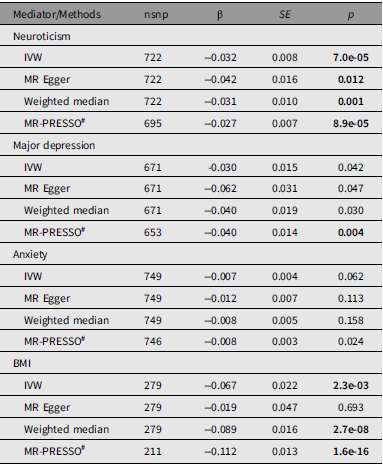
The genetically predicted height was significantly negatively associated with neuroticism (β = −0.032, SE = 0.008, p = 7.0e-05) and BMI (β = −0.067, SE = 0.022, p = .002; Table 1). Increased genetic height was associated with lower neuroticism (OR = 0.968, 95% CI [0.953, 0.984]) and lower BMI (OR = 0.935, 95% [CI: 0.896, 0.976]). No significant effects of height on anxiety or major depression were observed (Table 1).
Mendelian randomization analysis of the effect of height on mediators

Table 1 Long description
A table summarizing the association between genetically predicted height and various psychological and physical traits. The table has four rows and five columns. The columns are labeled Mediator/Methods, nsnp, β, SE, and p. The rows are labeled Neuroticism, Major depression, Anxiety, and BMI. Each row contains values for different methods: IVW, MR Egger, Weighted median, and MR PRESSO. Row 1: Neuroticism, nsnp 722, β -0.032, SE 0.008, p 7.0e-05; MR Egger, nsnp 722, β -0.042, SE 0.016, p 0.012; Weighted median, nsnp 722, β -0.031, SE 0.010, p 0.001; MR PRESSO, nsnp 695, β -0.027, SE 0.007, p 8.9e-05. Row 2: Major depression, nsnp 671, β -0.030, SE 0.015, p 0.042; MR Egger, nsnp 671, β -0.062, SE 0.031, p 0.047; Weighted median, nsnp 671, β -0.040, SE 0.019, p 0.030; MR PRESSO, nsnp 653, β -0.040, SE 0.014, p 0.004. Row 3: Anxiety, nsnp 749, β -0.007, SE 0.004, p 0.062; MR Egger, nsnp 749, β -0.012, SE 0.007, p 0.113; Weighted median, nsnp 749, β -0.008, SE 0.005, p 0.158; MR PRESSO, nsnp 746, β -0.008, SE 0.003, p 0.024. Row 4: BMI, nsnp 279, β -0.067, SE 0.022, p 0.002; MR Egger, nsnp 279, β -0.019, SE 0.047, p 0.693; Weighted median, nsnp 279, β -0.089, SE 0.016, p 2.7e-08; MR PRESSO, nsnp 211, β -0.112, SE 0.013, p 1.6e-16.
Note: IVW, reverse variance weighted; MR, Mendelian randomization analysis; nsnp, number of SNPs included in MR analysis. #MR-PRESSO provided the outlier-corrected MR analysis.
Effects of Mediators on Intelligence
Neuroticism and BMI exhibited significant negative effects on general intelligence (NEU: β = −0.215, SE = 0.047, p = 3.8e-06, OR = 0.806, 95% CI [0.736, 0.883]; BMI: β = -0.127, SE = 0.020, p = 6.4e-11, OR = 0.880, 95% CI [0.847, 0.915]) and fluid intelligence (NEU: β = −0.615, SE = 0.097, p = 2.4e-10; BMI: β = −0.246, SE = 0.044, p = 3.1e-08).
Multivariable MR and Mediation Analysis
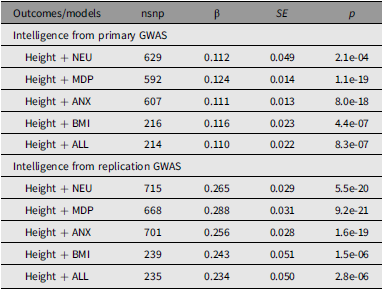
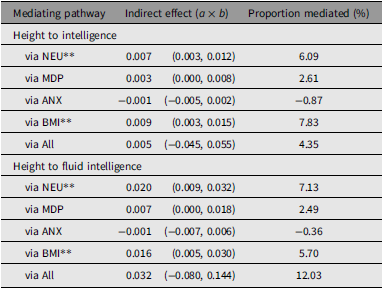
MVMR results showed that the estimated causal effect of genetically predicted height on intelligence remained significant after adjusting for neuroticism, major depression, anxiety, and BMI individually and simultaneously (Table 2), in both the discovery (β > 0.110, p < 2.1e-04) and validation samples (β > 0.234, p < 2.8e-06). Two-step mediation analysis revealed that both neuroticism and BMI significantly mediated the causal effect of height on intelligence (NEU: z = 3.011, SE = 0.002, p Sobel test = 2.6e-04; and BMI: z = 2.746, SE = 0.003, p Sobel test = 6.0e-03; Figure 3). They mediated 6.09% and 7.83% of the total effect, respectively (Table 3). Results from the validation sample confirmed these mediating effects.
MVMR analysis of the direct causal effects of height on intelligence with adjustment of the mediators

Table 2 Long description
A table with 8 rows and 5 columns. The columns are labeled nsnp, β, S E, and p. The rows are grouped under two headings: Intelligence from primary GWAS and Intelligence from replication GWAS. Each group contains rows for different mediators: Height + NEU, Height + MDP, Height + ANX, Height + BMI, and Height + ALL. The values in the columns represent the number of single nucleotide polymorphisms (nsnp), beta coefficients (β), standard errors (S E), and p-values (p) for the causal effects of height on intelligence with adjustment for different mediators. Notable trends include significant p-values across all mediators in both primary and replication GWAS, indicating strong causal effects.
Note: Only the results of MR using the IVW method are presented. nsnp, number of SNPs included in MR analysis; ANX, anxiety disorder; BMI, body mass index; MVMR, multivariable Mendelian randomization analysis; NEU, neuroticism; MDP, major depression.
Mediating effects in the association between genetically predicted height and intelligence. Schematic diagram illustrating the causal assumptions in Mendelian randomization (MR) mediation analysis with the measured associations in solid black lines. The effects of exposures on mediators (a), mediators on outcome (b), and direct effect of exposure on outcome (c’), were estimated by univariable MR and multivariable MR (MVMR) analyses respectively.
Note: ANX, anxiety disorder; BMI, body mass index; MDP, major depression; NEU, neuroticism; SNP, single nucleotide polymorphism.

Mediation analysis of height on intelligence via potential mediators

Table 3 Long description
The table presents the mediating pathways of height to intelligence and fluid intelligence through various factors. It has two main sections: Height to intelligence and Height to fluid intelligence. Each section lists the indirect effects and the proportion mediated for different pathways: via neuroticism, major depression, anxiety, and BMI. The table has 10 rows and 3 columns. The columns are labeled Mediating pathway, Indirect effect (a x b), and Proportion mediated (%). The rows list the specific pathways and their corresponding values. For Height to intelligence, the pathways are via neuroticism, major depression, anxiety, BMI, and all. For Height to fluid intelligence, the pathways are via neuroticism, major depression, anxiety, BMI, and all. Each row provides the indirect effect values and the proportion mediated in percentage.
Note: ANX, anxiety disorder; MDP, major depression; NEU, neuroticism score; nsnp, number of SNPs included in analysis; BMI, body mass index. **p value of the Sobel test < .01.
Reverse Analysis
Reverse MR analysis also showed significant association between general intelligence (β = 0.132, SE = 0.030, p = 8.7e-06) and fluid intelligence (β = 0.055, SE = 0.016, p = 7.3e-04) on predicted height using most methods (except MR-Egger method; Table S4). Intelligence also had a significant negative effect on neuroticism scores (general intelligence: OR = 0.936, 95% CI [0.897, 0.976], p = .002; fluid intelligence: OR = 0.960, 95% CI [0.934, 0.986], p = .003). However, none of the four moderators showed significant effect on height (Table S5). Subsequent MVMR and mediation analyses indicated no significant moderation of the intelligence-height relationship by these factors (Tables S6 and S7, Figure S1).
Discussion
This study systematically explored the association between genetic height and intelligence and the potential mediating roles of neuroticism, BMI, anxiety, and depression using MR and mediation analysis. The core findings are a significant bidirectional causal relationship between height and intelligence, and unidirectional mediating effects of neuroticism and BMI on the pathway from height to intelligence. These results provide new genetic-level evidence for the association mechanism between height and intelligence, clarify the distinct roles of psychological and metabolic factors, and hold significant theoretical and practical value.
Methodologically, MR analysis uses genetic variants as instrumental variables to effectively circumvent confounding bias (e.g., socioeconomic status, nutrition) and reverse causality inherent in traditional observational studies (Skrivankova et al., Reference Skrivankova, Richmond, Woolf, Yarmolinsky, Davies, Swanson, VanderWeele, Higgins, Timpson and Dimou2021). This strengthens the causal validity of the ‘bidirectional causal relationship’ conclusion. While previous studies have mostly focused on correlation or unidirectional causation in the general population or specific patient groups (Hagenaars et al., Reference Hagenaars, Gale, Deary and Harris2017; Huang et al., Reference Huang, Zhang, Bodimeade, Nassan, Gill, Cronje, Dib and Daghlas2025), this study is among the first to demonstrate bidirectional effects based on genetic evidence, suggesting complex regulatory mechanism and providing a new perspective on the coevolution of human cognition and physical development (Sanderson et al., Reference Sanderson, Spiller and Bowden2021).
Mediation Role of Neuroticism: A ‘Bridge Effect’ of Psychological Traits
The mediating effect of neuroticism, a core dimension of emotional stability (Mader et al., Reference Mader, Arslan, Schmukle and Rohrer2023), suggests that height may indirectly influence intelligence by affecting emotional regulation abilities. Mechanistically, taller individuals might experience less negative social evaluation (e.g., height discrimination), reducing the likelihood of developing neuroticism. Low neuroticism, in turn, may diminish the cognitive resources drain caused by emotional fluctuations, ultimately fostering a more stable psychological environment for intellectual development (Revelle et al., Reference Revelle, Wilt, Condon, Chamorro-Premuzic, von Stumm and Furnham2011). This aligns with previous findings of a negative correlation between neuroticism and cognitive function (Stanek & Ones, Reference Stanek and Ones2023). Crucially, this study clarifies its unidirectional mediating role — height influences intelligence partly by modulating neuroticism, not vice versa — suggesting targeted interventions (e.g., emotion management for height-related stress) could potentially improve cognitive outcomes.
Mediating Effect of BMI: A ‘Regulatory Node’ of Metabolic Health
BMI, a key indicator of metabolic status, mediated the height-intelligence effect, suggesting involvement of metabolic pathways. Specifically, taller individuals with a healthier BMI likely have a lower risk of metabolic disorders. Metabolic health can enhance brain nutrient supply and reduce neuroinflammation, thereby supporting neuronal development and synaptic plasticity, ultimately benefiting intelligence. Conversely, an abnormal BMI in taller individuals might offset the positive effect of height, explaining heterogeneity in some observational studies. Furthermore, the absence of a reverse mediating effect for BMI suggests that in the bidirectional height-intelligence relationship, metabolic factors primarily act downstream of the ‘height → intelligence’ effect rather than regulating the ‘intelligence → height’ pathway. This provides genetic evidence supporting cognitive development optimization through weight management.
Nonmediating Effects of Anxiety and Depression: Mechanistic Complexity and Limitations
Notably, anxiety and depression showed no significant mediating effects, unlike neuroticism. Potential reasons include: First, neuroticism is a stable personality trait, whereas anxiety and depression are often transient emotional states with greater volatility (Friedman & Kern, Reference Friedman and Kern2014), making them less suitable as stable mediator in a long-term causal pathway like ‘height-intelligence’. Second, MR sensitivity depends on IV validity; the genetic loci for anxiety and depression in this study might have had low explanatory power (due to sample size or pleiotropy), potentially leading to under-detection of mediation effects. Third, anxiety and depression might influence height and intelligence through more complex interactions (e.g., synergies with other traits) rather than acting as independent mediators, requiring further investigation via multivariate MR.
Limitations and Future Outlook
While MR strengthens causal inference, this study has several limitations. First, the reliance on publicly available genetic data derived predominantly from European populations restricts the generalizability of the findings. Second, the observed associations are modest in magnitude, and further evidence from clinical or public health interventions is required to substantiate and refine these suggestive causal mechanisms. Third, although mediation effects were identified, the specific dose-response relationship — such as how different BMI ranges influence the strength of mediation—remain unclear. Although a significant association between genetically predicted height and intelligence persists after accounting for heterogeneity and pleiotropy bias, this relationship should be interpreted with caution, as it may still be influenced by environmental factors, including nutrition, early-life socioeconomic status, pubertal timing, sample overlap. Additionally, phenotypic correlations between measured height and intelligence were not available in summary-level data.
Future research directions include: (1) integrating neuroimaging data (e.g., structural MRI) to explore whether the height-intelligence relationship is mediated by specific brain regions (e.g., prefrontal cortex, hippocampus); (2) designing intervention studies targeting the identified mediators (e.g., emotion management training, weight control programs) to verify whether they can modulate the impact of height on intelligence; (3) incorporating more potential confounders (e.g., genetic proxies for childhood nutrition, education) to refine the ‘height-intelligence’ causal network model.
Conclusions
This MR study supports bidirectional genetic associations between height and intelligence. Neuroticism and BMI statistically mediate the association from height and intelligence. The observed effect size is modest, and no direct clinical or public health interventions can be inferred. These results advance etiological insights into the joint development of physical and cognitive traits.
Supplementary material
To view supplementary material for this article, please visit https://doi.org/10.1017/thg.2026.10069
Acknowledgments
We appreciated all the genetics consortiums for making the GWAS summary data publicly available. We thank all participants, investigators who contributed to this study.
Financial support
This study was supported by the Shaanxi Provincial Natural Science Basic Research Program (Grant number 2024JC-YBMS-621; K. Zhang).
Competing interests
The authors declare that the research was conducted in the absence of any commercial or financial relationships that could be construed as a potential conflict of interest.
Ethics statement
This study used publicly available de-identified data from participant studies that were approved by an ethical standards committee concerning human experimentation. No separate ethics approval was required in this study.