In recent decades issues concerning indigenous peoples have found their way onto the international agenda in ever-increasing numbers, politically as well as culturally. One vital issue has been the indigenous peoples' claims for territorial and resource rights, argued on the basis of residence in a certain area since time immemorial. Hence, historical knowledge is often assigned great importance.
The indigenous peoples, as well as their political status and position in a broader geopolitical context, have of course been on the political agenda for centuries. What possibly may not be as easily recognized is that this was also deeply reflected in the way various indigenous groups were being classified and categorized by external forces and state powers. Not only may the historical sources pose many technical challenges for interpretation in themselves, but a quick glance at the evidence indicates that these classifications may be rather heavily imbued with ideological and political considerations that led to a choice of categorizations that might have served changing political goals.
In this article, we will present some results from a diachronic study of the various categorization principles applied by state authorities to the non-Norwegian population of Northern Norway. This investigation was confined to the northern part of present-day Nordland County, and was undertaken as part of a wider, multi-disciplinary project effort, focusing on ‘Ethnic relations in northern Nordland in a historical perspective’.Footnote 1 Mostly we will deal with the indigenous group the Sami people, but the Kvens are also included to a certain degree. The latter is a minority group with roots in Finland that was resident in Norway at least from the seventeenth century. In the sources examined for this project, the Kvens are not visible until the 1740s. In particular, we will focus on two important periods when state authorities were particularly active and engaged in defining, categorizing and re-categorizing the non-Norwegian population. The first is the middle of the eighteenth century, when geopolitical pressures formed a significant background to the establishment of clear borders and the resolution of sovereignty issues between the various state units, and when the focus was on drawing the state border between Sweden and Norway from the regions Trøndelag/Jemtland northwards. Consequentially, as we shall see, the Danish-Norwegian authorities redefined the categories that were applied to the Sami, based on the differential potentials the various Sami groups might have for contributing to the most successful drawing of the border according to the interests of the state (see Map 1).
The administrative districts (fjerdinger) of Salten bailiwick (the northern part of Nordland County) in the seventeenth and eighteenth centuries.

The second part of the article will focus primarily on the period between the turn of the nineteenth century and on to the interwar years of the twentieth, when the Norwegian authorities enforced a policy of assimilation or ‘Norwegianization’ vis-à-vis the ethnic minorities. Not only did this policy apply harsh measures against various expressions of non-Norwegian language and culture traits – in the education system particularly – but it also had major repercussions for how the Sami and the Kvens were to be treated in the censuses and official statistics. The explicit aims of state policy seem also to have been highly complex and varying during this period, ranging from making very accurate surveys of ethnic affiliation in the smallest detail to trying to present an overall picture of the population as being extremely homogeneous and uniform, culturally and ethnically speaking. Finally, we will contrast this policy with the policy of the post-war years, when both the state has adopted a more liberal view and the initiatives of the Sami for self-determination and control over their own designations and identification have been stronger.
It should also be understood that the Sami for and among themselves used their own self-designating term all the time: ‘sámit’, ‘same’ and ‘saemieh’, according to different Sami dialects. They are also known to have used specific mutual designations – relating to habitation area, landscape forms or livelihoods – to refer to each other, such as ‘Upper People’, ‘Sea People’, ‘Reindeer People’. On the other hand, however, the majority of the written sources that we are obliged to use when charting Sami history in older times were produced by non-Sami – most often with no or poor knowledge of the Sami language and the Sami's own designations, and with varying amounts of insight into Sami culture and sources of income.Footnote 2 46, 1 (1980), 21–52. The authorities who in earlier times entered taxpayers into the registers, compiled cadastres (public land records) and made entries in parish registers and censuses almost without exception belonged to the governing elite of Denmark-Norway, or Sweden. However, the different ways of approaching and categorizing the Sami that this elite applied over the centuries cannot be viewed solely as the result of their political and ideological assumptions. At the same time, great changes were taking place in Sami ways of livelihood, settlement and economy (such as the development of large-scale reindeer herding, sedentarization into settlements and so on).Footnote 3 The Sami's relationship to Norwegians, Swedes and Finns underwent changes too, as did the internal relationships between different Sami regions.
THE OUTSET: THE DESIGNATIONS ‘FINN’ AND ‘LAPP’ – AND WHAT THEY COVERED IN THE SIXTEENTH AND SEVENTEENTH CENTURIES
The Old Norwegian designation for the Sami – ‘finn’ – is used as far back as Ohthere's report to King Alfred of Wessex (end of the ninth century)Footnote 4 and is customary in Norse skaldic poetry and saga literature during medieval times as well.Footnote 5 When we come to the fifteenth–sixteenth centuries finn is the prevailing basic designation for the more or less stationary coastal Sami population along the coast to the north and west. In south Troms and northern Nordland it points to Sami who have a connection to farms – either through steady, permanent settlement on homesteads or in the form of regular, annual migrations between sites that were used as winter dwelling places and resource areas situated further into the fjords and used as summer dwelling places, so-called sommerseter in Norwegian.Footnote 6 This Sami population was thus primarily located along the fjords, but also partly on the outer coast. In this period they were registered in tax lists both on the Danish-Norwegian and Swedish sides, and in this connection the designation could be compounded with the prefix ‘Sea’. Hence the Danish-Norwegian lists speak of ‘Sea Finns’ (søefinner), while the Swedish tax collectors often called them ‘Western Sea Finns’ (västersjöfinner), since the Atlantic was called the ‘Western Sea’ (Västerhavet) from the Swedish point of view.
The clerically educated Swedish Sami Samuel Rheen, who wrote a detailed report at the end of the seventeenth century on the Sami's mode of living, occupations and religious situation, stressed that on the west side of the mountain ridge there were two kinds of lapper. The one group is called finnar by the Norwegians, he wrote, and they
live together with the Norwegians, and keep no reindeer, other than just a few. But their food consists mostly of livestock, cows, goats and sheep, plus a little farming, so that the one who sows best can reap up to one barrel or at most two: their language and clothing is the same as the Lapps', [and they] also hunt bears, black foxes, otters: they build boats that they sell to those who live in Norway, with which they sail to other lands … In sum they live together with the Norwegians and with them use the woods and fishing waters.Footnote 7
Rheen here presents a picture of ‘the Finns’ as having a complex economic life – comprising hunting, trapping, fishing and manufacture of boats for sale, alongside raising livestock, a modest kind of agriculture and perhaps a minimal number of reindeer. This picture tallies very well with what can be reconstructed from Swedish accounts from the latter half of the sixteenth century and the early seventeenth.Footnote 8
The ‘lapp’ designation for its part is also known from the Middle Ages but seems to have a more easterly origin, and it was used early in the present Finnish area and in Sweden. Possibly the terms ‘lapp’/'lappalainen' arose in some of the multilingual environments in northwest Russia, where Slavs, several Finno-Ugric peoples and Scandinavians carried on trade with each other during the Viking Age.Footnote 9 When we come forward to the sixteenth century, ‘Lapps’ (lappar) is the usual designation for the Sami under Swedish administration and it was therefore used, among other terms, for the inland Sami who stayed in the siidas Footnote 10 east of the mountain ridge, in the administrative units that were called lappmarks.
The clear-cut demarcation between ‘the Finns’ and ‘the Lapps’, when it came to the geographical extent of usage areas and subsistence adaptation, has also been confirmed by some testimonies that were taken down by the regional judge at Steigen, Peder Hanssen Schønnebøl, in Ofoten close to Christmas in 1591. When confronted with the judge's questions, both Norwegians and Sami from the surrounding fjords answered that ‘Finns are the ones who live out by the sea, but those who live in the mountains are Lapps.’ In addition they claimed that ‘the Finns do not use anything belonging to the King of Sweden, neither forest, nor field, nor mountain, nor beach, nor sea, nor lakes, nor birds or animals which the Lapps always use in the mountains …’. Now these statements must obviously be viewed in light of the situation in which they were made: this examination of witnesses came about as part of the increased political interest that the governmental authorities from both states showed towards the northern sections of their countries, and that was caused by the sharpened rivalry between Denmark-Norway and Sweden, over dominion over the Sea Sami and their areas. The judges were mainly looking for points and arguments that could be used against continued Swedish taxation of the Sea Sami, as well as for information about where the border actually went, according to the opinion of the local inhabitants. Nevertheless, the answers seem to give a realistic impression of the two Sami population groups.
Other sources from about the same time also give the impression that the two – in part contrasting – designations ‘Sea Finns’ and ‘Lapps’ were understood as exhaustive and such that they together covered the entire Sami population. This goes for the peace treaty concluded after the Nordic Seven Years War (1563–1570), the so-called Peace of Stettin,Footnote 11 as well as for the accounts produced by government officials during the years shortly before and after 1600, such as the reports of Governor Hans Olufssøn (Vardøhus) and Claus Urne (the Nordlands).Footnote 12
In addition to the inland Sami on the Swedish side of the mountain ridge, and the reindeer-herding Sami from these areas, it seems however, that the ‘lapp’ designation in this period also covered some reindeer herders with permanent residence on the west side of the mountain ridge. To presiding Judge Schønnebøl's question in 1591 as to whether there were also ‘lapps’ on the western side of the mountain ridge or ‘down here in Norway’, the witnesses answered that there were actually a few ‘in the Sami fjords’: namely, four in Ofoten, three in Tysfjord, one in the Hamarøy area and none in Lofoten. This enumeration should probably be understood as the numbers of households. Almost a century later this piece of information was confirmed by Samuel Rheen, who wrote that there were also a few specialized reindeer-herders on the Norwegian side of the mountain ridge, but that the areas they had at their disposal were too small for reindeer-herding to be very extensive.Footnote 13
EIGHTEENTH-CENTURY GEOPOLITICS AND BORDER-DRAWING: ‘SETTLED FINNS’ (BUFINNER AND BOESIDDENDES FINNER)
Throughout the latter half of the seventeenth century, the source material does not allow historians to follow the reindeer-herding Sami continuously from year to year. The reason is primarily that the so-called ‘Lapp tax’ (lappeskatt) – collected from them by the Danish-Norwegian authorities – was delegated to the magnate Joachim Irgens as part of the great sales of Crown lands in January 1666. As a consequence, the right to a long series of taxes and fees from the fief of Nordland – such as rents of Crown land – was also sold. This arrangement continued until 1682, when the state again took over the property and the collection of revenue. However, the taxes from the Sami who were settled on farms, called ‘Tax and conscription of Sea-Finns’ (sjøfinneskatt and -leidang), was collected annually throughout the whole period 1687–1750, according to detailed nominative surveys.Footnote 14
We actually have to go all the way forward to the 1740s before we get more detailed information about those Sami who in various ways practised reindeer-herding in the northern part of Nordland. Following the Great Nordic War (1700–1720), the prospects improved for a final border settlement between Denmark-Norway and Sweden, and a number of attempts were made to map the reindeer-herding Sami. An important source on Sami settlement, mode of living and subsistence forms in the middle of the eighteenth century is the comprehensive investigations carried out by the Norwegian border commissioner Peter Schnitler in the 1740s. Focusing on settlement, resources and land use in the border regions, the results of these investigations were deposited in seven massive handwritten protocols.Footnote 15 In order to illustrate the conditions, Schnitler carried out regular structured examinations of witnesses, of Norwegian farmers, settled Sami people and reindeer-herding Sami – all the way from Trøndelag in the south to eastern Finnmark in the northeast.
According to Schnitler, there was a clear three-part division of the Sami population in northern Nordland (and Troms): (1) ‘Settled Finns’ (bufinner or boesiddendes finner), (2) ‘Parish or District Lapps’ (bygdelapper) and (3) ‘Eastern Lapps’ (østlapper) on the Swedish side. In parts of Salten county – particularly in Saltdalen – he also used the designation ‘District Finns’ (bygdefinner), which seems to have been concurrent with ‘District Lapps’. In addition he sometimes used the double concept ‘Lapp-Finns.’ In part this seems to have served as a more general concept for the Sami as a whole, as when in Salten he contrasted the Sami with the Norwegian farmers, and counted so-called ‘Settled’, ‘Parish’ and ‘Eastern’ Lapps as subgroups under ‘Lapp-Finns’.Footnote 16 In part it also seems as if he used ‘Lapp-Finns’ as a common designation for those Sami who still herded reindeer, regardless of whether they had their base on the Norwegian or the Swedish side.Footnote 17
Terms such as ‘Settled Finns’ – or maybe ‘Resident Finns’ – were clearly intended to identify the same population that earlier had been called just ‘Finns’ in the tax lists and other descriptions and that evidently covered the (relatively) settled Sami population, attached to farms.Footnote 18 From Schnitler's mode of expression it is evident that he considered the permanent residence and farm connection to be a decisive characteristic of the Settled Finns. It is thus for good reason that he tied the prefix ‘bu-’ (which means ‘settled’, ‘resident’) to the old ‘Finn’ designation, and he was certainly the first to do this. The earlier summaries from the years around 1600 and the tax lists from the seventeenth century did not use the bufinn concept, even if they identified the same population. Another aspect that Schnitler included, in order to stress the special position of the Sami who were settled on farms, was the institution of the so-called ‘Sami allodium’ (or finneodel in Norwegian).Footnote 19 In addition, he stressed both the parallels with the Norwegian farmers' forms of subsistence and at the same time that there was not much intermarriage taking place between the Settled Sami and the Norwegian peasant population. In a summary commentary to the missionary Johan Georg Rasch's census of the Sami in Saltdalen and Nord- and Sørfold, as well as Sagfjorden (Røttangen), Schnitler identified expressly the missionary's ‘Sea Finns’ with ‘Settled Finns’:
The reported Sea Finns are actually so-called Settled Finns, who are supposed to have their own Sami allodium (as said) and to use their farms with horses, cows and other livestock just like other Norwegian farmers, [and] they also pay taxes for the same farms to the Crown: they have been settled here in the country since time immemorial, man after man, and do not move anywhere; their farms are also situated among and intermingled with the Norwegian farmers' farms, one after the other, and [they] are to be considered as Norwegian farmers.Footnote 20
The commentary suggests that the use of concepts for the established Sami farming community at this point in time varied, but that Schnitler actively wanted the ‘Settled Finn’ designation to become the generally accepted designation.
‘PARISH/DISTRICT LAPPS’, ‘FOREST LAPPS’ AND ‘MOUNTAIN FINNS’
The group of ‘Parish’ or ‘District’ Lapps (bygdelapper) was for their part presented as a contrast to the Settled Finns. But here too it seems that Schnitler tried to bring about a more consistent terminology than what was used in his supporting material. In the same commentary on Rasch's census as above he says:
The enumerated Mountain Lapps are found to be such District/Parish Lapps (‘Bøyde-Lapper’) who with the farmers' permission occupy outlying fields on the farms' mountains, subsist on a little hunting and fishing in the fjords, [and who] also generally keep some small livestock of goats and sheep, for which they cut hay in the mountain valleys; [they] also work sometimes for the farmer; and stay there steadily, without moving over to Sweden during winter, so they can be considered as cotters elsewhere on the farmers' farms; they also go to Norwegian churches and Norwegian courts.Footnote 21
Since the time of the revival of missionary efforts vis-à-vis the Sami during the 1720s, the missionaries had striven to get a reasonable overview of that part of the Sami population who resided in or visited the coastal areas on such a regular basis that it was possible for the missionaries to reach them and get them to seek religious services on the Norwegian side. In the censuses set up by the missionaries, they had in fact used much more varied concepts for the Sami population. First of all they used the term ‘Sea Finns’ for those Sami who were settled on farms, and who attended church regularly on a level with the Norwegians. Secondly, there were the nomadic reindeer-herders who still had winter quarters on the Swedish side, but who regularly migrated over the mountain ridge during summer. But in addition the missionaries identified a third group that was alternately called ‘District Lapps’ (bøyde-lapper), ‘District Mountain Lapps’ (bøyde-fjellapper) or simply ‘Mountain Finns’ (fieldfinner). This group resided entirely on the Norwegian side and were nomadic between restricted areas. They had close relationships with the farming community, but without residing on any kind of farm themselves. The essential criterion for defining this group seems to have been that one could state relatively precisely which sections of the mountains – or alternately which parts of the fjords – they had taken refuge in. This can, for example, be seen from a census that the missionary J. G. Rasch drew up in 1743 for his district, which extended from Saltdalen to Steigen and Røttangen.Footnote 22 For his part, he used the designations ‘District Mountain Lapps’ (bøyde-field-lapper) and ‘Mountain Lapps’ (field-lapper) to characterize these Sami. However, to him they were clearly distinct from those who resided ‘on the Swedish Lappmark during the winter, but who in summer migrated over here’. Corresponding terminology was simultaneously used in the Tysfjord and Ofoten regions. Even if this group of Sami resided quite permanently on the Norwegian side, their church attendance on the Norwegian side could vary considerably. About some of them we hear that they regularly went to church in the local communities on the Norwegian side; about others it says that ‘nowhere do they go to God's table’.Footnote 23 When we come forward to the censuses of the so-called extra tax in the 1760s, some sections of the same group are designated ‘forest Lapps’ (skouglapper).Footnote 24 In the first comprehensive national census, carried out in Norway in 1769 and in which all age groups and both sexes were included, there was very considerable variation, though, as to whether ethnic characteristics were included or not. For some areas/parishes ‘Finns’ and ‘Lapps’ were entered in separate lists at the end, but in the case of Nordland this is only the case in the three parishes of Steigen, Skjerstad and Saltdalen.Footnote 25
How complex and varied the subsistence forms of these settled ‘District Sami’ could be, is outlined in the following summary written by Schnitler after examination of witnesses at Rognan in Saltdalen. Here it emerges that they also could keep their own reindeer, which were sent along with the herds of the nomads, to be fed:
Of the 11 District Lapps in Saltdalen's parish the following were present … They explained that with the permission of the farmers they occupy ‘field clearances’ situated on the mountains of these farms, where they keep a few livestock, goats and sheep, and in addition cut the grass in the valleys between the mountains; but grain they cannot sow there; for it would take a longer time to ripen than down in the settled area, and it would have to be a very good year if grain were to ripen; fishing lakes they do not have; and hunting is poor since the birds have diminished. They also produce sheepskin blankets, fine shoes of leather and reindeer hides for the farmers, and where there is forest they make wooden containers. When their children grow up, they place them in service with the farmer. Some can also have a few tame reindeer, but during the winter they must send them over to the Swedish Lappmark to be fed.
Since they occupy outlying fields on the farmers' mountains, they can do one day's work for the farmer.Footnote 26
Thus it is this group Schnitler tries to subsume and standardize under the concept of ‘District Finns’ or ‘District Lapps’, regardless of the fact that the missionaries had used widely different terms for them. When Schnitler is that clear in his reports, and states explicitly that those Sami whom the missionaries call ‘Mountain Lapps’ are in reality ‘such residing, District Lapps’, then it must be understood as an expression of a new political agenda, and that Schnitler's work was part of a conscious effort to draw the national border through Norway and Sweden through Sami usage areas. Consequently, the diverse Sami groupings had to be distributed according to their degree of attachment to one or the other state, and their potential contribution in securing the most favourable drawing of the border.
In the period right after the Great Nordic War it had been the missionary work above all that had been significant. But with the increased attention on the imminent border-drawing between the states, other, secular initiatives also came to tie the migrating Sami more closely to institutions on the Norwegian side. By labelling some Sami groups as ‘Settled Finns’ and others with the prefixes ‘Parish’ or ‘District’ Schnitler was able to emphasize what connection they had to the permanently settled areas (bygdene) on the Norwegian side – districts that undoubtedly lay under Norwegian authority and jurisdiction – in contrast to those Sami who still migrated between the Swedish and Norwegian sides.Footnote 27 Nevertheless, it seems that he must have distorted the actual reality when he drew so sharp and definitive a distinction between the reindeer-herding nomads who still migrated between the Norwegian and Swedish sides and the more resident ‘District Lapps’ locally attached to the settled areas. First of all, it is clear that the latter to a large degree were recruited from reindeer-herding Sami with winter quarters on the Swedish side. With close family relations over the mountain ridge the option of taking up temporary residence on the Swedish side presented itself as a real alternative, since the climate often created problems for reindeer herding on the Norwegian side. Several special studies also show that individual Sami households could reside in the mountain areas of the peninsulas for a certain period, then take refuge for shorter or longer periods on the Swedish side, before they finally returned and took more permanent residence on the Norwegian side.Footnote 28 In addition those who still focused on reindeer herding to some extent could migrate between the different districts on the Norwegian side, depending on whether the conditions were favourable. Therefore, the Danish-Norwegian authorities complained frequently that it was problematic to collect taxes from these Sami, since they were sometimes within the boundaries of one district and sometimes within another.Footnote 29
Nevertheless, there also seem to have been clear cultural dividing lines between the so-called ‘District’ or ‘Parish Lapps’ and the established ‘Settled Finns’. In 1789, a good forty years after Schnitler, the parish pastor in Bodø wrote that the ‘resident Lapps who inhabit farms or cotter's homesteads and support themselves like other farmers … do not want to be called Lapps, although they really are that, but Finns’. Where they lived together with Norwegians they could speak and understand Norwegian, but in areas where they were in the majority ‘their knowledge and proficiency in the Norwegian language is generally found to be less’.Footnote 30 The ‘Parish’ or ‘District Lapps’, on the other hand, were descended from Swedish Lapps ‘who for the sake of poverty have moved to Norway. These have no permanent dwelling, but stay sometimes here, sometimes there in the outlying fields and in the mountains.’Footnote 31
Obviously, both the so-called ‘District Lapps’ and ‘District Finns’ were involved in the same kind of sedentarization process that has earlier been documented for the southern part of Troms county. In that region, the sedentarization process leading to the establishment of the outlying field settlements (markebygder) is thought to have comprised several successive phases: first, during the first half of the eighteenth century, an initial ‘orientation phase’ when the reindeer herding Sami became interested in settling down as resident – sometimes attached to farms in the coastal plain and sometimes to locations further up in ‘the outlying fields’ at higher levels.Footnote 32 Next followed an ‘establishment-’ or ‘expansion-phase’ at the end of the eighteenth century and beginning of the nineteenth, when the population in the individual outlying field settlements expanded demographically and geographically.Footnote 33 Based on such a course of development, one cannot exclude the possibility that the status of ‘Parish’ or ‘District Lapps’ in some areas and at particular times represented a certain distinct step within a progressive life cycle; that is, that the status of ‘Parish/District Lapp’ was a preliminary one, that individual Sami held for a limited period of time before they went on to other, more specialized livelihoods and eventually took up a more permanently fixed residence. Moreover, even if the outlying field settlements experienced Sami immigration from the end of the seventeenth century and at the beginning of the eighteenth, this need not mean that this was the very first phase of Sami farm settlement in these areas. At Hoantas/Nipen in Skånland and Skolpie/Kalvåsen in Ballangen municipality, traces of settlement and changes in vegetation indicate that these farms in fact were established during the Middle Ages, that is, from the twelfth to the fourteenth centuries.Footnote 34
‘OUTLYING FIELD SAMI’
The content of Schnitler's different commentaries, where he emphasizes how the District Lapps are located ‘with the farmers’ permission … in outlying fields on the farms' mountains', and describes their complex livelihoods, comes in fact very close to a set of descriptions that were written down forty years earlier about those Sami who at that time were in the process of settling down in the outlying field districts of Southern Troms (see, for example, the 1701 male census for the district of Senja).Footnote 35 And in the same way as in southern Troms it seems that the immigration of Sami reindeer-herders took on various forms, according to whether there was still land available on the coastal plain at the time, or whether the immigrants had to seek a dwelling a little further up the terrain, in valley corridors that stretched upwards from sea level.Footnote 36 In southern Troms the designation ‘outlying field settlements’ (markebygder) began to be used to designate these kinds of settlements, precisely because of their location – in contrast to farm settlements along the shore area. In spite of this designation not having attained a corresponding breakthrough in Nordland, there is some evidence from place- and farm-names that the settlement was considered in the same way. A selection of names of district Sami dwelling places shows that the compound ‘-marka’ was frequently used in this region too: Ballangsmarka and Kjeldemarka in Ofoten, Dragsmarka, Rørvikmarka and Forsåmark in Tysfjord, Solvikmarka in Fauske, and Soløymarka at Bodø. From Lofoten corresponding -marka names are also known: Kongsmarka, Svolværmarka and Kabelvågmarka in Vågan municipality, alongside Risjordmark on Vestvågøy. All of these are outlying field areas, near the farming settlement area, where in the eighteenth and nineteenth centuries Sami lived who likely had their origin in a reindeer-herding milieu, or possibly continued keeping reindeer themselves. Marka- names on farms with permanent Sami settlement are also known from the South Sami area.
While in southern Troms the key factor influencing the question of location on the coastal plain or up in the valley corridors was probably when settlement occurred, it appears that regional differences in topography played a larger role in the county of Nordland. In some areas – as, for example, in Lofoten – it could be a question of smaller groups that did not form a stable community. On the other hand, in other regions – such as Ofoten and Tysfjord – new districts could become established with resident Sami. But within these areas there were also local variations: in inner Tysfjord there was actually vacant land down on the coastal plain as late as the middle of the eighteenth century and thereby new farms/districts could be established by the sea shore in Hellemofjorden, Grunnfjord, Mannfjord as well as Stefjord.Footnote 37
The vacillation in the use of the terms ‘District’ Lapps and ‘District’ Finns that appears in the source material can be explained by the fact that the Sami way of living and settlement conditions became more complicated from the early eighteenth century and onwards. Both concepts were used as synonyms to designate Sami who had adapted to a new subsistence activity as residents in contact with an established Norwegian and Sami farming community.
THE NOMADS: ‘EASTERN LAPPS’, ‘SWEDISH LAPPS’ AND MIGRATING ‘NORWEGIAN LAPP-FINNS’
In clear contrast to the groups we have discussed above were the Sami who focused primarily on reindeer-herding. The majority of these were characterized as ‘Eastern Lapps’ (østlapper) or ‘Swedish Lapps’ – or, as was also said, those who stay ‘in the Swedish Lapmark during the winter, but in the summer move over here.’ In some areas, as during the witness examination at Rognan, there was also talk about ‘Norwegian Lapp Finns … who spend the winter in Sweden's Lapmark’.Footnote 38
Schnitler also tried to get the best possible overview of these groups, and in particular the reindeer-herding nomads who still had winter quarters on the Swedish side, but who migrated over the mountain ridge in the summer. He was most interested in mapping which ‘mountain lodgings’ (field-lejer) or ‘mountain camps’ (field-sæder) they used on the Norwegian side. One suggestion he came up with, and that actually applied to a certain degree, was the establishment of a permanent, combined ‘Lapp thing’ (assembly) and markets. These were gatherings of the reindeer nomads, where the authorities could collect tax from the Sami and exercise control over them, at the same time as offering good possibilities for trading.Footnote 39 Schnitler had observed how easily tax collection and jurisdiction over the Sami could be administered on the Swedish side, where representatives of the authorities appeared at the fixed market and assembly intervals during winter. He probably wanted to create corresponding institutions on the Norwegian side. But at the same time he tried to give the impression that such markets and ‘things’ (assemblies) had been a standard occurrence along the fjords on the Norwegian side since time immemorial (‘af arilds tid’). This was obviously a deliberate misrepresentation, even though such market traditions could be shown to have old roots in some districts. The local authorities who were supposed to put some life into the organization of the Lapp ‘thing’ (assembly) and -markets, complained, however, and stressed the difficulties of getting the reindeer-herding Sami to show up at the right time and place. They claimed that the efforts and expenditure by the administrative officials and representatives who were sent out far exceeded what one could collect in the way of tax.Footnote 40
Schnitler's material also shows how regional topographical variations – probably related to access to pasture – could be of significance for the extent of the migrations. As far as Tysfjord is concerned he commented, for instance:
The largest portion of the Swedish Lapps stay on the easternmost side of the mountain ridge during summer, but a few of them, though, come at random, and out of order down to the innermost parts of our fjords in the spring, where they can stay for 14 days, until the snow diminishes somewhat in the mountains; no matter that it was noticed from several things … that still a few of them stay, for a little while during summer, on the westernmost side of the mountain ridge.'Footnote 41
In addition to the censuses Schnitler received from the missionaries, he prepared a number of others – some conducted by himself showing up at some ordered Lapp thing (assembly), and partly through the intervention of special administrative officials who were sent out. A preliminary impression from these censuses is that these reindeer-herding nomadic Sami to a greater degree appear with Sami family names than the other groups. Once the system of taking censuses of the nomads had been practiced for a few years, it is also clear that the division of the categories became more refined and polished. In a note from 1752 concerning the Ofoten district, the ‘Lapp administrative official’ identified two categories of ‘Swedish Lapps’ in addition to ‘native-born District Lapps,’ namely:
– the Swedish Eastern Lapps who always reside here in the district,
– the Swedish Eastern Lapps who reside here during summer and in winter migrate over to Sweden.Footnote 42
THE NATIONAL CENSUSES OF THE NINETEENTH AND TWENTIETH CENTURIES
After the first complete census of 1769, censuses were arranged on a more regular basis from 1801 onwards. They contained scattered information about the minority population in specific areas. In Finnmark, where Sami and Kvens made up a significant portion of the population, the registration was carried out for most municipalities, whereas the opposite held true for the county of Nordland, thus leading to under-registration of the Sami and Kven population in Nordland.
Nevertheless, for the period 1850 to 1930 the national censuses are the most used source for analysing ethnic affiliation in the population.Footnote 43 Beginning with the census of 1845, the authorities attached great importance to registering the number of Sami and Kvens within the country's borders. In order to simplify the registration, the national authorities decided how the classification should be done. A separate rubric for ethnic status was entered into the census. It was supposed to contain ‘Information on the number of Lapps or Finns and Kvens in the kingdom’.
Norway was not the only country in which the authorities wanted to count minorities. In Canada early laws were introduced that were supposed to protect the indigenous peoples' political and social rights. From 1869 an ‘Indian’ was a person who had an ‘Indian’ father, and thereby access to his rights. When the Swedish authorities set about identifying the ‘real’ Sami, their purpose was to separate out those who would have the right to herd reindeer.Footnote 44
In Norway there were no rights tied to minority groups. On the contrary, in the age of liberalism the minority groups had a limited freedom of livelihood compared to the Norwegian population. What were the authorities supposed to do, then, with such a registration? Scholars like Lie and Roll-Hansen have suggested that an explanation could lie in the need for statistical analysis of the relationships between peoples. The methodological inspiration came from the sociologist Eilert Sundt, in part in his 1866 work Marriage in Norway. Another explanation that is most valid for the county of Finnmark, and partly for Troms, holds that the identification of ethnic minorities was inspired by motives relating to security policy. The areas bordering on Russia and Finland were subject to great concern about security. The Norwegian authorities therefore looked with scepticism at peoples who had a network of contacts and family relations that crossed the national borders, that is the Sami and Kvens.Footnote 45 (Oslo, 1981). They therefore wanted to conduct a survey of this part of the population, in order to Norwegianize them. The security argument, however, was of little importance as far as Nordland was concerned, as it bordered on Sweden. A third explanation originates with the Norwegianization policy, which was at its harshest in the period from 1850 to 1940. In the registration of the minorities lay a potential for measuring to what degree the Norwegianization policy was successful. On the basis of statistical analysis it was possible to find out whether and how the ethnic composition of the population varied from census to census. Through census statistics the authorities could be kept informed as to whether the indirect Norwegianization was functioning too.
It was that era's Central Bureau of Statistics – Centralbureauet – that provided the guidelines for those who undertook the actual census work. The instructions from 1865, for example, stated that ‘in every parish where the population is mixed with these peoples, Kvens, Finns or Lapps’, this should be entered on the form. In the directions for the census-takers there is no clear definition of to whom they were supposed to put these questions, or how they were supposed to know whether they were facing a household of Norwegian, Sami or Kven origin. It was probably expected that the census-takers were already informed about the local conditions in the area concerned, and noted the right origin for households. At that time it was the parish pastor who was the contact person, and who was supposed to recruit the census-takers. Teachers and clergy were chosen for this task. In order to compensate for the inherent weakness in the way the actual households that were supposed to answer the questions were to be selected, it was necessary to rely to a great extent upon the census-takers' ‘knowledge of the local conditions in the census district’.Footnote 46
LANGUAGE AS ETHNIC MARKER
The census of 1855 was much like that of 1845. With the next census, in 1865, came several changes. This census was the first one that was nominative; in other words, it included names of individuals. It contained, in addition to the rubric on ethnic status, a new question and a new rubric about what languages the individual understood. The instructions that year stated, ‘Finally it will be recorded whether the person concerned understands Norwegian.’ If the answer to this question was ‘yes’, ‘Norwegian’ was supposed to be marked off in the rubric, even if the person spoke Sami or Kven better. The main point was whether the Norwegian language was understood. Thus, ethnic status was defined on the basis of a narrowly objective criterion, that of understanding the Norwegian language. In a time of nationalism a population of Norwegian origin was considered most important.
Historians have paid less attention to this rubric. However, there was one scholar in the latter half of the nineteenth century who began to use the language criterion to provide an overview of the population's ethnic composition. Linguist and theologian Jens Andreas Friis had undertaken several study trips in Finnmark and Troms to familiarize himself with the Sami and Kven languages. In addition to the material he compiled himself, he also obtained information that was collected by clergymen, material that had been written down according to the instructions given by Friis, as expressed to the parish pastor in Vardø, for example: ‘Nationality is determined according to the language that is spoken every day by man, wife and children in the home, regardless of dress, descent etc.’Footnote 47 Basing himself on these detailed notes, Friis published in 1861 and 1888/1890 an ethnographic map where every household was entered according to an elaborate system of symbols. In sum this provided an exceptional visual overview of basic ethnic characteristics of a family, its type of residence and language ability.Footnote 48
Language usage played a decisive role for Friis, despite all the weaknesses it entailed when it came to registering ethnicity. An investigation from Southern Troms, where the categorizations made by Friis in his 1888 maps have been juxtaposed with those made in the 1891 census, reveals that Friis' method was apt to lead to under-registration of those sections of the ethnic populations which did not display characteristics of an active and prolific language community. Thus, the Kvens became under-represented to a certain degree in Southern Troms. However, his emphasis on language use seems on the other hand to have led to results that came not too far from the categorization principles applied by the vicar when compiling the parish records, and presumably among the people of the local community themselves, in their everyday communication. Contrary to the registration principles used in the censuses, both Friis and the local vicar gave very little consideration to subtle genealogical connections, which might contradict individuals' main cultural affinity as expressed, for example, in their everyday language use.Footnote 49 But his information was, as mentioned above, based on more extensive material than the census statistics alone could give him.
Friis finished his investigation in Ofoten, possibly because he had learned that the language criterion was less usable the further south he went, as a consequence of the Sami language being in decline to a greater degree than further north. The Nordland area was – with the exception of Ofoten – not included in Friis' material.
The question whether an individual understood the Norwegian language was only in 1920 changed to one of which language was spoken at home every day. This change was made ‘to prevent those who understand Norwegian but mostly use their mother tongue, from declaring themselves as Norwegian-speaking’.Footnote 50 At this time the intention was to register who was not in command of the Norwegian language.
‘WHOLE, HALF AND QUARTER SAMI’
From 1865 it was decided that ‘the mixed population’ should also be counted, specifying what kind of mixture was at issue between the people involved. The census of 1875 went a step further in this direction, defining ethnic identity on the basis of family relationships. The authorities determined that each individual's ethnic identity should be established on the parent level; that is, each person received a double letter code based on their parents' identity. In a household with children, parents and grandparents, ethnic identity could now be followed backward from the first to the second and third generations.
Descendants of Sami and Norwegian parents or grandparents could now be registered as ‘mixed’, independent of whether they considered themselves to be Sami or not. This registration was based upon people's own knowledge – and/or the accumulated knowledge (ascription) in their local areas – about an individual's descent and the ethnic affiliations of their past and living relatives. As such, the result of this ethnic registration was not dependent on whether this older generation – who also became classified through this process – was alive or not. This procedure led to a general increase in the registered non-Norwegian population. For Evenes municipality in Ofoten no one was registered as ‘mixed’ in 1865, while ten years later 78 persons were registered under this designation. In Folda municipality the increase was from 11 persons in 1865 to 57 in 1875.
A lot of effort was put into refining the statistics on the ‘mixed’ categories. The generalized work from the Central Bureau summed up whether people were ‘mixed in the first generation’, in ‘the second generation’ and/or in ‘the third’. Thus, they could be said to be whole, half or quarter Sami, or their various ethnic affiliations were calculated in percentages. It ended in a jumble of categories.
Perhaps varying knowledge on the part of the census-takers could explain some of the great changes in the number of ‘mixed’ in Evenes and Folda, as mentioned above. All, or parts of, the census-taking staff could be replaced from one census to the next, ten years later, and thereby the knowledge about the family background of the local population could also vary from one census to the next. Another reason could be different degrees of thoroughness on the part of the census-takers.
Independent of whether the registrations were reliable or not, the category ‘mixed’ turned out not to be very fruitful and almost impossible to manage statistically since the mixture was followed over several generations. Another major problem whose significance gradually came to be appreciated was that the point in time which was taken as the point of departure for calculating the degree of ‘mixture’ necessarily had to be arbitrarily chosen. Consequently, the period when the alleged but fictitious ‘100% Sami’ were supposed to have lived was also arbitrarily fixed.
In the censuses and statistics after 1910 the category ‘mixed’ was not included in the instructions but still registered in the primary census material. In the official statistics it was still included in a separate table, and the division into first and second generations also followed. In 1920 new criteria were used as a starting point: ‘If the mixture was uneven, for example one of the parents was a pure Kven, the other half Norwegian, half Kven, two lines were to be put under the race that was strongest, accordingly Norwegian-Kven.’Footnote 51 This system was also used in 1930.
Internationally, ethnic status was as a rule decided on the basis of the father's ethnic status, as happened in both Canada and Sweden. Such a pattern was not found in Norway. The father's ethnic identity alone was not decisive. The individual, or the census-taker, could decide whether it was the father's or the mother's ethnic identity that was more important, by underlining it in the original form, but the other parent's identity also had to be included.
The ‘mixed’ category created many ambiguities, and must above all be seen as an ideological construct, created by the authorities who issued the guidelines to the census takers, and which were removed by the same authorities.
AMBIGUOUS MAIN CATEGORIES
Nor was the registration of the other ‘pure’ categories unproblematic. Before every census instructions were sent out to the census-takers, specifying among other things a list of which criteria should be used as the starting point for the classification of the non-Norwegian population. In the years 1845, 1855 and 1865 this was ‘Lapps or Finns and Kvens’. ‘Lapps or Finns’ must be interpreted as synonyms for the same group; otherwise there would have been a comma between them. In the instructions for 1865 it is stated that some of the ‘Lapps or Finns’ are migrating, and that this in such cases must be mentioned especially. Those who were settled were not supposed to have any special note. In northern Nordland, the descendants of the old Sea Sami population could presumably have made up a large portion of these Settled Sami. Another group of them who came under the designation of ‘Settled Lapps’ had likely taken up permanent residence on the Norwegian side after having immigrated from Sweden. In the sources they are also called ‘Settled Lapps’ (see above). Such a sedentarization was in some instances encouraged by bad years for reindeer-herding on the Swedish side.Footnote 52
In the instructions for the censuses that followed in 1875, 1891 and 1900 the main categories are defined in a new way. Census-takers were now directed to record the non-Norwegian population as ‘Kvens (Finns) or Lapps’. The category ‘Finn’ was in other words moved over from being a synonym for ‘the Lapps’ to become synonymous with ‘the Kvens’.
An example shows that the categories were in even greater flux than appears here. In his Contribution to population statistics (Bidrag til en befolkningsstatistikk), published in 1882, the head of the Central Bureau, A. N. Kiær, wrote a separate chapter on the Lappish and the Finnish populations. There he chose to use the designations ‘Norwegian’, ‘Lappish/Lapp’ and ‘Finnish/Finn’ as simplified categories. When the census-takers wrote down ‘Finn’ in the section on ethnicity, Kiær interpreted it as relating to a person of Finnish origin. He dismissed the designation ‘Kven’ and lumped the two together as ‘Finn’, signifying a person coming from Finland.Footnote 53 For some areas this made sense, but in most cases in northern Nordland, a ‘finn’ would still mean a Sami who was not a reindeer-herding Sami, but one who was a Sea Sami or a District Sami. Locally, someone with Finnish roots would be designated as a ‘Kven’. In the printed statistics the difference between Kvens and the Sea Sami population thereby disappeared; they were all called ‘Finnish’ (finsk). Kiær's choice led the statistics astray, at least in northern Nordland.
In the instructions for 1910 this was continued: here the categories were ‘Lappish resident’, ‘Lappish nomad’, ‘Finnish and Kven’ and ‘Mixed’. Again ‘Finn’ was judged to be synonymous with ‘Kven’, and all were characterized as ‘Finnish’.
Ten years later, in 1920, ‘Finn’ was completely excluded from the list of accepted categories; now only Sami and Kven descent are mentioned in the instructions. Finally there are the instructions for the 1930 census, the last census where ethnicity was recorded, now called ‘race’ on the census form. Here the categories ‘sam’ (Sami) and ‘kven’ are the only ones given. The more detailed explanation covering the registration of ‘sam’ or ‘kven’ was that the terms should be used if the individual is ‘of Sami (Finnish) or Kven descent’. The designation ‘Finn’ had not disappeared; many still stated they were ‘Finn’. Statistically the issue was solved by ‘Finn’ now being defined as synonymous with the category sam (Sami).
WHERE DID ‘THE FINNS’ BELONG?
To sum up, we can say that the authorities from 1845 to 1930 usually categorized the non-Norwegian portion of the population as Kvens (kvener) and as Sami (samer), including both nomads and Settled Sami. The third main category, ‘finn,’ which was mentioned in all the instructions except in 1920, clearly involved greater uncertainty. The authorities did not preserve ‘finn’ as a distinct category, but followed divergent practices. In the censuses of 1845, 1855, 1865 and 1930, they combined Finns with ‘the Lapps’, whereas they counted them together with the Kvens in 1875, 1891, 1900 and 1910. In the two first censuses the common designation, according to the instructions, was supposed to be ‘Kvens’ (kvæner); in the last two it was ‘Finns’ (finner). In the first place, it is clearly difficult to distinguish between ‘Finns’ and ‘Kvens’ in these censuses. Secondly, the common designation varies. No wonder demographic research including ethnic status has been considered to be almost impossible! In addition there was also a possible general under-registration of the Sami population.
As shown earlier in this article, the term ‘Finn’ is the Old Norwegian designation for the Sami. We have also demonstrated how different groups of Sami through compound processes of various natures – comprising, for instance, divergent places of residence and cultural conditions – have come to be identified by different labels pointing to one or other subgroup among the Sami population. In the Norwegian Historical Encyclopedia (1999) it is also asserted that ‘In Northern Norway Finn is not used for people from Finland; they are called Finlanders (finnlendere) or Kvens (kvener).’ The authorities must have known this, and chose to follow such an understanding for the censuses from 1845 to 1865 and in 1930. In the years between, though, ‘Finn’ was construed as identifying persons originating from Finland. This might reflect the opinion of the above-mentioned director of the Central Bureau, A. N. Kiær, who ran the office and had great influence in precisely these years. In his opinion the two designations ‘Finn’ and ‘Kven’ referred to the same people.
The old category ‘Finn’, signifying the Sami people, disappeared from population statistics between 1865 and 1920, having been removed on ideological grounds. These years were at the same time the period with the harshest Norwegianization policy. This might explain why no one supported the retention of the category ‘Finn’ in its rightful position in censuses and population statistics. When the census-takers sought to register ethnic status in a family with Sea Sami roots, and ‘Finn’ was not an acceptable option, the categories ‘Mixed’ and ‘Kven’ became the only actual alternatives.
It turns out that the ‘Sea Finns’ statistically wandered between the categories ‘Sami’, ‘Kven’ and ‘Mixed’ in the censuses. The Sea Sami were the group of Sami who became assimilated with the Norwegian population earliest and to the largest degree, in contrast to both ‘Settled Lapps’ and those Sami who still kept on with reindeer-herding. This is well documented from the Tysfjord area.Footnote 54 The question that naturally arises is whether it was the Sea Sami (the Finns) who made up the largest share of the category ‘Mixed’ that was registered in the censuses. To take one example: in the areas in Tysfjord a ‘mixed’ population was registered in some of the fjords. In the 1990s local people could confirm that it was just there the Sea Sami population had lived, and still lived.Footnote 55 This supports the hypothesis that the old Sea Sami population in northern Nordland in fact made up a large proportion of those who were registered as ‘mixed’ in the censuses. In the official statistics they were eventually counted as Norwegian, because they used the Norwegian language. From a statistical point of view, it was therefore the Sea Sami population that was exposed to the most thorough Norwegianization around the year 1900, because ‘Finn’ had ceased to be one of the census categories.
The Kvens that we find in the censuses of Northern Nordland were not numerous. In Ofoten in 1865 there were 14 who were so designated. Of these, 11 were born in Sweden and 9 were adults (in other words they had not been on the Norwegian side for a long time). But that was not the case with everyone. One of the Kvens who was born in Lødingen was a 70-year-old, unmarried woman. Her family must have been in the area before 1795.
In Tysfjord it emerged that Sami families called themselves ‘Sami’ in some contexts and in other ‘Kvens’. An explanation given was that some families could trace their background through immigration from Ostrobothnia in Finland, through Swedish Lappland and on to Tysfjord. They had ancestors in both a Sami and a Kven population, and at one time they chose to display one side of the family, in other cases the other.Footnote 56 This could lead to their being registered as Sami in some years and at other times as Kvens. But there are also examples where the explanation must lie with the particular definitions that were given in the instructions to the census-takers. If a family held itself to be ‘Finns’, the census-takers during the period 1875–1910 could report that this was synonymous with having ancestors from Finland, so they would be designated as ‘Kvens’ in 1875 and as ‘Finns’ in 1900 and 1910. For some this was accurate, but in areas where there had been a ‘Sea Finnish’ settlement since time immemorial, it is likely that the category ‘Mixed’ was selected in such cases.
In northern Nordland ‘the Finns’ belonged to the Sami part of the population. One exception must be mentioned: wandering migrant workers who were born in Finland and who found work at the large industrial plants in Sulitjelma or Narvik. He or she would be entered as Finn or Finnish if they were present when the census was taken. In such cases, however, we can check against occupational group and citizenship, and in that way most of them can be separated from the old Sami (‘Finnish’) population in the area. In using the census material as a source for reconstructing the ethnic composition of the population in northern Nordland, such sources of error must be taken into consideration.
THE NOMADS: A CATEGORY BRINGING NO PROBLEMS?
A large part of the Sami who were reindeer-herders in northern Nordland moved between Norway and Sweden, with winter pastures on the Swedish side. However, the instructions to the census-takers did not always contain specific guidelines about how to deal with the nomadic Sami. In 1865 the instructions read: ‘with those Finns or Lapps who are migratory this circumstance is to be recorded’ (‘Instructions’, 1865). In 1900 and 1910 this was taken up again: ‘nomadic Lapps are counted where they have residence at the time of the census’ (‘Instructions’, 1910). Here it should be added that the censuses were carried out in the middle of winter, when the largest portion of the population was at rest in their winter quarters. Most Sami who were involved in cross-border reindeer-herding were therefore not included in the Norwegian statistics of nomadic Sami, since they were staying on the Swedish side at the moment of counting.
Neither can the censuses on the Swedish side help in filling out the picture of how many reindeer-herding Sami lived in Nordland for certain periods of the year, while making use of pastures on the Norwegian side, without reference to other sources. The Swedish census from 1890 could have been a valuable supplement. However, it was of a different kind, usually taken by a clergyman and based on his own collection of information throughout the entire year (husforhörslister). Thus, these registrations did not reflect a picture of the population present on a specific day or two days, as was the case with the Norwegian censuses. This complicates the situation when it comes to comparing information about the Sami who were engaged in cross-border reindeer-herding. Here other sources, such as the reports of the ‘Lapp official’ (lappefogden), may fill in the picture.
The nomads that appear in the Norwegian statistics are primarily those who spent the entire year on the Norwegian side. The number of registered nomads in northern Nordland varies a great deal from census to census. In Evenes, for example, there are 5 in 1865 and none in the other years. In Lødingen and Tysfjord there are 12 in 1900, none in the other censuses. This reflects the fact that individuals engaged in reindeer-herding could change their winter residence from one year to another.
THE SAMI CENSUS OF 1970
The excesses of a policy focusing on race and supposed racial differences in the period before and during the Second World War led to a reluctance to use such categories in the post-war period. Consequently, there were no details about race or ‘nationality’ in the census for 1946. In the 1950 census in the three northernmost counties a question was posed about everyday language use in the home. Investigations have shown that the under-reporting was large.Footnote 57 In 1960 the registration of Sami and Kvens was left out. What had been the most central and continuous source for studying ethnic affiliation all the way back to 1845 was no longer available. Nor were other sources produced that could fill the void.
For the Sami this was seen as a challenge that had to be addressed. At the third Nordic Sami conference in Enare in 1959 a resolution was adopted to carrying out a demographic investigation among the Sami in Finland, Sweden and Norway. In the first two countries censuses were undertaken respectively in 1962 and 1972/73. In Norway in 1969 sociology professor Vilhelm Aubert was commissioned with the task of organizing fieldwork that would serve as a basis for a possible Sami census in connection with the ordinary census of 1970. Aubert, for his part, took Friis' ethnographic maps as a point of departure when the itinerary for the fieldwork was determined. As mentioned above, the maps did not include areas south of Ofoten. Aubert, however, chose to start further south, in the municipality of Fauske. Here he based his registration on local knowledge, to identify districts where questions about ethnic identity would be included. The registration was carried out by a number of persons with knowledge of local conditions. It was based on three questions concerning use of the Sami language and a fourth which asked whether the person considered her/himself to be a Sami.
The selection of districts had an effect. In the municipality of Fauske, for example, no one answered ‘yes’. Probably this was an effect of the fact that the areas where the reindeer-herding Sami stayed had been left out. The under-registration was also pointed out by Aubert himself: ‘It is impossible to estimate how many persons [there were] who ought to have been registered as Sami, strong and weak, but who fell outside the counting districts.’Footnote 58
Aubert wrote that ‘no attempt was made to map another minority group in Northern Norway, namely the descendants of Finnish immigrants … usually called Kvens … A certain mixture has occurred, [indicated] for one thing by the expressions Finn, Sea Finn and Mountain Finn having been used for the Sami.’Footnote 59
Aubert interpreted ‘Finn’ as part of the category ‘Kven’, in the same way as had been done in the censuses between 1875 and 1910. Thus, the different ways of interpreting ‘Finn’ continued. After 1930 the Kvens for their part had disappeared from the statistics.
The censuses after 1970 have not contained questions about ethnic affiliation. Nor after the 1970s are there other surveys or registers of the Sami or the Kven population in any of the countries that include a Sami population.
SAMI AND NEWER NORWEGIAN CATEGORIES
The end of the nineteenth century had been characterized by Norwegianization; an ethno-political and -cultural flourishing marked the end of the twentieth century. On the part of the authorities the designations used for the Sami and the Kven portions of the population changed. Between 1875 and 1910 these were categorized in the official statistics as ‘nationalities’. With the increasing focus on ‘races’ in the interwar period, the Norwegian authorities chose to use the designations ‘races’ and ‘racial mixture’ in 1920 and 1930. For the census in 1970 ‘Sami affiliation’ (samisk tilknytning) and ‘Sami characteristics’ (samiske kjennetegn) were used for the Sami part of the population.
The Sami concept ‘Sápmi’ is found in all Sami dialects and signifies both the traditional Sami settlement area and the Sami people. This term therefore comprises both the geographic area and the Sami people themselves: it means both ‘Samiland’ and ‘the Sami people’. The Sami's own designation is sámit (pl.), sápmelaččat (pl.) in the North Sami dialect; sámi (sing.), sábmelattja (pl.) in the Lule Sami dialect; and saemieh (pl.) in the South Sami dialect.Footnote 60 It is rendered as ‘same’ in Norwegian.
Moreover, within Sami society, there are also separate reciprocal Sami designations, for example designations that refer to local identity or relational topographic location, as shown in the introduction to this article.
From the Norwegian point of view, a new designation – ‘coastal Sami’ (kystsamer) – was introduced by scholars around 1980. The category was supposed to cover ‘those who have lived and sought their livelihood in the coastal zone the entire year, often called Sea Sami’.Footnote 61 The designation is used today in parallel with other concepts where geographic identification is deemed relevant.
In our day, the power to define which designations are to be used in official contexts has largely been captured by those it concerns. One may also observe a transition from objective to subjective criteria taken as a basis for expressing ethnic identity. The concept of ‘Lule Sami’, for example, was created in the 1970s through an ethno-political process when Sami from northern Nordland emphasized that they were a separate group that did not fit into the existing definitions of ‘North’ and ‘South’ Sami. Since 1979 the designation has been used in official documents. A decade later descendants of Sea Sami in Tysfjord wished to represent themselves as a separate group.Footnote 62 In the 1990s it was the Pite Sami's turn: from their geographic point of departure in the south, in Salten, they wanted to indicate that they did not belong to the Lule Sami group.Footnote 63
Of the original three main categories, ‘Lapps,’ ‘Finns’ and ‘Kvens,’ only the last one is still in use. The designation ‘Kven’ was little used in public in the years between the census in 1930 and the new ethno-political movement after 1980/1990.Footnote 64 Today it used on an equal basis with ‘Same’.
THE NON-NORWEGIAN POPULATION IN NORTHERN NORDLAND
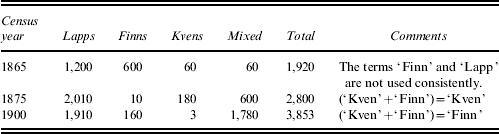
The ways in which the data on ethnic affiliation were presented had a significant impact on attempts to estimate the size of the non-Norwegian population in northern Nordland. Table 1 shows the numerical consequences this had for the registration of non-Norwegians in northern Nordland. In 1875 only 10 Finns were registered, while in 1900 their number had increased to 160. The opposite was the case for the group of Kvens: their number declined from 180 to just 3 in 1900. To some extent, this is probably related to purely demographic causes, such as migrations or the balance between births and deaths. The main explanation, though, must relate to how the categories were defined in the instructions for the census-takers, and how this affected the actual registration.
Summary of the non-Norwegian population in northern Nordland according to primary census data

Source: The census results for these years are available in a printed edition and in digitized form on the website of the Registreringssentral for Historiske Data (RHD) at the University of Tromsø: http://www.rhd.uit.no/.
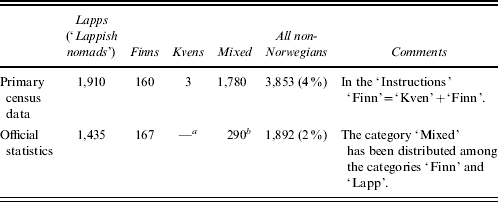
At the statistical processing of the census in 1900 this led to an order from senior officials in the Central Bureau that the category ‘mixed’ should be dropped. This had major consequences for the presentation of the final statistics. One consequence was that there was an especially large discrepancy between the official statistics that were drafted after aggregate processing and the material in the original census in 1900 (see Table 2).Footnote 65
A comparison of the size of the non-Norwegian population in northern Nordland in the primary census data and in the official statistics for the year 1900

a Not specified as a separate category; see ‘Comment’.
b The calculation proceeded as follows: total ‘mixed’=4,956; of these there were in Finnmark 1,240 and in Troms 3,139=4,379. Thus south of Troms and Finnmark there were 4,956−4,379=577. These 577 ‘mixed’ persons are not geographically identified. In general we know that more than half of the Sami south of Finnmark and Troms lived in northern Nordland, which brings us to approximately 290 ‘mixed’ persons.
Sources: Primary census data available at http://www.rhd.uit.no/. Official statistics calculated by the authors based on information in Central Bureau of Statistics, Official statistics of Norway, V 4 1900, Table 2.
Between the primary census material and the official, processed statistics there is a large difference in the numbers of non-Norwegian persons: 3,847 as opposed to 1,892, a difference of almost 2,000 persons. In other words, half of the population with a non-Norwegian affiliation had apparently disappeared from the statistics. Compared with the Norwegian part of the population the two estimates constitute respectively 4 per cent and 2 per cent of the total population of northern Nordland.
The categories ‘Finn’ and ‘Kven’ were only slightly amended, ‘Lappish’ somewhat more, but the most striking difference is that around 1,500 persons who were registered as ‘mixed’ in the primary sources have not been reported as such in the official statistics. These persons, of course, did not disappear from the statistics, but they had been redefined and merged with other ethnic groups. This was a consequence of, or at least partly a consequence of, the Norwegianization policy of that time. Relatively clear rules were applied. The group ‘mixed’ was supposed to be split up and subsumed into the other categories. The plan was that this operation should rely largely on the registered language use as a criterion for distributing the persons in the following way:
• Those who were ‘of Norwegian-Lapp, Norwegian-Finn and Norwegian-mixed descent and who spoke either Norwegian, or Norwegian in combination with one of the other two languages, or all three, should be entered as Norwegians’. This was probably the case with majority of the ‘mixed’.
• In the category ‘Finns’ those persons who were of ‘Finn-mixed descent regardless of language’, those who were of ‘Lapp-Finn’ origins who spoke ‘Finnish’, as well as those characterized as ‘Kvens’ should be counted.
• ‘Lapps’ included those who were entered as ‘Lapp-mixed regardless of language’ and those of ‘mixed’ or ‘Lapp-Finn’ origins who spoke ‘Lappish’.
• In addition, ‘Mixed, whose parents’ nationality was not stated and who spoke both Lappish and Finnish, shall usually be recorded on the basis of the nationality of the household in which they resided.'Footnote 66
Even though the category ‘mixed’ was an ideological construct which the Census Bureau tried to suppress in 1900, it did not mean that the authorities had been ignorant of the actual conditions. A commentary on the statistics in the census of 1875 noted:
Regarding these tasks it ought first of all to be noted that the designation ‘Lapps and Finns’ in contrast to persons of mixed origin should not be construed as if the former were never unmixed. Professor Friis demonstrates thus … that the Lapps hardly anywhere any longer constitute a pure race, but that already since time immemorial, Norwegian, Swedish, Finnish and Russian blood has flowed in their veins, and the same must be assumed to at least as high a degree to be the case with the Finns (+ the Kvens).Footnote 67
‘CATCHING BY CONCEPTS’ – A MATTER OF POLITICAL CONTEXT
This discussion brings us to a conclusion about the different issues that have been emphasized here through the complex process of defining minorities within the framework of the (allegedly) national state. There seems to have been a clear connection between national politics in general, ethno-politics and the concepts used to ‘catch’ the Sami and the Kvens in official sources and by way of statistics.
In the eighteenth century the dominating national politics aimed at establishing and consolidating the borders of the aspiring national state. It was of great importance for the authorities to register those who were living inside the newly fixed borders, in particular the nomads. A kind of geographical enclosure took place, thus including some of the Sami while excluding others – who were living on the newly fixed Swedish side. The concepts used for describing non-Norwegians were clearly influenced by such considerations. Several distinctions were applied, such as geographical directional terms (‘Eastern’/'Western' Sami); designations according to newly established state affiliation (‘Swedish’/'Norwegian' Lapps); and even varying degrees of attachment to the settled areas on the Norwegian side (‘Parish’, ‘Community’ and ‘Outlying field’ Sami).
In the nineteenth century, when nationalism was the dominant attitude, it became vital to make all inhabitants inside these borders appear as culturally homogeneous as possible. Registrations in the censuses became a tool in the Norwegianization process, to verify where and to what extent this process should be followed up. The instructions to the censuses stated that ‘strangers’ must be noted, meaning the Sami and the Kvens. The Sea Sami – the ‘Finns’ – were the most Norwegianized group, and were possibly not regarded as in need of being Norwegianized. This could be one of the reasons why statistically they were not defined as a specific group in their own right.
Now, at the beginning of the twenty-first century, the situation is entirely different. Today, from a scholarly point of view and distance, it is desirable to make the Sami and Kven population visible. The social context is the revitalization of the indigenous peoples on a national as well as an international level. The aim of this research is to provide knowledge about a society that is multi-ethnic. The concepts used today are ‘Sami’ and ‘Kven’. Peoples of the first kind are defined as indigenous, the latter as one out of five national minorities. ‘Finn’ is still in use, but in everyday language only.
ACKNOWLEDGEMENTS
This article was translated by John Weinstock.