I. INTRODUCTION
The addition of Sr to Mg–Al alloys was first performed to refine the grains and to modify the β-Mg17Al12 precipitates in casting alloys.Reference Koubichek1–Reference Pekguleryuz, Avedesian, Mordike and Hehman4 In 2002–2004, the Mg–Al–Sr (AJ) series of alloys were developed by the addition of higher levels of Sr to Mg–Al alloys; these AJ alloys had an excellent combination of creep performance and castabilityReference Pekguleryuz, Avedesian, Mordike and Hehman4, Reference Pekguleryuz, Baril, Labelle and Argo5–Reference Pekguleryuz, Baril and Hryn9 and have been used in BMW engine blocks since 2004. It was proposed that the high creep resistance is related to the absence of the low melting point β-Mg17Al12 and to the minimization of Al supersaturation in the primary magnesium.Reference Baril, Labelle and Pekguleryuz8 These changes are due to the high affinity of Sr to Al and to the precipitation of thermally stable Al–Sr phases. In the AJ series, depending on the Al/Sr ratio, various alloy compositions with different combinations of precipitates have been developed, which result in differing creep resistance, strength, and casting properties.Reference Pekguleryuz, Baril, Labelle and Argo5–Reference Pekguleryuz, Baril and Hryn9
The effect of Sr has not been limited to casting alloys, and there have been investigations on the effects of Sr on precipitation in commercial wrought alloysReference Jing, Yangshan, Shan, Feng and Tianbai10–Reference Sadeghi and Pekguleryuz13 and on the related effects on hot deformation processes.Reference Guan, Zhu, Wang, Yang and Cao14, Reference Jing, Yangshan, Feng, Shan, Jinga and Weijianb15 It has been reported that low levels of Sr reduce the grain size and refine the precipitates.Reference Aliravci, Gruzleski and Dimayuga3 A higher level of Sr forms thermally stable precipitates, which increase the strength and improve the creep behavior.Reference Zeng, Wang, Ding, Luo and Sachdev11–Reference Jing, Yangshan, Feng, Shan, Jinga and Weijianb15 In most of the Mg–Al commercial alloys, Mn is also added to increase the corrosion resistance.Reference Sadeghi and Pekguleryuz13 Although Al reduces the solid solubility of Mn (down to 0.3 wt%), it is still present in the solid solution and the excess Mn forms Al–Mn precipitates in the microstructure. Increasing the level of Sr may affect the formation of Mn precipitates as well.
In this study, the effect of Sr on precipitation during the solidification of AZ31 alloy (Mg–3Al–1Zn–0.4Mn) containing 0.01–1% Sr has been investigated. Microstructural examinations and thermodynamic modeling (FactSage 6.2, CRCT/Thermfact, Montreal, Canada and GTT-Technologies, Aachen, Germany) were used in this study to predict and verify the phase selection.
II. EXPERIMENTAL PROCEDURE
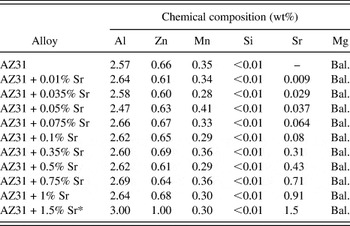
AZ31-extruded bars provided by Applied Magnesium (Denver, CO) were cut into small pieces and melted using a high-frequency induction furnace (NORAX, Norax Canada, Inc., Saint-Romauld, Canada). The addition of Sr to AZ31 was carried out using a Sr–10wt% Al master alloy (Timminco, Haley, ON). The alloy and the additive were melted in a graphite crucible and held at 700 °C for 15 min for complete dissolution. SF6–CO2 gas mixture was used to prevent oxidation. The molten alloy was cast into cylindrical preheated steel dies at 720 °C. The chemical compositions of the cast samples were determined by inductively coupled plasma from the middle part of the cylinders, and the data are summarized in Table I. Alloy compositions are given in wt%, hereafter, unless otherwise indicated.
Chemical compositions of the alloys.

* Composition for “AZ31 + 1.5%Sr” are taken from target and not from inductively coupled plasma-chemical analysis. Bal. = Balance.
For investigating the effect of temperature on precipitates, some of the samples were heated from 100 to 400 °C for 2 h in a Blue M Lindberg inert-gas mechanical convection-oven (Lindberg/MPH, Riverside, MI) and subsequently air-cooled. Samples for microstructural observations and analysis were sectioned from cast cylinders (Lindberg/MPH, Riverside, MI) and, after proper grinding, polishing was performed using 1 μm diamond paste. Picric-acetic solution was used to etch and reveal the microstructure of the specimens. Field-emission gun–scanning electron microscopy (FEG–SEM, Hitachi S-4700, Hitachi High Technologies America, Inc., Pleasanton, CA) was used for investigating the precipitates, and energy dispersive spectroscopy (EDS) was used for investigating the phase compositions. Nano-size precipitates in the microstructures were observed using transmission electron microscopy (TEM, Philips CM200, FEI, Hillsboro, OR) operating at 200 kV. The thin foil specimens were prepared from as-cast samples by grinding and were further thinned by jet polishing using a solution of 5% perchloric acid, 35% butanol, and 60% ethanol.
For more precise analysis of the Al–Sr and Al–Mn precipitate morphology and composition and to remove the effect of Mg matrix on the EDS results, intermetallics were extracted by dissolving the surrounding Mg matrix into a solution of 15-mL acetic acid and 150-mL water. The remaining precipitates were flushed with water and ethanol several times and finally collected using a vacuum filtering device. The extracted particles were analyzed using x-ray diffraction (XRD), SEM, and EDS.
III. THERMODYNAMIC CALCULATIONS
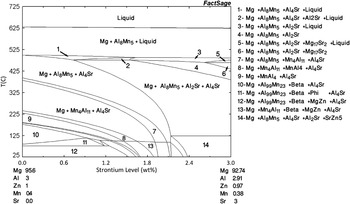
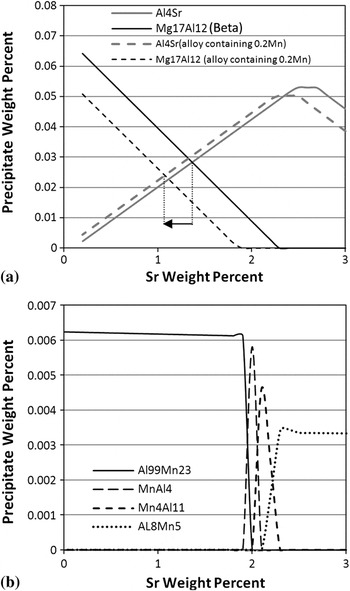
A pseudo-binary section for the AZ31 alloy with up to 3% Sr (Fig. 1) was calculated using the FactSage software and the FTLite database. The compositions of alloy used for this calculation are exactly the same as given in the scale of Fig. 1 (except the level of Mn, which changes in different calculations). The ratios of Mg/Al/Zn/Mn are kept constant and the Sr content is varied. According to the binary Al–Sr phase diagram, two different stable Al–Sr intermetallics (Al2Sr and Al4Sr) are likely to form during solidification. In a Mg–Al–Sr system, the affinity of Sr to Al is so strong that it can suppress the formation of β-(Mg17Al12) phase at a specific concentration of Sr.Reference Sadeghi and Pekguleryuz13 Both the Mg–Al and Al–Sr precipitates have large solidification ranges, which make it possible to dissolve other elements and form different complex stochiometries.Reference Janz, Gröbner, Mirković, Medraj, Jun Zhu, Chang and Schmid-Fetzer16–Reference Janz, Gröbner and Schmid-Fetzer17 As can be seen in the phase diagram, thermodynamic modeling shows that the precipitation of Al–Mn particles is also correlated to the level of Sr. Calculations predict that the decrease in β-Mg17Al12 and the increase in Al4Sr with increasing Sr is affected by the Mn content of the alloy [Fig. 2(a)]. Because Mn forms intermetallics with Al, the increase in Mn leads to the suppression of the β phase at lower concentrations of Sr (the cross shifts to the left). With increasing Sr, more Al is bound to Al–Sr precipitates and the formation of Al–Mn precipitates with high Al/Mn ratio (Al99Mn23, MnAl4, and Mn4Al11) is suppressed in sequence. Figure 2(b) demonstrates the precipitation sequence of Al–Mn phases with increasing Sr, predicted by thermodynamic calculations. Nonetheless, the Al8Mn5 precipitate with the lowest Mn/Al ratio stays in equilibrium with the Al–Sr phases even at high levels of Sr.
Mg–Al–Zn–Mn–Sr phase diagram.

Effect of increasing level of Sr on the phase amounts (in wt%) of (a) Al4Sr and Mg17Al12 and (b) Al–Mn precipitates calculated at 25 °C and equilibrium conditions.

On the other hand, it is known that thermodynamic equilibrium conditions do not hold during castingReference Jing, Yangshan, Shan, Feng and Tianbai10; therefore, a kinetic model of fast solidification under Scheil cooling condition has been used to calculate the amount of precipitation in a nonequilibrium condition. Scheil cooling assumes a local equilibrium of the advancing solidification front at the solid–liquid interface. In this approach, there is limited solute back-diffusion into the solid and the solute is rejected into the liquid. Complete mixing of solute in the liquid as a result of convection and/or stirring is also assumed.
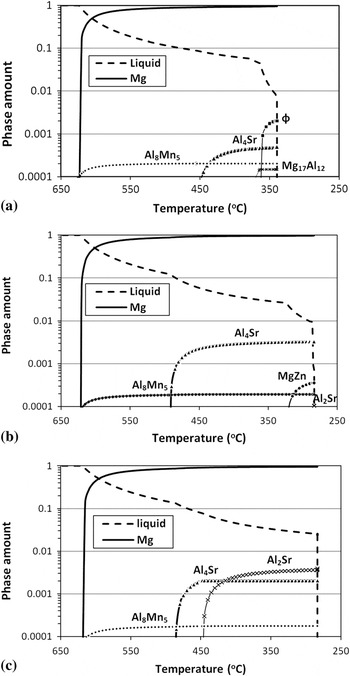
The relative amounts of phases calculated under fast solidification conditions in the Scheil mode are presented in Fig. 3. As shown by thermodynamic calculations, at all levels of Sr, out of the four equilibrium Al–Mn precipitates, only the Al8Mn5 phase is expected to precipitate. The addition of 0.05wt% Sr [Fig. 3(a)] leads to the formation of Al4Sr, but the precipitation of the β (Mg17Al12) and φ (Mg6(AlZn)5) is not suppressed. At 0.4 wt% Sr [Fig. 3(b)], the β precipitate ceases to form and the MgZn phase precipitates instead of φ. Finally, at 0.8% Sr, no Mg-containing precipitates exist [Fig. 3(c)]. Although thermodynamic simulation predicts the precipitation of two different Al–Sr precipitates (Al4Sr and Al2Sr), the microstructures and cooling curve analysis of the alloys show only one precipitate during solidification.Reference Sadeghi and Pekguleryuz13 This is attributed to the capture of Sr atoms during solidification in the primary α-Mg dendrite interfaces and the possibility of its back diffusion in solid, which are not considered in equilibrium or even in Scheil conditions. Therefore, the concentration of Sr in the liquid phase during solidification is less in reality compared to that in calculations. As a result, the precipitate with the higher Sr/Al ratio (Al2Sr) is not likely to form during solidification or, if it does, its amount and size are not sufficient for microstructural observation.
Phase amounts (atomic fractions) of each phase under Scheil solidification condition versus temperature: (a) AZ31 + 0.05% Sr (Mg−2.99Al−0.99Zn−0.39Mn−0.05Sr), (b) AZ31 + 0.4% Sr (Mg−2.98Al−0.99Zn−0.39Mn−0.40Sr), and (c) AZ31 + 0.8% Sr (Mg−2.97Al−0.99Zn−0.36Mn−0.80Sr).

IV. RESULTS AND DISCUSSION
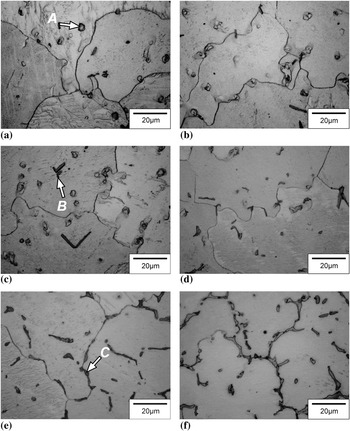
The β-Mg17Al12 (determined via SEM/EDS) precipitate can be distinguished by its globular morphology in Figs. 4(a)–4(d) [A in Fig. 4(a)]. It is noted that small amounts of Sr (0.01–0.5%) seem to refine the β-Mg17Al12 particles and the grain size (from 174 μm for AZ31 to 115μm for AZ31 + 0.5% Sr). EDS mapping revealed the presence of dissolved Sr inside the β phase.Reference Sadeghi and Pekguleryuz13 The effect of Sr on the refinement of β precipitatesReference Koubichek1 and the grain size of Mg–Al–Zn alloys has been previously reported by other researchersReference Zhao, Wang, Zhai and Zhu12, Reference Guan, Zhu, Wang, Yang and Cao14, Reference Jing, Yangshan, Feng, Shan, Jinga and Weijianb15, Reference Gruzleski and Aliravci18 and also in our previous work.Reference Sadeghi and Pekguleryuz13
Typical as-cast microstructures of (a) AZ31, (b) AZ31 + 0.01% Sr, (c) AZ31 + 0.1% Sr, (d) AZ31 + 0.5% Sr, (e) AZ31 + 1% Sr, and (f) AZ31 + 1.5% Sr, white arrows point to (A) Mg17Al12, (B) Al–Mn, and (C) Al–Mg–Sr precipitates.

In alloys with higher amounts of Sr [Figs. 4(e) and 4(f)], an interdendritic/grain-boundary phase of a different morphology is observed [C in Fig. 4(e)]. Al–Sr eutectic precipitates are seen in the grain boundaries but no globular β phase is seen inside the grains. The sample with the highest level of Sr (AZ31 + 1.5% Sr) reveals a higher amount of Al–Sr precipitates along the grain boundaries and inside the grains. In addition to the Al–Sr particles, Al–Mn phases are also present inside the microstructure. Al8Mn5 (with dissolved Si) and AlMn (a metastable precipitate with the lowest Al/Mn ratio) are among the particles that could be distinguished using optical microscopy (OM) and SEM inside the grains by their needle-shaped morphology [marked as B in Fig. 4(c)].
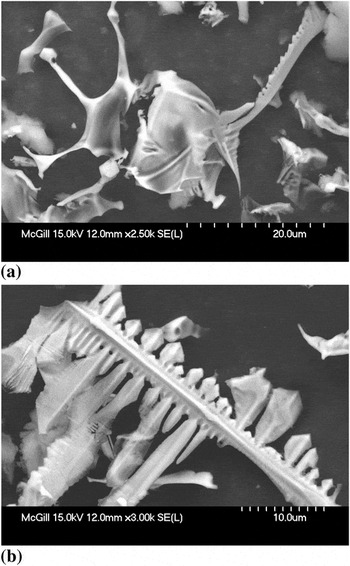
Figures 5(a) and 5(b) reveal the three-dimensional morphologies of extracted Al–Mn and Al–Sr precipitates after matrix-dissolution. EDS analysis on the extracted precipitates and TEM–EDS analysis on thin foils showed the composition of the precipitates to be more complex than simple Al4Sr stochiometry, containing Zn and Mg. XRD analysis on the extracted precipitates reveals the characteristic peaks of Al4Sr but with small deviation (Fig. 6), which suggests that the Al–Sr–Zn–Mg phase is actually Al4Sr with small amounts of dissolved Mg and Zn, which has slightly distorted lattice parameters. However, it is also known that the Al4Sr precipitate dissolves other elements in higher order systems (quaternary or higher) and assumes more complex stochiometry,Reference Baril, Labelle and Pekguleryuz8–Reference Sadeghi and Pekguleryuz13, Reference Janz, Gröbner, Mirković, Medraj, Jun Zhu, Chang and Schmid-Fetzer16, Reference Janz, Gröbner and Schmid-Fetzer17, Reference L’Esperance, Plamondon, Kunst and Fischersworring-Bunk19 potentially losing its thermal stability. A recent study reported that in an Mg–Al–Sr alloy the chemical composition of the complex phase (Mg9Al3Sr) changes by moving toward an equilibrium condition. During annealing, the Al/Sr ratio increases in the Mg–Al–Sr ternary phase, whereas its Mg content decreases. Consequently, the ternary intermetallic decomposes to α-Mg and Al4Sr.Reference L’Esperance, Plamondon, Kunst and Fischersworring-Bunk19 It has also been observed by Liu et al.Reference Liu, Li, Wang, Su and Han20 that the Al/Sr ratio increases during annealing and the complex stochiometry moves toward equilibrium Al4Sr.
Scanning electron microscope image of extracted (a) Al–Sr and (b) Al–Mn precipitates from as-cast AZ31 + 0.75% Sr.

X-ray diffraction spectrum of extracted precipitates from as-cast AZ31 + 0.75% Sr.

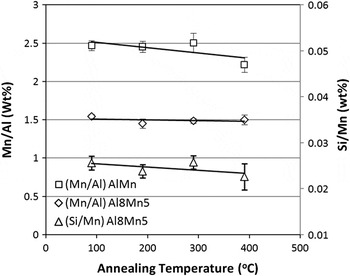
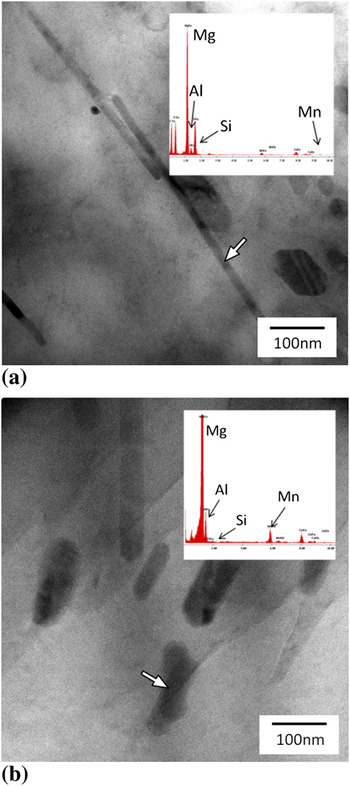
As explained previously, annealing has an effect on phase composition: the Al–Sr precipitate increases its Al content as it moves toward the equilibrium Al4Sr. The AlMn precipitate is also a nonequilibrium precipitate and is not stable when it is subjected to heat. Experiments show that as the annealing temperature increases, the Mn/Al ratio of the AlMn precipitate drops, whereas this ratio is almost constant for the equilibrium Al8Mn5 precipitate (Fig. 7). The excess Mn dissolves into the primary Mg grains. If the concentration of Mn exceeds the solid solubility, it is likely to bind with the dissolved Al in the primary α-Mg grains and form Al–Mn phases (probably Al8Mn5) nano-sized precipitates [Fig. 8(a)]. The precipitation of Al–Mn phase in Mg alloys at elevated temperatures has been reported by other researchers.Reference Kunst, Fischersworring-Bunka, L’Esperanceb, Plamondonb and Glatzelc7 Moreover, as a result of exposure to heat, the large Al8Mn5 precipitates start to reject their dissolved Si and their Si/Mn ratio drops (Si/Mn ratio in Fig. 7). TEM shows the presence of Al–Mn precipitates inside the grains of the as-cast and annealed samples [Fig. 8(b)].
Change of Al/Mn and Si/Mn ratio of Al8Mn5 and AlMn precipitates of AZ31 + 0.35% Sr by annealing at different temperatures.

Nano-sized (a) Al–Mn precipitate with Si (most likely Al8Mn5) and (b) Al–Mn precipitate without Si (most likely AlMn) of AZ31 + 0.75% Sr at 350 °C.

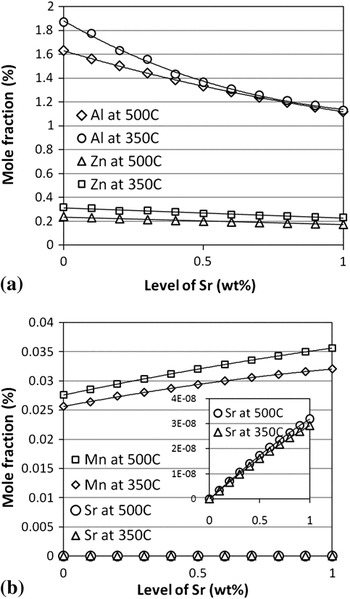
The addition of Sr also affects the solid solubility of other elements in α-Mg (Fig. 9). The values have been computed at 500 and 350 °C by the thermodynamic model considering the Scheil cooling conditions: 1 wt% increase in Sr results in 36% reduction in Al solid solubility and 27% in Zn solubility. The trend in Al has been confirmed by TEM–EDS analysis of the matrix between the precipitates, which shows ∼10% decrease in aluminum content from 2.8 at% in AZ31. However, a change in Zn concentration was not detected. It has been previously observed that Zn is surface active in Mg and segregates to grain boundaries,Reference Becerra and Pekguleryuz21 which could explain the EDS results. Evidence of formation of pure Zn dendrites has also been found in this work by precipitate extraction (Fig. 10). Depletion of Al inside the grains as a result of Sr in AJ series has been previously reported.Reference Baril, Labelle and Pekguleryuz8 In contrast, it is known that Al reduces the solid solubility of MnReference Avedesian and Baker22; hence, with the increase in the level of Sr and the accompanying decrease in Al concentration, the solid solubility of Mn should increase, although the Mn content in solid solution is very low. The calculation predicts ∼23% increase in mol fraction (from 0.025 to 0.032 at 350 °C) when 1 wt% Sr is added to AZ31 (TEM verifies the increase from 0.01 to 0.03 at%). The level of dissolved Sr in Mg is increased as well, but the concentration is very low even at its maximum level.
Calculated change in interstitial concentration by increase in Sr level using thermodynamic computation.

(a) Pure Zn dendrites after precipitate extraction and (b) energy dispersive spectroscopic analysis of point A.

AZ31 alloys containing 0.01–1.5 wt% Sr can be divided into three groups on the basis of their microstructure. The first group contains trace levels of Sr (<0.1 wt%) and the main precipitate is β-Mg17Al12 similar to AZ31, but the grains and precipitates are refined. In these alloys, a large portion of the precipitates would be dissolved at high temperatures and provide good workability at elevated temperatures, while the precipitates would provide strength at lower temperatures. The other set of alloys have high Sr levels (>1 wt%) and contain a web of thermally stable precipitates at the grain boundaries and interdendritic regions. Although higher creep performance is expected (same as AJ series), severe deformation at high temperatures might result in brittleness and surface cracking. The last group of alloys fit in between the two groups and possesses a combination of their characteristics. The amount of thermally stable precipitates is not high enough to cause significant brittleness but they would enhance mechanical properties both at high and low temperatures. Moreover, as the precipitates do not dissolve at elevated temperatures, they could potentially act as nucleation sites for dynamic recrystallization and cause particle-stimulated nucleation during hot deformation, contributing to texture weakening.
V. CONCLUSION
Thermodynamic calculations were used to predict the precipitation of various Al–Mg, Al–Sr, and Al–Mn phases as a function of Sr in AZ31, and the results were verified by microstructural examinations.
1. Thermodynamic calculations predict the substitution of β-Mg17Al12 with Al4Sr with increasing Sr. The onset of this substitution occurs at lower concentrations of Sr in the presence of Mn, which was confirmed by microstructural examinations.
2. Although equilibrium calculations predict the formation of four different Al–Mn precipitates, applying the Scheil cooling conditions predicts the existence of only Al8Mn5. EDS analysis confirms the formation of the Al8Mn5 phase and reveals the presence of the AlMn nonequilibrium precipitate.
3. Annealing experiments show the decrease of Mn/Al and Si/Mn ratio in the nonequilibrium Al–Mn precipitates. TEM images confirm the formation of nano-scale Mg–Si and Al–Mn precipitates inside the grains.
4. EDS analysis in TEM and thermodynamic calculations both show the depletion of Al and slight increase of Mn inside the grains with increasing Sr.
5. On basis of the microstructures and phase selection, Sr additions higher than 0.1 wt% but lower than 1 wt% can be beneficial for wrought alloy development.
ACKNOWLEDGMENT
This study was carried out under a Strategic project grant from Natural Sciences and Engineering Research Council of Canada and Applied Magnesium (formerly Timminco) with the industrial support and providing the raw materials and master alloy. We thank Scott Shook of Applied Magnesium for technical support. A. Sadeghi gratefully acknowledges the financial support of McGill University through McGill Engineering Doctoral Award program.