1. Introduction
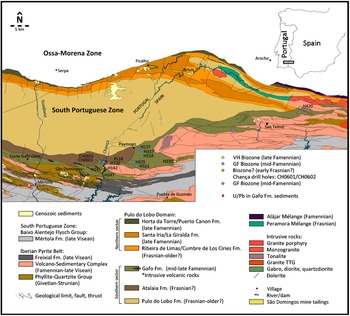
The Pulo do Lobo Domain (PLD) antiform structure has been considered an accretionary terrane located between the Variscan Ossa-Morena Zone (OMZ) and the South Portuguese Zone (SPZ) collisional belt (Oliveira, Reference Oliveira, Dallmeyer and Martinez Garcia1990; Oliveira et al. Reference Oliveira, Quesada, Pereira, Matos, Solá, Solá, Rosa, Albardeiro, Díez-Montes, Morais, Inverno, Rosa, Relvas, Quesada and Oliveira2019; Quesada et al. Reference Quesada, Braid, Fernandes, Ferreira, Jorge, Matos, Murphy, Oliveira, Pedro, Pereira, Quesada and Oliveira2019; Fig. 1).
Geological map of the Pulo do Lobo Domain, with Chança drillholes and outcrop sections highlighted. Geology adapted from Diez-Montes et al. (Reference Díez-Montes, Matos, Valverde-Vaquero, Solá, Albardeiro, Salgueiro and Morais2020 b). Fm. – Formation.

Four main domains are identified in the SPZ, namely: the PLD, Iberian Pyrite Belt (IPB), Baixo Alentejo Flysch Group (BAFG) and the SW Portuguese Sector (Oliveira, Reference Oliveira, Dallmeyer and Martinez Garcia1990; Oliveira et al. Reference Oliveira, Quesada, Pereira, Matos, Solá, Solá, Rosa, Albardeiro, Díez-Montes, Morais, Inverno, Rosa, Relvas, Quesada and Oliveira2019). This research focuses on the PLD anticlinal structure (Fig. 1), particularly the southern sector, which comprises clastic formations including the Atalaia and Gafo formations. The Gafo Formation is characterized by flysch facies in turbiditic sedimentary rocks. While its petrographic and paleogeographic setting is known, the definition of stratigraphic units for field mapping, the lateral correlation of the facies and depositional age all remain contentious.
This paper discusses the Late Devonian miospore assemblages of the Gafo Formation, southern PLD, comprising palynostratigraphic analysis from drillhole and outcrop samples collected in both the Portuguese and Spanish sectors of the PLD (see location in Fig. 1 and online Supplementary Material, available at http://journals.cambridge.org/geo).
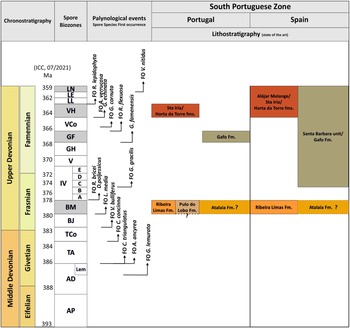
The Gafo Formation was previously studied by PA Lake (unpubl. Ph.D. thesis, University of Southampton, 1991), Rodríguez González (Reference Rodríguez González1999) and Pereira et al. (Reference Pereira, Fernandes and Oliveira2006 a, b, Reference Pereira, Matos, Fernandes and Oliveira2008), who attributed a Givetian – early Famennian age, late Frasnian – late Famennian age and early Frasnian age, respectively (Figs 2, 3). An attempt is made to integrate and correlate these data with new biostratigraphic records based on spores and chitinozoans in order to achieve an accurate age of the Gafo Formation, as well as an understanding of the microfloral assemblages of the PLD and the SPZ, thus confirming an affinity with the Avalonian Terrane (Oliveira et al. Reference Oliveira, Horn and Paproth1979; Loboziak & Streel Reference Loboziak and Streel1981; Korn Reference Korn1997; Clayton et al. Reference Clayton, Wicander and Pereira2002; Higgs et al. Reference Higgs, Prestianni, Streel and Thorez2013). Newly obtained U–Pb detrital zircon data are also included and discussed.
Stratigraphy of the Pulo do Lobo Domain PA Lake (unpubl. Ph.D. thesis, University of Southampton, 1991); Rodríguez González, Reference Rodríguez González1999; Pereira et al. Reference Pereira, Fernandes and Oliveira2006 a, b, Reference Pereira, Matos, Fernandes and Oliveira2008, Reference Pereira, Fernandes, Matos, Oliveira and Jorge2018). FM. – Formation; FO – first occurrence.

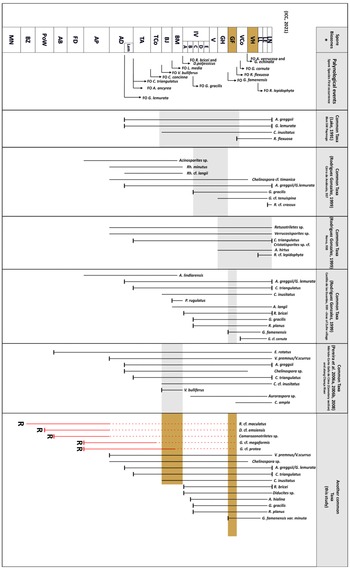
Zonal scheme and ranges of stratigraphically relevant taxa recovered in this study. Palynoflora age correlation is integrated with previous studies in the Gafo Formation PA Lake (unpubl. Ph.D. thesis, University of Southampton, 1991); Rodríguez González, Reference Rodríguez González1999; Pereira et al. Reference Pereira, Fernandes and Oliveira2006 a, b, Reference Pereira, Matos, Fernandes and Oliveira2008). The zonal scheme follows Loboziak & Streel (Reference Loboziak and Streel1981, Reference Loboziak and Streel1989), Streel et al. (Reference Streel, Higgs, Loboziak, Riegel and Steemans1987), Higgs et al. (Reference Higgs, Avkhimovitch, Loboziak, Maziane-Serraj, Stempien-Salek and Streel2000, Reference Higgs, Prestianni, Streel and Thorez2013) and Pereira et al. (Reference Pereira, Matos, Fernandes and Oliveira2008). R – reworked taxon.

This research was a co-sponsored geological mapping project supported by the Portuguese (LNEG) and Spanish (IGME) geological surveys of the South Portuguese Zone, 1:200 000 scale (GEO_PFI Project), including the Pulo do Lobo and Iberian Pyrite Belt domains. Based on this project, recent palynostratigraphy studies were developed to constrain the sedimentary sequence of the southern PLD, particularly the Gafo Formation, and to test correlations with the Santa Bárbara Unit, as defined in the Spanish sector.
2. Geological setting
The PLD E–W-trending complex antiform structure crops out both in Portugal and Spain, in a sigmoidal shape bound to the north by the OMZ (the Beja-Acebuches Ophiolite Complex in particular) and the south by the IPB, and is part of the SPZ (Fig. 1).The domain is divided into a northern sector, represented by the Ferreira–Ficalho Group (including the Ribeira de Limas, Santa Iria and Horta da Torre formations; Fig. 2) and the southern limb, characterized by the Chança Group (including Atalaia and Gafo formations; Fig. 2), the latter being the focus of this work.
In the core of this domain, the Pulo do Lobo Formation (Late Devonian, middle Frasnian in age; Pereira et al. Reference Pereira, Fernandes and Oliveira2006 a, b, Reference Pereira, Fernandes, Matos, Oliveira and Jorge2018, Reference Pereira, Fernandes, Matos, Oliveira and Jorge2019) crops out and is well exposed in the Guadiana and Chança river sections, including strongly deformed chloritic and sericitic phyllites and quartzites with minor intercalations of felsic volcanic rocks (Pfefferkorn, Reference Pfefferkorn1968; Oliveira, Reference Oliveira, Dallmeyer and Martinez Garcia1990).
In the PDL northern sector, three formations are recognized in the Ferreira–Ficalho Group, including the Ribeira de Limas, Santa Iria and Horta da Torre formations (Fig. 2; Carvalho et al. Reference Carvalho, Correia and Inverno1976; Oliveira et al. Reference Oliveira, Cunha, Streel and Vanguestaine1986; Giese et al. Reference Giese, Reitz and Walter1988; Oliveira, Reference Oliveira, Dallmeyer and Martinez Garcia1990; CP Eden, unpubl. Ph.D. thesis, University of Southampton, 1991; Silva, Reference Silva, Oliveira and Dias1998). In Spain, the northern sector of the PLD includes, from bottom to top: the Peramora Mélange, the Ribeira de Limas Formation (Frasnian age), Santa Iria Formation and Horta da Torre Formation (both late Famennian age) (Pereira et al. Reference Pereira, Fernandes, Matos, Oliveira and Jorge2018), and the Alájar Mélange (Fig. 2). In the northern part of the PLD, the stratigraphy and age of the formations are described in detailed in Pereira et al. (Reference Pereira, Fernandes, Matos, Oliveira and Jorge2018, Reference Pereira, Fernandes, Matos, Oliveira and Jorge2019) and Oliveira et al. (Reference Oliveira, Quesada, Pereira, Matos, Solá, Solá, Rosa, Albardeiro, Díez-Montes, Morais, Inverno, Rosa, Relvas, Quesada and Oliveira2019).
2.a. The Chança Group
Focusing on the southern sector of the PLD structure, the Chança Group comprises, from base to top, the Atalaia and the Gafo formations, defining a clastic succession (Pfefferkorn, Reference Pfefferkorn1968; Oliveira, Reference Oliveira, Dallmeyer and Martinez Garcia1990; Silva, Reference Silva1989, Reference Silva, Oliveira and Dias1998; Silva et al. Reference Silva, Oliveira, Ribeiro, Dallmeyer and Martinez Garcia1990). The Atalaia Formation (age unknown) is composed mainly of phyllites, quartzites and quartzwackes, has identical lithological and deformation characteristics as the Ribeira de Limas Formation, and is deformed in a similar fashion to the Pulo do Lobo Formation (Pfefferkorn, Reference Pfefferkorn1968; Carvalho et al. Reference Carvalho, Correia and Inverno1976; Oliveira Reference Oliveira1982, Reference Oliveira, Dallmeyer and Martinez Garcia1990; Oliveira et al. Reference Oliveira, Relvas, Pereira, Matos, Rosa, Rosa, Munhá, Jorge, Pinto, Dias, Araújo, Terrinha and Kullberg2006). However, it has not yet been dated (Pereira et al. Reference Pereira, Fernandes, Matos, Oliveira and Jorge2018). Pereira et al. (Reference Pereira, Gutíerrez-Alonso, Murphy, Drost, Gama and Silva2017) provided a U–Pb zircon maximum depositional age of 390.5 ± 4.7 Ma (Eifelian age) for a quartzite within the Atalaia Formation.
The Gafo Formation represents a sequence of greywackes and interbedded shales, with minor intercalations of fine volcaniclastic sediments, intruded by metre-thick felsic and mafic volcanic rocks (veins and pipes structures) that are several hundred metres long (Oliveira et al. Reference Oliveira, Quesada, Pereira, Matos, Solá, Solá, Rosa, Albardeiro, Díez-Montes, Morais, Inverno, Rosa, Relvas, Quesada and Oliveira2019). Felsic volcanic rocks are generally (sub)intrusive (Rosa et al. Reference Rosa, Finch, Andersen and Inverno2008). The age of this unit has been considered Middle Devonian – (?)early Frasnian to Late Devonian (PA Lake, unpubl. Ph.D. thesis, University of Southampton, 1991) and middle Frasnian – BM Biozone (Pereira et al. Reference Pereira, Fernandes and Oliveira2006 a, b, Reference Pereira, Matos, Fernandes and Oliveira2008) based on palynostratigraphy (Fig. 3).
The Gafo Formation shows three main episodes of tectonic deformation and associated cleavages (Silva et al. Reference Silva, Pereira and Chichorro2013). The second-phase deformations exhibit an E–W-aligned trend in Spain, a WNW–ESE to NW–SE-aligned trend in Portugal, and tectonic vergence to the south or SSW. The structural thickness may reach 500 m (Oliveira et al. Reference Oliveira, Quesada, Pereira, Matos, Solá, Solá, Rosa, Albardeiro, Díez-Montes, Morais, Inverno, Rosa, Relvas, Quesada and Oliveira2019). Metamorphism is low greenschist facies (Pereira et al. Reference Pereira, Fernandes and Oliveira2006 a, b).
In Spain, the stratigraphic equivalent unit of the Gafo Formation is the Santa Bárbara Group, which includes: (1) in the northern sector, the Gafo Formation itself, including greywackes and interbedded shale successions with minor tuffite intercalations, intruded by felsic and mafic veins (Quesada et al. Reference Quesada, Braid, Fernandes, Ferreira, Jorge, Matos, Murphy, Oliveira, Pedro, Pereira, Quesada and Oliveira2019) of late Frasnian age (Late Devonian; Rodríguez González, Reference Rodríguez González1999), and (2) in the south, the Santa Bárbara Unit, comprising an interbedded shale succession with siltite lamination, intruded by felsic veins of late Famennian (Late Devonian) to probably earliest Tournaisian age (early Carboniferous; Rodríguez González, Reference Rodríguez González1999; Matas et al. Reference Matas, Martín Parra, Rubio Pascual, Roldán and Martín-Serrano2015; Fig. 3). The units show identical lithological characteristics, but are tectonically divided by the Santa Bárbara Thrust Fault (Matas et al. Reference Matas, Martín Parra, Rubio Pascual, Roldán and Martín-Serrano2015; Díez-Montes et al. Reference Díez-Montes, Matos, Dias, Huerta Carmona, Albardeiro, Oliveira, Morais, Fernandes, Inverno, Machado, Ressurreição, Pereira, Mendes, Solá, Salgueiro, Matilla, Valdés, Gonçalves, Santos and López López2020 a).
3. Previous palynostratigraphic and geochronological studies of the Gafo Formation
The first reference to miospores in the Gafo Formation in PLD was provided by PA Lake (unpubl. Ph.D. thesis, University of Southampton, 1991), who recorded the presence of dispersed and poorly preserved assemblage of miospores. In three samples located in the vicinity of Paymogo, the author considered a late Givetian – early Famennian age for the Gafo Formation (Fig. 3). Rodríguez González (Reference Rodríguez González1999) and Matas et al. (Reference Matas, Martín Parra, Rubio Pascual, Roldán and Martín-Serrano2015) have also dated the Gafo Formation and Santa Bárbara Unit (included in the Santa Bárbara Group), and also obtained long-ranging ages, spanning middle Frasnian – latest Famennian and to probably earliest Tournaisian age (Fig. 3). Reworked palynomorph taxa seem to be persistent in the described palynoassemblages (Matas et al. Reference Matas, Martín Parra, Rubio Pascual, Roldán and Martín-Serrano2015). Rodríguez González (Reference Rodríguez González1999) also identified chitinozoan remains, interpreted by the author as being reworked Fungochitina pilosa, characteristic of Givetian sediments.
Pereira et al. (Reference Pereira, Fernandes and Oliveira2006 a, b, Reference Pereira, Matos, Fernandes and Oliveira2008) recognized 12 specimens in two sections from Mértola to Corte Gafo de Cima (Cemetery section) and along the Chança River (Volta Falsa section). The assemblage provided for the first time a BM Biozone marked primarily by zonal species Verrucosisporites bulliferus, of Frasnian age (Fig. 3). The age and geological interpretation of the Gafo Formation and Santa Bárbara Unit are therefore still poorly understood; further research is required.
U–Pb ages from the above-mentioned felsic rocks (Rosa et al. Reference Rosa, Finch, Andersen and Inverno2008) in the Azinhalinho region (middle–northwestern IPB) indicate crystallization ages of 356 ± 1.5 Ma and 355 ± 2.5 Ma (both early Tournaisian ages) for two rhyodacite porphyry samples, and 356 ± 1.4 Ma (also early Tournaisian age) for a granular rhyodacite. Those authors interpret the volcanism as late Famennian – Visean age, contemporaneous with the IPB volcanism. Another group of volcanic rocks within the Gafo sediments is found in the Chança and Paymogo areas (northern IPB, on opposite margins of the Chança River), with ages of 353.9 ± 1.1, 349.0 ± 4.9 and 347.3 ± 6.8 Ma (Rosa et al. Reference Rosa, McPhie, Relvas and Williams2009; Solá et al. Reference Solá, Albardeiro, Salgueiro, Morais, Díez-Montes and Matos2019) and 347.3 ± 0.8, 348.9 ± 0.4 and 346.0 ± 12.0 Ma (Donaire et al. Reference Donaire, Sáez and Pascual2002; Díez-Montes et al. Reference Díez-Montes, Matos, Valverde-Vaquero, Solá, Albardeiro, Salgueiro and Morais2020 b), respectively.
Recent U–Pb zircon dating of a rhyodacite intrusive rock in the Pego do Altar sector (westernmost Gafo Formation in the NNW IPB region in Portugal; Matos et al. Reference Matos, Pereira, Solá, Represas and Dias2018) indicates an age of 346.5 ± 1.6 Ma (Díez-Montes et al. Reference Díez-Montes, Matos, Valverde-Vaquero, Solá, Albardeiro, Salgueiro and Morais2020 b). This age is in general accordance with those reported above, defining an age interval of c. 346–356 Ma for the (sub)volcanic rocks in the Gafo Formation. Additional data on the Gafo greywacke sedimentary units indicate a maximum depositional age of 384 ± 6 Ma based on the two youngest concordant grains (Pereira et al. Reference Pereira, Gutíerrez-Alonso, Murphy, Drost, Gama and Silva2017).
In this work, new U–Pb zircon age data were obtained from the greywacke units in the Volta Falsa section of the Gafo Formation (see Fig. 1).
4. Materials and methods
4.a. Gafo Formation palynology and U–Pb zircon geochronology
A total of 44 samples (20 outcrop samples and 24 drill core samples) collected from the Gafo Formation sediments were subjected to standard palynological laboratory procedures to extract and concentrate the palynomorphs (Wood et al. Reference Wood, Gabriel and Lawson1996). Oxidation of the palynomorphs was carried out using Schultze solution. Oxidation time varied according to the degree of carbonization, ranging from 30 min to 2 hours, and resulted in 27 productive samples for palynology studies (19 outcrop samples and 8 drill core samples), yielding moderate to well-preserved palynomorphs.
A sample list with geographic coordinates is provided in the online Supplementary Table S1 (available at http://journals.cambridge.org/geo). The selected productive residues were mounted on slides and examined with a Nikon Eclipse Ci transmitted light microscope. All samples, residues and microscope slides are stored at the Portuguese Geological Survey (LNEG). The standard western Europe miospore biozonal scheme was followed (Loboziak & Streel, Reference Loboziak and Streel1981, Reference Loboziak and Streel1989; Streel et al. Reference Streel, Higgs, Loboziak, Riegel and Steemans1987; Pereira et al. Reference Pereira, Matos, Fernandes and Oliveira2008; Higgs et al. Reference Higgs, Avkhimovitch, Loboziak, Maziane-Serraj, Stempien-Salek and Streel2000, Reference Higgs, Prestianni, Streel and Thorez2013). The studies of Clayton et al. (Reference Clayton, Owens, Al-Hajri, Filatoff, Al–Hajri and Owens2000) and Loboziak (Reference Loboziak, Al–Hajri and Owens2000) were used to correlate the palynoflora with Saudi Arabia assemblages.
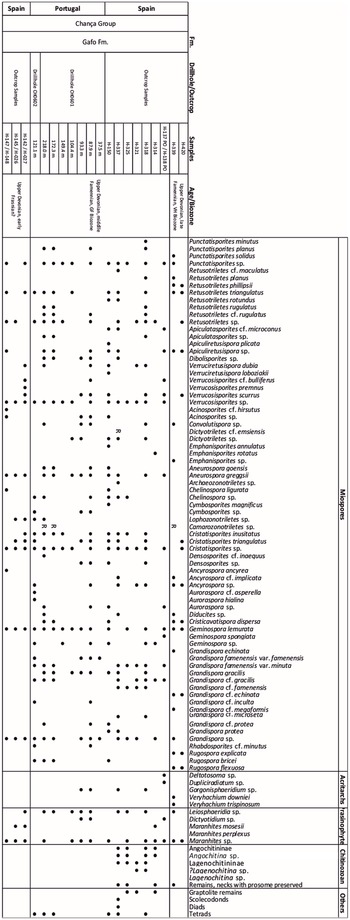
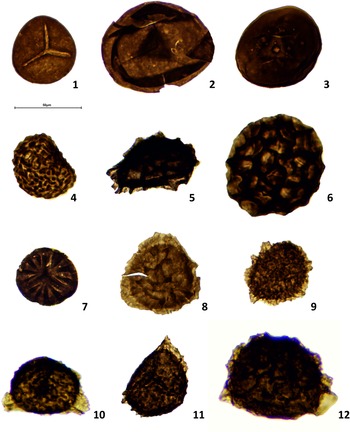
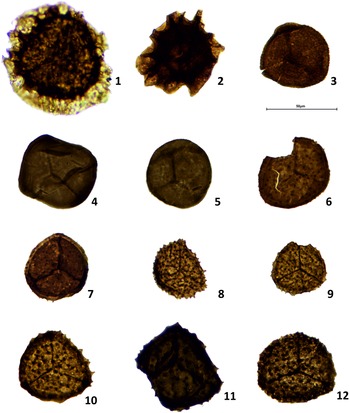
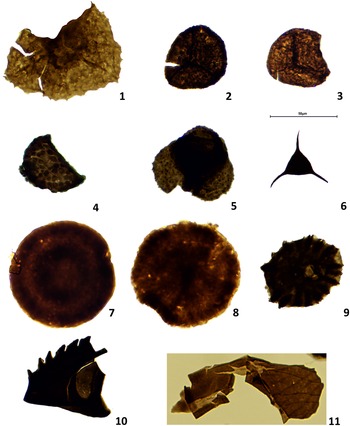
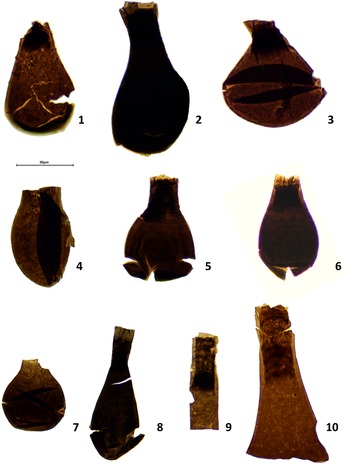
The palynomorph assemblages recovered from the drillholes and outcrop samples are presented in Figures 3, 4. Important stratigraphic taxa are illustrated in Figures 5–8. A list of all taxa recovered or mentioned in this work is also available in the online Supplementary Material.
Palynomorph assemblages recovered in the Gafo Formation sedimentary rocks sampled in Portugal and Spain. Points indicate the presence of the specified taxon within the palynoflora; blanks indicate absence. R – reworked taxon.

Important taxa from the studied drillholes and outcrops. All specimens are housed in the collections of the Portuguese Geological Survey (LNEG). 1, Punctatisporites minutus Kosanke 1950; H-318 sample, 218.0 m sample, slide 1_135, MC 1030/329. 2, Retusotriletes triangulatus (Streel) Streel, Reference Streel1967; H-337 sample, slide 1_53, MC 1000/440. 3, Retusotriletes phillipsii Clendening, Eames & Wood, Reference Clendening, Eames and Wood1980; H-339 sample, slide 1_99, MC 1023/273. 4, Verrucosisporites sp.; H-318 sample, slide 1_28, MC 1030/495; 5, Dictyotriletes cf. emsiensis (Allen) McGregor, Reference McGregor1973; H-337 sample, slide 1_136, MC 1068/260. 6, Dictyotriletes sp.; H-318 sample, slide 1_202, MC 975/134. 7, Emphanisporites rotatus (McGregor) emend. McGregor, Reference McGregor1973; H-314 sample, slide 2_11, MC 1078/203. 8, Cristatisporites inusitatus (Allen) McGregor & Camfield, Reference McGregor and Camfield1982; H-337, slide 1_98, MC 982/333. 9, Cristatisporites Cristatisporites inusitatus (Allen) McGregor & Camfield, Reference McGregor and Camfield1982; H-337 sample, slide 1_45, MC 968/447. 10, Cristatisporites triangulatus (Allen) McGregor & Camfield, Reference McGregor and Camfield1982; CH0601 drillhole, 172.3 m sample, slide 1_76, MC 1030/357. 11, Cristatisporites triangulatus (Allen) McGregor & Camfield, Reference McGregor and Camfield1982; H-337 sample, slide 1_79, MC 1095/398. 12, Cristatisporites sp.; CH0601 drillhole, 218.0 m sample, slide 1_117, MC 1129/253.

Important taxa from the studied drillholes and outcrops. All specimens are housed in the collections of the Portuguese Geological Survey (LNEG). 1, Ancyrospora sp.; CH0601 drillhole, slide 1_112, MC 958/266; 2, Ancyrospora sp.; H-318 sample, slide 1_54, MC 1135/458; 3, Geminospora lemurata (Balme) emend. Playford, Reference Playford1983; H-339 sample, slide 1_111, MC 1037/230; 4, Geminospora lemurata (Balme) emend. Playford, Reference Playford1983; CH0601 drillhole, 121.1 m sample, slide 1_75, MC 1113/414; 5, Geminospora lemurata (Balme) emend. Playford, Reference Playford1983; CH0601 drillhole, 121.1 m sample, slide 1_49, MC 1065/430; 6, Grandispora echinata Hacquebard, Reference Hacquebard1957; H- 339 sample, slide 1_105, MC 1050/237; 7, Grandispora echinata Hacquebard, Reference Hacquebard1957; H-339 sample, slide 1_88, MC 970/312; 8, Grandispora gracilis Streel in Becker et al. Reference Becker, Bless, Streel and Thorez1974; H-318 sample, slide 1_130, MC 1020/328; 9, Grandispora gracilis Streel in Becker et al. Reference Becker, Bless, Streel and Thorez1974; H-318 sample, slide 1_36, MC 1060/481; 10, Grandispora famenensis (Naumova) Streel, Reference Streel1974 var. minuta Higgs et al. Reference Higgs, Avkhimovitch, Loboziak, Maziane-Serraj, Stempien-Salek and Streel2000; H-318 sample, slide 1_163, MC 1032/268; 11, Grandispora famenensis (Naumova) Streel, Reference Streel1974 var. famenensis Higgs et al. Reference Higgs, Avkhimovitch, Loboziak, Maziane-Serraj, Stempien-Salek and Streel2000; CH0602 drillhole, 121.1 m sample, slide T1_2, MC 999/473; 12, Grandispora famenensis (Naumova) Streel, Reference Streel1974 var. minuta Higgs et al. Reference Higgs, Avkhimovitch, Loboziak, Maziane-Serraj, Stempien-Salek and Streel2000; H-337 sample, slide 1_92, MC 1108/369.

Important taxa from the studied drillholes and outcrops. All specimens are housed in the collections of the Portuguese Geological Survey (LNEG). 1, Grandispora protea (Naumova) Moreau-Benoit, Reference Moreau-Benoit1980; H-337 sample, slide 1_149, MC 1098/235; 2, Rugospora explicata (Jushko) Streel, Reference Streel1974; H-339 sample, slide 1_9, MC 1028/440; 3, Rugospora flexuosa (Jushko) Streel Reference Streel1974; H-339 sample, slide 1_16, MC 1001/429; 4, Verrucosisporites cf. bulliferus Richardson & McGregor, 1986; H-027 sample, slide 2_2, MC 1005/355; 5, Grandispora tetrad; CH0602 drillhole, 121.1 m sample, slide T1_30, MC 1094/438; 6, Veryhachium downiei Stockmans & Willièrre, Reference Stockmans and Willièrre1962; H-339 sample, slide 1_101, MC 1010/250; 7, Maranhites sp.; H-314 sample, slide 1_19, MC 975/355; 8, Maranhites sp.; H-314 sample, slide 1_33, MC 1096/248; 9, Dupliciradiatum sp.; H-137 sample, slide 1_6, MC 1095/260; 10, Scolecodont fragment; H-337 sample, slide 1_83, MC 991/390; 11, Graptolite fragment; H-314 sample, slide 1_30, MC 1003/257.

Important taxa from the studied drillholes and outcrops. All specimens are housed in the collections of the Portuguese Geological Survey (LNEG). 1, (?)Angochitina sp.; H-314 sample, slide 1_38; 2, Angochitina sp.; H-337 sample, slide 1_43; 3, Angochitina sp.; H-325 sample, slide 1_327; 4, Angochitina sp.; H-318 sample, slide 1_78; 5, Lagenochitina sp.; H-318 sample, slide 1_26; 6, Lagenichitinidae; H-318 sample, slide 1_19; 7, (?)Lagenochitina sp.; H-318 sample, slide 1_89; 8, (?)Lagenochitina sp.; H-321 sample, slide 1_6; 9, Chitinozoan neck, with prosome preserved; H-339 sample, slide 21_37; 10, Chitinozoan neck, with prosome preserved; H-314 sample, slide 1_35.

A representative sample from Gafo Formation greywacke unit (PL 18) was collected for U–Pb zircon geochronology (see Fig. 1 for location). Zircon grains were separated from whole-rock samples using standard crushing and mineral separation techniques (Mange & Maurer, Reference Mange and Maurer1992). The handpicked zircons were mounted in resin and ground and polished to half-thickness. Zircon U–Pb isotopic data were generated at the Department of Geology, Trinity College Dublin, Ireland. A Photon Machines Analyte Excite 193 nm ArF excimer laser-ablation system with a HelEx 2-volume ablation cell, coupled to an Agilent 7900 mass spectrometer, was used for the analyses. Line scans on NIST612 standard glass were used to tune the instruments by obtaining a Th/U ratio close to unity and low oxide production rates (i.e. ThO+/Th+ typically < 0.15%). A circular laser spot of 24 μm was used, with a repetition rate of 13 Hz. Helium carrier gas was fed into the laser cell at c. 0.4 L/min and was mixed with an aerosol of c. 0.6 L/min Ar make-up gas and 11 mL/min N2. During each analysis, eight isotopes (90Zr, 202Hg, 204Pb, 206Pb, 207Pb, 208Pb, 232Th and 238U) were measured. Each analysis comprised 21.5 s of ablation (280 shots) and 9 s of washout time. The latter portions of the washout time were used for baseline measurements. The reduction of the raw U–Th–Pb isotopic data was undertaken using the freeware IOLITE package (Paton et al. Reference Paton, Hellstrom, Paul, Woodhead and Hergt2011), with the VizualAge data reduction scheme (Petrus & Kamber, Reference Petrus and Kamber2012). Conventional sample-standard bracketing was applied to account for both downhole fractionation and long-term drift in isotopic or elemental ratios by normalizing all ratios to those of the U–Th–Pb reference materials. The primary U–Pb calibration standard was the 91500 zircon (206Pb/238U age of 1065.4 ± 0.6 Ma; Wiedenbeck et al. Reference Wiedenbeck, Allé, Corfu, Griffin, Meier, Oberli, von Quadt, Roddick and Spiegel1995) and the secondary standard was WRS 1348 zircon (206Pb/238U age of 526.26 ± 0.70; Pointon et al. Reference Pointon, Chew, Ovtcharova, Sevastopulo and Crowley2012). The secondary standard yielded a concordia age of = 530.2 ± 1.8 Ma (n = 25). Probability Density and Kernel Density Estimator plots were made using the Density Plotter spreadsheet (Vermeesch, Reference Vermeesch2012). The International Chronostratigraphic Chart ICS-v2021/07 (www.stratigraphy.org) was followed. Detailed information is provided in online Supplementary Table S2 (available at http://journals.cambridge.org/geo).
4.b. Gafo Formation drillholes
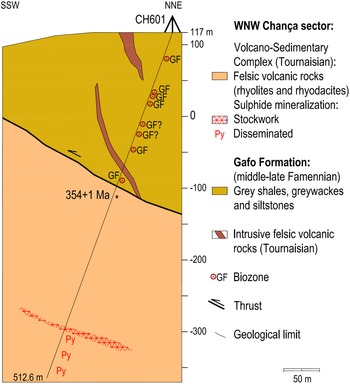
In this study two AGC Company exploration drillholes were sampled (Figs 1, 9). These holes were drilled at the IPB Chança massive sulphide deposit in 2006 by AGC Minas de Portugal. The CH0601 hole (inclination 70°, azimuth 194°) is in the WNW sector of the Chança Volcano-Sedimentary Complex (VSC) antiform. CH0601 intersects the Gafo Formation sediments (shales, silts and greywackes) from the surface to a depth of 227.9 m, and is in thrust contact with the VSC felsic volcanic rocks from 227.9 m to the full depth of the drillhole (512.6 m). The CH0602 hole (inclination 60°, azimuth 180°) was drilled in the northern sector of the Chança mine, and intersects the same facies of Gafo Formation sediments between the surface and a depth of 191.2 m. Only VSC felsic volcanic rocks are found from 191.2 m to the full depth of the drillhole (650 m). In both drillholes, minor mafic and felsic dykes occur in the Gafo Formation, and stockwork mineralization was intersected in the VSC felsic rocks (rhyolites and rhyodacites). Seven palynomorph-bearing samples were recovered from the CH0601 drillhole (from 37.5 m to 218.0 m) and one from the CH0602 drillhole (121.1 m). Figure 9 shows the WNW Chança section based on the CH0601 drillhole data and surface mapping.
Geological section of the WNW sector of Chança mine and the CH0601 drillhole samples. U–Pb data from Rosa et al. (Reference Rosa, McPhie, Relvas and Williams2009).

4.c. Gafo formation outcrop sections
4.c.1. Chança River section
This first group of samples (H-145/H-26, H-142/H-27, AD-H-147/AD-H-148 and AD-H-150) are located in the Chança River section (Fig. 1). South of Vuelta Falsa mine, samples H-145/H-26 and H-142/H-27 were collected from outcrops defined by an alternation of greywackes and black slate. Samples H-147 and H-148 were collected from a thick layer of black slate. North of Vuelta Falsa mine, sample H-150 was collected from a section of black slate, with scarce layers of quartzites and quartz wackes.
4.c.2. South Paymogo section
Samples H-137/H-138, H-314, H-318, H-321, H-325, H-336, H-337, H-378 (c. 318 m) and H-405 (c. 337 m) were collected from the South Paymogo section.
Samples H-137 and H-138 were collected to the SE of Paymogo, on the road to Puebla de Guzmán (Fig. 1). An alternation of quartz wackes and slate forms the outcrop, a brownish colour with greenish tones. Some thin levels of impure quartzites can also be observed. Samples H-336 and H-337 (= H-405) were collected to the SE of Paymogo, on the route to Los Peros. The outcrops are formed by a succession of quartz wackes, lithic arenites and slate. Samples H-314, H-318 (= H-378) and H-321 were collected in the Albahacar creek. The outcrops are formed by a succession of quartz wackes, quartzite and black slate. Sample H-325 was taken from the riverbed of the Corte creek. The outcrop is formed by an alternation of black slate, greywackes, quartz wackes and occasional quartzite beds.
4.c.3. Paymogo SE sector
Sample H-339 was collected SE of Paymogo, on the Rivera Aguas de Miel. This outcrop is an alternation of black slate, lithic arenites, greywackes and quartz wackes.
4.c.4. Santa Bárbara section
Samples H-398, H390 and H-395, collected from the Santa Bárbara section, are all negatives. Sample H-390 was collected east of Santa Bárbara de Casa from a horizon of slate with an intense schistosity. Sample H-395 was collected from an outcrop consisting of greenish slate, sandstones and quartzites along the road from Cabezas Rubias to El Mustio. Sample H-398 was collected north of Santa Bárbara de Casa, on the road that leads to El Mustio. The outcrop comprises slate and sandstones. S-C-type textures are observed throughout the outcrop, which show thrust movement towards the south.
4.c.5. South of Gil Márquez Unit section
Sample H-420 was collected south of Gil Márquez, in the Rivera de Olivarga. A succession of slate and sandstones forms this outcrop, which is very close contact with the Pulo de Lobo thrust.
5. Gafo Formation palynology results
The Gafo Formation palynoflora comprises a diverse and abundant set of 73 spore types (including 28 different genera), five acritarch types, five prasinophyte specimens and some chitinozoans and graptolite remains, enabling the identification of three different assemblages. The poor preservation of some specimens did not allow specific identification; these specimens were left as open nomenclature (Figs 3, 4). These assemblages are characterized by the first occurrence (FO) of key taxa and the relative abundance of prominent taxa. The palynomorph assemblages and biozones identified are described in stratigraphic order in the following sections.
5.a. Latest Givetian – (?)early Frasnian assemblage
The Gafo Formation was sampled in three outcrop sections in the southernmost Spanish sector, exposed along the Chança River (southern section) (Fig. 1). The shales yielded a poorly preserved assemblage of miospores assigned a Late Devonian age, probably of latest Givetian – (?)early Frasnian.
The assemblage includes Aneurospora greggsii, Apiculiretusispora sp., Cristatisporites Cristatisporites cf. inusitatus, Cristatisporites Cristatisporites sp., Geminospora lemurata, Grandispora sp., Punctatisporites sp., Retusotriletes triangulatus, Retusotriletes sp., Verruciretusispora dubia, Verrucosisporites cf. bulliferus, Verrucosisporites premnus, Verrucosisporites scurrus and Verrucosisporites sp. Despite its poor general preservation, the assemblage includes long-ranging species that include taxa first occurring in the Eifelian Stage, such as Ancyrospora ancyrea, and early Givetian species, such as Cristatisporites Cristatisporites triangulatus. The assemblages seem incomplete, but the presence of Cristatisporites Cristatisporites cf. inusitatus, Lophozonotriletes sp. and Verrucosisporites cf. bulliferus indicates a Late Devonian age ((?)early Frasnian). Marine palynomorphs were relatively rare, including Leiosphaeridia sp., Maranhites mosesii and Maranhites sp.
5.b. Middle Famennian assemblage
The Gafo Formation was sampled in two drillholes, CH0601 (of the 12 studied samples, 7 were positive) and CH0602 (of the 12 studied samples, 1 was positive) at Chança mine sector in Portugal, and a road section south of the Paymogo/Puebla de Guzmán area in Spain (Fig. 1). The shales yielded an abundant and well preserved palynomorph assemblage, assigned to the GF Biozone of middle Famennian age based on the common occurrence of zonal species Grandispora gracilis and Grandispora famenensis (Fig. 3). Other common taxa include Acinosporites cf. hirsutus, Acinosporites sp., Aneurospora goensis, Aneurospora greggsii, Ancyrospora ancyrea, Ancyrospora cf. implicata, Ancyrospora sp., Apiculatasporites cf. microconus, Apiculatasporites sp., Apiculiretusispora plicata, Apiculiretusispora sp., Archaeozonotriletes sp., Auroraspora cf. asperella, Auroraspora hyalina, Auroraspora sp., Camarozonotriletes sp., Chelinospora ligurata, Chelinospora sp., Convolutispora sp., Cristatisporites Cristatisporites inusitatus, Cristatisporites Cristatisporites triangulatus, Cristatisporites Cristatisporites sp., Cristicavatispora dispersa, Cymbosporites magnificus, Cymbosporites sp., Densosporites cf. inaequus, Densosporites sp., Diducites sp., Dibolisporites sp., Dictyotriletes cf. emsiensis, Dictyotriletes sp., Emphanisporites annulatus, Emphanisporites rotatus, Emphanisporites sp., Geminospora lemurata, Geminospora spongiata, Geminospora sp., Grandispora famenensis var. famenensis, Grandispora famenensis var. minuta, Grandispora cf. gracilis, Grandispora cf. famenensis, Grandispora cf. microseta, Grandispora cf. inculta, Grandispora sp., Lophozonotriletes sp., Punctatisporites minutus, Punctatisporites planus, Punctatisporites solidus, Punctatisporites sp., Retusotriletes cf. maculatus, Retusotriletes planus, Retusotriletes phillipsii, Retusotriletes triangulatus, Retusotriletes rotundus, Retusotriletes rugulatus, Retusotriletes cf. rugulatus, Retusotriletes sp., Rhabdosporites cf. minutus, Rugospora bricei, Verruciretusispora dubia, Verruciretusispora loboziakii, Verrucosisporites cf. bulliferus, Verrucosisporites premnus, Verrucosisporites scurrus and Verrucosisporites sp.
Rare acritarchs and prasinophytes of the taxa Deltotosoma sp., Dupliciradiatum sp., Gorgonisphaeridium sp., Veryhachium downiei, Veryhachium trispinosum, Leiosphaeridia sp., Dictyotidium sp., Maranhites mosesii, Maranhites perplexus and Maranhites sp. were found. All samples contain common Grandispora sp. tetrads.
The identified species Camarozonotriletes sp., Dictyotriletes cf. emsiensis and Retusotriletes cf. maculatus of Early Devonian age, and Grandispora cf. megaformis, Grandispora cf. protea and Grandispora protea of Middle Devonian age, are interpreted as reworked miospores. Chitinozoans and scolecodont fragment remains are very common in the samples studied in the Spanish sector sections (Fig. 7).
5.c. Late Famennian assemblage
Preliminary data obtained in two samples, one collected from the easternmost region of the Gafo Formation in the Santa Bárbara East section (sample H-339) and the other from south of Gil Márquez (sample H-420) (see Fig. 1), present a palynomorph assemblage assigned to the VH Miospore Biozone of late Famennian age based on first occurrence of the regional key species Grandispora echinata (Fig. 3). Assemblages are also dominated by Apiculiretusispora sp., Cristicavatispora dispersa, Grandispora cf. echinata Grandispora sp., Retusotriletes phillipsii, Rugospora explicata and Rugospora flexuosa. Other common miospore species are Aneurospora greggsii, Ancyrospora cf. implicata, Ancyrospora sp., Convolutispora sp., Diducites sp., Emphanisporites sp., Geminospora lemurata, Grandispora cf. megaformis, Grandispora sp., Punctatisporites solidus, Punctatisporites sp., Retusotriletes planus, Retusotriletes triangulatus and Retusotriletes sp.
Acritarchs and prasinophytes are rare and assigned to Leiosphaeridia sp., Maranhites mosesii, Maranhites sp., Veryhachium downiei and Veryhachium trispinosum. Similar to the lowermost samples from the Gafo Formation, chitinozoan fragments are common. The presence of the taxa Grandispora cf. megaformis is interpreted as reworked upper Emsian – middle Givetian strata.
6. Gafo Formation chitinozoan results
Eight samples were studied for chitinozoans, four of which were productive (H-314, H-318, H-321 and H-378). It was possible to recognize some chitinozoans from the observations made, but the preparations mostly included other groups, namely prasinophytes algae and spores. Most of the chitinozoan specimens observed show evidence of transport, as most of them are broken, incomplete and worn on their surface.
Focusing on the Spanish outcrop samples, the chitinozoan taxa recovered in palynology samples of middle–late Famennian age were carefully documented. Two main subfamilies were identified – Lagenochitininae and Angochitininae (Paris & Verniers, Reference Paris, Verniers, Selley, Plimer and Cocks2005) – with the recognized species Lagenochitina sp. and Angochitina sp. (Fig. 8) assigned a Middle–Late Devonian age. Some additional forms or fragments of low preservation are retained under open nomenclature.
7. U–Pb age results
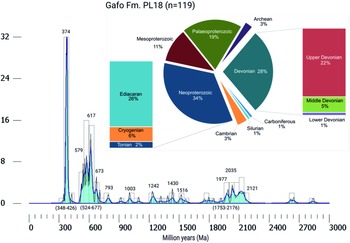
Sampled PL 18 greywacke (north of the VSC Chança structure, Fig. 1) yielded 149 zircon grains, 119 of which are concordant and comprising Palaeozoic (33%), Neoproterozoic (34%), Mesoproterozoic (11%), Palaeoproterozoic (19%) and Archean (3%) grains. Within the Palaeozoic population, the largest population is of Devonian (28%), particularly Late Devonian (22%) and Middle Devonian (9%) age; there were also single zircons of Early Devonian (1%) and Carboniferous (348 Ma) (1%) age, interpreted as representing minor lead loss (Fig. 10). Based on probability distribution and kernel density estimator plots, a major Late Devonian peak at c. 374 Ma was identified. Within this Late Devonian peak, 10 grains occur in the 371.4–367.3 Ma age range (early Famennian) and 16 zircon ages within the 381.9–373.6 Ma time range (Frasnian). The remaining Devonian-aged grains comprise four of Givetian (385.3–382.8 Ma), two of Eifelian (393–388 Ma) and one of Emsian (401.4 Ma) age. A single Silurian grain has an age of 426.1 Ma. These Devonian grains are associated with the Early Variscan evolution of the Iberian Pyrite Belt.
U–Pb detrital zircon spectra from the Gafo Formation using a kernel density estimator (light blue area and approximate age peaks). Parameters: adaptative bandwidth 10, histogram bin width 50. Inset: pie chart distribution of U–Pb ages divided into major chronostratigraphic units.

Within the Neoproterozoic-aged population, the Ediacaran period is dominant (631.8–541.2 Ma with a central peak at c. 617 Ma and a secondary peak at c. 579 Ma) with 26% of all grains, followed by Cryogenian (8%) and Tonian (2%) ages. The Palaeoproterozoic group ages range from 2175.6–2051.1 Ma to 2042.4–1842.2 Ma with 11 and 10 grains, respectively. Minor peaks were defined at c. 1977, 2035 and 2121 Ma.
A Concordia age was obtained using the youngest five (out of 10) late Famennian grains with favourable statistics, yielding an age of 369.1 ± 2.5 Ma (mean squared weighted deviation and probability of concordance of 0.019 and 0.89, respectively). This age is proposed as the maximum depositional age for the greywackes of the Gafo Formation.
8. Discussion
8.a. Miospores
This study was undertaken on a regional basis, based on both exploration drillholes and reference geological sections of the turbiditic sequences of the Gafo Formation in the Portuguese and Spanish PLD southern sector (Fig. 1). The miospore content was qualitatively considered, first and last occurrences were established, and common distinctive taxa presented (Figs 3, 4).
The Gafo Formation samples cropping out in the south Chança River section yielded an assemblage from a (?)latest Givetian – early Frasnian age based on the occurrence of Verrucosisporites cf. bulliferus. The palynoassemblage is complemented by frequent Cristatisporites Cristatisporites triangulatus and Ancyrospora ancyrea, and by the most frequent Frasnian taxa, Cristatisporites Cristatisporites cf. inusitatus and Lophozonotriletes sp. Since the association is uncertain, it is not possible to constrain the age considering the poorly preserved and long-ranging palynomorphs. Nevertheless, these preliminary age constraints have redefined the Gafo Formation as a greywacke and interbedded shale unit, previously interpreted as Culm facies in the Spanish literature and assigned to the BAFG and an early Carboniferous age (typically Visean; Matas et al. Reference Matas, Martín Parra, Rubio Pascual, Roldán and Martín-Serrano2015).
The Gafo Formation data sampled in drillholes (Portugal) and several outcrops (Spain) show a very consistent GF Miospore Biozone, assigned a middle Famennian age. The microflora observed contain similar miospore taxa as recorded by Streel (Reference Streel and Königshof2009) and Higgs et al. (Reference Higgs, Prestianni, Streel and Thorez2013), specifically Grandispora gracilis, Grandispora famenensis and Grandispora cf. microseta. According to Higgs et al. (Reference Higgs, Prestianni, Streel and Thorez2013), the GF Miospore Biozone can be characterized by the first occurrence of Grandispora famenensis and of Grandispora microseta, which appear in the middle of the GF Biozone. Common occurrences of Grandispora gracilis are also observed in this biozone, suggesting a middle GF Miospore Biozone of middle Famennian age.
In Spain, the Santa Bárbara Group crops out in the south Paymogo road section, where the Gafo Formation (to the north) and the Santa Bárbara Unit (to the south) are separated by the Santa Bárbara Fault (Fig. 1). The Santa Bárbara Unit has yielded a middle Famennian age (GF Biozone) based on palynomorphs for the first time. The same palynomorph assemblage is recognized in the Gafo Formation, both in Portuguese and Spanish outcrops and drillholes, allowing lithological and age correlation (Figs 2, 3). The Santa Bárbara Unit in Spain and the Gafo Formation are therefore reinterpreted in the present work as representing the same unit (Figs 2, 4; Díez-Montes et al. Reference Díez-Montes, Matos, Dias, Huerta Carmona, Albardeiro, Oliveira, Morais, Fernandes, Inverno, Machado, Ressurreição, Pereira, Mendes, Solá, Salgueiro, Matilla, Valdés, Gonçalves, Santos and López López2020 a).
A late Famennian palynomorph assemblage (VH Miospore Biozone) was also identified in the easternmost part of the Spanish sector, indicating a probable younger age for the Gafo Formation in the SPZ region, suggesting a probable sedimentary progradation from the west to the east sector. Nevertheless, more detailed palynostratigraphic studies are needed to confirm this hypothesis. A similar age and palynoassemblage are found in the Represa and Phyllite-Quartzite Formations of the IPB Phyllite-Quartzite Group (Cunha & Oliveira, Reference Cunha and Oliveira1989; Pereira et al. Reference Pereira, Matos, Fernandes and Oliveira2008, Reference Pereira, Matos, Batista, Sóla, Salgueiro, Oliveira, Oliveira, Inverno and Rosa2014, Reference Pereira, Matos, Solá, Batista, Salgueiro, Rosa, Albardeiro, Mendes, Morais, de Oliveira, Pacheco, Araújo, Castelo Branco, Neto, Lains Amaral, Inverno and Oliveira2021; Oliveira et al. Reference Oliveira, Relvas, Pereira, Matos, Rosa, Rosa, Munhá, Fernandes, Jorge, Pinto, Dias, Araújo, Terrinha and Kullberg2013).
8.b. Reworked miospores
The common presence of Early–Middle Devonian cosmopolitan taxa in the samples, such as Camarozonotriletes sp., Dictyotriletes cf. emsiensis and Retusotriletes cf. maculatus (Early Devonian), Grandispora cf. megaformis, Grandispora cf. protea and Grandispora protea (Middle Devonian; Loboziak & Melo, Reference Loboziak and Melo2002) are interpreted as reworked.
In the PLD northern sector, common Early Devonian reworked spore assemblages were reported by Pereira et al. (Reference Pereira, Fernandes, Matos, Oliveira and Jorge2018) within the Pulo do Lobo and Ribeira de Limas formations (sections located ESE of Serpa). Reworking is also confirmed by the presence of graptolite fragments.
When we consider the palynoassemblages described by PA Lake (unpubl. Ph.D. thesis, University of Southampton, 1991), Rodríguez González (Reference Rodríguez González1999), and Pereira et al. (Reference Pereira, Fernandes and Oliveira2006 a, b, Reference Pereira, Matos, Fernandes and Oliveira2008), the following conclusions can be drawn. Despite the complex tectonics, the small number of samples studied, the low biodiversity and the long-ranging species associated with the reworking processes, the age interval is broad and unclear, or else corresponds to the age of reworked miospores (Fig. 3).
However, examining the new data with the palynoassemblage described by Rodríguez González (Reference Rodríguez González1999) in Castillo de las Guardas (Fig. 3), an age correlation can be made based on the abundance of miospores and chitinozoans remains; however, the age is not constrained as it is mainly based on long-ranging species taxa.
8.c. Chitinozoans
The occurence of several fragments of Lagenochitina sp. and Angochitina sp. (Fig. 8) indicates a Middle and Late Devonian age. These taxa are common in assemblages showing erosion of the main processes. Chitinozoan biostratigraphic schemes for the Middle–Late Devonian are scarce for Europe and Iberia (Paris et al. Reference Paris, Winchester-Seeto, Boumendiel and Hrahn2000), and few previous studies have been undertaken (Askew & Russell, Reference Askew and Russell2019).
In this research, the occurrence of moderately to well preserved chitinozoans can be helpful for stratigraphic correlations with other Devonian chitinozoan biozonal schemes (e.g. North Africa, Brazil, Argentina and Poland; Grahn et al. Reference Grahn, Melo and Loboziak2006), confirming a Middle–Late Devonian age.
In Santa Barbara unit (PLD), Rodríguez González (Reference Rodríguez González1999) identified chitinozoan assemblages that included reworked Fungochitina pilosa, a late Givetian – Frasnian key species globally (Paris, Reference Paris1996). Other uncertain fragments were interpreted as reworked, probably from close to the Middle–Late Devonian boundary (Rodríguez González, Reference Rodríguez González1999). In this complex stratigraphic context, the occurrence of chitinozoan taxa in the assemblages studied, including reworked graptolite remains and reworked Early–Middle Devonian miospore taxa, reinforces the importance of reworking processes. This is highlighted by the first documented chitinozoan specimens in the IPB and PLD (Rodríguez González, Reference Rodríguez González1999). However, more detailed studies are needed to improve knowledge of the chitinozoan assemblages and the importance of identified in situ and reworked taxa.
8.d. Comment on depositional environment
The palaeoecology of chitinozoans and scolecodonts indicates deposition in marine nearshore to offshore environments. However, moderate to good preservation of specimens of these fossil groups in the flysch sediments of the Gafo Formation suggests a short time gap from their reworking on the continental platform and transport in turbidity currents to deep-sea fans.
From the discussion above, the Gafo Formation was deposited during middle–late Famennian time (c. 368–363 Ma), corresponding to the GF and VH palynomorph biozones.
The Gafo Formation sediments are intersected by felsic intrusive rocks (rhyodacite, dacite and felsic porphyritic rocks), of age c. 346–356 Ma (e.g. Rosa et al. Reference Rosa, McPhie, Relvas and Williams2009; Solá et al. Reference Solá, Albardeiro, Salgueiro, Morais, Díez-Montes and Matos2019; Diez Montes et al. Reference Díez-Montes, Matos, Dias, Huerta Carmona, Albardeiro, Oliveira, Morais, Fernandes, Inverno, Machado, Ressurreição, Pereira, Mendes, Solá, Salgueiro, Matilla, Valdés, Gonçalves, Santos and López López2020 a), interpreted as feeder structures to volcanic activity closely related to IPB volcanism (Rosa et al. Reference Rosa, Finch, Andersen and Inverno2008; Diéz-Montes et al. Reference Díez-Montes, Matos, Dias, Huerta Carmona, Albardeiro, Oliveira, Morais, Fernandes, Inverno, Machado, Ressurreição, Pereira, Mendes, Solá, Salgueiro, Matilla, Valdés, Gonçalves, Santos and López López2020 a). A maximum depositional age of 369 ± 2.5 Ma was obtained in this study.
9. Conclusions
This study of the Gafo Formation from the southern sector of the Pulo do Lobo Domain allows the following conclusions to be made.
-
– The Gafo Formation yielded an abundant and diverse palynomorph assemblage assigned to the GF Miospore Biozone of middle Famennian (Late Devonian) age, both in Portugal and in Spain. In the easternmost sector of the basin (Spain), a VH Miospore Biozone of late Famennian age was also attained.
-
– The palynological results obtained for the Gafo Formation, both in Portugal and Spain, are consistent and in agreement with the stratigraphic, structural and mapping interpretations.
-
– In Spain, these data show that the Santa Bárbara Unit corresponds to the same lithostratigraphic unit as the Gafo Formation (Fig. 1).
-
– In the south Chança River section, an assemblage probably of (?)latest Givetian – early Frasnian (Late Devonian) age was recovered based on a poorly preserved assemblage. Further studies will be developed in this section to improve the accuracy of the age. However, this preliminary study allowed identification of a greywacke and interbedded shale unit previously interpreted as culm (BAFG; of Visean age) as being part of the Gafo Formation (Late Devonian age) (Fig. 1).
-
– The consistent occurrence of Lagenochitininae and Angochitininae chitinozoans indicates a Middle–Late Devonian age, consistent with the miospore age determination.
-
– Common graptolite fragments, poorly preserved chitinozoans fragments and the common occurrence of Early–Middle Devonian miospores represent strong evidence of reworking processes in the basin.
-
– A maximum U–Pb depositional age of 369 ± 2.5 Ma from detrital zircons was obtained for the Gafo Formation greywackes.
-
– This work highlights the importance of palynostratigraphy and detrital zircon geochronology for an integrated understanding of the depositional age and paleoenvironmental models, confirming the field-based interpretations of the complex stratigraphy of the southern sector of the Pulo do Lobo Domain.
Acknowledgements
This research received financial assistance from the European Regional Development Fund, EU/Interreg-VA/Poctep/0052_GEO_FPI_5_E Project. DC acknowledges support from a Science Foundation Ireland (grant no. 13/RC/2092_P2). Special thanks are extended to Rosa Irene Sousa (National Laboratory of Energy and Geology, Portugal) for palynological laboratory and sample procedures and José Tomás Oliveira for the careful discussion of the Gafo Formation geological and structural setting. The editors and reviewers are gratefully acknowledged for valuable comments that helped to improve the paper.
Declaration of interests
None.
Supplementary material
To view supplementary material for this article, please visit https://doi.org/10.1017/S0016756822000346