INTRODUCTION
While cognitive impairments are a commonly examined component of disability in multiple sclerosis (MS), there is recently heightened scientific interest in examining social cognitive impairments, such as emotion perception and theory of mind (ToM; Chalah & Ayache, Reference Chalah and Ayache2017). While the full impacts of social cognitive deficits are still being identified, these impairments have been linked to poor quality of life in individuals with MS (Phillips et al., Reference Phillips, Henry, Scott, Summers, Whyte and Cook2011). Although social cognitive deficits are found in all disease subtypes and are evident even in the early stages of MS (Chalah & Ayache, Reference Chalah and Ayache2017), these deficits appear to be more pronounced in those with progressive MS (Henry et al., Reference Henry, Tourbah, Chaunu, Bakchine and Montreuil2017). Unfortunately, to date, the majority of research on social cognition in MS has focused on relapsing-remitting MS, thus limiting our ability to understand these deficits in more progressive subtypes.
Most tests assessing social cognition use still photographs or written vignettes, which constitute a poor representation of the complex social information that people navigate during interactions with others and limits the generalizability of these tests. As we expand our understanding of the prevalence and impacts of social cognitive deficits in MS, there is a need to use more ecologically valid tools for the assessment of these constructs. Ecologically valid assessments better approximate the skills needed to function in everyday life and are stronger predictors of functional impairment in MS (Higginson et al., Reference Higginson, Arnett and Voss2000). Accordingly, the current study sought to use an ecologically valid tool to assess social cognition in a sample of individuals with progressive MS. The Virtual Assessment of Mentalising Ability (VAMA; Canty et al., Reference Canty, Neumann, Fleming and Shum2017) was designed to assess ToM and involves watching vignettes of a group of actors interacting and answering questions that probe the actors’ beliefs and emotions. Similar to other ToM tasks such as the Faux pas test (Baron-Cohen et al., Reference Baron-cohen, Riordan, Stone, Jones and Plaisted1999), the VAMA allows for differentiation between cognitive and affective components of ToM (cognitive: reflecting an understanding of the thoughts and intentions of others and affective: reflecting an understanding of the emotions of others). However, the VAMA is argued to be a more realistic approximation of ToM than traditional tasks involving written scenarios, as it employs immersive vignettes rich in verbal and nonverbal social information (Canty et al., Reference Canty, Neumann, Fleming and Shum2017). Importantly, the VAMA’s predictive validity is far superior, more robustly predicting social functioning and social skills than traditional measures of ToM when used in a population of healthy participants (Canty et al., Reference Canty, Neumann, Fleming and Shum2017). For these reasons, the VAMA was chosen to assess ToM deficits in progressive MS, a population in which the VAMA has not yet been utilized.
An additional goal of the current study is to characterize the relationship between cognitive deficits and social cognitive deficits in MS, which is currently debated (Cotter et al., Reference Cotter, Firth, Enzinger, Kontopantelis, Yung, Elliott and Drake2016). Although some studies have shown that social cognition in MS is significantly correlated with one’s general cognition, and thus, social cognitive deficits may be explained by underlying impairments in processing speed or executive function (Ciampi et al., Reference Ciampi, Uribe-San-Martin, Vásquez, Ruiz-Tagle, Labbe, Cruz, Lillo, Slachevsky, Reyes, Reyes and Cárcamo-Rodríguez2018; Henry et al., Reference Henry, Bakchine, Maarouf, Chaunu, Rumbach, Magnin and Montreuil2015, Reference Henry, Tourbah, Chaunu, Bakchine and Montreuil2017), other studies have found cognition and social cognition to be dissociable in MS (Batista et al., Reference Batista, Freitas, Afonso, Macário, Sousa, Cunha and Santana2018; Raimo et al., Reference Raimo, Trojano, Pappacena, Alaia, Spitaleri, Grossi and Santangelo2017). As there is still limited research in this area, a better understanding of the specific mechanisms contributing to social cognitive impairments in MS will allow for more refined treatments and interventions.
METHODS
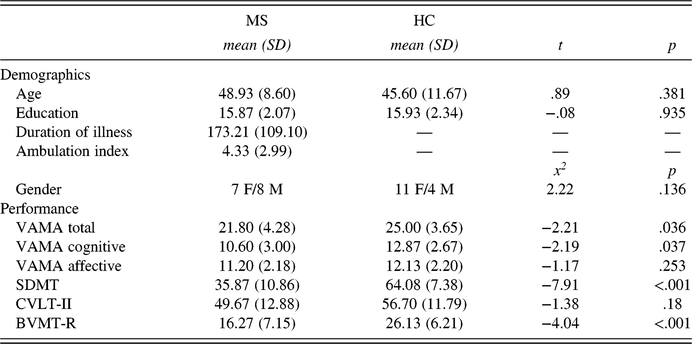
Participants included 15 healthy controls (HCs) and 15 individuals with progressive MS (11 with primary-progressive and 4 with secondary-progressive). Participants with MS were diagnosed an average of 173.21 (SD = 109.10) months earlier and were free from exacerbation within the last 30 days, and their diagnosis was based on the McDonald criteria (Thompson et al., Reference Thompson, Banwell, Barkhof, Carroll, Coetzee, Comi, Correale, Fazekas, Filippi, Freedman, Fujihara, Galetta, Hartung, Kappos, Lublin, Marrie, Miller, Miller, Montalban, Mowry, Sorensen, Tintoré, Traboulsee, Trojano, Uitdehaag, Vukusic, Waubant, Weinshenker, Reingold and Cohen2018) and confirmed through a written medical history from their primary physician. Participants with MS scored an average of 4.33 on the Ambulation Index (Hauser et al., Reference Hauser, Dawson, Lehrich, Beal, Kevy, Propper and Weiner1983), corresponding to a disability level requiring unilateral support for walking (assisted by a cane or crutch) 25 feet in ≤20 s. Seven of the 13 MS participants for whom medication information had been acquired reported taking disease course modifying medications (e.g., interferon beta-1a and glatiramer acetate). All participants were free from neurological diseases other than MS, had no history of bipolar disorder, schizophrenia, or psychosis, and had not consumed opiates, benzodiazepines, or neuroleptics within the last month. Participants were matched on demographic variables and did not differ on years of education, age, or distribution of gender across groups, as shown in Table 1.
Demographics and performance metrics for study participants

Age and education are reported in years, while illness duration is reported in months. VAMA = Virtual Assessment of Mentalising Ability, SDMT = Symbol Digit Modalities Test, CVLT-II = California Verbal Learning Test II, BVMT-R = Brief Visuospatial Memory Test – Revised.
This study was approved by the Kessler Foundation Institutional Review Board and was conducted in accordance with the Helsinki Declaration. All participants provided informed consent and were paid $100 for their time. As part of the study procedures, participants completed the Brief International Cognitive Assessment for MS (BICAMS; Benedict et al., Reference Benedict, Amato, Boringa, Brochet, Foley, Fredrikson, Hamalainen, Hartung, Krupp, Penner, Reder and Langdon2012), which is a series of neuropsychological tests to assess cognitive impairment and comprises the Symbol Digit Modalities Test (Smith, Reference Smith1982) total score, the California Verbal Learning Test II (Delis et al., Reference Delis, Dean, Kramer, Kaplan and Ober2000) total immediate recall score, and the Brief Visuospatial Memory Test – Revised (Benedict et al., Reference Benedict, Schretlen, Groninger, Dobraski and Shpritz1996) total recall score. As these scores are highly correlated, each measure was Z-transformed and all measures were averaged to create a composite score of cognitive ability. Participants also completed the VAMA to assess ToM impairments (Canty et al., Reference Canty, Neumann, Fleming and Shum2017). While the original implementation had participants navigate a virtual shopping mall between watching the vignettes, this component was eliminated in the current study to conserve time, as it had no bearing on the outcome measures. The dependent variables were the number of correct responses for cognitive ToM (questions about the actors’ beliefs), the number of correct responses for affective ToM (questions about the actors’ emotions), and a summary score collapsing across both categories (total correct). The number of correct responses used in the current study corresponds to the frequency score from the original VAMA paper (Canty et al., Reference Canty, Neumann, Fleming and Shum2017).
Statistical analyses were performed using SPSS. Independent samples t-tests were used to examine the differences in cognitive and ToM performance between the MS and HC groups. Pearson correlation coefficients were computed to determine the association between cognitive and ToM performance. Finally, a mediation analysis using nonparametric bootstrapping with 5000 resamples was run to test whether cognitive performance mediated the MS-related deficits in ToM (Preacher & Hayes, Reference Preacher and Hayes2008). All dependent variables met the assumptions of normality and homogeneity of variance, as indicated by nonsignificant Shapiro–Wilk and Levene’s tests.
RESULTS
Performance on the test of ToM is summarized in Table 1. Overall, participants with MS scored significantly lower than HCs on the VAMA total correct score, t(28) = −2.21, p = .036. When examining performance on the cognitive and affective subtest scores separately, we observed that the MS group performed significantly worse on the VAMA cognitive subtest, t(28) = −2.19, p = .037, but the groups did not differ on the VAMA affective subtest, t(28) = −1.17, p = .253.
Participants with MS also performed significantly poorer than HCs on the BICAMS, as indicated by their composite general cognitive ability score, t(28) = 3.96, p < .001 (see Table 1 for a summary of performance on each neuropsychological test). Furthermore, all participants’ general cognitive ability was associated with their cognitive ToM ability, r(28) = .56, p = .001, but not significantly with their affective ToM ability, r(28) = .36, p = .06. Importantly, as shown in Figure 1, this pattern was especially pronounced in the MS sample whose general cognitive ability was highly correlated with cognitive ToM, r(13) = .83, p < .001, but not affective ToM, r(13) = .20, p = .485. Given this pattern of results, we used mediation analysis to test whether the cognitive deficit observed between groups could also explain the difference in observed cognitive ToM. In this mediation model, VAMA cognitive ToM served as the dependent variable, disease status (HC or MS) as the independent variable, and general cognitive ability as the mediator. This model was tested using the procedure advocated by Preacher and Hayes (Reference Preacher and Hayes2008), and a nonparametric bootstrapping with 5000 resamples was employed. In this procedure, the indirect effect was significant if the 95% bias-corrected bootstrap confidence intervals do not cross the zero point. The model was significant: indirect effect = .181, SE = .097, 95% CI = [.023, .408], indicating that the cognitive ToM deficits observed in the MS group could be attributed to their general cognitive impairments.
Relationship between cognitive and affective ToM and general cognitive ability in HC and MS groups. Panels A and B show that cognitive – but not affective – ToM is positively associated with cognitive ability in MS [Panel A: MS r(13)=.83, p < .001; HC r(13) = −.07, p = .817; Panel B: MS r(13) = .20, p = .485, HC r(13) = .38, p = .161]. Panel C shows that cognitive ability mediates the relationship between having MS and having deficits in cognitive ToM [path c = total effect; path c′= direct effect; paths ab = indirect effect].

DISCUSSION
Using an ecologically valid test of ToM, we found that individuals with progressive MS performed significantly worse on the VAMA and showed a specific deficit in the cognitive ToM subtest; in contrast, the MS and HC groups did not differ in their performance on the affective ToM subtest. The finding that the MS group’s affective ToM was conserved while their cognitive ToM was impaired is in agreement with prior research on individuals with relapsing-remitting MS (Roca et al., Reference Roca, Manes, Gleichgerrcht, Ibáñez, González de Toledo, Marenco, Bruno, Torralva and Sinay2014). This finding was also recently replicated in a combined sample of relapsing-remitting and progressive MS (Isernia et al., Reference Isernia, Baglio, d’Arma, Groppo, Marchetti and Massaro2019); importantly, this recent study showed that deficits in cognitive ToM were more pronounced in individuals with progressive MS than those with relapsing-remitting MS, suggesting that social cognitive deficits may be amplified in a progressive disease course (Henry et al., Reference Henry, Tourbah, Chaunu, Bakchine and Montreuil2017).
Our findings expand on this prior research by demonstrating that the impairment in cognitive ToM is attributable to impairments in processing speed and memory that are commonly documented in MS (Benedict et al., Reference Benedict, Amato, Boringa, Brochet, Foley, Fredrikson, Hamalainen, Hartung, Krupp, Penner, Reder and Langdon2012). While other studies have reported correlations between ToM and cognitive performance (e.g., Isernia et al., Reference Isernia, Baglio, d’Arma, Groppo, Marchetti and Massaro2019; Roca et al., Reference Roca, Manes, Gleichgerrcht, Ibáñez, González de Toledo, Marenco, Bruno, Torralva and Sinay2014), the current study is the first to use mediation analysis to demonstrate that the group differences in cognitive ToM are explained by cognitive ability. This finding may suggest a common pattern of neurodegeneration substrative of both cognitive and social cognitive processes in MS; this is supported by recent neuroanatomical evidence that atrophy in the brain regions contributing to social cognitive deficits in MS overlap with those that are important for memory and processing speed (Ciampi et al., Reference Ciampi, Uribe-San-Martin, Vásquez, Ruiz-Tagle, Labbe, Cruz, Lillo, Slachevsky, Reyes, Reyes and Cárcamo-Rodríguez2018; Kollndorfer et al., Reference Kollndorfer, Krajnik, Woitek, Freiherr, Prayer and Schöpf2013; Silva et al., Reference Silva, Spedo, Barreira and Leoni2018). Interestingly, affective ToM was not significantly associated with general cognitive ability, suggesting that inferring an actor’s thoughts and intentions may be more cognitively demanding than inferring their emotions, or may rely on distinct neural pathways that are differentially affected by MS (Abu-Akel & Shamay-Tsoory, Reference Abu-Akel and Shamay-Tsoory2011). As cognitive and affective components of ToM are not always separately examined, this finding may then also explain some of the conflicting results in the broader literature on the relationship between cognitive and social cognitive impairments in MS (Cotter et al., Reference Cotter, Firth, Enzinger, Kontopantelis, Yung, Elliott and Drake2016).
While this study made several novel contributions to our understanding of the nature of social cognitive deficits in progressive MS, this study should be interpreted cautiously in light of its small sample size and heterogeneous population of progressive MS (inclusive of all progressive subtypes and differing in medication status). Our failure to detect impairments in affective ToM could be a result of low power rather than the absence of impairment. Previous studies in this area have yielded inconsistent results, sometimes finding deficits spanning both cognitive and affective components of ToM (e.g., Genova et al., Reference Genova, Cagna, Chiaravalloti, Deluca and Lengenfelder2015; Raimo et al., Reference Raimo, Trojano, Pappacena, Alaia, Spitaleri, Grossi and Santangelo2017), other times finding deficits only in cognitive ToM (e.g., Isernia et al., Reference Isernia, Baglio, d’Arma, Groppo, Marchetti and Massaro2019; Roca et al., Reference Roca, Manes, Gleichgerrcht, Ibáñez, González de Toledo, Marenco, Bruno, Torralva and Sinay2014), or only in affective ToM (e.g., Mike et al., Reference Mike, Strammer, Aradi, Orsi, Perlaki, Hajnal and Illes2013). Given the diversity of the assessments used to measure ToM across these previous studies, it is also possible that differences in the assessments’ psychometric properties contributed to some of the observed inconsistencies. Future research will be needed to replicate the findings of the current study and explore their boundary conditions. For instance, a larger and well-phenotyped sample could determine whether the effects reported are free from potentially confounding factors such as fatigue, depression, alexithymia, or other clinical characteristics. Despite these limitations, this study represents an important first step toward understanding ToM deficits in MS: demonstrating how separate components of ToM are differentially affected by MS, and illustrating the sensitivity of an ecologically valid measure for assessing these deficits.
ACKNOWLEDGEMENTS
This study was supported by the Consortium of Multiple Sclerosis Centers. We thank Allana Canty, David Shum, and David Neumann for sharing the VAMA materials and facilitating the current research. We report no conflicts of interest.