From February 2018 to January 2019, as part of postdoctoral research, I travelled the Xingu river, from its mouth to its sources.Footnote 1 My aim was to research the impact of the construction of the Belo Monte hydroelectric plant on the peoples (human and extra-human) who live on the river’s banks; the different forms of resilience created by these peoples to resist the pressures coming from contact with the Karaí (non-indigenous people); and the environmental, social and economic pressure caused by the construction of this and other megaprojects.
Although the fight of Amerindian peoples for the survival of their traditional cultures (as well as of the rivers and forests) is very old, it has been given new urgency due to the current climate crisis, and the aggressive agribusiness and mining initiatives supported by the Bolsonaro government. This emergency demands responsibility from Brazilian intellectuals and artists to document, expose and reflect upon this conjuncture, in order to promote the invention of new means of resistance.
Theatre, charged with engaging urgent contemporary issues, cannot shirk its responsibility in addressing the environmental and human catastrophe that is happening in Brazil today. In the face of a new global threat represented by COVID-19, the situation has become extreme. If the virus reaches isolated populations in indigenous villages, the tragedy will be intentional; this would constitute genocide because all government agencies responsible for indigenous policies were wilfully dismantled.
The case studies examined in this article seek to communicate my field research of working with Amerindian peoples and traditional communities between 2018 and 2019, while exploring how these encounters might illuminate the experience of living through a pandemic in 2020.
However, let us start from the beginning.
Altamira 2042
In February 2018, I arrived in Altamira, a city in Pará on the banks of the Xingu river, to participate in field research for the Margens: Sobre Rios, Crocodilos, Boiúnas e Vagalumes (Riverbanks: On Rivers, Crocodiles, Boiúnas and Fireflies) project.Footnote 2
The Margens project – authored and carried out by the actress and researcher Gabriela Carneiro da Cunha – comprised three performances based on field research on Brazilian rivers in a state of catastrophe. Altamira 2042, the second performance, was the result of two years of research in the Altamira region, with riparian and Amerindian peoples impacted by the construction of the Belo Monte hydroelectric plant (HEP).
In February and March 2018, the project’s team was in the Altamira region and its surroundings conducting interviews with leaders of the many social and religious movements that acted in the fight against Belo Monte.
In each of these interviews, the same question served as the conceptual basis and structure for the future dramaturgy: ‘If the Xingu river could talk, what would it say?’ The idea was to listen to the testimony of the river itself, from the sensations and testimonies of those who live at and from the Xingu river. Meanwhile, we filmed and recorded the sounds of the ‘river’ and the ‘street’.Footnote 3
After the field research, Gabriela Carneiro da Cunha viewed all the recorded material and started a sound and video script, together with a dramaturgical script. This was not a case of speaking ‘for’ someone or ‘in the place’ of anyone, much less of creating characters who spoke on behalf of any of the social agents involved in the Belo Monte conflict; rather, Carneiro da Cunha focused on creating a performance structure in which the images and sounds could speak for themselves – a bricolage or juxtaposition of explicit points of view. To do so, basic speakers (found everywhere we visited) fed by flash drives were used, with the voices–witnesses of the river and its peoples. These speakers and their ‘pop-futuristic’ design, resembling masks, and the LED lights that flash inside them, give life to the voices that speak through them. The formal result is a syncretic mix between traditional and contemporary influences, between the ‘river’ and the ‘street’, between ‘indigenous’, ‘alien’ and what I call ‘aliendigenous’, who coexist all over the region where the field research was carried out. These speakers and their sounds were an image synthesis of the contradictions in which traditional peoples impacted by the Belo Monte HEP live, and therefore cross the entire performance.
The Altamira 2042 performance was divided into three parts. In the first part, called ‘River-Street’, Carneiro da Cunha puts the flash drives in the speakers spread all over the space, which remained dark, creating a sound atmosphere with sounds from the Xingu river. Gradually, the sound of chainsaws and the streets of Altamira invades the speakers, drowning out the sounds of the forest. At the same time they are placed in a line, forming a border, barrier or dam. The noise is extreme.
The second part is called ‘Erundine’.Footnote 4 It mainly featured the voice of Raimunda Gomes, a riparian and great philosopher of life, who told the myth of a woman who gives birth on the banks of the Xingu river to a daughter who becomes a black snake, living under Altamira. She also narrated her experience at the arrival of the Belo Monte. Raimunda fought with all her strength against the injustices perpetrated by Norte Energia and gathered a group of riparian leaders with whom she created the Riparian Council – a lesson of resistance and joy in extreme adversity.
In this second part, Gabriela carried two mask-speakers and a machete, becoming a double of Dona Erundina. She put a speaker over her belly, as if pregnant, and together with the public delivered her own baby. As in the story of the black snake, in plenty of Amerindian mythologies the curse will only end when the snake gives birth.
In the third part, called ‘Mr Dam Breaker’, Gabriela wore a mask video projector, and from the eye it created in the middle of her forehead she projected images of the crossing of Altamira up to the Mïratu village while we listened to an edition of various answers to the question ‘If the Xingu river could talk, what would it say?’ In the end, sledgehammers and props were given to seven women of the audience, who used them to destroy a great block of cement (representing Belo Monte), freeing the Xingu river. After the end, speakers were left, playing lines from the performance along with Araweté songs and Yudjá sacred flutes.
The fact that we did not have character ‘representation’, but a body–entity–mechanism that was a channel for multiple voices, made the performance a rite of techno-shamanism, which relied on active audience participation to free the Xingu river.
Os Um e Os Outros
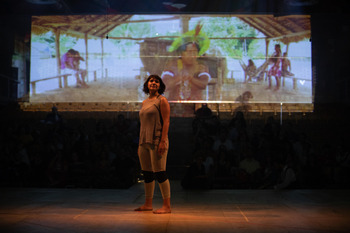
In 2019, we were in the Tubatuba village, owned by the Yudjá people, when President Bolsonaro took office. His first action was to issue Provisional Measure 870, which by force of law transferred the competence of demarcating indigenous lands from the Ministry of Justice to the Ministry of Agriculture, occupied by agribusiness representatives. In other words, it placed the country’s indigenous policies in the hands of the enemies of indigenous peoples. When the news reached the village, the shaman and political leader, Yabaywá Juruna, told us that the following morning, they would paint themselves for war and send a message to the white people (Karaí). They asked us ‘to come armed with our cameras’. Chief Tinini then sent a direct message to the new president:
This ruler wants to end us. He is saying that the Indian does not exist any more, because the Indians dress like the whites and that, then, we are all the same … If he saw and listened to this message, he would know that we are different, because every people has its culture, we dress the way our God did for us: with our culture, our body paintings, our art and our way of life. If he saw this, he would realize we are not the same.Footnote 5
Photograph of the Os Um e Os Outros spectacle by Cia. Livre, in which the projected video of Chief Tinini sending his message to the Karaí (non-indigenous) appears. Photograph by Cacá Bernardes.

How to deliver the message of Chief Tinini to the Karaí was the starting point for the creation of the new show by Cia. Livre, a theatre group that I have run since 1999. Because of this origin, how we positioned ourselves as theatre-makers was central to the work, and something I highlight during the article.
We then decided to adapt the learning piece The Horatians and the Curiatians, by Brecht, to focus on the resistance struggle of indigenous peoples in the face of threats from the new government, with the participation of the Guarani M'Bya people who live on the outskirts of the city of São Paulo. The question of anthropological ethics posed by this proposal was how we could build the participation of a Guarani chorus so that they could act as protagonists and an autonomous voice within the play without reproducing white domination in the creation process. In order to do so, we never determined a scene for the Guarani chorus from the outside, but we preferred to show the scenes and wait for their answers, so that they could independently decide what to do in the play, and when and how to do it.
The two families that made up the Guarani chorus were very active, making autonomous and conscious suggestions as part of the scenes, such as epic interruptions and comments, funeral songs and rites, narratives and direct speeches. It is important to note here that the Guarani M'Bya chorus did not consider their actions as representation or fiction, but as a shared experience, political speech or even ritual action. This was what happened, for example, on the occasion of a mourning scene in which Kerexu Mirim decided to ‘blow smoke’ from his ‘petyngua’ (ritual pipe) on Lu Favoreto, not because the character was crying over the warriors killed in the play, but because Favoreto the actress was in fact mourning her father, which made this action a real experience, for both Mirim and Favoreto. This position of the Guarani, in turn, demanded that actors and actresses from Cia. Livre increasingly dismantle their performance, to the point of each one identifying themselves very intimately when narrating Brecht's story, specifying their ethnic origin, gender and social class, as well as political position. For this, we created a prologue where actors and actresses improvised an introduction in which they contextualized their first contacts with the Amerindian peoples, in order to epically explain the positionality of each one. At the end of the prologue, I introduced myself, as a director, and right at the beginning of the play, I explained the meaning of our adaptation:
This play is like a book, which I open to narrate the FIGHT that Brecht wrote in 1933, retelling a historical battle in ancient Rome. The text sung and spoken by actresses and actors is from Brecht’s original play. We will intersperse, entangle or juxtapose our own historical time to the text, through messages, documents and images of the war going on, right now, in the forest and in major cities of the country such as São Paulo … For us, on the stage, the ‘Curiatians’ are the people of the ‘ONE’, who believe that their culture is UNIVERSAL. As do we, Juruá. And the ‘Horatians’ are all the ‘OTHERS’, peoples, with their multiple ways of life, who fight to survive, with their different human, animal, plant, mineral cultures. BREAK A LEG!Footnote 6
What follows is a structural description of the four acts and how we explicated positionality in each of them. In the first act, we introduced both sides of the conflict. One side, enclosed in an elevator, was presented as an image synthesis of our society: a group of men and women in dispute, pressed into space and trapped in time. The introduction of the Others was an improvisation on the Xondaro, a Guarani dance game that trains the warriors of its people for resistance fights. The Guarani chorus directed the scene and the public were invited to dance with us. This moment was long and fun, as if we had all forgotten the spectacle to have a party. The party was interrupted by a virulent speech in which Bolsonaro made threats to native peoples’ freedom and autonomy. The reply was given ‘by themselves’, through a film with a speech by Sonia Guajajara, coordinator of the Association of Indigenous Peoples of Brazil who, on behalf of the 305 peoples of the Brazilian territory, said, ‘We will not surrender, NO!’
In this moment the two sides of the battle were properly introduced, the conflict was set and the audience found itself abandoned in the middle of the stage, among the contenders. The idea was to surprise the spectators who carelessly gave themselves over to the dance and leave them in the centre of the battle, lost in the middle of the shooting. In the first interval, the audience ended up returning to the safety of their seats, but the relationship between the spectators and the spectacle was already completely transformed. The subliminal message was clear: the conflict concerned everyone. It was not possible to remain outside, indifferent or neutral, because all bodies were in danger.
In the second act, the play returned to Brecht's text, with the ‘battle of the archers’, which was narrated in song, like an recitative. An actress who spoke important rubrics of the text crossed the scene with a lamp, measuring the time of the battle, while a hitter built the light of the scene, and two stairs formed the topography of the territory in dispute. Elements of explicit theatricality popped up everywhere, from the lighting, to ways of saying the text, to tracking the passage of time.
At the end of the archers’ battle, I, the director, interrupted the play, asked for the service light to be turned on and told the audience about the message of Chief Tinini for the Karaí, revealing the origin of the play they were watching. This cross-reference in the dramatic progression served to emphasize the importance of the message of Chief Tinini for the general sense of the spectacle: to bring a message from far away – from the village of Tubatuba – that recalled another message from the beginning of time, when Sena’ã (the Creator Yudjá) warned of the danger of a destructive action by white people, which could lead to the end of times. Mythic time may become our future: ‘So Sena’ã left a message that when the white end the Yudjá, he will end the white, he will end the world. He said: “Then I will undo the sky and the sky will fall to end the world. Is that what they want?”’Footnote 7
There remained silence and from it came a new question I posed to the audience:
Is that what we, karaip, caraíba, kuben, juruá, want? (Long pause.) If, by any chance, you knew that the way of life of the people of the gods and, therefore, the way of life of each one of us, in twelve, twenty-five or fifty years, will irrevocably destroy the forest, their lives and cultures … what would you do today, so that the sky doesn’t fall on our heads, or on our children?Footnote 8
The third act juxtaposed Brecht's text with the arrival of ‘progress’ at Volta Grande do Rio Xingu, the place where the Yudjé people live, between the two dams of the Belo Monte hydroelectric plant. The animated map of Volta Grande was projected onto the floor of the stage, in an area of action of one hundred square metres (ten metres by ten metres). With each move by the contenders of Brecht's play, the spectacle presented the historic advance of megaprojects and the environmental and human consequences for the Xingu river: (1) the trans-Amazonian road, built in the 1970s, with the objective of integrating and populating the forest, initiating deforestation in the Amazon; (2) the construction of the two dams of the Belo Monte plant that threatened to dry up Volta Grande, with tragic consequences for the region's biome and for the Juruna people; (3) the operating licence of a large Canadian mining company called Belo Sun, which intended to extract a large amount of gold in the region, making life impossible on the Xingu river.
Throughout the battle, the spearman of the UM surrounded disputed territory, with a hybrid, technological body: his head was formed by a golden gas mask and an LED necklace, and one of his was a chainsaw, forming a hyper machine being. The spearman of the OTHERS, on the other hand, was interpreted not by one but by two actors (a man and a woman) that constituted one single body. This double warrior was inspired by the figure of Iraparadi, the killer spirit of the Araweté people, who, when in the world of the dead, attaches himself to his own victim, forming a complex person, with a head, four arms and four legs, a kind of hyper human being.
When the Brecht scene ended, I interrupted the action again to say that President Bolsonaro had just inaugurated the last turbine at the Belo Monte plant and read an excerpt from an article by Eliane Brum in the newspaper El Pais about the current situation of the Xingu river:
This is the news: Xingu is going to die. The Public Prosecution Office warns that the greatest Amazonian tragedy today in the Altamira region is the ‘ecocide’ of the Big Bend of the Xingu river … The attorney Thais Santi considers Belo Monte ‘the world where everything is possible’. She says, ‘If the world of law worked, Belo Monte would have to be closed. To no one is the right to kill the Xingu river given.’Footnote 9
In the fourth act we had the last battle. In the original by Brecht, the strategy of fleeing to divide the enemy allowed the last Horatian warrior to kill the enemies of Curiatians, winning the battle. In our adaptation, we interrupted the fight before the last death and dismantled the battle, questioning the logic of destruction of the OTHER, to guarantee the supremacy of the ONE. Was the enemy's death the only way to stay alive? We challenged the audience to think of another end to this battle and to the play itself, in order to reflect on our strategies of political struggle. Would it be possible to invent a form of transformation without using the enemy's weapons, outside the logic of violence? Was it possible to decolonize our heads? We awaited the answers … or the reflective silence that followed the questions still in the air.
The end of the spectacle, then, was improvised and unique each day. The fact of leaving the end in suspense, constituting an always unfinished work, aimed to explain the very purpose of the learning play as a reflection in constant movement.
When the play was over, Kerexu Mirim took the microphone and made an impromptu and personal speech about relations between the Guarani people and the ‘Juruá’, that is, ourselves. So the last line was not ours, but the other's.
Conclusion
Before finishing this article, I would like to declare here that these theatrical dialogues with the Amerindians have major limitations – the richness and complexity of the cultures and ways of life I found in the different peoples we visited cannot be contained in a few words. Maybe much less through a performance.
I approached my fieldwork seeking to find origin myths that could be told by the old, and then performed, somehow, by the young as a way to reinterpret the traditional myths through theatre. However, I did not find anything that could resemble what we call theatre and, for the first time in my life, entirely devoted to the performing arts, I considered that ‘theatre’, as we know it, may not exist and may not be missed.
The stories told by the old are not fiction, maybe not even ‘myths’ (as the current meaning of this word seems to suggest). They are reality. They tell and re-update, through every generation, the origin of peoples, and teach how to plant, harvest, fish and cook, to play the flute or sing a particular song. They are connected to day-to-day life, as much as to ritualistic life, and both are intimately related.
But, if the ‘theatre’ does not exist, in the sense of representation, the ways of life and the relationship with other ways of life are, so to speak, scenic. They are ceremonials, filled with conventions, and have an intrinsic relation between technique and form. All day-to-day actions have a conventional way to be performed, taking into consideration the beauty and also a history that explains why they are done that way. Technique, ethics and aesthetics allied are woven through stories, which can be told or sung and danced. Orality is a way of acting, by either telling or singing a story, or in a political speech. Rites, in their turn, relive the relationships between a people and other humans, as well as between humans and extra-humans. In this sense, shamans are ambassadors between worlds; all real, each one with its language. This would be the place of theatre today for the Amerindian peoples, operating as an ambassador between worlds.
Narratives are, therefore, modes of teaching and learning, that tell the history of their people. They remind us, every time they are told and retold, how the direct and respectful relationship with nature and its spirits must remain alive. This is the condition for us human beings to continue to exist, without the sky falling definitively on our heads, as is beginning to happen now, on a global scale.