Introduction
Spiritual well-being and a sense of meaning are important influences for quality of life (QoL) in patients with advanced cancer (Field and Cassel, Reference Field and Cassel1997; Sinclair et al., Reference Sinclair, Pereira and Raffin2006).
The importance of the existential care lead to the emergence of meaning-focused interventions (Breitbart, Reference Breitbart2002; Chochinov et al., Reference Chochinov, Hack and Hassard2005; Puchalski, Reference Puchalski2013) in advanced cancer patients or terminally ill (Yalom and Greaves, Reference Yalom and Greaves1977; Spiegel et al., Reference Spiegel, Bloom and Yalom1981; Edelman et al., Reference Edelman, Bell and Kidman1999; Edmonds et al., Reference Edmonds, Lockwood and Cunningham1999; Classen et al., Reference Classen, Butler and Koopman2001; Kissane et al., Reference Kissane, Bloch and Smith2003, Reference Kissane, Grabsch and Clarke2007; Lee et al., Reference Lee, Cohen and Edgar2006; Breitbart et al., Reference Breitbart, Rosenfeld and Gibson2010; Chochinov et al., Reference Chochinov, Kristjanson and Breitbart2011). In response to this need, Breitbart and his investigation group developed meaning-centered psychotherapy (MCP) to help patients with advanced cancer sustain or enhance a sense of meaning and purpose in their lives, even as they approach the end of life (Breitbart, Reference Breitbart2000, Reference Breitbart2002; Greenstein and Breitbart, Reference Greenstein and Breitbart2000; Breitbart et al., Reference Breitbart, Rosenfeld and Gibson2010, Reference Breitbart, Rosenfeld and Pessin2015; Van der Spek et al., Reference van der Spek, Vos and van Uden-Kraan2013; Applebaum et al., Reference Applebaum, Kulikowski and Breitbart2015). MCP was first developed in a group format (meaning-centered group psychotherapy — MCGP), which is a manualized eight-week intervention (each session: 1.5 h) that utilizes a combination of didactics, experiential exercises and discussion (Breitbart, Reference Breitbart2002). The first randomized control trial (RCT) showed benefits in enhancing spiritual well-being and a sense of meaning (Breitbart et al., Reference Breitbart, Rosenfeld and Gibson2010). Further studies suggested that more severe forms of despair respond better to existential interventions (Breitbart et al., Reference Breitbart, Rosenfeld and Pessin2015).
The goal of this study is to describe the feasibility of an MCGP adaptation in a sample of Portuguese cancer patients. The outcomes were: MCGP adapted version improves QoL and spiritual well-being (primary), and the levels of depression, anxiety, and distress (secondary).
Methods
Procedures
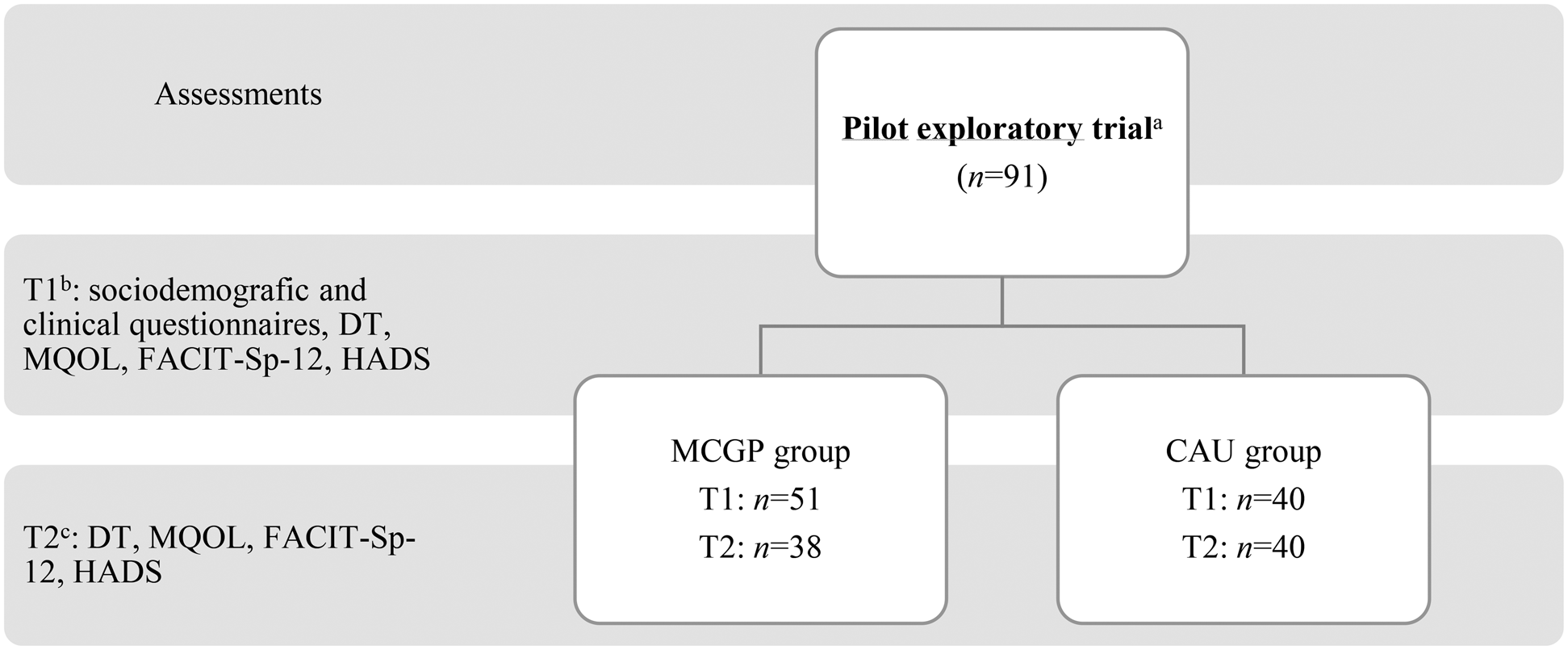
This study was implemented according to four steps. Transcultural adaptation and validation of MCGP standardized manual to the Portuguese language was carried out through focus groups (1st step). The preliminary study with the original version of MCGP (2nd step) revealed a high number of dropouts, which could jeopardize the study, and led to the 3rd step — adaptation of MCGP original version to a 4-session version (maintaining the same periodicity and duration of the original version), and internal pilot study (to test its feasibility), which followed the same methodology as the 4th step, except regarding the care as usual (CAU) group. A pilot exploratory trial (4th step — Figure 1) had two arms, according to allocation criteria: MCGP vs. CAU. MCGP was led by a therapist (psychiatrist) and attended by another health professional for training purposes, and after participants’ consent.
Pilot exploratory trial (aintent to treat analysis; bMCGP: before the 1st session/ CAU: 1st moment; cMCGP: after the last session/CAU: 1 month after T1; DT, distress thermometer; FACIT-Sp-12, functional assessment of chronic illness therapy — spiritual well-being scale; HADS, hospital anxiety and depression scale; MCGP, meaning-centered group psychotherapy).

It was carried out two assessments (T1 — MCGP: before the 1st session vs. CAU: 1st moment; T2 — MCGP: after the last session vs. CAU: 1 month after T1) with socio-demographic and clinical questionnaires and self-report instruments to measure QoL, spiritual, and psychological well-being: Distress Thermometer (DT; Ouakinin et al., Reference Ouakinin, Eusebio and Torrado2015; National Comprehensive Cancer Network, 2017), McGill Quality of Life Questionnaire (MQOL; Cohen et al., Reference Cohen, Mount and Bruera1997; Duarte et al., Reference Duarte, Querido and Dixe2010), Functional Assessment of Chronic Illness Therapy — Spiritual Well-Being Scale (FACIT-Sp-12; FACIT Group, 2011; Pereira and Santos, Reference Pereira and Santos2011), and Hospital Anxiety and Depression Scale (HADS; subscales: depression [HADS-D] and anxiety [HADS-A]; Zigmond and Snaith, Reference Zigmond and Snaith1983; Pais-Ribeiro et al., Reference Pais-Ribeiro, Silva and Ferreira2007). After each session, the therapist completed “Checklist of therapist adherence,” a self-report to assess if the goals of each session were achieved (Breitbart and Poppito, Reference Breitbart and Poppito2014).
Participants
Participants with cancer were recruited at a district hospital (Centro Hospitalar Barreiro-Montijo) and two cancer associations (Portuguese League Against Cancer and Algarve Cancer Association) in Portugal, between January 1, 2018 and December 31, 2019. To ensure reliability, the inclusion criteria of this convenience sample (>18 years, psychological complaints, as depressed mood and anxiety, and difficulty to adapt to cancer) satisfied the following assumptions: to replicate previous methodologies; to consist in a formal indication for existential psychotherapies (Teixeira, Reference Teixeira2006; Breitbart and Alici, Reference Breitbart and Alici2014; Julião, Reference Julião2014; Van der Spek et al., Reference van der Spek, Vos and van Uden-Kraan2014; Van Lankveld et al., Reference van Lankveld, Fleer and Schroevers2018); and to use Hierarchical Taxonomy of Psychopathology (HiTOP) — a dimensional psychopathological classification (Kotov et al., Reference Kotov, Waszczuk and Krueger2017; Conway et al., Reference Conway, Forbes and Forbush2019) — to facilitate symptoms recognition by the recruiters (medical oncologists and psychologists). The authors assumed that screening of distress it would not be a good measure to inclusion criteria, as high levels of distress do not necessarily correspond to maladaptive responses, as these are determined by a complex process of mental adjustment (Moyer et al., Reference Moyer, Sohl and Knapp-Oliver2009; Croy, Reference Croy2010; Van Lankveld et al., Reference van Lankveld, Fleer and Schroevers2018). Exclusion criteria were: cognitive deficits that interfere in the capacity to give informed consent, psychotic symptoms or substance abuse (Julião, Reference Julião2014). The allocation was according to participants preference to be included in MCGP vs. CAU (Applebaum et al., Reference Applebaum, Lichtenthal and Pessin2012). The participants were contacted, within 1 month after having expressed their availability, when it was reached a minimum of 5 per group (Applebaum et al., Reference Applebaum, Lichtenthal and Pessin2012), and it was considered dropout when they participate in less than 3 sessions (this cut-off ensures the “same dose” of treatment, it is the ideal to verify differences in the outcomes keeping and, at the same time, maintain a conservative approach) (Breitbart et al., Reference Breitbart, Rosenfeld and Pessin2015). For participants with current psychiatric/psychologic follow-up, their therapists were informed.
MCGP has no known risks, and its structure provides space for participants personal feedback (Breitbart and Poppito, Reference Breitbart and Poppito2014). The study was approved by the Institutional Ethical Committees, and the Portuguese National Commission of Data Protection, in accordance with the principles embodied in the Declaration of Helsinki.
Statistical analysis
For the internal pilot study (3rd step) and the checklist of therapist adherence, it was performed a descriptive analysis. For the pilot exploratory trial (4th step), it was carried out a sample characterization, using descriptive analyses and chi-square test. For group comparisons, parametric and nonparametric tests were used (Wilcoxon test, Mann–Whitney, and Student's t-tests). Analysis of group effects in primary and secondary outcomes used ANCOVA (independent variables: MCGP and CAU; dependent variables: 2nd assessment; covariate: 1st assessment; six covariables were identified to control possible confounding influences — age, gender, cancer stage, current chemotherapy [CT] treatments, personal psychiatric history, and current follow-up). Primary outcomes were QoL (MQOL total score and all domains) and spiritual well-being (FACIT total score and both dimensions). Secondary outcomes were depression (HADS-D), anxiety (HADS-A), and distress (DT). ANCOVA analysis demonstrated homogeneous variances for all variables; the assumption of slope homogeneity showed that there was not significant interaction between each dependent variable and the covariate, except for the support domain of QdV (P = 0.022). The groups had a similar dimension, so ANCOVA was robust to the analysis of these assumptions. The effect dimension was calculated using partial eta2 ([η 2p]; small effect size: η 2p = 0.01, medium: η 2p = 0.06, high: η 2p = 0.14). Also, it was done a comparison analysis (T1 and T2) of spiritual and psychological between the participants who attended 1 or 2 sessions and those who attended 3 or all sessions.
Intent to treat analysis was performed, and missing values were inputted according to the expectation–maximization method. Analysis used SPSS, version 25, and values P < 0.05 was considered statistically significant.
Results
1st step: Transcultural adaptation and validation
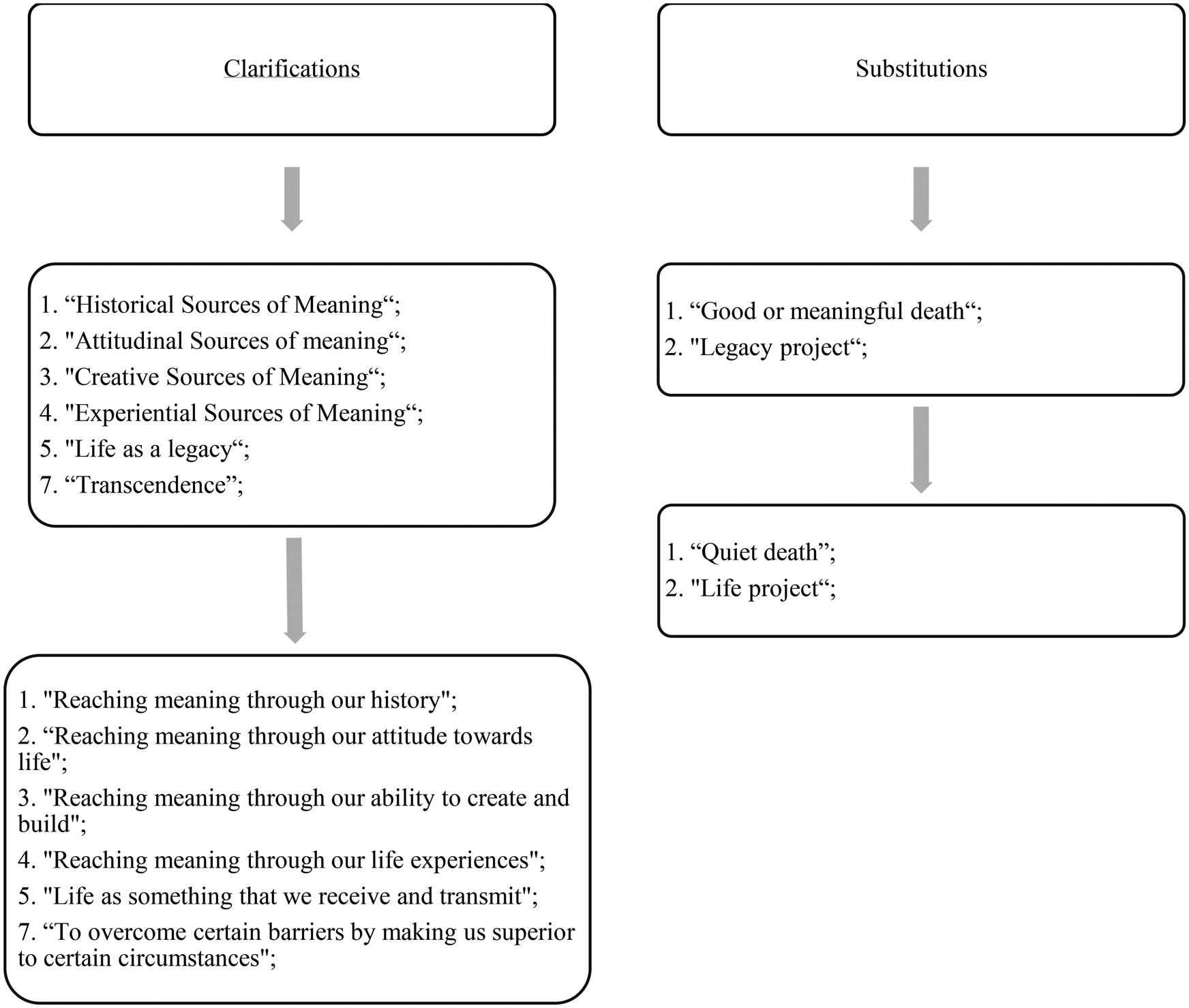
Transcultural adaptation and validation was performed by four focus groups, led by the therapist, to evaluate the manual comprehensibility (Goes, Reference Goes2007; Pasquali, Reference Pasquali2009; Epstein et al., Reference Epstein, Santo and Guillemin2015; Medeiros et al., Reference Medeiros, Júnior and Pinto2015). The first two focus groups discussed the manual content (1st group: cancer patients; 2nd: mental health professionals without experience in MCP), and the results were discussed in the 3rd group, constituted by experts. The findings showed the necessity to clarify some of MCP core concepts (Figure 2), which seemed culturally determined and independent from the educational level (Da Ponte et al., Reference Da Ponte, Ouakinin and Breitbart2017). The manual's reformulation was tested in another focus group, with cancer patients, and it was verified the substantial improvement of its comprehensibility.
Meaning-centered group psychotherapy transcultural adaptation and validation.

2nd step: Preliminary study (MCGP original version — 8 sessions)
Of the initial sample (n = 11), six dropped out (the main reason was time consumption by the hospital, at the expense of participants' personal life), and the majority of these did not complete the 2nd assessment.
3rd step: Adaptation of MCGP original version to a 4-session version (and internal pilot study)
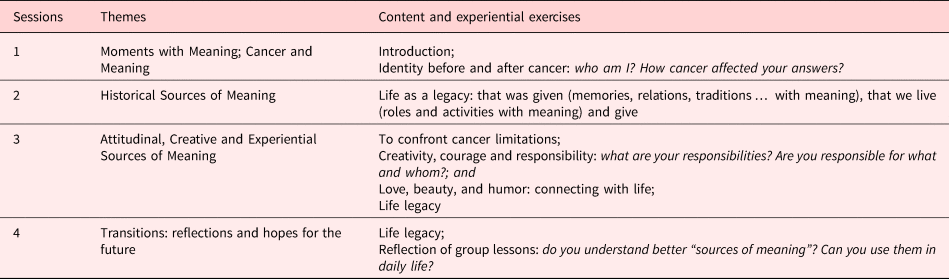
Because of dropouts in the preliminary study that could jeopardized the investigation, and after consulting previous adaptations of MCGP to different settings (Breitbart et al., Reference Breitbart, Rosenfeld and Gibson2010, Reference Breitbart, Poppito and Rosenfeld2012, Reference Breitbart, Rosenfeld and Pessin2015, Reference Breitbart, Pessin and Rosenfeld2018; Van der Spek et al., Reference van der Spek, Vos and van Uden-Kraan2014, Reference Van der Spek, Vos and van Uden-Kraan2016; Lichtenthal et al., Reference Lichtenthal, Corner and Sweeney2015; Rosenfeld et al., Reference Rosenfeld, Saracino and Tobias2017), the participants´ preference for some themes (in the first steps of the study), and discussing with the author, MCGP was adapted to a 4-session version (Table 1). This consisted of a combination of sessions 1 and 2 (“Moments with Meaning” and “Cancer and Meaning”) and sessions 5, 6, and 7 (Attitudinal, Creative, and Experiential Sources of Meaning) of the original version in single sessions (respectively); similarly to the original version, and because of its importance described in previous studies, “Historical Sources of Meaning” occupied an entire session (Breitbart et al., Reference Breitbart, Rosenfeld and Gibson2010, Reference Breitbart, Poppito and Rosenfeld2012, Reference Breitbart, Rosenfeld and Pessin2015, Reference Breitbart, Pessin and Rosenfeld2018; Van der Spek et al., Reference van der Spek, Vos and van Uden-Kraan2014, Reference Van der Spek, Vos and van Uden-Kraan2016; Lichtenthal et al., Reference Lichtenthal, Corner and Sweeney2015; Rosenfeld et al., Reference Rosenfeld, Saracino and Tobias2017). Based on therapist training in MCP and available support material (Memorial Sloan Kettering Cancer Center, 2016), it was designed a short manual with the goals and exercises of each session, which conserved the same structure as MCGP original version: after a brief presentation of the therapist and the participants (session 1), session's themes were presented, experiential exercises were distributed and participants were asked to write their answers; the remaining time consisted of didactic discussions and participants’ feedback.
Structure of meaning-centered group psychotherapy-4 session version

Of the initial sample (n = 15), one-third of participants dropped out. The findings showed improvements in spiritual well-being (FACIT-Sp-12 total score: T1 — 32.54 vs. T2 — 33.77; FACIT-Sp-12 dimension meaning/peace: T1 — 32.54 vs. T2 — 33.77), levels of depression (HADS-D: T1 — 6.5 vs. T2 — 2.6), anxiety (HADS-A: T1 — 8.67 vs. T2 — 6.2), distress (DT: T1 — 4.56 vs. T2 — 3.75), and QoL (MQOL total score: T1 — 6.18 vs. T2 — 6.99; MQOL existential domain: T1 — 6.87 vs. T2 — 7.91).
4th step: Pilot exploratory trial (MCGP-4 session version)
Sample description
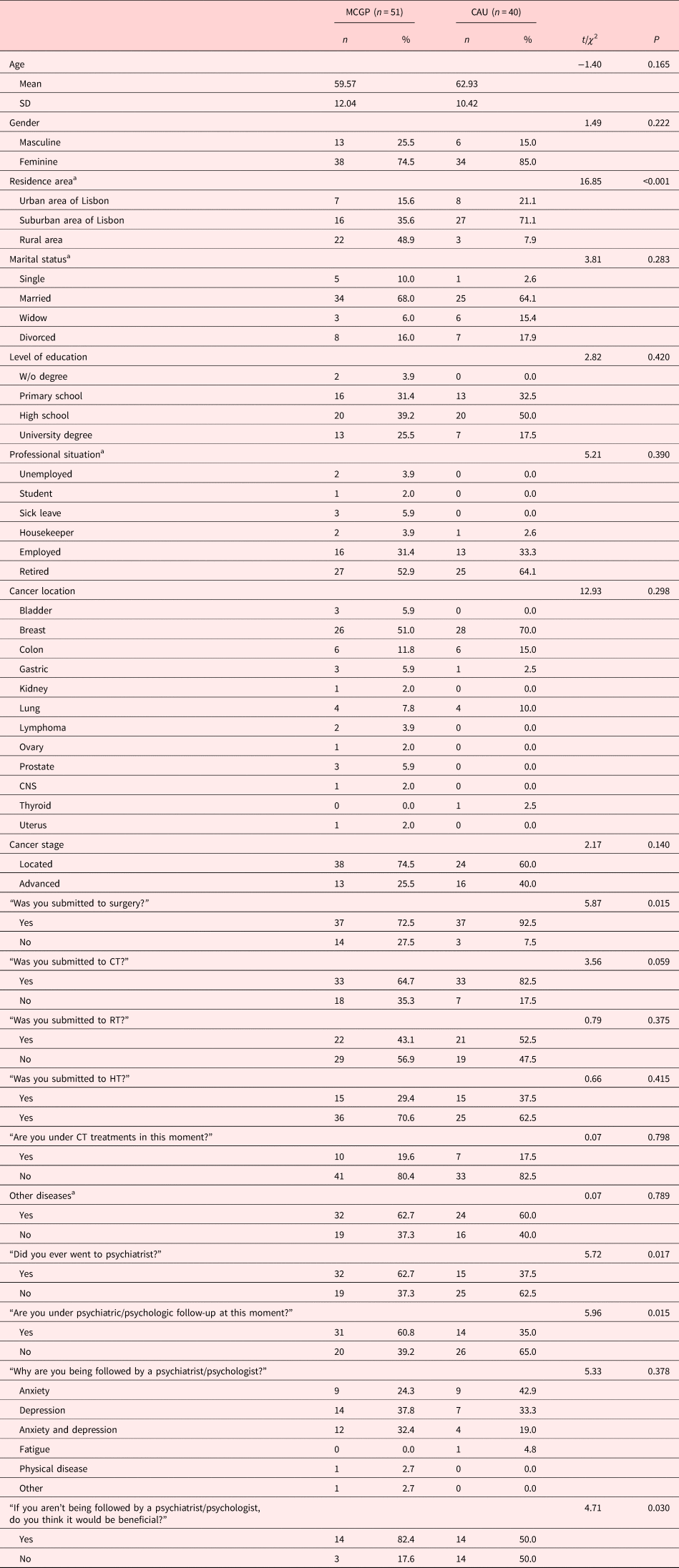
Socio-demographic and clinical characteristics of the sample are represented in Table 2. Of the 91 participants, 51 (56%) participated in MCGP and 40 (44%) in CAU. The mean age of the sample was 61.04 years (SD: ±11.42; MCGP: 59.57; CAU: 62.93), and the majority was female, married, and retired. In terms of clinical characteristics, breast cancer was the most frequent (MCGP: 51% vs. CAU: 70.0%), as it was the located stage (74.5% vs. 60%); most of participants were submitted to surgical (72.5% vs. 92.5%) and CT (64.7% vs. 82.5%) treatments and had physical comorbidities (62.7% vs. 60.0%). Although most of socio-demographic and clinical characteristics between the groups had no statistically significant differences, a more significant proportion of MCGP participants lived in a rural area and a lesser proportion lived in the suburbs of Lisbon, compared with CAU (48.9% vs. 7.9%; 35.6% vs. 71.1%, χ 2 = 18.85, P < 0.001); fewer proportion of MCGP participants had done surgery, comparing with CAU (72.5% vs. 92.5%, χ 2 = 5.87, P = 0.015), and a higher proportion of MCGP participants had personal psychiatric history (62.7% vs. 37.5%, χ 2 = 5.72, P = 0.017), and current follow-up (60.8% vs. 35.0%, χ 2 = 5.96, P = 0.015), comparing with CAU. Of the participants that were not on current follow-up, there was a significantly higher percentage of MCGP participants that considered it would be beneficial (82.4% vs. 50.0%, χ 2 = 4.71, P = 0.030), comparing with CAU.
Socio-demographic and clinical characteristics of meaning-centered group psychotherapy (MCGP) and care as usual (CAU) groups (n = 91)

a Variable with missing values; CAU, care as usual; CNS, central nervous system; CT, chemotherapy; HT, hormone therapy; RT, radiotherapy; SD, standard deviation; w/o, without.
Group comparison and group effects
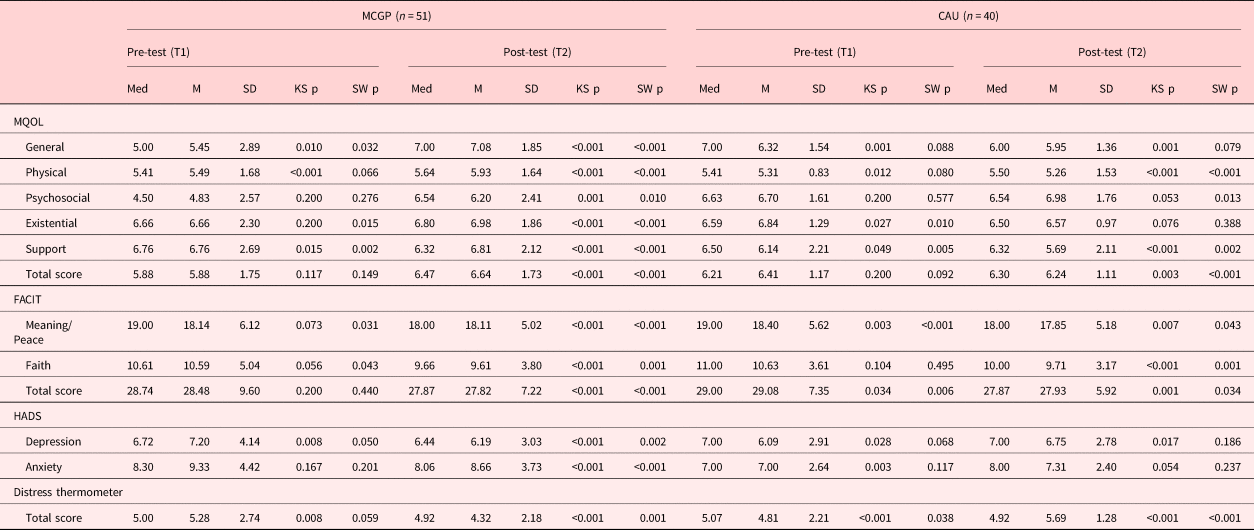
The comparison between groups (Table 3) in T1 showed that there was statistically significant differences in the psychosocial domain of QoL (mean: MCGP: 4.83 vs. CAU: 6.70; U = 566.90, P < 0.001) and anxiety (mean: MCGP: 9.33 vs. CAU: 7.00; U = 646.00, P = 0.003), where the MCGP group scored significantly lower in the psychosocial domain of QoL, and higher in anxiety, comparing with the CAU group. At T2, there was statistically significant differences between the general (mean: MCGP: 7.08 vs. CAU: 5.95; U = 552.00, P < 0.001), physical (mean: MCGP: 5.93 vs. CAU: 5.26; U = 731.50, P = 0.018) and existential (mean: MCGP: 6.98 vs. CAU: 6.57; U = 727.50, P = 0.018) domains and the total score (mean: MCGP: 6.64 vs. CAU: 6.24; U = 717.50, P = 0.015) of QoL, and anxiety (mean: MCGP: 8.66 vs. CAU: 7.31; U = 740.50, P = 0.023), where the MCGP group scored significantly higher. On the other hand, the CAU group presented statistical higher levels in DT (mean: MCGP: 4.32 vs. CAU: 5.69; U = 608.50, P = 0.001), in comparison with the MCGP group. Comparing the groups between T1 and T2, for the MCGP group, there was a statistically significant improvement in the general (mean: T1: 5.45 vs. T2: 7.08; Z = −3.67, P < 0.001) and psychosocial (mean: T1: 4.83 vs. T2: 6.20; Z = −2.89, P = 0.004) domains and total score (mean: T1: 5.88 vs. T2: 6.64; Z = −2.71, P = 0.007) of QoL, and a statistically significant decrease in DT (mean: T1: 5.28 vs. T2: 4.32; Z = −2.40, P = 0.016). In the CAU group, there was a significant statistical decrease in the support domain (mean: T1: 6.14 vs. T2: 5.69; Z = −2.18, P = 0.029) of QoL and a significant statistical increase in DT (mean: T1: 4.81 vs. T2: 5.69; Z = 02.44, P = 0.015).
Medians, means, standard deviations, and tests of the normal distribution for each group, in the pre- (T1) and in the post-test (T2) (intent to treat analysis)

CAU, care as usual; FACIT, Functional Assessment of Chronic Illness Therapy Spiritual Well-Being Scale; HADS, Hospital Anxiety and Depression Scale; KS: Kolmogorov–Smirnov; M, mean; Med, median; MCGP, meaning-centered group psychotherapy; MQOL, McGill Quality of Life Questionnaire; SD, Standard Deviation; SW, Shapiro–Wilk.
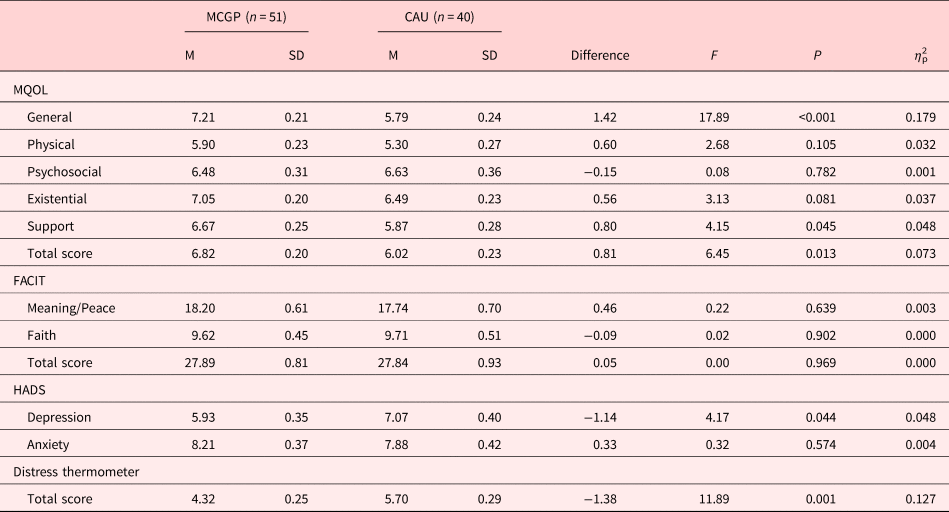
ANCOVA analysis (Table 4) tested group effects in QoL, spiritual well-being, anxiety, depression, and distress, after controlling for the scores in T1, as well as age, gender, cancer stage, CT treatments, and personal psychiatric history. For QoL and spiritual well-being, after accounting for the covariables effects, general, and support domains and the total score of QoL were significantly influenced by the group (group effect with small to elevated dimensions), where the MCGP group, compared with the CAU group, had an increase in general (b = 1.42, P < 0.001, η 2p = 0.179), and support (b = 0.80, P = .045, η 2p = 0.048) domains and total score (b = 0.81, P = 0.013, η 2p = 0.073) of QoL. For spiritual well-being, there was not an improvement in the MCGP group, comparing with the CAU group. For depression, anxiety and distress, after taking into account the covariables effect, it was found significant differences in the variables depression and distress, with an improvement (decrease) in levels of depression (b = −1.14, P = 0.044, η 2p = 0.048) and distress (b = −1.38, P = 0.001, η 2p = 0.127) in the MCGP group, in comparison with the CAU group. These results had small to medium dimension effects.
Average change scores and standard deviations for all variables by group, covariance analysis, and effect size (n = 91)

CAU, Care as usual; FACIT, Functional Assessment of Chronic Illness Therapy Spiritual Well-Being Scale; HADS, Hospital Anxiety and Depression Scale; M, mean; MCGP, meaning-centered group psychotherapy; MQOL, McGill Quality of Life Questionnaire; SD, standard deviation; η 2p, eta2 partial.
Attrition rate
The attrition rate was 25.5% (13 dropouts), and the main reasons were illness and appointments (n = 3, 23.1%, respectively). In T1, participants that frequented 1 or 2 sessions (n = 13) had a statistically significant higher score in FACIT total score (U = 128.50, P = 0.010), and its dimension faith (U = 123.50, P = 0.007), comparing with those participants that frequented ≥3 sessions (n = 38). In T2, those participants that frequented ≥3 sessions had a statistically significative higher score in the general domain of QoL (U = 130.00, p = 0.009), comparing with those that frequented less sessions.
Checklist of therapist adherence
The therapist was less adherent to session 3 (mean: 5.75; minimum: 4; maximum: 7), comparing all sessions. The main reason was the difficulty of accomplishing all the goals of the session' themes (Attitudinal, Creative, and Experiential Sources of Meaning), namely the exercises related to “Experiential Sources of Meaning.”
Discussion
MCGP transcultural adaptation and validation showed that existential themes, particularly “sources of meaning” or “transcendence,” raised questions culturally determined and related to the “meaning of life” (Hambleton and Patsula, Reference Hambleton and Patsula1990; Swaine-Verdier et al., Reference Swaine-Verdier, Doward and Hagell2004; Goes, Reference Goes2007; Pasquali, Reference Pasquali2009; Epstein et al., Reference Epstein, Santo and Guillemin2015; Medeiros et al., Reference Medeiros, Júnior and Pinto2015; Da Ponte et al., Reference Da Ponte, Ouakinin and Breitbart2017). The high number of dropouts verified with MCGP original version is well described in previous studies that reported the link between the limitations of psychosocial research in cancer patients and personal time-consumption by medical care (Croy, Reference Croy2010; Applebaum et al., Reference Applebaum, Lichtenthal and Pessin2012). The internal pilot study using MCGP adapted version supported its feasibility and possible positive benefits in QoL and spiritual and psychological well-being.
Many socio-demographic and clinical characteristics between MCGP and CAU had not statistically significant differences, which supports the sample's homogeneity. Although a higher proportion of MCGP participants had personal psychiatric history and current follow-up, these variables were controlled by statistical analysis. On the other hand, the smaller proportion of MCGP participants submitted to surgery gives to this group a lower theoretical risk of psychopathology (McFarland et al., Reference McFarland, Walsh, Napolitano and Morita2019), but this result needs to be integrated with the rest, namely the number of participants in question (MCGP: 37/51 vs. CAU = 37/40).
The group comparison in the 1st assessment showed that MCGP, compared with the CAU group, presented a reduction of QoL, in its psychosocial domain, and higher levels of anxiety. In the 2nd assessment, the MCGP group, compared with the CAU group, presented higher QoL in its general, physical and existential domains and total score, and, although it was not statistically significant, an improvement in the psychosocial domain of QoL (mean: T1: 4.83 vs. T2: 6.20). Similarly, the result of higher levels of anxiety in MCGP, comparing with the CAU group, needs to be integrated in the improvement (not statistically significant) of its levels (mean: T1: 9.33 vs. T2: 8.66). The group comparison between assessments supports the previous findings, as the MCGP group presented better QoL in its general and psychosocial domains and total score. The new finding of higher levels of distress in the MCGP group, comparing with the CAU group, give additional evidence of its benefit in this dimension of psychological well-being.
In terms of group effects, for the primary outcome (MCGP adapted version improves QoL and spiritual well-being), it was verified a group effect, with small to high dimensions, in which the MCGP group, compared with the CAU group, presented a higher QoL (general and support domains, and total score), but not for spiritual well-being. This last data needs to be integrated in former results, namely the mean values of FACIT, and its dimension meaning/peace, at baseline (and also in 2nd assessment), which could mean that there was little space for improvement (MCGP: FACIT total score — T1: 28.48 vs. T2: 27.82; dimension meaning/peace — T1: 18.11 vs. T2: 18.40; FACIT Group, 2011). For the secondary outcome (MCGP adapted version improves levels of depression, anxiety, and distress), it was verified a group effect, with small to medium dimensions, in which the MCGP group improved levels of depression and distress, supporting the former results of group comparison.
It was also verified that participants who attended less sessions had better spiritual well-being at the beginning and, therefore, less need for psychotherapy. The improvement in QoL after psychotherapy in participants who attend more sessions can support the benefit of MCGP in QoL.
In terms of limitations, our pilot exploratory trial did not consist of RCT but an efficacy study, which is considered the more appropriate to study psychosocial interventions, given that it ensures external validity (Croy, Reference Croy2010). The small sample, its cultural characteristics, and the adaptation in a short version of MCGP, could have conditioned the absence of its proven benefit in spiritual well-being. It is well described the relation between the benefit and duration of psychotherapies (Spiegel, Reference Spiegel1978; Spiegel et al., Reference Spiegel, Bloom and Yalom1981). Our recruitment rate was only possible by the expansion of inclusion criteria and allocation method — the first limitation was overpassed by our methodology (replication of previous studies) and statistical analysis (control of confounding variables) (Van Lankveld et al., Reference van Lankveld, Fleer and Schroevers2018). The absence of screening for distress at the baseline was admitted, but it followed the assumption that high levels of distress do not necessarily correspond to maladaptive responses, as it is not the intensity but the nature of distress that determines the response (Moyer et al., Reference Moyer, Sohl and Knapp-Oliver2009; Croy, Reference Croy2010; Van Lankveld et al., Reference van Lankveld, Fleer and Schroevers2018). The second limitation — allocation according to participants' preference — was also considered, given its relation with prognosis (Deeks et al., Reference Deeks, Dinnes and D'Amico2003). Although this, former studies gave strength to the intervention's efficacy, pointing to the inconsistency between participants’ preference and attrition (Applebaum et al., Reference Applebaum, Lichtenthal and Pessin2012).
The reduction of the number of sessions in this adapted version could represent an advantage in terms of attrition rate (25.5%), taking into account that studies using MGCP original version showed rates between 25.8% and 56.9% (Applebaum et al., Reference Applebaum, Lichtenthal and Pessin2012; Breitbart et al., Reference Breitbart, Rosenfeld and Pessin2015).
The checklist of the therapist's adherence revealed his difficulty in adhering to all of session 3 goals, namely the completion of exercises. To overpass this limitation, the authors suggest dividing this session into two.
In conclusion, the preliminary results gave evidence for the benefits of the MCGP adapted version in increasing QoL and psychological well-being. The authors believe that there is space to improve the consistency of this study, with a reformulation of the MCGP adapted version and a larger sample.
Acknowledgments
The authors would like to thanks to the Portuguese League Against Cancer, South Regional Centre, Lisbon, namely its Psycho-Oncology Unit, for their collaboration, in these three main areas: recruitment of the sample, administration of questionnaires to the control group, and logistical support for conducting the study.
Conflict of interest
The authors declare no conflict of interests.