Gynaephora groenlandica (Wocke) (Lepidoptera: Erebidae: Lymantriinae) is one of the best examples of cold-adapted insect species (Danks Reference Danks2004). It has an extraordinarily extended developmental period, with up to seven overwintering larval instars (Danks Reference Danks1992; Morewood and Ring Reference Morewood and Ring1998). Low temperatures restrict larval feeding activities and metabolism, and biotic factors, such as parasitism and phenology of their preferred plant species (Kukal and Kevan Reference Kukal and Kevan1987; Kukal and Dawson Reference Kukal and Dawson1989), constrain larval activity to a three-week period following snowmelt. After that, larvae build silky hibernacula amidst the tundra vegetation and become dormant until the next spring (Morewood and Ring Reference Morewood and Ring1998).
Widely distributed in the Canadian Arctic and Greenland, G. groenlandica was, until recently, considered a High Arctic endemic species. However, the discovery of alpine populations of this species in the southwestern Yukon (Barrio et al. Reference Barrio, Schmidt, Cannings and Hik2013b) led to the description of a new subspecies, G. groenlandica beringiana Schmidt and Cannings (as opposed to the nominal High Arctic subspecies, G. groenlandica groenlandica). The life history of these newly discovered alpine populations may differ from those in the High Arctic because they are exposed to different environmental conditions, including seasonal and daily patterns of temperature and photoperiod (Danks Reference Danks1999). Such differences occur in a closely related species, G. rossii, which has a truly arctic-alpine distribution. The two species share some ecological and morphological resemblance and their geographical distribution overlaps at many sites in the Canadian Arctic, but they are reproductively isolated (Morewood Reference Morewood1998). Gynaephora rossii shows a noticeable degree of geographical variation (Ferguson Reference Ferguson1978) and there are several morphological and life history differences between alpine and Arctic populations (Schaefer and Castrovillo Reference Schaefer and Castrovillo1979). For instance, alpine populations of G. rossii have a shorter developmental cycle (estimated as 2–3 years versus 10 years in Arctic populations) and a longer annual activity period, females are more mobile than their flightless Arctic counterparts, and larvae have a broader diet spectrum (Schaefer and Castrovillo Reference Schaefer and Castrovillo1979). Thus, these differences between alpine and Arctic populations might also be expected for G. groenlandica.
Gynaephora groenlandica can be one of the main invertebrate tundra herbivores (Mølgaard and Morewood Reference Mølgaard and Morewood1996) and, similar to many insects, can have substantial impacts on the structure and diversity of tundra plant communities (Mulder et al. Reference Mulder, Koricheva, Huss-Danell, Högberg and Joshi1999; Roslin et al. Reference Roslin, Wirta, Hopkins, Hardwick and Várkonyi2013). For instance, the foraging activities of G. groenlandica caterpillars can affect the reproductive success and vegetative growth of their host plants (Mølgaard and Morewood Reference Mølgaard and Morewood1996) and impact the foraging decisions of other herbivores (Barrio et al. Reference Barrio, Hik, Peck and Bueno2013a). Their main host plant in the High Arctic is the Arctic willow, Salix arctica Pallas (Salicaceae); other food plants have been reported but consumption of these alternative hosts was very limited (<10%; Kukal and Dawson Reference Kukal and Dawson1989; Morewood and Lange Reference Morewood and Lange1997). Although the extended life-cycles in insect herbivores have been typically linked to a loose association with a host plant (Bale et al. Reference Bale, Masters, Hodkinson, Awmack, Bezemer and Brown2002), seasonal phenology of Salix arctica seems to be a key driver of larval activity of G. groenlandica, with larvae ceasing to feed when leaf quality decreases in mid-summer (Kukal and Dawson Reference Kukal and Dawson1989). Latitudinal changes in diet choice, with a progressive restriction of plant use towards higher latitudes, can be related to a tighter phenological bond between the herbivore and its host (Hodkinson Reference Hodkinson1997). In more severe environments foraging needs to maximise growth over a short period, which requires a closer synchrony between the herbivore and its host plant (Nylin et al. Reference Nylin, Nygren, Söderlind and Stefanescu2009).
Food plant preferences of G. groenlandica beringiana were assessed by conducting cafeteria-type experiments, where caterpillars were presented with different plant species from which they could choose to eat. In addition, we recorded occasional observations of the plant species and part of the plant eaten by free-ranging larvae observed actively feeding on the tundra, following Morewood and Lange (Reference Morewood and Lange1997). Twenty-nine late instar caterpillars (third instar or older; Kukal and Kevan Reference Kukal and Kevan1987; Morewood and Lange Reference Morewood and Lange1997) were collected in early to mid-June on alpine meadows and adjacent talus at our study site in southwestern Yukon (Ruby Range; 61°12′ N, 138°16′ W). Until used in the experiment caterpillars were raised indoors in plastic pots (500 mL) on a varied diet of common tundra plants, to avoid affecting food preference due to prior experience (Pérez-Harguindeguy et al. Reference Pérez-Harguindeguy, Díaz, Vendramini, Cornelissen, Gurvich and Cabido2003). Caterpillars were deprived of food for 24 hours before the experiment. Cafeteria experiments were set up in rectangular (34×20×10 cm) translucent plastic containers. The bottom of the container was lined with white open-cell foam, with a hole cut in each of the four corners to hold a 1.5 mL water-filled vial to support plant samples (MacLean and Jensen Reference MacLean and Jensen1985). New plants were collected immediately prior to the start of cafeteria trials, with 1 cm of woody stem or taproot when possible; dry leaves were removed from plant samples and samples were arranged so that all leaves were above the water and available for grazing. The water inside the vials was replaced along with plants for every new trial. One caterpillar was placed in each cafeteria, where it was presented with four species of plants; each caterpillar was used only once. We used two combinations of four plants selected at random from the most abundant tundra species: in combination 1, caterpillars were presented with Salix arctica, Dryas octopetala Linnaeus (Rosaceae), Polygonum bistorta Linnaeus (Polygonaceae), and Saussurea viscida Hultén (Asteraceae); and in combination 2, caterpillars were presented with Salix reticulata Linnaeus (Salicaceae), Carex bigelowii Torrey ex Schweinitz (Cyperaceae), Betula glandulosa Michaux (Betulaceae), and Vaccinium vitis-idaea Linnaeus (Ericaceae). Only caterpillars that ate during the cafeteria trials were considered in further analyses (14 caterpillars in combination 1, and nine caterpillars in combination 2). Trials lasted for 24 hours, with four cafeterias running simultaneously. Each trial started at the same time every morning to avoid potentially confounding effects of time of day.
The proportion of herbivory on each plant species was estimated visually using a scale from 0 to 4, with 0 being uneaten and 4 being completely eaten (MacLean and Jensen Reference MacLean and Jensen1985). Because our response variable represents a proportion, data were analysed using generalised linear mixed effects models with a binomial error structure (Zuur et al. Reference Zuur, Ieno, Walker, Saveliev and Smith2009), where plant species was included as a fixed factor and caterpillar identity was included as a random factor to account for the structure of the data (i.e., each caterpillar was presented with several plants at the same time). All analyses were performed in R 3.0.1 (R Development Core Team 2011). Voucher specimens of adult G. groenlandica beringiana were deposited in the Strickland Museum at the University of Alberta (Edmonton, Alberta, Canada).
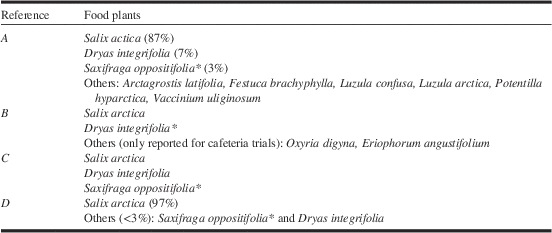
The diet spectrum of G. groenlandica beringiana was much broader than that of the nominal subspecies at High Arctic sites (Table 1). Our cafeteria trials showed that caterpillars readily accepted a variety of plants (Fig. 1), which was further supported by field observations. Although we cannot establish absolute ranks of species preference because that would have required testing each plant species against all others in the cafeteria trials, we can still detect broad patterns in the foraging choices of caterpillars in the experimental setting, with Salix arctica and Vaccinium vitis-idaea being the most consumed food plants of each trial, while other species, such as Saussurea viscida, were seldom eaten. In a similar cafeteria-type experiment on a High Arctic population of G. groenlandica only four plant species (out of 15 common tundra plants) were consumed to some extent (Kukal and Kevan Reference Kukal and Kevan1987). In their study, caterpillars were raised on a diet of Salix arctica, which could affect the results of their cafeteria trials; foraging choices of caterpillars were nevertheless supported also by field observations (Kukal and Kevan Reference Kukal and Kevan1987). At our study site, most caterpillars actively foraging in the field were using Vaccinium uliginosum Linnaeus (Ericaceae), the most abundant plant in the talus patches where most caterpillars were found. This may reflect an opportunistic use of the most abundant plants, linked more to their availability than to a strong host preference suggested for High Arctic populations (Kukal and Kevan Reference Kukal and Kevan1987; Mølgaard and Morewood Reference Mølgaard and Morewood1996). This opportunistic feeding behaviour has been suggested previously (Morewood and Lange Reference Morewood and Lange1997), with G. groenlandica caterpillars being able to accept a variety of food plants, but a consistent preference for Salix arctica has been repeatedly noted from field observations (Ferguson Reference Ferguson1978; Kukal and Dawson Reference Kukal and Dawson1989). However, differences in the results of cafeteria-type experiments and leaf consumption in the field might be expected because of the different accessibility of plants in the field when compared to the cafeterias (Pérez-Harguindeguy et al. Reference Pérez-Harguindeguy, Díaz, Vendramini, Cornelissen, Gurvich and Cabido2003). For example, Kukal and Kevan (Reference Kukal and Kevan1987) reported G. groenlandica caterpillars using the sedge Eriophorum angustifolium Honckeny (Cyperaceae) in cafeteria trials, while no larvae were seen eating this plant at their field site on Ellesmere Island, Nunavut, Canada. In any case, our results from cafeteria trials and field observations, even if not strictly comparable, consistently suggest a broader plant use by G. groenlandica beringiana than that reported for different studies on High Arctic populations (Fig. 1; Table 1).
Diet choices of Gynaephora groenlandica beringiana assessed (A) with feeding trials and (B) in field observations of foraging caterpillars (n=41). In (A) combinations of plants presented together in cafeterias are grouped; letters indicate significant differences within groups (P<0.05) according to the corresponding generalised linear mixed model results. In (B) asterisks indicate species where evidence of floral herbivory was recorded.

Diet of Gynaephora groenlandica at High Arctic sites on Ellesmere Island, Nunavut, Canada, as reported by (A) field observations of Morewood and Lange (Reference Morewood and Lange1997), (B) cafeteria trials in Kukal and Kevan (Reference Kukal and Kevan1987), (C) field observations in Kukal and Kevan (Reference Kukal and Kevan1987), and (D) field observations of Kukal and Dawson (Reference Kukal and Dawson1989).
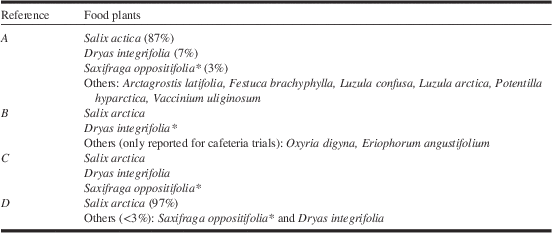
Asterisks indicate evidence of floral herbivory.
The use of a broad range of plant species by alpine populations might be related to the longer active period of caterpillars at our study site, and may reflect a broader availability of food plants. We recorded longer activity periods than those reported in the High Arctic, where caterpillars start building their hibernacula by late June (Morewood and Lange Reference Morewood and Lange1997). At our site, younger instars spun their hibernacula earlier in the season (end of June), while later instars remained active for longer (latest record of an active caterpillar was 8 August 2013). Similarly, in 2012 at the same site larvae were active on the tundra in mid-July (Barrio et al. Reference Barrio, Schmidt, Cannings and Hik2013b), despite monthly temperatures in summer 2012 being on average 2 °C colder than in 2013 (Barrio et al. Reference Barrio, Schmidt, Cannings and Hik2013b) and snow cover lasting longer. The extended active period of alpine caterpillars even in years with contrasting environmental conditions suggests that the length of the active period may reflect a latitudinal response to milder conditions and plant availability, rather to local weather conditions, with southern alpine populations being active for longer periods. Similar patterns have also been reported for G. rossii, with Arctic populations being active until mid-August (Morewood and Lange Reference Morewood and Lange1997) and alpine populations extending their activity period until mid-September (Schaefer and Castrovillo Reference Schaefer and Castrovillo1979). This longer active period has been suggested as the reason for the difference in diet preferences of the two moth species (Morewood and Lange Reference Morewood and Lange1997). Gynaephora rossii has a broader diet, feeding on a variety of plants, including sedges and ericaceous plants (Schaefer and Castrovillo Reference Schaefer and Castrovillo1979; MacLean and Jensen Reference MacLean and Jensen1985), probably as a result of the greater availability of different plant species during its longer active period.
Parasitoids may play a role in determining the extremely short duration of the active period of G. groenlandica in the High Arctic (Kukal and Kevan Reference Kukal and Kevan1987). Although we found a high number of parasitised G. rossii in the field, we did not find clear evidence of parasitism in G. groenlandica; none of the observed caterpillars displayed distinctive behaviours of parasitism by Ichneumonidae (Hymenoptera) (Kukal and Kevan Reference Kukal and Kevan1987), nor did we detect the presence of eggs of Tachinidae (Diptera) parasitoids (Morewood Reference Morewood1999). We also found no evidence of parasitoids in the larvae we reared indoors. To what extent differences in the parasitoid community between our alpine site and the High Arctic are due to latitudinal or climatic differences is unknown. The study of the parasitoid community at our site was outside the scope of the present study, but deserves further consideration (Roslin et al. Reference Roslin, Wirta, Hopkins, Hardwick and Várkonyi2013; Várkonyi and Roslin Reference Várkonyi and Roslin2013).
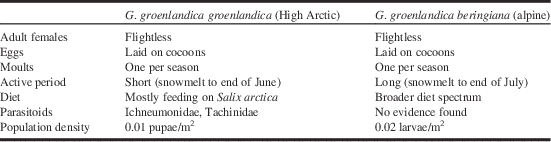
An extension of the activity period of G. groenlandica in summer, however, may not necessarily translate into a shorter life cycle in alpine populations and the potential for increased population numbers through shorter generation cycles (Bale et al. Reference Bale, Masters, Hodkinson, Awmack, Bezemer and Brown2002). Gynaephora groenlandica may not be able to moult more than once per season (Kukal and Kevan Reference Kukal and Kevan1987; Morewood Reference Morewood1999) even if conditions would allow. In contrast, G. rossii can moult several times per season, considerably shortening their life cycle in alpine sites relative to Arctic populations (Schaefer and Castrovillo Reference Schaefer and Castrovillo1979). Alpine and Arctic populations of G. groenlandica do not seem to differ as much in their life history as in G. rossii (Table 2; Schaefer and Castrovillo Reference Schaefer and Castrovillo1979) but, similarly, alpine populations have extended active periods and broader diets than those in the Arctic. A broader diet may imply that these alpine populations are not as tightly dependent on the synchrony of their host plants, and can readily use other plants when available. This may confer an advantage to alpine populations in the face of warming (Braschler and Hill Reference Braschler and Hill2007), where phenological mismatches are likely to occur (Høye and Forchhammer Reference Høye and Forchhammer2008). Other potential advantages of a longer active season, such as increased growth, remain uncertain at the population level because increased exposure to parasitoids seems to be more limiting for this species (Morewood Reference Morewood1999). Although the results presented here are descriptive of an alpine population and our conclusions are necessarily tentative, there appears to be great potential for further comparative studies of Arctic moths in contrasting environments. Future studies using matched comparison approaches will prove extremely useful as models for understanding adaptation to harsh and changing environments.
Comparison of population and life history characteristics of Gynaephora groenlandica groenlandica and G. groenlandica beringiana.
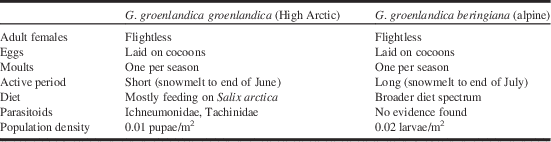
Population density estimates are for optimal habitat in Ellesmere Island, Nunavut, Canada (Kukal and Kevan Reference Kukal and Kevan1987) and southwestern Yukon, Canada (Barrio et al. Reference Barrio, Schmidt, Cannings and Hik2013b).
Acknowledgements
Funding was provided by the Natural Sciences and Engineering Research Council (Canada) and the Percy Sladen Memorial Fund. I.C.B. was supported by the Consejería de Educación, Ciencia y Cultura (JCCM, Spain) and the European Social Fund. The authors are very grateful to F. Hik for field assistance, D. Ertz and M. Charrier for providing a French abstract, and the Kluane First Nation for the opportunity to conduct research on their traditional lands.