INTRODUCTION
The snappers (Lutjanidae) are circumtropical fish, comprising 17 genera and 110 species (Allen, Reference Allen1985; Cervigón, Reference Cervigón1993; Froese & Pauly, Reference Froese and Pauly2013). The Indo-Pacific region is considered to be where snappers appeared, in the light of their high variability of genera, diversity of species and endemism (Druzhinin, Reference Druzhinin1970), although it is not known whether all Lutjanidae arose from a single Indo-Pacific lineage (Miller & Crib, Reference Miller and Cribb2007). Snappers play an important role in the ecology of reefs, mangrove swamps and seagrasses (e.g. Aiken, Reference Aiken1993; Appeldoorn & Meyers, Reference Appeldoorn and Meyers1993; Baisre, Reference Baisre2000; Claro et al., Reference Claro, Lindeman and Parenti2001; Teixeira et al., Reference Teixeira, Yalan and Ferreira2010); moreover, they are very important commercial fish in tropical and subtropical seas (Randall, Reference Randall1995; Valinassab et al., Reference Valinassab, Daryanabard, Dehghani and Pierce2006; Grandcourt et al., Reference Grandcourt, Hecht, Booth and Robinson2008). Some snappers have been introduced to new regions to enhance sport fisheries (Baltz, Reference Baltz1991), and in addition, there are reported cases of translocation of snappers, for example, from the Red Sea into the Mediterranean Sea (Vacchi et al., Reference Vacchi, Psomadakis, Repetto and Würtz2010). Since snappers are opportunistic feeders and have an aggressive feeding behaviour (e.g. Rooker, Reference Rooker1995; Grandcourt et al., Reference Grandcourt, Hecht, Booth and Robinson2008), they may oust and be a threat to native populations of fish and even oust them (Friedlander et al., Reference Friedlander, Parrish and DeFelice2002).
Off the African coasts, from Senegal to Angola (central eastern Atlantic), there occur five species of the genus Lutjanus (Allen, Reference Allen1985): L. dentatus (Duméril, 1858); L. agennes (Bleeker, 1863); L. endecacanthus (Bleeker, 1863); L. fulgens (Valenciennes, 1830); and L. goreensis (Valenciennes, 1830). Of these, L. goreensis have been reported around the Canary Islands (González & Santana, Reference González and Santana1986; Brito et al., Reference Brito, Falcón and Herrera2005), an archipelago close to the African coast.
MATERIALS AND METHODS
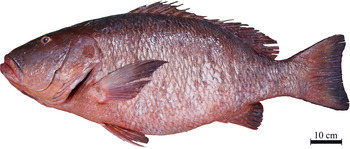
On 15 August 2013, one specimen of African brown snapper Lutjanus dentatus (Figure 1) was caught with a bottom trap at 100 m in a rocky bottom off the Agaete coast (28°05.33′N 15°49.56′W) (Gran Canaria Island, Canary Islands, north-eastern Atlantic Ocean). The individual was photographed and then kept frozen within a labelled plastic bag. Several days later, it was taxonomically identified by using the Food and Agriculture Organization of the United Nations key for the Eastern Central Atlantic (Allen, Reference Allen1985). Furthermore, a morphometric and meristic analysis was performed in accordance with the standard procedures for fish. Subsequently, the specimen was sent to and deposited at the Museum of Nature and Man at Tenerife (Tenerife, Canary Islands) with the code TFMCBM-VP/1944. This occurrence constitutes the first record of this species around the Canary Islands.
Non-native specimen, Lutjanus dentatus, from the Gulf of Guinea collected in the Canary Islands.

RESULTS AND DISCUSSION
The specimen measured 107.5 cm in total length (TL) and 91 cm in standard length (SL); it had a total weight (TW) of 23 kg. Thus, L. dentatus can be considered a large-sized predator, which can attain a maximum TL around 150 cm (Allen, Reference Allen, Daget, Gosse and Thys van den Audenaerde1986). The presence of large-sized demersal fish, such as Epinephelus itajara (Lichtenstein, 1822), Argyrosomus regius (Asso, 1801) or Cephalopholis taeniops (Valenciennes, 1828) off the West African coast has been described as occasional in the Canary Islands (Brito et al., Reference Brito, Falcón and Herrera2005, Reference Brito, Clemente and Herrera2011). However, these predators may have significant repercussions in ecosystems where they can establish themselves, because they often feed at higher trophic levels (Petchey et al., Reference Petchey, Beckerman, Riede and Warren2008) and thereby strongly affect the food webs (Côté et al., Reference Côté, Green and Hixon2013).
In the decade of the 1980s, the presence among the Canary Islands of fish such as L. goorensis from the African coast was associated with mass movements of water (González & Santana, Reference González and Santana1986). Brito et al. (Reference Brito, Falcón and Herrera2005) concluded that the increase in the population of tropical littoral fish fauna in the Canarian archipelago was mainly due to ocean warming, and more recently numerous studies have revealed that latitudinal shifts in certain assemblages can be associated with warming waters (e.g. Perry et al., Reference Perry, Low, Ellis and Reynolds2005; Machado & Barreiros, Reference Machado and Barreiros2006; Abecasis et al., Reference Abecasis, Bentes, Ribeiro, Machado, Oliveira, Veiga, Gonçalves and Erzini2008; Azurro et al., Reference Azurro, Moschella and Maynou2011: González-Wangüemert & Borrero-Pérez, Reference González-Wangüemert and Borrero-Pérez2012). However, Brito et al. (Reference Brito, Clemente and Herrera2011), in the light of repeated observations of specimens of C. taeniops inside oil platforms, emphasized that maritime transport between the African coast and the Canary Islands might serve as a channel for carrying new species, and especially for large-sized carnivorous fish.
The African brown snapper was distinguished from the other snappers inhabiting the West African coast by its tooth pattern and meristic data (Allen, Reference Allen1985); the vomerine teeth did not present extensions, as occurs in L. goreensis and L. fulgens. In addition, the meristic counts were: dorsal fin with 10 spines and 14 rays; anal fin with 3 spines and 8 rays; and pectoral fin with 17 rays. Eight well-formed gill rakers (excluding rudimentary ones) on the anterior gill arch, 1 on the upper limb and 7 on the lower limb were also noted. Finally, a total of 5 longitudinal scale rows above the lateral line and 10 scale rows on the cheek were counted. Lutjanus dentatus differs from L. agennes in the higher number (9 or 10) of scale rows on the cheek, and from L. endecanthus in the smaller number (4 or 5) of longitudinal scale rows above the lateral line, and in having a more pointed snout.
The body proportions of our present specimen are as follows: SL is 85% of TL; body depth is 37% of SL; pectoral ray length is 24% of SL; pelvic ray length is 17% of SL; head length (HL) is 32% of SL; head depth is 27% of SL; eye diameter is 10% of HL; interorbital width is 24% of HL; distance from upper lip to eye is 35% of HL; pre-orbital distance is 43% of HL; and pre-opercular distance is 40% of HL. In addition, the specimen presented a brownish colour dorsally, and ranged from brownish to pink on the lateral and ventral surfaces; the ventral zone of the head acquired an orange colour, and the posterior parts of the fins were dark. A recent study (Miller & Cribb, Reference Miller and Cribb2007) demonstrated that the morphology and external coloration of snappers were congruent with their phylogenetic evolution, and recognized several clades: ‘blue-lined’; ‘black spot’ complex; ‘yellow-lined’; and ‘red-lined’. In the light of all of its morphological and colour traits, it is very likely that L. dentatus is close to the ‘red-lined’ clade, characterized in that the adults live alone, exhibit territorial behaviour and inhabit deeper or dimly illuminated waters (e.g. Allen, Reference Allen1985; Appeldoorn & Meyers, Reference Appeldoorn and Meyers1993; Baisre, Reference Baisre2000; Teixeira et al., Reference Teixeira, Yalan and Ferreira2010). This also seems to be consistent with the depth (100 m) at which the present specimen was captured.
ACKNOWLEDGEMENTS
We thank Mrs Juana Ojeda García, secretary of Agaete Fishing Port, for providing the specimen. We also thank Dr Gerald R. Allen for his help in its identification. Thanks are expressed to the referees for comments and advice on the improvement of the manuscript. We also acknowledge Ron Price for her assistance in the language editing of this manuscript.
FINANCIAL SUPPORT
This research received no specific grant from any funding agency, commercial or not-for-profit sectors.