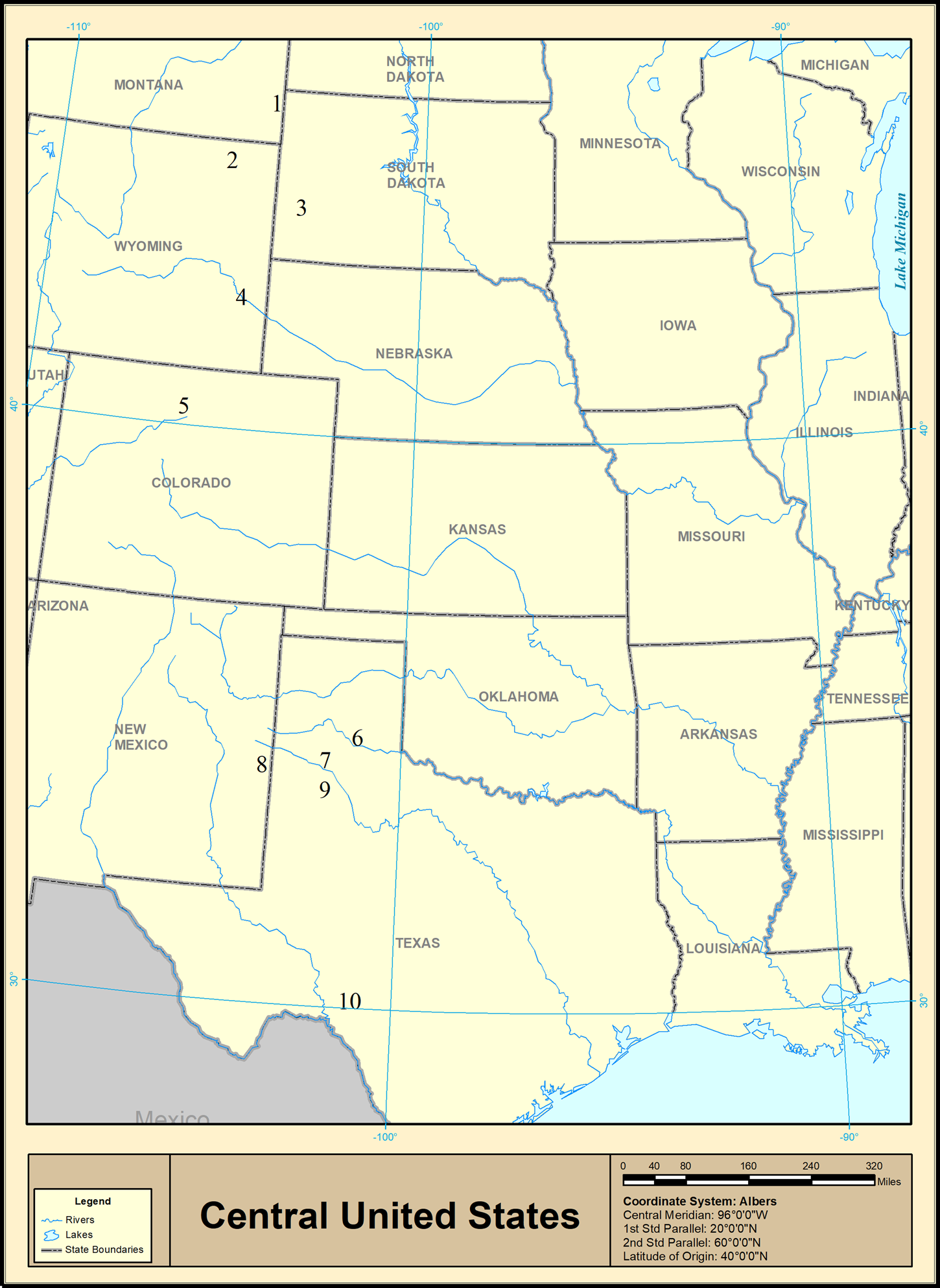
Goshen is a type of Paleoindian projectile point that is lanceolate, has parallel to slightly convex or concave sides and a concave base, and exhibits well-controlled and evenly spaced pressure-flake scars (Bradley and Frison Reference Bradley, Frison and Frison1996; Irwin-Williams et al. Reference Irwin-Williams, Irwin, Agogino and Vance Haynes1973). Goshen points have been recovered as surface finds across much of the Northern Plains, and they are also known from five well-documented sites (Figure 1): Hell Gap in Wyoming (Irwin Reference Irwin1967; Irwin-Williams et al. Reference Irwin-Williams, Irwin, Agogino and Vance Haynes1973; Larson et al. Reference Larson, Kornfeld and Frison2009), Mill Iron in Montana (Frison, ed. Reference Frison1996), Upper Twin Mountain in Colorado (Kornfeld and Frison Reference Kornfeld and Frison2000), Jim Pitts in South Dakota (Sellet et al. Reference Sellet, Donohue and Hill2009), and Dilts in Wyoming (LaBelle Reference LaBelle2007).
Location of sites mentioned in the text: (1) Mill Iron; (2) Carter/Kerr McGee and Dilts; (3) Jim Pitts; (4) Hell Gap; (5) Upper Twin Mountain; (6) Lake Theo; (7), Plainview; (8), Ted Williamson–Plainview, Milnesand, and Warnica-Wilson; (9) Lubbock Lake and Ryan's Site; (10) Bonfire Shelter.

The type specimen for Goshen was found at Hell Gap. As excavations were coming to a close in August 1966, the field crew found an unfluted lanceolate point and point fragments below the Folsom level (Irwin-Williams et al. Reference Irwin-Williams, Irwin, Agogino and Vance Haynes1973). The specimens resembled Plainview points from the Southern Plains, but there was a problem: received wisdom at the time was that Plainview postdated Folsom, which in turn postdated Clovis. Consequently, the excavators reasoned that the Hell Gap specimens could not be Plainview points. Their stratigraphic context suggested they were transitional between Clovis and Folsom, or perhaps that they were unfluted Clovis points (Frison Reference Frison1991). To circumvent this apparent problem, the excavators of Hell Gap proposed a new complex name—Goshen.
Several decades later, that small collection of Goshen specimens was supplemented by a larger excavated assemblage of points from Mill Iron, a camp area and bison-bone bed (Frison, ed. Reference Frison1996; Haynes Reference Haynes, Taylor, Long and Kra1992). There was a strong resemblance between the points from Mill Iron and Plainview points, but, as with Hell Gap, there was a chronological problem. Radiocarbon dates from Mill Iron overlapped not only with the then-known age of Folsom but also with that of Clovis—so much so that it was thought that perhaps Clovis and Folsom had developed out of Goshen, with Plainview evolving out of Goshen later than Clovis and Folsom and retaining many of the features its ancestor possessed, including a lack of fluting (Frison, ed. Reference Frison1996).
Another possibility was that Goshen points and Plainview points were actually the same typologically and that the early radiocarbon assays from Mill Iron did not date the human occupation of the site, perhaps due to contamination or the use of old wood by the inhabitants (Frison Reference Frison and Frison1996; Haynes and Hill Reference Haynes, Hill, Holliday, Johnson and Knudson2017). In line with this argument, Frison and colleagues (Reference Frison, Vance Haynes, Larson and Frison1996:215) proposed the type name Goshen-Plainview for the unfluted lanceolate points from Mill Iron, arguing that “until the true chronological position of Goshen as pre-Folsom on the Northern Plains and as post-Folsom on the Southern Plains is resolved, the two terms are needed. This can always be changed when new data demand a change.”
A number of attempts have been made to resolve Goshen chronology. Waters and Stafford (Reference Waters and Stafford2014) assayed XAD-purified collagen extracted from three bison bones from Mill Iron and arrived at a date range of 12,525–12,120 cal BP. Carlson and colleagues (Reference Carlson, Culleton, Kennett and Bement2016) added two additional bone-collagen dates for Mill Iron, both falling in the range indicated by the Waters and Stafford (Reference Waters and Stafford2014) assays. Dates on bison bone from a kill at Upper Twin Mountain produced a comparable age range (Kornfeld and Frison Reference Kornfeld and Frison2000). Those dates, in turn, are in line with charcoal-based dates from the Goshen component at Jim Pitts, which are slightly younger than the Goshen component at Upper Twin Mountain. Another date, derived from a bison-skull fragment from Dilts, overlaps with the age of Jim Pitts (LaBelle Reference LaBelle2007).
Based on their analysis of available dates from Goshen assemblages, Waters and Stafford (Reference Waters and Stafford2014) suggested that the calendrical span of Goshen was approximately 12,500–11,800 cal BP and that the tradition appeared sometime after the beginning of Folsom, around 12,700 cal BP, and continued into the post-Folsom period (ca. post-12,200 cal BP). Waters and Stafford (Reference Waters and Stafford2014) noted that the chronological overlap helps explain the stratigraphic position of Goshen below Folsom at Hell Gap and also at Carter/Kerr-McGee in northeastern Wyoming (Frison Reference Frison1984; Frison et al. Reference Frison, Vance Haynes, Larson and Frison1996).
Waters and Stafford (Reference Waters and Stafford2014:547) noted that “this new dating of the Goshen complex also seems to bring Goshen and the typologically similar Plainview points . . . into a similar time horizon; however, Plainview remains poorly dated.” This is correct; Plainview has been notoriously difficult to date. Based on samples from four sites in Texas—Bonfire Shelter, Lubbock Lake, Lake Theo, and Williamson-Plainview—Holliday, Johnson, and Miller (Reference Holliday, Johnson, Miller, Holliday, Johnson and Knudson2017) proposed that the minimum age range for Plainview is approximately 12,100–11,300 cal BP and that there is evidence of temporal overlap between Folsom and Plainview at Bonfire Shelter, similar to the situation at Hell Gap and Carter/Kerr-McGee with respect to Folsom and Goshen.
There consequently appears to be a north-south chronological gradient for Goshen and Plainview, with Goshen (12,500–11,800 cal BP) beginning earlier than Plainview (12,100–11,300 cal BP) and Plainview lasting longer than Goshen, with perhaps a 300-year overlap between the two. In terms of oldest and youngest dates, Mill Iron, in the north, has the oldest (12,515–12,250 cal BP) and Bonfire Shelter, in the south, the youngest (11,935–11,445 cal BP).Footnote 1 Jim Pitts, some 200 km south of Mill Iron, has a range of 11,955–11,770 cal BP (Waters and Stafford Reference Waters and Stafford2014), making it younger than Mill Iron and overlapping with the early half of the Bonfire Shelter date range.
This chronological gradient is interesting for reasons we discuss later, but that discussion hinges on the question of typological similarity: exactly how similar are Goshen and Plainview points? To address that question, we used geometric morphometric (GM) methods to compare the shapes of complete points from well-documented Goshen and Plainview sites. We used GM because it has proven to be markedly more effective at capturing morphological differences among specimens than traditional morphometric techniques (Zelditch et al. Reference Zelditch, Swiderski and David Sheets2012). We have used the methods in previous studies of Paleoindian point types (e.g., Buchanan and Collard Reference Buchanan and Collard2010; Buchanan et al. Reference Buchanan, Eren, Boulanger and O'Brien2015, Reference Buchanan, O'Brien, Collard, Holliday, Johnson and Knudson2017), and we followed similar protocol in the study reported here.
Materials and Methods
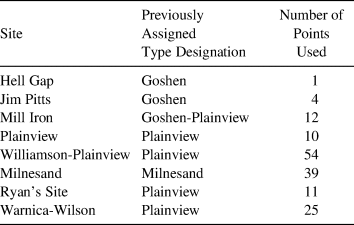
We focused on complete points from well-documented excavated assemblages that previous authors have assigned to the Goshen (including Goshen-Plainview) and Plainview types (Table 1). We analyzed 17 Goshen points from three sites: Hell Gap, Jim Pitts, and Mill Iron (Supplemental Table 1). Our Plainview sample comprised 139 points from five sites (see Buchanan et al. Reference Buchanan, Johnson, Strauss and Lewis2007, Reference Buchanan, O'Brien, Collard, Holliday, Johnson and Knudson2017). Two sites are in West Texas—Plainview (Holliday, Johnson, and Speer Reference Holliday, Johnson, Speer, Holliday, Johnson and Knudson2017; Sellards et al. Reference Sellards, Evans and Meade1947) and Ryan's Site (Hartwell Reference Hartwell1995); three in New Mexico—Milnesand (Hill Reference Hill2002; Sellards Reference Sellards1955; Warnica and Williamson Reference Warnica and Williamson1968), Williamson-Plainview (also known as Ted Williamson [Buchanan et al. Reference Buchanan, Litwinionek, Johnson, Holliday and Kent Hicks1996]), and Warnica-Wilson (also known as Bethel [Reutter Reference Reutter1996]; Figure 1). We did not include points from Dilts, Bonfire Shelter (Texas), or Upper Twin Mountain because it was logistically impossible for us to visit the collections.
Samples of Goshen and Plainview Points by Site.

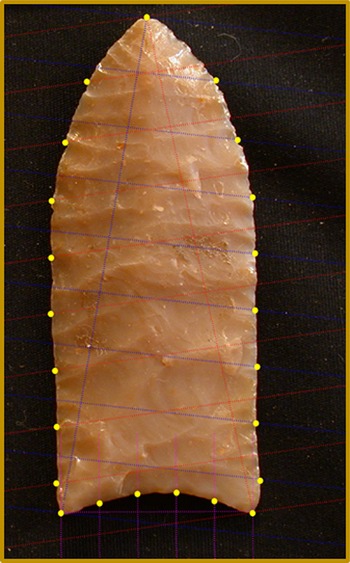
We imported photos of the points into digitizing software (Rohlf Reference Rohlf2017) and placed landmarks around the perimeters of the points. To make the analysis comparable to previous studies (e.g., Buchanan et al. Reference Buchanan, Eren, Boulanger and O'Brien2015, Reference Buchanan, O'Brien, Collard, Holliday, Johnson and Knudson2017), we used 23 landmarks to define the outline of each point. Three landmarks (one at the tip and two defining the basal edges) were deemed homologous, and 20 landmarks were placed along the blade and basal edges using equally spaced line segments superimposed on the images and placed between the tip and basal landmarks (Figure 2). Overall point shape incorporates many of the attributes that have been traditionally used to distinguish among types—including Goshen, Plainview, and related forms—such as basal-concavity depth and shape (Haynes and Hill Reference Haynes, Hill, Holliday, Johnson and Knudson2017; Hester Reference Hester, Holliday, Johnson and Knudson2017; Rondeau et al. Reference Rondeau, Smith, Dougherty, Holliday, Johnson and Knudson2017), blade shape (Buchanan and Collard Reference Buchanan and Collard2010), and base shape (O'Brien et al. Reference O'Brien, Boulanger, Buchanan, Collard, Lee Lyman and Darwent2014).
Digital image of a Plainview point with the locations of 23 landmarks marked along the point outline. The lines superimposed on the point image were produced using the MakeFan6 shareware program (www.philadb.com/an-behav/imp/ [Sheets Reference Sheets2014]).

Next, using MorphoJ version 1.06d software (Klingenberg Reference Klingenberg2011), we carried out a Generalized Procrustes Analysis (GPA) on the landmark configurations (Bookstein Reference Bookstein1991). For the GPA, landmark coordinates were aligned to remove nonshape sources (translation, scaling, and rotation) and to extract shape (Procrustes coordinates) information from the landmark configurations. MorphoJ uses the full Procrustes algorithm and projects the data to the tangent space (a linear space that locally approximates the shape space) by orthogonal projection (Klingenberg Reference Klingenberg2011).
We applied MorphoJ's principal components analysis (PCA) to the variance and covariance matrices to examine patterns of shape variation, and we used discriminant function analysis (DFA) to statistically examine the degree of separation between the two predefined groups, with “predefined” referring to how a point was identified in the original publications. We report both the Procrustes and Mahalanobis distances as well as the associated permutation tests of these distances. The former describes the total shape change from the consensus landmark configuration, and the latter is the distance between the types scaled by the within-group standard deviation in the respective direction. Klingenberg and Monteiro (Reference Klingenberg and Monteiro2005) determined that cases where the p-values for these tests using the two types of distances differ, it is primarily a consequence of the variation within groups—here, shape variation—going in different directions (anisotropy). Following the DFA, we used the cross-validated misclassification matrix to assess misclassification rates (Kovarovic et al. Reference Kovarovic, Aiello, Cardini and Lockwood2011). A high rate of misclassification corresponds to a limited ability to distinguish among the groups—in this case, point types.
Results
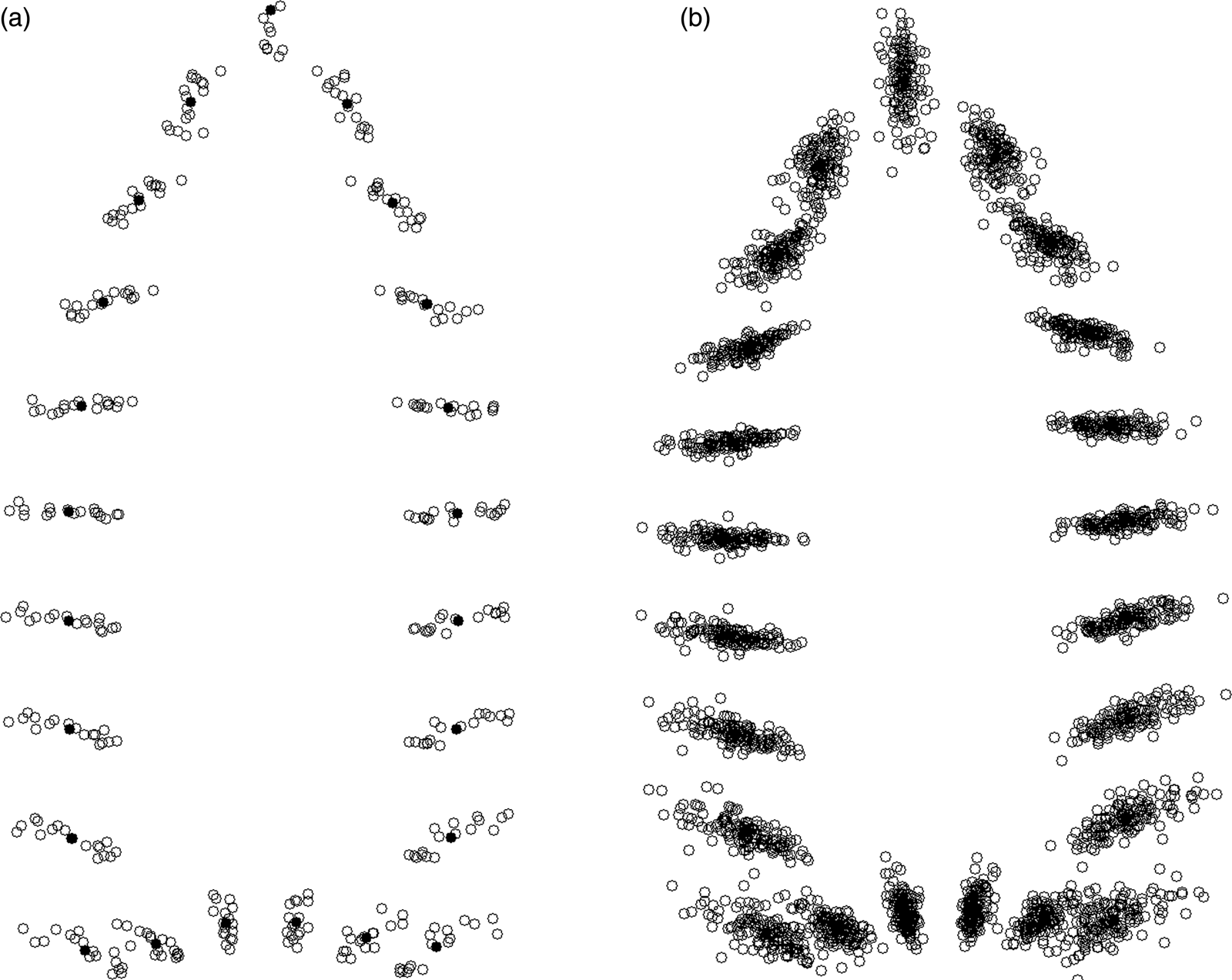
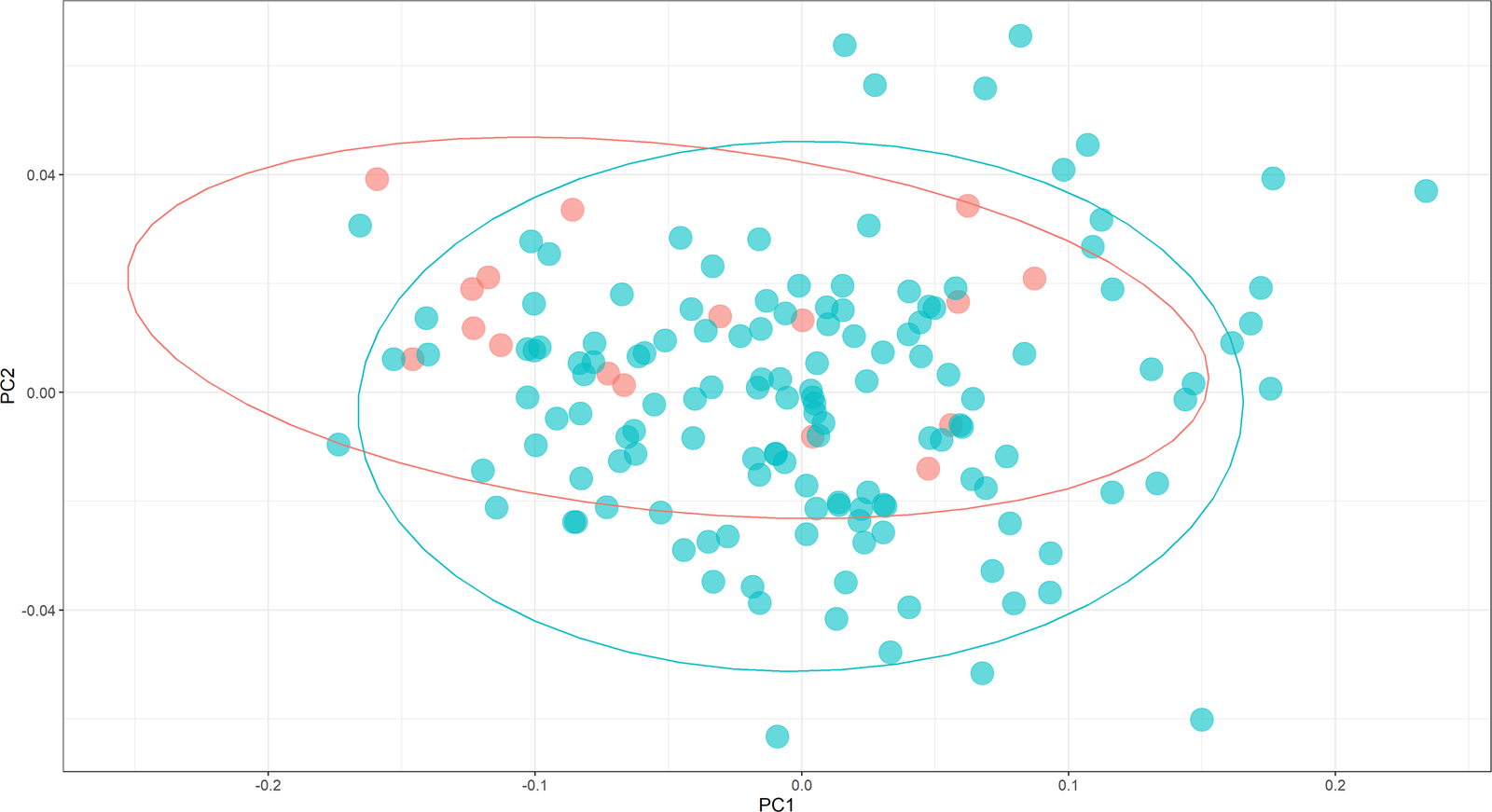
The landmark configurations shown in Figure 3, which are averages of the individual measurements (shown), demonstrate there is considerable overlap between the shapes of Goshen and Plainview points. Only two minor differences are discernible: the average Goshen point has a somewhat narrower blade than the average Plainview point, and the average Goshen point has a slightly more triangular basal concavity than the average Plainview point. These similarities and slight differences in shape were picked up in the PCA, which indicated that the first two components accounted for most of the variation (88%) in the dataset (Figure 4). Sixteen of the 17 Goshen points fell within the 95% confidence ellipse for Plainview on the first principal component, while the two groups of points overlapped completely on the second principal component. Therefore, the PCA indicates there is no difference between Goshen and Plainview points.
Average landmark configurations for (a) Goshen and (b) Plainview points. Open circles represent landmark locations for individual points and the closed black circles are the consensus configuration.

Bivariate plot of principal component scores for component 1 (x-axis), which accounts for 81.12% of the overall variation, and component 2 (y-axis), which accounts for 6.76% of the overall variation of Goshen (light red circles) and Plainview (turquoise circles) points. The 95% confidence ellipses encompass the Goshen and Plainview variability.

The DFA analyses were more ambiguous. The DFA based on Mahalanobis distances indicated that the distance between the Goshen and Plainview samples was not statistically significant (D = 2.34; permutation test p = 0.0749). In contrast, the Procrustes distance between the Goshen and Plainview points was statistically significant (Procrustes distance = 0.051; permutation p = 0.0148). The cross-validated classification matrix was consistent with the PCA and Mahalanobis distance–based DFA. It also indicated substantial overlap between the shapes of the Goshen and Plainview points. Goshen points were misclassified as Plainview points 41% of the time (seven misclassified out of 17), while Plainview points were misclassified as Goshen points 20% of the time (28 misclassified out of 139). The overall misclassification rate was 22%.
Discussion
Overall, results of the analyses indicate that the shapes of Goshen and Plainview points are very similar. There was considerable overlap in the distributions of the samples when the average shapes and the first two PCs were plotted (Figures 3 and 4); the Mahalanobis distance between the two samples was insignificant; and there was a high rate of misclassification in the cross-validation analysis. However, because the permutation test of the Procrustes distances returned a significant result, there remains some uncertainty about whether the two point types should be kept separate or merged.
One way to decide which option is more appropriate is to compare the Goshen versus Plainview Procrustes distance with Procrustes distances between other Paleoindian point types. Recently, Buchanan and colleagues (Reference Buchanan, Andrews, O'Brien and Eren2018) computed the distance between a sample of Clovis points and a sample of Folsom points using the same set of landmarks and geometric techniques as those employed here. Because Clovis and Folsom points have well-established shape and typological differences (Wormington Reference Wormington1957), the distance between them represents a useful yardstick for assessing the importance of the Goshen versus the Plainview Procrustes distance (0.051). The value reported by Buchanan and colleagues was 0.159 (permutation test p < 0.0001). Consequently, the distance separating their samples of Clovis and Folsom points is over three times larger than the distance separating our samples of Plainview and Goshen points.
The Goshen versus Plainview Procrustes distance can also be usefully compared to a distance that Buchanan and colleagues (Reference Buchanan, Andrews, O'Brien and Eren2017) obtained in a study in which they compared the shapes of Milnesand, Plainview, and Lubbock points. The shapes of Milnesand and Plainview points were so similar that the recommendation was made that they should be treated as a single type. The Procrustes distance that Buchanan and colleagues reported for their Milnesand versus Plainview comparison was 0.095, which is also considerably larger than the Goshen versus Plainview distance of 0.051.
Given these results, there appear to be grounds for viewing Goshen as typologically unimportant. This means that the results of each analysis reported here support the idea that Goshen and Plainview represent a single point type. Because the Plainview type was recognized before the Goshen type (Sellards et al. Reference Sellards, Evans and Meade1947), the type name “Plainview” has priority and the type name “Goshen” should be retired.
Haynes and Hill (Reference Haynes, Hill, Holliday, Johnson and Knudson2017), who used linear dimensions and ratios to compare Goshen points from Mill Iron to Plainview points from the Plainview type site, also suggested that the Goshen type name should be abandoned in favor of Plainview. Similarly, Bradley and Frison (Reference Frison and Frison1996:66) argued that whereas the Mill Iron points could be classified as Goshen, “they are basically the same, technologically and typologically, as Plainview.” Their only reservation was the apparent age difference between the two types, but as we explained earlier, that issue now seems to have been resolved.
Beyond the similar age and shape of Goshen and Plainview points, future analyses should address if similarities also exist in flaking patterns. Bradley (Reference Bradley, Kornfeld, Frison and Larson2010) noted differences in the amount of pressure flaking used on the Plainview type points and the Goshen points from Mill Iron, suggesting that the Mill Iron points exhibit more transmedial and comedial pressure flaking than do the points from the Plainview type site. Others, however, have suggested that Goshen points from Mill Iron lack regular pressure flaking (Sellet et al. Reference Sellet, Donohue and Hill2009). Future systematic work should clear up any confusion.
Sinking Goshen into Plainview allows us to move beyond typological issues and examine the nature and causes of the variation that exists among Plainview points, especially chronospatial variation. We indicated earlier that there appears to be a north-south, older-to-younger chronological gradient for what we are calling Plainview points—again, comprising points previously typed as Plainview, Goshen, Goshen-Plainview, and Milnesand—starting in the north with Mill Iron (12,515–12,250 cal BP), moving south to Jim Pitts (11,955–11,700 cal BP), and finally farther south to Bonfire Shelter (11,935–11,445 cal BP). Thus, the limited reliable radiocarbon evidence that is currently available (we exclude dates from the Plainview site because of their unreliability [Holliday, Johnson, and Speer Reference Holliday, Johnson, Speer, Holliday, Johnson and Knudson2017]) indicates that the Plainview tradition arose at or near Mill Iron on the Northern Plains during the waning centuries of the Folsom tradition and then spread south, reaching Jim Pitts by 11,955 cal BP and Bonfire Shelter by 11,935 cal BP.
This movement could have occurred through cultural diffusion (movement of ideas), demic expansion (movement of people), or both. Interestingly, the north-to-south movement has similarities with the situation with Folsom, which according to Collard and colleagues (Reference Collard, Buchanan, Hamilton and O'Brien2010) appeared first around 12,800 cal BP in the northern High Plains—perhaps around Hell Gap—and spread north and south from there (but see Jennings Reference Jennings2012). Collard and colleagues’ (Reference Collard, Buchanan, Hamilton and O'Brien2010) summed probability distributions of calibrated radiocarbon dates suggested that above 36° N latitude, Folsom technology could have spread through either demic expansion or cultural diffusion (or a combination of the two), but below 36° N it appears to have spread through the former, as there is a hiatus between Clovis and Folsom radiocarbon dates from the Southern Plains.
Distinguishing between demic expansion and cultural diffusion in the archaeological record is particularly difficult in cases where there is evidence of diffusion of a novel trait into a region that has evidence of a population already in place (Smith and Goebel Reference Smith and Goebel2018). The radiocarbon resolution for Plainview is not good enough to resolve the issue, but we suspect that demic expansion did not play a significant role in its dispersal. We say this because bison-hunting groups were already spread across the Northern and Southern Plains and, during at least a portion of the Folsom period, they were making unfluted points, termed Midland, alongside fluted points (Hofman Reference Hofman, Stanford and Day1992).
The spatiotemporal overlap in point types should not be surprising when the transition of types is understood within a social-learning framework (Eren et al. Reference Eren, Buchanan and O'Brien2015; O'Brien and Buchanan Reference O'Brien and Buchanan2017). Although point types are useful as time markers and as windows into technological traditions, we need to move away from the notion that people produced one form, then another, and so on in a unilinear evolutionary sequence (Holliday, Johnson, and Knudson Reference Holliday, Johnson, Knudson, Holliday, Johnson and Knudson2017). Rather, forms often overlapped in time—demonstrated by Plainview, Folsom, and Midland—as new innovations were adopted in certain regions as a result of selection and drift working on different portions of points (O'Brien Reference O'Brien2019; Smith et al. Reference Smith, Smallwood, DeWitt, Smallwood and Jennings2015). For example, in their phylogenetic analysis of Paleoindian points from the Southeast, Smallwood and colleagues (Reference Smallwood, Jennings, Pevny and Anderson2019) found evidence that point bases, blades, and end-thinning techniques did not evolve as a package. Instead, each had its own trajectory, which was subject, at least in part, to different evolutionary forces—a case of mosaic evolution. Similarly, our study of the modularity of Clovis and Folsom points from the Northern and Southern Plains (Buchanan et al. Reference Buchanan, Andrews, O'Brien and Eren2018) showed that Folsom bases and blades are less variable than those of Clovis, which suggests that point standardization increased during the Early Paleoindian period in western North America.
In conclusion, when it comes to projectile-point typology, we walk a fine line: too many types and we create confusion; too few and we compress variation that could help address chronological, cultural, and technological matters. This issue has a deep history in American archaeology (O'Brien and Lyman Reference O'Brien and Lyman1999). The decades-long discussion of the typological placement not only of Goshen and Plainview but of all Late Pleistocene unshouldered lanceolate points from the Northern and Southern Plains is a classic example of the dilemma. As we have shown here, geometric morphometrics offers a way forward.
Acknowledgments
We thank Laura Nightengale of the Texas Archeological Research Laboratory, Austin, for access to the Plainview assemblage as well as portions of the Milnesand and Lubbock Lake assemblages collected by E. H. Sellards. The late Ted Williamson and his son, Ted Williamson Jr., graciously permitted analysis of their personal collections of the Milnesand and Ted Williamson–Plainview sites, as did James Warnica with the Warnica-Wilson assemblage and his surface collection from Roosevelt County, New Mexico. We also thank Eileen Johnson of the Museum of Texas Tech University for access to the Ryan's Site collections. Finally, we thank Lynn Gamble and three anonymous reviewers for their suggestions on how to improve the manuscript. Our work was supported by the Canada Research Chairs Program (231256), the Canada Foundation for Innovation (36801), and the British Columbia Knowledge Development Fund (962-805808).
Data Availability Statement
The data used in this report are available in the Supplemental Materials.
Supplemental Materials
For supplemental material accompanying this paper, visit https://doi.org/10.1017/aaq.2019.89.
Supplemental Table 1. PC scores.
Supplemental Table 2. PC coefficients.
Supplemental Table 3. PCA eigenvalues.
Supplemental Table 4. Procrustes fit.
Supplemental Table 5. Goshen and Plainview point specimens in analyses.