INTRODUCTION
Language impairments are well recognized in Parkinson’s disease (PD), including deficits in sentence comprehension (Angwin, Chenery, Copland, Murdoch, & Silburn, Reference Angwin, Chenery, Copland, Murdoch and Silburn2006b; Colman, Koerts, Stowe, Leenders, & Bastiaanse, Reference Colman, Koerts, Stowe, Leenders and Bastiaanse2011; Ye et al., Reference Ye, Milenkova, Mohammadi, Kollewe, Schrader, Dengler and Munte2012), action naming (Bocanegra et al., Reference Bocanegra, Garcia, Pineda, Buritica, Villegas, Lopera and Ibanez2015; Cotelli et al., Reference Cotelli, Borroni, Manenti, Zanetti, Arevalo, Cappa and Padovani2007; Rodríguez-Ferreiro, Menendez, Ribacoba, & Cuetos, Reference Rodriguez-Ferreiro, Menendez, Ribacoba and Cuetos2009), and verb generation (Peran et al., Reference Peran, Rascol, Demonet, Celsis, Nespoulous, Dubois and Cardebat2003). Impairments to semantic processing have also been identified in PD (Bocanegra et al., Reference Bocanegra, Garcia, Pineda, Buritica, Villegas, Lopera and Ibanez2015; Lewis, Lapointe, Murdoch, & Chenery, Reference Lewis, Lapointe, Murdoch and Chenery1998; Portin, Laatu, Revonsuo, & Rinne, Reference Portin, Laatu, Revonsuo and Rinne2000), including deficits to semantic inhibition (Arnott et al., Reference Arnott, Chenery, Angwin, Murdoch, Silburn and Copland2010; Copland, Sefe, Ashley, Hudson, & Chenery, Reference Copland, Sefe, Ashley, Hudson and Chenery2009) and alterations to automatic or controlled semantic priming (Angwin, Chenery, Copland, Murdoch, & Silburn, Reference Angwin, Chenery, Copland, Murdoch and Silburn2005, Reference Angwin, Chenery, Copland, Murdoch and Silburn2007; Angwin et al., Reference Angwin, Arnott, Copland, Haire, Murdoch, Silburn and Chenery2009; Arnott, Chenery, Murdoch, & Silburn, Reference Arnott, Chenery, Murdoch and Silburn2001; Arnott et al., Reference Arnott, Copland, Chenery, Murdoch, Silburn and Angwin2011; Copland, Reference Copland2003; Grossman et al., Reference Grossman, Zurif, Lee, Prather, Kalmanson, Stern and Hurtig2002). Thus, developing a better understanding of the nature and extent of semantic impairments in PD is critical to understanding language function and cognitive decline in this population.
The results of behavioral studies do not provide direct insight into the neural mechanisms that underpin changes to semantic function. In contrast, the analysis of event-related potentials (ERPs) provides an opportunity to explore changes to neurophysiological function during cognitive-linguistic processing. The N400 is a well-recognized ERP component that is sensitive to aspects of both language processing and memory in healthy persons, with a smaller amplitude when words are more expected (Kutas & Federmeier, Reference Kutas and Federmeier2011). A late positive component, sometimes referred to as the P600, is also sensitive to various aspects of language processing. A P600 is often observed in studies of sentence processing, with a larger positivity in response to syntactic or agreement errors (Kotz & Friederici, Reference Kotz and Friederici2003; Van Petten & Luka, Reference Van Petten and Luka2012). A similar late component is evident in semantic priming, where it has been linked to various processes including automatic spreading activation (Hill, Strube, Roesch-Ely, & Weisbrod, Reference Hill, Strube, Roesch-Ely and Weisbrod2002) and post-lexical semantic matching (Smith, Chenery, Angwin, & Copland, Reference Smith, Chenery, Angwin and Copland2009). The P600 has also shown sensitivity to memory processes, and although it typically has a larger positivity for items recognized as old in recognition memory tasks (Van Petten & Luka, Reference Van Petten and Luka2012), in other tasks its amplitude is smaller for repeated words that are semantically predictable based on prior context (Olichney et al., Reference Olichney, Van Petten, Paller, Salmon, Iragui and Kutas2000; Van Petten, Kutas, Kluender, Mitchiner, & McIsaac, Reference Van Petten, Kutas, Kluender, Mitchiner and McIsaac1991).
To date, ERP studies of cognitive-linguistic processing in PD have been limited. Friederici, Kotz, Werheid, Hein, and Von Cramon (Reference Friederici, Kotz, Werheid, Hein and Von Cramon2003) used ERPs to examine sentence processing in PD. Participants listened to sentences that were either correct, or contained a semantic or syntactic violation. Control participants showed a P600 effect in response to the sentences with syntactic violations, but this effect was absent in PD, suggesting that controlled syntactic integration processes were impaired for these patients. In contrast, a comparable N400 effect was observed in PD patients and controls during the processing of the semantically incorrect sentences. This finding suggested that the semantic processing required to detect semantic anomalies during sentence processing were intact in PD. Such findings, however, do not speak to whether neurophysiological deficits may be evident during the performance of other semantic processing tasks in PD. Indeed, given that the N400 is a useful marker of semantic processing in other semantic paradigms such as semantic priming (Deacon, Hewitt, Yang, & Nagata, Reference Deacon, Hewitt, Yang and Nagata2000; Hill et al., Reference Hill, Strube, Roesch-Ely and Weisbrod2002; Smith et al., Reference Smith, Chenery, Angwin and Copland2009), the further investigation of the N400 in PD is warranted.
Kutas et al. (Reference Kutas, Iragui, Niu, D’Avanzo, Yang, Salmon and Olichney2013) used a semantic judgement task to investigate the N400 congruity effect in nondemented patients with PD. Spoken phrases that defined either an antonymic or categorical relationship were followed by a semantically congruent or incongruent visual target word. A larger peak amplitude for the N400 congruity effect was evident in PD patients relative to healthy controls for both the antonymic and categorical relationships, as well as a larger N400 mean amplitude in PD patients for the antonymic relationships. Kutas et al. suggested these results could be consistent with reduced inhibition of irrelevant semantic information, greater activation of the target or a larger reliance on external cues in PD.
Although other researchers have also investigated the N400 in PD, this has been done primarily within the context of recognition memory for words or other stimuli. Minamoto, Tachibana, Sugita, and Okita (Reference Minamoto, Tachibana, Sugita and Okita2001) asked participants to listen to words and decide whether each stimulus was the first (new) or a repeated (old) presentation of the word, with repeated items coming after a lag of 0, 1, or 6 items. The N400 effect for new words was attenuated in young healthy adults at each lag. In contrast, however, healthy older adults and PD patients only showed an attenuation of the N400 at lags of 0 and 1 item. The findings suggested a common impairment to delayed recognition memory in both older adults and PD. Minamoto et al. also noted a smaller N400 amplitude in response to the new words in PD patients compared to the older adults, which they suggested may reflect impaired context integration processes in PD. In a similar paradigm testing recognition memory for unfamiliar faces, Kida, Tachibana, Takeda, Yoshikawa, and Okita (Reference Kida, Tachibana, Takeda, Yoshikawa and Okita2007) found no evidence for an attenuation of the N400 for repeated faces at lags of 0, 1, and 3 items in PD, suggesting that PD patients failed to generate a sufficient memory representation upon the first presentation of faces during task performance.
Rather than a direct test of recognition memory, Tachibana, Miyata, Takeda, Sugita, and Okita (Reference Tachibana, Miyata, Takeda, Sugita and Okita1999) assessed memory indirectly in PD by using a repetition priming paradigm. Specifically, participants heard spoken word or nonword stimuli and were simply required to press a button in response to the nonword stimuli. Word stimuli were repeated after an interval of either 0 or 5 items, or after a list of items (i.e., lag of between 11–77 items). Overall, a smaller N400 mean amplitude was evident in PD relative to controls, which was attributed to a potential disturbance in lexical processing in PD. Tachibana et al. also found that, while the amplitude of the N400 was attenuated at each lag for control participants, the N400 was only attenuated in the PD group at a lag of 0 items, suggesting that implicit memory may be disturbed in PD. Taken together, the results of research to date suggest that the N400, as well as later occurring components such as the P600, may be sensitive to cognitive and/or linguistic processing alterations in PD.
Importantly, research has indicated that both the N400 and P600 are potentially viable markers and predictors of cognitive decline in other populations. Olichney et al. (Reference Olichney, Taylor, Gatherwright, Salmon, Bressler, Kutas and Iragui-Madoz2008) used a semantic judgement task that required participants to listen to category statements and then decide whether a visually presented word was a member of that category. The stimuli were also repeated after a lag of 1 to 14 trials, allowing the researchers to examine not only the standard N400 congruity effect associated with processing target words that were incongruous with the preceding category, but also the impact of stimulus repetition on both the N400 and P600 components.
Using this paradigm, Olichney et al. (Reference Olichney, Taylor, Gatherwright, Salmon, Bressler, Kutas and Iragui-Madoz2008) explored semantic processing and memory related impairments in people with amnestic mild cognitive impairment (MCI), tracking these participants annually to identify those who converted to dementia within 3 years of baseline assessment. Olichney et al. found a disruption to the N400 congruity effect in the MCI converter group, but not for the MCI stable group. They also observed abnormalities in the ERP repetition effects for the MCI converters. Specifically, the N400 repetition effect, defined as a smaller N400 amplitude for repeated incongruous target words, was present in the MCI stable group but not for the MCI converter group.
The P600 repetition effect, defined as a smaller P600 amplitude for repeated congruous target words, was also present in the MCI stable group but absent in MCI converters. Olichney et al.’s research indicated that people with MCI who demonstrated abnormalities in the N400 or P600 repetition effect have an increased risk of conversion to dementia. In similar studies, there has also been evidence for reduced N400 and P600 repetition effects in people with mild Alzheimer’s disease (AD) (Olichney et al., Reference Olichney, Iragui, Salmon, Riggins, Morris and Kutas2006) and reduced P600 repetition effects in people with preclinical AD (Olichney et al., Reference Olichney, Pak, Salmon, Yang, Gahagan, Nowacki and Iragui-Madoz2013). Notably, P600 repetition effects have been observed to correlate with measures of verbal learning and memory (Olichney et al., Reference Olichney, Morris, Ochoa, Salmon, Thal, Kutas and Iragui2002, Reference Olichney, Taylor, Gatherwright, Salmon, Bressler, Kutas and Iragui-Madoz2008). These findings underscore the potential usefulness of such ERPs as both an index of cognitive decline and as a marker of future cognitive deterioration.
The present study aims to investigate alterations to semantic processing in a group of PD patients without dementia. Similar to Olichney et al. (Reference Olichney, Taylor, Gatherwright, Salmon, Bressler, Kutas and Iragui-Madoz2008), a semantic judgement task will be used to explore the N400 and P600 components. The investigation of N400 congruity and repetition effects will offer insight into the underlying neurophysiological nature of semantic processing impairments in PD. Furthermore, the analysis of P600 repetition effects will provide additional insight into the nature of memory-related impairments in this population. Given the high prevalence of dementia in PD (Aarsland, Andersen, Larsen, Lolk & Kragh-Sorensen, Reference Aarsland, Andersen, Larsen, Lolk and Kragh-Sorensen2003), the present study also provides preliminary data against which future studies in PD patients with dementia can be compared to identify possible markers of cognitive decline. Based on previous findings of semantic processing impairments and delayed semantic activation in PD, it is hypothesized that semantic processing impairments in PD will manifest as altered N400 congruity or repetition effects or a slower N400 latency relative to controls. It is also hypothesized that the P600 repetition effects may be reduced in PD.
METHODS
Participants
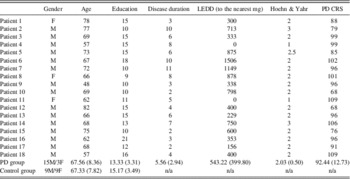
Eighteen people with PD (15 male) who were diagnosed according to the UK Brain Bank criteria (Hughes, Daniel, Kilford, & Lees, Reference Hughes, Daniel, Kilford and Lees1992) and had no diagnosis of dementia participated in the study. Eighteen healthy adults (9 male) also participated. There was no significant difference between the groups in age or education. The demographic features of the individual PD patients and the means for each group, together with the levodopa equivalent daily dosage (Tomlinson et al., Reference Tomlinson, Stowe, Patel, Rick, Gray and Clarke2010) and other clinical features of the PD patients are presented in Table 1. All PD participants had completed the Parkinson’s Disease Cognitive Rating Scale (PDCRS) (Pagonabarraga et al., Reference Pagonabarraga, Kulisevsky, Llebaria, Garcia-Sanchez, Pascual-Sedano and Gironell2008) before the current study (within an average of 6.89 months).
Participant demographics and clinical features

Note. Standard deviations are presented in brackets.
PD CRS=Parkinson’s disease Cognitive Rating Scale; LEDD=levodopa equivalent daily dosage.
A cutoff score of ≤64 on the PDCRS has been identified as having high sensitivity and specificity for screening of Parkinson’s disease dementia (Kulisevky & Pagonabarraga, Reference Kulisevky and Pagonabarraga2009), and all participants in the current study scored above this cut-off. All participants reported as right-handed, and had no history of any other neurological condition or surgery, drug or alcohol abuse, and were not taking any anti-depressive medications. This project was approved by the human research ethics committee of the University of Queensland. Written informed consent was obtained from all participants before their participation.
Cognitive Testing
All participants completed the Hopkins Verbal Learning Test (HVLT; Brandt & Benedict, Reference Brandt and Benedict2001) to assess verbal learning and memory, as well as semantic (animal) and letter (FAS) fluency to assess lexical-semantic processing. The semantic and letter fluency data was unavailable for one control participant.
ERP Testing: Semantic Judgement Task
Stimuli
Stimuli consisted of 72 semantically congruent word pairs and 72 semantically incongruent word pairs. The congruent word pairs (e.g., ship-boat, tiger-lion) were from the same category based on the Battig and Montague (Reference Batig and Montague1969) category norms, whereas the incongruent word pairs (e.g., cottage-belt, chisel-pig) were from different categories. Furthermore, the congruent word pairs were also associated based on the University of South Florida Free Association Norms (Nelson, McEvoy, & Schreiber, Reference Nelson, McEvoy and Schreiber2004), whereas the incongruent word pairs were not associated. The CELEX written frequency (Baayen, Piepenbrock, & Gulikers, Reference Baayen, Piepenbrock and Gulikers1995) was obtained for all stimuli using N-watch software (Davis, Reference Davis2005), and analyses confirmed that the frequency and letter length of congruent and incongruent stimuli were not significantly different.
Half of the congruent and incongruent word pairs were presented twice during the experiment, with a lag of 0–2 intervening items between the first and second presentation. Hence, the final experimental list consisted of a total of 214 word pairs, with a pseudorandomized order of presentation held constant for each participant. All stimuli were presented on a PC using E-prime 2.0 experimental software (Psychology Software Tools, Pittsburgh, PA), which measured participant’s responses via a PST serial response box. The experimental events from E-prime were sent to Netstation and were synchronized with the electroencephalogram (EEG) data via a single clock timing method.
Procedure
A semantic judgment task was used. Participants were informed that two words would be presented consecutively in the middle of the computer screen. They were asked to judge whether the second word was related to the first word by pressing the “Yes” button if it was related and pressing the “No” button if it was unrelated. Experimental stimuli were presented to participants via four blocks of trials, with a short rest break provided following the completion of each block. Before completing the experimental task, participants first completed a short practice task to familiarize them with the experimental procedure.
All stimuli were written in lower case letters of 18-point Arial font, and presented in the center of the computer screen. The sequence of events for each trial was as follows: a fixation point “+” was presented for 500 ms followed by a blank screen for 200 ms; the prime word was presented in the center of the screen for 500 ms followed by a blank screen for 1000 ms; finally, the target word was presented in the center of the screen until the participant either gave a response, or until 3000 ms had passed with no response. The next trial was initiated automatically after a delay of 1500 ms.
ERP Recording and Analysis
A 128 channel high-density EEG system (Electrical Geodesics, Inc.) was used to record EEG data with a sampling rate of 500 Hz. Electrode impedance was kept below 50 kΩ, which is acceptable with the use of high impedance amplifiers (Ferree, Luu, Russell, & Tucker, Reference Ferree, Luu, Russell and Tucker2001). Netstation 4.5.1 (Electrical Geodesics, Inc.) was used for offline processing of the ERP data. The data were digitally filtered from 0.1–30 Hz and then segmented into 1100-ms epochs that began 100 ms before the onset of the target word.
Eye movements and blinks were processed using an ocular artefact reduction procedure (Gratton, Coles, & Donchin, Reference Gratton, Coles and Donchin1983) and then any trials that subsequently still contained ocular artefacts or that consisted of more than 20% bad channels (defined as reaching amplitudes greater than 200 µV) were excluded from analysis. The data was re-referenced using the average of all electrodes and then baseline corrected to the 100 ms pre-target interval.
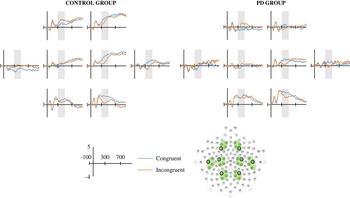
Eight clusters of electrodes (four clusters within each hemisphere; frontal, central, posterior, and temporal) were selected for analysis (Fig. 1) to provide a well distributed sample of recording sites for comparison between PD and controls. A 300- to 500-ms time window was selected for analysis of the N400, whereas a 500- to 700-ms time window was selected for analysis of the P600. Repeated measures analysis of variance (ANOVA) statistics were used for analysis, with the Greenhouse-Geisser correction used whenever evaluating effects with more than one degree of freedom in the numerator (corrected p value reported together with uncorrected degrees of freedom). Significant effects of hemisphere and electrode cluster are only reported in the analyses when they include interactions with congruity for the N400 congruity analyses, or presentation (i.e., first or second presentation) for the N400/P600 repetition effect analyses.
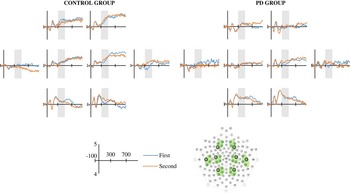
N400 congruity effect. Grand averaged ERPs for the congruent and incongruent condition (first presentation only) for each group. One representative electrode from each electrode cluster is depicted (see black circles in electrode montage), with the N400 time window (300–500 ms) shaded in each waveform.

RESULTS
The behavioral responses for one block of trials in the ERP semantic judgement task were not recorded for one PD participant. Both the behavioral and the ERP data corresponding to that block of items was subsequently excluded from analysis for that participant.
Behavioral data
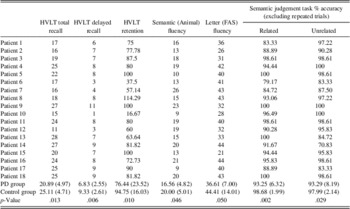
Table 2 presents the results of the HVLT and verbal fluency tasks, together with the behavioral results of the ERP semantic judgement task. The PD group performed more poorly than the control group across all measures (Table 2), with the exception of phonemic verbal fluency which was just outside significance (p=.05). The mean accuracy on the semantic judgement task exceeded 90% for both groups.
Behavioural test score data for individual PD participants and each group

Note. Group comparisons conducted using independent samples t tests. Standard deviations are presented in brackets. Semantic and letter fluency for one control participant was unavailable.
HVLT=Hopkins Verbal Learning Test.
ERP Data
All trials involving an incorrect response to the judgement task were removed before ERP analysis for each participant, which resulted in the removal of 1.44% of the control group’s data and 6.18% of the PD group’s data. The removal of ERP trials contaminated by artefacts resulted in the additional exclusion of 6.33% of the control group’s data and 6.48% of the PD group’s data from analysis. Overall, for the analysis of the semantic congruity effect, there was an average of 67.17 congruent trials and 66.56 incongruent trials available for the control group, and an average of 62 congruent and 62.56 incongruent trials for the PD group. For the analysis of the subset of items repeated during the experiment, there was an average of more than 30 trials available for the analysis of each condition in both the control group (new congruent 33.33, old congruent 32.89, new incongruent 33.33, old incongruent 33.39) and the PD group (new congruent 30.67, old congruent 32, new incongruent 31.28, old incongruent 30.89).
N400 Congruity Effect
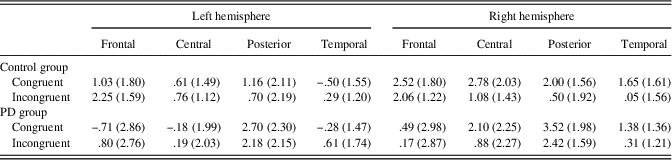
A repeated-measures ANOVA was used to analyze the mean amplitude of congruent and incongruent trials (excluding the second presentation of the repeated items), using group (PD, Control), congruity (congruent, incongruent), hemisphere (left, right), and electrode cluster (four levels) as the independent variables. The analysis revealed a main effect of congruity (F(1,34)=6.78; p=.014; ηp 2=.166) and interaction effects of congruity × hemisphere (F(1,34)=103.04; p<.001; ηp 2=.752) and congruity×cluster (F(3,102) =16.13; p<.001; ηp 2=.322). A three-way interaction of congruity × hemisphere × cluster (F(3,102)=13.76; p<.001; ηp 2=.288) was also significant, indicative of a robust N400 effect for both groups within the right hemisphere which was reversed in the frontal and temporal areas of the left hemisphere (Fig. 1 and Table 3).
Mean amplitude across electrode clusters for the N400 congruity effect

Note. Standard deviations are presented in brackets.
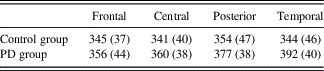
The onset latency of the N400 component in the right hemisphere from 300–500 ms was subsequently estimated by calculating a difference wave between the incongruent and congruent condition and identifying the latency at which the difference wave reached 50% of its peak amplitude. This latency was entered into a repeated measures ANOVA with group and electrode cluster as independent variables. The analysis revealed a significant main effect of group (F(1,34)=6.68; p=.014; ηp 2=.164), while effects of cluster and group × cluster were not significant. The effect of group was indicative of a delayed N400 onset latency in the PD group relative to the control group (Table 4).
Onset latency for the N400 congruity effect (incongruent minus congruent) in the right hemisphere

Note. Standard deviations are presented in brackets.
N400 Repetition Effect
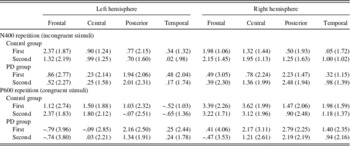
The subset of incongruent items that were presented twice during the experiment were analyzed to explore the impact of repetition on the mean amplitude of the N400 effect. A repeated-measures ANOVA was used with group (PD, Control), presentation (first, second), hemisphere (left, right), and electrode cluster (four levels) as the independent variables. The analysis revealed a significant interaction effect of presentation×hemisphere (F(1,34)=14.12; p=.001; ηp 2=.293), indicating that for both groups the N400 effect was attenuated upon repeated presentation within the right hemisphere (Fig. 2 and Table 5). A presentation × cluster interaction was also evident (F(3,102)=3.45; p=.037; ηp 2=.092), indicating that overall, N400 amplitudes were more positive upon first presentation relative to second presentation over the frontal electrodes (Table 5).
N400 repetition effect. Grand averaged ERPs for the incongruent condition (first and second presentation) for each group. One representative electrode from each electrode cluster is depicted (see black circles in electrode montage), with the N400 time window (300–500 ms) shaded in each waveform.

Mean amplitude of the N400 and P600 across electrode clusters for the first and second (repeat) presentation of stimuli

Note. Standard deviations are presented in brackets.
P600 Repetition Effect
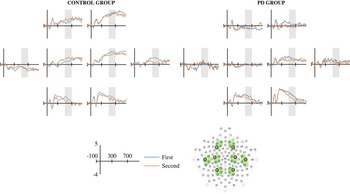
The subset of congruent items presented twice during the experiment were analyzed to explore the impact of repetition on the mean amplitude of the P600 effect within the 500- to 700-ms time window. A repeated-measures ANOVA was used with group (PD, Control), presentation (first, second), hemisphere (left, right), and electrode cluster (4 levels) as the independent variables. The analysis revealed a presentation × hemisphere (F(1,34)=10.18; p=.003; ηp 2=.230) interaction, indicating that both groups showed an attenuation of the P600 effect with repetition of stimuli that occurred predominantly over the right hemisphere (Fig. 3 and Table 5). A presentation × hemisphere × cluster interaction (F(3,102)=9.44; p<.001; ηp 2=.217) was also evident, indicative of the reversal of the P600 repetition effect in the central and frontal electrodes of the left hemisphere.
P600 repetition effect. Grand averaged ERPs for the congruent condition (first and second presentation) for each group. One representative electrode from each cluster is depicted (see black circles in electrode montage), with the P600 time window (500–700 ms) shaded in each waveform.

Correlations
Additional Pearson’s r correlational statistics were used to determine whether the mean amplitude and onset latency of the N400 congruity effect and the mean amplitude of the N400/P600 repetition effects in the PD group were impacted by age, medication (levodopa equivalent daily dosage), disease duration, or neuropsychological performance on the PD-CRS, HVLT (total recall, delayed recall, and retention), or verbal fluency tests (semantic and letter fluency). The N400 congruity effect was calculated based on difference waves between the incongruent and congruent condition, and the repetition effects were calculated based on difference waves between the first and second presentation of incongruent (N400) and congruent (P600) stimuli. These correlational analyses were conducted on the data for each cluster within the right hemisphere, using a Bonferroni correction for multiple comparisons such that significance was defined as p<.002. The analyses revealed no significant correlations.
DISCUSSION
This study used ERPs to explore semantic processing in PD. It was hypothesized that the PD group would display an aberrant N400 congruity effect and aberrant N400/P600 repetition effects relative to controls. The hypotheses were partially supported, with evidence of a delayed onset latency for the N400 congruity effect. However, both groups demonstrated similar N400 and P600 repetition effects.
Analysis of the results revealed a prominent N400 effect in the right hemisphere for incongruent word pairs, and the mean amplitude of this effect was similar for both groups. This result is consistent with previous reports of an intact N400 during sentence processing in PD (Friederici et al., Reference Friederici, Kotz, Werheid, Hein and Von Cramon2003), and confirms that such findings extend to single word processing. Although Kutas et al. (Reference Kutas, Iragui, Niu, D’Avanzo, Yang, Salmon and Olichney2013) found an increased N400 congruity effect in PD, their measures of mean amplitude only demonstrated this increase for the antonymic relationships. In contrast, the mean amplitude of the N400 congruity effect for categorical relationships was similar for both PD and controls. These findings highlight the need for further ERP investigations of semantic processing in PD using a wide range of semantic manipulations.
While the N400 results of this study initially suggest that lexical-semantic processing is not disrupted in PD, further analysis of the data indicated that the onset latency of this N400 congruity effect was delayed in the PD group relative to the control group. This result is consistent with findings of delayed lexical-semantic activation during semantic priming in some patients with PD (Angwin et al., Reference Angwin, Chenery, Copland, Murdoch and Silburn2005; Arnott et al., Reference Arnott, Chenery, Murdoch and Silburn2001; Grossman et al., Reference Grossman, Zurif, Lee, Prather, Kalmanson, Stern and Hurtig2002). Also worthy of note, Kotz, Frisch, Von Cramon, and Friederici (Reference Kotz, Frisch, Von Cramon and Friederici2003) found that patients with a basal ganglia lesion demonstrated an N400-like effect in response to verb-argument structure violations in a sentence processing task, but that this N400 effect was extended in duration relative to controls. Kotz et al. suggested that such results may reflect a slowed time course of lexical-semantic processing following unilateral basal ganglia damage. The results of the present study extend Kotz et al.’s findings to demonstrate that aberrations in the timing of the N400 also occur in PD.
The results of the present study also have implications for other aspects of language processing in PD. Based on P600 deficits in PD during sentence processing, Friederici et al. (Reference Friederici, Kotz, Werheid, Hein and Von Cramon2003) suggested that a disruption to late integrational processes may be responsible for deficits to sentence comprehension in PD. Similarly, slowed lexical-semantic activation as suggested by the delayed N400 in the current study could also contribute to difficulties with sentence comprehension. This notion is consistent with behavioral findings of slower semantic priming in PD patients with poor comprehension of complex sentences (Angwin et al., Reference Angwin, Chenery, Copland, Murdoch and Silburn2007; Grossman et al., Reference Grossman, Zurif, Lee, Prather, Kalmanson, Stern and Hurtig2002).
The delayed N400 may also be consistent with other deficits in PD. Shao, Janse, Visser, and Meyer (Reference Shao, Janse, Visser and Meyer2014) showed that lexical access speed may have a stronger impact on semantic than phonemic fluency performance in older adults. Thus, delays to lexical access in PD may contribute to semantic verbal fluency impairments that are often observed in this population (Henry & Crawford, Reference Henry and Crawford2004), including in the present study which showed poorer semantic verbal fluency in the PD group relative to the controls. However these proposed links between delayed N400 and behavioral measures of language processing in PD must be considered speculative at this point, and should therefore be interpreted with caution.
It has been suggested that delayed lexical-semantic activation may be influenced by the magnitude of dopamine depletion and subsequent frontal-striatal dysfunction for individual patients (Grossman et al., Reference Grossman, Zurif, Lee, Prather, Kalmanson, Stern and Hurtig2002). Semantic priming research has suggested that longer delays to semantic activation may be evident in patients tested when off levodopa medication (Angwin et al., Reference Angwin, Chenery, Copland, Murdoch and Silburn2007) or that semantic priming may be more sensitive to disruption in patients off medication, possibly due to weaker activation of the prime word (Angwin, Chenery, Copland, Murdoch, & Silbern, Reference Angwin, Chenery, Copland, Murdoch and Silburn2006a; Angwin et al., Reference Angwin, Arnott, Copland, Haire, Murdoch, Silburn and Chenery2009; Arnott et al., Reference Arnott, Copland, Chenery, Murdoch, Silburn and Angwin2011). It may, therefore, be expected that testing PD patients while off their levodopa medication may result in further delays to the onset latency of the N400 congruity effect, or that the mean amplitude of the N400 may be reduced. Further research that examines the N400 in PD patients on versus off levodopa medication will be necessary to further explore the impact of dopamine depletion on the N400.
In addition to the presence of the N400 congruity effect, an N400 repetition effect was evident for both groups in the present study, suggesting that item repetition facilitated semantic processing for both controls and PD patients. Accordingly, the result is consistent with the notion that lexical-semantic processing is generally intact in PD, albeit with a slower time course as evidenced by the delayed latency of the congruity effect. Despite Minamoto et al.’s (Reference Minamoto, Tachibana, Sugita and Okita2001) use of a different paradigm involving recognition memory for single words, they also observed similar N400 word repetition effects in PD and controls at short lags of 0 and 1 item. In contrast to the present study, however, Minamoto et al. (Reference Minamoto, Tachibana, Sugita and Okita2001) and Tachibana et al. (Reference Tachibana, Miyata, Takeda, Sugita and Okita1999) observed a smaller amplitude of the N400 in PD relative to controls, whereas no such difference in amplitude was evident in the present study. Task differences in the present study such as the use of a paired-word semantic judgement paradigm with written stimuli potentially underpin these differential findings.
Turning to the P600 repetition effect, both groups in the present study demonstrated a P600 repetition effect for the congruent stimuli. Given previous findings that the P600 repetition effect correlates with measures of verbal learning (Olichney et al., Reference Olichney, Morris, Ochoa, Salmon, Thal, Kutas and Iragui2002, Reference Olichney, Taylor, Gatherwright, Salmon, Bressler, Kutas and Iragui-Madoz2008), the presence of a P600 repetition effect in the PD group appears surprising in light of their poorer performance on all measures of the HVLT relative to controls. Furthermore, no correlations between the P600 repetition effect and the HVLT were observed. Certain methodological differences in the current study may have contributed to this finding. For instance, some items in Olichney et al.’s (Reference Olichney, Morris, Ochoa, Salmon, Thal, Kutas and Iragui2002) research were repeated with short lags of 0 to 3 trials, such that there was a delay of approximately 10 to 40 seconds between repeated presentations. In contrast, although stimuli in the present study were repeated using a similar short lag of only 0 to 2 trials, the task design meant that the delay between repeated trials was closer to approximately 5 to 15 s. This short delay may not have been sufficiently sensitive to memory related changes in PD, so the use of longer delays should be considered for future studies.
Given substantial heterogeneity in the profile of cognitive decline in PD (Kehagia, Barker, & Robbins, Reference Kehagia, Barker and Robbins2010), additional research with larger cohorts of PD patients is needed to identify the capacity of EEG to predict future cognitive decline in this population. Although the PD group performed more poorly than the control group across most of the neuropsychological measures, a larger magnitude of cognitive impairment in PD might be expected to result in a reduction of the N400 congruity effect, together with reductions in the N400 and P600 repetition effects. Indeed, research has shown that impairments in verbal memory and attention are associated with conversion to dementia in PD patients with MCI at baseline assessment (Pedersen, Larsen, Tysnes, & Alves, Reference Pedersen, Larsen, Tysnes and Alves2013). Longitudinal analyses may therefore by useful for tracking cognitive decline in PD over time to identify potential neurophysiological markers for conversion to dementia.
There are several limitations of this study that should be recognized. The PD group consisted of a higher proportion of male participants. The analyses of the ERP data were also restricted to trials with a correct behavioral response. Given that the PD group demonstrated a significantly higher error rate than controls, the exclusion of errors in the analysis could potentially mask aberrations in the ERP congruity or repetition effects for the PD group. This issue also has implications for the future application of this paradigm to PD cohorts with dementia that may exhibit higher error rates than those observed in the present study.
The current findings also prompt consideration of other paradigms that may be useful for future investigations of semantic processing in PD. Reduced N2 and P3 amplitudes and longer N2 latencies have been observed in older relative to younger healthy adults during performance of a Go/NoGo semantic categorization task, suggesting neurophysiological changes to cognitive control with aging (Mudar et al., Reference Mudar, Chiang, Maguire, Spence, Eroh, Kraut and Hart2015). Delayed N2 latencies relative to controls have also been demonstrated in people with amnestic MCI during semantic categorization (Mudar et al., Reference Mudar, Chiang, Eroh, Nguyen, Maguire, Spence and Hart2016).
Chiang et al. (Reference Chiang, Mudar, Spence, Pudhiyidath, Eroh, DeLaRosa and Hart2014) examined semantic function in younger and older healthy adults using an object retrieval task, whereby participants were presented with word pairs and judged whether each pair elicited retrieval of an object or not. While both younger and older adults had similar ERP responses to retrieval trials, a late positive frontal potential was observed for non-retrieval trials only in the older adults. Chiang et al. suggested that older adults engaged in a more effortful and extensive search within semantic memory when the word pairs did not elicit semantic retrieval of an object. Moreover, using the same object retrieval task, Chiang et al. (Reference Chiang, Mudar, Pudhiyidath, Spence, Womack, Cullum and Hart2015) found that an increased late fronto-parietal effect distinguished between retrieval and non-retrieval trials for participants with amnestic MCI, but not for healthy controls, suggesting that the participants with MCI engaged a more effortful and extensive search of the semantic network during task performance. These findings highlight the potential utility of other semantic tasks for future neurophysiological investigations of semantic deficits in PD.
Other avenues for further research include the investigation of potential lateralization effects in PD. De Letter, van Borsel, and Santens (Reference De Letter, Van Borsel and Santens2012) measured EEG during the comprehension of action words in PD patients on and off levodopa. An increase in current density on levodopa was lateralized in some patients to the hemisphere on the same side as their predominant motor symptoms, but no patients showed higher dopamine sensitivity in the hemisphere contralateral to their motor symptoms. These findings highlight the possible impact of dopamine on language function within the less affected hemisphere, which should be explored with further EEG research on semantic processing.
CONCLUSIONS
In summary, the present study revealed a delayed onset latency of the N400 congruity effect in PD, which is consistent with a delayed time course of lexical-semantic activation in this population. Both the N400 and P600 repetition effects were intact for the PD group. Further research is needed to establish whether the integrity of these components changes over time with disease progression.
ACKNOWLEDGMENTS
This research was supported by a research grant from Parkinson’s Queensland, Inc. (A.J.A, D.A.C., K.L.M., N.N.W.D). The authors acknowledge the University of Queensland’s Ageing Mind Initiative for assistance with the recruitment of control participants. The authors declare no conflict of interest.