The role of insects in ecosystems as pollinators is well known, and plants have evolved structures, colours, and scents to maximise the benefits they gain from efficient insect pollination (Gullan and Cranston Reference Gullan and Cranston2014). The role of orchids in ecosystems is less known, yet orchids represent one of the largest plant families (Hapeman and Inoue Reference Hapeman, Inoue, Givinish and Sytsma1997) with some of the highest numbers of threatened taxa of any flowering plant group (Swarts and Dixon Reference Swarts and Dixon2009). Unlike the pollination service offered by insects, orchids are not directly linked to an ecosystem service. However, they are intrinsically linked to insect and fungal communities through their need for pollination and germination, respectively (Fay et al. Reference Fay, Pailler and Dixon2015). As a group, orchids are particularly sensitive to environmental change (Gaskett and Gallagher Reference Gaskett and Gallagher2018). Terrestrial orchids, in particular, are often at risk due to cumulative effects (Swarts and Dixon Reference Swarts and Dixon2009) because they are restricted to areas with suitable mycorrhizae, access to pollinators, and appropriate levels of disturbance and competition – all of which are subject to anthropogenically mediated change. Thus, terrestrial orchids may play vital roles as indicator species, reflecting early changes in habitat condition (Laroche et al. Reference Laroche, Pellerin and Brouillet2012) and insect communities (Gaskett and Gallagher Reference Gaskett and Gallagher2018), given their sensitivity to extrinsic and intrinsic factors. The current paucity of population-level data for many insect groups (Saunders et al. Reference Saunders, Janes and O’Hanlon2020a), the concern that local insect diversity may be declining (Hallmann et al. Reference Hallmann, Sorg, Jongejans and Siepel2017; Saunders et al. Reference Saunders, Janes and O’Hanlon2020b), and our poor knowledge of plant–insect interactions for many groups of plants make it increasingly important to document insect diversity in a range of habitats.
Despite the service that orchids could provide as indicators of biodiversity, they are relatively understudied in North America compared to on other continents. Characterising the insect communities in orchid habitat and the insects that interact with orchid species is an important step towards providing baselines for insect and orchid diversity, understanding and recognising changes in diversity, and identifying potential pollinators. However, commonly used methods for assessing insect diversity associated with flowering plants have rarely been applied in orchid habitats (Reiter et al. Reference Reiter, Whitfield, Pollard, Bedggood and Argall2016). Pan traps are commonly used to sample local insect diversity because they are inexpensive, are easy to deploy, and can achieve a broad sample of the local insect community without being affected by collector or observer biases (Leong and Thorp Reference Leong and Thorp1999; Saunders and Luck Reference Saunders and Luck2012). Typically, several colours of pan trap are used (Stephen and Rao Reference Stephen and Rao2005; Campbell and Hanula Reference Campbell and Hanula2007; Abrahamczyk et al. Reference Abrahamczyk, Steudel and Kessler2010; Saunders et al. Reference Saunders, Roger, Geary, Meredith and Welbourne2018) to reduce variation in catch due to habitat effects and colour preferences among insect species (Leong and Thorp Reference Leong and Thorp1999; Saunders and Luck Reference Saunders and Luck2012; Vrdoljak and Samways Reference Vrdoljak and Samways2012).
The main objective of this study was to survey the insect diversity present in Platanthera (bog and rein orchid) habitat on Vancouver Island. Vancouver Island, off the west coast of British Columbia, Canada, is considered a biodiversity hotspot due to the number of endemic plant species it supports (Enns et al. Reference Enns, Kraus and Hebb2020). Representation from the genus Platanthera, which includes the formerly recognised genus Piperia (rein orchids; Bateman et al. Reference Bateman, Hollingsworth, Preston, Yi-Bo, Pridgeon and Chase2003, Reference Bateman, James, Luo, Lauri, Fulcher, Cribb and Chase2009), is high on Vancouver Island; seven of the 12 described species present in the Cascadia region of western Canada, in addition to several recognised variants and hybrids (Brown Reference Brown2006), are present. Platanthera can also be found in varying habitats such as fens, bogs, meadows, woodlands, barrens, and open tundra (Brown Reference Brown2006), and they show considerable variation in several floral features thought to facilitate reproductive isolation among some species by attracting different pollinators (Schiestl and Schlüter Reference Schiestl and Schlüter2009). Although studies of Platanthera are common in Europe (e.g., Boberg et al. Reference Boberg, Alexandersson, Jonsson, Maad, Ågren and Nilsson2013; Mõtlep et al. Reference Mõtlep, Tali, Ilves, Õunap and Kull2018), few studies have focused on the group in North America. To date, no published studies of Platanthera have been conducted on Vancouver Island or in British Columbia. Also, reports of insect diversity in the Cascadia region, outside of a forest pest insect context, are limited (e.g., Waloff Reference Waloff1966). The information gained from the present study adds to our understanding of insect communities in understudied geographic areas (e.g., on Vancouver Island and within the greater Cascadia region of the Pacific Northwest) and habitat types (known orchid habitat). This is particularly important considering that British Columbia currently has no specific species-at-risk legislation (Westwood et al. Reference Westwood, Otto, Mooers, Darimont and Hodges2019) to better safeguard its biodiversity levels.
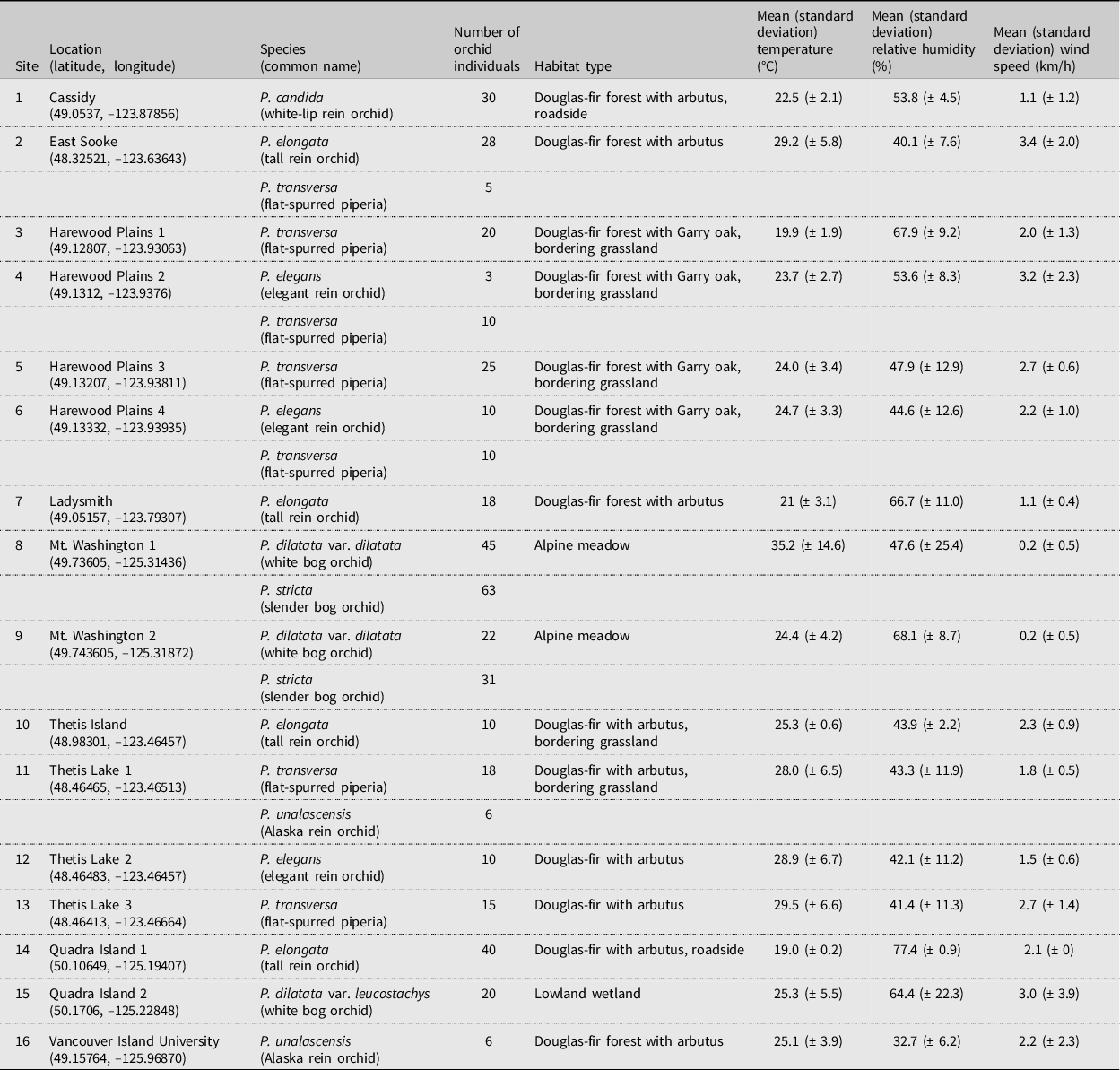
We selected sites based on the occurrence of one or more species of Platanthera, with a minimum of five individuals required. Where possible, we sought a minimum of three sites per orchid species across southern and eastern Vancouver Island. Platanthera was located in alpine meadows (> 1000 m), lowland wetlands, and in areas dominated by Douglas-fir, Pseudotsuga menziesii (Mirbel) Franco (Pinaceae), intermixed with either arbutus, Arbutus menziesii Pursh (Ericaceae), or Garry oak, Quercus garryana Douglas ex Hooker (Fagaceae). Sites were visited three times during peak orchid-flowering times, June–August 2019. Temperature and humidity were recorded using Kestrel K2 Drops (Kestrel Instruments, Boothwyn, Pennsylvania, United States of America) every 10 minutes while pan traps were active. Start- and end-of-session wind speeds were recorded by a Kestrel 1000 Pocket Wind Speed Meter Anemometer (Kestrel Instruments). Table 1 provides species, abundance, and habitat information for each site.
Orchid species and habitat information for sites on Vancouver Island, British Columbia, Canada used during this study.

At each site, eight coloured pan traps (red, orange, yellow, light blue, dark blue, purple, pink, and white) were placed randomly, one metre apart, around the orchids. These traps were coloured plastic bowls (12 × 5 cm) filled with water and dish soap. Previous work on Platanthera flower longevity indicates a two-week window for peak flowering, which is reduced significantly once pollination of individual flowers occurs (Stpiczynska Reference Stpiczynska2003). Thus, to maximise the number of species and sites we could visit within the peak flowering period, pan traps were set for approximately two hours each visit between the hours of 09:00 and 16:00. Pan trap catches were identified to taxonomic family using available keys (Goulet and Huber Reference Goulet and Huber1993; Marshall Reference Marshall2006, Reference Marshall2012). Insects within Strathcona Provincial Park, Vancouver Island were collected with a Letter of Authorisation from the British Columbia Parks Strathcona Area Manager (dated 2 August 2019). Additionally, three orchid plants per site were observed for 10 minutes each (30 minutes per visit; 1.5 hours total per site) to observe the following insect behaviours: flying by the orchid, hovering near flowers, landing on the orchid, and crawling or sitting on the orchid. Insects visiting orchid flowers were identified to taxonomic order and collected when possible; ethyl acetate was used as the killing fluid. Insects are currently stored at the Vancouver Island University Natural History Museum (Nanaimo, British Columbia) until they can be transferred to the Royal British Columbia Museum (Victoria, British Columbia).
Numbers of insects per pan colour were tested for normality using a Shapiro–Wilk test (Shapiro and Wilk Reference Shapiro and Wilk1965). Kruskal–Wallis one-way analyses of variance (Zar Reference Zar and Zar1974) were performed using the Real Statistics Resource Pack, version 7.2 (Zaiontz Reference Zaiontz2020) to determine if one pan trap colour was preferred by insects. Both Shannon’s (H’) and Simpson’s (D) diversity indices were calculated in the Real Statistics Resource Pack, version 7.2 (Zaiontz Reference Zaiontz2020), to assess the diversity of insect families caught in pan traps. Shannon values emphasise rare species, whereas Simpson values weight dominant or common species higher (Krebs Reference Krebs2014).
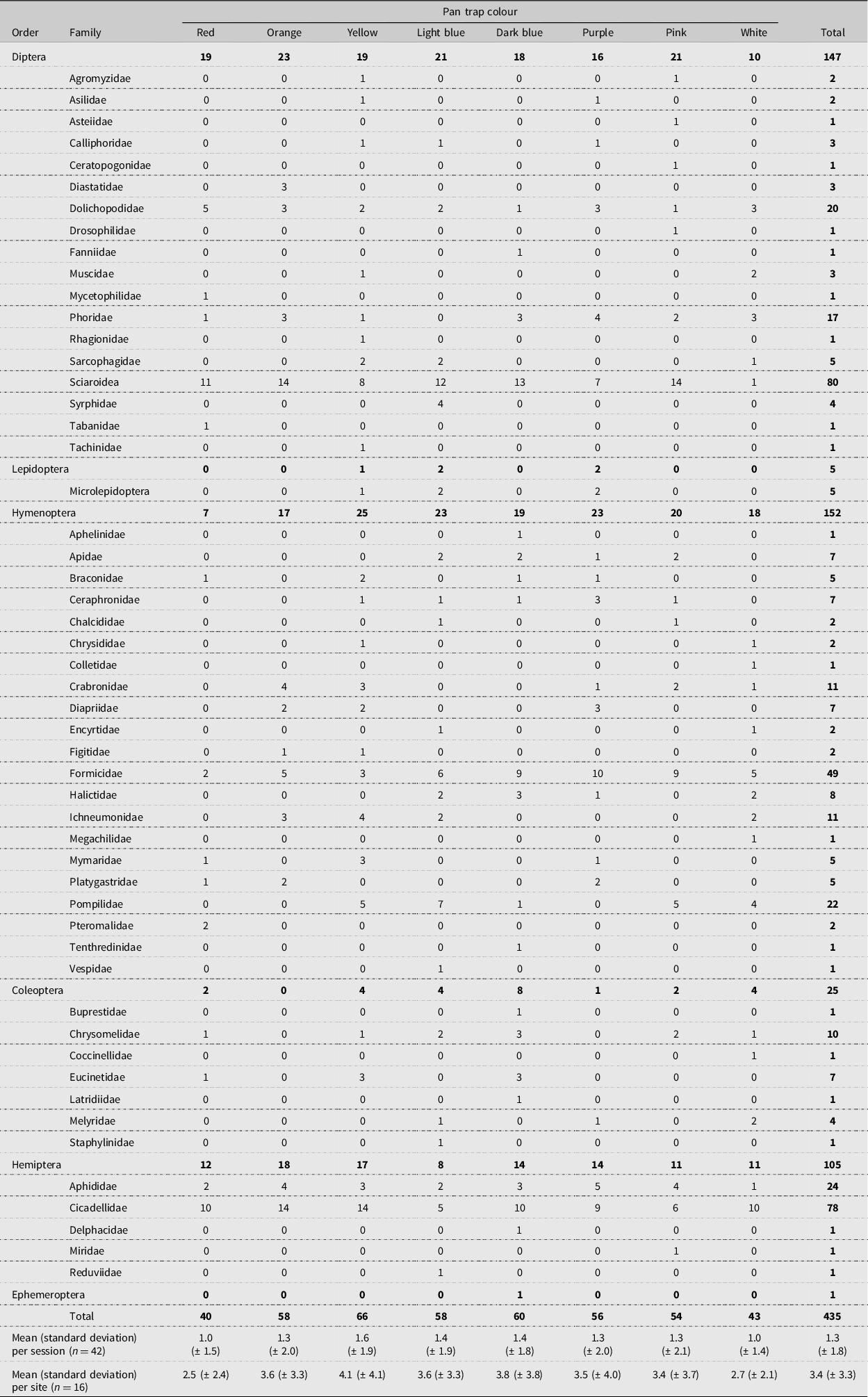
Seven orchid species, including two variants of Platanthera dilatata (Pursh) Lindley ex L.C. Beck, over 16 sampling sites were established (Table 1). One species, P. candida (Randall Morgan and J.D. Ackerman) R.M. Bateman, is currently listed as a “species of special concern” in British Columbia. The most common species was P. transversa (Suksdorf) R.M. Bateman (seven sites), whereas P. candida and P. dilatata var. leucostachys (Lindley) Luer were least common (one site each). Platanthera unalascensis (Sprengel) Kurtz consistently had low numbers of individuals per site. Pan trapping yielded 435 insects and 29 arachnids (21 Araneae and eight Acari), representing 53 insect families, caught over 64.9 hours. The most common families were Formicidae (ants), Cicadellidae (leafhoppers), Aphididae (aphids), and the superfamily Sciaroidea (gnats); gnats were not identified past superfamily. Nineteen families were represented by single individuals. Five Lepidoptera were caught and identified as “microlepidoptera moths”. Sciaroidea, Thysanoptera (thrips), Collembola (springtails), and arachnids were not included in further data analyses. Table 2 provides the total number of insects per family per pan colour.
Total numbers of insects caught per pan trap colour. Insects are organised by order and family and represent a sampling effort over 42 trapping sessions across 16 sites on the southwest of Vancouver Island, British Columbia, Canada. Numbers in bold, total number of insects per order; numbers not bold, total number of insects per family within that insect order.

Timed observations of behaviour yielded 254 insects and 29 arachnids over 21.5 hours. Six insect orders were observed, the most common of which was Diptera. The most frequently observed behaviour was “flying by plant”, with 151 occurrences. No activity indicating pollination was observed in any session, and none of the insects captured had orchid pollinia attached to them.
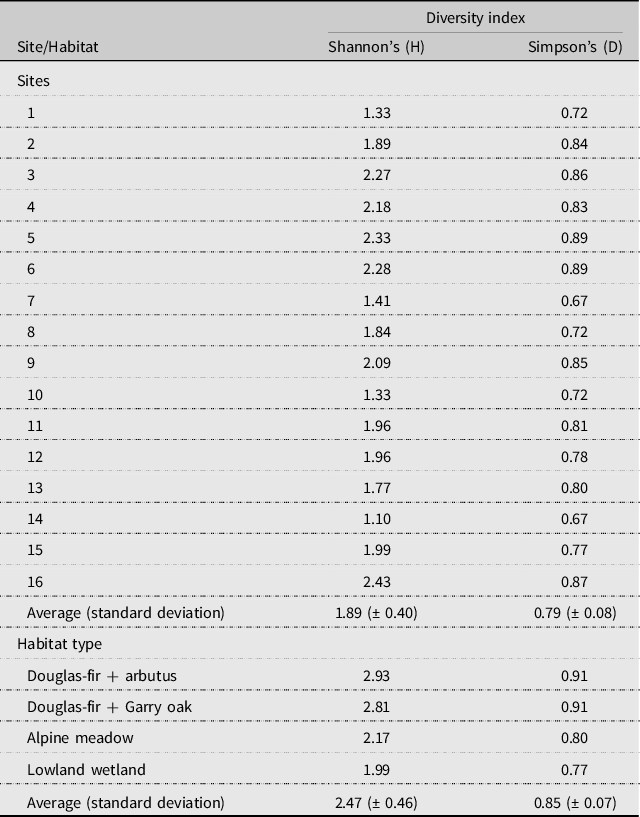
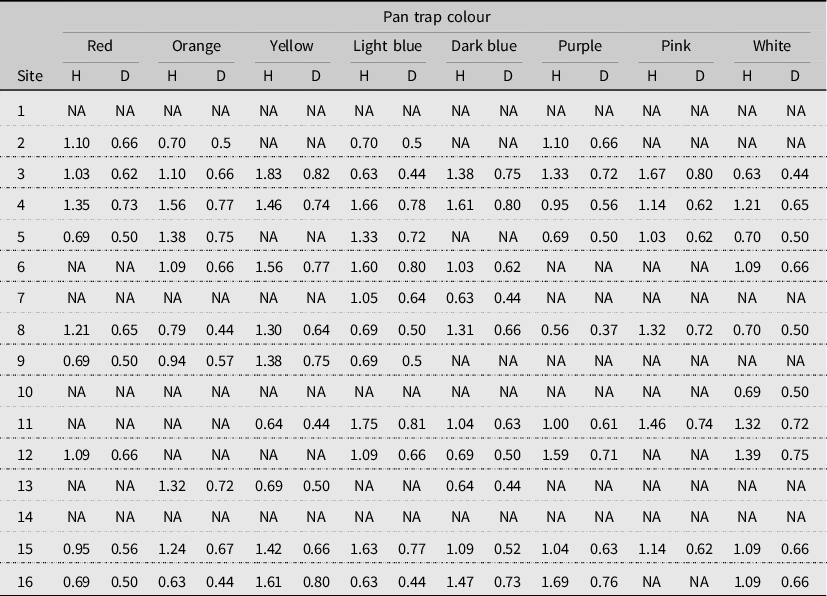
Insects showed no preference for trap colour (Kruskal–Wallis analysis of variance: (H’ = 4.31, df = 7, P = 0.673, α = 0.05), nor were certain families more attracted to particular trap colours (e.g., Hymenoptera H’ = 6.06, df = 7, P = 0.233, α = 0.05; Diptera H’ = 1.02, df = 7, P = 0.973, α = 0.05). Table 3 shows insect family-level diversity was low across sites (average H’ = 1.89; average D = 0.79) and habitat type (average H’ = 2.47; average D = 0.85). Insect family-level diversity was low for each pan trap colour per site (Table 4).
Insect family-level diversity index values per site and habitat type.

Insect family-level diversity index values per pan trap colour per site. Both Shannon’s (H) and Simpson’s (D) diversity index values are presented. NA entries represent instances when only one insect was caught per trap across sampling periods.

To our knowledge, this is the first study to assess the diversity and behaviour of insect communities associated with Platanthera orchid habitats in North America and the first study to specifically use pan traps to characterise insect diversity associated with orchid habitat. We found reference to pan traps and orchids in Reiter et al. (Reference Reiter, Whitfield, Pollard, Bedggood and Argall2016); however, the original paper by Darling and Packer (Reference Darling and Packer1988) specifically assessed the efficacy of malaise traps in sand dune communities in southern Ontario, Canada, so it is unclear how pan traps were used in orchid habitat.
Although our study was limited in geographic scale and sampling effort was low compared to other studies because of the limited flowering period, we were able to observe substantial numbers of insects (Table 2). However, insect family-level diversity was relatively low across pan trapping sessions (Tables 3 and 4). Many orchid species are found in areas with intermediate levels of disturbance, such as forested trails, grasslands, and the borders between open- and closed-canopy forests (Janes et al. Reference Janes, Steane and Vaillancourt2010). Thus, suitable orchid habitat may represent a transition zone or an area of unsuitable habitat for many insect species, thereby impacting observable levels of diversity (McCabe et al. Reference McCabe, Colella, Chesshire, Smith and Cobb2019). Of course, identifications to lower taxonomic levels may have increased our measures of diversity. For example, gnats are a broad grouping that are taxonomically challenging to identify, yet they are known to encompass high numbers of individual species (Kerr Reference Kerr2008).
We did not observe pollination for any Platanthera spp.; pollinia removal was not recorded, and no captured insects had pollinia attached to them. However, we did observe many of the same families that previous studies suggest are involved in pollination of Platanthera. For example, several North American Platanthera have been documented as having diurnal lepidopteran (Van Der Cingel Reference Van Der Cingel2001), hymenopteran (Larson Reference Larson1992), and syrphid fly pollinators (Boland Reference Boland1993). Species-level identifications of pollinators are more limited, but diurnal activity remains consistent. Larson (Reference Larson1992) observed Noctuidae (Anarta oregonica Grote) moths pollinating P. dilatata var. dilatata in Oregon, United States of America during daylight hours in July. Larson (Reference Larson1992) states that there were hundreds of orchid individuals present, considerably more than the numbers of plants observed at a single site in the present study, which may lend support to the idea that flower density is more important in attracting pollinators than habitat type (Scriven et al. Reference Scriven, Sweet and Port2013). There is also the possibility that pollinators of many Platanthera are nocturnal. Observations of geometrid and prodoxid moth pollinators were associated with P. stricta Lindley in Washington, United States of America (Patt et al. Reference Patt, Merchant, Williams and Meeuse1989). Nocturnal pollination also seems more common for Platanthera on other continents (e.g., Steen Reference Steen2012; Suetsugu and Hayamizu Reference Suetsugu and Hayamizu2014).
Many studies have identified strong preferences among insect families for certain pan trap colours. For example, Coleoptera and Diptera often prefer white traps, whereas Hymenoptera may prefer blue traps (Campbell and Hanula Reference Campbell and Hanula2007) or yellow traps (Abrahamczyk et al. Reference Abrahamczyk, Steudel and Kessler2010). Within North America, particularly within the Cascadia region of the Pacific Northwest, blue traps are reported to attract more bees (Stephen and Rao Reference Stephen and Rao2005). Other work has indicated that preferences for trap colour can be influenced by the taxonomic level of identification used. For example, blue traps caught more bees, but the level of attractiveness between yellow or blue traps for Hymenoptera overall was not significant (Moreira et al. Reference Moreira, da Silva Santos, Penna, Angel-Coca and Freitas de Oliveira2016). In some cases, there appears to be no preference exhibited even when using multiple-coloured traps across a range of habitats (Saunders et al. Reference Saunders, Roger, Geary, Meredith and Welbourne2018). In the present study, no preference for pan trap colour was observed. Yellow traps caught the most insects and red the least (Table 2), but these differences were not significant. The highest numbers of Hymenoptera were obtained from yellow, light blue, and purple pans (Table 2), but these differences were not significant when compared to other trap colours. Several factors may contribute to the patterns we observed: (1) our sample size may not be large enough to detect differences (Saunders et al. Reference Saunders, Roger, Geary, Meredith and Welbourne2018); (2) many of our sites were highly shaded, which can influence insect activity and diversity in general (Abrahamczyk et al. Reference Abrahamczyk, Steudel and Kessler2010); and (3) traps placed on the ground may catch a different suite of insects compared to elevated traps (Campbell and Hanula Reference Campbell and Hanula2007). Despite these potential limitations, our data appear to support more generalised statements regarding the attractiveness of yellow and blue traps for Hymenoptera. We do caution against overinterpretation, as local factors and species-level differences may drive such patterns. For example, most of the bees caught in this study were from the family Apidae subfamily Xylocopinae, not subfamily Apinae as other studies often report (e.g., Campbell and Hanula Reference Campbell and Hanula2007).
Overall, few studies have examined local insect diversity within Platanthera habitat, the efficacy of pan trapping to characterise insect communities in orchid habitats, or the pollination ecology of Platanthera in North America. Our results contribute baseline data on the diversity and behaviour of insect communities in orchid habitats of Vancouver Island, British Columbia and on the use of pan traps to characterise insect communities. Further research is necessary to build an accurate representation of biodiversity in these geographic areas, and nocturnal sampling, in particular, would be helpful in identifying potential pollinators of Platanthera in North America.
Acknowledgements
The authors thank the reviewers and editors for their thoughtful comments and suggestions to improve the manuscript. They gratefully acknowledge the support of Andy Smith and Erica McClaren in obtaining permission to sample within the Strathcona Provincial Park. The project was funded by a Vancouver Island University Inquiry grant (100207) and financial assistance to G.V. through an Entomological Society of America Systematics, Evolution, and Biodiversity BioQuip Undergraduate Scholarship. The authors also thank Professor Staffan Lindgren for his insight during the project.