INTRODUCTION
The most studied endocrine disruptor is tributyltin (TBT), which has been widely used as biocide in a variety of products. Among them, antifouling paints are the most important contributors of organotin compounds to the aquatic environment, where they are known to cause deleterious effects to non-target organisms. Marine gastropods are the most sensitive animals to environmental contamination by organotin compounds. More than 150 species (Santos et al., Reference Santos, Ten Hallers-Tjabbes, Vieira, Boon and Porte2005) are affected by imposex (Smith, Reference Santos, Filipe, Vieira, Micael, Morabito, Massanisso and Reis-Henriques1971) or pseudohermaphroditism (Jenner, Reference Gooding, Wilson, Folmar, Marcovich and Leblanc1979). This condition is expressed by the masculinization of neogastropod females following the development of a penis and/or a vas deferens. Since the development of male genital tract in females is dose-dependent (Bryan et al., Reference Bryan, Gibbs, Hummerstone and Burt1986), the imposex phenomenon in several gastropods has been widely used as bioindicator of marine pollution by TBT.
The banded murex Hexaplex trunculus has proved to be a good sentinel species for TBT biomonitoring in coastal waters, being considered one of the most sensitive neogastropod species to TBT contamination, exhibiting initial stages of imposex at concentrations lower than 1 ng Sn.g−1 dry weight (Axiak et al., Reference Axiak, Vella, Micallef, Chircop and Mintoff1995). At the final stages of imposex development, females are sterilized by obstruction of the pallial oviduct or by the splitting of the capsule gland (Trigui El Menif et al., Reference Terlizzi, Delos, Garaventa and Faimali2006). Imposex in H. trunculus has been well documented in several countries of the Atlantic Ocean and Mediterranean Sea, such as Portugal (Vasconcelos et al., Reference Trigui El Menif, Lahbib, Romdani, Boumaiza and Le Pennec2006), Spain (El Hamdani et al., Reference El Hamdani, Ferrer and García Carrascosa1998), France (Martoja & Bouquegneau, Reference Limaverde, Wagener, Fernandez, Scofield and Coutinho1988), Italy (Terlizzi et al., Reference Stroben, Oehlmann and Fioroni1998, Reference Terlizzi, Geraci and Minganti1999, Reference Terlizzi, Geraci and Gibbs2004; Chiavarini et al., Reference Chiavarini, Massanisso, Nicolai, Nobili and Morabito2003; Pellizzato et al., Reference Oberdörster and McClellan-Green2004), Malta (Axiak et al., Reference Axiak, Vella, Micallef, Chircop and Mintoff1995, Reference Axiak, Vella, Agius, Bonnici, Cassar, Cassone, Chircop, Micallef, Mintoff and Sammut2000, Reference Axiak, Micallef, Muscat, Vella and Mintoff2003), Israel (Rilov et al., Reference Prime, Peharda, Jelić, Mladineo and Richardson2000), Croatia (Prime et al., Reference Pellizzato, Centanni, Marin, Moschino and Pavoni2006; Garaventa et al., Reference Garaventa, Pellizzato, Faimali, Terlizzi, Medakovic, Geraci and Pavoni2007), Morocco (Lemghich & Benajiba, Reference Lahbib, Boumaiza and Trigui El Menif2007) and Tunisia (Trigui El Menif et al., Reference Terlizzi, Delos, Garaventa and Faimali2006, Reference Trigui, Menif, Lahbib, Le Pennec, Flower and Boumaiza2007; Lahbib et al., Reference Jenner2007, Reference Lahbib, Abidli, Le Pennec, Flawoer and Trigui El Menif2008a, b).
Some authors have studied the mechanism of imposex induction in some gastropods such as Nucella lapillus (Spooner et al., Reference Smith1991; Bettin et al., Reference Bettin, Oehlmann and Stroben1996), Ilyanassa obsoleta (Oberdörster & McClellan-Green, Reference Morcillo and Porte2002), Bolinus brandaris (Morcillo & Porte, Reference Mensink, Kralt, Vethaak, Ten Hallers-Tjabbes, Koeman, Van Hattun and Boon1999) and Buccinum undatum (Santos et al., Reference Ronis and Mason2002). They showed that this biocide has caused variations in testosterone rate following the aromatase P450 inhibition. Other hypothetical mechanisms explaining how TBT acts on the increase of testosterone rate were proposed by Ronis & Mason (Reference Rilov, Gasith, Evans and Benayahu1996) consisting in the inhibition of sulphotransferase in Littorina littorea, and by Gooding et al. (Reference Gibbs, Bryan, Pascoe and Burt2003) following an inhibition of the testosterone acyltransferase (ATAT) in I. obsoleta.
In the laboratory, TBT contamination experiments in gastropods are limited to a few species, such as B. undatum (Mensink et al., Reference Martoja and Bouquegneau2002), N. lapillus (Santos et al., Reference Santos, Ten Hallers-Tjabbes, Vieira, Boon and Porte2005) and Stramonita haemastoma (Limaverde et al., Reference Lemghich and Benajiba2007). In the absence of such studies with H. trunculus, the present study aimed to carry out in vivo exposure experiments in order to assess the effect of TBT on the imposex intensity, reproduction and mortality in females of this species.
MATERIALS AND METHODS
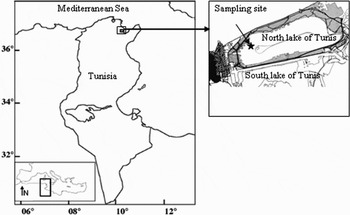
Specimens of H. trunculus were collected in early February 2006, before the spawning season, in the mouth of the small channel of the North Lake of Tunis (Figure 1). A preliminary imposex study carried out at this site on 66 females has shown the presence of eight abnormal individuals constituting 12.1% of the sample. The eight affected females exhibited a vas deferens section localized on half of the area separating the right ocular tentacle and the vaginal opening. In the laboratory, 600 adult females with a size ranging between 40 and 70 mm in shell length (SL) were selected. Since H. trunculus lacks external sexual dimorphism, sexes were separated by observing the penis. Observation was done after keeping snails in tanks without seawater and waiting animals extending their foot from the shell (the penis is absent in females and present in males). Selected females were divided into three aquaria (200 females per aquarium of 24 l). One aquarium was used as a control and the other two were contaminated with TBT concentrations of 5 and 50 ng l−1. The TBT cations (500 × 103 ng l−1) were obtained from the TBT chloride standard solution ([CH3(CH2)3]3SnCl 95%, Aldrich) by diluting one volume in absolute ethanol.
Map of Tunisia and sampling site of Hexaplex trunculus in the north lake of Tunis.

The seawater was oxygenated and renewed three times a week with water from the collecting site. Specimens were fed with the clam Ruditapes decussatus also caught at the same sampling site. The exposure experiment extended for five months. During this period, the imposex development was registered monthly. Eight specimens were sacrificed and the imposex stages were identified under a stereomicroscope through the examination of the area between the penis and the vagina. The imposex development was assessed by calculating the following indices:
– Imposex incidence or frequency (I (%) = percentage of imposex-affected females compared to the total number of females in the sample).
– Female vas deferens average length (VDL) and female penis average length (FPL).
– Vas deferens stages (VDS) according to the schemes proposed by Stroben et al. (Reference Stickle, Sharp-Dahl, Rice and Short1992) and Lahbib et al. (Reference Lahbib, Abidli and Trigui El Menif2008b).
– Vas deferens sequence index (VDSI = (sum of imposex stages of all females)/(total number of females)), following Gibbs et al. (1987).
At the first week of March 2006 (1 March 2006 for the control; 5 March 2006 for the two exposure groups), females started depositing individual and collective spawns. Spawning in each aquarium was asynchronous among females and extended to 7–12 days with interruptions of 3–5 days in the rhythm of laying. The number of spawning females was registered for all aquaria. Due to the spawning behaviour of this species (formation of communal spawns), and to avoid stress caused by removing specimens to individual aquaria, fecundity was assessed from only two selected specimens (with individual spawns) per aquarium. The studied females had a size ranging between 50 and 60 mm SL. The number of egg-capsules per female was recorded. Thirty egg-capsules were taken from each individual spawn immediately after females finished spawning (spawning duration: 2–3 days), measured and excapsulated under a stereomicroscope. The number of eggs per capsule was counted using a Dollfus box. At this early stage of development it was not possible to distinguish between nurse and embryonic eggs. Mortality was registered monthly and shells of dead snails were carefully examined to detect eventual drilling by conspecifics (cannibalism). Comparisons of average values and rates between groups/treatments were made using Student's t-test and the Chi-square test, with statistical significance considered for P < 0.05.
RESULTS
Imposex development
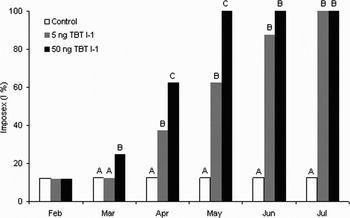
The summary of the results of the imposex indices used in the present study are compiled in Table 1 and in Figures 2 to 7. The evolution of the imposex incidence/frequency was different in the three groups during all the experimental period. In the control aquarium, no significant differences were recorded, with imposex varying slightly from 12.1% to 12.5%. At 5 ng TBT l−1 the imposex frequency increased from 12.1% at the beginning of the experiment to 12.5% in March, and continued increasing significantly in April (37.5%), May (62.5%), June (87.5%) and July (100%). At the highest concentration (50 ng TBT l−1), the imposex incidence was 25% in March, rapidly increasing to 62.5% in April and 100% in May and during the remaining experimental period. Significant differences (P < 0.05) between the treatment groups only occurred in March, April and May (Figure 2).
Imposex incidence (I%) in female Hexaplex trunculus according to the duration of exposure and the TBT concentration. Different letters (A, B, C) denote statistically significant differences (P < 0.05) between groups in each month.

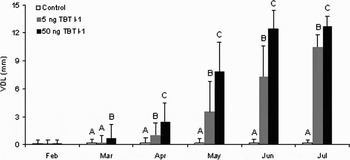
Vas deferens length (VDL) in female Hexaplex trunculus according to the duration of exposure and TBT concentration. Different letters (A, B, C) denote statistically significant differences (P < 0.05) between groups in each month.

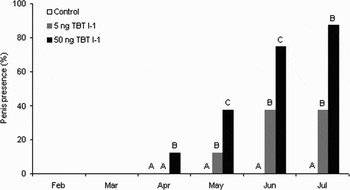
Percentage of penis-bearing females of Hexaplex trunculus according to the duration of exposure and the TBT concentration. Different letters (A, B, C) denote statistically significant differences (P < 0.05) between groups in each month.

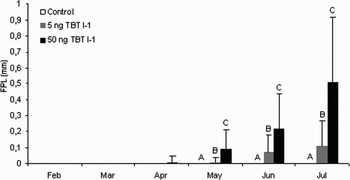
Female penis length (FPL) in Hexaplex trunculus according to the duration of exposure and the TBT concentration. Different letters (A, B, C) denote statistically significant differences (P < 0.05) between groups in each month.

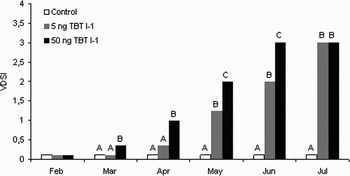
Vas deferens sequence index (VDSI) in female Hexaplex trunculus according to the duration of exposure and the TBT concentration. Different letters (A, B, C) denote statistically significant differences (P < 0.05) between groups in each month.

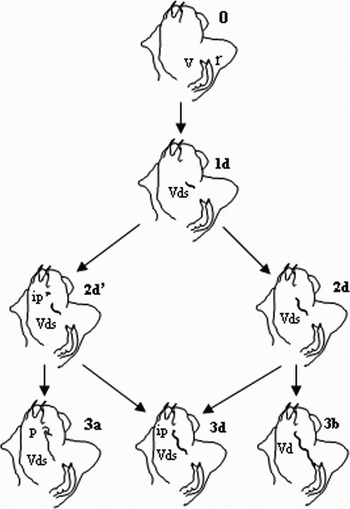
Schematic representation of the imposex pathways observed in Hexaplex trunculus during the contamination experiment. Abbreviations: ip, incipient penis; p, penis; r, rectum; v, vulva; Vds, vas deferens section; Vd, vas deferens.

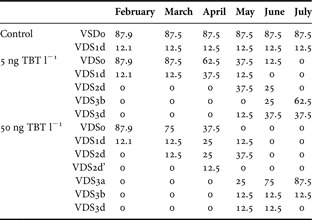
Vas deferens stages (VDS) in female Hexaplex trunculus according to the duration of exposure and TBT concentration.

Concerning the vas deferens length (VDL), abnormal females in the control group showed a small section of the vas deferens at the mid-level between the vaginal opening and the penis site. No significant differences in VDL were observed between the beginning (0.14±0.40 mm) and the end of the experiment (0.15±0.41 mm). In the treatment groups, females showed longer vas deferens compared to the control. At 5 ng TBT l−1 the VDL increased continuously until the end of the experimental period and significant differences with the control group occurred since April. At 50 ng TBT l−1, differences with the control were observed one month after exposure, increasing from 0.14±0.40 mm in February to 12.68±1.13 mm at the end of the experiment. Statistically significant differences (P < 0.05) were detected during all the experiment (Figure 3).
Regarding the penis development, all females in the control group lacked penis during all the exposure period. In the group treated with 5 ng TBT l−1, an incipient penis started developing in the third month of exposure (May) with an incidence of 12.5% (FPL = 0.01±0.03 mm), reaching 37.5% (FPL = 0.11±0.16 mm) in July. At 50 ng TBT l−1, penises developed two months after exposure. The incidences reached 37.5% (FPL = 0.09±0.12 mm) in May, 75% (FPL = 0.22±0.22 mm) in June and 87.5% (FPL = 0.51±0.41 mm) in July (Figures 4 and 5). The comparison of female penis length between the control (always lacking penis) and both treatment groups revealed significant differences (P < 0.05) between May and July (Figure 5).
All abnormal females in the control group were found in VDS 1d of imposex (VDSI = 0.12, Table 1, Figure 7). At the end of the experiment (July) with 5 ng TBT l−1, all females were affected by imposex, were found at stages VDS 3d (37.5%) and VDS 3b (62.5%), and the VDSI reached 3. Significant differences (P < 0.05) with the control group were observed since May (Figure 6). At higher concentration (50 ng TBT l−1), the stages observed in March were VDS 1d and 2d, with similar rates (12.5%, VDSI = 0.37). In May all females were abnormal, with the following stages: VDS 1d (12.5%), 2d (37.5%) 3a (25%), 3b (12.5%) and 3d (12.5%), and with VDSI increasing to 2. In June and July, only stage 3 was observed and VDSI reached 3. The comparison of the VDSI with the control group revealed significant differences since March. Between the treatment groups, significant differences were recorded in March, April, May and June (P < 0.05) (Figure 6).
Reproduction
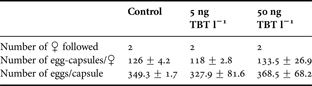
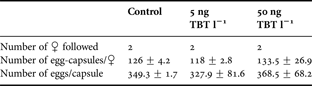
The rate of spawning females was similar in the control and 5 ng TBT l−1 treatment group (58% and 60% respectively, P > 0.05). At 50 ng TBT l−1, the rate decreased significantly (31%) compared to the other two groups (Table 2). No significant differences (P > 0.05) between the three groups were recorded for the number of capsules laid per female and for the number of eggs per capsule (Table 2). The capsules spawned by females exposed to 50 ng TBT l−1 had walls with a fragile structure compared to those of the control and 5 ng TBT l−1 treatment groups, whose capsules had a quite hard texture.
Number of egg-capsules laid by females and number of eggs per capsule according to TBT concentration.
Mortality rate
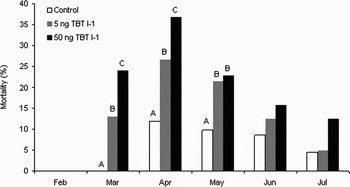
Mortality rate varied between the three aquaria (Figure 8). The first dead females were detected one month after exposure to TBT in the treatment groups and in the second month for the control group. In the untreated females the mortality rate was 11.9% in April, decreasing progressively to 9.8% in May, 8.6% in June and 4.4% in July. At 5 ng TBT l−1, mortality rate was 13% in March, increased until 26.6% in April, and then decreased to 21.5% in May, 12.5% in June and 5% in July. At 50 ng TBT l−1, the evolution in mortality was similar, with the higher values being observed in April (36.8%) and July (12.5%). Significant differences with the control group were observed in March, April and May (P < 0.05), whereas between the treatment groups differences only occurred in March and April (P < 0.05).
Mortality rate of female Hexaplex trunculus according to the duration of exposure and the TBT concentration. Different letters (A, B, C) denote statistically significant differences (P < 0.05) between groups in each month.

DISCUSSION
The evolution of imposex according to the TBT concentration (5 and 50 ng l−1), allowed us to confirm the imposex effect induced by this pollutant, with the imposex frequency evolving from 12.1% to 100% after only three months of exposure to 50 ng TBT l−1.
Apparently, H. trunculus is among the best bio-indicator species to monitor environmental pollution by TBT. Indeed, the imposex incidence in N. lapillus ranged between 20 and 50% after three months of exposure to 50 ng TBT l−1 (Santos et al., Reference Santos, Ten Hallers-Tjabbes, Vieira, Boon and Porte2005). In six months of exposure of I. obsoleta to TBT, Gooding et al. (Reference Gibbs, Bryan, Pascoe and Burt2003) recorded an increase in imposex frequency from 2.5% to 27% at 1 ng l−1 and from 2.5% to 28% at 10 ng l−1. In juvenile B. undatum, Mensink et al. (Reference Martoja and Bouquegneau2002) detected an increase in imposex from 0 to 54% after eight months of exposure to 100 ng TBT l−1 Ac, while in adults imposex features were not found at 1µg TBT l−1 Ac. These observations also confirm the high sensitivity of H. trunculus to TBT, since imposex also developed in adult individuals.
The first sign of imposex in H. trunculus was the development of a section of the vas deferens half way between the right ocular tentacle and the vagina. This observation is similar to those reported by Lahbib et al. (Reference Lahbib, Abidli and Trigui El Menif2008b) in the same species transplanted from a less affected site (I% = 12.9%) to a highly affected place (I% = 100%). Moreover, these authors also recorded a progressive increase in the VDL as the duration of exposure increased. The rate of development of the incipient penis in H. trunculus varied according to the exposure time and TBT concentration, with average penis length increasing from 0 (lacking penis) to 0.09±0.12 mm after three months of exposure to 50 ng TBT l−1. With the same duration of exposure and TBT concentration, Santos et al. (Reference Santos, Ten Hallers-Tjabbes, Vieira, Boon and Porte2005) recorded an increase in average penis length from 0.01 to 0.23 mm in N. lapillus. In addition, N. lima lacked a penis at the beginning of the experiment, but it developed and reached 1.96 mm after four months of exposure to 64 ng TBT l−1 (Stickle et al., Reference Spooner, Gibbs, Bryan and Goad1990).
In the present study, the VDS stages evolved from 0 to 3 after three months of exposure, while the VDSI increased from 0.12 at the beginning of the experiment to 2 after three months of exposure to 50 ng TBT l−1. In N. lapillus, Santos et al. (Reference Santos, Ten Hallers-Tjabbes, Vieira, Boon and Porte2005) observed a VDSI varying from 0.18 to 1.2 after three months of exposure to 50 ng TBT l−1 and Stroben et al. (Reference Stickle, Sharp-Dahl, Rice and Short1992) detected an increase of the VDSI from 2 to 2.7 after six months of exposure to 5 ng TBT l−1. At this concentration (5 ng TBT l−1) and with an exposure duration of five months, the VDSI in H. trunculus increased from 0.12 to 3, suggesting that this species is more sensitive to TBT contamination than N. lapillus.
The development of imposex observed in the present work was similar to that described by Lahbib et al. (Reference Lahbib, Abidli and Trigui El Menif2008b). However, this scheme was different from that proposed for H. trunculus from Malta (Axiak et al., Reference Axiak, Vella, Micallef, Chircop and Mintoff1995) and Italy (Terlizzi et al., Reference Terlizzi, Geraci and Minganti1999), where the first sign of imposex was expressed by the development of the incipient penis, followed by the development of a vas deferens. This distinct type of imposex expression is presumably explained by environmental and genetic differences between Tunisian and European populations of this species.
TBT induces the development of a male genital tract in females. In the present case, this abnormality apparently had no effect on reproduction, since the development of the vas deferens was limited to the area between the right ocular tentacle and the vagina, thus females were still able to lay egg-capsules. This study also showed that the rate of spawning females decreased as the TBT concentration increased. However, negative effects of TBT on fecundity were not recorded. The number of egg-capsules per female and the number of eggs per capsule did not exhibit significant differences among the studied groups. In comparison to other studies, Trigui El Menif et al. (Reference Terlizzi, Delos, Garaventa and Faimali2006) have reported that the rate of spawning H. trunculus in the laboratory was 12% for the Channel of Bizerte where imposex intensity was high (I% = 100%, VDSI = 4.19) and 30% for the Lagoon of Bizerte (Menzel Jemil) where imposex intensity was low (I% = 65.8%, VDSI = 0.34). In H. trunculus from the Ria Formosa lagoon (Portugal), a site affected by imposex (>90% of masculinized females) (Vasconcelos et al., Reference Trigui El Menif, Lahbib, Romdani, Boumaiza and Le Pennec2006), the number of egg-capsules per female recorded in the laboratory was similar to that recorded in this study (118±89, minimum: 17, maximum: 242) while the number of eggs per capsule was much higher in the Portuguese population (723±66, minimum: 641, maximum: 804) (Vasconcelos et al., Reference Vasconcelos, Gaspar and Castro2004). These differences could be related to several factors such as distinct laboratory conditions, the size of spawning females, and genetic factors.
The present study showed that mortality rate increased in function of the TBT concentration, especially during the first months of exposure. Thereafter, individuals seemed acclimated to the contamination and mortality gradually decreased. Santos et al. (Reference Santos, Ten Hallers-Tjabbes, Vieira, Boon and Porte2005) recorded <7% mortality in N. lapillus in both the control and 50 ng TBT l−1 treatment groups. In addition, Czech et al. (Reference Czech, Weber and Dietrich2001) reported that the freshwater gastropod Lymnaea stagnalis is not very sensitive to TBT because after three months of exposure mortality was not significantly different between the control and the 100 ng TBT l−1 treatment group. The exposure of N. lima to 64 ng TBT l−1 increased mortality from 2% in the first month to 10% after four months of exposure (Stickle et al., Reference Spooner, Gibbs, Bryan and Goad1990). Altogether, these observations suggest that, among these species, H. trunculus is the most sensitive to TBT contamination.
These experiments in vivo, coupled with other studies in situ, confirmed that H. trunculus is a highly adequate bioindicator species for monitoring TBT contamination in the natural environment. Nevertheless, longer eco-toxicological experiments, chemical analyses of TBT in tissues of H. trunculus and the histological study of the area between the penis site and the gonad would be highly interesting and valuable to clarify the dose–effect relationship of this biocide in this gastropod species.