Introduction
Lutein is a lipid-soluble pigment found in most plants. Lutein, and its stereoisomer zeaxanthin, belongs to the xanthophyll family of carotenoids. Dietary lutein is not currently appreciated as an essential nutrient for humans and animals because of the limited information on biological mechanisms regarding how its deficiency or high intake affects physiological functions and prevents certain diseases. However, sufficient intake of lutein is currently recommended to improve human health, especially in eyes, because low intake has been associated with increasing incidence of various diseases, such as age-related macular degeneration, and cataracts (Alves-Rodrigues and Shao, Reference ALVES-RODRIGUES and SHAO2004). Moreover, lutein has also been reported to show antioxidant activity because the conjugated double bonds in lutein can quench singlet oxygen from reactive oxygen species, indicating that sufficient intake of lutein may decrease oxidative stress in humans and animals (Johnson, Reference JOHNSON2004). In line with improved antioxidant activity, dietary supplementation of lutein has been involved in decreased inflammatory responses and activation of immune systems in animals (Bedecarrats and Leeson, Reference BEDECARRATS and LEESON2006; Shanmugasundaram and Selvaraj, Reference SHANMUGASUNDARAM and SELVARAJ2011; Moraes et al., Reference MORAES, RIBEIRO, SANTIN and KLASING2016)
Lutein, as for other carotenoids, cannot be synthesised in humans and animals, and thus, it needs to be obtained from the diet (Granado et al., Reference GRANADO, OLMEDILLA and BLANCO2003). Lutein is present primarily in fruits and vegetables, particularly in dark green leafy vegetables. Eggs are considered an important source of dietary lutein because of their relatively high concentrations of lutein in egg yolk (Leth et al., Reference LETH, JAKOBSEN and ANDERSEN2000). Therefore, poultry nutritionists are paying increasing attention to lutein-enriched egg production. Many studies have attempted to develop dietary regimens to produce lutein-enriched eggs. However, various factors, including dietary treatments and environmental managements, are known to influence lutein concentrations in eggs. The following review discusses the current information regarding lutein-enriched egg production in laying hens and factors affecting retention in eggs.
Lutein in foods and feed ingredients
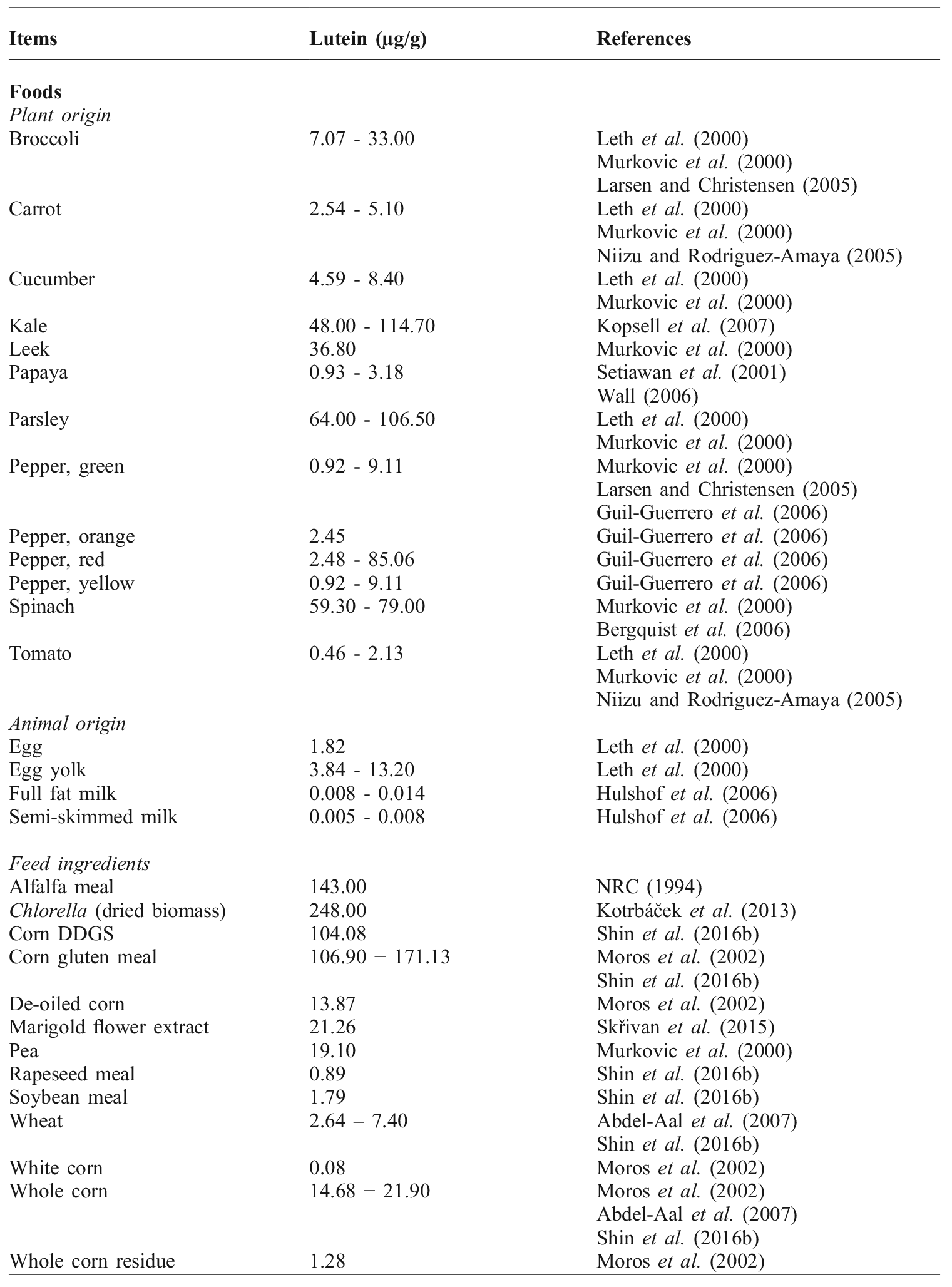
Lutein concentrations in common foods and feed ingredients have been reported in various publications (Table 1). Various foods, fruits and vegetables, particularly dark green leafy vegetables, contain high amounts of lutein. Among feed ingredients, corn and its by products, including corn distillers dried grains with solubles (DDGS) and corn gluten meal (CGM), are the richest sources of dietary lutein for animals (Moros et al., Reference MOROS, DARNOKO, CHERYAN, PERKINS and JERRELL2002; Abdel-Aal et al., Reference ABDEL-AAL, YOUNG, RABALSKI, HUCL and FREGEAU-REID2007). Lutein from plant ingredients can be transferred to animal products such as eggs (Leeson and Caston, Reference LEESON and CASTON2004) and dairy products (Nozière et al., Reference NOZIÈRE, GRAULET, LUCAS, MARTIN, GROLIER and DOREAU2006). Among various animal products, eggs are considered the major lutein-enriched food source for humans.
Lutein concentrations in foods and feed ingredients.

Digestion, absorption, transport, and metabolism of lutein
digestion and absorption of lutein
Lutein is a fat-soluble compound, and its digestion and absorption pathways are close to those of other dietary lipids (Furr and Clark, Reference FURR and CLARK1997). The digestion and absorption of dietary lutein involves a series of steps. Initially, dietary lutein is released from the food matrix through mechanical and enzymatic actions in the mouth. Next, the released lutein is emulsified by bile salts to form lipid droplets in the gastrointestinal tract (GIT). Subsequently, the lipid droplets are incorporated in mixed micelles consisting of phospholipids, cholesterol, fatty acids, monoacylglycerols, and other lipid-hydrolysed products (Yonekura and Nagao, Reference YONEKURA and NAGAO2007). During the emulsion process, lutein is placed generally at the emulsion surface, which enables its direct solubilisation in mixed micelles (Yonekura and Nagao, Reference YONEKURA and NAGAO2007). The extent of its solubilisation is an important factor affecting its absorption rate in enterocytes (Kotake-Nara and Nagao, Reference KOTAKE-NARA and NAGAO2011). Mixed micelles move through the brush border of the intestinal epithelial cells where lutein is absorbed by enterocytes (Parker, Reference PARKER1996; Yonekura and Nagao, Reference YONEKURA and NAGAO2007).
In poultry, lutein is absorbed by simple or facilitated diffusion in the duodenum and jejunum (Kotake-Nara and Nagao, Reference KOTAKE-NARA and NAGAO2011). Simple diffusion involves the migration of micelles through penetration into the unstirred water layer of the brush border membrane (Furr and Clark, Reference FURR and CLARK1997). The lutein outflows from mixed micelles and diffuses through the membrane into enterocytes by concentration gradients (Yonekura and Nagao, Reference YONEKURA and NAGAO2007). In addition, recent studies have proposed that lutein absorption is partly mediated by facilitated diffusion using scavenger receptor class B type 1 (SR-B1; Kotake-Nara and Nagao, Reference KOTAKE-NARA and NAGAO2011). The SR-B1 has a hairpin-like structure that forms a hydrophobic channel, which facilitates the uptake of carotenoids by enterocytes without energy expenditure.
transport and metabolism of lutein
In poultry, lutein, as with other lipid molecules, enters the portal system as part of the large particle lipoproteins (i.e., portomicrons) and is transported to the liver before its release into the blood circulation (Surai et al., Reference SURAI, SPEAKE and SPARKS2001). Lutein is preferentially placed on the outer surface of portomicrons because of its highly hydrophilic characteristics (Parker, Reference PARKER1996). Portomicrons are degraded by the lipoprotein lipase enzyme in extra-hepatic tissues during blood circulation. The released lutein is transferred to various tissues or high-density lipoproteins (HDL). The subsequent transport of lutein from the liver to other tissues is mediated mainly via HDL (Connor et al., Reference CONNOR, DUELL, KEAN and WANG2007). The lutein remaining in the HDL is finally transported back to the liver (Surai et al., Reference SURAI, SPEAKE and SPARKS2001). However, Connor et al. (Reference CONNOR, DUELL, KEAN and WANG2007) reported that very low-density lipoprotein (VLDL) and low-density lipoproteins (LDL) can carry lutein in the blood to various tissues in chickens, but HDL was still the major carrier of transporting lutein to the retina.
For lutein metabolism in laying hens, Schaeffer et al. (Reference SCHAEFFER, TYCZKOWSKI, PARKHURST and HAMILTON1988) measured various lutein metabolites in laying hens after feeding diets containing marigold flower extracts. Lutein in the serum and egg yolk has been identified in various forms of free-, mono- or diester lutein, and 3'-oxolutein, which indicates that some of absorbed compound is esterified to either mono- or diester lutein, whereas others are directly oxidised to 3'-oxolutein. It has been reported that lutein in the blood is transported in a free-form, and is preferentially esterified by local enzymes as it enters tissues for deposition (Tyczkowski and Hamilton, Reference TYCZKOWSKI and HAMILTON1986). In addition, the 3'-oxolutein appears to be an excreted form via the bile into the intestinal lumen, where it may be remixed with dietary lutein, as 3'-oxolutein concentrations have been shown to be very high in intestinal contents and mucosa as compared to other tissues (Tyczkowski et al., Reference TYCZKOWSKI, SCHAEFFER, PARKHURST and HAMILTON1986). However, the clear mechanisms regarding lutein metabolism in laying hens is still not fully understood.
Lutein metabolism in the retina has attracted much attention. Wang et al. (Reference WANG, CONNOR, WANG, JOHNSON and CONNOR2007) fed xanthophyll-free diets to chicks and found rapid depletion of lutein and zeaxanthin in the blood and other tissues. However, a slow depletion rate was found in the retina, indicating the importance of xanthophylls (i.e., lutein and zeaxanthin) for the retinal physiology. Wang et al. (Reference WANG, ILLINGWORTH, CONNOR, BARTON DUELL and CONNOR2010) observed increased lutein concentrations in the retina and other tissues when chicks were fed diets containing high amounts of lutein, but supplementation with zeaxanthin and β-carotene decreased the concentrations of lutein in the retina, plasma, and other tissues, which may demonstrate a possible antagonism among carotenoids.
Dietary regimens to increase lutein concentrations in eggs
An egg normally contains 0.3 to 0.5 mg of total xanthophyll, with more than 50% being lutein (Steinberg et al., Reference STEINBERG, GRASHORN, KLUNTER and SCHIERLE2000). Many efforts have been made to increase lutein concentrations in eggs (i.e. yolk) using a variety of dietary regimens for laying hens.
lutein supplements
Lutein supplementation, in a purified form, has been adopted to increase lutein concentrations in eggs. Leeson and Caston (Reference LEESON and CASTON2004) reported that increasing levels of lutein from 0 to 1,000 mg/kg in diets increased concentrations in eggs 10-fold (0.16 mg lutein/egg for basal diets vs. 1.62 mg lutein/egg when 1,000 mg/kg lutein supplied in diets). The transfer efficiency of lutein supplements into eggs was only 0.05%. Steinberg et al. (Reference STEINBERG, GRASHORN, KLUNTER and SCHIERLE2000) showed a 3.2-fold increase in lutein in yolks when feeding hens 120 mg/kg lutein compared to those fed a basal diet (13.1 vs. 42.0 mg lutein/egg). Adabi et al. (Reference ADABI, KAMALI, DAVOODI, COOPER and HAJIBABAEI2010) demonstrated that 250 mg/kg lutein in feed increased concentrations in egg yolk (0.12 mg/egg for basal vs. 1.35 mg lutein/egg for supplemented hens), but inclusion at 500 or 750 mg/kg feed did not further increase lutein concentrations in eggs. These studies suggested that the linear relationship between levels in feed and deposition of lutein in eggs may be limited beyond a certain concentration in diets and further supplementation has little effects on increasing levels in eggs.
The bioavailability of different forms (free vs. esterified form) of lutein has been determined. Hencken (Reference HENCKEN1992) reported a greater bioavailability of the free-form (110%) than of the esterified form (100%) based on concentrations in egg yolk. This observation is likely related to the fact that the free-form lutein in the gut can be directly absorbed without hydrolysis of ester bonds (Hencken, Reference HENCKEN1992). However, esterification of lutein containing short chain fatty acids may not impair the bioavailability of lutein. Nolan et al. (Reference NOLAN, MEAGHER, HOWARD, MORAN, THURNHAM and BEATTY2016) observed no significant differences in concentrations in egg yolk between hens fed diets containing either free-from or diacetate lutein. It has been suggested that the free-from may have a greater bioavailability than esterified lutein, in theory at least; however, the degree of esterification and the chain length of fatty acids esterified to lutein may influence bioavailability (Hencken, Reference HENCKEN1992; Nolan et al., Reference NOLAN, MEAGHER, HOWARD, MORAN, THURNHAM and BEATTY2016).
corn and corn co-products
Corn is the major energy source in animal diets and contains relatively high amounts of xanthophylls, including lutein and zeaxanthin, compared to other conventional feed ingredients (Moros et al., Reference MOROS, DARNOKO, CHERYAN, PERKINS and JERRELL2002). Thus, decreasing inclusion of corn in diets, for instance by increasing inclusion of alternative ingredients in combination with corn, can be expected to decrease lutein concentrations in eggs. Moreover, different corn varieties may affect lutein deposition in eggs because of differences in levels among corn varieties. Moreno et al. (Reference MORENO, DÏAZ-GÕMEZ, NOGAREDA, ANGULO, SANDMANN, PORTERO-OTIN, SERRANO, TWYMAN, CAPELL, ZHU and CHRISTOU2016) determined lutein concentrations in egg yolk from hens fed diets containing various bio-fortified corns with different amounts of carotenoids. They compared four different varieties of corn, including standard yellow corn (2.97 μg lutein/g), wild-type white corn (0.18 μg lutein/g), high-carotenoid corn (3.08 μg lutein/g) and ketocarotenoid corn (0.45 μg lutein/g). The lutein concentrations in egg yolk were the greatest for hens fed diets containing high-carotenoid corn.
The DDGS and CGM are corn co-products produced by the fermentation process from the ethanol industry and corn milling, respectively. These co-products have been widely used as feed ingredients in poultry diets, and contain high amounts of lutein. Sun et al. (Reference SUN, LEE, SAMARAWEERA, PERSIA and AHN2013) reported that increasing inclusion of DDGS from 0 to 50% in diets increased lutein concentrations from 4.86 to 9.1 μg/g of egg yolk, respectively. Similar results showed a linear increase in lutein concentrations in egg yolk by increasing inclusion of DDGS in feed from 0 to 20% (Shin et al., Reference SHIN, KIM, LEE, LEE and KIL2016b). In this experiment, every 1% increase in DDGS in diets increased lutein by 5.9 μg/g of egg yolk. Furthermore, increasing feeding duration of diets containing 20% DDGS up to 12 weeks linearly increased lutein concentrations from 61.2 to 174.2 μg/g of egg yolk, respectively (Shin et al., Reference SHIN, KIM, KIM, LEE, LEE and KIL2016a). Conversely, Sun et al. (Reference SUN, LEE, SAMARAWEERA, PERSIA and AHN2013) reported that feeding diets containing 17 or 35% DDGS increased lutein concentrations in egg yolk only for initial five weeks of feeding, and afterwards, lutein concentrations in egg yolk were maintained during an additional 18 weeks of feeding. These results indicated that a longer feeding period with DDGS can be expected to induce a greater lutein concentration in egg yolk, but prolonged feeding may not continuously, or linearly, increase lutein concentrations further, possibly because hens may reach a steady-state of intake and deposition in eggs.
As observed in the data from feeding DDGS, increasing inclusion of CGM in diets raised lutein concentrations in egg yolk (Burdick and Fletcher, Reference BURDICK and FLETCHER1984; Fletcher et al., Reference FLETCHER, PAPA, HALLORAN and BURDICK1985; Leeson and Caston, Reference LEESON and CASTON2004). Shin et al. (Reference SHIN, KIM, LEE, LEE and KIL2016b) reported that every 1% increase in CGM in diets increased 19.4 μg lutein/g of egg yolk. They determined the relative bioavailability of lutein in DDGS compared to CGM using multiple regression analysis, and reported that lutein from DDGS was only 61.6% bioavailable compared to CGM (100%), as identified by concentrations in egg yolk (Shin et al., Reference SHIN, KIM, LEE, LEE and KIL2016b). This result was unexpected, because heat treatment in food materials is known to increase carotenoid absorption (Stahl and Sies, Reference STAHL and SIES1992; Poor et al., Reference POOR, BIERER, MERCHEN, FAHEY and ERDMAN1993). The possible reason for the lower bioavailability in DDGS than in CGM may be due to high concentrations of fibre in DDGS and exposure to very high temperature during production (Shin et al., Reference SHIN, KIM, LEE, LEE and KIL2016b).
alfalfa
Alfalfa (Medicago sativa L.) and its by-products contains several types of xanthophylls with a high abundance of lutein (NRC, 1994), and have been considered potential ingredients in layer diets to produce lutein-enriched eggs (Burdick and Fletcher, Reference BURDICK and FLETCHER1984; Fletcher et al., Reference FLETCHER, PAPA, HALLORAN and BURDICK1985; Leeson and Summers, Reference LEESON and SUMMERS2005). In addition, Sullivan and Holleman (Reference SULLIVAN and HOLLEMAN1962) reported that lutein in alfalfa was more bioavailable than other supplements, based on yolk yellowness. Guenthner et al. (Reference GUENTHNER, CARLSON, OLSON, KOHLER and LIVINGSTON1973) reported that every 1 mg/kg lutein intake from purified lutein supplements increased 0.82 μg lutein/mg of egg yolk, whereas every 1 mg/kg lutein intake from alfalfa extract or meal resulted in increases of 1.74 μg lutein/mg of egg yolk. In addition, Mattioli et al. (Reference MATTIOLI, DAL BOSCO, MARTINO, RUGGERI, MARCONI, SILEONI, FALCINELLI, CASTELLINI and BENINCASA2016) reported that feeding alfalfa sprouts (40 g/day) with diets containing alfalfa meal for 42 days further increased lutein concentrations (6.21 μg/g) in egg yolk as compared to no additional feeding of alfalfa sprouts (3.02 μg/g).
marigold flower extracts
Marigold (Tagetes erecta L.) is a flower containing high amounts of xanthophylls, mainly lutein and zeaxanthin (Karunajeewa et al., Reference KARUNAJEEWA, HUGHES, MCDONALD and SHENSTONE1984). Thus, marigold flower or its extracts have long been used to increase egg yolk colour, and possibly increase lutein concentrations in eggs (Sirri et al., Reference SIRRI, IAFFALDANO, MINELLI, MELUZZI, ROSATO and FRANCHINI2007; Lokaewmanee et al., Reference LOKAEWMANEE, YAMAUCHI, KOMORI and SAITO2011). Kim (Reference KIM2014) reported that inclusion of 2% marigold flower extracts in layer diets increased lutein concentrations of eggs (1.71 mg lutein/egg) as compared to an unsupplemented control group (0.51 mg lutein/egg). Skřivan et al. (Reference SKŘIVAN, ENGLMAIEROVÁ, SKŘIVANOVÁ and BUBANCOVÁ2015) reported that increasing inclusion of marigold flower extracts from 0 to 350 mg/kg in layer diets increased lutein and zeaxanthin concentrations from 18.1 up to 29.8 μg lutein/g of egg yolk. Similarly, Skřivan et al. (Reference SKŘIVAN, MAROUNEK, ENGLMAIEROVÁ and SKŘIVANOVÁ2016) observed a linear increase in lutein concentrations from 12.3 to 36.3 μg lutein/g of egg yolk by increasing inclusion of marigold flower extracts from 0 to 950 mg/kg in layer diets. Grčević et al. (Reference GRČEVIĆ, KRALIK, KRALIK and GALOVIC2019) reported that feeding diets containing 0.1 or 0.2% marigold extracts to laying hens resulted in lutein concentrations of 105.6 and 116.1 μg lutein/g of egg yolk, respectively, which was greater than lutein concentrations of 21.3 μg lutein/g of egg yolk for hens fed unsupplemented diets. It has been shown that lutein concentrations in egg yolk were increased rapidly when hens resumed consuming diets containing marigold extracts after feeding low-lutein diets for 21 days (Islam et al., Reference ISLAM, KHALIL, MÆNNER, RAILA, RAWEL, ZENTEK and SCHWEIGERT2017).
algae-derived ingredients
Several studies using algae-derived ingredients such as Chlorella spp. have been performed to increase lutein concentrations in eggs because of their high concentrations (Jeon et al., Reference JEON, KIM, IM, OH, LIM, KWON, MOON, KIM, AN and KANG2012). An et al. (Reference AN, JEON, KANG, KIM and HWANG2014) demonstrated that dietary supplementation with 0.2% lutein-fortified chlorella (produced by Chlorella vulgaris) increased lutein concentrations by 35.4% in egg yolk. A similar study was conducted by Jeon et al. (Reference JEON, KIM, IM, OH, LIM, KWON, MOON, KIM, AN and KANG2012), who observed that increasing inclusion of dry-powder chlorella from 0 to 2.0% in diets increased lutein concentrations from 13.34 to 14.18 μg lutein/g of egg yolk in six weeks of feeding, and suggested that the maximal concentrations were achieved after two- or three-weeks consumption. Kotrbáček et al. (Reference KOTRBÁČEK, SKŘIVAN, KOPECKÝ, PĔNKAVA, HUDEČKOVÁ, UHRÍKOVÁ and DOUBEK2013) investigated the use of 2.0% chlorella biomass (produced by heterotrophic fermentation) in laying hens’ diets and found a significant 117.6% increase in lutein concentrations in yolk. However, the bioavailability of lutein in these ingredients was reported to be less (36.6%) than that in commercial lutein supplements (100%; Englmaierová et al., Reference ENGLMAIEROVÁ, SKŘIVAN and BUBANCOVÁ2013).
lutein-enriched food materials
Fruits and vegetables are not common feed ingredients used in layer diets. However, because they contain high amounts of lutein, there has been increasing attention on them as an alternative to the commercial lutein supplements for laying hens. Jang et al. (Reference JANG, KO, KANG, KIM, SONG, CHO, HAM and SOHN2014) compared the bioavailability of lutein in supplements with in spinach extracts for laying hens, and found no differences between these sources.
Hammershoj et al. (Reference HAMMERSHOJ, KIDMOSE and STEENFELDT2010) investigated the short-term effects of feeding diets containing three carrot varieties with different colours (i.e., orange, yellow, and purple) and they found that feeding yellow and purple carrot increased lutein concentrations (10.4 and 12.2 μg lutein/g of egg yolk) to a greater extent than feeding orange varieties (8.25 μg lutein/g of egg yolk). The lutein in yellow carrot had the highest efficiency for retention in egg yolk.
Akdemir et al. (Reference AKDEMIR, ORHAN, SAHIN, SAHIN and HAYIRLI2012) demonstrated that inclusion of 11% dietary tomato powder increased lutein concentrations in egg yolk by 31.8%, in addition to increasing lycopene, β-carotene, and vitamin A. Hamilton et al. (Reference HAMILTON, TIRADO and GARCIA-HERNANDEZ1990) reported that hens fed diets containing saponified oleoresin extracted from red peppers had a greater lutein concentration (0.23 μg lutein/g egg yolk) than those fed diets containing unsaponified oleoresin (0.14 μg lutein/g egg yolk). However, the ratio for lutein concentrations to total carotenoids in egg yolks did not differ between the two sources.
other dietary ingredients
Although some ingredients contain little or no lutein, their inclusion in layer diets has been reported to affect lutein concentrations in eggs. Inclusion levels and sources of dietary fat (i.e., saturated vs. unsaturated fat) may be factors influencing the bioavailability of lutein as its absorption is directly involved with fat digestion (Yonekura and Nagao, Reference YONEKURA and NAGAO2007). Papadopoulos et al. (Reference PAPADOPOULOS, CHALVATZI, KOPECKY, ARSENOS and FORTOMARIS2019) reported that decreasing the ratio of unsaturated fatty acids to saturated fatty acids (U:S ratio) from 3.41 to 2.39 in diets decreased concentrations of lutein, zeaxanthin, and total carotenoids in egg yolk during the early laying period. However, they found no differences in concentrations when hens were fed diets containing different amounts of fat with the similar U:S ratio. Therefore, it may be hypothesised that the U:S ratio in dietary fat may be more critical to bioavailability of lutein than actual amounts of fat in diets.
Islam et al. (Reference ISLAM, KHALIL, MANNER, RAILA, RAWEL, ZENTEK and SCHWEIGERT2016) showed that dietary alpha-tocopherol increased lutein concentrations by 23.2% in egg yolk and speculated that this may due to increased bioavailability, because the antioxidant properties of dietary alpha-tocopherol aid in the absorption and retention of lutein in the yolk. However, Olson et al. (Reference OLSON, WARD and KOUTSOS2008) investigated the effects of feeding diets containing different concentrations of lycopene and alpha-tocopherol to laying hens, but lutein concentrations in egg yolk were not influenced. Recently, Secci et al. (Reference SECCI, BOVERA, NIZZA, BARONTI, GASCO, CONTE, SERRA, BONELLI and PARISI2018) reported that the inclusion of insect meals from the black soldier fly (Hermetia illucens) as a substitute of soybean meal in diets increased lutein concentrations by 75.5% in egg yolks for Lohmann Brown laying hens, but the reason for this was not clear.
Other factors affecting lutein concentrations in eggs
management systems
A variety of alternative management systems for laying hens is currently practiced because of increasing consumer interest in animal health and welfare issues. Differences in management systems for laying hens have been reported to affect lutein concentrations in eggs. Skřivan and Englmaierová (Reference SKŘIVAN and ENGLMAIEROVÁ2014) compared lutein concentrations in eggs from hens raised under two free-range systems (with or without pasture access) and reported that eggs from hens with access to grass had eggs which contained 120.4% more lutein. Mugnai et al. (Reference MUGNAI, SOSSIDOU, DAL BOSCO, RUGGERI, MATTIOLI and CASTELLINI2014) conducted an experiment with laying hens which were raised over four seasons in conventional cages or in an organic production system with 4 m2 grass paddock, or a 10 m2 grass paddock. Results indicated that egg yolks from hens raised in organic production system with 10 m2 grass paddock contained the highest lutein concentrations.
The effects of different management systems for laying hens on lutein concentrations in eggs may be complicated because of the obvious variations in management environments, differences in egg production rate, and the intake and type of feeds and grazing forages among experiments. However, increasing access to certain feed or forage containing high amounts of lutein promotes its retention in eggs, regardless of management systems.
environmental stress and disease
Increasing stress in laying hens may affect lutein concentrations in eggs because such conditions often produce eggs with a paler egg yolk, which is used as indirect evidence of low lutein concentrations. However, data regarding the relationship between stress and lutein concentrations in eggs have been scarce. Some studies reported that high environmental temperature (i.e. heat stress) decreased egg yolk colour, possibly due to decreased feed intake (Hassan et al., Reference HASSAN, RABBANI, SULTANA and SARKER2018). Moreover, some pathological conditions, such as coccidiosis (Ruff and Britton, Reference RUFF and BRITTON1976) and the presence of high aflatoxin B1 in diets (Zaghini et al., Reference ZAGHINI, MARTELLI, RONCADA, SIMIOLI and RIZZI2005), were reported to decrease egg yolk colour. These studies suggested that this may be related to impairments in lutein absorption in the gut and its metabolism in the liver, although they did not measure concentrations in egg yolk. Likewise, Shanmugasundaram and Selvaraj (Reference SHANMUGASUNDARAM and SELVARAJ2011) reported that artificial injection of endotoxins decreased lutein concentrations in the tissues of poultry and this may be related to accelerated utilisation and diversion of lutein into immune responses and antioxidant defences, which can lead to an increase in its metabolism and excretion from the body. This evidence suggests that laying hens under certain stress or disease conditions require higher levels of lutein supplementation in feed, although more research is required to elucidate such mechanisms.
age and breed
The ability to digest and absorb dietary lutein and to deposit it in egg yolk may vary with age and breed of laying hens (Fletcher et al., Reference FLETCHER, JANKY, CHRISTMAS, ARAFA and HARMS1977). Egg size and the ratio of egg yolk to whole eggs, which is one of the determinants for lutein concentrations in egg yolk, depends on age and breed (Rossi and Pompei, Reference ROSSI and POMPEI1995; Zita et al., Reference ZITA, TUMOVA and ŠTOLC2009; Wall et al., Reference WALL, JONSSON and JOHANSSON2010). These effects may be correlated with different feed intake.
As hens age, the proportion of egg yolk increases with egg size (Rossi and Pompei, Reference ROSSI and POMPEI1995), which can be accompanied with decreasing colour unless sufficient pigments are present in diets (Toomer et al., Reference TOOMER, HULSE-KEMP, DEAN, BOYKIN, MALHEIROS and ANDERSON2019). In addition, Karunajeewa (Reference KARUNAJEEWA1980) reported that 53-week-old hens showed 10 to 12% less efficiency of depositing dietary β-carotenoids in egg yolk than 36-week-old hens, possibly due to a decreased ability to digest and absorb β-carotenoids. However, it should be noted that such effects of age are complicated with changes in diet formulation and feed intake. For instance, energy concentrations in diets are typically decreased with age because of higher intakes, and therefore, inclusion of high energy ingredients, such as corn which is high in lutein, may be reduced in diets fed to aged hens. Moreover, increasing feed intake of aged hens may compensate for decreased lutein concentrations in egg yolk due to lower intake. Finally, the effects of age are also likely variable with the rearing season (e.g. hot summer) during the experiment because of variations in feed intake and stability of lutein in diets during storage (Kingan and Sullivan, Reference KINGAN and SULLIVAN1964).
In regard to the effects of breeds, Sirri et al. (Reference SIRRI, IAFFALDANO, MINELLI, MELUZZI, ROSATO and FRANCHINI2007) reported that ISA Brown hens had a greater egg deposition rate of both dietary synthetic β- and natural carotenoids from marigold extracts by 10% than Hy-Line White hens. This observation was likely a consequence of heavier eggs with a lower ratio of yolk to whole eggs in ISA Brown hens, which reflected the possibility of more lutein in egg yolk. For similar reasons, Pintea et al. (Reference PINTEA, DULF, BUNEA, MATEA and ANDREI2012) found greater lutein concentrations in egg yolk (4.3%) for ISA Brown hens than for Araucana hens originating from South America, when both breeds were raised in free-range housing systems, but did not find any clear genetic factors.
Conclusions
Lutein is an important component in human food and sufficient intake plays a role in human health, especially for preventing eye diseases. Eggs are good dietary sources of lutein for humans, and therefore, their enrichment promotes benefits to both consumers and egg producers. Many efforts have been made to develop dietary regimens to produce lutein-enriched eggs. The use of various feed ingredients, including purified lutein supplements, corn co-products, alfalfa meal, marigold flower extracts and algae-derived products, can be used in layer feed to enrich eggs with lutein. However, the inclusion level is important, as, beyond, a certain does, no further benefits are seen in yolk deposition. However, establishing effective inclusion levels in feed from the relative efficiency of the feed ingredients to purified lutein supplements have been inconsistent, and information regarding various other factors which affect the bioavailability of lutein from those ingredients is still limited. Non-dietary factors, including management systems and physiological status of laying hens such as stress, disease, age and breed, may influence the bioavailability of lutein in diets. However, there is little published work to elucidate the effects of those factors on lutein retention in eggs. A more complete understanding of lutein utilisation in laying hens is a prerequisite to develop the most effective means to produce lutein-enriched eggs.
Acknowledgments
This research was carried out with the support of the Cooperative Research Program for Agriculture Science and Technology Development (Project No. PJ01256701), Rural Development Administration, Republic of Korea.